ADAPTIVE CODING AND TRANSMISSION PARADIGMS FOR WIRELESS CHANNELS
A Light-Hearted Overview
L. Hanzo, T.H. Liew
Dept. of Electr. and Comp. Sc., Univ. of Southampton, SO17 1BJ, UK.
Tel: +44 23 8059 3125, Fax: +44 23 8059 4508
Email: [email protected]; http://www-mobile.ecs.soton.ac.uk
ABSTRACT
Following a brief historical perspective on channel coding the concept of near-instantaneously adaptive wireless transceivers is introduced as a counter-measure of mitigating the channel-quality fluctuations experienced in wireless communications. It is argued that channel coded adaptive modulation schemes can be viewed as a lower complexity alternative of mitigating the channel quality fluctuations of wideband wireless channels in comparison to multiple-transmitter and multiple-receiver based space-time codes. However, provided that the complex-ity of the latter schemes employing multiple transmitters and receivers is affordable, the performance advantages of adap-tive modulation and adapadap-tive channel coding schemes erode, since the channel quality fluctuations of the wireless channel are effectively mitigated.
1. BRIEF HISTORY OF CHANNEL CODING
Following Shannon’s ground-breaking predictions outlining the math-ematical foundations of information theory [1], during the 1950s coding theory researchers embarked on contriving coding schemes that are capable of approaching Shannon’s predictions. Fulfiling this ambition required about 45 years of intensive research by the entire channel coding community, which culminated in the inven-tion of turbo codes by Claude Berrou and his colleagues [2, 3]. The history of channel coding research spanning over half a century is summarised in Figure 1 [4], showing particularly intensive activi-ties during the 1990s, although the individual contributors are too numerous to name here.
In parallel with the impressive developments in the processing capabilities of the chips dedicated to channel encoding and decod-ing, over the years more and more complex solutions have been invented for various commercial and professional applications in both storage and transmission. In this light it became clear that the conception of channel coding and transmission schemes dedicated to a particular application is based on a complex set of contradic-tory design factors, which are summarised in Figure 2 [4].
Convolutional FEC codes date back to 1955 [5], which were discovered by Elias, while Wozencraft and Reiffen [6, 7], as well as Fano [8] and Massey [9] proposed various algorithms for their decoding. A major milestone in the history of convolutional er-ror correction coding was the invention of a maximum likelihood sequence estimation algorithm by Viterbi [10] in 1967. A classic
This overview is based on L. Hanzo, T.H. Liew, B.L. Yeap: Trubo coding, turbo equalisation and space-time coding, John Wiley - IEEE Press, 2002
1990
2000 1980 1970 1960 1950
Shannon limit (1948)
Elias, Convolutional codes
Viterbi algorithm
Bahl, MAP algorithm Hamming codes
PGZ algorithm
Wolf, trellis block codes Chase algorithm Reed Solomon codesBCH codes
algorithm Berlekamp-Massey
RRNS codes
Ungerboeck, TCM
Berrou, turbo codes
Robertson, Log-MAP algorithm Koch, Max-Log-MAP algorithm Hagenauer, SOVA algorithm
Nickl, turbo Hamming code Hagenauer, turbo BCH code
Alamouti, space-time block code
Tarokh, space-time trellis code Robertson, TTCM
Pyndiah, SISO Chase algorithm
Convolutional Codes Block Codes
[image:1.612.319.561.216.617.2]Acikel, punctured turbo code
Implementational complexity
Channel characteristics
Effective throughput bandwidth
System Bit errorrate
Coding gain scheme
Modulation Coding/
Coding rate
[image:2.612.54.280.39.141.2]Coding/interleaving delay
Figure 2:Factors affecting the design of channel coding and modulation schemes cJohn Wiley and IEEE Press, 2002, Hanzo, Liew, Yeap [4].
interpretation of the Viterbi algorithm (VA) can be found, for ex-ample, in Forney’s often-quoted paper [11]. One of the first prac-tical applications of convolutional codes was proposed by Heller and Jacobs [12] during the seventies.
We note here that the VA does not result in minimum bit error rate (BER), it rather finds the most likely sequence of transmitted bits. However, it performs close to the minimum possible BER, which can be achieved only with the aid of the extremely complex full-search algorithm evaluating the probability of all possible 2n binary strings of a k−bit message. The minimum BER decoding algorithm was proposed in 1974 by Bahl et al. [13], which was termed the Maximum A-Posteriori (MAP) algorithm. Although the MAP algorithm slightly outperforms the VA in BER terms, because of its significantly higher complexity it was rarely used in practice, until turbo codes were contrived by Berrou et al. in 1993 [2, 3].
Focusing our attention on block codes, the single-error cor-recting Hamming block code was too weak for practical applica-tions. An important practical milestone was the discovery of the family of multiple error correcting Bose-Chaudhuri-Hocquenghem (BCH) binary block codes [14] in 1959 and in 1960 [15, 16]. In 1960, Peterson [17] recognised that these codes exhibit a cyclic structure, implying that all cyclically shifted versions of a legiti-mate codeword are also legitilegiti-mate codewords. The first method of constructing trellises for linear block codes was proposed by Wolf [18] in 1978. Due to the associated high complexity, there was only limited research in trellis decoding of linear block codes [19, 20]. It was in 1988, when Forney [21] showed that some block codes have relatively simple trellis structures. Motivated by For-ney’s work, Honary, Markarian and Farrell et al. [19, 22, 23, 24, 25] as well as Lin and Kasami et al. [20, 26, 27] proposed various methods for reducing the associated complexity. The Chase algo-rithm [28] is one of the most popular techniques proposed for near maximum likelihood decoding of block codes.
Furthermore, in 1961 Gorenstein and Zierler [29] extended the binary coding theory to treat non-binary codes as well, where code symbols were constituted by a number of bits, and this led to the birth of burst-error correcting codes. They also contrived a combination of algorithms, which is referred to as the Peterson-Gorenstein-Zierler (PGZ) algorithm. In 1960 a prominent non-binary subset of BCH codes was discovered by Reed and Solomon [30]; they were named after their inventors Reed-Solomon (RS) codes. These codes exhibit certain optimality properties, since their codewords have the highest possible minimum distance be-tween the legitimate codewords for a given code-rate. This, how-ever, does not necessarily guarantee attaining the lowest possible
BER. The PGZ decoder can also be invoked for decoding non-binary RS codes. A range of powerful decoding algorithms for RS codes was found by Berlekamp [31, 32] and Massey [33, 34]. Various soft decision decoding algorithms were proposed for soft decoding of RS codes by Sweeney [35, 36, 37] and Honary [19]. In recent years RS codes have found practical applications, for exam-ple, in Compact Disc (CD) players, in deep-space scenarios [38], and in the family of Digital Video Broadcasting (DVB) schemes [39], which were standardised by the European Telecommunica-tions Standardisation Institute (ETSI).
Inspired by the ancient theory of Residue Number Systems (RNS) [40, 41, 42], which constitute a promising number system for supporting fast arithmetic operations [40, 41], a novel class of non-binary codes referred to as Redundant Residue Number Sys-tem (RRNS) codes were introduced in 1967. An RRNS code is a maximum-minimum distance block code, exhibiting similar dis-tance properties to Reed-Solomon (RS) codes. Watson and Hast-ings [42] as well as Krishna et al. [43, 44] exploited the properties of the RRNS for detecting or correcting a single error and also for detecting multiple errors. Recently, the soft decoding of RRNS codes was proposed in [4, 45].
During the early 1970s, FEC codes were incorporated in var-ious deep-space and satellite communications systems, and in the 1980s they also became common in virtually all cellular mobile radio systems. However, for a long time FEC codes and modula-tion have been treated as distinct subjects in communicamodula-tion sys-tems. By integrating FEC and modulation, in 1987 Ungerboeck [46, 47, 48] proposed Trellis Coded Modulation (TCM), which is capable of achieving significant coding gains over power and band-limited transmission media. A further historic breakthrough was the invention of turbo codes by Berrou, Glavieux, and Thiti-majshima [2, 3] in 1993, which facilitate the operation of com-munications systems near the Shannonian limits. Turbo coding is based on a composite codec constituted by two parallel concate-nated codecs. Since its recent invention turbo coding has evolved at an unprecedented rate and has reached a state of maturity within just a few years due to the intensive research efforts of the turbo coding community. As a result of this dramatic evolution, turbo coding has also found its way into standardised systems, such as for example the recently ratified third-generation (3G) mobile ra-dio systems [49]. Even more impressive performance gains can be attained with the aid of turbo coding in the context of video broad-cast systems, where the associated system delay is less critical, than in delay-sensitive interactive systems.
and Montorsi [58, 59], Perez, Seghers and Costello [60]. Dur-ing the mid-nineties Hagenauer, Offer and Papke [61], as well as Pyndiah [62] extended the turbo concept to parallel concatenated block codes as well. Nickl et al. show in [63] that Shannon’s limit can be approached within 0.27 dB by employing a simple turbo Hamming code. In [64] Acikel and Ryan proposed an efficient procedure for designing the puncturing patterns for high-rate turbo convolutional codes. Jung and Nasshan [65, 66] characterised the achievable turbo coded performance under the constraints of short transmission frame lengths, which is characteristic of interactive speech systems. In collaboration with Blanz they also applied turbo codes to a CDMA system using joint detection and antenna diversity [67]. Barbulescu and Pietrobon addressed the issues of interleaver design [68]. The tutorial paper by Sklar [69] is also highly recommended as background reading.
Driven by the urge to support high data rates for a wide range of bearer services, Tarokh, Seshadri and Calderbank [70] proposed space-time trellis codes in 1998. By jointly designing the FEC, modulation, transmit diversity and optional receive diversity scheme, they increased the throughput of band-limited wireless channels. A few months later, Alamouti [71] invented a low-complexity space-time block code, which offers significantly lower complexity at the cost of a slight performance degradation. Alamouti’s invention motivated Tarokh et al. [72, 73] to generalise Alamouti’s scheme to an arbitrary number of transmitter antennas. Then, Tarokh et al., Bauch et al. [74, 75], Agrawal [76], Li et al. [77, 78] and Naguib et al. [79] extended the research of space-time codes from considering narrow-band channels to dispersive channels [70, 80, 79, 71, 73].
A further important advance in the field, which was also pro-posed by Berrou and his colleagues, was the invention of turbo equalisation in 1995 [81], where instead of separate channel equal-isation and channel decoding, these functions are jointly and iter-atively performed. This technique is capable of attaining an im-proved performance after a number of consecutive iterations. Fur-thermore, it is capable of improving the channel estimation accu-racy of wireless receivers and can also be efficiently exploited in the context of multi-user equaliser/detector assisted Code Division Multiple Access (CDMA) systems.
2. ADAPTIVE CODING AND TRANSMISSION FOR WIRELESS CHANNELS
The capacity of Gaussian channels is unambiguosly characterised with the aid of the channel’s bandwidth and its signal-to-noise ratio (SNR). By contrast, wireless channels [49] require a high number of parameters for their characterisation, such as the distribution of the fading envelope and phase, the Doppler frequency, the channel impulse response, etc. and hence the capacity of wireless channels is typically characterised for specific scenarios only [82]. The ulti-mate goal of wireless communications research is to devise trans-mission schemes, which are capable of communicating near the
capacity of the wireless channel.
Since the instantaneous channel quality of wireless systems fluctuates over a wide range, as it is demonstrated in Figure 3, it is irrealistic to expect that conventional fixed-mode transceivers would maintain wireline-like transmission qualities. At the time of writing numerous existing wireless systems already exhibit some grade of adaptivity, as it was documented for example in the ex-cellent overview article by Nanda et al. [83]. The third-generation (3G) systems UTRA/IMT200 [49] are also amenable to agile, Burst-by-Burst (BbB) reconfiguration [84, 85, 86] on the basis of 10ms transmission bursts with the advent of their sufficiently high-rate
1 Tx 1 Rx
0 128
256 384
512 Subcarrier
index
0 25 50
75 100125 150
Transmission
frame(Time)
4 5 6 7 8 9 10 11 12 13 14
Instantenous
SNR
(dB)
2 Tx 1 Rx
0 128
256 384
512 Subcarrier
index
0 25 50
75 100125 150
Transmission
frame(Time)
4 5 6 7 8 9 10 11 12 13 14
Instantaneous
SNR
(dB)
2 Tx 2 Rx
0 128
256 384
512 Subcarrier
index
0 25 50
75 100125 150
Transmission
frame(Time)
4 5 6 7 8 9 10 11 12 13 14
Instantaneous
SNR
(dB)
2 Tx 6 Rx
0 128
256 384
512 Subcarrier
index 0 25 50 75 100 125150
Transmission
frame(Time)
4 5 6 7 8 9 10 11 12 13 14
Instantaneous
SNR
[image:3.612.329.479.20.621.2](dB)
and suitably low-delay control channels.
Albeit the well-known Orthogonal Variable Spreading Factor (OVSF) direct-sequence spreading codes [49, 87] have originally not been proposed for BbB-based reconfiguration, they can be po-tentially adapted on a near-instantaneous basis in an effort to coun-teract the near-instantaneous channel quality fluctuations of the wireless channel. Controlling the OVSF codes can also be po-tentially combined with near-instantaneous modulation mode con-trol. The advantage of counteracting the near-instantaneous chan-nel quality fluctuations in this way instead of the extensive em-ployment of agile power control is that power control may inflict excessive co-channel interference in an effort to maintain the chan-nel quality of specific users. By contrast, BbB-adaptive transmis-sion constitutes a ’non-intrusive’ way of mitigating the effects of transmission bursts, since only the user of interest adjusts its trans-mission mode appropriately.
The High PERformance Local Area Network standard known as HIPERLAN2 was also designed with a similar BbB-adaptive baseband modulation tool-box concept in mind [85], although again, the BbB employment of different transmission modes was not orig-inally forseen. Nonetheless, the agile BbB-based application of adaptive source- and channel-coding as well as modulation [84, 86, 85] is emerging as a promising new system design paradigm in conjunction with the powerful channel prediction techniques pro-posed for example by Duel-Hallen, Hu and Hallen [88].
Over the past decades most channel coding schemes have been optimised for achieving the highest possible minimum distance amongst the legitimate codewords, which is an adequate design criterion for the Gaussian channels of wireline based or other quasi-stationary channels. However, the design of channel coding schemes for high error-rate, fading and dispersive wireless channels is still in its infancy [89]. Since the radio spectrum is a scarce resource, one of the most important objectives in the design of a digital cel-lular system is the efficient exploitation of the available spectrum in order to accommodate the ever-increasing traffic demands. Trel-lis Coded Modulation (TCM) [46, 4], which is based on combin-ing the functions of codcombin-ing and modulation, is a bandwidth ef-ficient scheme that has been widely recognized as an excellent error control technique suitable for applications in mobile com-munications. Turbo Trellis Coded Modulation (TTCM) [90, 4] is a more recent channel coding scheme that has a structure similar to that of the family of power efficient binary turbo codes [2, 4], but employs TCM codes as component codes. TCM and TTCM schemes invoked Set-Partitioning (SP) based signal labeling, in or-der to achieve a higher Euclidean distance between the unprotected bits of the constellation. By contrast, parallel trellis transitions are associated with the unprotected data bits, which reduces the decoding complexity. In our TCM and TTCM schemes, random symbol interleavers were utilised for both the turbo interleaver and the channel interleaver.
Another powerful coded modulation scheme utilising bit-based channel interleaving in conjunction with Gray signal labeling, which is referred to as Bit-Interleaved Coded Modulation (BICM), was proposed in [91, 4]. It combines conventional convolutional codes with several independent bit interleavers, in order to increase the associated diversity order. With the aid of bit interleavers, the code’s diversity order can be increased to the binary Hamming dis-tance of a code, and the number of parallel bit-interleavers equals the number of coded bits in a symbol [91, 4]. The performance of BICM is better, than that of TCM over uncorrelated (or per-fectly interleaved) fading channels, but worse than that of TCM in Gaussian channels due to the reduced Euclidean distance im-posed by the associated “random modulation” inherent in a
bit-interleaved scheme [91, 4]. Recently, iteratively decoded BICM using SP based signal labeling, referred to as BICM-ID has also been proposed [92, 93, 4]. The philosophy of BICM-ID is to in-crease the Euclidean distance of the BICM code and to exploit the full advantage of bit interleaving by a simple iterative decoding technique.
The question arises, whether - instead of designing channel codecs for wireless channels - it might be a better approach to attempt to render the wireless channel Gaussian-like and then invoke the classic channel codecs designed for Gaussian channels?
Adaptive transmission schemes are instrumental in achieving this objective. More specifically, adaptive modulation and trans-mission schemes [84, 86, 85] are attractive in terms of providing a high instantaneous throughput, when the instantaneous channel quality is high. By contrast, under low instantaneous channel qual-ity conditions a lower-throughput but more robust transmission mode can be invoked. The advantage of such adaptive
trans-mission schemes is that the perceived channel quality becomes more Gaussian-like and hence the error statistics become less bursty. This in turn renders the channel codec more efficient and allows us to achieve potentially higher coding gains, than in conjunction with fixed-mode transceivers.
3. APPLICATION EXAMPLE:
ADAPTIVE MULTI-USER DETECTION AIDED TTCM/CDMA WIRELESS VIDEOPHONY[94]
As a powerful application example, in this section we characterise the achievable performance of a burst-by-burst adaptive coded mod-ulation based wireless video telephone scheme supporting eight users employing the MultiUser Detection (MUD) aided CDMA system of Reference [94]. More specifically, the H.263 video codec [86] was used for transmitting 176x144-pixel Quarter Com-mon Intermediate Format (QCIF) resolution video sequences scann-ed at 10 frames/s [86]. The burst-by-burst adaptive CDMA trans-ceiver was capable of reconfiguring itself as a 2, 3, 4 or 6 bit/symbol TTCM scheme.
The achievable video quality was quantified in terms of the Peak-Signal-To-Noise-Ratio (PSNR) [86] and Figure 4 shows the video quality in terms of the PSNR versus the channel SNR for each of the modulation modes. As expected, the higher through-put bitrate of the 64QAM mode provides a better video quality. However, as the channel quality degrades, the video quality of the 64QAM mode is reduced and hence it becomes beneficial to switch from 64QAM to 16QAM, then to even lower throughput modulation modes, as the channel quality degrades. Although the inherently reduced bitrate of the more robust but lower-throughput BbB-adaptive TTCM modes resulted in a reduced video PSNR, this was less objectionable in subjective video quality terms, than the effects of channel errors would have been, had we not recon-figured the transceiver in a more robust TTCM mode.
4. MULTIPLE-INPUT, MULTIPLE-OUTPUT SYSTEMS VERSUS ADAPTIVE TRANSMISSION
It is a natural ambition to combine these adaptive transceivers with diversity aided Multiple Input, Multiple Output (MIMO) or space-time coded diversity systems [72, 4] in a further effort towards mitigating the effects of fading and hence rendering the channel more Gaussian-like. A vital question in this context is, whether
$RCSfile: psnr-vs-csnr-missa-fixed.gle,v $ $Date: 1998/09/25 17:48:53 $
0 5 10 15 20 25 30
Channel SNR (dB)
34 35 36 37 38 39 40 41 42 43
A
v
erage
PSNR
(dB)
[image:5.612.312.535.31.350.2]AQAM 64QAM 16QAM 8PSK 4QAM
Figure 4:Average PSNR versus channel SNR for the four fixed TTCM modes of 4QAM, 8PSK, 16QAM as well as 64QAM and for the four-mode TTCM AQAM scheme using the H.263 encoded QCIF video sequence scanned at 10 frame/s, when communicating over the Universal Mo-bile Telecommunications System’s Terrestrial Radio Access (UTRA) [87] scheme’s vehicular channel A. The channel coded transmission rate varied near-instantaneously between 48 and 144 kbit/s cIEEE VTC’2002 Spring, Chung, Ng, Kuan and Hanzo [94].
The inspection of Figure 3 allows us to intuitively answer this question, where the instantaneous channel SNR experienced by an Orthogonal Frequency Division Multiplex (OFDM) modem [4, 84, 85] versus both time as well frequency has been plotted. The OFDM modem has 512-subcarriers. Explicitly, in Figure 3 a con-ventional single-transmitter, single-receiver scheme as well as Alam-outi’s space-time block code G2[71] using one, two and six
re-ceivers were employed for communicating over a low-dispersion indoor channel. The average channel SNR was 10 dB. We can see in Figure 3 that the variation of the instantaneous channel SNR for the single-transmitter and single-receiver scheme is severe and may become as low as 4 dB owing to deep fades of the channel. On the other hand, we can see that for the space-time block code
G2 using two transmitters and one receiver the variation in the
instantaneous channel SNR becomes less severe. Explicitly, by employing multiple transmit antennas - as shown in Figure 3 - the effect of the channels’ deep fades may be significantly reduced.
As we increase the number of receivers, i.e. the diversity order, we observe that the variation of the channel becomes less dramatic. Effectively, by employing higher-order diversity, the fading chan-nels have been converted to AWGN-like chanchan-nels, as evidenced by the scenario employing the space-time block code G2using six
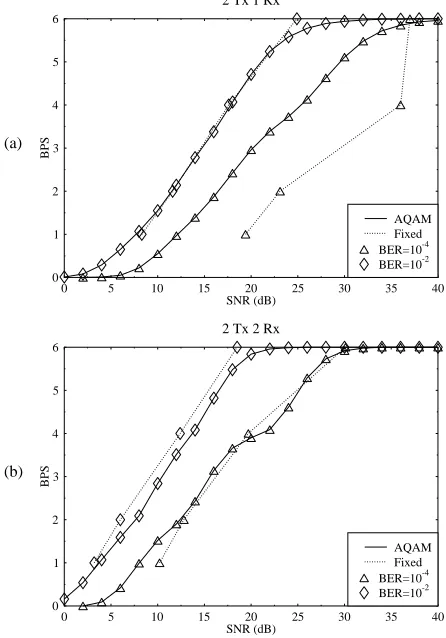
receivers. Since adaptive modulation only offers advantages over fading channels, we argue that using adaptive modulation might become unnecessary, as the diversity order is increased. Hence, adaptive modulation can be viewed as a lower-complexity alter-native to space-time coding, since only a single transmitter and receiver is required. These informal conclusions are confirmed by the quantitative evidence seen in Figure 5 [4, 85], suggesting that no significant joint benefits accrue for BbB-adaptive systems em-ploying high-order space-time coded transmit and receive diversity systems, since both of these regimes aim for mitigating the effects of fading and once the fading has been sufficiently mitigated for it to become near-constant, no further fading counter-measures are necessary.
0 5 10 15 20 25 30 35 40
SNR (dB) 0
1 2 3 4 5 6
BPS
2 Tx 1 Rx
BER=10-2 BER=10-4 Fixed AQAM
(a)
0 5 10 15 20 25 30 35 40
SNR (dB) 0
1 2 3 4 5 6
BPS
2 Tx 2 Rx
BER=10-2 BER=10-4 Fixed AQAM
[image:5.612.62.282.31.201.2](b)
Figure 5: BPS throughput performance comparison between adaptive OFDM and fixed modulation based OFDM using Alamouti’s space-time block code G2 employing (a) one receiver and (b) two receivers, when communicating over a low-dispersion indoor channel cIEEE, Hanzo, Liew and Yeap [4], 2002. The target BER was set to either 1% or 0.01%.
5. CONCLUSIONS
In summary, we argue that channel coded adaptive modulation schemes can be viewed as a lower complexity alternative for miti-gating the channel quality fluctuations of wideband wireless chan-nels in comparison to multiple-transmitter and multiple-receiver based space-time codes. However, provided that the complexity of the latter schemes employing multiple transmitters and receivers is affordable, the performance advantages of adaptive modulation and adaptive channel coding schemes erode, since the channel quality fluctuations of the wireless channel are effectively miti-gated.
6. REFERENCES
[1] C. E. Shannon, “A mathematical theory of communication,” Bell System Technical Journal, pp. 379–427, 1948.
[2] C. Berrou, A. Glavieux, and P. Thitimajshima, “Near Shan-non Limit Error-Correcting Coding and Decoding: Turbo Codes,” in Proceedings of the International Conference on Communications, (Geneva, Switzerland), pp. 1064–1070, May 1993.
[3] C. Berrou and A. Glavieux, “Near optimum error correcting coding and decoding: Turbo codes,” IEEE Transactions on Communications, vol. 44, pp. 1261–1271, October 1996.
[4] L. Hanzo and B. Y. T.H. Liew, Turbo Coding, Turbo Equal-isation and Space-Time Coding. New York, USA: John Wi-ley, IEEE Press, 2002. (For detailed contents, please refer to http://www-mobile.ecs.soton.ac.uk.).
[5] P. Elias, “Coding for noisy channels,” IRE Convention Record, pt.4, pp. 37–47, 1955.
[6] J. Wozencraft, “Sequential decoding for reliable communi-cation,” IRE Natl. Conv. Rec., vol. 5, pt.2, pp. 11–25, 1957.
[7] J. Wozencraft and B. Reiffen, Sequential Decoding. Cam-bridge, MA, USA: MIT Press, 1961.
[8] R. Fano, “A heuristic discussion of probabilistic coding,” IEEE Transactions on Information Theory, vol. IT-9, pp. 64– 74, April 1963.
[9] J. Massey, Threshold Decoding. Cambridge, MA, USA: MIT Press, 1963.
[10] A. Viterbi, “Error bounds for convolutional codes and an asymptotically optimum decoding algorithm,” IEEE Trans-actions on Information Theory, vol. IT-13, pp. 260–269, April 1967.
[11] G. Forney, “The Viterbi algorithm,” Proceedings of the IEEE, vol. 61, pp. 268–278, March 1973.
[12] J. H. Chen, “High-quality 16 kb/s speech coding with a one-way delay less than 2 ms,” in Proceedings of Interna-tional Conference on Acoustics, Speech, and Signal Process-ing, ICASSP’90, vol. 1, (Albuquerque, New Mexico, USA), pp. 453–456, IEEE, 3–6 April 1990.
[13] L. R. Bahl, J. Cocke, F. Jelinek, and J. Raviv, “Optimal De-coding of Linear Codes for Minimising Symbol Error Rate,” IEEE Transactions on Information Theory, vol. 20, pp. 284– 287, March 1974.
[14] A. Hocquenghem, “Codes correcteurs d’erreurs,” Chiffres (Paris), vol. 2, pp. 147–156, September 1959.
[15] R. Bose and D. Ray-Chaudhuri, “On a class of error correct-ing binary group codes,” Information and Control, vol. 3, pp. 68–79, March 1960.
[16] R. Bose and D. Ray-Chaudhuri, “Further results on error cor-recting binary group codes,” Information and Control, vol. 3, pp. 279–290, September 1960.
[17] W. Peterson, “Encoding and error correction procedures for the Bose-Chaudhuri codes,” IEEE Transactions on Informa-tion Theory, vol. IT-6, pp. 459–470, September 1960.
[18] J. Wolf, “Efficient maximum likelihood decoding of linear block codes using a trellis,” IEEE Transactions on Informa-tion Theory, vol. IT-24, pp. 76–80, January 1978.
[19] B. Honary and G. Markarian, Trellis Decoding of Block Codes. Dordrecht, The Netherlands: Kluwer Academic, 1997.
[20] S. Lin, T. Kasami, T. Fujiwara, and M. Fossorier, Trellises and Trellis-based Decoding Algorithms for Linear Block Codes. Norwell, MA, USA: Kluwer Academic, 1998. [21] G. Forney, “Coset Codes-Part II: Binary Lattices and Related
Codes,” IEEE Transactions on Information Theory, vol. 34, pp. 1152–1187, September 1988.
[22] H. Manoukian and B. Honary, “BCJR trellis construction for binary linear block codes,” IEE Proceedings, Communica-tions, vol. 144, pp. 367–371, December 1997.
[23] B. Honary, G. Markarian, and P. Farrell, “Generalised array codes and their trellis structure,” Electronics Letters, vol. 29, pp. 541–542, March 1993.
[24] B. Honary and G. Markarian, “Low-complexity trellis de-coding of Hamming codes,” Electronics Letters, vol. 29, pp. 1114–1116, June 1993.
[25] G. M. B. Honary and M. Darnell, “Low-complexity trellis decoding of linear block codes,” IEE Proceedings Communi-cations, vol. 142, pp. 201–209, August 1995.
[26] T. Kasami, T. Takata, T. Fujiwara, and S. Lin, “On complex-ity of trellis structure of linear block codes,” IEEE Transac-tions on Information Theory, vol. 39, pp. 1057–1937, May 1993.
[27] T. Kasami, T. Takata, T. Fujiwara, and S. Lin, “On the opti-mum bit orders with respect to the state complexity of trellis diagrams for binary linear codes,” IEEE Transactions on In-formation Theory, vol. 39, pp. 242–245, January 1993. [28] D. Chase, “A class of algorithms for decoding block codes
with channel measurement information,” IEEE Transactions on Information Theory, vol. IT-18, pp. 170–182, January 1972.
[29] D. Gorenstein and N. Zierler, “A class of cyclic linear error-correcting codes in pmsynbols,” Journal of the Society of Industrial and Applied Mathematics., vol. 9, pp. 107–214, June 1961.
[30] I. Reed and G. Solomon, “Polynomial codes over certain fi-nite fields,” Journal of the Society of Industrial and Applied Mathematics., vol. 8, pp. 300–304, June 1960.
[31] E. Berlekamp, “On decoding binary Bose-Chaudhuri-Hocquenghem codes,” IEEE Transactions on Information Theory, vol. 11, pp. 577–579, 1965.
[32] E. Berlekamp, Algebraic Coding Theory. New York, USA: McGraw-Hill, 1968.
[33] J. Massey, “Step-by-step decoding of the Bose-Chaudhuri-Hocquenghem codes,” IEEE Transactions on Information Theory, vol. 11, pp. 580–585, 1965.
[34] J. Massey, “Shift-register synthesis and BCH decoding,” IEEE Transactions on Information Theory, vol. IT-15, pp. 122–127, January 1969.
[35] M. Oh and P. Sweeney, “Bit-level soft-decision sequential decoding for Reed Solomon codes,” in Workshop on Coding and Cryptography, (Paris, France), January 1999.
[37] D. Burgess, S. Wesemeyer, and P. Sweeney, “Soft-decision decoding algorithms for RS codes,” in Seventh IMA Confer-ence on Cryptography and Coding, (Royal Agricultural Col-lege, Cirencester, UK), December 1999.
[38] Consultative Committee for Space Data Systems, Blue Book: Recommendations for Space Data System Standards: Telemetry Channel Coding, May 1984.
[39] European Telecommunication Standard Institute (ETSI), Digital Video Broadcasting (DVB); Framing structure, chan-nel coding and modulation for MVDS at 10GHz and above, ETS 300 748 ed., October 1996. http://www.etsi.org/.
[40] F. Taylor, “Residue arithmetic: A tutorial with examples,” IEEE Computer Magazine, vol. 17, pp. 50–62, May 1984.
[41] N. Szabo and R. Tanaka, Residue Arithmetic and Its Applica-tions to Computer Technology. New York, USA: McGraw-Hill, 1967.
[42] R. Watson and C. Hastings, “Self-checked computation us-ing residue arithmetic,” Proceedus-ings of the IEEE, vol. 54, pp. 1920–1931, December 1966.
[43] H. Krishna, K. Y. Lin, and J. D. Sun, “A coding theory ap-proach to error control in redundant residue number systems - part I: Theory and single error correction,” IEEE Trans-actions on Circuits and Systems, vol. 39, pp. 8–17, January 1992.
[44] J. D. Sun and H. Krishna, “A coding theory approach to er-ror control in redundant residue number systems — part II: Multiple error detection and correction,” IEEE Transactions on Circuits and Systems, vol. 39, pp. 18–34, January 1992.
[45] T. H. Liew, L. L. Yang, and L. Hanzo, “Soft-decision Re-dundant Residue Number System Based Error Correction Coding,” in Proceedings of IEEE VTC’99, (Amsterdam, The Netherlands), pp. 2546–2550, September 1999.
[46] G. Ungerboeck, “Treliis-coded modulation with redundant signal sets part 1: Introduction,” IEEE Communications Magazine, vol. 25, pp. 5–11, February 1987.
[47] G. Ungerboeck, “Treliis-coded modulation with redundant signal sets part II: State of the art,” IEEE Communications Magazine, vol. 25, pp. 12–21, February 1987.
[48] C. Schlegel, Trellis Coding. New York, USA: IEEE Press, 1997.
[49] R. Steele and L. Hanzo, eds., Mobile Radio Communica-tions: Second and Third Generation Cellular and WATM Systems. New York, USA: IEEE Press - John Wiley & Sons, 2nd ed., 1999.
[50] W. Koch and A. Baier, “Optimum and sub-optimum detec-tion of coded data disturbed by time-varying inter-symbol interference,” IEEE Globecom, pp. 1679–1684, December 1990.
[51] J. Erfanian, S. Pasupathy, and G. Gulak, “Reduced com-plexity symbol dectectors with parallel structures for ISI channels,” IEEE Transactions on Communications, vol. 42, pp. 1661–1671, 1994.
[52] P. Robertson, E. Villebrun, and P. H¨oher, “A Comparison of Optimal and Sub-Optimal MAP Decoding Algorithms Op-erating in the Log Domain,” in Proceedings of the Inter-national Conference on Communications, (Seattle, USA), pp. 1009–1013, June 1995.
[53] J. Hagenauer and P. H¨oher, “A Viterbi algorithm with soft-decision outputs and its applications,” in IEEE Globecom, pp. 1680–1686, 1989.
[54] J. Hagenauer, “Source-controlled channel decoding,” IEEE Transactions on Communications, vol. 43, pp. 2449–2457, September 1995.
[55] S. L. Goff, A. Glavieux, and C. Berrou, “Turbo-codes and high spectral efficiency modulation,” in Proceedings of IEEE International Conference on Communications, pp. 645–649, 1994.
[56] U. Wachsmann and J. Huber, “Power and bandwidth ef-ficient digital communications using turbo codes in mul-tilevel codes,” European Transactions on Telecommunica-tions, vol. 6, pp. 557–567, September–October 1995.
[57] P. Robertson and T. W¨orz, “Bandwidth-Efficient Turbo Trellis-Coded Modulation Using Punctured Component Codes,” IEEE Journal on Selected Areas in Communications, vol. 16, pp. 206–218, February 1998.
[58] S. Benedetto and G. Montorsi, “Design of parallel concate-nated convolutional codes,” IEEE Transactions on Commu-nications, vol. 44, pp. 591–600, May 1996.
[59] S. Benedetto and G. Montorsi, “Unveiling turbo codes: Some results on parallel concatenated coding schemes,” IEEE Transactions on Information Theory, vol. 42, pp. 409–428, March 1996.
[60] L. Perez, J. Seghers, and D. Costello, “A distance spectrum interpretation of turbo codes,” IEEE Transactions on Infor-mation Theory, vol. 42, pp. 1698–1709, November 1996.
[61] J. Hagenauer, E. Offer, and L. Papke, “Iterative decoding of binary block and convolutional codes,” IEEE Transactions on Information Theory, vol. 42, pp. 429–445, March 1996.
[62] R. M. Pyndiah, “Near-optimum decoding of product codes: Block turbo codes,” IEEE Transactions on Communications, vol. 46, pp. 1003–1010, August 1998.
[63] H. Nickl, J. Hagenauer, and F. Burkett, “Approaching Shan-non’s capacity limit by 0.27 dB using simple Hamming codes,” IEEE Communications Letters, vol. 1, pp. 130–132, September 1997.
[64] O. F. Ac¸ikel and W. E. Ryan, “Punctured turbo-codes for BPSK/QPSK channels,” IEEE Transactions on Communica-tions, vol. 47, pp. 1315–1323, September 1999.
[65] P. Jung and M. Nasshan, “Performance evaluation of turbo codes for short frame transmission systems,” IEE Electronics Letters, vol. 30, pp. 111–112, January 1994.
[66] P. Jung, “Comparison of turbo-code decoders applied to short frame transmission systems,” IEEE Journal on Selected Ar-eas in Communications, pp. 530–537, 1996.
[67] P. Jung, M. Naßhan, and J. Blanz, “Application of Turbo-Codes to a CDMA Mobile Radio System Using Joint De-tection and Antenna Diversity,” in Proceedings of the IEEE Conference on Vehicular Technology, pp. 770–774, 1994.
[68] A. Barbulescu and S. Pietrobon, “Interleaver design for turbo codes,” IEE Electronics Letters, pp. 2107–2108, December 1994.
[70] V. Tarokh, N. Seshadri, and A. R. Calderbank, “Space-Time Codes for High Data Rate Wireless Communication: Perfor-mance Criterion and Code Construction,” IEEE Transactions on Information Theory, vol. 44, pp. 744–765, March 1998. [71] S. M. Alamouti, “A Simple Transmit Diversity Technique for
Wireless Communications,” IEEE Journal on Selected Areas in Communications, vol. 16, pp. 1451–1458, October 1998. [72] V. Tarokh, H. Jafarkhani, and A. Calderbank, “Space-time
block codes from orthogonal designs,” IEEE Transactions on Information Theory, vol. 45, pp. 1456–1467, May 1999. [73] V. Tarokh, H. Jafarkhani, and A. R. Calderbank, “Space-time
block coding for wireless communications: Performance re-sults,” IEEE Journal on Selected Areas in Communications, vol. 17, pp. 451–460, March 1999.
[74] G. Bauch, A. Naguib, and N. Seshadri, “MAP Equaliza-tion of Space-Time Coded Signals over Frequency Selec-tive Channels,” in Proceedings of Wireless Communications and Networking Conference, (New Orleans, USA), Septem-ber 1999.
[75] G. Bauch and N. Al-Dhahir, “Reduced-complexity turbo equalization with multiple transmit and receive antennas over multipath fading channels,” in Proceedings of Information Sciences and Systems, (Princeton, USA), pp. WP3 13–18, March 2000.
[76] D. Agrawal, V. Tarokh, A. Naguib, and N. Seshadri, “Space-time coded OFDM for high data-rate wireless communica-tion over wideband channels,” in Proceedings of IEEE Vehic-ular Technology Conference, (Ottawa, Canada), pp. 2232– 2236, May 1998.
[77] Y. Li, N. Seshadri, and S. Ariyavisitakul, “Channel estima-tion for OFDM systems with transmitter diversity in mobile wireless channels,” IEEE Journal on Selected Areas in Com-munications, vol. 17, pp. 461–471, March 1999.
[78] Y. Li, J. Chuang, and N. Sollenberger, “Transmitter diversity for OFDM systems and its impact on high-rate data wireless networks,” IEEE Journal on Selected Areas in Communica-tions, vol. 17, pp. 1233–1243, July 1999.
[79] A. Naguib, N. Seshdri, and A. Calderbank, “Increasing Data Rate Over Wireless Channels: Space-Time Coding for High Data Rate Wireless Communications,” IEEE Signal Process-ing Magazine, vol. 17, pp. 76–92, May 2000.
[80] A. F. Naguib, V. Tarokh, N. Seshadri, and A. R. Calderbank, “A Space-Time Coding Modem for High-Data-Rate Wire-less Communications,” IEEE Journal on Selected Areas in Communications, vol. 16, pp. 1459–1478, October 1998. [81] C. Douillard, A. Picart, M. J´ez´equel, P. Didier, C. Berrou,
and A. Glavieux, “Iterative correction of intersymbol in-terference: Turbo-equalization,” European Transactions on Communications, vol. 6, pp. 507–511, 1995.
[82] W. Lee, “Estimate of channel capacity in Rayleigh fading environment,” IEEE Transactions on Vehicular Technology, vol. 39, pp. 187–189, August 1990.
[83] S. Nanda, K. Balachandran, and S. Kumar, “Adaptation tech-niques in wireless packet data services,” IEEE Communica-tions Magazine, vol. 38, pp. 54–64, January 2000.
[84] L. Hanzo, W. Webb, and T. Keller, Single- and Multi-Carrier Quadrature Amplitude Modulation: Principles and Applica-tions for Personal CommunicaApplica-tions, WLANs and Broadcast-ing. IEEE Press, 2000.
[85] L. Hanzo, C. H. Wong, and M. S. Yee, Adaptive Wireless Transceivers. New York, USA: John Wiley, IEEE Press, 2002. (For detailed contents, please refer to http://www-mobile.ecs.soton.ac.uk.).
[86] L. Hanzo, P. Cherriman, and J. Streit, Wireless Video Com-munications: From Second to Third Generation Systems, WLANs and Beyond. Piscataway, NJ, USA: IEEE Press, 2001. (For detailed contents please refer to http://www-mobile.ecs.soton.ac.uk).
[87] J. Blogh and L. Hanzo, 3G Systems and Intelligent Net-working. New York, USA: John Wiley and IEEE Press, 2002. (For detailed contents, please refer to http://www-mobile.ecs.soton.ac.uk.).
[88] A. Duel-Hallen, S. Hu, and H. Hallen, “Long Range Predic-tion of Fading Signals,” IEEE Signal Processing Magazine, vol. 17, pp. 62–75, May 2000.
[89] S. Al-Semari and T. Fuja, “I-Q TCM: Reliable communi-cation over the Rayleigh fading channel close to the cutoff rate,” IEEE Transactions on Information Theory, vol. 43, pp. 250–262, January 1997.
[90] P. Robertson, T. W¨orz, “Bandwidth-Efficient Turbo Trellis-Coded Modulation Using Punctured Component Codes,” IEEE Journal on Selected Areas in Communications, vol. 16, pp. 206–218, February 1998.
[91] E. Zehavi, “8-PSK trellis codes for a Rayleigh fading channel,” IEEE Transactions on Communications, vol. 40, pp. 873–883, May 1992.
[92] X. Li and J.A. Ritcey, “Trellis-Coded Modulation with Bit Interleaving and Iterative Decoding,” IEEE Journal on Se-lected Areas in Communications, vol. 17, April 1999. [93] X. Li and J.A. Ritcey, “Bit-interleaved coded modulation
with iterative decoding using soft feedback,” IEE Electron-ics Letters, vol. 34, pp. 942–943, May 1998.
![Figure 1: Brief history of channel coding research, c⃝John Wiley andIEEE Press, 2002, Hanzo, Liew, Yeap [4].](https://thumb-us.123doks.com/thumbv2/123dok_us/1022625.617381/1.612.319.561.216.617/figure-brief-history-channel-coding-research-wiley-andieee.webp)
![Figure 2: Factors affecting the design of channel coding and modulationschemes c⃝John Wiley and IEEE Press, 2002, Hanzo, Liew, Yeap [4].](https://thumb-us.123doks.com/thumbv2/123dok_us/1022625.617381/2.612.54.280.39.141/figure-factors-affecting-design-channel-coding-modulationschemes-wiley.webp)
![Figure 3: Instantaneous channel SNR versus time and frequency for a512-subcarrier OFDM modem in the context of a single-transmitter single-receiver scheme as well as for the space-time block code G2 [71] usingone, two and six receivers when communicating o](https://thumb-us.123doks.com/thumbv2/123dok_us/1022625.617381/3.612.329.479.20.621/instantaneous-frequency-subcarrier-transmitter-receiver-usingone-receivers-communicating.webp)