Abstract—The present paper investigates the influence of geometric irregularities on the performance of orifice compensated four pocket journal bearing under misaligned conditions. Geometrically irregular journals in form of barrel shape, bellmouth shape and circumferential undulated shape have been considered in the analysis. The misalignment in journal bearing system is considered by using two non-dimensional parameters and in the analysis corresponding to the misalignment of journal about X and Z axis respectively. The governing Reynolds equation is solved by using finite element method. Newton Raphson method is used to linearize the flow equation for orifice restrictor in finite element formulated system equation. Numerically simulated characteristics of bearing system indicate that the geometric irregularities of journal substantially affect the performance of journal bearing operated in aligned and misaligned condition.
Index Terms— Geometric irregularities, Misalignment, Orifice, Newton Raphson Method.
NOMENCLATURE
Cij :Oil-film damping coefficients (
i
,
j
x
,
z
),N.s m-1Cs2 :Restrictor design parameters
F : Oil-film reaction ( 0
t
h ), N
Q : Lubricant flow, m3.sec-1
Sij : Oil-film stiffness coefficients (
i
,
j
x
,
z
), N. m-1Tf : Frictional torque, N-m
Wo : External load, N
XJ, ZJ : Journal center coordinate
3 2 1/a /a
a : Barrel/ Bellmouth/ Undulated error, m
b
a : Axial land width, m h : Oil-film thickness, m
n : Number of waves in undulated journal p : Pressure, N. m-2
pc : Pressure at pocket, N. m-2
ps : Supply pressure, N. m-2
α : Non-dimensional circumferential Coordinate β : Non-dimensional axial Coordinate
θ : Inter recess angle
μ : Viscosity of the classical fluid, N-s m-2
Ω : Non-dimensional journal speed Subscripts and Superscripts
E : eth element
J : journal
o : Steady state condition : Non-dimensional
Manuscript received March 23, 2017; revised April 11, 2017.
A. K. Rajput is with Deptt. of Mechanical Engg., SNU Greater Noida, India (phone: +91-3819412, e-mail: [email protected])
S. K. Yadav is with Deptt.. of Mechanical Engg., Graphic era Univesity, Dehradun, India (e-mail: [email protected]).
S. C. Sharma is with Deptt. of Mechanical & Industrial Engg., IIT Roorkee, India(e-mail: [email protected]).
I. INTRODUCTION
ESPITE of highly précised, accurate and versatile manufacturing techniques are available nowadays, several geometric irregularities of the order of microns may occur during manufacturing processes of a machine element. Likewise a journal and bearing are also bound to have several form of micro-geometric irregularities during its manufacturing. The effect of geometric irregularities of journal on the characteristics of bearing system is quite important as geometric irregularities of journal reveal dynamic conditions due to rotation of journal. The geometric irregularities of journal are generally either of barrel type, bellmouth type and circumferential waved type. The order of these geometric irregularities are the order of oil film thickness. As a consequence of this, these geometric irregularities of journal significantly contribute in the performance of a journal bearing system. A number of researchers examined the effect of these irregularities on the characteristics of various bearing system [1-8]. The studies [1-10] reveal that the geometric irregularities of journal usually deteriorates the bearing performance. This necessitates that the design of a journal bearing system should include the influence of these geometric irregularities for more realistic and stringent operation of bearing system. Improper installation, improper loading, elastic or thermal distortion of journal may results in misalignment in journal bearing system. Many realistic evident of bearing failure revealed the failure of bearing operation caused by misaligned operation. In view of this severe operating condition of a bearing system, a little tolerance needs to be given in design in bearing operation to tackle any misalignment condition. This tolerance may be computed by considering the misalignment effect in the analysis of bearing system. The misalignment of journal may be (about either about horizontal axis or about a plane perpendicular to cross–section (1 dimensional) or combination of both (2 dimensional). Recently, many researchers investigated the misalignment effect on journal bearing performance [9-17]. Fisher [9] illustrated that misalignment in bearing system results in an irregular heating of bearing. Bou-Said and Nicolas [14] illustrated that turbulence in bearing system partially compensate the deterioration in bearing performance due to misalignment operation vis-à-vis operation in laminar regime.
The literature concerning journal bearing system reveals that no study in literature illustrate the influence of geometric irregularities of journal on orifice compensated journal bearing system operating under misaligned conditions. In view of this, the present work is aimed to evaluate the combined influence of geometric irregularities of journal and misalignment of journal on the performance of hydrostatic journal bearing with orifice restrictor. The numerically simulated results for bearing characteristics
Arvind K. Rajput, Saurabh K. Yadav, Satish C. Sharma
Analysis of Orifice Compensated Four Pocket
Geometric Irregular Misaligned Journal Bearing
parameters versus external load have been presented for different misaligned conditions.
Fig. 1. Schematic of Four-Pocket Cylindrical Hybrid Journal Bearing System. (The idea of the schematic is from Ref. [8])
II. ANALYSIS
Assuming Newtonian, iso-viscous and incompressible lubricant, the governing Reynolds equation for a hydrostatic journal bearing system as shown in Fig.1 is expressed in non-dimensional form as follows [6-8].
𝜕 𝜕𝛼
ℎ 3 12μ
𝜕𝑝
𝜕𝛼 +
𝜕 𝜕𝛽
ℎ 3 12μ
𝜕𝑝
𝜕𝛽 =
Ω 2
𝜕ℎ
𝜕𝛼+
𝜕ℎ
𝜕𝑡 (1)
For a geometrically irregular misaligned journal bearing, the fluid film thickness h is expressed as follows [5-8].
ℎ = 1 − 𝑋 𝑗𝑐𝑜𝑠𝛼 − 𝑍 𝑗𝑠𝑖𝑛𝛼 + ℎ 𝑖𝑟 + ℎ 𝑚𝑖 (2)
Where, hir indicates the change in oil film thickness due to different geometric irregularities of journal and is expressed as follows [5, 7].
shape Undulated For
) sin( . . 5 . 0
shape bellmouth For
2 sin .
shape barrel For 2 sin .
3 2
1
n a a
a
hir (2a)
And indicates the change in the value of oil film thickness due to misalignment of journal and is expressed as follows [8].
ℎ 𝑚𝑖 = 𝛽𝛹 𝑐𝑜𝑠 𝛼 − 𝛽𝜑 𝑠𝑖𝑛 𝛼 (2b) Where and are the misalignment parameters indicating the misalignment of journal about horizontal axis (X) and vertical axis (Z) respectively.
The flow rate of lubricant through an orifice restrictor is expressed in non-dimensional form as follows.
𝑄𝑅= 𝐶𝑠2 1 − 𝑝𝑐 (3)
where,
123 2 2
2 3
12 1
s d r o S
p c
d C
A. FE Formulation
To obtain the unknown fluid film pressure field in governing Reynolds equation (1), FEM has been used. The weak formulation of governing Reynold equation is obtained by using weightage residual method. Minimizing
the residue by using Gallerkin’s orthogonality condition, yields the following elemental equation [6-8].
𝐹𝑖𝑗 𝑒
𝑝 𝑒 = 𝑄 𝑖
𝑒
+ Ω 𝑅 𝐻𝑖 𝑒 + 𝑋 𝐽 𝑅𝑋𝐽𝑖
𝑒
+
𝑍 𝑗 𝑅𝑍𝐽𝑖 𝑒
+ 𝜑 𝑅 𝜑 𝑒
− Ψ 𝑅 Ψ 𝑒 (4a)
Where,
e
A
j i j i e
ij d d
N N N N h
F
12
3
e
e i e
i n Nd
p h n h p h
Q
12 2
12
3 3
e A
i e
i
H d d
N h
R
2
e i J
A i e
X N d d
R cos
e i J
A i e
Z N d d
R sin
𝑅𝜑𝑖 𝑒
= 𝑁𝑖 𝛽𝑠𝑖𝑛𝛼 𝑑𝛼𝑑𝛽 𝐴𝑒
𝑅Ψ𝑖 𝑒
= 𝑁𝑖 𝛽𝑐𝑜𝑠𝛼 𝑑𝛼𝑑𝛽 𝐴𝑒
Where,
n
α and nβ are the direction cosines and i,j=1,2,3,4 (number of nodes per element). Ae Refers to area
domain and Γe is the boundary domain of the eth element.
The lubricant flow field has been discretized using 4 noded quadrilateral isoparametric elements. The variation of pressure over the element is approximated as follows.
𝑝 = Njpj 4
𝑗 =1 (4b)
Where,
p
j is the nodal pressure value at jth node ofelement and Nj is the shape function
Usual globalization procedure of FEM yields the following system equation in algebraic form.
𝐹 𝑝 = 𝑄 + Ω 𝑅𝐻 + 𝑋 𝐽 𝑅𝑋𝐽 + 𝑍 𝐽 𝑅𝑍𝐽 + +𝜑 𝑅 𝜑 −
Ψ 𝑅 Ψ (4c)
B. Boundary Conditions
To compute the fluid film pressure field, the algebraic system equation (4c), the following boundary conditions relevant to the lubricant flow field are used [6-8].
(i) Nodes on external boundary possess zero relative pressure as these nodes are exposed to the ambient pressure.
(ii) The flow of lubricant through the compensator is equal to the bearing input flow
(iii) All Nodes situated on a pocket have equal pressure. (iv) To avoid the cavitation in bearing, the Swift-Striber
boundary condition is applied at the trailing edge of positive region i.e., 0.00
p
p .
III. SOLUTIONPROCEDURE
compute the corrections in journal center position (XJ,ZJ). Iterations for establishing the journal centre
equilibrium position are continued until the convergence as indicated in equation (5) is attained [27]. As flow equations for orifice restrictor is nonlinear, Newton-Raphson method (As indicated in Appendix- A) is used to obtain the converged solution of these equations and this can be achieved by using iterative schemes.
𝑃𝐸𝑅𝑅 = ∆𝑿𝒊𝒋 𝟐
+ ∆𝒁𝒊𝒋𝟐𝟏 𝟐
𝑿𝒊𝒋𝟐+ 𝒁𝒊𝒋𝟐 𝟏 𝟐 × 100 ≤ 𝑇𝑂𝐿𝐼𝑀 < 0.001 (5)
Fig.2. A flow chart to illustrate the overall solution scheme IV. RESULTS AND DISCUSSIONS
To find out the unknown pressure field po for steady
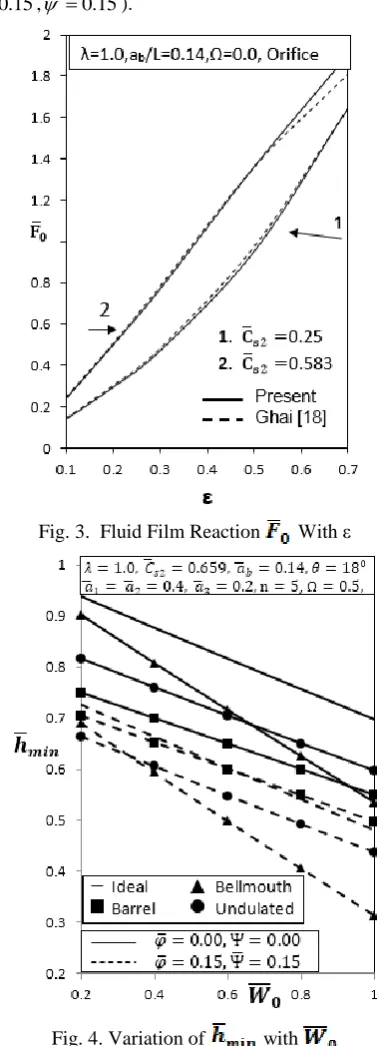
state conditions a computer program has been developed as per the methodology discussed in earlier sections. To authenticate the developed program, the present results have been compared with earlier published results by Ghai [18]. A close validation for the variation in the values of fluid film reaction Foversus eccentricity ratio () has been
obtained as indicated in Fig. 3.
The characteristics parameters of the bearing system have been computed for the judiciously chosen values of geometric and operating parameters of bearing systems viz.
𝜆 = 1.0, 𝐶𝑠2= 0.659, 𝑎𝑏 = 0.14,AAp
b = 0.576, 𝑊
𝑜= 0.0 − 1.0, Ω = 0.5, 𝜑 = 0 − 0.15, Ψ = 0 − 0.15.
The selected value of restrictor design parameter Cs2 =
0.659 corresponds the value of concentric design pressure ratio β*=0.5 in aligned ideal journal bearing system.
Misalignment effect on the performance of geometrically irregular bearing has been investigated for aligned condition
[image:3.595.51.293.44.525.2]( 0.0, 0.0) and misalignment about X and Z axis ( 0.15, 0.15).
Fig. 3. Fluid Film Reaction With ε
Fig. 4. Variation of with
The effect of geometric irregularities of journal on the characteristics parameters of orifice compensated four pocket misaligned cylindrical hybrid journal bearing system are presented through Figs. (4-8) as follows.
Fig. 4 depicts the variation in the value of
h
min with respect to the external load (W0) for orifice compensated geometrically imperfect misaligned journal bearing system. It may be observed that the value of hmin gets reduced with an increase in the value of W0. Furthermore, for a specified value ofW0, the value ofh
min gets decreased for each type of geometric imperfections vis-à-vis ideal journal bearing. The consideration of misalignment of journal in the analysis results in an enormous decrease in the value of hmin forSTART
STOP
Input the 2 D mess of bearing parameters as
Compute film thickness on nodal points using Eqn.2.
Compute matrices of the system Eqn. 4c.
Apply boundary conditions as subsection 2.2.
Solve system Equation for unknown pressure field and Compute Fluid Film reactions Components Fx,Fz
Compute Correction in Journal Centre Position i J i
J Z
X
, .
Compute Static and Dynamic Characteristics parameters of Bearing
i J i J Z X ,
Yes No
1 1
,
i J i
J Z
X
Linearize system equation by using Newton Raphson Method for orifice restrictor as illustrated in Appendix A
[image:3.595.329.518.69.593.2]ideal journal as well as each type of geometrically imperfect journal bearing as for misaligned operating condition, the inclination of journal along Z and X axis results in reduction in the value of hmin.
Fig. 5. Variation of Q with W0
Fig. 6. Variation of Tf with W0
The variation in the values of the lubricant flow rate (Q)
versus external load (W0) is shown in Fig.5 for four pocket
geometrically imperfect misaligned hybrid journal bearing system. It may be clearly seen from Fig. 5 that the value of
Q gets increased appreciably for misaligned operating
condition as compared to the aligned operating condition. This may be attributed to the fact that for a misaligned journal bearing system, the requirement of the flow is higher to operate the bearing with an appropriate fluid film thickness. Thus, misalignment of journal causes an unfavorable effect from the viewpoint of pumping power loss as misaligned journal bearing system requires more flow rate of lubricant for satisfactory operation.
The variation of frictional torque (Tf) for orifice
compensated geometrically imperfect misaligned journal bearing system with respect to external load (W0) is
depicted in Fig. 6. It is obvious that the value of Tf gets increased with an increase in the value of W0. Further, for a
specified value ofW0, the value of Tf gets extensively reduced for bellmouth shaped journal and get notably increased for barrel shaped journal as compared to the ideal journal bearing. However, undulations on journal results in an insignificant effect on the value of
f
T . This may be attributed to the fact that the value of maximum fluid film pressure gets significantly increased for barrel shaped journal and decreased for bellmouth shaped journal as compared to the ideal journal. Therefore, the cumulative effect of the fluid film pressure developed in the domain may be higher for barrel shaped journal and lower for bellmouth shaped journal. Thus, bellmouth shaped journal may be beneficial from the viewpoint of frictional power loss. Further, misalignment of journal results in an increase in the value of
f
[image:4.595.341.517.314.765.2]T for each ideal journal and different geometrically imperfect journal studied. Thus misalignment of journal exhibits the damaging effect on the bearing performance from the viewpoint of frictional torque.
Fig. 7a. Variation of Sxx with W0
Fig. 8a. Variation of Cxx with W0
Fig. 8b. Variation of Czz with W0
Figs. 7(a-b) depict the variation of direct fluid film stiffness coefficients (Sxx,Szz) with respect to external load (
0
W ) respectively. It may be seen that for a specified
value ofW0, the values of (Sxx,Szz) increases for barrel shaped journal while decreases for bellmouth and undulation type imperfections of journal. Furthermore, the misaligned operating condition of bearing system results in a significant reduction in the values of Sxx,Szz vis-à-vis aligned operating condition for each case studied. Thus, misalignment of journal is also undesirable from the viewpoint of direct as well as cross coupled fluid film stiffness coefficients.
The variation of direct fluid film damping coefficients (Cxx,Czz) with respect to external load (W0) are shown in
Figs. 8(a-b) sequentially. The different forms of geometric irregularities of journal results in substantial effect on the values of (Cxx,Czz) similar as on the values of (Sxx,Szz). The values of (Cxx,Czz) gets increased considerably for barrel shaped journal while decreased substantially for bellmouth shaped journal vis-à-vis ideal journal. However, undulations on journal produces a marginal effect on the values of (Cxx,Czz) vis-à-vis ideal journal. Misalignment of journal results in a significant reduction in the values of fluid film damping coefficients (Cxx,Czz) for ideal as well geometrically irregular hybrid journal bearing system as indicated in Figs. 8(a-b). Cross coupled fluid film stiffness and damping coefficients have been also computed but are not presented due to brevity.
V. CONCLUSIONS
A theoretical study to investigate the combined effect of geometric irregularities of journal and misalignment on the performance of orifice restricted four pocket hybrid journal bearing has been carried out. The key conclusions of present study are as follows.
i) For a specified value ofW0, the value of hmin gets decreased for geometrically irregular journal vis-à-vis ideal journal bearing. The consideration of misalignment of journal in the analysis results in an enormous decrease in the value of
h
min for ideal journal as geometrically irregular journal bearing. ii) Misalignment of journal causes an unfavorable effectfrom the viewpoint of pumping power loss as misaligned journal bearing system requires more flow rate of lubricant for satisfactory operation.
iii) Misalignment of journal exhibits the damaging effect on the bearing performance from the viewpoint of frictional torque.
iv) For a specified value ofW0, the values of (Sxx,Szz) increases for barrel shaped journal while decreases for bellmouth and undulation type imperfections of journal. The misaligned operating condition of bearing system results in a significant reduction in the values of
zz
xx S
S , vis-à-vis aligned condition.
v) Misalignment of journal results in a significant reduction in the values of fluid film damping coefficients (Cxx,Czz) for ideal as well geometrically irregular hybrid journal bearing system.
APPENDIX-1: Newton-Raphson Method
The flow equations are non-linear for the case of a orifice restrictor (equations 3). As the system equations after adjustment for the continuity of flow through the restrictors becomes non-linear for orifice restrictor. Therefore Newton Raphson method has been used for solving these non- linear equations for orifice restrictors. The Newton Raphson method has been discussed in details as follows.
For an efficient operation of a hydrostatic journal bearing system, a continuous flow between the restrictor and the clearance space of bearing is essential. Let pth,qth,rth and sth
are the nodes on the pockets 1,2,3 and 4 sequentially, and the corresponding flow terms are Qp, Qq, Qrand Qs in
For the steady state condition ( 0
t
h i.e., 0
J
J Z
X ) and maintaining the continuity of flow, the system equation yield in general form as:
0 2
2 1
1
k o k o kp op kq oq k Hk
k F p F p F p F p Q R
F
(A.1)
Where k=1, 2,…p,…q, …r,…s….n
The flow through pockets p, q, r and s may be replaced for steady state condition as follows.
𝑄𝑜𝑝 = 𝐶𝑠2 1 − 𝑝𝑜𝑝 ; 𝑄𝑜𝑞 = 𝐶𝑠2 1 − 𝑝𝑜𝑞
𝑄𝑜𝑟= 𝐶𝑠2 1 − 𝑝𝑜𝑟 ; 𝑄𝑜𝑠 = 𝐶𝑠2 1 − 𝑝𝑜𝑠
(A.2)
It may be clearly understood that the components of nodal vector Q are non-zero at the nodes lying on pockets only. The value of Q is zero for non-pocket nodes.
Further, for a pocket node and kkth component in system
equation A.2 yields as follows (as nodal values of flow on pocket is function of nodal pressure)
∆𝐹 𝑘𝑘 = 𝐹 𝑘𝑘𝑝 𝑜𝑘 − 𝑄 𝑘
The derivative of kkth term may be computed as follows.
𝜕Δ𝐹 𝑘𝑘
𝜕𝑝 𝑜𝑘 0= 𝐹 𝑘𝑘 −
𝜕𝑄 𝑘
𝜕𝑝 𝑜𝑘 𝑜 (A.3)
Where, k = p, q, r, & s
Letpoi o (i=1,2,3,………n) are the initial approximations of the nodal pressures.
Taylor’s series approximation is used to linearize the equations (A.1) considering the last term of equations (A.2) i.e. ΩRHiterms is constant.
𝐹 𝑙 0+𝜕𝑝 𝜕𝐹 𝑙
01 0𝛥𝑝 1+…….+ 𝜕𝐹 𝑙
𝜕𝑝 0𝑝 0𝛥𝑝 𝑝+ ⋯
𝜕𝐹 𝑙
𝜕𝑝 0𝑞 0𝛥𝑝 𝑞+
⋯ 𝜕𝐹 𝑙
𝜕𝑝 0𝑟0𝛥𝑝 𝑟+ ⋯
𝜕𝐹 𝑙
𝜕𝑝 0𝑠0𝛥𝑝 𝑠+ ⋯
𝜕𝐹 𝑙
𝜕𝑝 0𝑛 0𝛥𝑝 𝑛= 0 (A.4)
where, 𝑙 = 1, 2, . … 𝑝, … 𝑞, … 𝑟, … 𝑠 … . 𝑛.
Equation (A.5) is expressed in following matrix form,
on os or oq op o nn ns nr nq np n n sn ss ss sr sq sq sp s s rn rs rr rr rq rp rp r r qn qs qs qr qq qq qp q q pn ps pr pr pq pp pp p p n s r q p p p p p p p F F F F F F F F D F F D F F F F F F D F F D F F F F D F F D F F F F F F D F F D F F F F F F F F F F 1 2 1 ) 2 1 ) 2 1 ) 2 1 ) ) 2 1 1 1 1 1 1 12 11 ) ( ( ) ( ( ( ) ( ( ( on os or oq op o nn ns nr nq np n n sn ss sr sq sp s s rn rs rr rq rp r r qn qs qr qq qp q q pn ps pr pq pp p p n s r q p Hn Hs Hr Hq Hp H Rn Rs Rr Rq Rp p p p p p p F F F F F F F F F F F F F F F F F F F F F F F F F F F F F F F F F F F F F F F F F F R R R R R R Q Q Q Q Q Q 1 2 1 2 1 2 1 2 1 2 1 1 1 1 1 1 12 11 1 0 0 0 0 0 10 (A.5) The terms oj Ri ij p Q D
, is the derivative of the flow QRi with
respect to pocket pressure poj. For the orifice compensated bearing, the expressions for Dijcan be expressed as follows.
0
qs rp sq
pr D D D
D
𝐷 pp=-0.5𝐶𝑠2/ 1 − 𝑝𝑜𝑝 ; 𝐷 qq=-0.5𝐶𝑠2/ 1 − 𝑝𝑜𝑞
𝐷 rr=-0.5𝐶𝑠2/ 1 − 𝑝𝑜𝑟 ; 𝐷 ss=-0.5𝐶𝑠2/ 1 − 𝑝𝑜𝑠
The solution of equation (A.5) requires nodal pressure vector {po} which is used from previous iteration equation. Equation (A.5) provides the correction in the value of nodal pressure (po) in current iteration, i.e. if correction in nodal flow vector for nth iteration is
no
p
, the new nodal pressure for (n+1)th iteration are obtained as:
{𝑝 𝑜}𝑛+1={𝑝 o}n+ {Δ𝑝 o}n (A.6)
Iterations are continued until the corrections in the values of nodal pressure follow the convergence criterion indicated in equation A.7.
𝛥𝑝 𝑗
𝑝𝑗 × 100 < 𝑃𝐸𝑅𝑅 = 10
−5 (A.7)
REFERENCES
[1] D. S. Wilson, “The effect of geometry variations on hydrodynamic bearing performance,” ASLE Trans., vol. 9, pp. 411-419, 1966. [2] M. O. A. Mokhtar, W. Y. Aly and G. S. A. Shawki, “Computer-aided
study of journal bearings with undulating surfaces,” ASME J. Tribol., vol. 106, no. 4, pp. 468–472, 1984.
[3] M. O. A. Mokhtar, W. Y. Aly and G. S. A. Shawki, “Experimental study of journal bearings with undulating journal surfaces,” Tribol. Int., vol. 17, no.1, pp. 19–24, 1984.
[4] T. S. Chennabasavan and R. Raman, “The effects of geometric irregularities of journals on the performance of porous bearings,” Proc. Inst. Mech. Eng. Part J: J. Eng. Tribol., vol. 208, pp. 141–145, 1994.
[5] S. C. Sharma and A. K. Rajput, “Effect of Geometric Imperfections of Journal on the Performance of Micropolar Lubricated 4- Pocket Hybrid Journal Bearing,” Tribol. Int., vol. 60, pp. 156–168, 2013. [6] A. K. Rajput and S. C. Sharma, “A study of capillary compensated
geometrically imperfect six pocket hybrid journal bearing of various geometric shapes of recess,” Proc. Inst. Mech. Eng. Part J: J. Eng. Tribol., vol. 228, pp. 170–186, 2014.
[7] D. Jain and S. C. Sharma, “Two-lobe geometrically imperfect hybrid journal bearing operating with power law lubricant,” [J]. Proc. Inst. Mech. Eng. Part J: J. Eng. Tribol., vol. 229, pp.: 30-46, 2015. [8] A. K. Rajput and S. C. Sharma, “Combined influence of geometric
imperfections and misalignment of journal on the performance of four pocket hybrid journal bearing,” Tribol. Int., vol. 97, pp. 59-70, 2016.
[9] A. Fisher, “Oil Flow in Ring Lubricated Bearings,” Machinery, London, vol. 21, pp. 311, 1922.
[10] G. B. Dubois, H. H. Mabie and F. Ocvirk, “Experimental Investigation of Oil Film Pressure Distribution for Misaligned Plain Bearings,” Technical Note 2507, NACA: 1951.
[11] S. Asanabe, M. Akahoshi and R. Asai, “Theoretical and Experimental Investigation on Misaligned Journal Bearing Performance,” Inst. Mech. Eng. Tribol. Conv., pp. 1-8, 1972.
[12] D.V. Singh, R. Sinhasan and H. N. Singh, “Analysis of Hydrodynamic Journal Bearing with Axes Skew,” Mech. Engg. Sci., vol. 15, no. 2, pp. 123-131, 1973.
[13] B. Bou-Said and D. Nicolas, “Effects of Misalignment on Static and Dynamic Characteristics of Hybrid Bearings,” STLE Tribol. Trans., vol. 35, no. 2, pp. 325-331, 1992.
[14] L. A. S. Andres, “The Effect of Journal Misalignment on the Operation of a Turbulent Flow Hydrostatic Bearing,” ASME J. Tribol., vol. 115, pp. 355-363, 1993.
[15] J. Bouyer and M. Fillon, “An Experimental Analysis of Misalignment Effects on Hydrodynamic Plain Journal Bearing Performances,” ASME J. Tribol., vol. 124, no. 2, pp. 313-319, 2002.
[16] S. C. Sharma, T. Nagaraju and S.C. Jain, “Combined Influence of Journal Misalignment and Surface Roughness on the Performance of an Orifice Compensated Non-Recessed Hybrid Journal Bearing,” STLE Tribol. Trans., vol. 45, no. 4, pp. 457-463, 2002.
[17] R. K. Awasthi, S.C. Jain and S.C. Sharma, “Finite element analysis of orifice-compensated multiple hole-entry worn hybrid journal bearing,” Finite element in Anal. Des., vol. 42: pp. 1291-1303, 2006. [18] R. C. Ghai, “Static and Dynamic Analysis of Compensated