Abstract— This research investigated how the concepts of
perceived boundary and habit impact on students’ online assignment submission process. This study adopted Facebook as the assignment submission platform because Facebook is currently the most popular social networking site used by the majority of the younger generations. It is currently used by many instructors for academic purposes, however, the major usages are around information dissemination and communication among co-learners. To explore more Facebook uses for academic purposes, this study aims at examining the possibilities of extending the uses of Facebook for assignment completion and submission. A research framework was proposed to measure the impact of the two above-mentioned constructs on students’ assignment completion and submission process. A pilot study was then conducted by asking a class of students to submit their 5 pieces of course assignments electronically. Multiple channels were proposed for submission, including emails, university Moodle, and Facebook. It is found that 76% of the students submitted their assignments with Facebook. Although the majority of students had submitted their assignments to the course Facebook page, it doesn’t mean that this group of students preferred to have their social and learning activities mingled together. The way of their assignment submission differed from the way they performed their normal Facebook activities. All of them were using Facebook timeline for submission, which made their postings separate from their normal Facebook social activities. The result of this pilot study reveals that Facebook possesses the flexibility in addressing the demands between learning and social domains, but, permeability does not exist in our case. Based on this small scaled pilot study, we can make a preliminary conclusion that students are reluctant to make their learning identities cross-over to their social domain although social and learning activities are taking place in the same online platform. A refined research framework and new propositions were proposed.
Index Terms—Facebook, social networking site, boundary
theory, activity theory, habit
I. INTRODUCTION
ACEBOOK, is the most popular social networking site (SNS) that most of the younger generations visit regularly. Many of the digital natives spend significantly their time in this social environment. Some of them have their Facebook account always connected to the Internet so as to interact with their peer groups by positing entries, reading, and responding to their friends’ postings
Acknowledgment: This research is supported by the Macau Foundation under Grant No. 0249.
Rachael K. F. IP is with Macau University of Science and Technology, Macau (phone: +85388972015, fax: +85328823281, email:
Yun HUANG is with Macau University of Science and Technology, Macau (email: [email protected]).
continuously. This kind of online interaction has already become the social routines of many of our students. Facebook can even be described as part of their daily life due to such heavy uses.
According to alexa.com, the number of Facebook users is around 1.11 billion. Such popularity is further intensified by the BYOD (Bring-your-own-device) phenomenon. BYOD phenomenon becomes popular when possessing smartphones and tablet computers becomes the norms among our younger generations. With such convenient devices and the availability of wireless networks, connection to social networking sites becomes the daily routines of the majority of our students.
To grasp the opportunities provided by the upsurge of the BYOD phenomenon and SNSs, it may be possible that learning activities can be integrated in the social environment in where our students spend much of their time. Currently, Facebook has been deployed by many teachers as a complementary tool to their teaching [9], [10], [17]. Many researches demonstrate the positive sides of Facebook toward teaching and learning [9], [10], [17], while other studies show the negative effect brought by Facebook [11], [22]. The majority of successful cases of Facebook adoption evidence the communication and coordination effectiveness, while the negative examples mainly focus on the distraction brought by this SNS.
Every coin has two facets. In spite of the distraction brought by the Facebook social activities, it could be beneficial to our students if we bring learning activities to this environment since our students have already spent much of their time in and be very familiar with this platform. To understand the possibility of integrating learning activities into this social environment, this study aims at investigating how course assignments are completed and submitted in the Facebook platform. We had developed our research framework based on different theories and a pilot study had been conducted to assess the suitability of such learning and social activities integration.
The following of this paper is organized as follows. Section 2 describes the current Facebook phenomenon and the theoretical building blocks of our original research framework. Section 3 shows the finding of our pilot study. Section 4 depicts the refinement of our research framework and propositions based on the pilot study findings and followed by the conclusion.
II. BACKGROUND
A. Facebook for Learning Purposes
It is not uncommon that Facebook is used by instructors in their teaching-related activities. Many studies have been conducted to evaluate how Facebook contributes to learning
Facebook – A Place for Learning Activities?
Rachael K. F. IP, Yun HUANG
[9-11], [17], [22] and positive and negative results are both found. Since students are familiar with the Facebook environment, it is more efficient and effective to have their learning-related activities conducted [9], [10] in the environment our students feel most comfortable. Facebook is a suitable platform for instructors to disseminate information and encourage communications because most of the students visit Facebook regularly, and therefore, messages can easily be seen by them. However, [17] finds the level of engagement with social-oriented Facebook activities has a negative correlation with the students’ academic grades. Other studies find that Facebook will make learners distractible, tend to procrastinate learning activities, shorten their attention span [11], and decrease the ability to read real-life facial expression [22]. From these prior studies, we can see that Facebook is a two-faceted sword with great potential contributions as well as damages to our students’ learning activities.
B. Habits
Habit is “learned sequences of acts that become automatic responses to specific situations which may be functional in obtaining certain goals or end status” [26, p540] and is repetitive and habitual in a variety of circumstances [26] and usually goal-oriented [3]. Habit is an automatic behavior [19]. Although controllable, habit is not easily abandoned by the actor [14].
Many of our students have already developed the habit of visiting Facebook and spending a lot of their Facebook time for social activities. As Facebook activities become the routines of our students, it is possible that we can take some of their social time for academic purposes.
C. Boundary
The original design spirit of Facebook is for social and leisure activities. If instructors want to adopt Facebook for learning purposes, they have to consider seriously about the boundary between social and work domains. Boundary theory helps individuals to recognize their identity [2]. It allows individuals to distinguish ‘what is acceptable’ from ‘what is unacceptable’ under such identity [2], [7] and to know the edge of appropriate behavior under the identity [5]. Through the understanding of what is acceptable within the boundary, an individual can then know what is expected from them and what they can expect from others. Boundary theory, therefore, can be considered as one of the tools to help an individual to clarify the relationship as well as the associated expectations on the others within a certain boundary.
Differentiation in social space creates boundaries [2], while flexibility and permeability are mechanisms to integrate these differentiated domains. Flexibility means “the extent to which a border may contract or expand, depending on the demands of one domain or the other” [6], while permeability is “the degree to which elements from other domains may enter” [5]. When two domains are flexible and permeable, they are blended [5].
D. BYOD Phenomenon
Since there are not much sensitive data in the school
networks, teachers are not prohibited to bring their own notebooks to the classrooms for better delivery of their teaching materials. Therefore, BYOD phenomenon has been existing in educational institutions for decades. Owing to the popularity of mobile devices, such as smartphones and tablets, the BYOD phenomenon has become pervasive in almost all kinds of business, except those industries deal with sensitive data [20]. In our classrooms, our students are also bringing their own devices. Their uses of these devices are mainly for socialization, such as sending messages, watching “muted” videos and accessing their Facebook accounts. In addition to searching information for class discussion, not many of our students are using their mobile devices to perform other types of learning activities.
E. Activity Theory
Activity theory is a “Philosophical framework for studying different forms of human praxis as developmental process, with both individual and social levels interlinked” [13, p.253]. Activity theory helps teachers to design constructive learning environments (CLEs) for their students. Such CLEs help the learners to construct their own knowledge through participating actively in the learning activities. Among all the activity framework components, tools are comparably more important because tools shape the ways learners interact with their surroundings. Tools help to link learners to work together to fulfill their assigned goals. Such collaboration relies heavily on the rules and regulations that the learning community has developed. When designing learning activities conducted in Facebook, it is essential for us, as the instructors, to consider how this tool influences the effectiveness of our designed learning activities.
III. PILOT STUDY
A. Research Framework and Design
With the theoretical background and prior studies as the foundation, we developed a research framework to address the following two propositions to investigate how Facebook contributes to the effectiveness of our students’ learning outcomes.
P1: When a learner habitually visits Facebook, he or she will automatically perform both social and learning activities in the same environment.
P2: A learner’s perceived boundary between social and non-social domains will influence his or her willingness to perform his or her learning activities in Facebook.
appendix. B. Findings
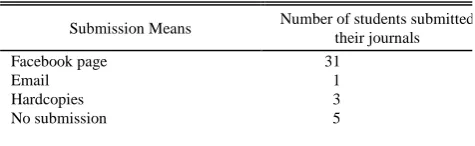
During the semester, students had to submit 5 reflective journals as part of the course assessment requirements. Table 1 shows the ways of the journal submission.
For the Facebook submission, it is interesting to find that all the submissions were submitted to the “timeline” of the course Facebook page, instead of submission as an update status. Among the 31 students who submitted their journal entries to the Facebook page, 17 of them were using their own “real” Facebook accounts, while the rest (i.e. 14 students) used “newly created” accounts for submission.
IV. REFINED RESEARCHFRAMEWORK
A. Discussion of the Pilot Study Findings
The findings of the pilot study reveal some interesting insights to encourage refining our research framework for future study.
First – although the majority of students were submitting their assignments in the Facebook page, their submission way differed from the way they submitted their social postings. Instead of submitting to the general “update status”, all students submitted their assignments to the Facebook page “timeline”. “Timeline” is separated from the general Facebook view.
Second – only slightly more than half of the students who submitted their journals were using their own “real” Facebook accounts. 14 out of the 31 students created a new account for submission.
B. Discussion
The findings of the pilot study demonstrate that Facebook is able to be used by our students as one of the channels to complete and submit their assignments. However, it is hard to tell whether habit plays a significant influence on the adoption of Facebook for learning activities. Since there were only 17 out of 41 students were using their own Facebook accounts for submission, (We assume that this group of students visited their own Facebook regularly), this small number of occurrences (around 41% of the subjects) cannot help to draw any conclusion on Proposition one.
For P2, the answer is two-folded. We found that 31% of the students (around 76% of the subjects) were submitting their assignments through Facebook page. Although there is no evidence showing that they completed the entries solely with Facebook (We cannot make the assumption that our students had completed the assignment in the Facebook. There might be chances that they developed their entries
with other means and only submitted them with Facebook timeline.), the assignment submission process was definitely by Facebook. Based on this observation, we can conclude that Facebook helps to change students’ assignment submission process.
However, we cannot conclude that our students had blended the boundary of social and learning domains within the Facebook environment. Based on the observation of the submission methods, we can conclude that the boundary of Facebook between social and non-social domain possesses the characteristics of flexibility, but not permeability. Facebook possesses the flexibility mechanism because our students were able to complete and submit their assignments within the same environment. That means the border between social and non-social can be blended. However, there were only a small number of students using their own real Facebook accounts and all of them submitted their assignments to the timeline. It makes us to draw another conclusion that the majority of our students were reluctant to show their student identities in front of their social groups. Such behavior demonstrates their willingness of making their student roles permeate to their social environment is low. Possible explanations may include:
Facebook culture
The collective culture of Facebook is quite high. According to [25], when an individual is in a loose culture, he or she tends to be more individualistic. On the contrary, an individual tends to hide its individual identity in a strong collective culture. Therefore, even our students were willing to submit the assignments with Facebook, they would find a way to lessen the exposure of such learning activities to their own Facebook community. It demonstrates that Facebook is mainly for socialization (at least from the eyes of this group of students). This kind of norms made our students refuse to post their assignments in normal Facebook page. Therefore, it is found that even Facebook can be used for learning activities and possesses the flexibility for both domains, the actors (i.e. our students) cannot wholly switch their roles between different domains in such social environment. Social comparison
Another possible explanation to such reluctance of identity exposure is our students’ perceived social comparison. Social comparison is defined as “an important means through which people come to understand their identities as organization members” [4]. Our students would compare their behavior with other Facebook community members to see whether it was acceptable or not. Based on this suspicion, our students tended to hide their identities by submitting their assignments in a sub-domain within the Facebook environment.
C. Refined Research Model and Propositions
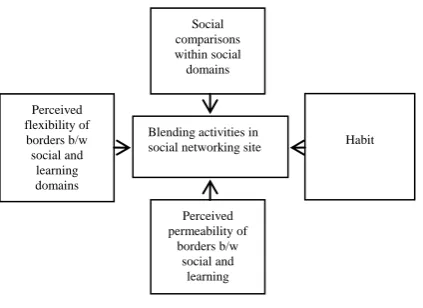
Based on our pilot study and the additional explanations to the findings, we have refined our research framework as
TABLEI MEANS OF SUBMISSION
Submission Means Number of students submitted their journals
Facebook page 31
Email 1
Hardcopies 3
[image:3.595.52.290.146.219.2]
To understand more about the phenomenon, we, therefore, reformulate the propositions as:
P1: When a learner habitually visits Facebook, he or she will automatically perform both social and learning activities in the same environment.
P2: The flexibility of the perceived boundary will influence a learner’s willingness to perform learning activities in Facebook.
P3: The permeability of the perceived boundary will influence a learner’s willingness to perform learning activities in Facebook.
P4: A sub-domain will be created to avoid social comparison if a non-social task has to be performed in Facebook.
V. CONCLUSION
A. Future study
The pilot study findings provide us insights of rethinking the original research framework. We further split the original P2 into 2 new propositions, aiming at understanding more about the impact of border flexibility and border permeability on learning activity processes. One new proposition is added to see how identity is influenced by social comparison within a social domain. To know more about this, another round of study will be conducted. Similar assignments will be given to a new batch of students. After the completion of the assignments, individual interviews will be conducted to understand in more details of what factors are influencing our students’ decision of choosing the ways to complete and submit the assignments in a social environment.
B. Implications
Practical Contribution
Facebook is pervasively used by our students for social activities. Many teachers have adopted Facebook as one of the platforms for their teaching activities. However, the majority of such adoption is just around course information dissemination and communication among learners and instructors. This study aims at exploring the possibility of adopting Facebook for other learning and teaching activities, aiming at understanding whether Facebook is able to change some types of learning processes, such as, idea creation and assignment submission. If the result is promising, we can
further encourage our students to perform learning activities in the environment they usually spend a lot of their time. Theoretical Contribution
Our original research framework aimed at exploring how perceived boundary impacted on learning activities taken place in a social environment. Our pilot study reveals the fact that different characteristics of the same boundary will have different impact on the adoption. Flexibility and permeability of the same border will impact the actor’s behavior differently. In addition to habit and perceived boundary, social comparison also takes place in influencing the way actors behave in the social environment.
APPENDIX
REFERENCES
[1] D. G. Ancona and D. F. Caldwell, “Bridging the Boundary: External Activity and Performance in Organizational Teams,” Administrative
Science Quarterly, Vol. 37, No. 4, pp. 634-665, Dec. 1992.
[2] B. E. Ashforth, G. E. Kreiner, and M. Fugate, “All in a Day’s Work: Boundaries and Micro Role Transitions,” Academy of Management
Review, Vol. 25, No. 3, pp. 472-491, 2000.
[3] J. A. Bargh, “Conditional Automaticity: Varieties of Automatic Influence in Social Perception and Cognition,” in P. M. Gollwitzer and J. A. Bargh, The Psychology of Action, New York, Guilford, 1989.
[4] C. A. Bartel, “Social Comparisons in Boundary-Spanning Work: Effects of Community Outreach on Members’ Organizational Identity and Identification,” Administrative Science Quarterly, Vol. 46, 2001. [5] S. C. Clark, “Work/Family Border Theory: A New Theory of Work/Family Balance,” Human Relations, Vol. 53, No. 6, pp. 747-770, 2000.
[6] T. G. Gutheil, G. O. Gabard, “The Concept of Boundaries in Clinical Practice: Theoretical and Risk-Management Dimensions,” The
American Journal of Psychiatry, Vol. 150, No. 2, 1993.
[7] D. T. Hall and J. Richter, “Balancing Work Life and Home Life: What Can Organizations Do to Help?” Academy of Management
Executive, Vol. 11, pp. 471-486, 1988.
[8] R. K. F. Ip and Y, Huang, “Will Learning Activities Spill over the Boundaries between Social and Learning Domains? An Exploratory Study on Adopting Facebook for Learning Activities,” Processing of 2013 International Conference on Engineering, Management
Science and Innovation, Macau, 2013.
[9] R. Junco, “Too Much Facebook and Not Enough Books: The Relationship between Multiple Indices of Facebook Use and Academic Performance,” Computers in Human Behavior, available:
http://reyjunco.com/wordprss/pdf/JuncoCHBFaceobookGrades.pdf, 2001.
[10] M. K. Kabilan, N. Ahmad and M. J. Z. Abidn, “Facebook: An Online Environment for Learning of English in Institutions of Higher Education?” Internet and Higher Education, Vol. 13, pp. 179-187, 2010.
Blending activities in social networking site Perceived
flexibility of borders b/w social and
learning domains
Perceived permeability of
borders b/w social and
learning domains
Habit Social
[image:4.595.51.263.56.210.2]comparisons within social domains
[11] A. C. Karpinski and A. Duberstein, “A Description of Facebook Use and Academic Performance among Undergraduate and Graduate Students,” Poster presented at the Meeting of the American
Education Research Association, San Diego, CA, 2009, April 16.
[12] B. Kooyman, “Boundary Theory as A Means to Understanding Social Space in Archaeological Sites,” Journal of Anthropological
Archaeology, Vol. 25, pp. 424-435, 2006.
[13] K. Kuutti, “Activity Theory as a Potential Framework for Human-Computer Interaction Research”, in Context and Consciousness:
Activity theory and human computer interaction, edited by B. Nardi,
MIT Press: Cambridge, pp. 17-44, 1995.
[14] M. Limayem, S. G. Hirt and C. M. K. Cheung, “How Habit Limits the Predictive Power of Intention: The Case of Information Systems Continuation,” MIS Quarterly, Vol. 31, No. 4, pp. 705-737, 2007. [15] S. Lysonshi, “A Boundary Theory Investigation of The Product
Manager’s Role,” Journal of Marketing, Vol. 49, pp. 26-40, 1985. [16] C. Madge, J. Meek, J. Wellens and T. Holley, “Facebook, Social
Integration and Informal Learning at University: ‘It Is More for Socializing and Talking to Friends about Work than for Actually Doing Work’,” Learning, Media and Technology, Vol. 34, No. 2, pp. 141-155, 2009.
[17] J. P. Mazer, R. E. Murphy and C. J. Simonds, “I’ll See You on “Facebook”: The Effect of Computer-Mediated Teacher Self-Disclosure on Student Motivation, Affective Learning, and Classroom Climate,” Communication Education, Vol. 56, No. 1, pp. 1-17, 2007.
[18] J. P. Mello, “BYOD Runs Wild at Most Global Companies,” CIO, available:
http://www.cio.com/article/736596/BYOD_Runs_Wild_at_Most_Glo bal_Companies?taxonomyId=600007, 2013.
[19] A. Ortiz de Guinea and M. L. Markus, “Why Break the Habit of a Lifetime? Rethinking the Role of Intention, Habit, and Emotion in Continuing Information Technology Use,” MIS Quarterly, Vol. 33, No. 3, pp. 433-444, 2009.
[20] PC Connection, “2013 Outlook on Technology – BYOD Survey Results,” available: http://resources.idgenterprise.com/original/AST-0093821_25029_Cisco_BYODSurvey_PCC.pdf
[21] F. M. Santos and K. M. Eisenhardt, “Organizational Boundaries and Theories of Organization,” Organization Science, Vol. 16, No. 5, pp. 491-508, Sept-Oct. 2005.
[22] G. Small and G.Vorgan, iBrain – Surviving the Technological
Alternation of the Modern Mind, Harper Collins Publishers, 2008.
[23] M. Snyder and A. A. Stukas, Jr., “Interpersonal Processes: The Interplay of Cognitive, Motivational, and Behavioral Activities in Social Interaction,” Annual Review of Psychology, Vol. 50, No. 1, pp. 273-303, 1999.
[24] Top site (July 2013), alexa.com, available: http://alexa.com/topsites
[25] H. C. Triandis, Interpersonal Behavior, Monerey, CA: Brooks/Cole Publishing Co., 1977.
[26] B. Verplanken, H. Aarts and A. van Knippenberg, “Habit, Information Acquisition, and the Process of Making Travel Mode Choice,” European Journal of Social Psychology, Vol. 27, pp. 539-560, 1997.
[27] J. B. Watson, Behavior: an Introduction to Comparative Behavior, New York: Holt, 1914.