Abstract—The advances of emerging technologies have broadened the meaning as well as the applications of the Internet. With smart connectivity, physical objects are networked and will gain the ability to communicate to each other. The vision of “The Internet of Things (IoT)” promises to enhance the capabilities of objects and forms a smart environment so that people will benefit from the IoT revolution. As the global population grows, the resources on earth are depleted quickly. In order to have a sustainable earth, governments around the world put a lot of efforts to advocate the reduction of carbon production as well as to emphasize the benefits of reducing the consumption of energy. The proposition has been promoted on campus of educational institutions as well. This research adopts the concept of the “Internet of Things” to construct a green campus environment which will realize the idea of energy-saving by properly managing the computers and air conditioners. The architecture of a green campus is established in this research. The prototype of the system is also demonstrated in the paper.
Index Terms—internet of things, RFID, Zigbee, green campus,
cloud computing.
I. INTRODUCTION
HE advances of emerging technologies have broadened the meaning as well as the applications of the Internet. In other words, almost every “object” can be part of a network. With smart connectivity, physical objects are networked and will gain the ability to communicate with each other. The vision of “The Internet of Things (IoT)” promises to enhance the capabilities of objects and forms a smart environment so that people can benefit from the IoT revolution [1], [2]. The IoT applications cover the building of smart cities, the set up of smart environment, the provision of smart public services, the plan of eHealth, and the building of smart home/office, etc. [1], [3].
As the global population grows, the resources on earth are depleted quickly. In order to have a sustainable earth, governments around the world put a lot of efforts to advocate the importance of the reduction of carbon production as well as to emphasize the benefits of reducing the consumption of energy. The proposition has been promoted on campuses of educational institutions as well.
Smart campus is a trendy application in the paradigm of the IoT. The concept of constructing a “Smart campus” implies that the institution will adopt advanced ICTs (Information
Manuscript received March 1, 2013; revised March 28, 2013.
Hsing-I Wang is now with the Department of Information Management, Overseas Chinese University, Taichung, Taiwan. (e-mail: [email protected]).
Communication Technologies) to automatically monitor and control every facility on campus. The benefits gained from building a smart campus include that the use of all facilities becomes more efficient and the energy consumed is minimized. Such efforts are also recognized as constructing a “Green campus”.
Two major ICTs which make the realization of IoT possible are the emergence of cloud computing and the network of wireless sensors. In fact, cloud computing and wireless-sensor network together can provide the most reliable, scalable, dynamic and composable resources that the IoTs required [4]-[ 6].
This paper demonstrates our work toward constructing a green campus. The objective is realized by constructing the Internet of Things using wireless sensors. The architecture of the green campus within IoT will be explained, and the system that we have developed is demonstrated in the paper as well.
II. LITERATURES REVIEW
A. The Development of Green Campus
New emerging technologies have changed human life styles dramatically. As people enjoy advanced and smart lives, ironically, our earth is facing major crisis that may bring disasters to human lives as well. Fig. 1 shows the carbon emission records from January 1955 to January 2013. The concentration of atmospheric CO2 was below 320 ppm in 1955. By January 2013, the number has increased by 25%. The data indicate how serious the earth has been polluted. In addition, more environmental crises such as global warming and climate disturbance; acid rain, and soil erosion; ecosystem damage and so forth have got the attention across the world [7], [8].
Toward a Green Campus with the Internet of
Things – the Application of Lab Management
Hsing-I Wang
[image:1.595.328.536.591.755.2]T
Scholars and experts have agreed that the knowledge of protecting the earth should be cultivated by educations. Universities should provide leadership for broader society [7] and institutions of higher learning have a special responsibility to address the continuing environmental crisis [7], [8].In [8], the author specifically points out that one of the greatest opportunity and ability to conserve energy is through facilities management on campus.
Educational institutions across the world, especially the higher education, have recognized that they are in a unique position to prevent the crisis from getting worse. Not only are the faculties realizing that they possess the intellectual capacity to address these issues, but also the institutions are putting a lot of efforts in the integration of all resources and effectively adopting new technologies to their missions to create a green environment. There are a number of well known “Green Campus” examples. For instance, the green campuses of the University of Pennsylvania, Boston University and the University of Chicago in the United States; Macquarie University in Australia; University of Copenhagen in Denmark and Queen's University in Canada, etc.
In Taiwan, Y. S. Sun Green Building Research Center Located at the NCKU Li-Hsing Campus is Taiwan’s first zero-carbon, energy-saving building. The building is very famous to people in Taiwan as ‘The Magic School of Green Technology’. Embedded within The Magic School is the hope that its design principles can eventually be scaled to Taiwan’s metropolitan centers [10]. The building was designed to use "adequate techniques", instead of "expensive techniques", to achieve "quadruple benefit". The aims are estimated to save 50% energy, to conserve 30% water, and to reduce 30% carbon emission. It is also expected that the building will be utilized for one hundred years [11]. The building started operation in January 2011, and in six months, the accumulated Energy Usage Intensity (EUI) was 19.3 kWh/m². The figure was far less than Taiwan's medium and low intensity office buildings, which consume 125 kWh/m² per year on average[11]. The existence of ‘The Magic School of Green Technology’ will be a model for all other universities in Taiwan.
B. Cloud Computing
The major function of cloud computing is the delivery of services. It is not new to consider the pursuit of “service” as the entire and sole philosophy in the adoption of new technology. Clustering computing, grid computing, and service oriented architectures are the three famous examples that have seamlessly combined technologies with business flow. Cloud computing is similar to the aforementioned concepts but with three unique characteristics, which include virtual, dynamic provision on demand, and negotiation. Therefore, in the literature, cloud computing is defined as, “offering hardware and software resources as services across a parallel and distributed system consisting of a collection of inter-connected and virtualized computers that are dynamically provisioned.” [12], [13].
According to the definition, in the cloud paradigm, there are many distributed systems. In many cases, the distributed
architecture consists of wireless sensor networks which are responsible for sensing data. Cloud computing usually plays important role in this kind of architecture since wireless sensor networks are limited in their processing power, battery life and communication speed while cloud computing is known for having powerful computational and processing capacity and the communication speed is much faster as well [14]. Cloud computing is also believed the paradigm for delivering services for IoT environment[4].
C. The Internet of Things
The concept and the realization of the “Internet of Things” make the world truly ubiquitous since the IoT radically changes the view of the “Internet” by embracing every physical object into network [4], [15].
The term “Internet of Things” has become very popular in recent years. There are books to teach or to discuss various subjects about the IoT. International conferences open up sessions for scholars and specialists to exchange their ideas, opinions and experiences regarding the development or the applications of the IoTs. And finally in 2009, even the EU Commission realized the importance of the revolution of the Internet and initiated an IoT action plan [16].
In [17], it is suggested that an IoT must be internet-oriented (middleware), things oriented (sensors) and semantic oriented (knowledge). Based on the assertions, [4] proposed that the architecture of an IoT actually contains three segments which are the hardware segment, the middleware segment and the presentation segment. The hardware segment mainly refers to the connection of sensors or any embedded communication hardware. The middleware segment usually refers to cloud environment which is responsible for data storage, computation and data analytics. The presentation segment, on the other hand, visualizes the result of data analytics or interprets the data in an easy and understandable format. Moreover, an IoT must possess the capabilities of communication and cooperation, addressability, identification, sensing, actuation, embedded information processing, localization and user interfaces [15].
At the hardware segment, wireless sensor network is expected to be a key technology for various IoT applications such as home automation[18], and energy saving[19]. The sensor devices in the wireless sensor network work as the communicate node and will communicate to other devices wirelessly [20]. The sensor device also carries out its designated duty to collect data and send data to data center. Therefore, communication and measurement are the two major functions of a wireless sensor network [20].
ZigBee is the name of a standard that specifies the application layer of a wireless network in a small area with a low communication rate [21]. Previous researches and projects have shown that ZigBee sensor networks are suitable for applications in many different areas.
III. CONSTRUCTING GREEN CAMPUS WITHIN IOT ARCHITECTURE
green campus within IoT. The architecture consists of three major segments which are the hardware segment, the middleware segment and the presentation segment.
The hardware segment mainly uses RFID to induce the students who are going to enter the computer labs. The IoT is setup to connect the computers and the air conditioners in the lab. Not only do the computers own an IP, but also each air conditioner is assigned an IP. The temperature sensor module of ZigBee is used to monitor the temperatures in the lab.
In our work, a ZigBee network is constructed with ZB2530-01devices from Dmatek Limited Taiwan. The specifications of the devices are as follows:
1) Radio frequency: 2.4 GHz band. 2) Data rate: 38400bit/s (max to 115200). 3) Distances: 10 meters
4) Number of channels: the device is able to search up to 32 satellite channels.
5) 10 I/O ports.
The emitter device shown in Fig. 3 is placed in the lab and connected to the IoT. The receiver device shown in Fig. 4 is connected to a PC via a USB interface. The receiver device will collect all the data sent by the emitters.
All the data collected, including the data read by RFID, the status of each of the computers in the lab as well as the temperatures of the computer room, are sent to the center of data and applications. The data are computed, analyzed and controlled.
At the presentation segment, two major systems are provided to students and controller of the general affair office. The students may use computers or any mobile devices to connect to the system and retrieve the usage status of the selected computer lab. This will allow the students to make proper decisions if they still want to go to the labs which might not have seats available.
The application that monitors the changes of the temperatures of each lab allows the controller to control the air conditioners in the lab. In addition, the network alert system will track the usage of each computer so that the computer will be shut down once it has been idle for a designated time.
IV. THE INTRODUCTION OF THE SYSTEM
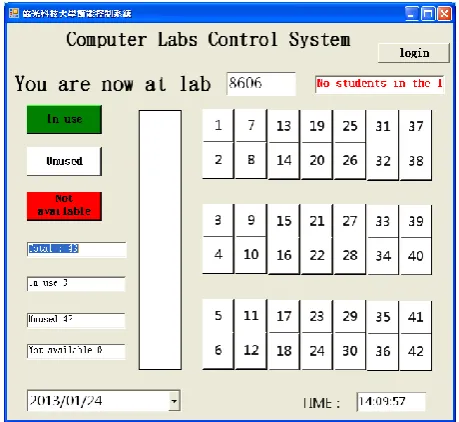
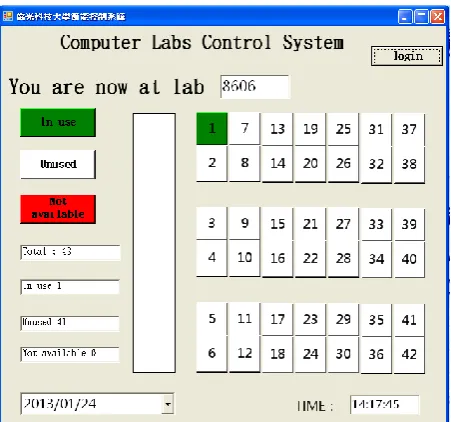
The prototype of the computer labs control system has been developed in this research. Fig. 5 through Fig. 11 demonstrates how the system operates.
On the lab side, the system tracks the usage of every computer lab at all times (Fig. 5). The system gives the information of computers that are occupied, available or malfunctioning.
[image:3.595.337.530.54.193.2]Once a student enters a lab, the RFID reader reads his or her ID, the system will assign an available seat to the student (Fig. 6) and the status of that seat will be marked with green color to indicate that the seat is ‘in use’ (Fig. 7).
[image:3.595.336.527.55.360.2]Fig. 2. The architecture of the green campus within IoT proposed in this research.
Fig. 4. The receiver that reads the signal from emitter. Fig. 3. The emitter which equips with the temperature sensor and sends out the temperature reading continuously.
[image:3.595.61.288.102.270.2] [image:3.595.310.540.507.718.2]Each student is allowed one hour to use the computer. A warning message will be given and the computer will be shut down automatically by the system (Fig. 8) if the computer has been occupied for more than one hour or if the system detects that the computer has been idle for some time.
A system control dashboard is provided to the controller in the general affairs office. Four functions are available at present system. The first tab shows the same labs information as the students can see. The second tab (Fig. 9) gives the current temperature of a selected lab. By clicking the on/off button, the controller is able to turn on or turn off the air conditioners in the lab.
[image:4.595.313.542.59.233.2]The third page shows the real time average temperatures of all computer labs (Fig. 10). In every 30 minutes, this system records the average temperatures of all computer labs. The records are shown on the fourth page of the dashboard (Fig. 11). The temperatures that are below 26 are marked with green. If the temperatures are higher than 30, red colors appear to show the warning. Yellow colors are shown if the temperatures are in between.
[image:4.595.53.283.126.303.2]Fig.6. RFID reader senses a tag and assigns a seat to the student.
Fig. 11. The changes of the temperatures in the computer labs. Fig. 10. The average temperature measured by ZigBee temperature sensor in the computer labs.
Fig. 9. The status of each of the air conditions in the computer lab.
[image:4.595.55.281.323.534.2]Fig. 8. The warning message will pop up on the screen either when the computer has been occupied for more than an hour or the computer was assigned to a student but has been detected idle for some time.
[image:4.595.313.541.369.544.2] [image:4.595.314.539.581.757.2]Together with the information of the status of computer labs, air conditioners and the changes of the temperatures as well as the statistics of the temperatures in the labs, the controller can make decisions easily. The decisions such as how many labs should open to students, when and which air conditioner should be turned on, and finally, the controller can also monitor if the computers are used properly and efficiently.
V. CONCLUSION
This research adopts the concept of the “Internet of Things” to construct the green campus which will realize the idea of energy-saving. The objects of our work include the computers and air conditioners. RFIDs and the ZigBee device with temperature module are used to build up the wireless sensor network.
The contributions delivered by this research include: 1) The computer labs can be managed efficiently. More labs
will be open only when the demand is increasing. 2) The use of the computers will be monitored at all times.
This mechanism decreases the number of idle power-on computers.
3) The air conditioners will be turned on only when the temperatures reach a preset level. As a result, more energy will be saved.
The idea of constructing a green campus is just the first step in our institution. This research shows how to build up the IoT to manage computer labs. The performance of current project will be examined continuously. The next phase is to build the IoT around the whole campus. Hopefully, as a higher educational institution, we can show some leadership and demonstrate our responsibilities to the society.
ACKNOWLEDGMENT
The author likes to thank Y. Lai, Y. Chen, Y. Lin, M. Shen, L. Hung and H. Chen for their dedication to the development of the system.
REFERENCES
[1] A. Gluhak, S. Krco, M. Nati, D. Pfisterer, N. Mitton, and T. Razafindralambo, “A Survey on Facilities for Experimental Internet of Things Research,” IEEE Commun Mag. vol. 49, 2011, pp. 58-67. [2] M. Zorzi, A. Gluhak, S. Lange, and A. Bassi, “From Today’s Intranet
of Things to a Future Internet of Things: A Wireless- and Mobility-Related View,” IEEE Wirel Commun. vol. 17, 2010, pp. 43-51.
[3] Libelium, “50 Sensor Applications for a Smarter World,” [Online]. Available:
http://www.libelium.com/top_50_iot_sensor_applications_ranking. Visited on January 10, 2013.
[4] J. Gubbi, R. Buyya, S. Marusic, and M. Palaniswami, “Internet of Things (IoT): A Vision, Architectural Elements, and Future Directions,” FGCS (in review, unpublished work). Available: http://www.cloudbus.org/papers/Internet-of-Things-Vision-Future201 2.pdf.
[5] G. Kortuem, F. Kawsar, D. Fitton, V. Sundramoorthy, “ Smart Objects as Building Blocks for the Internet of Things,” IEEE Internet Computing, pp. 30-37, Jan/Feb 2010.
[6] O. Vermesan, P. Friess, P. Guillemin, S. Gusmeroli, H. Sundmaeker, A. Bassi, I. S. Jubert, M. Mazura, M. Harrison, M. Eisenhauer and P. Doody, (2011) “Internet of Things Strategic Research Roadmap,”
Chapter 2 in IoT Cluster Strategic Research Agenda 2011, pp. 10-52.
Available:
http://www.internet-of-things-research.eu/pdf/IoT_Cluster_Strategic_ Research_Agenda_2011.pdf.
[7] L. Sharp, "Green campuses: the Road from Little Victories to Systemic Transformation,” International Journal of Sustainability in Higher Education, vol. 3 no. 2, pp.128-145, 2002.
[8] W. Simpson, “Energy Sustainability and the Green Campus,” Planning for Higher Education, vol. 31, no. 3, pp.150-158, March/May 2003.
[9] Earth’s Home Page, Available: http:// http://co2now.org. Visited on February 5, 2013.
[10] B. Fox and J. D’Angola, (2011, June 10), “Taiwan’s Magic Green School,” Available:
http://thediplomat.com/china-power/taiwans-magic-green-school/. [11] NCKU News, (2009, May 21), Available:
http://top-en.ncku.edu.tw/files/14-1051-53784,r78-1.php.
[12] Y. S. Tsai, (2009, September 30), “The Issues to Think about Before Entering the Cloud Services Market,” Available: http://www.zdnet.com.tw.
[13] H.R. Motahari Nezhad, B. Stephenson, S. Singhal, and M. Castellanos, “Virtual Business Operating Environment in the Cloud: Conceptual Architecture and Challenge,” Lecture Notes in Computer Science, 5829, pp. 501-514, 2009.
[14] W. Kurschl and W. Beer, “Combining Cloud Computing and Wireless Sensor Networks,” iiWAS '09: Proceedings of the 11th International Conference on Information Integration and Web-based Applications & Services, pp. 512-518, December 2009.
[15] F. Mattern and C. Floerkemeier, “From the Internet of Computers to the Internet of Things,” K. Sachs, I. Petrov, and P. Guerrero (Eds.): Buchmann Festschrift, LNCS 6462, pp. 242–259, 2010.
[16] European Commission, (2009), “Internet of Things – An action plan for Europe,” COM (2009) 278. Available: http://eur-lex.europa.eu/LexUriServ/site/en/com/2009/com2009_027 8en01.pdf
[17] L. Atzori, A. Iera, and G. Morabito, “The Internet of Things: A survey,”
Comput Netw, vol. 54, pp. 2787–2805, 2010.
[18] ZigBee Alliance, (2007), “ZigBee Home Automation Public Application Profile,” Available:
http://www.zigbee.org/Products/TechnicalDocumentsDownload/tabid /237/Default.aspx. Visited on November 20, 2012.
[19] ZigBee Alliance (2007) , “The Choice for Energy Management and Efficiency,” ZigBee White Paper. Available: http://www.zigbee.org/Products/TechnicalDocumentsDownload/tabid /237/Default.aspx. Visited on November 20, 2012.
[20] M. Terada, “Application of ZigBee Sensor Network to Data Acquisition and Monitoring,” Measurement Science Review, vol. 9, no. 6, pp. 1983-186, 2009.
![Fig. 1. Carbon emission from 1955 to 2015 [9]](https://thumb-us.123doks.com/thumbv2/123dok_us/477382.546142/1.595.328.536.591.755/fig-carbon-emission-from-to.webp)