University of Southampton Research Repository
ePrints Soton
Copyright © and Moral Rights for this thesis are retained by the author and/or other
copyright owners. A copy can be downloaded for personal non-commercial
research or study, without prior permission or charge. This thesis cannot be
reproduced or quoted extensively from without first obtaining permission in writing
from the copyright holder/s. The content must not be changed in any way or sold
commercially in any format or medium without the formal permission of the
copyright holders.
When referring to this work, full bibliographic details including the author, title,
awarding institution and date of the thesis must be given e.g.
AUTHOR (year of submission) "Full thesis title", University of Southampton, name
of the University School or Department, PhD Thesis, pagination
University of Southampton
Faculty of Engineering and Applied Science Department of Electronics and Computer Science
Southampton S17 1BJ
Power Minimisation Techniques for Testing Low Power VLSI Circuits
by Nicola Nicolici a dissertation submitted
in partial fulfillment of the requirements for the degree of Doctor of Philosophy
UNIVERSITY OF SOUTHAMPTON ABSTRACT
FACULTY OF ENGINEERING
DEPARTMENT OF ELECTRONICS AND COMPUTER SCIENCE Doctor of Philosophy
Power Minimisation Techniques for Testing Low Power VLSI Circuits by Nicola Nicolici
Testing low power very large scale integrated (VLSI) circuits has recently become an area of concern due to yield and reliability problems. This dissertation focuses on minimising power dissipation during test application at logic level and register-transfer level (RTL) of abstraction of the VLSI design flow.
The first part of this dissertation addresses power minimisation techniques in scan se-quential circuits at the logic level of abstraction. A new best primary input change (BPIC) technique based on a novel test application strategy has been proposed. The technique increases the correlation between successive states during shifting in test vectors and shifting out test responses by changing the primary inputs such that the smallest num-ber of transitions is achieved. The new technique is test set dependent and it is applicable to small to medium sized full and partial scan sequential circuits. Since the proposed test application strategy depends only on controlling primary input change time, power is minimised with no penalty in test area, performance, test efficiency, test application time or volume of test data. Furthermore, it is shown that partial scan does not provide only the commonly known benefits such as less test area overhead and test application time, but also less power dissipation during test application when compared to full scan. To achieve power savings in large scan sequential circuits a new test set independent multi-ple scan chain-based technique which employs a new design for test (DFT) architecture and a novel test application strategy, is presented. The technique has been validated using benchmark examples, and it has been shown that power is minimised with low computa-tional time, low overhead in test area and volume of test data, and with no penalty in test application time, test efficiency, or performance.
Contents
1 Introduction 1
1.1 VLSI Design Flow . . . 2
1.2 External Testing . . . 5
1.3 Internal Testing . . . 8
1.3.1 Scan BIST Methodology . . . 10
1.3.2 BIST Embedding Methodology . . . 11
1.4 Power Dissipation During Test Application . . . 18
1.4.1 Three Dimensional Testable Design Space. . . 19
1.5 Dissertation Organisation and Contributions . . . 22
2 Motivation and Previous Work 23 2.1 Motivation for Low Power Testing . . . 24
2.2 Previous Work. . . 25
2.2.1 Sources of Higher Power Dissipation During Test Application . . 25
2.2.2 Other Work on Low Power Testing. . . 29
3 Best Primary Input Change Time 43 3.1 Motivation and Objectives . . . 45
3.2 Power Dissipation During Test Application . . . 46
3.2.1 Power Dissipation Model. . . 46
3.2.2 The Influence of Test Vector and Scan Cell Ordering on Power Minimisation in Full Scan Sequential Circuits . . . 47
CONTENTS iv
3.2.3 The Influence of Scan Cell Ordering on Power Minimisation in
Partial Scan Sequential Circuits . . . 49
3.3 New Technique for Power Minimisation . . . 51
3.3.1 New Test Application Strategy for Full Scan Sequential Circuits . 51 3.3.2 The Applicability of the New Test Application Strategy to Partial Scan Sequential Circuits . . . 61
3.3.3 Extention of the New BPIC Test Application Strategy to Scan BIST Methodology . . . 67
3.4 Novel Algorithms for Power Minimisation . . . 69
3.4.1 Best Primary Input Change (BPIC) Algorithm. . . 69
3.4.2 Simulated Annealing-Based Design Space Exploration . . . 70
3.5 Experimental Results . . . 73
3.5.1 Experimental Results for Full Scan Sequential Circuits . . . 73
3.5.2 Experimental Results for Partial Scan Sequential Circuits . . . 79
3.5.3 Further Benefits of Partial Scan in Minimising Power Dissipation in Scan Based Sequential Circuits . . . 84
3.6 Concluding Remarks . . . 86
4 Multiple Scan Chains-Based Power Minimisation 87 4.1 Motivation and Objectives . . . 88
4.2 Background and Definitions . . . 90
4.3 New Multiple Scan Chain-Based DFT Architecture . . . 91
4.3.1 Proposed Design for Testability Architecture Using Multiple Scan Chains . . . 91
4.3.2 Compatible, Incompatible, and Independent Scan Cells . . . 93
4.3.3 Power Dissipated by the Buffered Clock Tree . . . 100
4.3.4 Extention of the Proposed DFT Architecture Based on Multiple Scan Chains to Scan BIST Methodology . . . 101
4.4 Novel Algorithms for Multiple Scan Chains Generation . . . 103
CONTENTS v
4.4.2 New Test Application Strategy Using Multiple Scan Chains and
Extra Test Vectors . . . 109
4.5 Experimental Results . . . 111
4.5.1 Experimental Results for Multiple Scan Chains-Based Power Min-imisation . . . 111
4.5.2 Comparing Multiple Scan Chains-Based Power Minimisation and Best Primary Input Change Test Application Strategy . . . 119
4.6 Concluding Remarks . . . 121
5 Test Compatibility Classes 122 5.1 Considering Testability at Register-Transfer Level . . . 124
5.1.1 Previous Work . . . 124
5.1.2 Motivation and Objectives . . . 126
5.2 New BIST Methodology for RTL Data Paths . . . 128
5.2.1 An Illustrative Example . . . 128
5.2.2 Definition of Test Compatibility Classes . . . 132
5.3 New BIST Hardware Synthesis Algorithm . . . 136
5.3.1 Tabu Search-Based Testable Design Space Exploration . . . 136
5.3.2 Generation of New Solutions and Speed Up Techniques for Local Neighbourhood Search . . . 139
5.3.3 Incremental TCC Scheduling Algorithm . . . 142
5.4 Experimental Results . . . 151
5.4.1 Comparison of the TCC Grouping and BIST Embedding Method-ologies for Benchmark Circuits . . . 151
5.4.2 Experimental Validation of the TCC Grouping Methodology . . . 154
5.4.3 Comparison for Complex Hypothetical Data Paths . . . 158
5.4.4 Reduction in Fault-Escape Probability of the Proposed TCC Group-ing Methodology Over the BIST EmbeddGroup-ing Methodology . . . . 161
CONTENTS vi
6 Low Power BIST for RTL Data Paths 164
6.1 Motivation and Objectives . . . 166
6.2 Power Dissipation Classification . . . 167
6.3 Effect of Test Synthesis and Scheduling . . . 169
6.4 Power Conscious Test Synthesis and Scheduling (PC-TSS) . . . 178
6.4.1 Move Acceptance During Power Conscious Test Synthesis . . . . 178
6.4.2 Module Selection During Power Conscious Test Scheduling . . . 180
6.4.3 Power Conscious Generation of Test Compatibility Classes. . . . 182
6.5 Experimental Results . . . 184
6.5.1 Experimental Results for BIST Embedding Methodology . . . 184
6.5.2 Experimental Results for TCC Grouping Methodology . . . 189
6.6 Concluding Remarks . . . 194
7 Conclusions and Future Work 195 7.1 Summary of Thesis Contributions . . . 196
7.2 Future Research Directions . . . 198
A Experimental Validation Flow 201 A.1 Integration of the Proposed Register-Transfer Level Techniques . . . 201
A.2 Integration of the Proposed Logic Level Techniques . . . 203
B Supplementary Experimental Results 205 B.1 Node Transition Count as Reliable Relative Power Information . . . 205
B.2 Supplementary Experimental Results on Test Compatibility Classes . . . 209
Acknowledgement
My supervisor, Dr. Bashir Al-Hashimi, has provided me with guidance and encourage-ment needed to complete the work presented in this dissertation. I am very grateful to him for teaching me how to conduct research, how to clearly and effectively present my work, and how to organise and write technical papers.
The members of the Electronic Systems Design Group in the Department of Elec-tronics and Computer Science of University of Southampton have inspired me with their support. I wish to acknowledge Professor Andrew Brown and Dr. Mark Zwolinski for serving on my MPhil to PhD transfer examination, as well as Dr. Alan Williams. I am thankful to Theo Gonciari, Paul Rosinger, Marcus Schmitz, and Mauricio Varea, for their constant friendship and providing appreciated feedback on several occasions.
I want to acknowledge Staffordshire University, where I have started my graduate studies and made many friends, to whom I give thanks. I am grateful to Dr. Peter Kollig of Philips Semiconductors, for many technical and friendly discussions. Also, I would like to thank my former colleagues and mentors at the University of Timis¸oara, particularly Professor Mircea Vl˘adut¸iu and Dr. Petru Eles¸, as well as University of Illinois, Virginia Polytechnic, and University of Southern California for providing valuable references.
I am especially indebted to Tanti Dorica and many friends from my hometown Timis¸oara in Romania. Thank you for being a part of my life, for so many years, with your unlimited friendship: Crapu, Frigu, Ghiolbanu, Mas¸i, Ochelari, P˘arinte, Supi, T¸ av˘a, and T¸ rni.
Members of my family, my cousin Radoica, aunt T¸ veta, uncle Emanoil, and many more than I can include here, have loved me far beyond what I could ever return. Special thanks to my aunt Mitra, uncles Nica and Cedomir, and great uncle Stani˘sa for their steady support over the years. No words would be enough to thank my mother Liubinca, father Ilia, brother Milos¸, and grandmother Liubit¸a. Therefore, to them and to the memory of my grandparents Dara, Jarco, and Rada, I dedicate this dissertation as a token of gratitude.
Abbreviations
ALAP As Late As Possible ALU Arithmetic Logic Unit ASAP As Soon As Possible ATE Automatic Test Equipment
ATPG Automatic Test Pattern Generation
BAO BIST Area Overhead
BILBO Built-In Logic Block Observer BIST Built-in Self-Test
BPIC Best Primary Input Change
CA Cellular Automata
CAD Computer-Aided Design
CBILBO Concurrent Built-In Logic Block Observer CMOS Complementary Metal-Oxide Semiconductor CUT Circuit Under Test
DCT Discrete Cosine Transform
DFT Design For Test
EDA Electronic Design Automation
ESC Extra Scan Chain
EWF Elliptic Wave Filter
G-TIG Global Test Incompatibility Graph FT-DP Fully Testable Data Path
HDL Hardware Description Language HLS High Level Synthesis
LFSR Linear Feedback Shift Register NTC Node Transition Count
CONTENTS ix
MISR Multiple-Input Signature Analyser MSC Multiple Scan Chains
PC-TSS Power Conscious Test Synthesis and Scheduling PD Performance Degradation
PT-DP Partially Testable Data Path
RAM Random Access Memory
RTL Register-Transfer Level
SA Signature Analyser
SP Shifting Power dissipation
SR Shift Register
TAP Test Application Power dissipation TAT Test Application Time
TA-TSS Time and Area Test Synthesis and Scheduling TCC Test Compatibility Classes
TCG Test Compatibility Graph TIG Test Incompatibility Graph TPG Test Pattern Generator
VHDL VHSIC Hardware Description Language VLSI Very Large Scale Integration
Chapter 1
Introduction
The topic of this investigation is power minimisation during test application in low power digital very large scale integrated (VLSI) circuits. This is a sub-problem of the general goal of testing VLSI circuits. Testing VLSI circuits bridges the gap between the imper-fection of integrated circuit (IC) manufacturing and consumer expectations of flawless products [94]. Manufacturers test their products and discard the defective components to ensure that only defect free chips make their way to the consumer. With the advent of deep sub-micron technology [138], the tight constraints on power dissipation of VLSI circuits have created new challenges for testing low power VLSI circuits which need to overcome the traditional test techniques that do not account for power dissipation during test application.
The aim of this chapter is to place the problem of testing low power VLSI circuits within the general context of the VLSI design flow. The rest of the chapter is organised as follows. Section1.1overviews the VLSI design flow and outlines the importance of test-ing integrated circuits. External testtest-ing ustest-ing automatic test equipment and the need for design for test (DFT) methods are described in Section1.2. Section1.3introduces built-in self-test (BIST) and provides the termbuilt-inology used throughout the dissertation with the help of detailed examples. Section1.4describes the importance of power minimisa-tion during test applicaminimisa-tion for low power VLSI circuits which will lead to an improve-ment in both test efficiency and circuit yield and reliability. Finally Section1.5 provides an overview of the dissertation and outlines the main contributions of the research pro-gramme.
CHAPTER 1. INTRODUCTION 2
1.1
VLSI Design Flow
In the complementary metal-oxide semiconductor (CMOS) technology, process technolo-gies race to keep pace with Moore’s law which observes that chip processing power dou-bles every 18 months [7]. While the increase in integration comes with numerous bene-ficial effects, the perception of the faulty behaviour is changing. This section introduces the design and test flow of CMOS integrated circuits, which is the dominant fabrication technology for implementation of VLSI circuits that contain more than 105 transistors [59].
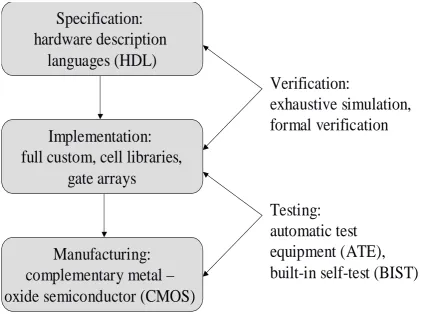
As shown in Figure 1.1 the design flow of VLSI circuits is divided into three main steps: specification, implementation and manufacturing [148]. Specification is the step of describing the functionality of the VLSI circuit. The specification is done in hardware description languages (HDLs), such as VHDL [136] or Verilog [137] in two different design domains, the behavioural domain or the structural domain [59], at various levels of abstraction. For example the logic level of abstraction is represented by means of expressions in Boolean algebra in the behavioural domain, or interconnection of logic gates in the structural domain. Going up in abstraction level, one reaches the register-transfer level. Register-register-transfer level (RTL) is the abstraction level of the VLSI design flow where an integrated circuit is seen as sequential logic consisting of registers and functional units that compute the next state given the current memory state. The highest level for system specification is the algorithmic level where the specification consists of tasks that describe the abstract functionality of the system.
Implementation is the step of generating a structural netlist of components that
CHAPTER 1. INTRODUCTION 3
Specification:
hardware description
languages (HDL)
Implementation:
full custom, cell libraries,
gate arrays
Manufacturing:
complementary metal –
oxide semiconductor (CMOS)
Verification:
exhaustive simulation,
formal verification
Testing:
[image:13.595.99.525.70.384.2]automatic test
equipment (ATE),
built-in self-test (BIST)
Figure 1.1: VLSI design flow.
Manufacturing is the final step of the VLSI design flow and it results in a physical
cir-cuit realised in a fabrication technology with transistors connected as specified by imple-mentation. The term fabrication technology refers to the semiconductor process used to produce the circuit which can be characterised by the type of semiconductor (e.g. silicon), the type of transistors (e.g. CMOS), and the details of a certain transistor technology (e.g. 0.35 micron). CMOS technology is the dominant technology for manufacturing VLSI circuits and it is considered throughout this dissertation. From now onwards, unless ex-plicitly specified, the term VLSI circuit refers to CMOS VLSI circuit. Due to significant improvement in the fabrication technology designers can place millions of transistors on a single piece of silicon that only accommodated thousands of transistors a few decades ago. However, complex designs are more failure-prone during the design flow. There-fore, to increase the reliability of the final manufactured product two more problems have to be addressed during the early stages of the VLSI design flow shown in Figure 1.1:
CHAPTER 1. INTRODUCTION 4
Verification involves comparing the implementation to the initial specification. If there
are mismatches during verification, then the implementation may need to be modified to more closely match the specification [128]. In traditional VLSI design flow the com-parison between specification and implementation is accomplished through exhaustive simulation. Because exhaustive simulation for complex designs is practically infeasible, simulation provides at best only a probabilistic assurance. Formal verification, in con-trast to simulation uses rigorous mathematical reasoning to prove that an implementation meets all or parts of its specification [95].
Testing assures that the function of each manufactured circuit corresponds to the
func-tion of the implementafunc-tion [2, 127]. Producing reliable VLSI circuits depends strongly on testing to eliminate various defects caused by the manufacturing process. Basic types of defects in VLSI circuits [138] are the following: particles (small bits of material that bridge two lines), incorrect spacing, incorrect implant value, misalignment, holes (ex-posed area that is unexpectedly etched), weak oxides, and contamination. The defects lead to faulty behaviour of the circuit which can be determined either by parametrical testing [163] or logic testing [2]. Testing circuits parametrically includes measuring the current flowing through the power supply in the quiescent or static state [163]. As CMOS technology scales down parametric testing is no longer practical due to an increase in sub-threshold leakage current. Logic testing involves modelling manufacturing defects at the logic level of abstraction of the VLSI design flow, where faulty behaviour is measured by the logic value of the primary outputs of the circuit [2]. The basic fault models for logic testing are stuck-at fault model, bridging fault model, open fault model, and timing related fault models such as gate delay and path delay fault models [7]. The earliest and most common fault model is the stuck-at fault model where single nodes in the structural netlist of logic gates are assumed to have taken a fixed logic value (and thus is stuck-at either 0 or 1). From now onwards throughout this dissertation, testing VLSI circuits refers to the most common and generally accepted logic testing for stuck-at fault model.
CHAPTER 1. INTRODUCTION 5
ATE memory with fault free responses
(CUT)
Circuit Under
Test ATE memory with test
patterns generated by automatic test pattern generation (ATPG)
Automatic Test Equipment (ATE):
control processor, timing module,
power module, format module
Figure 1.2: Basic principle of external testing using ATE
1.2
External Testing Using Automatic Test Equipment
Given the design complexity of state of the art VLSI circuits, the manufacturing test pro-cess relies heavily on automation. Figure1.2shows the basic principle of external testing using automatic test equipment with its three basic components: circuit under test is the integrated circuit part which is tested for manufacturing defects; automatic test equipment
(ATE) including control processor, timing module, power module, and format module; ATE memory that supplies test patterns and measures test responses. In the following an
overview [138] of each of the previously outlined components is presented.
The circuit under test (CUT) is the part of silicon wafer or packaged device to which tests are applied to detect manufacturing defects. The connections of the CUT pins and bond pads to ATE must be robust and easily changed since testing will connect and dis-connect millions of parts to the ATE to individually test each part.
CHAPTER 1. INTRODUCTION 6
The ATE memory contains test patterns supplied to the CUT and the expected fault free responses which are compared with the actual responses during testing. State of the art ATE measures voltage response with millivolt accuracy at a timing accuracy of hundreds of picoseconds [138]. Test patterns or test vectors stored in ATE memory are obtained using automatic test pattern generation (ATPG) algorithms [35]. From now on-wards throughout this dissertation, test patterns and test vectors are used interchangeably. ATPG algorithms can broadly be classified into random and deterministic algorithms. Random ATPG algorithms involve generation of random vectors and test efficiency (test quality quantified by fault coverage) is determined by fault simulation [2]. Determinis-tic ATPG algorithms generate tests by processing a structural netlist at the logic level of abstraction using a specified fault list from a fault universe (defined by an explicit fault model such as stuck-at fault model outlined in the previous Section1.1). Compared to random ATPG algorithms, deterministic ATPG algorithms produce shorter and higher quality tests in terms of test efficiency, at the expense of longer computational time. High computational time associated with deterministic ATPG algorithms is caused by low con-trollability and observability of the internal nodes of the circuit. This problem is more severe for sequential circuits where despite recent advancements in ATPG [34] computa-tional time is large, and test efficiency is not satisfactory. Further, the growing disparity between the number of transistors on a chip and the limited input/output pins makes the problem of achieving high test efficiency very complicated and time consuming.
Design for testability (DFT) is a methodology that improves the testability, in terms
of controllability and observability, by adding test hardware and introducing specific test oriented decisions during the VLSI design flow shown in Figure1.1. This often results in shorter test application time, higher fault coverage and hence test efficiency, and easier ATPG. The most common DFT methodology is scan based DFT where sequential ele-ments are modified to scan cells and introduced into a serial shift register. This is done by having a scan mode for each scan cell where data is not loaded in parallel from the combinational part of the circuit, but it is shifted in serially from the previous scan cell in the shift register. Scan based DFT can further be divided into full scan and partial
scan. The main advantage of full scan is that by modifying all the sequential elements
mod-CHAPTER 1. INTRODUCTION 7
CUT Primary Inputs
Primary Outputs
Pseudo Inputs Pseudo Outputs
D i
p-1 D ip-2 D i0 S im-1 S im-2 S i0
D i
p-1 D ip-2 D i0 Y im-1 Y im-2 Y i0
D i
p-1 D ip-2 D i0 Y im-2 Y im-3 Si+1m-1
D i
p-1 D ip-2 D i0 Y i0 S i+1m-1 S i+11
D i+1
p-1D i+1p-2D i+10 S i+1m-1S i+1m-2 S i+10 Time
t+m t+m-1
t+1 t t-1
S0 Sm-2 Sm-1
Figure 1.3: Scan based design
ifies only a small subset of sequential elements leading to lower test area overhead at the expense of more complex ATPG. The introduction of scan based DFT leads to the mod-ification of the test application strategy which describes how test patterns are applied to the CUT. Unlike the case of combinational circuits or non-scan sequential circuits where a test pattern is applied every clock cycle, when scan based DFT is employed each test pattern is applied in a scan cycle. Figure1.3 illustrates the application of a test pattern
Vi+1=Dip+−11Dip+−12. . .D0i+1Sim+−11Sim+−12. . .Si0+1at time t+m after shifting out the test response
of test pattern Vi=Dip−1Dip−2. . .Di0Sim−1Sim−2. . .S0i applied at t−1, where p is the num-ber of primary inputs, and m is the numnum-ber of memory elements modified to scan cells
S0. . .Sm−1that are pseudo inputs to the CUT. The scan cycle lasts for m+1 clock cycles of
which m clock cycles are required to shift out the pseudo output part of the test response
Ymi−1Ymi−2. . .Y0i for test vector Vi (time t to t+m−1) and one clock cycle is required to
apply Vi+1.
This section has described the basic principles of external testing using ATE and con-cepts of scan based DFT method. Finally, it should be noted that five main test parameters which assess the quality of a scan DFT method when using external ATE are: test area required by extra DFT hardware, performance, test efficiency, test application time and
CHAPTER 1. INTRODUCTION 8
T
P
G
S
A
(CUT)
Circuit Under
Test Test
Mode Good/Bad
Test Pattern Generator
Signature Analyser
Integrated circuit part
Figure 1.4: Basic principle of internal testing using BIST
1.3
Internal Testing Using Built-In Self-Test
Despite its benefits of detecting manufacturing defects, external testing using ATE has the following two problems. Firstly, ATE is extremely expensive and its cost is expected to grow in the future as the number of chip pins increases [138]. Secondly, when applying generally accepted scan based DFT, test patterns cannot be applied to the circuit under test in a single clock cycle since they need to be shifted through the scan chain in a scan cycle. This makes at-speed testing extremely difficult.
These problems have led to development of built-in self-test (BIST) [2, 4, 5, 6, 10] which is a DFT method where parts of the circuit are used to test the circuit itself. There-fore test patterns are not generated externally as in the case of ATE (Figure1.2of Section
1.2), but they are generated internally using BIST circuitry. To a great extent this alle-viates the reliance on ATE and testing can be carried out at normal functional speed. In some cases this not only substantially reduces the cost of external ATE, but also enables the detection of timing related faults. The basic principle of BIST is illustrated in Figure
CHAPTER 1. INTRODUCTION 9
The most relevant approach for exhaustive, pseudoexhaustive, and pseudorandom generation of test patterns is the use of a linear feedback shift register (LFSR) as TPG [4]. LFSR is widely employed by BIST methods mainly due to its simple and fairly regular structure, its pseudorandom properties which lead to high fault coverage and test efficiency, and its shift property that leads to easy integration with serial scan (Section
1.2). The typical components of an LFSR are memory elements (latches or flip flops) and exclusive OR (XOR) gates. Despite their simple appearance LFSRs are based on complex mathematical theory [13] that help explain their behaviour as test pattern generators and response analysers. While LFSR can be used to compact and analyse the test responses for single-output CUT, its simple extension to multiple-input signature analyser (MISR) compacts and analyses test sequences for multiple-output CUT. MISR can be extended to built-in logic block observer (BILBO) or to concurrent BILBO (CBILBO) [2] to perform both test pattern generation and signature analysis. An alternative to LFSR for test pattern generation are cellular automata (CA) [175] in which each cell consisting of a memory element is connected only to its neighbouring cells.
Based on the time of application and its relation to functional operation, BIST methods are classified in two broad categories, on-line BIST and off-line BIST [114]. On one hand, in on-line BIST testing occurs during functional operation. Despite its benefits of in-field testing and on-line fault detection for improving fault coverage, on-line BIST leads to excessive power dissipation which increases packaging cost and reduces circuit reliability. Moreover, on-line testing conflicts with power management policies implemented in the state of the art deep sub-micron VLSI circuits to reduce power dissipation. This makes on-line BIST highly inefficient for testing low power VLSI circuits. On the other hand, the same test efficiency is achieved by off-line BIST which deals with testing a circuit when it is not performing its normal functions. From now onwards throughout this dissertation, unless explicitly specified, the term BIST refers to off-line BIST.
CHAPTER 1. INTRODUCTION 10
CUT
SR
MISR
q
Scan chain
LFSR
counter
p
Go / No Go
N/T
N/T
CUT
Primary Inputs
Primary Outputs
Pseudo Inputs
Pseudo Outputs
Figure 1.5: Basic principle of scan BIST methodology.
1.3.1
Scan BIST Methodology
CHAPTER 1. INTRODUCTION 11
CUT
LFSR
MISR
Test clock
p
q
Figure 1.6: Parallel BIST
1.3.2
BIST Embedding Methodology
In a parallel BIST methodology, test patterns are applied to the CUT every clock cycle which leads to a substantial reduction in test application time when compared to the scan BIST methodology (Figure 1.5 from Section 1.3.1). Figure 1.6 shows a circuit under test having p inputs and q outputs which is tested as one entity using an LFSR for test pattern generation and an MISR for signature analysis. Since most practical circuits are too complex to be tested as one entity, a circuit is partitioned into modules [47]. BIST
embedding is the parallel BIST methodology where each module is a test primitive in the
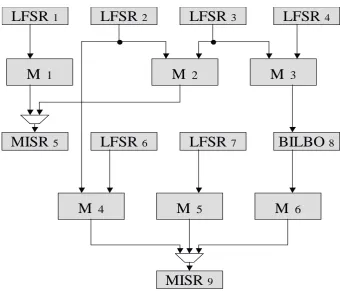
sense that test patterns are generated and output responses are compressed using test reg-isters for each module [114,115,155]. This methodology is particularly suitable for data path circuits described at register-transfer level of the VLSI design flow where modules are tested using test registers which are a subset of functional registers. The following example overviews the BIST embedding methodology for RTL data paths.
CHAPTER 1. INTRODUCTION 12
M
1LFSR
1M
2M
3LFSR
2LFSR
3LFSR
4M
4MISR
5M
5M
6LFSR
6LFSR
7BILBO
8 [image:22.595.141.482.65.356.2]MISR
9Figure 1.7: Example1.1data path
BILBOs, and CBILBOs [2]. During the test of modules Mk, k =1. . .6, the associated
TPGs and SAs are first initialised to known states, then a sufficient number of test patterns are generated by the TPGs and applied to Mk. Outputs from Mkare compressed in SAs to form a signature. After all patterns are applied to Mk, the final signature is shifted out of
the SAs and compared with the fault-free signature.
Test hardware is allocated such that each module receives test patterns and its output re-sponses are observable during test. The process of allocating test hardware (test resources) to each module is referred to as test synthesis. Since test hardware is allocated for BIST,
test synthesis and BIST synthesis are used interchangeably throughout this dissertation.
dur-CHAPTER 1. INTRODUCTION 13
ing testing. A test schedule specifies the order of testing all the modules by eliminating all the conflicts between modules. A test schedule is divided into several test sessions, where in each test session one or more modules are tested. Data paths with many modules in conflict have a higher number of test sessions and hence longer test application time. The
test application time of a built-in self-testable data path is the time to complete the test
schedule added to the shifting time required to shift in the seeds for test pattern genera-tors and shift out signatures stored in signature analysers as described in Example1.1. In the following the concepts defined in [47] are introduced based on the example data path shown in Figure1.7. These concepts are necessary to understand how a test schedule is generated and serve as a basis for the technique proposed in Chapters5and6.
A test tk for a module Mk has an allocation relation with a test register Ri if the
register generates test patterns for Mk or analyses test responses of Mk. In general, the
allocation between modules and test registers can be represented by a bipartite graph with a node set consisting of tests and resources. The resource allocation graph for the data path example from Figure1.7is shown in Figure1.8(a). If there is an allocation relation between tkand Ri, then there is an edge between tkand Riin the resource allocation graph.
For example in the case of M2from Figure1.7 LFSR2and LFSR3generate test patterns, and MISR5 analyses test responses. Therefore, in the resource allocation graph shown in Figure 1.8(a) there is an edge between t2 and R2, between t2 and R3, and between t2 and R5. If a resource node (register) is connected to more that one test this indicates a conflict between the tests that require that resource. A pair of tests that share a test resource cannot be run concurrently and are referred to as incompatible. Otherwise, they are compatible. Pairs of compatible tests form a relation on the set of tests which is a compatibility relation. Such a relation can be represented by a test compatibility graph
(TCG) shown in Figure1.8(b). In a TCG a node appears for each test and an edge exists between two nodes if the corresponding two tests are compatible. For example, in the case of TCG from Figure 1.8(b) there is an edge between t1 and t3 since the two tests do not share any resources in the resource allocation graph shown in Figure1.8(a). The test compatibility graph indicates which tests can be run concurrently. The complement of the test compatibility graph is the test incompatibility graph (TIG) shown in Figure
CHAPTER 1. INTRODUCTION 14
t
1
t
2
t
3
t
4
t
5
t
6
R
1
R
2
R
3
R
4
R
5
R
6
R
7
R
8
R
9
(a) Resource allocation graph
t
1t
2t
3t
4t
6t
5(b) Test compatibility graph
t
1t
2t
3t
4t
6t
5(c) Test incompatibility graph
Figure 1.8: Resource allocation, test compatibility and incompatibility graphs for data path shown in Figure1.7.
CHAPTER 1. INTRODUCTION 15
cliques. This problem can also be thought of as finding the minimum number of colours required to colour the TIG. This is because the graph colouring problem aims to minimise the number of colours in a graph such that two adjacent nodes do not have the same colour. Since all the nodes with the same colour in the TIG belong to the same clique in the TCG, minimum number of colours in the TIG will indicate the minimum number of test sessions which leads to the lowest test application time. The test scheduling problem to minimise the test application time was shown to be NP-hard [47,58] and therefore fast heuristics must be developed. Also, efficient algorithms for BIST synthesis for RTL data paths are required since it was formulated as 0-1 integer linear programming problem [155], which is, in general, NP-hard [58].
It should be noted that test scheduling differs fundamentally from traditional operation scheduling in high level synthesis (HLS) [51,59]. Unlike operation scheduling which is based on a data dependency graph, test scheduling is based on the TCG and the TIG shown in Figures1.8(b)and1.8(c). Therefore, in test scheduling there is no concern with regard to the precedence and the order of execution. The main objective in test scheduling is to minimise the number of test sessions and hence test application time by increasing the test concurrency based on the conflict information derived from the resource allocation graph (Figure1.8(a)).
It is desirable to allocate test hardware (test synthesis) such that both test application time and BIST area overhead are reduced. For each testable data path there are one or more test schedules according to the resource allocation and test incompatibility graphs (test scheduling). Test synthesis and test scheduling are strictly interrelated since each test resource allocation determines the number of conflicts between different tests. Example
1.2outlines this interrelation between test synthesis and test scheduling.
CHAPTER 1. INTRODUCTION 16
LFSR
2M
1R
1M
2LFSR
2M
1LFSR
1M
2Figure 1.9: Interrelation between test synthesis and test scheduling.
The set of feasible test resource allocations and test schedules define a testable design
space. For complex circuits, with a large number of registers and modules, the size of the
testable design space is huge due to the high number of test resource allocations and test schedules. Exploring different alternatives in the design space in order to minimise one or more test parameters, such as test application time or BIST area overhead, is referred to as testable design space exploration. To achieve high quality solutions with both low test application time and low BIST area overhead, efficient testable design space exploration is required. Further, efficient testable design space exploration is also important from the computational time standpoint, since for complex circuits the size of the testable design space is huge.
After test resources are allocated (test synthesis) and the test schedule is generated (test scheduling) the final step is to synthesise a BIST controller that controls the execu-tion of test sessions and shifts in the seeds for TPGs and shifts out the signatures stored in SAs. In order to achieve minimum area overhead, the BIST controller is merged with the functional controller into a single control unit for the data path. Figure 1.10 shows the extention of a functional data path (Figure1.10(a)) to a self-testable data path (Figure
CHAPTER 1. INTRODUCTION 17
DATAPATH
FunctionalController
Registers Modules
control signals
status signals
(a) Functional data path
DATAPATH
Functional Controller
Test Registers Modules
control signals
status signals
BIST controller
test signals
(b) Testable data path
Figure 1.10: Functional and testable data paths.
In addition to test application time, BIST area overhead, and performance degradation, other BIST parameters include volume of test data and fault-escape probability. Volume of test data affects storage requirements and shifting time required to shift in the seeds for the TPGs and to shift out the signatures stored in SAs. Hence, volume of test data has an influence on test application time which is the sum of the shifting time and the time required to complete the test sessions. High aliasing probability in signature analysis registers [139, 173] leads to data paths with high fault-escape probability which lowers fault coverage and hence decreases test efficiency. Finally, it should be noted that the six main test parameters which assess the quality of BIST embedding methodology are:
CHAPTER 1. INTRODUCTION 18
1.4
Power Dissipation During Test Application
The ever increasing demand for portable computing devices and wireless communica-tion systems requires low power VLSI circuits. Minimising power dissipacommunica-tion during the VLSI design flow increases lifetime and reliability of the circuit [29,158,169]. Numerous techniques for low power VLSI circuit design were reported [158] for CMOS technology where the dominant factor of power dissipation is dynamic power dissipation caused by switching activity [29,169]. While these techniques have successfully reduced the circuit power dissipation during functional operation, testing of such low power circuits has re-cently become an area of concern mainly because of the following two reasons (detailed in Section2.1). Firstly, it was reported in [199] that there is significantly higher switching activity during testing than during functional operation and hence higher power dissipa-tion. This can decrease the reliability of the circuit under test due to excessive temperature and current density which cannot be tolerated by circuits designed using power minimi-sation techniques. Secondly, high switching activity during test application leads to man-ufacturing yield loss which can be explained as follows. High switching activity during test application causes a high rate of current flowing in power and ground lines leading to excessive power and ground noise. This noise can erroneously change the logic state of circuit lines leading to incorrect operation of circuit gates causing some good dies to fail the test [191]. Therefore, addressing the problems associated with testing low power VLSI circuits has become an important issue.
Most of the solutions reported for power minimisation during normal operation re-duce spurious transitions during functional operation (glitches) which do not carry any useful functional information and cause useless power dissipation. Consequently, power can be minimised during test application by eliminating spurious transitions during test
application which do not carry any useful test operation. Spurious transitions during test
application will be defined later at different levels of abstraction in Chapters 3 and 6, and their minimisation is the aim of this investigation. Since dynamic power dissipation caused by switching activity is the dominant factor of power dissipation in CMOS VLSI circuits [29,158,169], from now onwards, unless explicitly specified, the terms dynamic
power dissipation and power dissipation are used interchangeably throughout this
CHAPTER 1. INTRODUCTION 19
800 1000 1200 1400 1600 1800 2000 2200 2400 2600
70 80 90 100 110 120 130 140 150 160 170 180
test application time (clock cycles)
[image:29.595.112.514.79.386.2]BIST area overhead (sqmils)
Figure 1.11: Test application time vs. BIST area overhead
1.4.1
Three Dimensional Testable Design Space
CHAPTER 1. INTRODUCTION 20
800 1000 1200 1400 1600 1800 2000 2200 2400 2600
20 30 40 50 60 70 80 90 100 110 120 130
test application time (clock cycles)
[image:30.595.107.514.81.382.2]power dissipation (mW)
Figure 1.12: Test application time vs. power dissipation
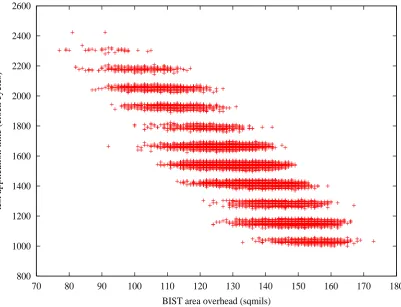
time decreases there is an increase in BIST area overhead. However, there are many test resource allocations leading to identical values in test application time with significantly different values in BIST area overhead. For example, in the case of the lowest test ap-plication time equal to 1064 clock cycles, BIST area overhead varies from approximately 130 square mils to 180 square mils. This justifies the need for efficient BIST hardware synthesis algorithms which minimise both test application time and BIST area overhead. This problem is addressed in Chapter5.
CHAPTER 1. INTRODUCTION 21
800
1000 1200 1400
1600 1800 2000
2200 2400 2600 test application time (clock cycles)
7080 90100
110120 130140
150160 170180
BIST area overhead (sqmil) 20
30 40 50 60 70 80 90 100 110 120 130
power dissipation (mW)
Figure 1.13: Three dimensional testable design space
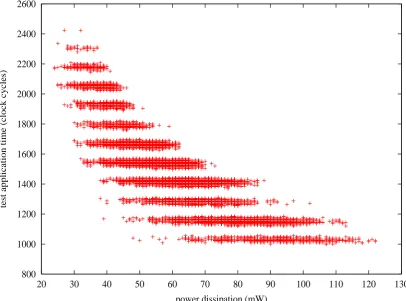
cosine transform data path. In the case of the lowest test application time equal to 1064 clock cycles, power dissipation varies from approximately 40mW to 130mW. The differ-ent values in power dissipation during test application are not caused only by differdiffer-ent values in BIST area overhead (Figure 1.11). Since power dissipation is dependent on switching activity of the active elements during each test session, the variation in power dissipation is also due to useless power dissipation defined in Chapter6.
Finally, Figure1.13shows the three dimensional testable design space for the 32 point discrete cosine transform data path. Unlike the case of exploring only test application time and BIST area overhead (Figure1.11) or only test application time and power dissipation (Figure1.12), the exploration of the three dimensional design space accounts for all the three parameters: test application time, BIST area overhead and power dissipation (Figure
CHAPTER 1. INTRODUCTION 22
1.5
Dissertation Organisation and Contributions
This dissertation presents new techniques in terms of algorithms and methodologies for testing low power VLSI circuits at the logic and register-transfer levels of abstraction of the VLSI design flow. The rest of the dissertation is organised as follows. Motivation for low power testing and a comprehensive review of previously reported approaches for minimising power dissipation during test application is provided in Chapter2.
Chapter3introduces a new technique [142, 145] for power minimisation during test application in scan sequential circuits with no penalty in area overhead, test application time, test efficiency, performance, or volume of test data when compared to standard scan method described in Section1.2. The technique is test set dependent and it is applicable to small to medium sized scan sequential circuits at the logic level of abstraction.
Chapter4 introduces a new test set independent technique [143] applicable to large scan sequential circuits and shows how with low overhead in test area and volume of test data, and with no penalty in test application time, test efficiency, or performance, considerable savings in power dissipation during test application in large scan sequential circuits is achieved with low computational time.
Prior to investigating power minimisation techniques for testing low power VLSI cir-cuits at RTL, Chapter 5 addresses testability of RTL data paths using BIST [139, 140,
144]. A new BIST methodology based on test compatibility classes achieves an improve-ment in terms of test application time, BIST area overhead, performance degradation, volume of test data, and fault-escape probability over the traditional BIST embedding methodology described in Section1.3.2.
Chapter 6 shows how power dissipation during test application is minimised at the register-transfer level of abstraction of the VLSI design flow [141]. The three dimen-sional testable design space described in Figure1.13 from Section1.4 is explored using novel power conscious test synthesis and test scheduling algorithms at the expense of low overhead in computational time.
Finally, conclusions and directions for future research are given in Chapter 7. The previously outlined contributions in Chapters3, 4,5, and6, and summarised in the final Chapter7have resulted in original work published or submitted for publication [139,140,
Chapter 2
Motivation and Previous Work
Personal mobile communications and portable computing systems are the fastest grow-ing sectors of the consumer electronics market. The electronic devices at the heart of such products need to dissipate low power, in order to conserve battery life and meet packaging reliability constraints. Low power design in terms of algorithms, architec-tures, and circuits has received significant attention and research input over the last decade [8, 116, 131, 158, 161, 179]. Although low power design methodologies will solve the problem of designing complex, low power digital very large scale integrated (VLSI) cir-cuits, such circuits will still be subject to manufacturing defects. It was implicitly as-sumed that traditional design for testability (DFT) methodologies are suitable for digital circuits designed using low power methods. However, recent research has shown that this assumption is not valid and leads to lower circuit reliability and reduced manufacturing yield [66, 188, 191]. For example, it was reported in [199] that a VLSI chip can dissi-pate up to three times higher power during testing when compared to normal (functional) operation. While some overstressing of devices during a burn-in phase may be desir-able, increasing the power dissipation by several times can be destructive. The additional power dissipation is caused by significantly higher switching activity during testing than in functional operation. This is due to the fact that there is a fundamental conflict be-tween the very aims of low power design where the correlation bebe-tween input patterns is increased and traditional DFT methodologies where any correlation between test vectors is destroyed in order to reduce test application time.
The aim of this chapter is to justify the need for low power testing in order to preserve high circuit yield and reliability (Section2.1) and to provide an overview of the solutions recently proposed to reduce power dissipation during test application (Section2.2).
CHAPTER 2. MOTIVATION AND PREVIOUS WORK 24
2.1
Motivation for Low Power Testing
Considerable research on low power design and testability of VLSI circuits was done over the last decade [94,116]. With the advent of deep sub-micron technology and tight yield and reliability constraints, in order to perform a non-destructive test for high performance VLSI circuits power dissipation during test application needs not to exceed the power constraint set by the power dissipated during functional operation of the circuit [27, 48,
66, 138, 174, 199]. This is because excessive power dissipation during test application caused by high switching activity may lead to the following two problems [66,188,191]:
i. Reliability decrease caused by the following two reasons: heat dissipation and elec-tromigration. The use of special cooling equipment to remove excessive heat dis-sipation during test application caused by higher switching activity, is difficult and costly as tests are applied at higher levels of circuit integration such as BIST (Sec-tion 1.3). Therefore, excessive heat dissipation may lead to permanent damage of the circuit under test or affect the reliability by accelerating corrosion mechanisms [188]. Also electromigration rate increases with temperature and current density that is underestimated by state of the art approaches [91, 187] which assume sig-nal correlations that are eliminated when DFT methodologies such as scan (Section
1.2) or scan BIST (Section1.3.1) are employed.
CHAPTER 2. MOTIVATION AND PREVIOUS WORK 25
2.2
Previous Work
The previous section has motivated the need to minimise power dissipation during test application in order to increase circuit yield and reliability. A review of the sources of higher power dissipation during test application and recently proposed low power testing techniques is given in Sections2.2.1and2.2.2respectively.
2.2.1
Sources of Higher Power Dissipation During Test Application
This section reviews low power design techniques and methodologies which lead to the conflict between low power dissipation during functional operation and achieving high testability of the circuit under test. Dynamic power dissipation in CMOS VLSI cir-cuits depends on three parameters: supply voltage, clock frequency, and switching ac-tivity [29, 158, 169]. While the first two parameters reduce power dissipation at the expense of circuit performance, power reduction by minimising switching activity and hence switched capacitance does not introduce performance degradation and it is the main technique researched over the last decade [158]. Depending on the level of abstraction, sources of high power dissipation during test application due to increased switching activ-ity can broadly be classified into logic level sources and register-transfer level sources:
i. Sources of high power dissipation during test application caused by design tech-niques at the logic level of abstraction can further be classified:
(a) Low power combinational circuits are synthesised by algorithms [11,19, 90,
consec-CHAPTER 2. MOTIVATION AND PREVIOUS WORK 26
utive test patterns during test application may lead to higher switching activity and hence power dissipation when compared to functional operation [191].
(b) Low power sequential circuits are synthesised by state assignment algorithms which use state transition probabilities [17, 18, 20, 42, 123, 168, 184]. The state transition probabilities are computed assuming the input probability dis-tribution and the state transition graph which are valid during functional oper-ation. These two assumptions are not valid during the test mode of operation when scan DFT technique is employed. While shifting out test responses, the scan cells are assigned uncorrelated values that destroy the correlation between successive functional states. Furthermore, in the case of data path circuits with large number of states that are synthesised for low power using the correlations between data transfers [30, 96, 103, 104, 105, 106, 107], in the test mode scan registers are assigned uncorrelated values that are never reached during functional operation, which may lead to higher power dissipa-tion than during the funcdissipa-tional operadissipa-tion.
ii. High power dissipation during test application caused by design techniques at the register-transfer level of abstraction is due to the following. Systems which com-prise a high number of memory elements and multifunctional execution units em-ploy power conscious architectural decisions such as power management where blocks are not simultaneously activated during functional operation [16,107]. Hence, inactive blocks do not contribute to dissipation during the functional operation. The fundamental premise for power management is that systems and their components experience nonuniform workload during the functional operation [15]. However, such an assumption is not valid during test application. In order to minimise test application time when the system is in the test mode, concurrent execution of tests is required. Therefore, by concurrently executing tests many blocks will be active at the same time leading to a conflict with the power management policy. This will result in higher power dissipation during test application when compared to functional operation.
CHAPTER 2. MOTIVATION AND PREVIOUS WORK 27
S
1S
2S
5C
S
S
3S
4State Code
S
1000
S
2011
S
3001
S
4010
S
5100
000 001 1
Functional
Transitions
state transition nt
000 100 1
011 010 1
001 011 1
010 000 1
100
010 2
scan sequential circuit
100 010 2
010 101
3
101
010 3
state transition
nt
Test
Transitions
Shift out S5=100
Shift in S4=010
NO correlation
Scan In
Scan Out
Figure 2.1: Sources of higher power dissipation during test application than during normal operation at logic level of abstraction when scan DFT is employed.
Example 2.1 Consider the state transition graph and its circuit implementation shown in Figure2.1. The functional description of the state transition graph comprises five states
S1,S2,S3,S4,S5, and circuit implementation consists of the combinational part C and the sequential part S. In order to achieve high test efficiency scan based DFT is employed and sequential elements are transformed into scan cells with serial input, Scan In, and serial output, Scan Out. To reduce power dissipation during functional operation, state assignment algorithms for low power, outlined in problem (ib), allocate a code to each state such that the number of transitions (nt) is minimised. However, when scan based DFT is employed, state transition correlations that exist during functional operation are destroyed. This leads to greater number of transitions during testing, and hence higher
CHAPTER 2. MOTIVATION AND PREVIOUS WORK 28
*1
-1
+2
-2
*2
+1
v
v
v
v
v
v
v
v
v
v
v
v
v
1 2
3 4 5 6
10 9 8 7 11 12 13
Register Variables
R v , v
R v , v
R v
R v
R v , v
R v
R v
R v , v , v
1 2 3 4 5 6 7
8 4 10
9 3 6 8 5 7 2 12 1 11 13
Clock 1
Clock 2
Clock 3
Clock 4
Clock 5
Figure 2.2: Data flow graph to illustrate the implementation of low power RTL data path.
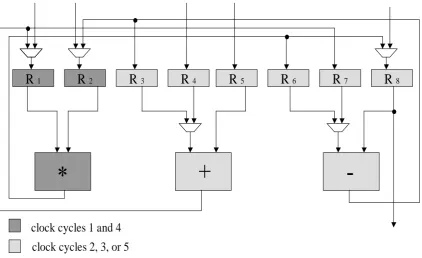
Example 2.2 In order to show that the high test concurrency required for low test ap-plication time aimed for by the BIST embedding methodology (Section 1.3.2) leads to higher power dissipation during test application, consider the data flow graph from Fig-ure2.2 and its low power implementation shown in Figure 2.3. The 13 variables in the data flow graph {v1. . .v13} are mapped to 8 registers {R1. . .R8}, and the 6 operations
CHAPTER 2. MOTIVATION AND PREVIOUS WORK 29
R
1R
2R
3R
4R
5R
6R
7R
8clock cycles 1 and 4
[image:39.595.103.526.69.327.2]clock cycles 2, 3, or 5
Figure 2.3: Low power RTL data path implementing data flow graph shown in Figure2.2.
2.2.2
Other Work on Low Power Testing
This section gives a review of recently proposed solutions for reducing switching activity and hence power dissipation during test application which leads to solving problems (i )-(ii) outlined in the previous Section2.2.1.
Problem (ia): A new ATPG tool [191] was proposed to overcome the low correlation between consecutive test vectors during test application in combinational circuits. Despite achieving the objectives of safe and inexpensive testing of low power circuits the approach in [191] increased the test application time. A different approach for minimising power dissipation during test application in combinational circuits is based on test vector order-ing [49,56,69,72,73]. The basic idea beyond test vector ordering is to find a new order of the set such that correlation between consecutive test patterns is increased as shown in Figure2.4. For example by considering a p input combinational circuit with a test set of
n test vectors (Figure2.4(a)), by swapping the position of test vectors Viand Vj will lead
CHAPTER 2. MOTIVATION AND PREVIOUS WORK 30
CUT
V
0p-1
V
0p-2V
00Time
t+n-1
t+j
t+i
t
V
ip-1
V
ip-2V
i0V
jp-1
V
jp-2V
j0V
n-1p-1
V
n-1p-2V
n-10initial
sequence
before
reordering
(a) Initial sequence before reordering
CUT
V
0p-1
V
0p-2V
00Time
t+n-1
t+j
t+i
t
V
jp-1
V
jp-2V
j0V
ip-1
V
ip-2V
i0V
n-1p-1
V
n-1p-2V
n-10after
reordering
vectors
V
iand V
j(b) After reordering
CHAPTER 2. MOTIVATION AND PREVIOUS WORK 31
CUT
SLOWLFSR
Test clock
NORMAL-SPEED LFSR
Test clock Slow clock Clock sel
Figure 2.5: Dual speed LFSR for power minimisation during test application [190]
CHAPTER 2. MOTIVATION AND PREVIOUS WORK 32
CUT
LFSR
Test clock
D
decoding
logic
Transmission gates
network enabling
signal propagation
(a) Filtering vectors
CUT
LFSR
Test clock
decoding
logic
Transmission gates
network enabling
signal propagation
Seed Memory
counter
(b) Reseeding LFSR
Figure 2.6: Vector filtering and test pattern generator reseeding for power minimisation during test application [68].
CHAPTER 2. MOTIVATION AND PREVIOUS WORK 33
CUT
LFSR
MISR
Test clock
p
q
MASK
p
enable
logic
Figure 2.7: Precomputation-based architecture for power minimisation during test appli-cation [45]
CUT
MISR
Test clock p
q
Hybrid Cellular Automata
Figure 2.8: Hybrid cellular automata for power minimisation during test application [44]
CHAPTER 2. MOTIVATION AND PREVIOUS WORK 34
sequences [68]. The seed memory combined with the decoding logic (Figure2.6(b)) is better than only decoding logic (Figure2.6(a)) in terms of low power dissipation and high fault coverage, at the expense of higher BIST area overhead.
A different approach for filtering non-detecting vectors inspired by the precomputa-tion architecture [8] is presented in [45]. The MASK block shown in Figure 2.7 is a circuit with a latch-based architecture or AND-based architecture which either eliminates or keeps unaltered the vectors produced by the LFSR. The enable logic implements an in-completely specified boolean fuction whose on-set [51] is the set of the unaltered vectors and whose off-set is the set of the eliminated (non-detecting) vectors [45]. An improve-ment in area overhead associated with filtering non-detecting vectors without penalty in fault coverage or test application time was achieved using a non-linear hybrid cellular automata [44]. The hybrid cellular automata shown in Figure 2.8 generates test patterns for the CUT using cell configurations optimised for low power dissipation under given fault coverage and test application time constraints. The regularity of multiplier modules and linear sized test set required to achieve high fault coverage lead to efficient low power BIST implementations for data paths [12,74,75,77,89].
Regardless of the implementation type of the test pattern generator, BIST architectures significantly differ one from another in terms of power dissipation [166]. The three dif-ferent architectures shown in Figures2.9(a)-2.9(c)were evaluated for power dissipation, BIST area overhead and test application time. It was found in [166] that the architecture consisting of an LFSR and a shift register SR (Figure2.9(c)) produces lower power dis-sipation, BIST area overhead and test application time when compared to a single LFSR (Figure2.9(a)) and two LFSRs with reciprocal characteristic polynomials (Figure2.9(b)). However, this is achieved at the expense of lower fault coverage and hence reduced test efficiency due to the modified sequence of patterns applied to the CUT which does not detect all the random pattern resistant faults.
CHAPTER 2. MOTIVATION AND PREVIOUS WORK 35
CUT
LFSR
MISR
Test clock
p
q
(a) Single LFSR
CUT
LFSR
1MISR
Test clock
p/2
q
LFSR
2p/2
P(x)
P*(x)
(b) Two LFSRs
CUT
LFSR
MISR
Test clock
k
q
SR
p-k
(c) LFSR and SR
CHAPTER 2. MOTIVATION AND PREVIOUS WORK 36
CUT
A B
C
D
E
F
(a) Initial circuit
CUT
1A B
C
D
E
F
CUT
2(b) The two circuit partitions
CUT
1A B
C
D
E
F
CUT
2(c) First partition testing
CUT
1A B
C
D
E
F
CUT
2(d) Second partition testing
Figure 2.10: Circuit partitioning for power minimisation during test application [67].
subcircuits has to be minimum. It was shown in [67] that by partitioning a single cir-cuit entity into two subcircir-cuits and executing two successive tests as shown in Figures
2.10(c)-2.10(d), savings in power dissipation can be achieved with roughly the same test application time as in the case of a single circuit entity.
CHAPTER 2. MOTIVATION AND PREVIOUS WORK 37
CUT
SR
MISR
q
Scan chain
LFSR
counter
p
Go / No Go
N/T
N/T
decoding
logic
enable
CUT
Primary Inputs
Primary Outputs
Pseudo Inputs
Pseudo Outputs
Figure 2.11: Precomputation architecture for power minimisation during test application in scan BIST methodology [46]
Problem (ib): To minimise power dissipation in non-scan sequential circuits during test application a test pattern generation methodology for low power dissipation was pro-posed in [43]. The methodology is based on three independent steps comprising redun-dant test pattern generation, power dissipation measurement and optimum test sequence selection. The solution proposed in [43], which is based on genetic algorithms, achieves considerable savings in power dissipation, however cannot be applied to scan sequen-tial circuits where shifting power dissipation is the major contributor to the total power dissipation.
CHAPTER 2. MOTIVATION AND PREVIOUS WORK 38
CUT Primary inputs
Primary Outputs
Pseudo inputs Pseudo Outputs
D i+1
p-1D i+1p-2D i+10 S i+1m-2S i+1m-1 S i+10
D i+1
p-1D i+1p-2D i+10 Y i+1m-1Y i+1m-2 Y i+10
D i+1
p-1D i+1p-2D i+10 Y i+1m-2Y i+1m-3 Sim-2
D i+1
p-1D i+1p-2D i+10 Y i+10 S im-2 S i1
D i
p-1 D ip-2 D i0 S im-2 S im-1 S i0 Time
t+m t+m-1
t+1 t t-1
[image:48.595.145.483.92.299.2]S0 Sm-1 Sm-2
Figure 2.12: Test vector and scan cell reordering for power minimisation in full scan sequential circuits [49]
power dissipation. Despite substantial savings in power dissipation vector detection and gating logic introduce not only significant area overhead but also considerable perfor-mance degradation for modified scan cell design. In [182] a new scan BIST structure was proposed based on the experimental observation that a very high fault coverage can be obtained by a small number of clusters of test vectors. Although not targeted specifi-cally for low power dissipation during test application the approach in [182], yields high fault coverage with correlated scan patterns which can also lead to lower power dissipa-tion. A similar approach is employed in the low transition random test pattern generator (LT-RTPG) proposed in [192], where neighbouring bits of the test vectors are assigned identical values in most test vectors. A simple and fast procedure to compact scan vectors as much as possible without exceeding power dissipation was proposed in [172]. All the previous scan-based BIST methods [46, 61, 172, 182,192] introduce test area overhead and/or further performance degradation when compared to scan DFT methodology.
CHAPTER 2. MOTIVATION AND PREVIOUS WORK 39
CUT Primary Inputs
Primary Outputs
D i
p-1 D ip-2 D i0 S im-1 S im-2 S i0
X 0
p-1 X 0p-2 X 00 Y im-1 Y im-2 Y i0
X 1
p-1 X 1p-2 X 10 Y im-2 Y im-3 Si+1m-1
X m-1
p-1X m-1p-2X m-10 Y i0 S i+1m-1 S i+11
D i+1
p-1D i+1p-2D i+10 S i+1m-1S i+1m-2 S i+10 Time
t+m t+m-1
t+1 t t-1
Pseudo Inputs Pseudo Outputs
[image:49.595.145.483.93.299.2]S0 Sm-2 Sm-1
Figure 2.13: Power minimisation in scan sequential circuits using extra primary input vectors for each clock cycle of the scan cycle of every test pattern presented in [189]
scan design (Figure1.3from Section 1.2) is significantly modified when reordering scan cells Sm−1and Sm−2and test vectors Vi+1=Dip+−11Dip+−12. . .Di0+1Sim
![Figure 2.12: Test vector and scan cell reordering for power minimisation in full scansequential circuits [49]](https://thumb-us.123doks.com/thumbv2/123dok_us/1043041.619996/48.595.145.483.92.299/figure-test-vector-reordering-power-minimisation-scansequential-circuits.webp)
![Figure 2.13: Power minimisation in scan sequential circuits using extra primary inputvectors for each clock cycle of the scan cycle of every test pattern presented in [189]](https://thumb-us.123doks.com/thumbv2/123dok_us/1043041.619996/49.595.145.483.93.299/figure-minimisation-sequential-circuits-primary-inputvectors-pattern-presented.webp)
![Figure 2.14: Power minimisation in scan sequential circuits using only a single extraprimary input vector for all the clock cycles of the scan cycle of every test pattern [88]](https://thumb-us.123doks.com/thumbv2/123dok_us/1043041.619996/50.595.146.483.94.299/figure-minimisation-sequential-circuits-single-extraprimary-cycles-pattern.webp)