http://www.scirp.org/journal/ojanes ISSN Online: 2164-5558
ISSN Print: 2164-5531
Does Checklist Implementation Improve
Quantity of Data Transfer: An Observation
in Postanesthesia Care Unit (PACU)
Lauren S. Park
1,2, Gloria Yang
2, Kay See Tan
3, Charlotte H. Wong
3,4, Sabine Oskar
2,
Ruth A. Borchardt
2, Luis E. Tollinche
2*1The Warren Alpert Medical School of Brown University, Providence, RI, USA
2Department of Anesthesiology and Critical Care Medicine, Memorial Sloan Kettering Cancer Center, New York City, NY, USA 3Department of Epidemiology and Biostatistics, Memorial Sloan Kettering Cancer Center, New York City, NY, USA
4Cornell University, Ithaca, NY, USA
Abstract
Background: Omission of patient information in perioperative communica-tion is closely linked to adverse events. Use of checklists to standardize the handoff in the post anesthesia care unit (PACU) has been shown to effectively reduce medical errors. Objective: Our study investigates the use of a checklist to improve quantity of data transfer during handoffs in the PACU. Design: A cross-sectional observational study. Setting: PACU at Memorial Sloan Ket-tering Cancer Center (MSKCC); June 13, 2016 through July 15, 2016. Pa-tients, other participants: We observed the handoff reports between the nurses, PACU midlevel providers, anesthesia staff, and surgical staff. Inter-vention: A physical checklist was provided to all anesthesia staff and recom-mended to adhere to the list at all observed PACU handoffs. Main outcome measure: Quantity of reported handoff items during 60 pre- and 60 post-im- plementation of a checklist. Results: Composite value from both surgical and anesthesia reports showed an increase in the mean report of 8.7 items from pre-implementation period to 10.9 post-implementation. Given that surgical staff reported the mean of 5.9 items pre-implementation and 5.5 items post- implementation without intervention, improvements in anesthesia staff report with intervention improved the overall handoff data transfer. Conclusions: Using a physical 12-item checklist for PACU handoff increased overall data transfer.
Keywords
Checklist, PACU, Recovery Room, Data Transfer, Handoff
How to cite this paper: Park, L.S., Yang, G., Tan, K.S., Wong, C.H., Oskar, S., Bor-chardt, R.A. and Tollinche, L.E. (2017) Does Checklist Implementation Improve Quan-tity of Data Transfer: An Observation in Postanesthesia Care Unit (PACU). Open Journal of Anesthesiology, 7, 69-82. https://doi.org/10.4236/ojanes.2017.74007
Received: March 14, 2017 Accepted: April 24, 2017 Published: April 28, 2017
Copyright © 2017 by authors and Scientific Research Publishing Inc. This work is licensed under the Creative Commons Attribution International License (CC BY 4.0).
1. Introduction
1.1. Communication to Improve Patient Safety
Miscommunication is a major patient safety concern. In 2016, The Joint Com-mission reported communication error as the number one cause of all anesthesia related sentinel events for the period 2004 to 2015 [1]. In the analysis of 444 sur-gical malpractice claims, 60 cases involved communication breakdown. When multiple healthcare providers across departments and disciplines care for a pa-tient, mistakes in transmitting increasingly complex patient information have been shown to lead to patient harm [2] [3]. Handoff is a transfer of information and professional responsibilities across teams [4]. Despite the wide use of an electronic health record (EHR), a verbal synchronous, face-to-face communica-tion in real-time is a fundamental paradigm of clinical discussion that provides a critical structure and an opportunity for an interactive discussion about a patient
[5] [6] [7]. For that reason, The American Society of Anesthesiologist’s standard
of care requires the presence of intraoperative anesthesia staff for monitoring during transport and verbal report [8].
From review of surgical malpractice claims, the highest percentage of peri-operative mistakes, including 43% of all communication failures, occurs post-operatively as a result of poor handoffs [9]. Studies have shown that poor han-doffs increase the risk of patient harm [2] [3] [9] [10] [11] [12] and that standar-dizing communication protocols for handoffs can decrease medical errors and adverse events [13] [14] [15] [16]. Lack of standard guidelines produces incon-sistent reports that are vulnerable to omission of pertinent information. Our ob-jective was to quantify the amount of information transferred. The omission of data has been associated with worse outcomes than passing on poor quality of information [17]. A complete omission of information occurred in 57% of sur-gical malpractice claims [9]. Observation of handoffs showed items deemed vital components of handoff were reported less than half of the times [18].
Inadequate communication in PACU has been shown to increase morbidity and mortality [19]; a review of 419 reports from Anesthetic Incident Monitoring Study (AIMS) indicated a failure of communication as the second most common contributing factor that led to adverse events in recovery units [10]. PACU is especially vulnerable to communication failures between providers because of physical transfer of patient, collaboration of multiple clinicians, and similar pa-tient histories are common features of PACU [17] [20].
1.2. Why a Checklist?
To avoid adverse events caused by miscommunication, The Joint Commission mandated “a standardized approach to handoffs” as a patient safety goal in 2006
medical errors [13] [15] [27]. Multicenter handoff interventions using a handoff checklist in PACU showed decrease in preventable adverse events across discip-lines and departments [15] [27]. In addition, use of checklists has shown im-provements in nursing staff satisfaction and handoff efficiency [25].
Overall, a checklist accomplishes two goals for both intraoperative and post-operative care providers. First, it provides a guideline that defines a standard for a handoff. Second, a physical checklist is used as a reminder of items to prevent omission of information [18] [26].
1.3. Goal & Hypothesis
The goal is to establish measures to decrease perioperative miscommunication and improve patient safety through standardized PACU handoff protocol. We hypothesize that a physical checklist will increase data transfer and efficiency at our PACU, and prevent omission of pertinent patient information in handoff.
2. Methods
2.1. IRB Approval
IRB exemption was approved by MSKCC under the criteria of observation of public behavior and collection of unidentifiable information of clinician interac-tions. IRB exemption was approved on May 16, 2016.
2.2. Derivation of the Checklist
According to a systemic review of 31 studies on PACU handoff, a handoff should include at minimum: patient information, anesthesia information, sur-gical information, current status, and care plan [17]. A published “Anesthesia Handover Checklist” by Lin and colleagues was used as the initial structural framework. The initial checklist included: Patient, Underlying diagnosis/pro- cedure, Technique-anesthetic, Status of procedure, Past significant medical his-tory, Allergies, Timing/expected duration, Immediate expected events next 30 min, Emergence plan, Noteworthy aspects of case, Treatment plan for post op care, Fluids/EBL, Induction events, Records available for review, Signs-vitals,
and Transfer care to. These items listed out a mnemonic: PUTS PATIENT
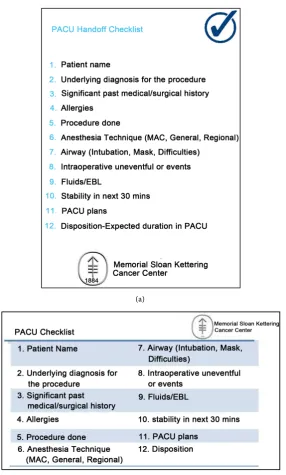
FIRST [28]. This checklist included key elements of the transfer of care measures recommended by The American Society of Anesthesiologists [29]. Following the recommendations from various studies that emphasized flexibility in making adjustments according to the implemented institutions [15] [24] [30], the pilot week was used to adjust the working checklist according to the practices at our institution (Figure 1(a)). Multiple iterations were made to test usability and strength of the checklist.
(a)
[image:4.595.232.519.64.540.2](b)
Figure 1. (a) Full-sized checklist that was displayed by every PACU bed; (b) ID badge- sized checklist for post-implementation period.
thesia staff, the item is considered to be addressed, and a score of 1 is allocated to the item. For department based scores, the surgical and anesthesia staff reports received separate score of 1 per item accordingly. The start and end time of the handoff was recorded for assessing the duration of handoff rounded to a whole minute. Lastly, every handoff was assigned an unidentifiable number to match the data between two observers.
This pilot study yielded 100% consensus on “item qualified” between attending anesthesiologists and the observers. The observers were physically present at all observed handoffs between June 13, 2016 and July 15, 2016 from 10AM to 5PM. Immediately after each handoff, two observers resolved any differences in as-sessment and arrived at 100% consensus.
2.3. Pre-Implementation Period
Second and third weeks served as the control period. Observers gathered data before the checklist was implemented to gauge the current quality of PACU handoff. Both anesthesia and surgical staff being observed were not informed of the reason for the presence of observers in PACU to avoid isolated improve-ments in handoff behavior.
2.4. Post-Implementation Period
After pre-implementation period and prior to the official implementation of the checklist, all anesthesia staff–including attending anesthesiologist, Certified Reg-istered Nurse Anesthetists (CRNAs), resident physicians, and CRNA students– were made aware of the study. They were provided an electronic and physical copy of the checklist. An A4-sized laminated checklist was available by every pa-tient bed. Additionally, ID badge-sized checklists were distributed to every pro-vider (Figure 1(b)). During the last two weeks of the study, anesthesia staff were asked to use the checklist by the observers before each report. Surgical staff were not part of the intervention although data were collected from their reports.
2.5. Statistical Analysis
A traditional randomized study would randomize each handoff 1:1 to the group with or without a checklist. However, this approach would require some staff to unlearn the checklist hints after being exposed to it. Because of these logistical and feasibility issues, our study is based on convenience sampling in that the first two weeks of the study was pre-implementation of the checklist, while the second two weeks was post-implementation. This approach assumes that the case mix (patient and surgical characteristics) is similar between the two phases of the study, which is reasonable in this high volume cancer center. Power cal-culation was performed prior to the study to determine the minimal detectable difference (MDD) necessary to achieve 80% and 90% power for a two-sided t-test, given 50 patients in each arm and type I error rate of 0.05. The MDD re-fers to the smallest treatment effect that can be identified assuming a known sample size. We assume mean of 5 items completed in the pre-implementation phase, with a conservative standard deviation (SD) of 5. The MDD are 2.85 and 3.25 for 80% and 90% power. This translates to an assumed mean of 7.85 and 8.25 checklist items completed in the post-implementation phase. If instead SD is 2, the MDD changes to 1.14 and 1.30 for 80% and 90% power.
The secondary outcome of duration of PACU handoff is compared between the two groups using Wilcoxon rank sum test. As exploratory analyses, we compare the total number of items addressed in the post-implementation phase by con-sistency status to assess whether concon-sistency impacts the quality of handoff. All analyses were repeated with the component scores which included the items ad-dressed by the anesthesia provider only. All statistical tests were two-sided at al-pha level of 0.05, performed using Stata 13 (Stata Corp, College Station, TX).
3. Results
3.1. Data Transfer
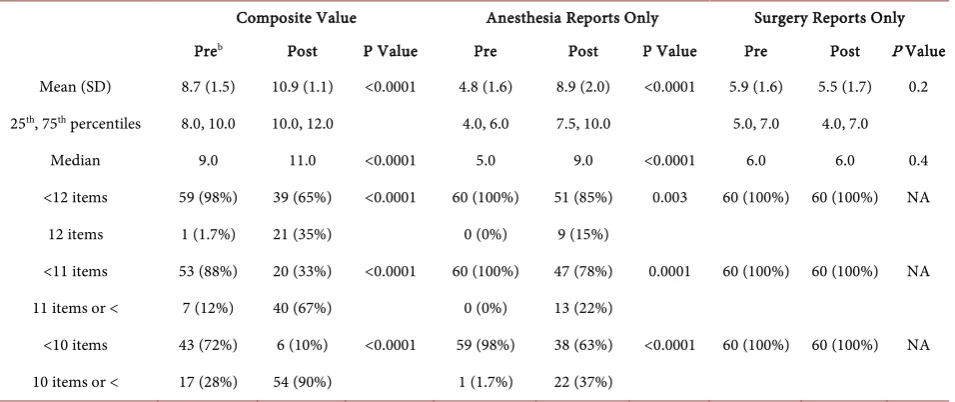
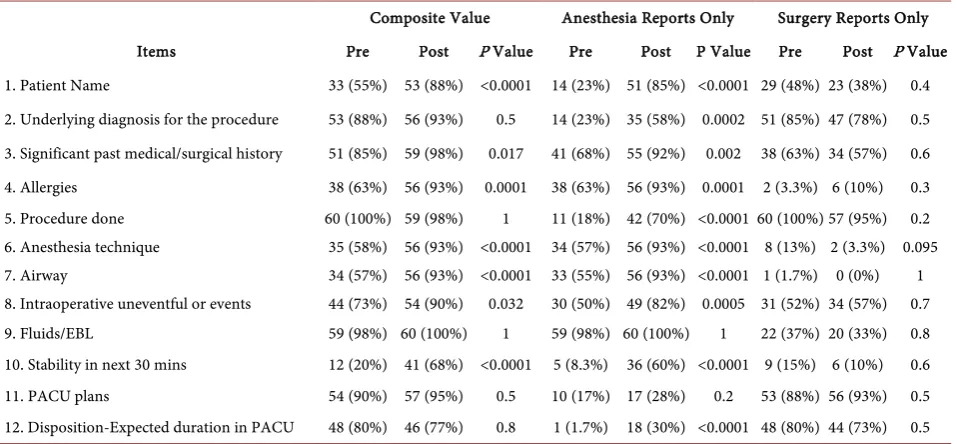
We observed a total of 120 PACU handoffs. 60 handoffs were each observed pre- implementation and post-implementation of the checklist. Composite values analyzed items as addressed by either surgical or anesthesia staff. Department based values analyzed items addressed by surgical and anesthesia staff separately. Pre-implementation of a checklist, the composite value showed a mean of 8.7 (SD = 1.5) items reported out of a total of 12 items on the checklist, and post- implementation the median report increased to 10.9 items (Table 1) (Figure 2). When anesthesia staff reports were analyzed independently, the mean reported items increased from 4.8 (SD = 1.6) to 8.9 (SD = 2.0) items post-implementation of the checklist (Table 1). Interestingly, surgical staff report stayed relatively consistent at mean of 5.9 items pre and 5.5 items post-implementation periods. In the analysis of anesthesia staff reports, items that were consistently reported at low numbers despite the checklist were: PACU Plans, Disposition-Expected Duration in PACU, Underlying Diagnosis, and Procedure Done (Table 2).
[image:6.595.62.540.499.700.2]From the composite values, most improvements were seen with the following items: Allergies, Anesthesia Technique, and Airway (Table 2). In pre-implemen-
Table 1. Summary of median and 25th, 75th percentiles of reported itemsa.
Composite Value Anesthesia Reports Only Surgery Reports Only
Preb Post P Value Pre Post P Value Pre Post P Value
Mean (SD) 8.7 (1.5) 10.9 (1.1) <0.0001 4.8 (1.6) 8.9 (2.0) <0.0001 5.9 (1.6) 5.5 (1.7) 0.2 25th, 75th percentiles 8.0, 10.0 10.0, 12.0 4.0, 6.0 7.5, 10.0 5.0, 7.0 4.0, 7.0
Median 9.0 11.0 <0.0001 5.0 9.0 <0.0001 6.0 6.0 0.4
<12 items 59 (98%) 39 (65%) <0.0001 60 (100%) 51 (85%) 0.003 60 (100%) 60 (100%) NA
12 items 1 (1.7%) 21 (35%) 0 (0%) 9 (15%)
<11 items 53 (88%) 20 (33%) <0.0001 60 (100%) 47 (78%) 0.0001 60 (100%) 60 (100%) NA
11 items or < 7 (12%) 40 (67%) 0 (0%) 13 (22%)
<10 items 43 (72%) 6 (10%) <0.0001 59 (98%) 38 (63%) <0.0001 60 (100%) 60 (100%) NA 10 items or < 17 (28%) 54 (90%) 1 (1.7%) 22 (37%)
Table 2. Breakdown of handoffs by reported items.
Composite Value Anesthesia Reports Only Surgery Reports Only
Items Pre Post P Value Pre Post P Value Pre Post P Value
1. Patient Name 33 (55%) 53 (88%) <0.0001 14 (23%) 51 (85%) <0.0001 29 (48%) 23 (38%) 0.4 2. Underlying diagnosis for the procedure 53 (88%) 56 (93%) 0.5 14 (23%) 35 (58%) 0.0002 51 (85%) 47 (78%) 0.5 3. Significant past medical/surgical history 51 (85%) 59 (98%) 0.017 41 (68%) 55 (92%) 0.002 38 (63%) 34 (57%) 0.6 4. Allergies 38 (63%) 56 (93%) 0.0001 38 (63%) 56 (93%) 0.0001 2 (3.3%) 6 (10%) 0.3 5. Procedure done 60 (100%) 59 (98%) 1 11 (18%) 42 (70%) <0.0001 60 (100%) 57 (95%) 0.2 6. Anesthesia technique 35 (58%) 56 (93%) <0.0001 34 (57%) 56 (93%) <0.0001 8 (13%) 2 (3.3%) 0.095 7. Airway 34 (57%) 56 (93%) <0.0001 33 (55%) 56 (93%) <0.0001 1 (1.7%) 0 (0%) 1 8. Intraoperative uneventful or events 44 (73%) 54 (90%) 0.032 30 (50%) 49 (82%) 0.0005 31 (52%) 34 (57%) 0.7
9. Fluids/EBL 59 (98%) 60 (100%) 1 59 (98%) 60 (100%) 1 22 (37%) 20 (33%) 0.8
10. Stability in next 30 mins 12 (20%) 41 (68%) <0.0001 5 (8.3%) 36 (60%) <0.0001 9 (15%) 6 (10%) 0.6 11. PACU plans 54 (90%) 57 (95%) 0.5 10 (17%) 17 (28%) 0.2 53 (88%) 56 (93%) 0.5 12. Disposition-Expected duration in PACU 48 (80%) 46 (77%) 0.8 1 (1.7%) 18 (30%) <0.0001 48 (80%) 44 (73%) 0.5 Most improved reported items in composite value were items related to anesthesia, such as: patient name, allergies, anesthesia technique, and airway. Pre: pre-implementation; Post: post-implementation.
Figure 2. Post-implementation of the checklist, median reported items increased from nine to eleven in composite values. Abbreviation: Pre: pre-implementation; Post: post- implementation.
[image:7.595.212.537.354.525.2]3.2. Secondary Analysis
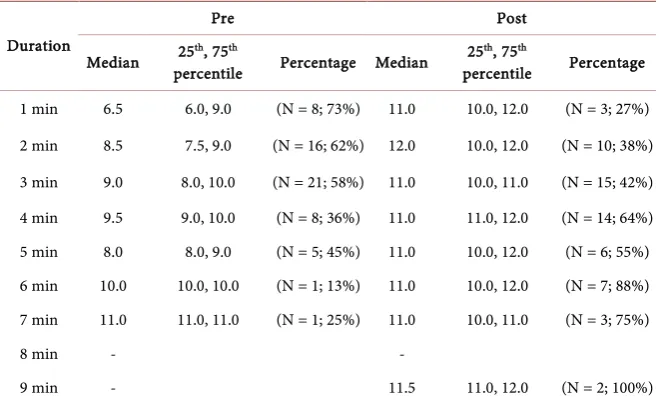
Duration of each handoff is the total time of both surgical and anesthesia staff reports rounded to a minute. Post-implementation, the median duration of handoff, is increased by one minute (Table 3). However, in comparison to the increase in the number of reported items with longer handoffs during the pre-implementation period, duration of the handoffs was independent of the number of reported items post-implementation (Table 4).
4. Discussion
Our results demonstrate that, in the setting studied, the use of a checklist im-proved the overall quantity of data transfer during PACU handoff. A checklist was introduced and implemented for two weeks. During the post-implementa- tion period, more items were reported in all intervals of “handoff duration” in comparison to pre-implementation period. Using a checklist to prevent omis-sion of patient information during handoff is important because miscommuni-cation from multiple care transfer has been shown to increase patient harm [2]
[3] [9] [10] [11] [12]. To mitigate these adverse events, a use of checklist in
[image:8.595.209.539.379.430.2]PACU has shown not only an increase in data transfer [23] [24] [25] [26] but also
Table 3. Summary of Handoff Duration (minute)a.
N Mean SD Median Min Max
Pre 60 2.9 1.3 3 1 7
Post 60 3.9 1.8 4 1 9
Overall duration of a handoff increased during the post-implementation period of the checklist. Pre: pre-implementation; Post: post-implementation; SD: standard deviation; Min: minimum; Max: maximum. aDuration included both surgical and anesthesia reports.
Table 4. Breakdown of handoff durationa,b.
Duration
Pre Post
Median percentile 25th, 75th Percentage Median percentile 25th, 75th Percentage
1 min 6.5 6.0, 9.0 (N = 8; 73%) 11.0 10.0, 12.0 (N = 3; 27%) 2 min 8.5 7.5, 9.0 (N = 16; 62%) 12.0 10.0, 12.0 (N = 10; 38%) 3 min 9.0 8.0, 10.0 (N = 21; 58%) 11.0 10.0, 11.0 (N = 15; 42%) 4 min 9.5 9.0, 10.0 (N = 8; 36%) 11.0 11.0, 12.0 (N = 14; 64%) 5 min 8.0 8.0, 9.0 (N = 5; 45%) 11.0 10.0, 12.0 (N = 6; 55%) 6 min 10.0 10.0, 10.0 (N = 1; 13%) 11.0 10.0, 12.0 (N = 7; 88%) 7 min 11.0 11.0, 11.0 (N = 1; 25%) 11.0 10.0, 11.0 (N = 3; 75%)
8 min - -
9 min - 11.5 11.0, 12.0 (N = 2; 100%)
[image:8.595.210.540.497.699.2]a decrease in medical errors [13] [14] [15]. Our study adds that a checklist re-minds the staff of defined standard of items to report in order to minimize in-formation omission during PACU handoff. Furthermore, the quantity of mini-mum data transferred during handoff is independent of the quality of the re-ports, which is more closely associated with complexity of patient history and not an objective of this study.
4.1. Quantity of Data Transfer
There are two important reasons for analyzing the data as composite values and department based values. First, PACU handoff is provided by both the surgical and anesthesia team at our institution. The median number of items reported by surgical staff stayed the same at a median of 6 items out of the total 12 during post-implementation period. This data indicates that the increase in overall provement in handoff during post-implementation can be attributed to im-provements in anesthesia reports without unintended observational influence on the quality of surgical staff reports. Quality of anesthesia reports as a standalone report is also important because collaborative report may not be a standard of practice at all institutions. In many institutions, only anesthesia gives report during PACU handoff. As an ideal standard, anesthesia staff should be able to adequately report surgical information in case anesthesia staff is the only infor-mant of intraoperative events.
Second, comparing composite and department based values helped us to identify items pertinent to either surgical or anesthesia staff during handoffs. Items related to surgical procedure improved the least in the anesthesia staff re-ports (i.e. PACU plans, Disposition-Expected Duration in PACU, Underlying diagnosis, and Procedure done) (Figure 3). Because compliance of reporting surgical information by anesthesia staff was lowest in a similar study, the data was used to recommend presence of surgical staff during handoffs [31]. Items relevant to the practice of anesthesia improved the most in anesthesia reports and composite value (i.e. Allergies, Anesthesia Technique, and Airway) (Figure 4). Considering that prior to implementation of a checklist, about half of the re-ports did not include these anesthesia specific information, a checklist reduced omission of at least the most relevant information.
4.2. Duration
Contradictory to our hypothesis that a checklist would reduce the duration of a handoff, we observed an overall increase in median time spent during a handoff. Previous studies have shown conflicting reports on the effect of handoff dura-tion after implementing a checklist [23] [25] [26] [31].
Figure 3. Analysis of the anesthesia reports showed least improvements with items related to surgical practice. Pre: pre-implementation; Post: post-implementation.
[image:10.595.85.514.447.703.2]improve incorporating a new checklist to practice [24] [25] [27] [32]. Second, we recommend multiple Plan-Do-Study-Act cycles24 and incorporating staff feed-back18 to design a checklist that better fits the context of each institution.
4.3. Limitations
Hawthorne effect is the influence of the presence of an observer on observed behavior. During pre-implementation phase, anesthesia staff was given limited details on what we were observing. We cannot overlook the influence of the presence of the two observers during all observed handoffs. It is likely that data transfer improved for our control group simply because of Hawthorne effect. For instance, we can assume that the observed handoffs were more comprehen-sive than the baseline handoffs before our study. It follows then, that the actual improvement in handoff is indeed better than we reported. We expect to find more pronounced improvement if our results were subject to the Hawthorne ef-fect.
Although prior studies have correlated adverse events with poor handoff [2] [3], direct comparison to patient outcome with a handoff checklist in a rando-mized trial is ideal but difficult to accomplish.33 Thus, deriving from previous studies, we assume that our improvement in data transfer will decrease adverse events and improve patient outcome. Secondly, although complexity of the pa-tient history may take longer to report, papa-tient population was not defined or re-stricted [33]. Patients may vary greatly in their phase of cancer treatment at our institution. Our data is based on the local context and exact results cannot be generalized for other institutions without further multicenter investigation [34]. Thirdly, creating definitive categories of medications or tools with the help of practicing anesthesiologists, observers were taught to convert qualitative data from observations to quantitative data during the pilot week. Despite the 100% consensus made between two observers after every handoff, we cannot neglect the human variables in information gathering.
5. Conclusion
In conclusion, implementation of a physical checklist for PACU handoff in-creased overall data transfer and prevented omission of patient information. Report duration did not have an impact on overall data transfer. For future di-rections, we recommend incorporating staff feedback into Plan-Do-Study-Act cycles for an improved checklist to ensure compliance and familiarize the staff with the use of a checklist through multimodal training modules.
Acknowledgements
1)The authors would like to thank the anesthesia staff at Memorial Sloan Ket-tering Cancer Center for complying with the intervention during the study period.
R25CA020449. The content is solely the responsibility of the authors and does not necessarily represent the official views of the National Institutes of Health. 3)This research was funded in part through the NIH/NCI Cancer Center
Sup-port Grant P30 CA00874.
4)Authors do not have conflicts of interest.
5)Preliminary data of this study was presented at the 14th Annual American
Medical Association Research Symposium on November 11, 2016.
References
[1] (2016) Root Causes by Event Type. In: Sentinel Event Data, The Joint Commission, 9.
[2] Saager, L., Hesler, B.D., You, J., et al. (2014) Intraoperative Transitions of Anesthe-sia Care and Postoperative Adverse Outcomes. Anesthesiology, 121, 695-706.
https://doi.org/10.1097/ALN.0000000000000401
[3] Hyder, J.A., Bohman, J.K., Kor, D.J., et al. (2016) Anesthesia Care Transitions and Risk of Postoperative Complications. Anesthesia & Analgesia, 122, 134-144.
https://doi.org/10.1213/ANE.0000000000000692
[4] Jeffcott, S.A., Evans, S.M., Cameron, P.A., Chin, G.S.M. and Ibrahim, J.E. (2009) Improving Measurement in Clinical Handover. Quality and Safety in Health Care, 18, 272-276. https://doi.org/10.1136/qshc.2007.024570
[5] Coiera, E. and Tombs, V. (1998) Communication Behaviours in a Hospital Setting: An Observational Study. BMJ: British Medical Journal, 316, 673-676.
https://doi.org/10.1136/bmj.316.7132.673
[6] Lane-Fall, M.B., Speck, R.M., Ibrahim, S.A., Shea, J.A., McCunn, M. and Bosk, C.L. (2014) Are Attendings Different? Intensivists Explain Their Handoff Ideals, Percep-tions, and Practices. Annals of the American Thoracic Society, 11, 360-366.
https://doi.org/10.1513/AnnalsATS.201306-151OC
[7] Flemming, D. and Hübner, U. (2013) How to Improve Change of Shift Handovers and Collaborative Grounding and What Role Does the Electronic Patient Record System Play? Results of a Systematic Literature Review. International Journal of Medical Informatics, 82, 580-592. https://doi.org/10.1016/j.ijmedinf.2013.03.004
[8] ASAHQ (2014) Anesthesiologists ASo. Standards for Postanesthesia Care. In: Stan-dards and Practice Parameters.
http://www.asahq.org/quality-and-practice-management/standards-and-guidelines/ [9] Greenberg, C.C., Regenbogen, S.E., Studdert, D.M., et al. (2007) Patterns of
Com-munication Breakdowns Resulting in Injury to Surgical Patients. Journal of the American College of Surgeons, 204, 533-540.
https://doi.org/10.1016/j.jamcollsurg.2007.01.010
[10] Kluger, M.T. and Bullock, M.F.M. (2002) Recovery Room Incidents: A Review of 419 Reports from the Anaesthetic Incident Monitoring Study (AIMS). Anaesthesia, 57, 1060-1066. https://doi.org/10.1046/j.1365-2044.2002.02865.x
[11] Kitch, B.T., Cooper, J.B., Zapol, W.M., et al. (2008) Handoffs Causing Patient Harm: A Survey of Medical and Surgical House Staff. TheJoint Commission Jour-nal on Quality and Patient Safety, 34, 563-570.
https://doi.org/10.1016/S1553-7250(08)34071-9
https://doi.org/10.1016/S1553-7250(11)37035-3
[13] Catchpole, K.R., De Leval, M.R., McEwan, A., et al. (2007) Patient Handover from Surgery to Intensive Care: Using Formula 1 Pit-Stop and Aviation Models to Im-prove Safety and Quality. Pediatric Anesthesia, 17, 470-478.
https://doi.org/10.1111/j.1460-9592.2006.02239.x
[14] Starmer, A.J., Spector, N.D., Srivastava, R., et al. (2014) Changes in Medical Errors after Implementation of a Handoff Program. TheNew England Journal of Medi-cine, 371, 1803-1812. https://doi.org/10.1056/NEJMsa1405556
[15] Bigham, M.T., Logsdon, T.R., Manicone, P.E., et al. (2014) Decreasing Handoff- Related Care Failures in Children’s Hospitals. Pediatrics, 134, e572-e579.
https://doi.org/10.1542/peds.2013-1844
[16] Mueller, S.K., Yoon, C. and Schnipper, J.L. (2016) Association of a Web-Based Handoff Tool with Rates of Medical Errors. JAMA Internal Medicine, 176, 1400- 1402. https://doi.org/10.1001/jamainternmed.2016.4258
[17] Segall, N., Bonifacio, A.S., Schroeder, R.A., Barbeito, A., et al. (2013) Can We Make Postoperative Patient Handovers Safer? A Systematic Review of the Literature. Sur-vey of Anesthesiology, 57, 40-41. https://doi.org/10.1097/01.sa.0000425544.99583.4b
[18] Siddiqui, N., Arzola, C., Iqbal, M., et al. (2012) Deficits in Information Transfer between Anaesthesiologist and Postanaesthesia Care Unit Staff: An Analysis of Pa-tient Handover. European Journal of Anaesthesiology, 29, 438-445.
https://doi.org/10.1097/EJA.0b013e3283543e43
[19] Eichenberger, A.-S., Haller, G., Cheseaux, N., Lechappe, V., Garnerin, P. and Wald-er, B. (2011) A Clinical Pathway in a Post-Anaesthesia Care Unit to Reduce Length of Stay, Mortality and Unplanned Intensive Care Unit Admission. European Jour-nal of Anaesthesiology, 28, 859-866.
[20] Smith, A.F., Pope, C., Goodwin, D. and Mort, M. (2008) Interprofessional Handov-er and Patient Safety in Anaesthesia: ObsHandov-ervational Study of HandovHandov-ers in the Re-covery Room. British Journal of Anaesthesia, 101, 332-337.
https://doi.org/10.1093/bja/aen168
[21] Joint Commission on Accreditation of Healthcare Organizations (2006) Joint Commission Announces 2006 National Patient Safety Goals. Nursing Economics, 24, 76.
[22] Haynes, A.B., Weiser, T.G., Berry, W.R., et al. (2009) A Surgical Safety Checklist to Reduce Morbidity and Mortality in a Global Population. TheNew England Journal of Medicine, 360, 491-499. https://doi.org/10.1056/NEJMsa0810119
[23] Potestio, C., Mottla, J., Kelley, E. and DeGroot, K. (2015) Improving Post Anesthe-sia Care Unit (PACU) Handoff by Implementing a Succinct Checklist. The Official Journal of the Anesthesia Patient Safety Foundation.
[24] Boat, A.C. and Spaeth, J.P. (2013) Handoff Checklists Improve the Reliability of Pa-tient Handoffs in the Operating Room and Postanesthesia Care Unit. Pediatric Anesthesia, 23, 647-654. https://doi.org/10.1111/pan.12199
[25] Caruso, T.J., Marquez, J.L., Wu, D.S., Shaffer, J.A., et al. (2015) Implementation of a Standardized Postanesthesia Care Handoff Increases Information Transfer without Increasing Handoff Duration. TheJoint Commission Journal on Quality and Pa-tient Safety, 41, 35-42. https://doi.org/10.1016/S1553-7250(15)41005-0
[26] Salzwedel, C., Bartz, H.-J., Kühnelt, I., et al. (2013) The Effect of a Checklist on the Quality of Post-Anaesthesia Patient Handover: A Randomized Controlled Trial. In-ternational Journal for Quality in Health Care, 25, 176-181.
[27] Starmer, A.J., Spector, N.D., Srivastava, R., et al. (2014) Changes in Medical Errors after Implementation of a Handoff Program. TheNew England Journal of Medi-cine, 371, 1803-1812. https://doi.org/10.1056/NEJMsa1405556
[28] Lin, D.M., Chase, C.J. and Merkel, M.J. (2014) Anesthesia Handovers: Why Are They So Complicated? ASA Monitor, 78, 24-27.
[29] (2015) Anesthesiologists ASo. Post-Anesthetic Transfer of Care: Use of Checklist or Protocol for Direct Transfer of Care from Procedure Room to Intensive Care Unit (ICU). American Society of Anesthesiologists.
[30] Arora, V. and Johnson, J. (2006) A Model for Building a Standardized Hand-Off Protocol. TheJoint Commission Journal on Quality and Patient Safety, 32, 646-655.
https://doi.org/10.1016/S1553-7250(06)32084-3
[31] Karakaya, A., Moerman, A.T., Peperstraete, H., François, K., Wouters, P.F. and de Hert, S.G. (2013) Implementation of a Structured Information Transfer Checklist Improves Postoperative Data Transfer after Congenital Cardiac Surgery. European Journal of Anaesthesiology, 30, 764-769.
https://doi.org/10.1097/EJA.0b013e328361d3bb
[32] Weinger, M.B., Slagle, J.M., Kuntz, A.H., et al. (2015) A Multimodal Intervention Improves Postanesthesia Care Unit Handovers. Anesthesia & Analgesia, 121, 957- 971. https://doi.org/10.1213/ANE.0000000000000670
[33] Horwitz, L.I. (2013) Does Improving Handoffs Reduce Medical Error Rates? JAMA, 310, 2255-2256. https://doi.org/10.1001/jama.2013.281827
[34] Møller, T.P., Madsen, M.D., Fuhrmann, L. and Østergaard, D. (2013) Postoperative Handover: Characteristics and Considerations on Improvement: A Systematic Re-view. European Journal of Anaesthesiology, 30, 229-242.
https://doi.org/10.1097/EJA.0b013e32835d8520
Abbreviation List
1)PACU: Post Anesthesia Care Unit
2)MSKCC: Memorial Sloan Kettering Cancer Center 3)EHR: Electronic Health Record
4)AIMS: Anesthetic Incident Monitoring Study 5)IRB: Institutional Review Board
6)CRNA: Certified Registered Nurse Anesthetist 7)MDD: Minimal Detectable Difference
Submit or recommend next manuscript to SCIRP and we will provide best service for you:
Accepting pre-submission inquiries through Email, Facebook, LinkedIn, Twitter, etc. A wide selection of journals (inclusive of 9 subjects, more than 200 journals)
Providing 24-hour high-quality service User-friendly online submission system Fair and swift peer-review system
Efficient typesetting and proofreading procedure
Display of the result of downloads and visits, as well as the number of cited articles Maximum dissemination of your research work
Submit your manuscript at: http://papersubmission.scirp.org/