Munich Personal RePEc Archive
Discount pricing
Armstrong, Mark and Chen, Yongmin
Department of Economics, University of Oxford
May 2012
Discount Pricing
Mark Armstrong
Department of Economics
University of Oxford
Yongmin Chen
Department of Economics
University of Colorado at Boulder
May 2012
Abstract
This paper investigatesdiscount pricing, the common marketing practice whereby a price is listed as a discount from an earlier, or regular, price. We discuss two reasons why a discounted price—as opposed to a merely low price—can make a rational consumer more willing to purchase the item. First, the information that the product was initially sold at a high price can indicate the product is high quality. Second, a discounted price can signal that the product is an unusual bargain, and there is little point searching for lower prices. We also discuss a behavioral model in which consumers have an intrinsic preference for paying a below-average price. Here, a seller has an incentive to o¤er di¤erent prices to identical consumers, so that a proportion of its consumers enjoy a bargain. We discuss in each framework when a seller has an incentive to o¤er false discounts, in which the reference price is exaggerated.
Keywords: Reference dependence, price discounts, sales tactics, false advertising.
1
Introduction
In his account of sales practices, Cialdini (2001, page 12) writes about
the Drubeck brothers, Sid and Harry, who owned a men’s tailor shop [...]
in the 1930s. Whenever Sid had a new customer trying on suits in front of the
shop’s three-sided mirror, he would admit to a hearing problem and repeatedly
request that the man speak more loudly to him. Once the customer had found
a suit he liked and asked for the price, Sid would call to his brother, the head tailor, at the back of the room, ‘Harry, how much for this suit?’ Looking up
from his work—and greatly exaggerating the suit’s true price—Harry would
call back, ‘For that beautiful, all wool suit, forty-two dollars.’ Pretending not
to have heard and cupping his hand to his ear, Sid would ask again. Once more
Harry would reply, ‘Forty-two dollars.’ At this point, Sid would turn to the
customer and report, ‘He says twenty-two dollars.’ Many a man would hurry
to buy the suit and scramble out of the shop with his [...] bargain before poor
Sid discovered the ‘mistake’.
As this anecdote suggests, consumers are more likely to buy an item if they perceive
it to be a bargain. This is easily understood when the consumer is given an accidental
discount, as occurs for instance if she sees that the product she wants has been given the
wrong price tag. If the product’s genuine price—which re‡ects its cost, quality and/or competitive environment—is $42, but by chance the consumer can get the product for
$22, this represents genuine value-for-money and will make the consumer more inclined to
purchase. This rational response to an accidental discount is exploited by the Drubecks’
fraudulent sales tactics.
What is more of a challenge is to explain why consumers might care about receiving a
deliberate discount from a seller, as opposed simply to obtaining a low price. For instance,
a consumer may be more likely to buy a jacket priced at $100 accompanied by a sign which
reads “50% of its previous price” than he/she would be if the price were merely stated as
$100. Alternatively, a retailer might claim its price was $100 even though the “manufac-turer’s recommended price” was $200. Despite its prevalence, this pricing practice—which
we term discount pricing—has apparently received little economic analysis. In the
litera-ture on sales (for instance, Lazear 1986), consumers care only about the price level, and
whether a low price is framed as a discount o¤ a higher price plays no role. In this paper,
we explore the economics of discount pricing, focussing on the potential information
con-tent of a discount and its strategic implications. Our analysis is developed in two models
that suggest di¤erent reasons why rational consumers care about discounts, as well as in
a third model with behavioural consumers.
First, in section 2, uninformed consumers rationally take a monopoly seller’s initial price as a signal of its choice of quality, and so are willing to pay more for the product when they
observe the initial price was high. The …rm sells its product to two groups of consumers,
one of which can accurately determine the product’s quality while the other group, the
casual buyers, cannot. The monopolist can price discriminate between the two consumer
groups using inter-temporal pricing, and the second group can use the price o¤ered to the
…rst group, when they observe it, as an indicator of quality. In this framework, it is more
can observe its initial price. Thus, the …rm’s ability to write “was $200, now $100”, if
credible, may induce it to provide a high-quality item.
In the second model, presented in section 3, the knowledge that a product is o¤ered at
a discounted price induces consumers to buy immediately rather than investigate a rival’s
price. Two …rms compete to sell to consumers, and either …rm o¤ers one of two prices: a full price or a sale price. (Price variation is generated by exogenous demand variation.)
When a product is o¤ered on sale, a consumer buys immediately even if that price is
relatively high, and so a consumer cares about whether a discount is o¤ered rather than
the level of the actual price. If a consumer is given no credible information about whether
the current price is discounted or not, she must judge how likely it is that the next price
will be higher, given the current price, and buy accordingly. This inability to …ne-tune her
search process can cause welfare losses.
In our third model, in section 4, consumers intrinsically care about getting a bargain.
Studies in behavioral economics (discussed shortly) have focused on how “reference prices”, which can sometimes be manipulated by a seller’s marketing activities, a¤ect purchase
decisions. In our model, a bargain is a price below the …rm’s average o¤ered price. If
consumers observe the …rm’s prices to all consumers, the …rm responds to the “demand
for bargains” by o¤ering distinct prices to otherwise identical consumers. If the demand
curve is concave, the …rm follows a simple “high-low” pricing strategy with just two prices,
a full price and a sale price. If instead consumers see only their own price, but hold
equilibrium beliefs about the average price, the …rm again has an incentive to pursue a
high-low policy, but one with lower prices relative to when consumers see the prices o¤ered
to all consumers. When its prices are secret, the …rm has a greater incentive to undercut its anticipated average price to some consumers, since others do not see this price cut and
cannot react to it.
If, for whatever reason, consumers care about getting a discount, a seller may have an
incentive to exploit this by making false claims about its previous or regular price. The
outcome when these deceptive marketing tactics are used depends on the “savviness” of
consumers. If consumers are aware that sellers are able to misrepresent their reference
price without penalty, they will simply regard such sale signs as pu¤ery and pay them no
attention. The result is that a potentially useful channel of information is absent. However,
if instead consumers are more gullible and believe a …rm’s false claims (when such claims are plausible), the outcome is worse, as these consumers may be induced to pay more for
The media regularly features stories in which a seller’s claimed discounts are alleged
to be …ctitious. For instance, a supermarket’s heavily advertised 15% average price
re-duction may have been preceded by an unadvertised gradual price rise cancelling out the
reduction. In Britain, a legal case involved the “O¢cers Club” chain of clothing stores,
where it was alleged that only a tiny share of sales were made at the regular price and the great majority of items were sold at “70% o¤” this supposed regular price.1 Several
jurisdictions have rules in place to combat false discounting.2 In the United States, the
Federal Trade Commission’s Guides Against Deceptive Pricing (para. 233.1) distinguishes
between genuine and …ctitious discounts. For instance, “where an arti…cial, in‡ated price
was established for the purpose of enabling the subsequent o¤er of a large reduction - the
‘bargain’ being advertised is a false one; the purchaser is not receiving the unusual value he
expects. In such a case, the ‘reduced’ price is, in reality, probably just the seller’s regular
price.”3
There are a number of earlier contributions which discuss issues related to our models. Our …rst model, where an initial price of a product signals its quality, builds on a large
literature which studies how (current) price can signal quality. For instance, Bagwell and
Riordan (1991) present a model where a …rm has private information about the exogenous
quality of its product. They …nd that high and declining prices signal high product quality:
the …rm distorts its price above the full-information level in order to signal high quality,
and, as more consumers become informed, there is less price distortion in later periods.
While their motivation is di¤erent from ours and their insights are derived mainly in a
setting where the …rm’s current price signals quality, they also consider an extension where
consumers can observe the …rm’s past price. In this case, the …rm’s prices may be more distorted in period 1 but less distorted in period 2, compared to when past price is not
observed, and they …nd that the high-quality …rm has an incentive to reveal past price
information to uninformed consumers. Thus, when a …rm makes sequential sales of a
product, the exogenous quality of which is the …rm’s private information, a policy that
1The England and Wales High Court (Chancery Division) found that the seller engaged in “misleading
advertising”. See details in the judgement of 26 May 2005 of Justice Etherton of the case between the O¢ce of Fair Trading and The O¢cers Club Ltd., www.bailii.org/ew/cases/EWHC/Ch/2005/1080.html. For instance, in paragraph 16 of this judgement, it states that between 1 September 2002 and 28 June 2003 only 0.15% of the total number of items sold in the chain of stores were at the “full price”. The judgement also discusses similar cases in other countries, such asColorado vs. May Department Stores in the United States (para. 59), andCommissioner of Competition vs. Sears Canada Inc. in Canada (para. 63).
2Some jurisdictions also have policies to prevent permanent sales by requiring all sales to occur on
stipulated dates. Thus the winter sales in Paris in 2012 had to take place between 11 January and 14 February.
bans false discounts would boost pro…t.
Muris (1991, section IIIC) and Rubin (2008, section III) discuss how the FTC has
ceased …ghting …ctitious pricing cases in recent years, in part because it was often rival
sellers—not consumers—who used the FTC’sGuidesto prevent a …rm’s heavy discounting,
and in part because of a perception that any focus on price was potentially pro-competitive. However, our second model in section 3 suggests that complaints by rivals about a …rm’s
false sales can have a procompetitive motive: false discounts discourage consumers from
investigating rival o¤ers and deprive the rivals of opportunity to compete e¤ectively. In
these settings, preventing false discounting can lead to more e¤ective competition.
Models and experiments from psychology and behavioral economics o¤er a number of
insights on the use of discount pricing.4 Thaler (1985) proposes a model of consumer
behaviour in which the context of a transaction matters to a consumer as well as the
transaction itself. One implication of this theory is that …rms can pro…t from a high
“suggested retail price”, which serves as a reference price, and a lower selling price may then provide consumers with a “transaction utility”. Bordalo, Gennaioli and Shleifer (2012)
develop a model of salience in consumer decision making, which they use to explain a
number of perplexing phenomena. Their analysis suggests that, by raising consumers’
valuation of quality through salience, …rms can bene…t from “misleading sales”—arti…cially
in‡ating the regular price and simultaneously o¤ering a generous discount. Jahedi (2011)
experimentally investigates a kind of “bargain” which we do not study in this paper, where
a seller o¤ers two units of its product for little more than the price of one unit. He shows
how consumers are less likely to buy two units when faced with the choice from {buy
nothing, buy two units for $1} than they are when faced with the larger choice set {buy nothing, buy one unit for $0.97, buy two units for $1}. Jahedi designs the experiments
so that subjects know that prices have no signaling role (such as the signaling roles we
analyze in our …rst two models), and deduces that his subjects have an intrinsic “taste for
bargains”.
Our third model is a model with consumer reference dependence, where consumers also
have a taste for bargains. Spiegler (2011a, section 9.4.2) brie‡y outlines a related model,
although his construction perhaps uses implausibly high prices (higher than any consumer’s
raw valuation for the product). Most existing models of consumer reference dependence
4Experimental evidence that consumers are in‡uenced by false sales is discussed by Urbany, Bearden
focus instead on loss-aversion, where a consumer’s propensity to buy falls when o¤ered a
price above her reference point. See Heidhues and K½oszegi (2005), Spiegler (2011b), Puppe
and Rosenkranz (2011) and Zhou (2011) for models involving consumer loss aversion. Much
of this literature …nds that loss aversion makes a …rm’s prices more rigid, for instance in
response to cost variation, than would be the case in a “standard” model. By contrast, when consumers are bargain-loving, we show that a …rm ismore inclined to vary its prices
than otherwise.
2
Initial Price as Signal of Product Quality
In this section we modify a standard static model of quality choice so that the …rm sells
over time.5 Speci…cally, a monopolist supplies a product over two periods, with its price
in period t = 1;2 denoted pt, and chooses its quality ex ante which is then …xed for the
two periods. The …rm can choose one of two quality levels, L and H, and it has constant unit costci if it chooses qualityi=L; H. All consumers have unit demand. For simplicity,
suppose the …rm aims to maximize the sum of pro…ts in the two periods.
A fraction of consumers are keen and particularly interested in the product: they
can discern the product’s quality, and they are impatient and wish to buy only in period
1. Their valuation isvi for the product when its quality is i=L; H. The remaining 1
consumers are casual buyers: they cannot directly observe quality and buy for simplicity
only in period 2. (Little of substance in the analysis would be a¤ected if some casual
buyers also purchased in the …rst period.) Their valuation for the product is vi when
quality is i= L; H, where the parameter 0 < 1 re‡ects the plausible situation where casual buyers have a lower willingness-to-pay for the item. To avoid discussing sub-cases
involving non-supply, we assume that
vL > cH (1)
so that the high-quality product can pro…tably be sold even to casual buyers who think
quality is low. We also assume that providing the high-quality product is socially e¢cient,
so that
[ + (1 ) ] v > c ; (2)
where v vH vL and c cH cL.
5This static model is taken from Tirole (1988, section 2.3.1.1), which itself incorporates elements from
We study market equilibrium under alternative information assumptions. A consumer
buys the item if the price is no higher than her willingness-to-pay, which depends on
observed (if the consumer is keen) or anticipated (if casual) product quality. The …rm’s
strategy consists of its choice of quality and its two prices. In equilibrium the …rm’s
strategy is optimal given consumer buying behaviour, while the expectations of product quality by casual buyers, which may depend on observed prices, are consistent with the
…rm’s strategy.
Consider …rst the case where the casual buyers do not observe the …rm’s initial price.
A casual buyer’s anticipated quality might depend on the period-2 price. However, all that
matters for the …rm is the maximum price, say P, which induces a casual buyer to buy the product. (If the …rm is going to sell to casual buyers it should set the highest possible
price, regardless of its chosen quality.) Clearly, we have vL P vH, since the value
of the item to the casual buyers is known to lie between these extremes. From (1), it is
pro…table to sell to these casual buyers, regardless of their beliefs about quality. Thus, given P, the …rm’s pro…t if it chooses to supply the high-quality product is
(vH cH) + (1 )(P cH) ;
while its pro…t if it supplies the low-quality product is
(vL cL) + (1 )(P cL) :
Comparing these two pro…ts, we see that if
> c
v
; (3)
the unique equilibrium is for the …rm to provide a high-quality product, and the …rm’s
prices fully extract consumer surplus so thatp1 =vH and p2 = vH. Thus, if the fraction
of informed buyers is large enough, the …rm makes more pro…t by serving these buyers
with their preferred product than by supplying a low-cost product to all consumers. By
contrast, if < c= v the unique equilibrium is to provide a low-quality product, and
prices are p1 =vL and p2 = vL. We summarize this discussion as:
Lemma 1 Suppose that casual buyers cannot observe the …rm’s initial price. If the
frac-tion of keen buyers is large enough that (3) is satis…ed, the unique rafrac-tional expectafrac-tions
equilibrium is for the …rm to supply a high-quality product, and to choose prices which fully
extract consumer surplus (i.e., p1 =vH; p2 = vH). If the fraction of keen buyers is small
…rm to supply a low-quality product, and to choose prices which fully extract consumer
surplus (i.e., p1 =vL; p2 = vL).
Consider next the case where casual buyers do observe the initial price. For instance,
they see a price label which truthfully states “was $200, now $100”. A similar argument
to that used for Lemma 1 establishes that when (3) holds, providing high quality is the
unique equilibrium. But now, even if (3) fails, high quality can be supported in equilibrium.
Speci…cally, suppose the …rm chooses a particular initial price p1 such that vL < p1 vH.
Suppose given p1 that the maximum price which induces the casual buyers to buy is P,
where as beforeP lies in the range vL P vH. Then the …rm’s pro…t if it supplies a
high-quality product is
(p1 cH) + (1 )(P cH);
while its pro…t if it provides a low-quality product is
(1 )(P cL):
(For this last expression, note that the …rm does not sell to the informed buyers since
vL < p1.) Thus, supplying a high-quality product is more pro…table if
(p1 cL)> c : (4)
In particular, we see that a higher initial price makes it more likely that o¤ering a
high-quality product is pro…table, and in this sense a high initial price acts as a signal to casual
buyers that quality is high. The reason is that a high initial price makes deviating to low
quality more costly for the …rm: if it deviates to low quality, it must forego serving the keen
(informed) buyers and serving these buyers is more pro…table with a higher initial price.
Settingp1 =vH in (4) implies that …rst-best pro…t—where the …rm supplies a high-quality
product and chooses pricesp1 =vH and p2 = vH— is feasible if (vH cL)> c, i.e., if
> c
v+ [vL cL]
: (5)
If this condition does not hold, there isno initial price which could convince casual buyers
that quality is high. In this case the …rm supplies a low-quality item and fully extracts the
resulting consumer surplus.
Since condition (5) is less stringent than (3), we deduce that e¢cient quality provision
this multiplicity of equilibrium is due to the arbitrariness of beliefs o¤ the equilibrium
path. For clear-cut statements in the rest of this section, we assume that beliefs o¤ the
equilibrium path satisfy the “forward induction” re…nement: when seeing a price o¤ the
equilibrium path, casual buyers reason what quality the …rm could have rationally chosen
given this price; if it is always optimal for the …rm to choose q, then their belief is that quality is q. Then, when (5) holds, high quality is the unique equilibrium.6
We summarize this discussion as:
Lemma 2 Suppose that casual buyers can observe the …rm’s initial price. If the fraction of
keen buyers is large enough that (5) is satis…ed, the unique rational expectations equilibrium
is for the …rm to supply a high-quality product, and to choose prices which fully extract
consumer surplus (i.e., p1 =vH; p2 = vH). If the fraction of keen buyers is small enough
that (5) is strictly violated, the unique rational expectations equilibrium is for the …rm to
supply a low-quality product, and to choose prices which fully extract consumer surplus
(i.e., p1 =vL; p2 = vL).
If the …rm can credibly reveal its initial price to casual buyers, then when the fraction
of keen buyers lies in the range
c
v+ [vL cL]
< < c
v
(6)
the …rm will wish to do so. (When the fraction lies outside this range, communicating
its initial price to casual buyers has no impact, as anticipated quality cannot be a¤ected
by the …rm’s initial choice of price.) Welfare—which equals pro…t in this setting with full
extraction of consumer surplus—also rises in this case.
We summarize the discussion as:
Proposition 1 Relative to a setting where casual buyers cannot observe the initial price,
if the …rm can credibly communicate the initial price to casual buyers, this weakly (strictly
if condition (6) holds) increases product quality, pro…t and welfare.
Now consider the scenario in which the …rm is able to make any claim—true or false—
about its initial price. If casual buyers are aware that the …rm can make false claims about
its discount without penalty, they will “discount the discount” and behave just as if they
6At the potential low-quality equilibrium (withp
1 =vL and p2 = vL), consider a deviation to high
quality withp1=vH andp2= vH. Since withp1=vH it is always optimal for the …rm to choose quality
do not observe the initial price. When the fraction of keen buyers lies in the range (6),
a policy which prevents …rms making false claims about discounts will induce the …rm to
switch from o¤ering a low-quality to a high-quality product, which will boost pro…t and
welfare. The policy opens up a useful channel of information to otherwise uninformed
buyers. In particular, if the casual buyers are savvy in this manner, the …rm will welcome
a policy which forbids it from making …ctitious discount claims.
However, casual buyers might instead be “gullible” and believe the …rm’s claims about
its initial price when such claims are plausible. For instance, they might mistakenly think
that e¤ective consumer policy is already in place to prevent misleading price claims.7 If the
fraction of keen consumers lies in the range (6), then faced with these more gullible casual
buyers the …rm would not switch to o¤ering a high-quality product. Instead, the …rm would
produce a low-quality product, actually o¤er the initial price p1 =vL to the keen buyers,
but claim to casual buyers that its initial price wasp1 =vH, who can therefore be charged
price p2 = vH. The outcome is poor for casual buyers, who su¤er negative consumer
surplus. Thus, in the case with gullible consumers a policy which prevents misleading
claims about initial prices not only ensures e¢cient quality choice (as was the case with
savvy consumers), but now improves consumer welfare and reduces pro…t.
The idea that consumers care about a seller’s initial price because it signals product
quality can be applied to other settings. Consider, for instance, the following variant of
Lazear’s (1986) model of clearance sales. Suppose that the …rm has only one unit of a
product to sell, and that the quality of its product, denoted v, is exogenous, uncertain, and initially unobserved even by the …rm itself.8 In the …rst period, a keen consumer who
observesv considers buying the product, and will buy if the initial pricep1 is belowv. If he
chooses not to buy the product, a casual consumer in the second period considers whether
to buy. The casual buyer does not directly observe v, and bases her purchase decision on the expected value of v, conditional on the item not having sold in the …rst period. In this setting, total supply is limited, and when the casual buyer sees the item on sale in period 2,
she knows that demand from the keen buyer was low. This causes her to lower her estimate
of quality. But the information content of the event that the item ends up on sale is less
when the initial price was high, as fewer informed consumers would have been willing to
buy at a higher price. That is, expected quality, conditional on the item remaining unsold,
7In an environment where casual buyers do not observe initial prices, there is no di¤erence between
“savvy” and “gullible” consumers, and both make rational inferences about a …rm’s choice of quality.
8In the fashion context, for example, v might represent whether or not the product’s colour or cut is
is higher when the initial price was higher.9 Hence, initial price again acts as a signal
of quality, albeit for a reason very di¤erent to that in our endogenous quality model. It
can be shown, however, that in this setting …rm pro…t is lower, and consumer surplus is
higher, when the initial price isnot observed. (We will obtain a similar result in our model
presented in section 4.)
3
Discounts as a Signal to Buy Immediately
A second reason why consumers like a discounted price is because this may signal the
price is unusually low, and they would do well to take advantage of it. This signal could
potentially operate in two dimensions. In a monopoly context where the …rm sets di¤erent
prices over time, a discounted rather than full price might indicate the price is likely
to go up, and the consumer should buy immediately rather than wait for a lower price.
Alternatively, in a static oligopoly search context, a discounted price from one seller could indicate that rival prices are likely to be no lower, and there is little reason to investigate
other sellers when search is costly. In this section we explore the latter possibility. (The
dynamic monopoly model can be analyzed in a very similar manner.)
Before describing the analysis in detail, we point out that to investigate the question at
hand we need a framework which is more complicated than standard models of search. As
usual, we require a framework with price dispersion so that consumers sometimes have an
incentive to search for a lower price. However, in order to discuss the impact of discounted
prices, as opposed to merely low prices, we need the pattern of price dispersion itself to
be uncertain from the consumer’s point of view. For instance, if the consumer knew the potential prices were pL and pH, then if she …rst encounters pL she knows the other price
is either pL or pH and so does not bene…t from additional information about whether the
price is discounted.
In more detail, suppose two …rms compete to sell a homogeneous product to consumers.
The two …rms sell repeatedly over time, although all consumers are short-lived and can
buy only in their own period. A …rm’s price is either pL or pH > pL in each period with
the probability of the latter being , and price is independently realized in each period and
across …rms. We refer topLas the “sale” (or discounted) price andpH as the “regular” (or
full) price. The market parameters (pL; pH; ) are unchanging over time. Thus the regular
and the sale prices are the same for both …rms, although with probability 2 (1 ) one
9In Lazear’s model, the second consumer is also well informed aboutv, and so does not care about the
…rm runs a sale while its rival does not. For now we take the process of price determination
to be exogenous. (The model will be “closed” in a particular way shortly.)
Suppose there are a number of “searchers” who are imperfectly informed about market
prices. Speci…cally, they can travel to their local …rm for free and see its price and, if
desired, buy immediately from that …rm (with an equal proportion of consumers local to each …rm), but they need to incur a cost s1 to travel to the second, to them more remote,
…rm and discover its price. Suppose a consumer can return to buy from her local …rm after
investigating the remote …rm by incurring the further search cost s2. Suppose prices are
such that these searchers will always wish to buy the product from one …rm or the other.
The ideal search rule for such a consumer, given known tari¤ parameters (pL; pH; ), is
simple. If the consumer knows the local price is the sale price she will buy immediately, as
the rival’s price cannot be lower. If the consumer knows the local price is the full price, she
may decide to investigate the rival’s price in case it turns out to be discounted. If her local
…rm o¤ers pH, the risk-neutral consumer has an incentive to investigate the remote …rm
wheneverpH s1+ pH+ (1 )pL, i.e., when the expected sale discount (1 )(pH pL)
satis…es
(1 )(pH pL) s1 : (7)
If the local price is the full price, the consumer will nevertheless buy locally if (7) does not
hold, as it is not worth incurring the search cost to obtain the small expected discount at
the rival. A consumer will never return to buy from her local …rm after travelling to the remote …rm. This ideal stopping rule depends on whether the local product is o¤ered on
sale, and on the size and frequency of the sale discount, but not on price levels.
Now suppose a consumer is initially o¤ered price p from her local …rm, without any credible information about whether this price is discounted. She must then decide whether
to buy immediately purely on the basis of the price level. Moreover, a consumer might
sometimes return to buy locally after travelling to the remote …rm, thus incurring a double
search cost s1 +s2. Suppose that tari¤ parameters (pL; pH; ) are uncertain from the
viewpoint of the consumer. A consumer conditions the distribution of rival’s price p~on the local …rm’s pricep, and a consumer who sees local pricep will buy immediately if and only if
p s1 +E[minfp; p~ +s2g jp] : (8)
Here, the right-hand side is the expected expense involved if the consumer travels to the
remote …rm: the search costs1 is sunk, but then the consumer has the ability to buy from
account). The search rule in (8) will in general be ine¢cient compared to the search rule
when the consumer knows when the local price is the discounted price, and so we expect
that credible information about discounts will bene…t consumers.
To investigate in more detail, we specialize and close the model in the following manner.
Here, the …rms’ price variation is generated by local demand shifts.10 Speci…cally, suppose
in each period there are also a number of “inert” consumers can buy only from their local
…rm (to which they can travel costlessly). These consumers have unit demand, and their
valuation for the unit can take one of three values: VL; VM orVH, where0< VL < VM < VH.
The market operates in one of two states. In the …rst state, the possible valuations are
fVL; VMg, and in any period and for either …rm these two demand realizations are equally
likely. In the other state, the possible valuations arefVM; VHgand again these two demand
realizations are equally likely. Each market statefVL; VMgorfVM; VHgis realized ex ante
with equal probability. A …rm knows which market state is realized, but in a given period
does not observe its rival’s local demand realization. Suppose each …rm’s production is costless.
The searchers are willing to pay up to VH for a single unit and their search costs are
s1 = s2 = s, where 0 < s < VH VM. (The condition s < VH VM will ensure that the
consumer will return to buy locally if she discovers the remote price is higher.) The key
feature of this set-up is that when a searcher knows that local demand is VM, she does
not know if the market state is fVL; VMg or fVM; VHg. We will derive an equilibrium in
which each …rm sets its price to fully extract surplus from their inert consumers, i.e., a
…rm choosesp=Vi when its realized local demand isVi. Intuitively, this pricing behaviour
is an equilibrium whenever the proportion of searchers is small enough, as then a …rm’s incentive to extract surplus from the inert consumers dominates the incentive to keep the
searchers from investigating the rival …rm.
For now, take as given this pricing rule by …rms. What is the optimal search rule for
the searchers? From (8), and given s < VH VM, a consumer has an incentive to travel to
the remote …rm when the local price is p=VM (and then to travel back to the local …rm
if the remote price turns out to bep=VH) if and only if
s 1
5(VM VL) : (9)
A consumer has an incentive to travel to the remote …rm when the local price is p=VH if
10There are other ways to close the model. For instance, we might have inert consumers with a constant
and only if
s 1
2(VH VM) : (10)
(Of course, a consumer will buy immediately if she is o¤ered the lowest price VL.) A
complicating factor is that this search rule may not be monotonic; that is, a consumer
might search on when she sees the intermediate price p = VM but not if she sees the
highest price p =VH. The reason is that in the latter case, the consumer knows that the
low price p =VL is not a possibility, and it might be that this chance of the low price is
what drives search incentives when p= VM. This possibility is ruled out if condition (9)
implies condition (10), i.e., if 1
2(VH VM) 1
5(VM VL). In particular, if the search cost
is small enough that
s < 1
5(VM VL) 1
2(VH VM) ; (11)
the optimal search rule is to buy immediately if the local price isp=VL and otherwise to
travel to the remote …rm. (If the local price is p=VM and the remote price isp=VH, the
consumer will then return to buy locally.) Of course, this search rule is ine¢cient, as when
the market state is fVM; VHg and the consumer is …rst o¤ered pricep=VM, she travels to
the remote …rm even though the price cannot be lower there. Nevertheless, the consumer
always buys the product at the cheapest price available.
The following result describes market equilibrium when consumers do not know whether
their local price is discounted or not:
Lemma 3 Suppose parameters satisfy (11). Provided the proportion of searchers in the
consumer population is su¢ciently small, the following strategies make up an equilibrium
when searchers have no credible information about whether the local price is discounted:
(i) each …rm sets its price to extract surplus fully from their inert consumers, i.e., a …rm
chooses p =Vi when its realized local demand is Vi, and (ii) searchers buy immediately if
the local price satis…es p VL and otherwise they travel to the remote …rm.
Proof. We have already shown that this search rule is optimal given the claimed price
choice by …rms. To see that …rms optimally price in the stated way given this consumer
search rule whenever the proportion of searchers is su¢ciently small, argue as follows.
Suppose the number of inert consumers isN and the number of searchers isn. Suppose for instance that the market state is(VL; VM)and a …rm’s demand realization isVM. If the …rm
follows the stated strategy and sets pricep=VM, its expected pro…t isVM(12N+ 1
4n)since
its 1
2N inert consumers will buy and the 1
2n searchers local to the rival …rm will buy from
it if the rival price is alsoVM, which occurs with probability 1
will never buy from it.) If the …rm deviates to pricep=VL, its pro…t isVL( 1 2N+
3
4n), since
now the …rm’s local searchers will buy from it as well. The latter pro…t is below the former
when n
n+N is small. Another potentially pro…table deviation is to set price p = VM s,
which will induce all searchers to buy from it in the event the rival price isp=VM, and so
generates pro…t(VM s)( 1 2N+
1
2n). This is belowVM( 1 2N+
1
4n)whenever the proportion
of searchers satis…es n n+N <
2s
VM. Similar arguments apply in other situations.
Note that if searchers could observe whether a …rm’s price was discounted or not, the
equilibrium outcome would be that a searcher buys immediately if and only if the local
price was discounted, and …rms continue to set prices to re‡ect local demand conditions.11
Thus, a simplifying feature of this particular framework is that equilibrium prices are not
a¤ected by policy towards misleading pricing.
Suppose the market initially operates in a regime where nothing except the current
price is revealed to consumers. When does a …rm have an incentive to reveal more details about its pricing policy? The …rm’s aim is simple: regardless of its current price state, it
wishes to deter its local consumers from travelling to the remote …rm. Suppose …rst that a
…rm can only make truthful claims about its prices. When the market state isfVM; VHg, a
…rm will announce that its price is discounted whenp=VM, as this will induce searchers to
buy immediately (while otherwise they would have travelled to the other …rm). Consumers
are better o¤ if they know when the local price is discounted, as this helps to re…ne their
search strategy.
However, a …rm has an incentive to mislead consumers, and falsely to claim its regular
price is discounted. If …rms are free to do so without penalty, savvy consumers will treat any claimed discount as cheap talk—they recognize that a …rm will claim a price p=VM
is discounted, regardless of whether the market state isfVL; VMg orfVM; VHg—and so the
outcome is as if consumers do not know whether or not the good is on sale. If instead
consumers are more gullible, they believe a …rm’s false claims whenever such claims are
possible. In this framework, this implies that when the market state is fVL; VMg and a
seller’s price is p = VM, the …rm can claim its price is discounted (i.e., that the market
state is fVM; VHg) and induce gullible consumers to buy immediately. (However, these
consumers are not so gullible that they believe a …rm’s claim that its price p = VH was
discounted.)
Expected expenditure from the searchers in the various regimes can be calculated as
11Condition (11) implies that a consumer will travel to the remote …rm if the o¤ered pricep=V
follows. In the regime where searchers do not know when a price is discounted, a searcher’s
expected outlay (including search costs where incurred) is12
3 8VL+
1 2VM +
1 8VH +
7
8s : (12)
Likewise, when a searcher knows when a price is discounted, her expected outlay is
3 8VL+
1 2VM +
1 8VH +
1
2s (13)
since she searches less often (although she makes exactly the same purchase decision).
Finally, if the consumer is more gullible and always believes the pricep=VM is discounted,
her outlay is
1 4VL+
5 8VM +
1 8VH +
1
4s : (14)
Here, relative to the other regimes, the consumer searches too little and ends up with a
more expensive product on average.
In sum, in this stylized framework a policy which prevents …rms from making misleading
claims about discounts is good for consumers. With such a policy, a …rm will always reveal
when its price is discounted, and this enables consumers to improve their search strategy.
Absent the policy, a …rm will always claim its product is on sale, and consumers will be
worse o¤: savvy consumers will disregard the permanent sale signs and search in ignorance
of whether the local price is discounted or not; more gullible consumers will fall victim to
the sale signs and too rarely search for a lower price. Industry pro…ts are not a¤ected by policy when consumers are savvy, as consumers make exactly the same purchase decisions
in either regime. However, if consumers are more gullible, policy which prevents misleading
price claims will reduce pro…ts, as consumers are more likely to search for a better deal.
In general, the impact of policy on welfare depends on the underlying process of price
determination, i.e., on whether pro…t margins are higher or lower when price is high or
low. However, the impact is easy to understand in this framework where unit costs do
not vary, since the prices paid by consumers are merely a transfer to …rms and have no
impact on welfare. Welfare is then inversely related to how much search occurs in the
various regimes. By inspecting expressions (12)–(14), we see that welfare is highest when consumers are gullible and …rms mislead them with false sales, for then search is rare. If
instead consumers are savvy and disregard false sale signs, then policy to prevent misleading
12For instance, in this regime a consumer will pay the lowest priceV
Lwhen the market state isfVL; VMg and at least one of the two …rms has pricep=VL, which together occur with probability 3
8. The consumer
makes a costly trip with probability 7
sales signs reduces the intensity of search and so boosts welfare. In sum, while the impact
of policy on consumers alone is clear-cut in this model, the impact on overall welfare is
more complex and depends on the presumed gullibility of consumers.
We summarize this discussion as:
Proposition 2 In the oligopoly search setting, when …rms provide accurate information
about when their price is discounted this bene…ts consumers relative to the situation where
no such information is available. Consumers buy immediately when they see a discounted
price. A policy which prevents …rms from falsely claiming discounts will bene…t consumers
regardless of whether or not consumers believe false sales signs. The impact on welfare depends on whether consumers are gullible or savvy.
4
Selling to Bargain-Loving Consumers
In our …nal model of discount pricing, we suppose that consumers intrinsically like the idea
of getting a bargain. Thus, unlike models in sections 2 and 3, here we do not derive why
it is that consumers care about receiving a discount, but simply take this as given. The
model here, then, is a behavioural model with reference dependence. Unlike recent papers
in industrial organization which focus on loss-aversion, we take the less familiar route of supposing consumers also enjoy a bene…t if they pay a price below the reference price. In
our model, the reference price is simply the average price o¤ered by the …rm.13
Suppose that a monopolist sells to a unit mass of consumers with constant marginal cost
c, and chooses its price according to a mixed strategy with c.d.f. G(p)which has expected valuep. (The …rm o¤ering a deterministic price as a special case of this framework.) Note that a given consumer is o¤ered a single price, and cannot search for additional prices. To
be concrete, we might imagine that the …rm makes its price contingent on some arbitrary
aspect of the consumer (e.g., location) which cannot easily be altered, and so pricing is not strictly random. Suppose a consumer’s “raw” valuation for the item is v, which has smooth distribution function F(v). If the consumer is given a “rip-o¤” price p p then she buys if v R(p p) p, where R 0 is a parameter which re‡ects her aversion
13An important ingredient of any model with reference dependence is how the reference point is
to paying above-average prices. If the consumer gets a bargain price p p then she buys if v + B(p p) p, where B 0 is a parameter which re‡ects her enjoyment of the
bargain.
Consider to start with the case where consumers are accurately informed about the
…rm’s price policy (in particular, they know the average pricep, which, together with their own price, is what they care about). First, we show that it is always pro…table for the
monopolist to o¤er dispersed prices in this context, provided that consumers care more
about getting a bargain than they do about avoiding a rip-o¤:
Lemma 4 When consumers can observe the …rms price policy, the …rm prefers to o¤er
dispersed prices than a uniform price when
B > R (15)
Proof. Letp > crepresent any pro…table uniform price (not necessarily the most pro…table uniform price). Suppose the …rm deviates from this uniform price by o¤ering two prices,
pL =p " and pH =p+" where " >0, where each price is o¤ered to half the consumer
population. (This modi…ed strategy leaves the average price unchanged at p.) The …rm’s pro…t with this new strategy is
(") 1
2(p+" c)(1 F(p+ [1 + R]")) + 1
2(p " c)(1 F(p [1 + B]")):
Di¤erentiating this expression with respect to " shows that
0(0) = 1
2(p c)f(p)[ B R]>0 ;
wheref( )is the density associated with F( ). Thus, starting from any pro…table uniform price, pro…t is increased by implementing a mean-preserving spread in its prices.
The intuition for this result is clear. Relative to a uniform price strategy, adding
a small amount of noise to prices reduces demand from those consumers o¤ered
above-average prices and boosts demand from those who get a bargain, and given (15) the latter
e¤ect dominates. We deduce that the …rm has an incentive to o¤er at least two prices when
consumers are more bargain-loving than loss-averse. Clearly, if only a fraction of consumers had these preferences (while the rest were “rational” and cared only about their own price),
the …rm would still have an incentive to pursue this dispersed pricing policy. If instead
consumers were more loss-averse than bargain-loving, so B < R, then the …rm has no
gives the …rm an incentive to o¤er distinct prices to otherwise identical consumers: in order
to satisfy a “demand for bargains”, the …rm creates bargains by arti…cially dispersing its
prices.
If we assume that the demand curve 1 F is weakly concave, one can show that the …rm will use only two prices in its optimal pricing policy. In order to derive this optimal policy, we suppose that the …rm is restricted to o¤er prices which are sometimes accepted
by consumers. (Or equivalently, that consumers ignore any price which is so high that
demand at that price is zero when they calculate the average price.) Let vmax be the
maximum valuation in the support of v. (Since the demand curve is concave, we know there is such a valuation.) Stated precisely, the …rm is restricted to choose a price policy
such that
pmax+ R(pmax p) vmax ; (16)
where pmax is the …rm’s maximum o¤ered price and p is its expected o¤ered price. This
assumption rules out a strategy in which the …rm o¤ers arbitrarily high prices to a tiny
fraction of consumers, which are not accepted, which would then make p arbitrarily large without signi…cant cost to the …rm.14
Lemma 5 Suppose consumers have a preference for bargains in the sense that (15) holds
and can observe the …rm’s price policy. If demand1 F(v) is weakly concave and the …rm chooses prices which satisfy (16), the …rm wishes to use exactly two prices in its pricing
scheme.
Proof. To avoid technicalities, suppose the …rm o¤ers a …nite number of distinct prices
(at least two in number), where price pi is o¤ered to a fraction i > 0 of consumers and
average price is p=Pi ipi. Clearly, at least one price is strictly above the mean and one
price is strictly below the mean.
Note …rst that it cannot be optimal for the …rm to set any price below cost. (If some
prices were below c, then pro…t is strictly increased by adjusting such prices to equal c: this adjustment increases p and so boosts demand from all consumers with pi c, and it
clearly increases pro…t from these hitherto loss-making consumers.) So suppose that all
prices satisfy pi c.
Next, we claim that the …rm optimally o¤ers only one price which is strictly above the
mean. (The following argument is essentially an instance of Jensen’s Inequality.) Suppose,
14A more satisfying solution to this problem would be for consumers to construct the “average price” in
to the contrary, there are at least two distinct prices, say p1 and p2, where p1 > p2 > p.
Suppose we reduce p1 by" >0 and increasep2 by 1
2", where " is small enough that both
prices remain abovepand that (16) continues to hold. By construction, the average pricep
is not a¤ected by this change, and so the pro…ts obtained from all other pricespi 2 f= p1; p2g
are una¤ected. If we write (") for the …rm’s expected pro…ts as a function of ", then
0(0)sign= [F(p
1+ R(p1 p)) F(p2+ R(p2 p))]
+(1 + R) [(p1 c)f(p1+ R(p1 p)) (p2 c)f(p2+ R(p2 p))] :
This expression is strictly positive: the …rst term[:]is strictly positive sinceF(:)is strictly increasing over this range, and the second term [:]is strictly positive from the assumption that 1 F is weakly concave. We deduce that the original prices cannot be optimal, and so the …rm chooses exactly one price above the average price in its optimal policy.
A similar argument shows that the …rm’s optimal policy also involves a single price which is weakly below the mean.
At least with concave demand, we deduce that the …rm uses exactly two prices and so
pursues a “high-low” price policy. It is then a simple matter to derive the …rm’s optimal
price policy. If the …rm o¤ers the full pricepH with probability and the discounted price
pL< pH with probability1 , its pro…t is
(1 )(pL c)[1 F(pL B (pH pL))]+ (pH c)[1 F(pH+ R(1 )(pH pL))]: (17)
Consider the example where v is uniform on [0;1], c = 0 and R = 0. Here, the most
pro…table uniform price is p = 1
2. One can check from (17) that the optimal pricing
strategy is
pH =
p
B+ 1 + 3
8 B
; pL =
pH
p
B+ 1
; =
p
B+ 1 1 B
: (18)
This policy satis…es pH > p = 1
2 > pL, so that the high price is above, and the low
price is below, the optimal uniform price p = 1
2. This solution requires B to lie in the
range 0 < B < 3 to satisfy (16). The policy converges to the optimal uniform price as
B becomes small. When B = 1 the approximately optimal policy involves pL = 0:44
and pH = 0:63, and the full price is o¤ered to 41% of consumers. Note that the average
price here (p 0:52) is higher than it would be if the …rm charged a uniform price (for instance, because consumers did not exhibit reference dependence, so B = 0).15 The
15Spiegler (2011a, section 9.1.2) shows that in a model where loss-aversion is the dominant force average
…rm’s pro…t with this policy is about 0:26 and aggregate consumer surplus, taking their reference-dependent preferences at face value, is 0:15.
There are at least two ways to relax the strong assumption that consumers observe the
…rm’s full pricing policy, and instead observe only the price they themselves are o¤ered.
First, savvy consumers could hold equilibrium beliefs about the average price; second, consumers might be more gullible and believe the …rm’s claims about its average price.16
Consider …rst the situation where consumers hold equilibrium beliefs about the …rm’s
entire pricing strategy, even though they observe only their own price. That is to say, from
a consumer’s viewpoint, the …rm’s prices to other consumers are “secret”. If all consumers
believe the average price is P, the …rm’s expected pro…t when it o¤ers price p to a given consumer is (p c)(1 F(p B(P p))) if p P and (p c)(1 F(p+ R(p P)))
otherwise.17 Thus, when (15) holds the …rm faces a demand curve with an “inward” kink
at the reference priceP. In this case we have the following result.18
Lemma 6 Suppose consumers observe only their own price, and that the demand curve
1 F( ) is logconcave.19 If (15) holds then (i) there is no equilibrium in which the …rm o¤ers a uniform price, and (ii) there exists an equilibrium in which the …rm o¤ers exactly
two prices, pL andpH, where both of the these prices are below the most pro…table uniform
price p .
Proof. (i) If to the contrary P is an equilibrium uniform price, anticipated by consumers, the …rm cannot make greater pro…t by choosing p < P, so that
1 F(P) (1 + B) (P c)f(P) 0 ;
and neither can the …rm make greater pro…t by choosing p > P, so that
1 F(P) (1 + R) (P c)f(P) 0 :
These two inequalities are inconsistent if (15) holds.
16In this paper we assume that the …rm either makes all its prices public or none. An interesting variant
is to suppose that the …rm can selectively reveal is price policy to consumers, in which case it might reveal the average price to those consumers who get a bargain, but keep those who pay a high price in the dark.
17Here, we assume consumers have “passive beliefs” about the average price, and the pricepa consumer
is o¤ered does not alter her anticipatedP.
18In formal terms, this result resembles the analysis in Zhou (2011). Like us, he …nds that a seller faces
demand with an inward kink and chooses prices according to a mixed strategy with exactly two prices; in his case, the prominent seller uses “sales” to in‡uence a loss-averse consumer’s reference point when she evaluates the rival o¤er, while our …rm uses “sales” to satisfy a consumer’s demand for bargains.
(ii) We construct the “high-low” equilibrium as follows. Let consumers anticipate the
average price P. If the …rm chooses a price strictly above P, this price pH must (locally)
maximize(p c)(1 F(p+ R(p P))), and when demand is logconcave there is at most
one such price, which is determined for given P by the …rst-order condition
pH =c+
1 F(pH + R(pH P))
(1 + R)f(pH + R(pH P))
: (19)
Likewise, if the …rm chooses a bargain price below P, this price pL must maximize (p
c)(1 F(p B(P p))), which is uniquely determined for given P by the …rst-order
condition
pL=c+
1 F(pL (P pL))
(1 + B)f(pL (P pL))
: (20)
The …rm must be indi¤erent between choosing the two prices pL and pH, so that
(pL c)(1 F(pL B(P pL))) = (pH c)(1 F(pH + R(pH P)) : (21)
Finally, in equilibrium consumer expectations of the average price are ful…lled, so that
P = pH + (1 )pL (22)
where is the fraction of consumers who pay pH. The four tari¤ parameters pL, pH, P
and then solve the four equations (19)–(22).
To see that a solution to these four equations exists, argue as follows. First note that if
we can …ndpL,pH andP satisfying (19)–(21) such that pL< P < pH, then we can …nd an
0 < < 1 which satis…es (22). Therefore, we look for pL, pH and P satisfying (19)–(21)
such thatpL< P < pH. Since1 F( )is logconcave, we can check thatpH in (19) is above
P if and only if P is su¢ciently small, and the threshold P which makes the …rm choose
pH =P in (19) is
PH =c+
1 1 + R
1 F(PH)
f(PH)
:
Likewise, from (20) we can see that pL is below P when P is su¢ciently large, and the
threshold P which makes the …rm choose pL=P in (20) is
PL =c+
1 1 + B
1 F(PL)
f(PL)
:
Given the logconcavity of 1 F and assumption (15), it follows that PL< PH. Thus, for
any P in the range PL < P < PH, the …rm’s high price in (19) is aboveP and the …rm’s
discounted price in (20) is belowP. Note that both PL and PH are below p , the optimal
It remains to show that we can …ndP in the rangePL< P < PH such that (21) holds.
Consider the lower boundary P = PL. By construction, when P = PL then pL = PL in
(20) in which case the …rm’s pro…t when it chooses p = pL is (PL c)(1 F(PL)). But
whenP =PL, the …rm’s pro…t when it chooses pH in (19) is strictly higher than this, since
the …rm could have chosen pH = PL which yields the same pro…t (PL c)(1 F(PL)).
Thus, when P =PL the …rm makes strictly greater pro…ts by choosing pH in 19) than it
does by choosing pL in (20). A similar argument establishes that when P =PH, the …rm
does strictly better by choosing the lower price pL in (20) than by choosing pH in (19).
By continuity, there exists at least one P in the range PL < P < PH where the …rm is
indi¤erent between choosing pL in (20) and pH in (19). This completes the proof.
In the same example where v is uniform on [0;1], c = 0 and R = 0, the equilibrium
pricing policy in the regime where consumers observe only their own price can be shown
from expressions (19)–(22) to be
pH =p =
1
2 ; pL = pH
p
B+ 1
; =P =
p
B+ 1 1 B
: (23)
Note that the high price in this example is equal to the optimal uniform price, and from
(19) this is true whenever R = 0 so that consumers do not care when they pay an
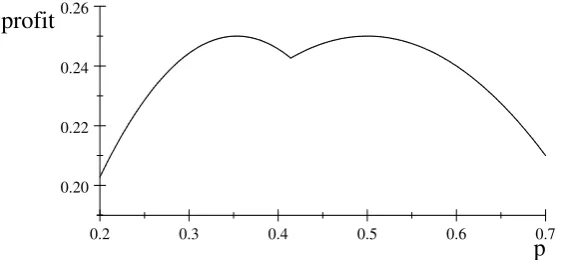
above-average price. When B = 1, the …rm’s pro…t as a function of its price p o¤ered to any
particular consumer, given that the consumer believes average price is P =p2 1, looks as shown on Figure 1. This …gure illustrates the bimodal nature of pro…t with
bargain-loving consumers, and the equilibrium is constructed so that the height of the two peaks
coincides.
0.2 0.3 0.4 0.5 0.6 0.7
0.20 0.22 0.24 0.26
[image:24.595.162.443.542.672.2]p profit
Figure 1: Monopolist’s pro…t as function ofp
This price policy in (23) is qualitatively the same as in the case in (18) where a consumer
is the same and the likelihood of getting a bargain is the same. However, prices are now
shifted downwards. Of course, quite generally, the …rm’s pro…ts here are lower compared
to when consumers see the full range of prices, since the …rm could choose the pricing
policy seen with secret deals as its policy when its prices are public. In this linear demand
example, aggregate consumer surplus is now higher, at about0:2, and total welfare is higher when the …rm’s prices are privately observed. Intuitively, when the …rm makes secret deals
with each consumer, the …rm has a greater incentive to undercut the average price since
other consumers do not observe, and cannot react to, the price cut.20
Suppose that the …rm is able to make false claims about its average price. If consumers
are savvy, they foresee that the …rm has an incentive to exaggerate its average price to
boost its demand from bargain-loving consumers, and so consumers discount its claims
and behave as if they cannot observe the average price. In such a situation, a policy which
enables the …rm credibly to reveal its average price will help the …rm and, at least in the
linear demand example, harm consumers. If policy forces the …rm to publish accurate information about its prices and the proportion of prices which are discounted, then any
price-cut targeted at particular individuals reduces demand from other consumers, and so
blunts the …rm’s incentive to discount.21
On the other hand, if consumers are more gullible and believe its claims, the …rm’s
pro…ts are increased when it is able to make misleading claims. It can then obtain the
bene…t of boosting demand from perceived “bargains” without the cost of sometimes having
to set ine¢ciently high prices. It would like to claim average price was as high as possible,
so that it could then set high actual prices without cutting demand.22
Summarizing our discussion of this model, we have:
Proposition 3 (a) Suppose consumers have an intrinsic preference for bargains. Then the
monopolist will o¤er distinct prices to identical consumers. If demand 1 F(p) is weakly concave, the …rm will adopt a “high-low” pricing strategy and o¤er exactly two prices to
the population of consumers. The …rm’s pro…t is higher when consumers can observe its average price compared to when they have no information about its average price.
20The e¤ect is analogous to the “secret deals” problem in vertical contracting, discussed in Rey and
Tirole (2007), in which an upstream manufacturer who sells to two competing retailers has an opportunistic incentive to boost supply to a retailer when the other does not observe the deal.
21Again, this is similar to the impact of policy on the secret deals problem in vertical contacting, where
a requirement to make the supplier’s deal to one retailer observed by another will boost supplier pro…ts and harm …nal consumers.
22In this case, the welfare impact of a policy banning false discounts is more complicated, and depends
(b) Suppose demand is linear. A policy which prevents the …rm from making false claims
about its average price helps the …rm and harms consumers and welfare if consumers are
savvy and foresee the …rm will exaggerate its average price. The same policy will harm the
…rm if consumers are gullible and believe its claims about average price.
5
Conclusion
This paper has explored some economic e¤ects of discount pricing. We suggest two reasons
why a discounted price—as opposed to a merely low price—may make a rational consumer
more willing to buy. First, the information that the product was initially sold at a high price
may indicate the product is high quality. Second, a discounted price can indicate that the
product is an unusual bargain, and that there is little point searching for alternative, lower
prices. We also discuss discount pricing with behavioural consumers. If consumers have an
intrinsic preference for bargains, a seller has an incentive to o¤er di¤erent prices to identical consumers, so that a proportion of its consumers will enjoy a bargain. Information about
discounts in this case assures consumers how good their deal is relative to the average,
which boosts their willingness to purchase.
Because of their incentive to mislead customers, in some—but not all—of the situations
we discuss, there is a potential role for policy to prevent sellers advertising false discounts.
In all models, if consumers are gullible and believe—rather than merely ignore—a …rm’s
false claims, such a policy will help consumers and harm the …rm. In most cases, the overall
impact on welfare of a policy which combats false discounting is positive.23 If consumers
are savvier, matters are more nuanced. In our model where the initial price serves to signal the choice of high quality, a ban on misleading claims will actually bene…t the …rm, as it
makes it easier to signal its quality. In the model with oligopoly search, such a policy
bene…ts consumers as they then learn when an o¤ered price is a discounted price and can
reduce their search e¤ort. Finally, in our model of bargain-lovers, when consumers are
savvy a ban on misleading price claims will help the …rm but harm consumers. Policy
which helps the …rm make public its pricing policy overcomes its “secret deals” problem,
to the detriment of consumers.
In any case, the potential bene…t from regulatory policy can be realized only if it is
e¤ectively enforced. Indeed, weakly enforced policy may be worse than no policy: it may make consumers gullible and act on a …rm’s false discounts, and it may harm honest sellers
23The exception is the model of oligopoly search in section 3, where permanent sale signs induce gullible
who follow the letter of policy. As discussed by Muris (1991) and Rubin (2008), it is hard
to enforce, or perhaps even coherently to formulate, policy towards misleading pricing. A
basic problem is how to determine how few sales need to occur at the full price, or for how
short a time the full price is available, for a sales campaign stating “was $200, now $100” to
be classi…ed as misleading. Sellers have a strong motive to make their customers feel they are getting a special deal, and they have myriad ways to achieve this. It is unrealistic and
undesirable to suppose that regulation can address all forms of false discounting without
unduly restricting a seller’s marketing abilities, and regulators should focus only on ‡agrant
examples of deception.
References
Bagwell, Kyle and Michael Riordan (1991), “High and Declining Prices Signal Product
Quality”, American Economic Review 81(1), 224-239.
Bordalo, Pedro, Nicola Gennaioli and Andrei Shleifer (2012), “Salience and Consumer
Choice”, NBER working paper 17947.
Cialdini, Robert (2001), In‡uence: Science and Practice, Allyn and Bacon (4th Edition).
Heidhues, Paul and Botond K½oszegi (2005), “The Impact of Consumer Loss Aversion on
Pricing”, CEPR discussion paper no. 4849.
Jahedi, Salar (2011), “A Taste for Bargains”, mimeo, University of Arkansas.
Lazear, Edward (1986), “Retail Pricing and Clearance Sales”, American Economic Review
76(1), 14–32.
Muris, Timothy (1991), “Economics and Consumer Protection”, Antitrust Law Journal
60, 103-121.
Puppe, Clemenz and Stephanie Rosenkranz (2011), “Why Suggest non-binding Retail
Prices?”, Economica 78, 371-329.
Rey, Patrick and Jean Tirole (2007), “A Primer on Foreclosure”, chapter 33 in Handbook
of Industrial Organization vol. 3, edited by Armstrong and Porter, Amsterdam: North-Holland.
Rubin, Paul (2008), “Regulation of Information and Advertising”, Competition Policy
International 4(1), 169–192.
Spiegler, Ran (2011a),Bounded Rationality and Industrial Organization, Oxford University
Spiegler, Ran (2011b), “Monopoly Pricing when Consumers are Antagonized by
Unex-pected Price Increases: A ‘Cover Version’ of the Heidhues-Koszegi-Rabin Model”,
Eco-nomic Theory (forthcoming).
Thaler, Richard (1985), “Mental Accounting and Consumer Choice”, Marketing Science
4(3), 199-214.
Tirole, Jean (1988),The Theory of Industrial Organization, MIT Press.
Urbany, Joel, William Bearden and Dan Weilbaker (1988), “The E¤ect of Plausible and
Exaggerated Reference Prices on Consumer Perceptions and Price Search”, Journal of
Consumer Research 15(1), 95-110.
Zhou, Jidong (2011), “Reference Dependence and Market Competition”, Journal of