ISSN Online: 2327-6053 ISSN Print: 2327-6045
Evolution of Microstructure in a Cu-Cr
in situ
Composite Produced by Thermo-Mechanical
Processing
Keming Liu1*, Deping Lu2*,Kai Fu1, Peilan Luo1, Zhikai Huang1, Wei Guo2, Jiuming Yu2, Jin Zou2, Qiang Hu2
1Jiangxi Key Laboratory for Precision Drive and Control, Nanchang Institute of Technology, Nanchang, China 2Jiangxi Key Laboratory for Advanced Copper and Tungsten Materials, Jiangxi Academy of Sciences, Nanchang, China
Abstract
This paper studied the microstructure evolution of a deformation-processed Cu-7Cr in situ composite prepared by thermo-mechanical processing. The longitudinal and transverse sectional microstructures were analyzed using an optical microscope and a scanning electronic microscope. In the longitudinal section, the initially randomly distributed Cr dendrites in the as-cast Cu-7Cr alloy were transformed into the fibres aligned parallel to the drawing axis; the Cr dendrites experienced breaking, flattening and rotating, lapping and merging, and homogenizing and refinement during thermo-mechanical processing. In the transverse section, the initially randomly distributed Cr dendrites in the as-cast Cu-7Cr alloy were changed into the curvy ribbon like fibres; the Cr dendrites underwent breaking, flattening and rotating, folding and twisting, and irregularizing and refinement during thermo-mechanical processing.
Keywords
Cu-Cr, in situ Composite, Evolution, Microstructure, Thermo-Mechanical Processing
1. Introduction
Over the past several decades, deformation-processed binary Cu-based in situ composites such as Cu-Fe, Cu-Ag, Cu-Nb, and Cu-Cr have been the subject of extensive research due to their high strength and good conductivity [1] [2] [3] [4] [5]. However, the Cu-Fe in situ composite has relatively low conductivity due to the relatively high solubility of Fe in the Cu matrix and the particularly How to cite this paper: Liu, K.M., Lu, D.P.,
Fu, K., Luo, P.L., Huang, Z.K., Guo, W., Yu, J.M., Zou, J. and Hu, Q. (2017) Evolution of Microstructure in a Cu-Cr in situ Composite Produced by Thermo-Me-chanical Process- ing. Journal of Materials Science and Chemi-cal Engineering, 5, 29-35.
https://doi.org/10.4236/msce.2017.57004
harmful effect on the conductivity of Fe atoms in solid solution [6]. Ag and Nb are expensive metals, which impede the use of the Cu-Ag and Cu-Nb in situ composites in large-scale applications. The Cu-Cr in situ composite is of partic-ular interest due to the relatively economical cost and the high strength of Cr, and the limited solubility of Cr in the Cu matrix [7] [8].
The deformation-processed Cu-Cr in situ composite belong to the class of bulk nanostructured metallic materials, due to the small size of the structural constitutes produced via the in situ deformation processing. The Cr fibres formed in the Cu matrix ensure the high tensile strength, and the limited solu-bility of Cr atoms in the Cu matrix ensures the high electrical conductivity. The filamentary structure of double phases in the Cu-7Cr in situ composite was produced by severe cold drawing and intermediate heat treatment. The consti-tuent concentration, cold drawing strain and heat treatment parameter strongly influence the properties [9] [10] [11]. In special, the microstructure evolution during cold drawing plays an important role in the change of the strength and conductivity with the cold drawing strain. Stepanov et al. [12] investigated the evolution of microstructure and mechanical properties in a Cu-14Fe in situ composite, and found that rolling resulted in significant microstructural refine-ment of the Cu-14Fe alloy. The work of Liu et al. [13] suggested that the eutectic colonies in Cu-Ag in situ composites were evolved into filamentary bundles with tight arrangement of double phases during severe cold drawing.
However, the evolution of microstructure in Cu-Cr in situ composites still needs further investigation because of the complex co-deformation of Cu and Cr phases. In this work, the as-cast and deformation-processed microstructures of a Cu-7Cr in situ composite were investigated. The microstructure evolution dur-ing cold drawdur-ing was analyzed.
2. Experimental Details
The Cu-7wt%Cr (designated Cu-7Cr) alloy was produced by melting appropri-ate amounts of electrolytic Cu and commercial Cr (of at least 99.9 wt.% purity) using a magnesia crucible in a vacuum induction furnace, and was casted into rod ingots of diameter, d = 36 mm. The deformation-processed Cu-7Cr in situ composite was prepared by homogenization treatment, hot rolling, heat treat-ment and cold drawing to a cumulative cold deformation strain of η = 8. The cumulative cold deformation strain η was obtained in terms of true strain as fol-lows:
. (1) where A0 is the initial transverse sectional area after hot rolling, and Af is the
fi-nal transverse sectiofi-nal area after cold drawing. The detailed production processing has been published elsewhere [14]. The subsequent thermo-me- chanical processing of the in situ composite of η = 7 was as follows: (i heat treated at 625˚C for 1 h, (ii cold drawn to η = 8.
The as-cast and deformation-processed samples were sectioned and the lon-0
ln(A /Af)
gitudinal and transverse sectional microstructures were examined using a Leica DMI5000 M optical microscope (OM) and a JSM-6360LV scanning electronic microscope (SEM). The samples were prepared by standard mechanical polish-ing and were etched in a solution of 120 ml H2O, 20 ml HCl and 5 g FeCl3 to reveal the Cr phase structure, prior to the OM and SEM examinations
3. Results and Discussion
3.1. Longitudinal Sectional Microstructure
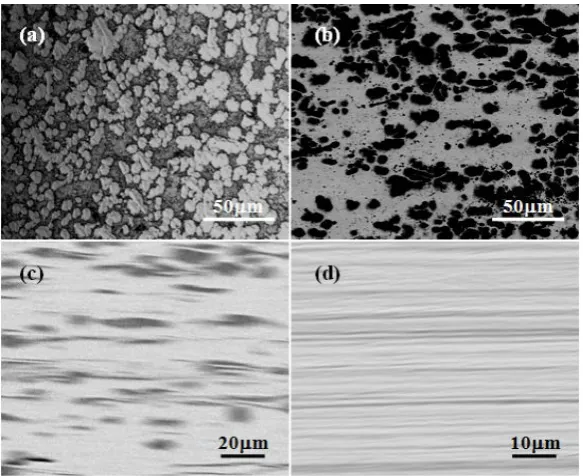
[image:3.595.228.520.464.702.2]Figure 1(a) shows the longitudinal sectional microstructure of the as-cast Cu-7Cr alloy. The secondary phase Cr dendrites were evenly distributed in the Cu matrix and randomly oriented with respect to the ingot axis. Figure 1(b) shows the longitudinal sectional microstructure of the Cu-7Cr alloy after hot rolling. The Cr dendrites were broken and changed into rod like and disk like Cr grains. However, the size and distribution of the Cr phase is no obvious change. Figure 1(c) shows the longitudinal sectional microstructure of the deformation- processed Cu-7Cr in situ composite with a cumulative cold deformation strain η = 4. There were the Cu matrix plus elongated Cr grains and thin Cr fibres paral-lel to the drawing direction. The deformation of the Cr grains in the Cu-7Cr was not uniform; there were still some tadpole-like Cr grains. Figure 1(d) shows the longitudinal sectional microstructure of the deformation-processed Cu-7Cr in situ composite with a cumulative cold deformation strain η = 8. The tadpole-like Cr grains in the Cu-7Cr in situ composite with η = 4 had been all drawn into long thin fibres. The size and spacing of the Cr fibres in the Cu-7Cr in situ composite with η = 8 were finer and smaller than those with η = 4. The micro-structure evolution of the deformation-processed Cu-7Cr in situ composite is
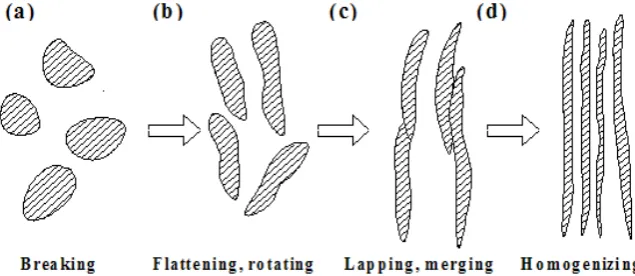
similar to those reported in previous research [9] [10] [15]. Figure 2 shows the schematic diagram of formation of fibres in deformation-processed Cu-based in situ composites along the longitudinal section. The hot deformation broke the dendrites to form the rod like and disk like grains, as presented in Figure 2(a). The cold drawing flattened the grains and rotated the grains parallel to the drawing axis, as presented in Figure 2(b). With increasing cumulative cold de-formation strain, the flattened and rotated grains were lapped and merged into fibres, as presented in Figure 2(c). With further cold drawing, the lapped and merged fibres were further refined and homogenized, as presented in Figure 2(d). The initially randomly distributed secondary dendrites in the as-cast mi-crostructure were transformed into fibres aligned parallel to the drawing axis, with fibre aspect ratio increasing with increasing η.
3.2. Transverse Sectional Microstructure
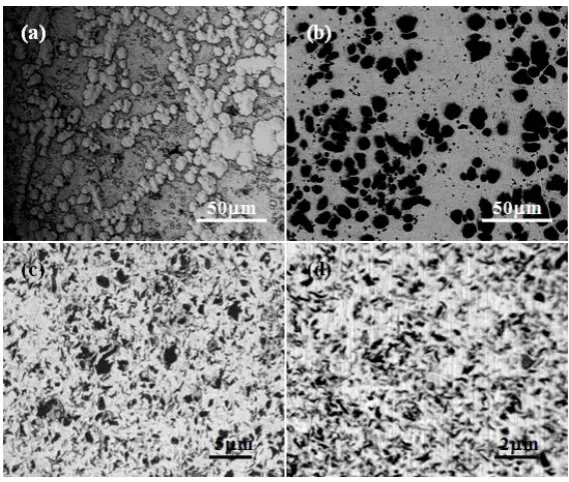
[image:4.595.215.533.554.692.2]Figure 3(a) shows the transverse sectional microstructure of the as-cast Cu-7Cr alloy. Similar to the longitudinal sectional microstructure, there were the Cu matrix and randomly oriented Cr dendrites. Figure 3(b) shows the transverse sectional microstructure of the Cu-7Cr alloy after hot rolling. Similar to the lon-gitudinal sectional microstructure, there were rod and disk like Cr grains in the Cu matrix. Figure 3(c) shows the transverse sectional microstructure of the de-formation-processed Cu-7Cr in situ composite with a cumulative cold deforma-tion strain η = 4. There were circular Cr grains and ribbon like Cr fibres in the Cu matrix. Figure 3(d) shows the transverse sectional microstructure of the de-formation-processed Cu-7Cr in situ composite with a cumulative cold deforma-tion strain η = 8. The circular Cr grains in the Cu-7Cr in situ composite with η = 4 had been all changed into ribbon like fibres. The size and spacing of the rib-bon like Cr fibres in the Cu-7Cr in situ composite with η = 8 were finer and smaller than those with η = 4. The ribbon like morphology is attributed to the deformation producing Cr fibres with a <111> fibre texture, which promoted plane strain deformation rather than axially symmetric flow. However, the Cu matrix did deform in an axially symmetric manner during wire drawing, which
constrained and forced the Cr fibres to fold or twist about the wire axis to main-tain compatibility with the matrix and produced the irregular transverse section [16]. Figure 4 shows the schematic diagram of formation of fibres in deforma-tion-processed Cu-based in situ composites along the transverse section. Similar to the longitudinal section, the hot deformation formed the rod like and disk like grains, and the cold drawing flattened and rotated the grains parallel to the drawing axis, as presented in Figure 4(a) and Figure 4(b). With increasing cu-mulative cold deformation strain, the flattened and rotated grains were folded and twisted into curvy ribbon like fibres, as presented in Figure 4(c). With fur-ther cold drawing, the folded and twisted fibres were furfur-ther refined and irregu-larized, as presented in Figure 4(d). The initially randomly distributed second-ary dendrites in the as-cast microstructure were changed into curvy ribbon like fibres, with fibre aspect ratio increasing with increasing η.
[image:5.595.231.516.277.518.2]Figure 3. Transverse sectional microstructures of the Cu-7Cr alloy: (a) as-cast; (b) hot rolling; (c) η = 4; (d) η = 8.
[image:5.595.235.514.565.679.2]4. Conclusions
1) In the longitudinal section, the initially randomly distributed Cr dendrites in the as-cast Cu-7Cr alloy were transformed into the fibres aligned parallel to the drawing axis.
2) The longitudinal sectional microstructure of the in situ composite expe-rienced breaking of dendrites, flattening and rotating of grains, lapping and merging of fibres, and homogenizing of fibres during thermo-mechanical processing.
3) In the transverse section, the initially randomly distributed Cr dendrites in the as-cast Cu-7Cr alloy were changed into the curvy ribbon like fibres.
4) The transverse sectional microstructure of the in situ composite underwent breaking of dendrites, flattening and rotating of grains, folding and twisting of fibres, and irregularizing of fibres during thermo-mechanical processing.
Acknowledgements
This work was supported by the National Natural Science Foundation of China (51461018; 51561010), the International Science and Technology Cooperation Project of Jiangxi Province (20151BDH80006), the Prior Science and Technology Program Led by the Returned Overseas Chinese Talents (RSTH[2015]192- GRSZ[2015]273), the Key Program of Natural Science Foundation of Jiangxi Province (20133BAB20008; 20144ACB20013), the Science and Technology Project of ShenZhen (JCYJ20150525092941012), and the Science and Technolo-gy Innovation Project of Jiangxi Academy of Sciences (2013-YYB-1; 2013- XTPH1-19; 2015XTTD04).
References
[1] Grillo, G., Liu, K.M., Jiang, Z.Y., Zhao, J.W., Zou, J., Lu, L. and Lu, D.P. (2015) Thermal Stability and Properties of Deformation-Processed Cu-Fe in situ Compo-sites. Metall. Mater. Trans. A, 46, 2255-2261.
https://doi.org/10.1007/s11661-015-2791-x
[2] Rdzawski, Z., Głuchowski, W., Stobrawa, J., Kempiński, W. and Andrzejewski, B. (2015) Microstructure and Properties of Cu-Nb and Cu-Ag Nanofiber Composites. Arch. Civ. Mech. Eng., 15, 689-697. https://doi.org/10.1016/j.acme.2014.12.002
[3] Primorac, M.M., Abad, M.D., Hosemann, P., Kreuzeder, M., Maier, V. and Kiener, D. (2015) Elevated Temperature Mechanical Properties of Novel Ultra-Fine Grained Cu-Nb Composites. Mater. Sci. Eng. A, 625, 296-302.
https://doi.org/10.1016/j.msea.2014.12.020
[4] Liu, K.M., Jiang, Z.Y., Zhao, J.W., Zou, J., Chen, Z.B. and Lu, D.P. (2014) Effect of Directional Solidification Rate on the Microstructure and Properties of Deforma-tion-Processed Cu-7Cr-0.1Ag in situ Composites. J. Alloys Compd., 61, 2221-2226. [5] Peng, L.M., Mao, X.M., Xu, K.D. and Ding, W.J. (2005) Property and Thermal
Sta-bility of in situ Composite Cu-Cr Alloy Contact Cable. J. Mater. Proc. Technol., 166, 193-198. https://doi.org/10.1016/j.jmatprotec.2004.08.013
https://doi.org/10.1016/j.msea.2010.04.051
[7] Liu, K.M., Lu, D.P., Zhou, H.T., Yang, Y.L., Atrens, A. and Zou, J. (2013) Micro-structure and Properties of a Deformation-Processed Cu-Cr-Ag in situ Composite by Directional Solidification. J. Mater. Eng. Perform., 22, 3723-3727.
https://doi.org/10.1007/s11665-013-0698-5
[8] Lee, K.L. (2004) The Thermo-Mechanical Behaviour of Cu-Cr In-Situ Composite. J. Mater. Sci., 39, 3047-3055. https://doi.org/10.1023/B:JMSC.0000025831.58057.52
[9] Que, Z.P., Lee, J.H., Jung, H.M., Shin, J.H., Han, S.Z. and Euh, K.J. (2013) Micro-structure evolution in Cu-1.54 wt% Cr alloy during directional solidification. J. Cryst. Growth, 362, 58-61. https://doi.org/10.1016/j.jcrysgro.2011.12.083
[10] Liu, J.B., Zhang, L., Yao, D.W. and Meng, L. (2011) Microstructure Evolution of Cu/Ag Interface in the Cu-6 wt.% Ag Filamentary Nanocomposite. Acta Mater., 59, 1191-1197. https://doi.org/10.1016/j.actamat.2010.10.052
[11] Feng, Q., Song, L., Zeng, Y., Fang, Y., Meng, L., Liu, J. and Wang, H. (2015) Evolu-tion of FCC/BCC Interface and Its Effect on the Strengthening of Severe Drawn Cu-3 wt.% Cr. J. Alloys Compd., 640, 45-50.
https://doi.org/10.1016/j.jallcom.2015.03.226
[12] Stepanov, N.D., Kuznetsov, A.V., Salishchev, G.A., Khlebova, N.E. and Pantsyrny, V.I. (2013) Evolution of Microstructure and Mechanical Properties in Cu-14%Fe Alloy During Severe Cold Rolling. Mater. Sci. Eng. A, 564, 264-272.
https://doi.org/10.1016/j.msea.2012.11.121
[13] Liu, J.B., Meng, L. and Zeng, Y.W. (2006) Microstructure Evolution and Properties of Cu-Ag Microcomposites with Different Ag Content. Mater. Sci. Eng. A, 435-436, 237-244. https://doi.org/10.1016/j.msea.2006.07.125
[14] Liu, K.M., Jiang, Z.Y., Zhou, H.T., Lu, D.P., Atrens, A. and Yang, Y.L. (2015) Effect of Heat Treatment on the Microstructure and Properties of Deformation-Processed Cu-7Cr in situ Composites. J. Mater. Eng. Perform., 24, 4340-4345.
https://doi.org/10.1007/s11665-015-1747-z
[15] Deng, L.P., Yang, X.F., Han, K., Lu, Y.F., Liang, M. and Liu, Q. (2013) Microstruc-ture and TexMicrostruc-ture Evolution of Cu-Nb Composite Wires. Mater. Charact., 81, 124-133. https://doi.org/10.1016/j.matchar.2013.04.013
[16] Liu, K.M., Lu, D.P., Zhou, H.T., Atrens, A., Chen, Z.B., Zou, J. and Zeng, S.M. (2010) Influence of Ag Micro-Alloying on the Microstructure and Properties of Cu-7Cr in situ Composite. J. Alloys Compd., 500, L22-25.
Submit or recommend next manuscript to SCIRP and we will provide best service for you:
Accepting pre-submission inquiries through Email, Facebook, LinkedIn, Twitter, etc. A wide selection of journals (inclusive of 9 subjects, more than 200 journals)
Providing 24-hour high-quality service User-friendly online submission system Fair and swift peer-review system
Efficient typesetting and proofreading procedure
Display of the result of downloads and visits, as well as the number of cited articles Maximum dissemination of your research work
Submit your manuscript at: http://papersubmission.scirp.org/