The effects of an exercise program on health-related
quality of life in postpartum mothers: A randomized
controlled trial
Megumi Haruna1*, Etsuko Watanabe1, Masayo Matsuzaki1, Erika Ota1, Mie Shiraishi1, Ryoko Murayama1, Mikako Yoshida1, SeonAe Yeo2
1Department of Midwifery and Women’s Health, Division of Health Sciences and Nursing, Graduate School of Medicine, The
Uni-versity of Tokyo, Tokyo, Japan; *Corresponding Author: [email protected] 2School of Nursing, University of North Carolina at Chapel Hill, North Carolina, USA
Received 18 January 2013; revised 25 February 2013; accepted 2 March 2013
ABSTRACT
Background and Objective: There is controversy on the psychological effects of postpartum exer- cise. The study aimed to evaluate the effective- ness of a postpartum exercise program on health- related quality of life and psychological well- being. Methods: We conducted a randomized controlled trial in Tokyo, Japan. The intervention groups participated in ball-exercise classes (week- ly exercise of 90 minutes for four weeks) at three months postpartum. The exercise class included the following: 1) greeting and warm-up; 2) aero- bic exercise involving bouncing on an exercise ball 55 or 65 cm in diameter; 3) rest and self- introduction; 4) stretching and cooling down. The primary outcome measure was health-relat- ed Quality of Life (QOL) assessed using the MOS Short-Form 36-Item Health Survey (SF-36v2). The secondary outcome measures were Rosen- berg Self-Esteem Scale (RSES) and Edinburgh Postnatal Depression Scale (EPDS) scores. The intervention group was compared to the control group at four months postpartum. Results: Of the 120 women screened, 110 women met the study criteria. Nine could not be included and the remaining 101 were allocated randomly into intervention and control groups (50 and 51 par- ticipants respectively). Analysis of covariance adjusting for baseline values indicated that the SF36 subscales of physical functioning (p = 0.018) and vitality (p = 0.016) significantly im- proved in the intervention group compared to the control group, although there were no signi- ficant differences between the groups in the SF36 Physical Component Summary (PCS) and Mental Component Summary (MCS) scores. The RSES increased in the intervention group (p =
0.020) compared to the control group. No signi- ficant group differences were observed in EPDS scores. Conclusions: The postpartum exercise class program provided to healthy postpartum women appears to have contributed to promo- ting health-related QOL and self-esteem.
Keywords: Exercise; Health Related Quality of Life; Postpartum Depression; Randomized Controlled Trial; Self-Esteem
1. INTRODUCTION
A small number of women experience a major depres- sive episode during the first three months postpartum; most of these episodes have onset following delivery. A recent review found 7.1% of women experience major depression; including minor depressive episodes, the 3- month period prevalence rate in this review was 19.2% [1]. In a Japanese study, the prevalence of major depres- sion was 4.3% and the prevalence of mental disorder including minor depressive episode was 10.6% within three months postpartum [2]. Furthermore, many of those who are not diagnosed with depression complain of mild mood disorder or feelings of anxiety. Even postpartum mothers who experienced normal pregnancy and delivery, have a risk of worsening psychological wellbeing, al- though prevalence of postpartum Post-Traumatic Stress Disorder (PTSD) is higher among women after pregnan- cy complications such as preeclampsia [3].
family structure and 72.5% of mothers of infants do not work [5], so many mothers spend most of their time at home after childbirth to care for their babies. Therefore, they tend to be socially isolated and are susceptible to mental health problems. There is also a need to provide opportunities for mothers to be together.
Meanwhile, physical exercise is believed to improve mild depression, anxiety, and feelings of discomfort. Previous studies have shown that physical exercise inter- vention could help improve the mood and well-being of patients with depressive disorder [6]. It is therefore ex- pected that the provision of an exercise program as part of postpartum care can help reduce mental health prob- lems. Most studies related to the benefits of postpartum exercise on mental health have targeted womedn with higher EPDS scores and have shown the effect of exer- cise in reducing depressive symptoms in this population [7-10].
A few recent studies have focused on the psychologi- cal well-being of healthy postpartum women. Norman et al. conducted an eight-week mother and baby program,
including specialized exercise combined with parenting education (n = 62), compared with a control group (n = 73). They found that mothers in the intervention group improved their level of well-being (Positive Affect Bal- ance Scale) and reduced their depressive symptoms (EPDS score) more than those in the control group [11]. Cramp et al. examined the effect of a moderate aerobic
exercise session (two 45-min exercise sessions) on feel- ing states when women (n = 23) exercised with their baby present compared to without their baby present. The findings suggested that there were no differences in the Exercise-induced Feeling Inventory when women exercised with or without their babies. However, partici- pants reported pre- to post-exercise improvements in feeling states and the State Anxiety Scale of the State- Trait Anxiety Inventory (STAI) [12].
There are a few studies showing that exercise substan- tially improves Quality of Life (QOL) in healthy popula- tions such as pregnant women, postmenopausal women and elderly women. Montoya Arizabaleta et al. demon-
strated that pregnant women (n = 64) in a 3-month su- pervised exercise program of primary aerobic exercise had improved their health-related QOL more than the control group [13]. Martin et al. showed that higher dose
of exercise was associated with larger improvements in mental and physical aspects of QOL among 430 seden- tary postmenopausal women [14]. Devereux et al. show-
ed that a water-based exercise and self-management pro- gram produced significant beneficial changes in QOL among women 65 years and over (n = 50) [15]. However, little is known about the impact of exercise programs on health-related QOL during the postpartum period.
In this study, we designed a feasible aerobic exercise
program which is expected to prevent isolation for post- partum mothers at three months after childbirth, and as- sessed its effect on health-related QOL and self-esteem using a randomized controlled trial (RCT).
2. METHODS
2.1. ParticipantsRecruitment started in December 2006 and was com- pleted in August 2007. Participants were recruited from three sources; the University of Tokyo Hospital and two public health centers located in the same district. Women living in the Tokyo area in Japan, signed up for this stu- dy until one month postpartum. Women voluntarily ap- plied for participation in the exercise class. Eligible women were more than 20 years of age without any me- dical complications who expected to give birth between January and July 2007. Women with restricted physical activity or suffering from psychiatric disorders were ex- cluded from the study.
2.2. Study Protocol
We used a randomized controlled trial design to test the psychological outcome of exercise class in postpar- tum women. Two researchers not involved in the alloca- tion process carried out the permutated block randomiza- tion (MM and EO). The ratio of randomization between the exercise and control group was 1:1 allocation using random block size of 4.
Blinding of participants and the exercise instructors was not possible as participants were allocated to the exercise group or control group. All outcomes were as- sessed without blinding to the intervention. Data entry personnel were blinded to random assignment and the data was analyzed by a non-blinded assessor.
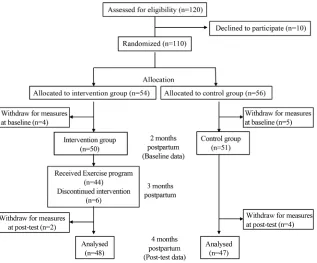
Of the 120 women at study entry, 110 women were eligible and agreed to participate in the study. They were allocated into the intervention group or control group using random numbers. However, nine women refused to participate at two months postpartum, and thus a total of 101 women were enrolled in the study (intervention group; n = 50, control group; n = 51).
baseline questionnaire, 95 finished the study. Of the 50 participants of the intervention group, four women did not attend the exercise classes, but of these three women still completed the outcome questionnaire. Figure 1 is a
flow diagram of participants in the trial. The participants in the control group were offered the program after the outcome measurement.
The protocol was approved by the institutional review board of the University of Tokyo. All women provided written informed consent. The study was conducted in accordance with the principles of the Declaration of Hel- sinki.
2.3. Postpartum Exercise Intervention
Women in the intervention group participated in an ex- ercise program that provided exercise classes four times weekly for four weeks, 90 minutes each, at three months postpartum. In each class, approximately 10 women par- ticipated and two expert exercise instructors familiar with postpartum exercise ensured the validity of the exer- cise program. The exercise class included the following: 1) greeting and warm-up, (15 minutes); 2) aerobic exer-cise (50 - 60 minutes) where the participant sits and bounces on an exercise ball (Gymnic, Italy) measuring 55 cm or 65 cm in diameter; 3) rest, self-introduction or partner-up communication (5 minutes); and 4) muscular stretching and cool down (15 - 20 minutes).
The participants were able to attend the class either with or without their babies. If they attended the class with their babies, babies were laid down in the center of the circle formed by the participants, and the mothers were able to hold their babies, change their diaper or breast-fed the babies at any time. The exercise instructors regulated in a flexible manner the time allocated to the aerobic exercise and the stretching and cool down com- ponent varied in length according to abilities of the par- ticipants. During the exercise, each participant had a chance to communicate with other participants.
2.4. Main Outcome Measures
The following three scales were evaluated.
MOS Short-Form 36-Item Health Survey version 2 (SF-36v2): The SF-36 is a multi-purpose, compre- hensive health survey with only 36 items for health- related QOL measures. The original version was de- veloped in the United States, and it has been trans- lated in more than 50 countries, and the reliability and validity of the Japanese version have been studied [16]. We used the standard (four-week) recall ver- sions. Total score ranges from a minimum of 0 to a maximum of 100, with higher scores indicating better health status. Three subscales [physical functioning, role-physical, and bodily pain] correlate most highly
with the physical component and contribute most to the scoring of the Physical Component Summary (PCS) measure [17]. The mental component corre- lates most highly with the [mental health, roleemo- tional, and social functioning] scales, which also con- tribute most to the scoring of the Mental Component Summary (MCS) measure. Three of the subscales [vitality, general health, and social functioning] cor- relate with both components.
Rosenberg Self-Esteem Scale (RSES): This scale me- asured the state of self-esteem, which was developed by Rosenberg in 1965 [18]. A Japanese version of the self-esteem scale has been developed [19]: it consists of 10 items, with a total score ranging from a low of 10 to a high of 50. Higher scores indicate a “higher state of self-esteem”.
EPDS Japanese version: the Japanese version has been examined and validated externally. The EPDS is a 10-item scale and an internationally used screening scale for postpartum depression [20]. The scale has been translated and validated for use in Japan. The validation study on the Japanese version of the EPDS demonstrated a sensitivity of 0.75 and a specificity of 0.93 at an optimum cut-off score of 9 and above [21], which was used in the present study.
2.5. Sample Size Estimation
The total sample size of 106 women was estimated for an expected effect size of 0.55 and power of 0.8 at an alpha of 0.05 [22]. This would be sufficient to detect a five point difference between groups in the PCS score of SF-36v2 on completion of the intervention, assuming a SD of 9.1 [16]. Taking into consideration possible dro- pouts, we recruited 120 women for the study.
2.6. Statistical Analysis
Descriptive statistics including means and standard deviations for quantitative variables and proportions for categorical variables were calculated for all baseline variables. The equivalence of control and intervention group was tested at baseline using unpaired t-test, chi- square test or Fisher’s exact test. For each participant who completed the follow-up assessments, the changes in each outcome were calculated (i.e. post-score minus
pre-score). We used one-way analysis of covariance (ANCOVA) to compare the groups with outcome data at four months postpartum in both the eight subscales and summary scores of SF-36v2, RSES and EPDS con- trolling for baseline values. The analyses were conducted on an intention-to-treat (ITT) basis for the outcome variables of the entire sample. We also conducted secon-
Figure 1. Flow diagram of participants through the study. the classes twice or more and 47 women who completed
the post-test evaluation in the control group. All p values were 2-sided and p < 0.05 was considered statistically significant. The SPSS version 16.0 statistical software package (SPSS Japan Inc.) was used for statistical ana- lyses.
3. RESULTS
3.1. Demographic Data
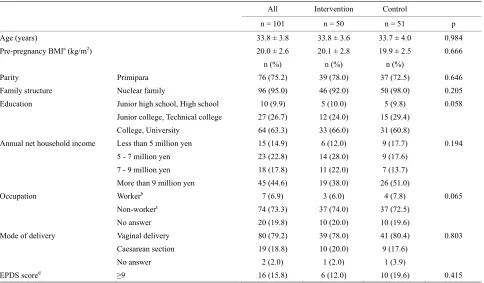
There were no significant differences between the two groups in terms of age and other demographic parame- ters. The two groups were well balanced with respect to socio-demographic characteristics (Table 1). Their ba-
bies were also in good health.
3.2. Class Attendance Rate
Finally, 48 women were followed through four months postpartum among 50 participants who were allocated to intervention group. Subsequently, the data for 48 women were analyzed. However, actual attendance at the class was 44 women and the attendance rate was 88.0%.
3.3. Comparison of SF-36v2 Scores of the Two Groups
No baseline differences in SF-36v2 scores were ap- parent between intervention and control groups. At four months after childbirth, there was no significant differ- ence in the PCS of SF-36v2 score between the two
groups. ANCOVA analyses identified the exercise group improved significantly more than the control group in two of the eight subscales within the SF-36v2 score: the Physical Functioning (PF) domain (p = 0.018) and the Vitality (VT) domain (p = 0.016). The MCS summary score and other subscales showed no significant differ- ence due to the exercise intervention (Table 2).
3.4. Comparison of EPDS Scores of the Two Groups
At baseline, no significant differences were seen in the rate of women scoring ≥ 9 on the EPDS score. The mean of EPDS score was higher in the control group than in the intervention group at baseline (p= 0.028). The mean of EPDS scores were reduced in both of intervention group and control group, but there were no differences between the two groups at outcome measurements (Ta-
ble 2). Although we re-analyzed our data excluding wo-
men with high EPDS scores of 13.0 and above at base- line, there was no change in the results of outcome mea- surements.
3.5. Secondary Analysis
Table 1. Characteristics of participants of the intervention and control groups at baseline.
All Intervention Control
n = 101 n = 50 n = 51 p
Age (years) 33.8 ± 3.8 33.8 ± 3.6 33.7 ± 4.0 0.984
Pre-pregnancy BMIa (kg/m2) 20.0 ± 2.6 20.1 ± 2.8 19.9 ± 2.5 0.666
n (%) n (%) n (%)
Parity Primipara 76 (75.2) 39 (78.0) 37 (72.5) 0.646
Family structure Nuclear family 96 (95.0) 46 (92.0) 50 (98.0) 0.205
Education Junior high school, High school 10 (9.9) 5 (10.0) 5 (9.8) 0.058
Junior college, Technical college 27 (26.7) 12 (24.0) 15 (29.4)
College, University 64 (63.3) 33 (66.0) 31 (60.8)
Annual net household income Less than 5 million yen 15 (14.9) 6 (12.0) 9 (17.7) 0.194
5 - 7 million yen 23 (22.8) 14 (28.0) 9 (17.6)
7 - 9 million yen 18 (17.8) 11 (22.0) 7 (13.7)
More than 9 million yen 45 (44.6) 19 (38.0) 26 (51.0)
Occupation Workerb 7 (6.9) 3 (6.0) 4 (7.8) 0.065
Non-workerc 74 (73.3) 37 (74.0) 37 (72.5)
No answer 20 (19.8) 10 (20.0) 10 (19.6)
Mode of delivery Vaginal delivery 80 (79.2) 39 (78.0) 41 (80.4) 0.803
Caesarean section 19 (18.8) 10 (20.0) 9 (17.6)
No answer 2 (2.0) 1 (2.0) 1 (3.9)
EPDS scored ≥9 16 (15.8) 6 (12.0) 10 (19.6) 0.415
Data are mean ± SD or n (%), aBMI: Body Mass Index; bWorker: Include part-time job and school attendance; cNon-worker: Include full-time homemakers and
[image:5.595.57.541.101.384.2]workers on a child-care leave; dEPDS: Edinburgh Postnatal Depression Scale: a higher score is a tendency for postpartum depression.
Table 2. SF-36v2 subscales, SF-36v2 summary scores, RSES and EPDS for the intervention and control groups.
Baseline (2 months postpartum)
Outcome
(4 months postpartum) Mean change
Mean between group
difference
95% CI of the difference
Interventiona Control Interventiona Control F valueb
p Interventiona Control
n = 48 n = 47 n = 48 n = 47 n = 48 n = 47
mean ± SD mean ± SD mean ± SD
SF-36v2 subscales
Physical functioning
(PF) 50.7 ± 8.2 50.5 ± 8.7 52.1 ± 6.7 48.7 ± 9.8 5.826 0.018 1.3 ± 6.4 −1.8 ± 7.9 3.1 (0.2, 6.1)
Role-physical (RP) 31.8 ± 18.5 36.5 ± 17.8 42.5 ± 15.9 43.6 ± 13.2 0.023 0.880 10.7 ± 17.8 7.1 ± 18.6 3.6 (−3.8, 11.0)
Bodily pain (BP) 44.7 ± 10.8 43.0 ± 9.8 44.6 ± 9.9 46.1 ± 10.2 1.057 0.307 −0.04 ± 11.7 3.1 ± 11.7 −3.2 (−7.9, 1.6)
General health (GH) 56.0 ± 10.1 53.0 ± 8.6 54.5 ± 11.1 52.9 ± 9.5 0.286 0.594 1.2 ± 7.5 −0.1 ± 5.5 −1.1 (−3.9, 1.6)
Vitality (VT) 45.2 ± 9.7 44.9 ± 9.1 49.8 ± 9.8 45.9 ± 9.3 6.036 0.016 4.6 ± 8.7 1.0 ± 7.4 3.6 (0.3, 6.9)
Social functioning (SF) 36.8 ± 16.5 39.6 ± 13.8 46.9 ± 12.9 48.4 ± 10.5 0.018 0.893 10.5 ± 13.4 8.8 ± 14.1 1.7 (−4.0, 7.3)
Role-emotional (RE) 43.1 ± 15.2 42.5 ± 16.0 47.4 ± 13.2 47.9 ± 11.1 0.129 0.720 4.3 ± 11.4 5.4 ± 16.2 −1.2 (−6.9, 4.6)
Mental health (MH) 49.7 ± 8.7 48.0 ± 8.9 52.1 ± 9.1 51.4 ± 7.9 0.027 0.869 2.4 ± 7.3 3.3 ± 8.3 −0.9 (−4, 2)
SF-36v2 summary score
PCS 38.3 ± 14.7 40.8 ± 14.3 44.8 ± 12.3 45.3 ± 10.7 0.052 0.819 6.5 ± 12.2 4.6 ± 14.1 1.9 (−3.4, 7.3)
MCS 50.7 ± 9.1 48.5 ± 8.6 52.3 ± 9.2 50.6 ± 7.5 0.032 0.858 1.5 ± 7.0 2.1 ± 7.4 −0.6 (−3.6, 2.3)
RSES 38.8 ± 7.4 37.3 ± 8.3 40.1 ± 7.2 37.2 ± 7.6 5.65 0.020 1.3 ± 3.4 −0.02 ± 3.4 1.3 (−0.04, 2.7)
EPDS 4.1 ± 4.0 5.9 ± 3.8 3.6 ± 4.2 4.1 ± 3.4 0.404 0.527 −0.5 ± 4.1 −1.8 ± 3.6 1.3 (−0.2, 2.9)
PCS: Physical Component Summary, MCS: Mental Component Summary; RSES: Rosenberge Self-Esteem Scale; EPDS: Edinburgh Postnatal Depression Scale;
the control group for two of the eight subscales within the SF-36v2: the Physical Functioning (PF) domain (p = 0.022); and the Vitality (VT) domain (p = 0.008). MCS summary score and other subscales showed no signi- ficant differences due to exercise intervention. A sig- nificant increase in self-esteem level (RSES) was seen in the 44 women in the exercise intervention group com- pared to controls (p = 0.037). No discrepancy was iden- tified between these results and the ITT analysis of out- come measurements.
4. DISCUSSION
This study demonstrated the effect of an exercise pro- gram on health-related QOL and self-esteem in women at three months postpartum. PF score and VT score of SF- 36v2 that is, health-related QOL increased due to exer- cise in the postpartum period, rather than as a result of natural recovery and this may explain the effects of the intervention. The increase of these subscales might re- flect that participating women were doing well after childbirth. We found that postpartum exercise might in- crease the physiological aspect of health-related QOL. Although the mean of PCS summary score increased 6.5 points after the exercise program in the intervention group, on the other hand, a naturally steeper recovery was found in the control group at the same time. There- fore, the mean between group differences was only 1.3 points.
SF-36v2 standard values for Japanese women in their 30s are as follows: PCS: 51.3 (7.8), 47.6 - 52.7; MCS: 47.9 (10.4), 39.7 - 56.6; mean (SD), 25th - 75th percentile. Mean values of PCS for our participants were below the 25th percentile of the coeval general population. Postpar- tum women seem likely to be experiencing some degree of physical discomfort. For this reason, improving the subscales [physical functioning, role-physical, bodily pain, vitality, general health, social functioning] com- prising PCS score among postpartum women is signifi- cant. Meanwhile, MCS scores for our participants were at almost the same level as the coeval general population.
The mean of EPDS scores reduced in both intervene- tion and control groups, and there were no differences between the two groups due to less change in healthy subjects in our study. The exercise program in this study involved aerobic exercise and it was expected that it would have an effect on reducing postpartum depressive symptoms. However, almost all participants in our study were women without high EPDS scores and significant differences were not found. As another reason for non- significant differences, the baseline EPDS score was higher in the control group than in the intervention group, even though we conducted a random allocation. There- fore, control group scores had a potentially steeper de-
cline over time compared to the intervention group. The target population for our study was healthy wo- men during the postpartum period, since we are inter- ested in developing programs for the primary prevention of postpartum depression. Our findings were thus limited to healthy postpartum women. The present intervention did not improve EPDS scores compared to the control group. Speculation on possible effects of programs like this as a treatment for women with depression is beyond the scope of the study.
In future investigation, dose-response trials will need to examine changes in QOL in postpartum women, and the exact type and intensity of exercise that is most ap- propriate for mothers remain to be determined. A previ- ous RCT that examined the effect of exercise in improve- ing QOL among sedentary postmenopausal women de- monstrated that higher doses of exercise were associated with larger improvements in mental and physical aspects of QOL [14]. Both the intensity and duration of exercise may influence improvements in QOL. As such, it seems desirable to conduct thorough and extensive studies on the effects of physical exercise on postpartum women, although it is difficult for mothers in the child-rearing period to follow an exercise program.
In our study, postpartum exercise resulted in a tenden- cy to increase self-esteem. Self-esteem was the link ex- plaining the relationship between depression and body image, with lower esteem associated with negative body attitude [23]. Many new mothers are confronted with a gap between the actual appearance of their body after childbirth and their expected postpartum weight and body changes. A previous study suggested that mothers’ body satisfaction worsened from 1 to 9 months post-par- tum, and that body dissatisfaction was associated with worse mental health [24]. Another intervention study de- monstrated that pregnant adolescents who participated in an aerobic exercise program showed a significant de- crease in depressive symptoms over time and an increase in total self-esteem [25]. Thus, it is important to encour- age mothers to enhance postpartum self-esteem.
Daley et al. [26] tested the feasibility of an exercise
The attendance rate in this exercise program was com- paratively high and remained at almost 90% despite many constraints against leaving home in the first six months after childbirth. The program was formulated so that mothers were easily able to attend classes with their babies, and run on a short term basis. The accessibility and acceptability of the services may have contributed to the high attendance rate.
There are several methodological issues that should be considered in interpreting these findings. First, although we tried to enroll a sufficient number of participants, the number was insufficient for power analysis, though the size of our sample was larger than similar previous trials. Second, most participants had normal BMI and were urban dwellers. Therefore, we do not know whether the results could be applied to other populations of post- partum women. Regardless of these limitations, our trial demonstrated that the exercise program used in this study allowed participation at a high rate and was well toler- ated by postpartum women, resulting in increased psy- chological well-being such as health-related QOL and self-esteem.
5. ACKNOWLEDGEMENTS
The authors thank all mothers who participated in this study, as well as the staff members of Tokyo University Hospital and Bunkyo-ku Public Health Centers where the study was conducted. We would also like to thank the exercise instructors, Ms. Mako Yoshioka and her col- leagues. Our appreciation also goes to Dr. Stuart Gilmour from The University of Tokyo, for advice on the English text. This study was part of a research project funded by a grant from Japan Society for the Pro- motion of Science (Grant-in-Aid for Scientific Research (B), 2006- 2008, No. 17390577).
REFERENCES
[1] Gavin, N.I., Gaynes, B.N., Lohr, K.N., Meltzer-Brody, S., Gartlehner, G. and Swinson, T. (2005). Perinatal depres- sion: A systematic review of prevalence and incidence.
Obstetrics & Gynecology, 106, 1071-1083. doi:10.1097/01.AOG.0000183597.31630.db
[2] Okano, S., Sugiyama, T. and Nishiguchi, H. (2007) A screening system for postnatal depression in Japanese pri- mary health care. Japanese Journal of Maternal Health,
48, 16-20. (in Japanese)
http://ci.nii.ac.jp/naid/110006274310
[3] Hoedjes, M., Berks, D., Vogel, I., Franx, A., Visser, W., Duvekot, J.J., Habbema, J.D., Steegers, E.A. and Raat, H. (2011) Symptoms of post-traumatic stress after preeclam- psia. Journal of Psychosomatic Obstetrics & Gynecology, 32, 126-134. doi:10.3109/0167482X.2011.599460
[4] Nagata, M., Ito, K., Suzuki, A. and Matsuura, K. (2007) Application of the EPDS scale for maternal and child health activity in local settings—Follow-up results from neonatal visits to three-month-infant health check-ups.
Japanese Journal of Maternal Health, 48, 289-294. (in
Japanese)
[5] Ministry of Health, Labour and Welfare (2007)
http://www.mhlw.go.jp/toukei/saikin/hw/k-tyosa/k-tyosa0 7/1-3.html
[6] Deslandes, A., Moraes, H., Ferreira, C., Veiga, H., Sil- veira, H., Mouta, R., Pompeu, F.A., Coutinho, E.S. and Laks J. (2009) Exercise and mental health: Many reasons to move. Neuropsychobiology, 59, 191-198.
doi:10.1159/000223730
[7] Armstrong, K. and Edwards, H. (2004) The effectiveness of a pram-walking exercise programme in reducing de- pressive symptomatology for postnatal women. Interna- tional Journal of Nursing Practice, 10, 177-194. doi:10.1111/j.1440-172X.2004.00478.x
[8] Heh, S.S., Huang, L.H., Ho, S.M., Fu, Y.Y. and Wang, L.L. (2008) Effectiveness of an exercise support program in reducing the severity of postnatal depression in Taiwan- ese women. Birth, 35, 60-65.
doi:10.1111/j.1523-536X.2007.00192.x
[9] Dritsa, M., Da Costa, D., Dupuis, G., Lowensteyn, I. and Khalifé, S. (2008) Effects of a home-based exercise inter- vention on fatigue in postpartum depressed women: Re- sults of a randomized controlled trial. Annals of Behav- ioral Medicine, 35, 179-187.
doi:10.1007/s12160-008-9020-4
[10] Da Costa, D., Lowensteyn, I., Abrahamowicz, M., Ionescu- Ittu, R., Dritsa, M., Rippen, N., Cervantes, P. and Khalifé, S. (2009) A randomized clinical trial of exercise to allevi- ate postpartum depressed mood. Journal of Psychosoma- tic Obstetrics & Gynecology, 30, 191-200.
doi:10.1080/01674820903212136
[11] Norman, E., Sherburn, M., Osborne, R.H. and Galea, M.P. (2010) An exercise and education program improves well-being of new mothers: A randomized controlled trial.
Physical Therapy, 90, 348-355. doi:10.2522/ptj.20090139
[12] Cramp, A.G. and Bray, S.R. (2009) Postnatal women’s feeling state responses to exercise with and without baby.
Maternal and Child Health Journal, 14, 343-349. doi:10.1007/s10995-009-0462-5
[13] Montoya Arizabaleta, A.V., Orozco Buitrago, L., Aguilar de Plata, A.C., Mosquera Escudero, M. and Ramirez- Velez, R. (2010) Aerobic exercise during pregnancy im- proves health-related quality of life: A randomised trial.
Journal of Physiotherapy, 56, 253-258. doi:10.1016/S1836-9553(10)70008-4
[14] Martin, C.K., Church, T.S., Thompson, A.M., Earnest, C.P. and Blair, S.N. (2009) Exercise dose and quality of life: A randomized controlled trial. Archives of Internal Medicine, 169, 269-278.
doi:10.1001/archinternmed.2008.545
[15] Devereux, K., Robertson, D. and Briffa, N.K. (2005) Ef- fects of a water-based program on women 65 years and over: A randomised controlled trial. The Australian Jour- nal of Physiotherapy, 51, 102-108.
doi:10.1016/S0004-9514(05)70038-6
Process Evaluation Research, Kyoto.
[17] Haley, S.M., McHorney, C.A. and Ware Jr., J.E. (1994) Evaluation of the MOS SF-36 physical functioning scale (PF-10): I. Unidimensionality and reproducibility of the Rasch item scale. Journal of Clinical Epidemiology, 47,
671-684. doi:10.1016/0895-4356(94)90215-1
[18] Rosenberg, M. (1965) When dissonance fails: On elimi- nating evaluation apprehension from attitude measure- ment. Journal of Personality and Social Psychology, 95,
28-42. doi:10.1037/h0021647
[19] Yamamoto, M., Matsui, Y. and Yamanari, Y. (1982) The structure of perceived aspects of self. Japanese Journal of Educational Psychology, 30, 64-68. (in Japanese)
[20] Cox, J.L., Holden, J.M. and Sagovsky, R. (1987) Detec- tion of postnatal depression. Development of the 10-item Edinburgh postnatal depression scale. The British Journal of Psychiatry, 150, 782-786.
doi:10.1192/bjp.150.6.782
[21] Okano, T., Murata, M., Masuji, F., Tamaki, R., Nomura, J., Miyaoka, H. and Kitamura, T. (1996) Validation and reli- ability of a Japanese version of the EPDS. Archives of Psychiatric Diagnosis and Clinical Evaluation, 7, 525-
533. (in Japanese)
[22] Faul, F., Erdfelder, E., Lang, A.G. and Buchner, A. (2007)
G*Power 3: A flexible statistical power analysis program for the social, behavioral, and biomedical sciences. Be- havior Research Methods, 39, 175-191.
doi:10.3758/BF03193146
[23] Kamysheva, E., Skouteris, H., Wertheim, E.H., Paxton, S.J. and Milgrom, J. (2008) Examination of a multi-fac- torial model of body-related experiences during preg- nancy: The relationships among physical symptoms, sleep quality, depression, self-esteem, and negative body atti- tudes. Body Image, 5, 152-163.
doi:10.1016/j.bodyim.2007.12.005
[24] Gjerdingen, D., Fontaine, P., Crow, S., McGovern, P., Center, B. and Miner, M. (2009) Predictors of mothers’ postpartum body dissatisfaction. Women Health, 49, 491- 504. doi:10.1080/03630240903423998
[25] Koniak-Griffin, D. (1994) Aerobic exercise, psychologi- cal well-being, and physical discomforts during adoles- cent pregnancy. Research in Nursing & Health, 17, 253-
263. doi:10.1002/nur.4770170404