Theoretical Study of Specific Heat and Density of States of
MgB
2
Superconductor in Two Band Models
Anuj Nuwal1, Shyam Lal Kakani2*
1Department of Physics, Sangam University, Bhilwara, India; 2Shastri Nagar, New Housing Board, Bhilwara, India. Email: [email protected], *[email protected]
Received October 15th, 2012; revised November 18th, 2012; accepted November 29th, 2012
ABSTRACT
MgB2 with Tc≈ 40 K, is a record-breaking compound among the s-p metals and alloys. It appears that this material is a
rare example of the two band electronic structures, which are weakly connected with each other. Experimental results clearly reveal that boron sub-lattice conduction band is mainly responsible for superconductivity in this simple com- pound. Experiments such as tunneling spectroscopy, specific heat measurements, and high resolution spectroscopy show that there are two superconducting gaps. Considering a canonical two band BCS Hamiltonian containing a Fermi Surface of π- and σ-bands and following Green’s function technique and equation of motion method, we have shown that MgB2 possess two superconducting gaps. It is also pointed out that the system admits a precursor phase of Cooper pair droplets that undergoes a phase locking transition at a critical temperature below the mean field solution. Study of specific heat and density of states is also presented. The agreement between theory and experimental results for specific heat is quite convincing. The paper is organized in five sections: Introduction, Model Hamiltonian, Physical properties, Numerical calculations, Discussion and conclusions.
Keywords: Green’s Function; p and d Holes; Specific Heat; Density of States
1. Introduction
The surprising discovery of superconductivity in the novel system MgB2 with Tc = 39 K by Nagamatsu et al.
[1] has stimulated new excitement in condensed matter physics. This discovery certainly revived the interest in the field of superconductivity especially in non-oxides, and initiated a search for superconductivity in related boron compounds [2]. Its high critical temperature gives hope for obtaining even higher Tc for similar compounds.
The crystal structure of MgB2 is very simple. It is composed of layers of boron and magnesium, alternating along the c-axis. Each boron layer has a hexagonal lattice similar to that of graphite. The magnesium atoms are arranged between the boron layers in the centers of the hexagons. This has allowed to perform consistent calcu-lations of its electronic structure. Band structure calcula-tions of MgB2 show that there are at least two types of nearly separated bands with two superconducting gaps in the excitation spectrum at the Fermi surface. The first one is a heavy hole band, built up of boron σ orbitals. The second one is the broader band with a smaller effec-tive mass, built up mainly of π boron orbitals [3-7].
It is now well established that MgB2 is an anisotropic two-gap superconductor [4]. The gap ratio 2 k TB c for
the larger gap d is 7.6. For the smaller gap p, this ratio is around 2.78, so that d p 2.7. Seemingly, both the energy gaps have s-wave symmetries, the larger gap is highly anisotropic, while the smaller one is either isotropic or slightly anisotropic. The induced character of
p
manifests itself in its temperature dependence. The larger energy gap d occurs in σ-orbital band, while
p
in the π-orbital band. For a simplified description, single effective σ- and π-bands can be introduced.
The Fermi surface consists of four sheets: two three dimensional sheets form the π bonding and antibonding bands
2pz
, and two nearly cylindrical sheets form thetwo-dimensional σ-band
2px y,
[4,8]. There is a large difference in the electron-phonon coupling on different Fermi surface sheets and this leads to multiband descrip- tion of superconductivity. The average electronphonon coupling strength is found to have small values [9-11]. Ummarino et al. [12] proposed that MgB2 is a weak coup- ling two band phononic system where the Coulomb pseudopotential and the interchannel paring mechanism are key terms to interpret the superconducting state. Gar- land [13] has remarked that Coulomb potential in the d-orbitals of the transition metal reduce the isotope ex- ponent, whereas sp-metals generally shows a nearly full isotope effect. Clearly, like sp metal, for MgB2 the Cou- lomb effect cannot be considered to explain the reductionof isotope exponent.
It is quite natural to describe a two-gap superconductor by means of a two-band model with interband coupling [14,15]. For MgB2, an approach of such kind is also directly proposed by the nature of the electron spectrum mentioned. There is a number of two band type ap- proaches for superconductivity in MgB2 [16]. We may note that two band models have been exploited in va- rious realizations for high-Tc cuprate superconductivity
[16,17].
Liu et al. [4] pointed the role of the electron-phonon interaction between effective σ- and π-bands in the two gap system MgB2. In the present study, we use σ-π inter-band coupling with a strong σ-interband contribution of electron-phonon and Coulobmic nature. Following Liu et al. [4], the interband interaction is considered to be re- pulsive (an advantage of two band models) correspond-ing to electron-electron interaction.
Using two band models, we study the basic MgB2 su- perconductivity characteristics, specific heat and density of states and compare the theoretical results qualitatively with the available experimental data.
2. The Model Hamiltonian
The model Hamiltonian has the form [18]0 0
p d
pd
HH H H (1) where
0p p p p p p p
pp p p pp p
p p
H C C C C
C C C C
p (2)
0 dd d d d d
d
dd d d dd d d
d d
H C C C C
C C C C
(3)and
pd pd p p d d
d
pd d d p p
p
pd d d p p
p
pd p p d
d
H V C C C C
V C C C C
V C C C C
V C C C C
d (4)Here p and d are momentum labels in the π- and σ- bands respectively with energies p and d, μ is the
common chemical potential. Each band has its pro- per pairing interaction pp and Vdd, while the pair in-
terchange between the two bands is assured by V
pd
V term.
We have assumed Vpd Vdp, and we define the fol-
lowing quantities
0 , 0
p p d d
pp pp p p
dd dd d d
V C C
V C C
Further we define
1
2
pd p p
pd d d
V C C
V C C
(5)
Now Hpd in Equation (1) read as
1 2
2 1
pd d d p p
d p
p p d
p d
H C C C C
C C C C
d
Final Hamiltonian can be written as
1 2
2 1
p p p p p pp p p
p p
pp p p d d d d d
p d
dd d d dd d d
d d
d d p p
d p
p p d d
p d
H C C C C C C
C C C C C C
C C C C
C C C C
C C C C
(6)We study the Hamiltonian (6) with the Green’s func- tion technique and equation of motion method.
2.1. Green’s Functions
In order to study the physical properties, we define the following normal and anomalous Green’s functions [18- 28]:
(a) , (b) , (c) , (d) , (e) , (f ) ,p p p
d d d
p p p
d d d
p p p
d d d
G p T C C
G d T C C
f p T C C
f d T C C
f p T C C
f d T C C
(7)
Following equation of motion method, we obtain Green’s functions as follows. In obtaining Green’s functions, we have assumed
pp 2
p and pp p
p
dd 1
d and dd dd Then
2 2 1 1 pp ppdd dd d
p (8)
1) Green’s functions for π-band
2 2
, p p p p C C E
(9)
2 2
, p p p p C C E
(10)
2) Green’s functions for σ-band
2 2
, d d d d C C E
(11)
2 2
, d d d d C C E
(12)
2.2. The Correlation Functions
Using the following relation [23-27],
0 ; ; Limit2π e 1
exp d
i B t A t
A t B t A t B t
i
i t t
i(13) and employing the following identity,
0
1 1
Limit 2π K
K K
i E
i E i E
we obtain the correlation functions for the Green’s func-tions given by Equafunc-tions (9) and (10) as:
2 1
1
1 2
P
p p
C C f f f
2 (14)
1
21 2
p p p
C C f f
(15)
where
2 2 2
1 2 2
2
2 2
2 2 2 2
2 2 2
2
2 2
2
and f
1 &f
2 are Fermi functions.Similarly correlation functions for Green’s functions (11) and (12) for σholes are obtained.
One can define the two superconducting order para- meters related to the correlation functions corresponding to Green’s functions Cp ,Cp
and Cd ,Cd
for π- and σ-bands respectively. In a similar manner elec- tronic specific heat can also be defined related to both π- and σ-bands.
3. Physical Properties
3.1. Superconducting Order Parameters
Gap parameter is the superconducting order parame- ter, which can be determined self consistently from the gap equations
2
p pp V fpp p V fpd
d (17)
1
d dd V fpd p V fdd
d (18)
In a matrix form, the order parameter for the super- conducting state is given by [19]
i ij j
j
V G j
(19)where Vij is the pairing interaction constant and func-
tion G’s are defined as
0 d 0 tanh 2 p p p p p p B E G N E k
T (20)
0 d 0 tanh 2 d d d d d B E G N E k
dT (21) Here Np
0 and Nd
0 are density of states for π-and σ-bands respectively at the Fermi level.
There are two superconducting gaps corresponding to
π- and σ-bands in this interband model. One can write the equations for superconducting gaps corresponding to π- and σ-bands as follows
p V Gpd d d V Gpp p p
(22)
d V Gd p p p V Gdd d d
(23)
2 2 2 2 pp pp
p pp pp
p pp p p
p pp pp
p pp p p
(16)
where pp and Vdd is pairing interaction for π- and σ
-bands respectively, while the pair interchange between the two bands is assured by the
V
pd term. The quantity
V
pd has been supposed to be operative and constant in
the energy interval for higher band and lower band, keeping in mind the integration ranges, the gap parameter satisfy the system if the interband interactions are miss- ing, i.e. pp dd
V
0
1 1.14 exp
B c c
pd p d
k T
V N N
(24)
Using Equations (24), we can write the simultaneous equation as
1
1 1 pd p pd d pp d pp p V G V G V G V G (25)
p d Vpd Vpp G p p G d d
(26)
3.2. Electronic Specific Heat (Ces)
The electronic specific heat per atom of a superconductor is determined from the following relation [3,23-28],
1) For π-band
1 2
p
es p p p
p
C C
T N
C (27)where p is the energy of π-band and μ is the common
chemical potential.
Substituting C Cp p from (10) and changing the summation over p into an integration by using the rela- tion
0 d pp
N
, we obtain
2 2 2 2 0 2 1 2 2 22 2
1 1 2 2
2 2 1 2 exp 2 0 d exp 1 2 exp exp
exp 1 exp 1
p pp p p es p p p
p pp pp
N C N T T
(28)where 1 and 2 are given by Equation (16). 2) For σ-band
Similarly one can write the expression for electronic specific heat d for σ-band, as
es C
1 2 2 2 0 2 1 2 2 21 1
1 1 2 2
2 2
1 2
2 0 exp
d
exp 1
2
exp exp
exp 1 exp 1
d dd dd d d es d d d d dd N C N T T
(29)where 1 and 2 are
2 2 2
1 1 1
2
2 2
1 2 2 2
2 1 1
2
2 2
1
d dd dd dd
d dd d
d dd dd dd
d dd d d
1 2 1 2 d
Electronics specific heat for π-band and σ-band are given by Equations (28) and (29) respectively.
3.3. Density of States N (ω)
The density of states is an important function. This helps in the interpretation of several experimental data e.g. many processes that could occur in crystal but are for-bidden because they do not conserve energy. Some of them nevertheless take place, if it is possible to correct the energy imbalance by phonon-assisted processes, which will be proportional to N
N 0 [25]. For0
, the density of states per atom N
is defined as [26,27].
0
lim , ,
2π
p
p N
i
G p i G p i
N
(30)where, Np
is the density of state function for π-band. For σ-band we have
0
lim , ,
2π
d d
N i
G d i G d i
N
(31)where G is one particle Green function for π- and
σ-bands, defined by Equations (9) and (11) respectively. We have the Green’s function Equation (9),
2 2
, p p p p C C E
(32)
where 2 2 2
p p p
E . Now solving Equation (32) and using partial fraction method, we obtain
1 1 1
, 2 1 1 2 p p p p p
p p p
C C
E E
E E E
(33)
Now substituting the Green function from Equation (33) in Equation (30) and using the delta function pro- perty,
0
1 1
2π p p p
i
Lt E
N i E i E
we obtain py
1 1 1
2
p
p p
p
p p p
N E E E
Ep
(34)
Changing the summation into integration and after simplification, one obtains
2 22 for 0 0 other p p p N N 0 wise (35)
Similarly, for σ-band
2 22 for 0 0 otherw d p d N N 0 ise (36)
4. Numerical Calculations
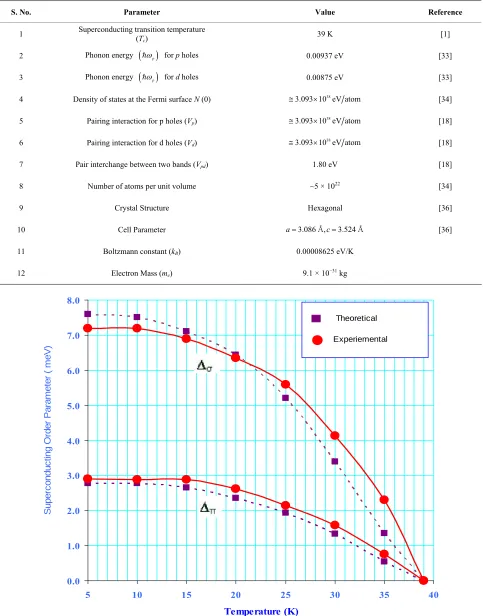
Values of various parameters appearing in equations ob-tained in the previous section are given in Table 1. Using these values, we study the various parameters for the system MgB2.
4.1. Superconducting Order Parameter
For the study of superconducting order parameter for MgB2 system within two band models, one finds the fol- lowing situations,1) The SC order parameter for π- and σ-bands. Using Equation (25), one can write
1
1 1 pd p pd d pp d pp p V G V G V G V G and p d
VpdVpp
G p p G
d d
Changing the variables as p , d p pdy
0
, and taking , we obtain
Solving Equation (37) numerically, one can study the variation of superconductivity order parameters p and
d
with temperature corresponding π- and σ-bands. The behavior of superconducting order parameters correspond- ing to π- and σ-bands with temperature is shown in Fi- gure 1.
2) SC order parameter in the presence of both π- and
σ-bands.
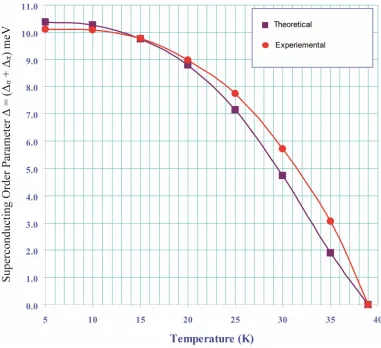
The superconducting order parameter for combined π- and σ-bands can be studied by taking a simple sum of both the parameters. Taking the sum of order parameters
π
, one can obtain the values by solving numerically. A comparison of with BCS type curve is shown in Figure 2.4.2. Electronic Specific Heat (Ces)
1) For π-band
Using Equation (28) and putting a1, a2 and 1 kT, after simplification, we obtain
2 22 2 2 0 0 d sech 2 2 p p p p
es p p
B B N C k T Nk T
(38) yChanging the variables as p p , d p pdy 0 , and using parameters from Table 1 with taking , we obtain 2 2 1 44 2 2 2 0 36.23 2.25 12.105 10 d sech p es C y x y y T T
(39)2) For σ-band
Similarly, we can write expression for specific heat for
σ-band using Equation (29)
2 2 2 2
2 2 2 2
2 2 2
1
102 102
2 2 0.5102 0.5102
0
1
108 108
2 2 0.4444 0.4444
0
108 108
2 2 0.4444
d 1 1
0
0.5102 e 1 e 1
1
1 0
0.4444 e 1 e 1
d 1 1
0
0.4444 e 1 e
pd d
y x y x
T T
pp p
y x y x
T T
pd p
y x y
T T y V N y x y V N y x y V N y x
d 1
2 2 2 1 0.4444 0 1 102 1022 2 0.5102
0
1 1
d 1 1
1 0
0.5102 e 1
x
pp d
y x
y V N
y x
(37)2 0.51022
e T y x 1 T
Table 1. Values of various parameters for MgB2 system.
S. No. Parameter Value Reference
1 Superconducting transition temperature (T
c) 39 K [1]
2 Phonon energy
p for p holes 0.00937 eV [33] 3 Phonon energy
p for d holes 0.00875 eV [33]4 Density of states at the Fermi surface N (0) 3.093 10 eV atom 38 [34]
5 Pairing interaction for p holes (Vp) 3.093 10 eV atom 38 [18]
6 Pairing interaction for d holes (Vd) 3.093 10 eV atom 38 [18]
7 Pair interchange between two bands (Vpd) 1.80 eV [18]
8 Number of atoms per unit volume ~5 × 10²² [34]
9 Crystal Structure Hexagonal [36]
10 Cell Parameter a3.086 ,Åc3.524Å [36]
11 Boltzmann constant (kB) 0.00008625 eV/K
12 Electron Mass (me) 9.1 × 10⁻³¹ kg
0.0 1.0 2.0 3.0 4.0 5.0 6.0 7.0 8.0
5 10 15 20 25 30 35
Temperature (K)
40
Theoretical
Experiemental
S
u
per
c
ond
uc
ti
n
g O
rder
P
ar
a
m
e
ter
(
m
eV
)
[image:6.595.57.540.101.717.2]Figure 2. Variation of superconducting order parameter Δ = (Δπ + Δσ) corresponding to π- and σ-bands with temperature.
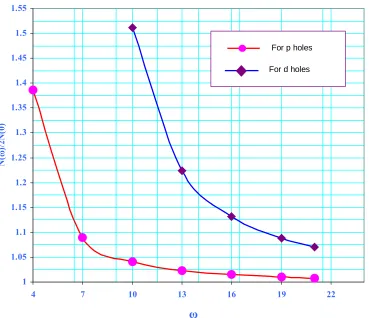
ated the values with different values of x1 and x2 for π- and σ-bands. The behavior of density of states function for both π- and σ-bands is shown in Figure 4.
2 2 1
44
2 2
2 0
36.23 1.96 9.841 10
d sech
d es
y x
C y y
T T
(40)The variation electronic specific heat (Ces) with
tem-perature (T) for π- and σ-band is shown in Figure 3. There is a good agreement with experiment data.
5. Discussion and Conclusions
In the foregoing sections, we have presented the study of superconductivity in MgB2 by canonical two band BCS Hamiltonian containing Fermi surfaces of π- and σ-bands. Following the Green’s function technique and equation of motion method, we have obtained the expressions for superconducting order parameters p and d, elec-
tronic specific heat, and density of states. Making use of values of various parameters given in Table 1 for the system MgB2, we have made study of various physical properties and wherever possible, compared our results with the available experimental data. We observe that
4.3. Density of States
Density of states function for the π-band is given by Equation (35). Now using the following values of y, x1 for p and x2 for d, and taking 0, one obtains,
2 21 2 0
p p
N y
N y x
(41)
Similarly, using Equation (36), density of states for σ-
band is obtained as 1) The transition temperature for our system MgB 2 is found 39 K [1].
2 22 2 0
d d
N y
N y x
(42) gaps 2) The temperature dependent two superconducting
p
and d corresponding to π- and σ-bands for
MgB2 is found. The two gaps structure is perfectly in agreement with experimental observations [29].
Figure 3. Variation of electronic specific heat with temperature for both π- and σ-bands.
1 1.05 1.1 1.15 1.2 1.25 1.3 1.35 1.4 1.45 1.5 1.55
4 7 10 13 16 19 22
ω
N(
ω
)/
2N
(0
)
For p holes
For d holes
[image:8.595.116.485.401.719.2]3) The specific heat behaviour obtained from our model, i.e. Ces versus T is in satisfactory agreement with
experimental results [30]. However, the theoretical val-ues obtained are slightly higher than the experimental ones. This can be attributed to mean field approximations. In our model, the main interaction is Vpd and Vpp & dd are taken zero (being negligibly small). For better
agreement
V
pp and dd have to be considered. Al-
though these interactions are very small in comparison to
V V
pd, but still they have some contribution to the specific
heat of the system. V
4) The density of states behaviour is similar to BCS weak coupling superconductors (Figure 4) correspond- ing to π- and σ-bands. There is marked difference be- tween two curves. This reveals that MgB2 superconduc- tors differ from conventional metallic superconductors. However, the behavior of MgB2 superconductors in this respect resembles to that of high Tc cuprates. This is a
major difference between the two classes of supercon- ductors and may be partly responsible for the difference in their properties. We may note that the density of states for the system MgB2 is quite high [31].
Our model shows reasonable agreement with available experimental data. This mechanism emerges as a strong contender for an acceptable model for MgB2, non cuprate high-Tc superconductor. The efforts to understand the
pairing mechanism in this and other similar systems need to continue, for such efforts go hand-in-hand with en- hancing future prospects for new HTSC materials and novel applications [32-35].
REFERENCES
[1] J. Nagamatsu, N. Nakagawa, T. Muranaka, Y. Zenitani and J. Akimitsu, “Superconductivity at 39 K in Magne- sium Diboride,” Nature, Vol. 410, No. 6824, 2001, pp. 63-64. doi:10.1038/35065039
[2] C. Buzea and T. Yamashita, “Review of the Supercon-ducting Properties of MgB2,” Superconductor Science
and Technology, Vol. 14, No. 11. 2001, p. R115.
[3] S. L. Kakani and S. Kakani, “Superconductivity,” Anshan, Ltd., Kent, 2009.
[4] A. Y. Liu, I. I. Mazin and J. Kortus, “Beyond Eliashberg Superconductivity in MgB2: Anharmonicity, Two-Phonon Scattering, and Multiple Gaps,” Physical Review Letters, Vol. 87, No. 8, 2001, pp. 087005-087009.
doi:10.1103/PhysRevLett.87.087005
[5] J. M. An and W. E. Pickett, “Superconductivity of MgB2: Covalent Bonds Driven Metallic,” Physical Review Let- ters, Vol. 86, No. 19, 2001, pp. 4366-4369.
doi:10.1103/PhysRevLett.86.4366
[6] K. D. Belaschenko, M. von Schilfgaarde and A. V. Antro- pov, “Coexistence of Covalent and Metallic Bonding in the Boron Intercalation Superconductor MgB2,” Physical
Review B, Vol. 64, No. 9, 2001, pp. 092503-092507.
doi:10.1103/PhysRevB.64.092503
[7] D. A. Papaconstantopoulos and M. J. Mehl, “Precise Tight- Binding Description of the Band Structure of MgB2,”
Physical Review B, Vol. 64, No. 17, 2001, pp. 2510-2514
[8] I. I. Mazin and V. P. Antropo, “Electronic Structure, Elec- tron-Phonon Coupling, and Multiband Effects in MgB2,”
Physica C: Superconductivity, Vol. 385, No. 1-2, 2003,
pp. 49-65. doi:10.1016/S0921-4534(02)02299-2
[9] F. Bouqut, Y. Wang, R. A. Fisher, D. G. Hinks, J. D. Jorgensen, A. Junod and N. E. Phillips, “Phenomenol-ogical Two-Gap Model for the Specific Heat of MgB2,”
Europhysics Letters, Vol. 56, No. 6, 2001, p. 856.
doi:10.1209/epl/i2001-00598-7
[10] F. Bouquet, R. A. Fisher, N. E. Phillips, D. G. Hinks and D. Jorgensen, “Specific Heat of Mg11B
2: Evidence for a Second Energy Gap,” Physical Review Letters, Vol. 87, No. 4, 2001, pp. 047001-047005.
doi:10.1103/PhysRevLett.87.047001
[11] Y. Wang, T. Plackowski and A. Junod, “Specific Heat in the Superconducting and Normal State (2-300 K, 0-16 T), and Magnetic Susceptibility of the 38 K Superconductor MgB2: Evidence for a Multicomponent Gap,” Physica C:
Superconductivity, Vol. 355, No. 3-4, 2001, pp. 179-193.
doi:10.1016/S0921-4534(01)00617-7
[12] G. A. Ummarino, R. S. Gonnelli, S. Massidda and A. Bianconi, “Electron-Phonon Coupling and Two-Band Superconductivity of Al- and C-Doped MgB2,” 2010. [13] S. L. Bud’ko, G. Lapertot, C. Petrovic, C. E. Cunningham,
N. Anderson and P. C. Canfield, “Boron Isotope Effect in Superconducting MgB2,” Physical Review Letters, Vol. 86, No. 9, 2001, pp. 1877-1880.
doi:10.1103/PhysRevLett.86.1877
[14] H. Shul, B. T. Matthias and L. R. Walker, “Bardeen-Coo- per-Schrieffer Theory of Superconductivity in the Case of Overlapping Bands,” Physical Review Letters, Vol. 3, No. 12, 1959, pp. 552-554. doi:10.1103/PhysRevLett.3.552 [15] V. A. Moskalenko, M. E. Palistrant and V. M. Vakalyuk,
“High-Temperature Superconductivity and the Characte- ristics of the Electronic Energy Spectrum,” Soviet Physics
Uspekhi, Vol. 34, No. 8, 1991, p. 717.
doi:10.1070/PU1991v034n08ABEH002466
[16] N. Kristoffel, P. Konsin and T. Ord, “Two-Band Model for High-Temperature Superconductivity,” Rivista Del
Nuovo Cimento, Vol. 17, No. 9, 1994, pp. 1-41.
doi:10.1007/BF02724515
[17] N. Kristoffel and P. Rubin, “Pseudogap and Supercon-ductivity Gaps in a Two Band Model with Doping De-termined Components,” Solid State Communications, Vol. 122, No. 5, 2002, pp. 265-268.
[18] B. K. Chakraverty, “Superconductivity in Two Band Model,” Physical Review B, Vol. 48, No. 6, 1993, pp. 4047-4053. doi:10.1103/PhysRevB.48.4047
[19] R. Lal, Ajay, R. L. Hota and S. K. Joshi, “Model for c-Axis Resistivity of Cuprate Superconductors,” Physical
Review B, Vol. 57, No. 10, 1998, pp. 6126-6136.
doi:10.1103/PhysRevB.57.6126
[20] A. Pratap, Ajay and A. S. Tripathi, “Effect of Interlayer Interactions in High-Tc Cuprate Supercoductors,” Journal
doi:10.1007/BF00728239
[21] S. Khandka and P. Singh, “Effect of Interlayer Interaction on Tc with Number of Layers in High Tc Cuprate Super-conductors,” Physica Status Solidi B, Vol. 244, No. 2, 2007, pp. 699-708. doi:10.1002/pssb.200542285
[22] S. Das and N. C. Das, “Erratum: Theory of Hole Super- conductivity,” Physical ReviewB, Vol. 46, No. 10, 1992, pp. 6451-6457. doi:10.1103/PhysRevB.46.6451
[23] S. L. Kakani and U. N. Upadhyaya, “Cooperative Phe-nomena in Ternary Superconductors,” Journal of Low
Temperature Physics, Vol. 53, No. 1-2, 1983, pp. 221-253.
doi:10.1007/BF00685781
[24] S. L. Kakani and U. N. Upadhyaya, “Superconducting and Magnetic Order Parameters in the Coexistence Region of Ternary Superconductors,” Physica Status Solidi B, Vol. 125, No. 2, 1984, pp. 861-867.
doi:10.1002/pssb.2221250249
[25] S. L. Kakani and U. N. Upadhyaya, “Frequency Depen- dent Susceptibility of Rare Earth Ternary Superconduc- tors,” Physica Status Solidi B, Vol. 136, No. 1, 1986, pp. 115-121. doi:10.1002/pssb.2221360113
[26] S. L. Kakani and U. N. Upadhyaya, “Coexistence of Su- perconductivity and Ferromagnetism in Rare Earth Ter- nary Systems,” Physica Status Solidi A, Vol. 99, No. 1, 1987, pp. 15-36. doi:10.1002/pssa.2210990104
[27] S. L. Kakani and U. N. Upadhyaya, “Magnetic Super-conductors: A Review,” Journal of Low Temperature
Physics, Vol. 70, No. 1-2, 1988, pp. 5-82.
doi:10.1007/BF00683246
[28] A. L. Fetter and J. D. Walecka, “Quantum Theory of Many Particle Physics,” McGraw-Hill, New York, 1971. [29] C. Buzea and T. Yamashita, “Review of the Supercon-
ducting Properties of MgB2,” Superconductor Science
and Technology, Vol. 14, No. 11, 2001, p. R115.
doi:10.1088/0953-2048/14/11/201
[30] C. Walti, E. Felder, C. Degen, G. Wigger, R. Monnier, B. Delley and H. R. Ott, “Strong Electron-Phonon Coupling in Superconducting MgB2: A Specific Heat Study,” Phy-
sical Review B, Vol. 64, No. 17, 2001, pp. 172515-
172519. doi:10.1103/PhysRevB.64.172515
[31] N. E. Phillips and R. A. Fisher, “Superconducting-State Energy Gap Parameters from Specific Heat Measure- ments,” Journal of Thermal Analysis and Calorimetry, Vol. 81, No. 3, 2005, pp. 631-635.
doi:10.1007/s10973-005-0835-y
[32] S. L. Kakani, “Superconductivity: Current Topics: Chap- ters 2 and 3,” Bookman Associate, Jaipur, 1999.
[33] S. Kakani and S. L. Kakani, “Theoretical Study of Spe- cific Heat, Density of States and Free Energy of Itinerant Ferromagnetic Superconductor URhGe,” Journal of Su-
perconductivity and Novel Magnetism, Vol. 22, No. 7,
2009, pp. 677-685. doi:10.1007/s10948-009-0465-x [34] A. Kashyap, S. C. Tiwari, A. Surana, R. K. Paliwal and S.
L. Kakani, “Theoretical Study of Specific Heat, Density of States, Free Energy,and Critical Field of High Tem- perature Cuprate Superconductors Based on Intra and In-terlayer Interactions,” Journal of Superconductivity and
Novel Magnetism, Vol. 21, No. 2, 2008, pp. 129-143.
doi:10.1007/s10948-008-0308-1
[35] A. Nuwal, R. K. Paliwal, S. L. Kakani and M. L. Kalara, “Theoretical study of Photoinduced Superconductors in a Two Band Model,” Physica C: Superconductivity, Vol. 471, No. 9-10, 2011, pp. 318-331.
doi:10.1016/j.physc.2011.03.004
[36] G. Alecu, “Reports in Physics,” Romanian Reports in