6558
Multimodal Transformer for Unaligned Multimodal Language Sequences
Yao-Hung Hubert Tsai†∗, Shaojie Bai†∗, Paul Pu Liang†, J. Zico Kolter†‡, Louis-Philippe Morency†, Ruslan Salakhutdinov†
†Carnegie Mellon University,‡Bosch Center for AI
{yaohungt,shaojieb,pliang,zkolter,morency,rsalakhu}@cs.cmu.edu
Abstract
Human language is often multimodal, which comprehends a mixture of natural language, facial gestures, and acoustic behaviors. How-ever, two major challenges in modeling such multimodal human language time-series data
exist: 1) inherent data non-alignment due
to variable sampling rates for the sequences from each modality; and 2) long-range depen-dencies between elements across modalities. In this paper, we introduce the Multimodal Transformer (MulT) to generically address the above issues in an end-to-end manner with-out explicitly aligning the data. At the heart of our model is the directional pairwise cross-modal attention, which attends to interactions between multimodal sequences across distinct time steps and latently adapt streams from one modality to another. Comprehensive experi-ments on both aligned and non-aligned multi-modal time-series show that our model outper-forms state-of-the-art methods by a large mar-gin. In addition, empirical analysis suggests that correlated crossmodal signals are able to be captured by the proposed crossmodal atten-tion mechanism in MulT.
1 Introduction
Human language possesses not only spoken words but also nonverbal behaviors from vision (facial attributes) and acoustic (tone of voice) modali-ties (Gibson et al., 1994). This rich information provides us the benefit of understanding human behaviors and intents (Manning et al.,2014). Nev-ertheless, the heterogeneities across modalities of-ten increase the difficulty of analyzing human lan-guage. For example, the receptors for audio and vision streams may vary with variable receiving frequency, and hence we may not obtain optimal mapping between them. A frowning face may re-late to a pessimistically word spoken in the past.
∗
*equal contribution.
It’s huge sort of spectacle movie Vision
Language
Audio [ ][ ][ ] [ ] [ ][ ]
[
]
…[
]
…[
]
…[
]
… … …[
…]
…[
]
…Vision-to-Language Alignment Audio-to-Language Alignment
(Pre-defined Word-level) Alignment
It’s huge sort of spectacle movie Vision
Language
Audio
…
… … … … … … … …
Vision-to-Language (‘spectacle’) Attention Weights Audio-to-Language (‘spectacle’) Attention Weights
(Ours) Crossmodal Attention
(uninformative) (eyebrows raise)
[image:1.595.309.532.221.412.2](emphasis) (neutral) (emphasis)
Figure 1: Example video clip from movie reviews. [Top]: Illustration of word-level alignment where video and audio features are averaged across the time interval of each spoken word. [Bottom] Illustration of cross-modal attention weights between text (“spectacle”) and vision/audio.
That is to say, multimodal language sequences often exhibit “unaligned” nature and require in-ferring long term dependencies across modalities, which raises a question on performing efficient multimodal fusion.
To address the above issues, in this paper we propose the Multimodal Transformer (MulT), an end-to-end model that extends the standard Trans-former network (Vaswani et al.,2017) to learn rep-resentations directly from unaligned multimodal streams. At the heart of our model is the cross-modal attention module, which attends to the crossmodal interactions at the scale of the entire utterances. This module latently adapts streams from one modality to another (e.g., vision →
language) by repeated reinforcing one modality’s
re-gardless of the need for alignment. In compari-son, one common way of tackling unaligned mul-timodal sequence is by forced word-aligning be-fore training (Poria et al., 2017; Zadeh et al.,
2018a,b; Tsai et al., 2019; Pham et al., 2019;
Gu et al., 2018): manually preprocess the vi-sual and acoustic features by aligning them to the resolution of words. These approaches would then model the multimodal interactions on the (al-ready) aligned time steps and thus do not directly consider long-range crossmodal contingencies of the original features. We note that such word-alignment not only requires feature engineering that involves domain knowledge; but in practice, it may also not always be feasible, as it entails extra meta-information about the datasets (e.g., the exact time ranges of words or speech utter-ances). We illustrate the difference between the word-alignment and the crossmodal attention in-ferred by our model in Figure1.
For evaluation, we perform a comprehensive set of experiments on three human multimodal lan-guage benchmarks: CMU-MOSI (Zadeh et al.,
2016), CMU-MOSEI (Zadeh et al., 2018b), and IEMOCAP (Busso et al., 2008). Our experi-ments show that MulT achieves the state-of-the-art (SOTA) results in not only the commonly eval-uated word-aligned setting but also the more chal-lenging unaligned scenario, outperforming prior approaches by a margin of 5%-15% on most of the metrics. In addition, empirical qualitative analysis further suggests that the crossmodal attention used by MulT is capable of capturing correlated signals across asynchronous modalities.
2 Related Works
Human Multimodal Language Analysis. Prior work for analyzing human multimodal language lies in the domain of inferring representations from multimodal sequences spanning language, vision, and acoustic modalities. Unlike learning multimodal representations from static domains such as image and textual attributes (Ngiam et al.,
2011; Srivastava and Salakhutdinov, 2012), hu-man language contains time-series and thus re-quires fusing time-varying signals (Liang et al.,
2018; Tsai et al., 2019). Earlier work used early fusion approach to concatenate input fea-tures from different modalities (Lazaridou et al.,
2015;Ngiam et al., 2011) and showed improved performance as compared to learning from a
sin-gle modality. More recently, more advanced mod-els were proposed to learn representations of hu-man multimodal language. For example,Gu et al.
(2018) used hierarchical attention strategies to learn multimodal representations, Wang et al.
(2019) adjusted the word representations using ac-companying non-verbal behaviors, Pham et al.
(2019) learned robust multimodal representations using a cyclic translation objective, andDumpala et al. (2019) explored cross-modal autoencoders for audio-visual alignment. These previous ap-proaches relied on the assumption that multimodal language sequences are already aligned in the res-olution of words and considered only short-term multimodal interactions. In contrast, our proposed method requires no alignment assumption and de-fines crossmodal interactions at the scale of the en-tire sequences.
Transformer Network. Transformer net-work (Vaswani et al., 2017) was first introduced for neural machine translation (NMT) tasks, where the encoder and decoder side each lever-ages a self-attention (Parikh et al., 2016; Lin et al., 2017; Vaswani et al., 2017) transformer. After each layer of the self-attention, the encoder and decoder are connected by an additional decoder sublayer where the decoder attends to each element of the source text for each element of the target text. We refer the reader to (Vaswani et al., 2017) for a more detailed explanation of the model. In addition to NMT, transformer networks have also been successfully applied to other tasks, including language modeling (Dai et al., 2018; Baevski and Auli, 2019), semantic role labeling (Strubell et al., 2018), word sense disambiguation (Tang et al., 2018), learning sentence representations (Devlin et al.,2018), and video activity recognition (Wang et al.,2018).
Crossmodal Transformer (V!L)
(A!L) (A!V) (V!A) Transformer Transformer Transformer
Prediction ˆy
Concatenation
Conv1D Conv1D Conv1D Positional
Embedding
XL2RTL⇥dL XV2RTV⇥dV XA2RTA⇥dA
Crossmodal Attention Self Attention
Bl
ock
i
=1
,.
..,
D
Crossmodal Transformer (L!V)
Crossmodal Transformer (L!A)
Multimodal Transformer
[image:3.595.74.295.62.222.2]ZL2RTL⇥2d ZV2RTV⇥2d ZA2RTA⇥2d
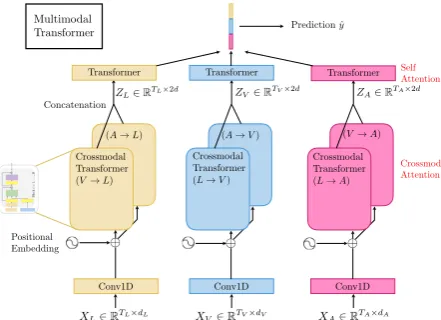
Figure 2: Overall architecture for MulT on modalities (L, V, A). The crossmodal transformers, which sug-gests latent crossmodal adaptations, are the core com-ponents of MulT for multimodal fusion.
is built up from multiple stacks of pairwise and bidirectional crossmodal attention blocks that di-rectly attend to low-level features (while remov-ing the self-attention). Empirically, we show that our proposed approach improves beyond standard transformer on various human multimodal lan-guage tasks.
3 Proposed Method
In this section, we describe our proposed Multi-modal Transformer (MulT) (Figure 2) for mod-eling unaligned multimodal language sequences. At the high level, MulT merges multimodal time-series via a feed-forward fusion process from mul-tiple directional pairwise crossmodal transform-ers. Specifically, each crossmodal transformer (introduced in Section 3.2) serves to repeatedly reinforce a target modality with the low-level features from another source modality by learn-ing the attention across the two modalities’ fea-tures. A MulT architecture hence models all pairs of modalities with such crossmodal transformers, followed by sequence models (e.g., self-attention transformer) that predicts using the fused features.
The core of our proposed model is crossmodal attention module, which we first introduce in Sec-tion3.1. Then, in Section3.2and3.3, we present in details the various ingredients of the MulT ar-chitecture (see Figure2) and discuss the difference between crossmodal attention and classical multi-modal alignment.
3.1 Crossmodal Attention
We consider two modalities α and β, with two (potentially non-aligned) sequences from each of them denotedXα ∈ RTα×dα andXβ ∈ RTβ×dβ,
respectively. For the rest of the paper,T(·)andd(·)
are used to represent sequence length and feature dimension, respectively. Inspired by the decoder transformer in NMT (Vaswani et al., 2017) that translates one language to another, we hypothesize a good way to fuse crossmodal information is pro-viding a latent adaptation across modalities; i.e.,β toα. Note that the modalities consider in our pa-per may span very different domains such as facial attributes and spoken words.
We define theQuerys asQα =XαWQα,Keys
asKβ = XβWKβ, andValues asVβ =XβWVβ,
where WQα ∈ R
dα×dk, W
Kβ ∈ R
dβ×dk and
WVβ ∈ R
dβ×dv are weights. The latent
adapta-tion from β toα is presented as the crossmodal attentionYα:=CMβ→α(Xα, XB)∈RTα×dv:
Yα=CMβ→α(Xα, Xβ)
=softmax QαK > β
√ dk
! Vβ
=softmax
XαWQαW > KβX
> β
√ dk
! XβWVβ.
(1)
Note that Yα has the same length as Qα (i.e.,
Tα), but is meanwhile represented in the feature
space of Vβ. Specifically, the scaled (by
√
dk)
softmax in Equation (1) computes a score matrix
softmax (·)∈RTα×Tβ, whose(i, j)-th entry
mea-sures the attention given by thei-th time step of modality α to the j-th time step of modality β. Hence, thei-th time step ofYαis a weighted
sum-mary of Vβ, with the weight determined byi-th
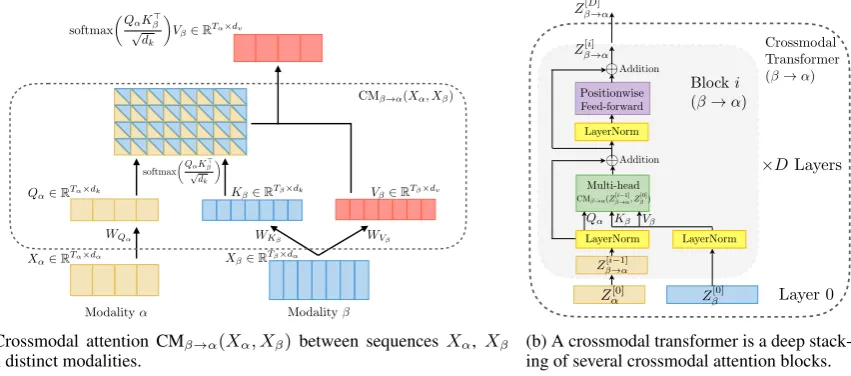
row insoftmax(·). We call Equation (1) a single-headcrossmodal attention, which is illustrated in Figure3(a).
Following prior works on transform-ers (Vaswani et al., 2017; Chen et al., 2018;
softmax
✓Q
↵K>
p
dk
◆
V 2RT↵⇥dv
CM!↵(X↵, X)
softmax ✓Q↵K>
pdk
◆
Q↵2RT↵⇥dk K 2RT⇥dk V 2RT⇥dv
X↵2RT↵⇥d↵ X 2RT⇥d↵
WQ↵ WK WV
Modality↵ Modality
(a) Crossmodal attention CMβ→α(Xα, Xβ) between sequencesXα, Xβ
from distinct modalities.
Multi-head Positionwise Feed-forward
⇥DLayers
Layer 0
Z[0]
↵ Z
[0]
Crossmodal Transformer ( !↵)
Blocki
( !↵)
CM!↵(Z[i1]
!↵, Z
[0] )
Z[i!1]↵ Z[i!]↵ Z[D!]↵
Q↵ K V
LayerNorm LayerNorm
LayerNorm
Addition Addition
[image:4.595.94.520.64.252.2](b) A crossmodal transformer is a deep stack-ing of several crossmodal attention blocks.
Figure 3: Architectural elements of a crossmodal transformer between two time-series from modalityαandβ.
from low-level feature benefits our model to preserve the low-level information for each modality. We leave the empirical study for adapting from intermediate-level features (i.e., Zβ[i−1]) in Ablation Study in Section4.3.
3.2 Overall Architecture
Three major modalities are typically involved in multimodal language sequences: language (L), video (V), and audio (A) modalities. We de-note with X{L,V,A} ∈ RT{L,V,A}×d{L,V,A} the
in-put feature sequences (and the dimensions thereof) from these 3 modalities. With these notations, in this subsection, we describe in greater details the components of Multimodal Transformer and how crossmodal attention modules are applied.
Temporal Convolutions. To ensure that each el-ement of the input sequences has sufficient aware-ness of its neighborhood elements, we pass the input sequences through a 1D temporal convolu-tional layer:
ˆ
X{L,V,A} =Conv1D(X{L,V,A}, k{L,V,A})∈RT{L,V,A}×d (2) wherek{L,V,A} are the sizes of the convolutional
kernels for modalities{L, V, A}, anddis a com-mon dimension. The convolved sequences are expected to contain the local structure of the se-quence, which is important since the sequences are collected at different sampling rates. More-over, since the temporal convolutions project the features of different modalities to the same di-mensiond, the dot-products are admittable in the crossmodal attention module.
Positional Embedding. To enable the se-quences to carry temporal information, follow-ing (Vaswani et al.,2017), we augment positional embedding (PE) toXˆ{L,V,A}:
Z{[0]L,V,A} = ˆX{L,V,A}+PE(T{L,V,A}, d) (3)
where PE(T{L,V,A}, d) ∈ RT{L,V,A}×d computes
the (fixed) embeddings for each position index,
andZ{[0]L,V,A} are the resulting low-level
position-aware features for different modalities. We leave more details of the positional embedding to Ap-pendixA.
Crossmodal Transformers. Based on the cross-modal attention blocks, we design the crosscross-modal transformer that enables one modality for receiv-ing information from another modality. In the fol-lowing, we use the example for passing vision (V) information to language (L), which is denoted by “V → L”. We fix all the dimensions (d{α,β,k,v})
for each crossmodal attention block asd.
Each crossmodal transformer consists ofD lay-ers of crossmodal attention blocks (see Figure
3(b)). Formally, a crossmodal transformer com-putes feed-forwardly fori= 1, . . . , Dlayers:
ZV[0]→L=Z
[0] L ˆ
ZV[i]→L=CMV[i]→,mulL(LN(ZV[i−→1]L),LN(ZV[0])) +LN(ZV[i−→1]L)
ZV[i]→L=fθ[i]
V→L
(LN( ˆZV[i]→L)) +LN( ˆZV[i]→L)
(4) wherefθ is a positionwise feed-forward sublayer
=no attention weight Time
Time
Ti
me
Ti
me
M
o
d
al
it
y
↵
Modality
Explicit alignment written in the form of a crossmodal attention matrix
A learned crossmodal attention in MulT
[image:5.595.307.525.61.231.2]=little attention weight
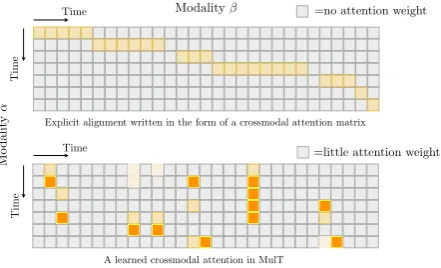
Figure 4: An example of visualizing alignment using
attention matrix from modality β toα. Multimodal
alignment is a special (monotonic) case for crossmodal attention.
divisible by the number of heads). LN means layer normalization (Ba et al.,2016).
In this process, each modality keeps updating its sequence via low-level external information from the multi-head crossmodal attention module. At every level of the crossmodal attention block, the low-level signals from source modality are trans-formed to a different set ofKey/Valuepairs to in-teract with the target modality. Empirically, we find that the crossmodal transformer learns to cor-relate meaningful elements across modalities (see Section4for details). The eventual MulT is based on modeling every pair of crossmodal interactions. Therefore, with3modalities (i.e.,L, V, A) in con-sideration, we have6crossmodal transformers in total (see Figure2).
Self-Attention Transformers and Prediction. As a final step, we concatenate the outputs from the crossmodal transformers that share the same target modality to yieldZ{L,V,A} ∈ RT{L,V,A}×2d.
For example, ZL = [ZV[D]→L;Z [D]
A→L]. Each of
them is then passed through a sequence model to collect temporal information to make predictions. We choose the self-attention transformer (Vaswani et al.,2017). Eventually, the last elements of the sequences models are extracted to pass through fully-connected layers to make predictions.
3.3 Discussion about Attention & Alignment
When modeling unaligned multimodal language sequences, MulT relies on crossmodal atten-tion blocks to merge signals across modalities. While the multimodal sequences were (manually) aligned to the same length in prior works be-fore training (Zadeh et al., 2018b; Liang et al.,
Metric Acch7 Acch2 F1h MAE`Corrh
(Word Aligned)CMU-MOSI Sentiment
EF-LSTM 33.7 75.3 75.2 1.023 0.608 LF-LSTM 35.3 76.8 76.7 1.015 0.625 RMFN (Liang et al.,2018) 38.3 78.4 78.0 0.922 0.681 MFM (Tsai et al.,2019) 36.2 78.1 78.1 0.951 0.662 RAVEN (Wang et al.,2019) 33.2 78.0 76.6 0.915 0.691 MCTN (Pham et al.,2019) 35.6 79.3 79.1 0.909 0.676
MulT (ours) 40.0 83.0 82.8 0.871 0.698
(Unaligned)CMU-MOSI Sentiment
CTC (Graves et al.,2006) + EF-LSTM 31.0 73.6 74.5 1.078 0.542 LF-LSTM 33.7 77.6 77.8 0.988 0.624 CTC + MCTN (Pham et al.,2019) 32.7 75.9 76.4 0.991 0.613 CTC + RAVEN (Wang et al.,2019) 31.7 72.7 73.1 1.076 0.544
[image:5.595.74.295.62.196.2]MulT (ours) 39.1 81.1 81.0 0.889 0.686
Table 1: Results for multimodal sentiment analysis on CMU-MOSI with aligned and non-aligned multimodal
sequences.hmeans higher is better and`means lower
is better. EF stands for early fusion, and LF stands for late fusion.
2018;Tsai et al., 2019;Pham et al., 2019;Wang et al.,2019), we note that MulT looks at the non-alignment issue through a completely different lens. Specifically, for MulT, the correlations be-tween elements of multiple modalities are purely based on attention. In other words, MulT does not handle modality non-alignment by (simply) align-ing them; instead, the crossmodal attention en-courages the model to directly attend to elements in other modalities where strong signals or rele-vant information is present. As a result, MulT can capture long-range crossmodal contingencies in a way that conventional alignment could not eas-ily reveal. Classical crossmodal alignment, on the other hand, can be expressed as a special (step di-agonal) crossmodal attention matrix (i.e., mono-tonic attention (Yu et al., 2016)). We illustrate their differences in Figure4.
4 Experiments
Metric Acch7 Acch2 F1h MAE` Corrh
(Word Aligned)CMU-MOSEI Sentiment
EF-LSTM 47.4 78.2 77.9 0.642 0.616 LF-LSTM 48.8 80.6 80.6 0.619 0.659 Graph-MFN (Zadeh et al.,2018b) 45.0 76.9 77.0 0.71 0.54
RAVEN (Wang et al.,2019) 50.0 79.1 79.5 0.614 0.662 MCTN (Pham et al.,2019) 49.6 79.8 80.6 0.609 0.670
MulT (ours) 51.8 82.5 82.3 0.580 0.703
(Unaligned)CMU-MOSEI Sentiment
CTC (Graves et al.,2006) + EF-LSTM 46.3 76.1 75.9 0.680 0.585 LF-LSTM 48.8 77.5 78.2 0.624 0.656 CTC + RAVEN (Wang et al.,2019) 45.5 75.4 75.7 0.664 0.599 CTC + MCTN (Pham et al.,2019) 48.2 79.3 79.7 0.631 0.645
[image:6.595.72.294.59.221.2]MulT (ours) 50.7 81.6 81.6 0.591 0.694
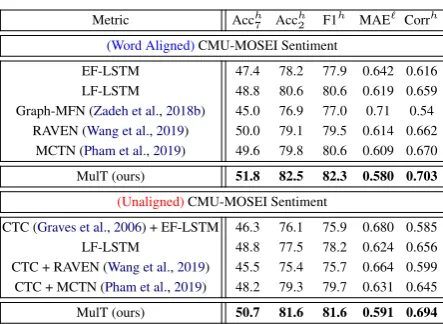
Table 2: Results for multimodal sentiment analysis on (relatively large scale) CMU-MOSEI with aligned and non-aligned multimodal sequences.
4.1 Datasets and Evaluation Metrics
Each task consists of aword-aligned(processed in the same way as in prior works) and anunaligned
version. For both versions, the multimodal features are extracted from the textual (GloVe word embeddings (Pennington et al., 2014)), vi-sual (Facet (iMotions, 2017)), and acoustic (CO-VAREP (Degottex et al., 2014)) data modalities. A more detailed introduction to the features is in-cluded in Appendix.
For the word-aligned version, following (Zadeh et al.,2018a;Tsai et al.,2019;Pham et al.,2019), we first use P2FA (Yuan and Liberman, 2008) to obtain the aligned timesteps (segmented w.r.t. words) for audio and vision streams, and we then perform averaging on the audio and vision fea-tures within these time ranges. All sequences in the word-aligned case have length 50. The pro-cess remains the same across all the datasets. On the other hand, for the unaligned version, we keep the original audio and visual features as extracted, without any word-segmented alignment or man-ual subsampling. As a result, the lengths of each modality vary significantly, where audio and vi-sion sequences may contain up to > 1,000time steps. We elaborate on the three tasks below.
CMU-MOSI & MOSEI. CMU-MOSI (Zadeh et al., 2016) is a human multimodal sentiment analysis dataset consisting of 2,199 short mono-logue video clips (each lasting the duration of a sentence). Acoustic and visual features of CMU-MOSI are extracted at a sampling rate of12.5and
15 Hz, respectively (while textual data are seg-mented per word and expressed as discrete word
embeddings). Meanwhile, CMU-MOSEI (Zadeh et al., 2018b) is a sentiment and emotion analy-sis dataset made up of 23,454 movie review video clips taken from YouTube (about 10× the size of CMU-MOSI). The unaligned CMU-MOSEI se-quences are extracted at a sampling rate of20Hz for acoustic and15Hz for vision signals.
For both CMU-MOSI and CMU-MOSEI, each sample is labeled by human annotators with a sentiment score from -3 (strongly negative) to 3 (strongly positive). We evaluate the model per-formances using various metrics, in agreement with those employed in prior works: 7-class ac-curacy (i.e., Acc7: sentiment score classification
inZ∩[−3,3]), binary accuracy (i.e., Acc2:
pos-itive/negative sentiments), F1 score, mean abso-lute error (MAE) of the score, and the correlation of the model’s prediction with human. Both tasks are frequently used to benchmark models’ ability to fuse multimodal (sentiment) information ( Po-ria et al.,2017;Zadeh et al., 2018a;Liang et al.,
2018;Tsai et al., 2019;Pham et al., 2019;Wang et al.,2019).
IEMOCAP. IEMOCAP (Busso et al., 2008) consists of 10K videos for human emotion anal-ysis. As suggested byWang et al.(2019), 4 emo-tions (happy, sad, angry and neutral) were selected for emotion recognition. Unlike CMU-MOSI and CMU-MOSEI, this is a multilabel task (e.g., a per-son can be sad and angry simultaneously). Its mul-timodal streams consider fixed sampling rate on audio (12.5 Hz) and vision (15 Hz) signals. We follow (Poria et al.,2017;Wang et al.,2019;Tsai et al.,2019) to report the binary classification ac-curacy and the F1 score of the predictions.
4.2 Baselines
We choose Early Fusion LSTM (EF-LSTM) and Late Fusion LSTM (LF-LSTM) as baseline mod-els, as well as Recurrent Attended Variation Embedding Network (RAVEN) (Wang et al.,
2019) and Multimodal Cyclic Translation Net-work (MCTN) (Pham et al.,2019), that achieved SOTA results on various word-aligned human multimodal language tasks. To compare the mod-els comprehensively, we adapt the connection-ist temporal classification (CTC) (Graves et al.,
Task Happy Sad Angry Neutral Metric Acch F1h Acch F1h Acch F1h Acch F1h
(Word Aligned)IEMOCAP Emotions
EF-LSTM 86.0 84.2 80.2 80.5 85.2 84.5 67.8 67.1 LF-LSTM 85.1 86.3 78.9 81.7 84.7 83.0 67.1 67.6 RMFN (Liang et al.,2018) 87.5 85.8 83.8 82.9 85.1 84.6 69.5 69.1 MFM (Tsai et al.,2019) 90.2 85.8 88.4 86.1 87.5 86.7 72.1 68.1 RAVEN (Wang et al.,2019) 87.3 85.8 83.4 83.1 87.3 86.7 69.7 69.3 MCTN (Pham et al.,2019) 84.9 83.1 80.5 79.6 79.7 80.4 62.3 57.0
MulT (ours) 90.7 88.6 86.7 86.0 87.4 87.0 72.4 70.7
(Unaligned)IEMOCAP Emotions
CTC (Graves et al.,2006) + EF-LSTM 76.2 75.7 70.2 70.5 72.7 67.1 58.1 57.4 LF-LSTM 72.5 71.8 72.9 70.4 68.6 67.9 59.6 56.2 CTC + RAVEN (Wang et al.,2019) 77.0 76.8 67.6 65.6 65.0 64.1 62.0 59.5 CTC + MCTN (Pham et al.,2019) 80.5 77.5 72.0 71.7 64.9 65.6 49.4 49.3
[image:7.595.142.457.60.242.2]MulT (ours) 84.8 81.9 77.7 74.1 73.9 70.2 62.5 59.7
Table 3: Results for multimodal emotions analysis on IEMOCAP with aligned and non-aligned multimodal se-quences.
objective and the human multimodal objective si-multaneously. We leave more detailed treatment of the CTC module to Appendix. For fair compar-isons, we control the number of parameters of all models to be approximately the same. The hyper-parameters are reported in Appendix.1
4.3 Quantitative Analysis
Word-Aligned Experiments. We first evaluate MulT on theword-aligned sequences— the “home turf” of prior approaches modeling human multi-modal language (Sheikh et al., 2018; Tsai et al.,
2019;Pham et al.,2019;Wang et al.,2019). The upper part of the Table1,2, and3show the results of MulT and baseline approaches on the word-aligned task. With similar model sizes (around 200K parameters), MulT outperforms the other competitive approaches on different metrics on all tasks, with the exception of the “sad” class results on IEMOCAP.
Unaligned Experiments. Next, we evaluate MulT on the same set of datasets in the unaligned setting. Note that MulT can be directly applied to unaligned multimodal stream, while the baseline models (except for LF-LSTM) require the need of additional alignment module (e.g., CTC module).
The results are shown in the bottom part of Ta-ble1,2, and3. On the three benchmark datasets, MulT improves upon the prior methods (some with CTC) by 10%-15% on most attributes.
Em-1All experiments are conducted on 1 GTX-1080Ti
GPU. The code for our model and experiments can be found in https://github.com/yaohungt/ Multimodal-Transformer
1 2 3 4 5 6 7 8 9 10 11 12 13 14 15 16 17 18 19 20 Epochs
0.575 0.600 0.625 0.650 0.675 0.700 0.725 0.750 0.775
Mean Average Error
(Unaligned) MOSEI Validation Performance
MulT LFLSTM CTC+RAVEN CTC+MCTN CTC+EFLSTM
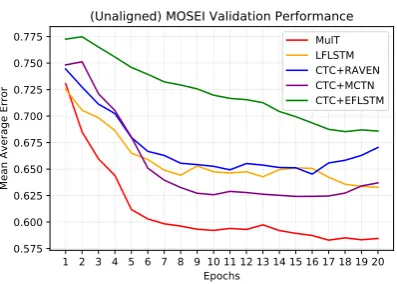
Figure 5: Validation set convergence of MulT when
compared to other baselines on the unaligned
CMU-MOSEI task.
pirically, we find that MulT converges faster to better results at training when compared to other competitive approaches (see Figure 5). In addi-tion, while we note that in general there is a per-formance drop on all models when we shift from the word-aligned to unaligned multimodal time-series, the impact MulT takes is much smaller than the other approaches. We hypothesize such perfor-mance drop occurs because the asynchronous (and much longer) data streams introduce more diffi-culty in recognizing important features and com-puting the appropriate attention.
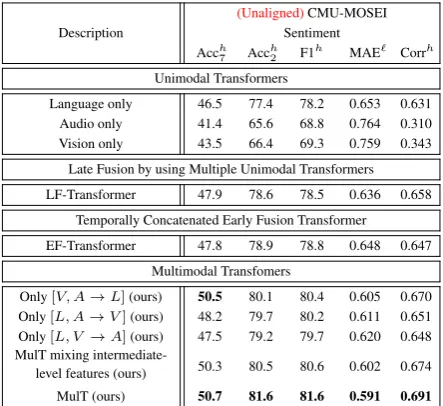
Ablation Study. To further study the influence of the individual components in MulT, we per-form comprehensive ablation analysis using the unaligned version of CMU-MOSEI. The results are shown in Table4.
[image:7.595.310.509.303.445.2]disappointingtoo and horribletoo
[sp]is moviethis
of endingthe unfortunatelybut
Te
x
t
Vision
Ti
me Each block is a few video frames Time (Summarized by temporal convolutions)
Lots of facial motions during this time (Waving DVD case angrily)
Frowned
Impatient/Angry
Movie reviewer emphasizes “butunfortunately” & frowns (With drastic expression changes)
[image:8.595.108.494.63.201.2]Emphasized
Figure 6: Visualization of sample crossmodal attention weights from layer 3 of[V →L]crossmodal transformer
on CMU-MOSEI. We found that the crossmodal attention has learned to correlate certain meaningful words (e.g., “movie”, “disappointing”) with segments of stronger visual signals (typically stronger facial motions or expression
change), despite the lack of alignment between originalL/V sequences. Note that due to temporal convolution,
each textual/visual feature contains the representation of nearby elements.
(Unaligned)CMU-MOSEI Description Sentiment
Acch7 Acch2 F1h MAE` Corrh
Unimodal Transformers
Language only 46.5 77.4 78.2 0.653 0.631 Audio only 41.4 65.6 68.8 0.764 0.310 Vision only 43.5 66.4 69.3 0.759 0.343
Late Fusion by using Multiple Unimodal Transformers
LF-Transformer 47.9 78.6 78.5 0.636 0.658
Temporally Concatenated Early Fusion Transformer
EF-Transformer 47.8 78.9 78.8 0.648 0.647
Multimodal Transfomers
Only[V, A→L](ours) 50.5 80.1 80.4 0.605 0.670 Only[L, A→V](ours) 48.2 79.7 80.2 0.611 0.651 Only[L, V →A](ours) 47.5 79.2 79.7 0.620 0.648 MulT mixing
intermediate-level features (ours) 50.3 80.5 80.6 0.602 0.674
[image:8.595.71.293.292.495.2]MulT (ours) 50.7 81.6 81.6 0.591 0.691
Table 4: An ablation study on the benefit of MulT’s crossmodal transformers using CMU-MOSEI.).
using unimodal transformers (i.e., language, au-dio or vision only). We find that the language transformer outperforms the other two by a large margin. For example, for the Acch2 metric, the model improves from65.6to77.4when compar-ing audio only to language only unimodal trans-former. This fact aligns with the observations in prior work (Pham et al.,2019), where the authors found that a good language network could already achieve good performance at inference time.
Second, we consider 1) a late-fusion trans-former that feature-wise concatenates the last elements of three self-attention transformers; and 2) an early-fusion self-attention trans-former that takes in a temporal concatenation of
three asynchronous sequences [ ˆXL,XˆV,XˆA] ∈ R(TL+TV+TA)×dq (see Section 3.2). Empirically,
we find that both EF- and LF-Transformer (which fuse multimodal signals) outperform unimodal transformers.
Finally, we study the importance of individ-ual crossmodal transformers according to the tar-get modalities (i.e., using[V, A → L], [L, A → V], or [L, V → A] network). As shown in Table 4, we find crossmodal attention modules consistently improve over the late- and early-fusion transformer models in most metrics on un-aligned CMU-MOSEI. In particular, among the three crossmodal transformers, the one where language(L) is the target modality works best. We also additionally study the effect of adapt-ing intermediate-level instead of the low-level fea-tures from source modality in crossmodal atten-tion blocks (similar to the NMT encoder-decoder architecture but without self-attention; see Sec-tion 3.1). While MulT leveraging intermediate-level features still outperform models in other ab-lative settings, we empirically find adapting from low-level features works best. The ablations sug-gest that crossmodal attention concretely benefits MulT with better representation learning.
4.4 Qualitative Analysis
L network of MulT (the original matrix has di-mensionTL×TV; the figure shows the attention
corresponding to approximately a 6-sec short win-dow of that matrix). We find that crossmodal at-tention has learned to attend to meaningful signals across the two modalities. For example, stronger attention is given to the intersection of words that tend to suggest emotions (e.g., “movie”, “disap-pointing”) and drastic facial expression changes in the video (start and end of the above vision se-quence). This observation advocates one of the aforementioned advantage of MulT over conven-tional alignment (see Section 3.3): crossmodal attention enables MulT to directly capture po-tentially long-range signals, including those off-diagonals on the attention matrix.
5 Discussion
In the paper, we propose Multimodal Trans-former (MulT) for analyzing human multimodal language. At the heart of MulT is the cross-modal attention mechanism, which provides a la-tent crossmodal adaptation that fuses multimodal information by directly attending to low-level fea-tures in other modalities. Whereas prior ap-proaches focused primarily on the aligned multi-modal streams, MulT serves as a strong baseline capable of capturing long-range contingencies, re-gardless of the alignment assumption. Empiri-cally, we show that MulT exhibits the best perfor-mance when compared to prior methods.
We believe the results of MulT on unaligned human multimodal language sequences suggest many exciting possibilities for its future appli-cations (e.g., Visual Question Answering tasks, where the input signals is a mixture of static and time-evolving signals). We hope the emergence of MulT could encourage further explorations on tasks where alignment used to be considered nec-essary, but where crossmodal attention might be an equally (if not more) competitive alternative.
Acknowledgements
This work was supported in part by DARPA HR00111990016, AFRL FA8750-18-C-0014, NSF IIS1763562 #1750439 #1722822, Apple, Google focused award, and Samsung. We would also like to acknowledge NVIDIA’s GPU support.
References
Jimmy Lei Ba, Jamie Ryan Kiros, and Geoffrey E
Hin-ton. 2016. Layer normalization. arXiv preprint
arXiv:1607.06450.
Alexei Baevski and Michael Auli. 2019. Adaptive in-put representations for neural language modeling. In International Conference on Learning Representa-tions (ICLR).
Carlos Busso, Murtaza Bulut, Chi-Chun Lee, Abe Kazemzadeh, Emily Mower, Samuel Kim, Jean-nette N Chang, Sungbok Lee, and Shrikanth S Narayanan. 2008. Iemocap: Interactive emotional
dyadic motion capture database. Language
re-sources and evaluation, 42(4):335.
Mia Xu Chen, Orhan Firat, Ankur Bapna, Melvin Johnson, Wolfgang Macherey, George Foster, Llion Jones, Mike Schuster, Noam Shazeer, Niki Parmar, Ashish Vaswani, Jakob Uszkoreit, Lukasz Kaiser, Zhifeng Chen, Yonghui Wu, and Macduff Hughes. 2018. The best of both worlds: Combining recent
advances in neural machine translation. InACL.
Zihang Dai, Zhilin Yang, Yiming Yang, William W Cohen, Jaime Carbonell, Quoc V Le, and Ruslan
Salakhutdinov. 2018. Transformer-xl: Language
modeling with longer-term dependency.
Gilles Degottex, John Kane, Thomas Drugman, Tuomo Raitio, and Stefan Scherer. 2014. Covarepa collabo-rative voice analysis repository for speech
technolo-gies. InICASSP. IEEE.
Jacob Devlin, Ming-Wei Chang, Kenton Lee, and Kristina Toutanova. 2018. Bert: Pre-training of deep bidirectional transformers for language understand-ing.arXiv preprint arXiv:1810.04805.
Sri Harsha Dumpala, Rupayan Chakraborty, and
Sunil Kumar Kopparapu. 2019. Audio-visual
fu-sion for sentiment classification using cross-modal
autoencoder. NIPS.
Paul Ekman. 1992. An argument for basic emotions. Cognition & emotion, 6(3-4):169–200.
Paul Ekman, Wallace V Freisen, and Sonia Ancoli.
1980. Facial signs of emotional experience. Journal
of personality and social psychology, 39(6):1125.
Kathleen R Gibson, Kathleen Rita Gibson, and Tim
In-gold. 1994. Tools, language and cognition in human
evolution. Cambridge University Press.
Alex Graves, Santiago Fern´andez, Faustino Gomez,
and J¨urgen Schmidhuber. 2006. Connectionist
temporal classification: Labelling unsegmented
se-quence data with recurrent neural networks. In
ICML.
with word-level alignment. In Proceedings of the 56th Annual Meeting of the Association for Compu-tational Linguistics. Association for Computational Linguistics.
iMotions. 2017.Facial expression analysis.
Angeliki Lazaridou, Nghia The Pham, and Marco Ba-roni. 2015. Combining language and vision with
a multimodal skip-gram model. arXiv preprint
arXiv:1501.02598.
Paul Pu Liang, Ziyin Liu, Amir Zadeh, and
Louis-Philippe Morency. 2018. Multimodal language
analysis with recurrent multistage fusion. EMNLP.
Zhouhan Lin, Minwei Feng, Cicero Nogueira dos San-tos, Mo Yu, Bing Xiang, Bowen Zhou, and Yoshua Bengio. 2017. A structured self-attentive sentence
embedding. arXiv preprint arXiv:1703.03130.
Christopher D. Manning, Mihai Surdeanu, John Bauer, Jenny Finkel, Prismatic Inc, Steven J. Bethard, and David Mcclosky. 2014. The stanford corenlp
natu-ral language processing toolkit. InIn ACL, System
Demonstrations.
Jiquan Ngiam, Aditya Khosla, Mingyu Kim, Juhan Nam, Honglak Lee, and Andrew Y Ng. 2011.
Multi-modal deep learning. InProceedings of the 28th
in-ternational conference on machine learning
(ICML-11), pages 689–696.
Ankur P Parikh, Oscar T¨ackstr¨om, Dipanjan Das, and Jakob Uszkoreit. 2016. A decomposable attention model for natural language inference. arXiv preprint arXiv:1606.01933.
Jeffrey Pennington, Richard Socher, and Christopher
Manning. 2014. Glove: Global vectors for word
representation. InProceedings of the 2014
confer-ence on empirical methods in natural language pro-cessing (EMNLP), pages 1532–1543.
Hai Pham, Paul Pu Liang, Thomas Manzini, Louis-Philippe Morency, and Barnabas Poczos. 2019. Found in translation: Learning robust joint repre-sentations by cyclic translations between modalities. AAAI.
Soujanya Poria, Erik Cambria, Devamanyu Hazarika, Navonil Majumder, Amir Zadeh, and Louis-Philippe Morency. 2017. Context-dependent sentiment anal-ysis in user-generated videos. InProceedings of the 55th Annual Meeting of the Association for Compu-tational Linguistics (Volume 1: Long Papers), vol-ume 1, pages 873–883.
Peter Shaw, Jakob Uszkoreit, and Ashish Vaswani. 2018. Self-attention with relative position represen-tations.
Imran Sheikh, Sri Harsha Dumpala, Rupayan
Chakraborty, and Sunil Kumar Kopparapu. 2018. Sentiment analysis using imperfect views from
spoken language and acoustic modalities. In
Proceedings of Grand Challenge and Workshop on Human Multimodal Language (Challenge-HML), pages 35–39.
Nitish Srivastava and Ruslan R Salakhutdinov. 2012. Multimodal learning with deep boltzmann
ma-chines. InAdvances in neural information
process-ing systems, pages 2222–2230.
Emma Strubell, Patrick Verga, Daniel Andor,
David Weiss, and Andrew McCallum. 2018.
Linguistically-informed self-attention for semantic role labeling. In Proceedings of the 2018 Confer-ence on Empirical Methods in Natural Language Processing, pages 5027–5038. Association for Computational Linguistics.
Gongbo Tang, Mathias M¨uller, Annette Rios, and Rico Sennrich. 2018. Why self-attention? a targeted eval-uation of neural machine translation architectures. arXiv preprint arXiv:1808.08946.
Yao-Hung Hubert Tsai, Paul Pu Liang, Amir Zadeh, Louis-Philippe Morency, and Ruslan Salakhutdinov. 2019. Learning factorized multimodal representa-tions.ICLR.
Ashish Vaswani, Noam Shazeer, Niki Parmar, Jakob Uszkoreit, Llion Jones, Aidan N Gomez, Łukasz Kaiser, and Illia Polosukhin. 2017. Attention is all
you need. InAdvances in Neural Information
Pro-cessing Systems, pages 5998–6008.
Xiaolong Wang, Ross Girshick, Abhinav Gupta, and Kaiming He. 2018. Non-local neural networks. In Proceedings of the IEEE Conference on Computer Vision and Pattern Recognition, pages 7794–7803.
Yansen Wang, Ying Shen, Zhun Liu, Paul Pu Liang, Amir Zadeh, and Louis-Philippe Morency. 2019. Words can shift: Dynamically adjusting word
rep-resentations using nonverbal behaviors. AAAI.
Lei Yu, Jan Buys, and Phil Blunsom. 2016. Online
seg-ment to segseg-ment neural transduction. arXiv preprint
arXiv:1609.08194.
Jiahong Yuan and Mark Liberman. 2008. Speaker
identification on the scotus corpus. Journal of the
Acoustical Society of America, 123(5):3878.
Amir Zadeh, Paul Pu Liang, Navonil Mazumder, Soujanya Poria, Erik Cambria, and Louis-Philippe Morency. 2018a. Memory fusion network for
multi-view sequential learning. In Thirty-Second AAAI
Conference on Artificial Intelligence.
Amir Zadeh, Rowan Zellers, Eli Pincus, and Louis-Philippe Morency. 2016. Multimodal sentiment in-tensity analysis in videos: Facial gestures and verbal
messages. IEEE Intelligent Systems, 31(6):82–88.
A Positional Embedding
A purely attention-based transformer network is
order-invariant. In other words, permuting the or-der of an input sequence does not change trans-former’s behavior or alter its output. One solution to address this weakness is by embedding the posi-tional information into the hidden units (Vaswani et al.,2017).
Following (Vaswani et al.,2017), we encode the positional information of a sequence of length T via thesinandcosfunctions with frequencies dic-tated by the feature index. In particular, we de-fine the positional embedding (PE) of a sequence X∈RT×d(whereT is length) as a matrix where:
PE[i,2j] = sin
i
100002dj
PE[i,2j+ 1] = cos
i
100002dj
for i = 1, . . . , T and j = 0,bd
2c. Therefore,
each feature dimension (i.e., column) of PE are positional values that exhibit a sinusoidal pat-tern. Once computed, the positional embedding is added directly to the sequence so thatX+PE en-codes the elements’ position information at every time step.
B Connectionist Temporal Classification
Connectionist Temporal Classification (CTC) (Graves et al., 2006) was first pro-posed for unsupervised Speech to Text alignment. Particularly, CTC is often combined with the output of recurrent neural network, which enables the model to train end-to-end and simultaneously infer speech-text alignment without supervision. For the ease of explanation, suppose the CTC module now are aiming at aligning an audio signal sequence [a1, a2, a3, a4, a5, a6] with length 6to a textual sequence “I am really really happy” with length 5. In this example, we refer to audio as the source and texts as target signal, noting that the sequence lengths may be different between the source to target; we also see that the output sequence may have repetitive element (i.e., “really”). The CTC (Graves et al.,2006) module we use comprises two components: alignment predictor and the CTC loss.
First, the alignment predictor is often chosen as a recurrent networks such as LSTM, which per-forms on the source sequence then outputs the
possibility of being the unique words in the tar-get sequence as well as a empty word (i.e., x). In our example, for each individual audio sig-nal, the alignment predictor provides a vector of length5regarding the probability being aligned to [x, ‘I’, ‘am’, ‘really’, ‘happy’].
Next, the CTC loss considers the negative log-likelihood loss from only the proper alignment for the alignment predictor outputs. The proper align-ment, in our example, can be results such as
i) [x, ‘I’, ‘am’, ‘really’, ‘really’, ‘happy’];
ii) [‘I’, ‘am’, x, ‘really’, ‘really’, ‘happy’];
iii) [‘I’, ‘am’, ‘really’, ‘really’, ‘really’, ‘happy’];
iv) [‘I’, ‘I’, ‘am’, ‘really’, ‘really’, ‘happy’]
In the meantime, some examples of the subopti-mal/failure cases would be
i) [x, x, ‘am’, ‘really’, ‘really’, ‘happy’];
ii) [‘I’, ‘am’, ‘I’, ‘really’, ‘really’, ‘happy’];
iii) [‘I’, ‘am’, x, ‘really’, x, ‘happy’]
When the CTC loss is minimized, it implies the source signals are properly aligned to target sig-nals.
To sum up, in the experiments that adopting the CTC module, we train the alignment predic-tor while minimizing the CTC loss. Then, ex-cluding the probability of blank words, we mul-tiply the probability outputs from the alignment predictor to source signals. The source signal is hence resulting in a pseudo-aligned target sin-gal. In our example, the audio signal is then transforming to a audio signal [a01, a02, a03, a04, a05] with sequence length 5, which is pseudo-aligned to [’I’, ’am’, ’really’, ’really’, ’happy’].
C Hyperparameters
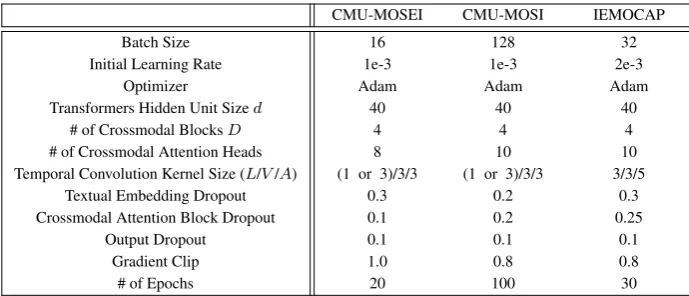
CMU-MOSEI CMU-MOSI IEMOCAP
Batch Size 16 128 32
Initial Learning Rate 1e-3 1e-3 2e-3
Optimizer Adam Adam Adam
Transformers Hidden Unit Sized 40 40 40
# of Crossmodal BlocksD 4 4 4
# of Crossmodal Attention Heads 8 10 10
Temporal Convolution Kernel Size (L/V/A) (1 or 3)/3/3 (1 or 3)/3/3 3/3/5
Textual Embedding Dropout 0.3 0.2 0.3
Crossmodal Attention Block Dropout 0.1 0.2 0.25
Output Dropout 0.1 0.1 0.1
Gradient Clip 1.0 0.8 0.8
[image:12.595.125.470.61.209.2]# of Epochs 20 100 30
Table 5: Hyperparameters of Multimodal Transformer (MulT) we use for the various tasks. The “# of Crossmodal Blocks” and “# of Crossmodal Attention Heads” are for each transformer.
D Features
The features for multimodal datasets are extracted as follows:
- Language. We convert video transcripts into pre-trained Glove word embeddings (glove.840B.300d) (Pennington et al.,2014). The embedding is a300dimensional vector.
- Vision.We use Facet (iMotions,2017) to in-dicate 35 facial action units, which records facial muscle movement (Ekman et al.,1980;
Ekman,1992) for representing per-frame ba-sic and advanced emotions.
- Audio. We use COVAREP (Degottex et al.,
![Figure 1: Example video clip from movie reviews.[Top]: Illustration of word-level alignment where videoand audio features are averaged across the time intervalof each spoken word](https://thumb-us.123doks.com/thumbv2/123dok_us/177926.513742/1.595.309.532.221.412/figure-example-illustration-alignment-videoand-features-averaged-intervalof.webp)