Locating Multiple Facilities in Convex Sets with Fuzzy
Data and Block Norms
Jafar Fathali, Ali Jamalian
Department of Mathematics, Shahrood University of Technology, Shahrood, Iran Email: [email protected], [email protected]
Received July 18, 2012; revised August 18, 2012; accepted August 25, 2012
ABSTRACT
In this paper we study the problem of locating multiple facilities in convex sets with fuzzy parameters. This problem asks to find the location of new facilities in the given convex sets such that the sum of weighted distances between new facilities and existing facilities is minimized. We present a linear programming model for this problem with block norms, then we use it for problems with fuzzy data. We also do this for rectilinear and infinity norms as special cases of block norms.
Keywords: Multifacility Location; Block Norm; Minisum; Fuzzy Data; Linear Programming
1. Introduction
Within the wide interaction between operations research (OR) and computer science, a major application area concerns locational decisions. The locational decisions determine how to use the best case possible for achieve- ment of activities with respect to existence a tools in our purpose direction. This aim is mostly contained of locat-ing facilities. Multiple facility location problem is a well-known problem in operations research and espe-cially in locational analysis and has been studied in depth, for more details see [1,2]. Locating facilities with some constraints on the regions which are contained facilities or customers is an interesting problem and has been studied by different constraints and conditions. Sarkar et al. [3] addressed the finite size 1-center placement prob-
lem on a rectangular plane in the presence of barriers. Barriers are regions in which both facility location and travel through are prohibited. The feasible region for facility placement is subdivided into cells along the lines by Larson and Sadiq [4]. Muoz-Pérez et al. [5] developed
the problem of locating an undesirable facility in a boun- ded polygonal region (with forbidden polygonal zones), using Euclidean distances, under an objective function that generalizes the maximin and maxisum criteria, and includes other criteria such as the linear combinations of these criterions. Bhattacharya et al. [6], presented a fuzzy
goal programming model for locating a single facility on a plane bounded by a convex polygon under the triple criteria maximin, minimax and minisum location. In [7] presented a fuzzy goal programming model for locating multiple new facilities on a plane bounded by a convex
polygon under the criteria: 1) minimize the sum of all the transportation costs and 2) minimize the maximum dis- tances from the facilities to the demand points. It has also been proved that the given methodology, always gives a nondominated solution. Nayeem and Pal [8] consider a facility location problem called p-center on fuzzy net-works.
In this paper we present a model for locating multiple new facilities in convex sets with respect to multiple ex- isting facilities and demand points, then present a linear programming model for this problem with block norms. We use this results for the problem with fuzzy data. We also do this for rectilinear and infinity norms as special cases of block norms. Rectilinear distances have been taken as the scenario may be thought of in an urban set- ting. Study of this problem and its modeling has many applications in industry such as locating machines in a workshop.
Let existing facilities be located at the known dis- tinct points 1 in the plane. In a multifacility location problem the optimal location of new facili- ties 1
m
, , m P P
n
n , ,
X X is sought with respect to the set of ex- isting facilities. Let d X
j,Pi
represents the distance between the locations of new facility and existing facility , andj
i
j, k
be the distance between the locations of new facilities and k.d X X j
Let the cost per unit distance between new facility and existing facility i be denoted by
j
ji and
w jk
being the corresponding cost per unit distance between new facilities and . The total transportation cost associated with new facilities located at
v
j k
1, , n
given by
1
1 <
1 1
, , ,
, .
n jk j
j k n n m
ji j i j i
k
f X X v d X X
w d X P
(1)
The multifacility location problem can be stated as the selection of locations X1, ,Xn
of new facilities such
that total cost is minimized. For more details in location theory see [4,9-12].
The block norms are norms which their contours are polytopes. For example 1 and are two block norms. The first application of block norms to solve the location problems suggested by Ward and Wendell [13,14]. They are shown that a block norm can be characterized as fol-lows:
l l
1 1
min r g : r g B
g g
g
x x b
(2)where the points bg and bg with g1, , r form the extreme points of the polytope corresponding to the unit contour. They also presented another characteriza- tion based on polar set for block norms. This characteri- zation follows:
0
max g : 1, , B
0
x xb g r (3)
where 0 g
b and bg0 with
0 1, ,
g r are extreme points of the polar set
0 : 1 for all 1, 2, , g
B v b v g r .
By using these characterizations Ward and Wendell [13,14] shown that the minimax and minisum single fa- cility location problems can be written as a LP problems.
If a block norm , is applied to measure the dis- tances in the plane then we can write a linear program- ming for the problem in two ways:
B
1) For i1, , n let
1 1
,
r r
i B gi gi i gi gi g
g g
.
X P X P
b2) For i1, , n let
0 0
max : 1, , .
i i B i g
z XP XP b g r
By substituting these in models we have a linear pro- gramming. In this paper we assume that distance is measured by block norm and as a special case rectilinear norm in two dimensional space. When Xj
x yj, j
and Pi
px pyi, i
, then objective function is as below:
1
1
1 1 , ,
.
n jk j
If we use the rectilinear norm for measuring distances between points we have:
j, k
j k jd X X x x y yk (5)
j, i
j i j i.d X P x px y py (6) On substituting (5) and (6) into (1) and rearranging terms, we obtain
1, , n
1
1, , n
2
1, , n
f X X f x x f y y (7) where
1 1
1
1 1
, , ,
,
n jk j
j k n n m
k
ji j i j i
f x x v d x x
w d x px
(8)
And
2 1
1
1 1
, , ,
,
n jk j
j k n n m
k
ji j i j i
f y y v d y y
w d y py
(9)
The expressions f1 and f2 give the total cost in- curred due to “travel” in the x and directions, re-
spectively.
y
From (7), it follows that
1 1 1
2 1
min , , min , ,
min , , .
n n
n
f X X f x x
f y y
We minimize f1 with constraints that new facilities be in convex sets, by transforming it to an equivalent LP problem will provide optimum x coordinate of the new
facilities. An exactly analogous procedure is used to minimize f2.
In Section 2 we introduce a model for locating multi- ple facilities in convex sets. In Section 3 we give a prac- tical exampl. A method for fuzzy linear programming problems and locating for fuzzy data are introduced in Section 4. Conclusion is achieved in the last section.
2. Locating Multiple Facilities in Convex
Sets
Suppose that we have a set of m machines in a workshop
for which their captured spaces are intervals. Assume that
pxj,pyj
,j1, , m corresponding to the coor- dinates of machines. Also, suppose that we divide the remaining region of the workshop to K convex regions(here we consider convex regions as rectangle ones) which are given as follows.
k B j k n
n m
ji j i B j i
f X X v X X
w X P
to locate new machines X1
x y1, 1
, , Xn
x yn, n
such that the sum of movement costs between each two new facilities and also new facilities and machines is minimized. We assume the movement cost between new facilities and machines to be proportional to the distance between them with a weight. Let jk be the weight of movement between facilities j and k, and
v
ji be the weight of movement between facility j and machine k.
Then we have the following problem.
w
1 1 1
1 1 1
,
, ,
, , 1, , ,
, 1, , .
n m
min ,
. . , 1,
, 1, ,
jk j j k n jk j k j k n j
i j i i j i
k ji j i j i
n m
ji j i i
Z v d x
v d y y
S t a x b i
c y d i
x w d x px
w d y py
K j n
K j n
(10)In this paper we consider the special case that only one machine is assigned to each region and for each machine, only one region contains it. In fact, this part of problem reduces to an assignment problem. So we define binary variables ij which are equal to 1 if machine is as- signed to region and are equal to 0 otherwise, and re- place the constraints of the problem with the following.
j
1, , , 1, ,
1, , , 1, ,
1, , , 1, ,
1, , , 1, ,
1, 1, , , 0,1
ij ij
K j n
i K j n
i K j n
i K j n
i K B i
1 1 1 , 1 , 1 , 1 ,1, 1, , ;
j i ij
j i ij
j i ij
j i ij
K n
ij
i j
x b M i
x a M
y d M
y c M
j n
where M is an upper bound for variables. This constraints
ensure that only one machine is assigned to each region and for each machine, only one region contains it. 2.1. The Problem with Block Norms
Suppose the distances are measured by a block norm , then we can write the problem as follows.
1 1 min. . 1 ,
1 ,
1 ,
1 ,
1, 1, , ;
jk j B
j k n j i ij j i ij j i ij j i ij
K n
ij ij
i j
Z v X
S t x b M i
x a M
y d M
y c M
j n
1 1 1
1, , , = 1, ,
1, , , = 1, ,
1, , , = 1, ,
1, , , = 1, ,
1, 1, , ,
n m
k B ji j i j i
ij
X w X P
K j n
i K j n
i K j n
i K j n
i K
0,1 .(11)
So by definition of block norms and using transforma- tions for the problem by variables gjk, gjk
, we have
1 11 1 1
1
1 min
. . ,
1 , 1, , , 1, , 1 , 1, , , 1, , 1 , 1, , , 1, ,
r
jk gjk gjk j k n g
n m r
ji gji gji j i g
r
j k gjk gjk g g
r
j i gji gji g g
j i ij
j i ij
j i ij
Z v
w
S t X X b
X P b
x b M i K j n
x a M i K j n
y d M i K j n
y
1 11 , 1, , , 1, , 1, 1, , ; 1, 1, , , 0,1 , , , , 0
j i ij
K n
ij ij
i j
ij gjk gjk gji gji
c M i K j n
j n i K
(12)which is a linear programming model.
2.2. The Problem with Rectilinear Norm
With rectilinear norm, model (10) is convertible to the following model:
1 1 1
1 1 1
1 min
. . 1 , 1, , , 1, ,
1 , 1, , , 1, , 1 , 1, , , 1, , 1 , 1, , , 1, ,
n m
jk j k ji j i j k n j i
n m
jk j k ji j i j k n j i
j i ij
j i ij
j i ij
j i ij
K i
Z v x x w x px
v y y w y py
S t x b M i K j n
x a M i K j n
y d M i K j n
y c M i K j n
11, 1, , ; n 1, 1, , , 0,1 .
ij ij ij
j
j n i K
(13)
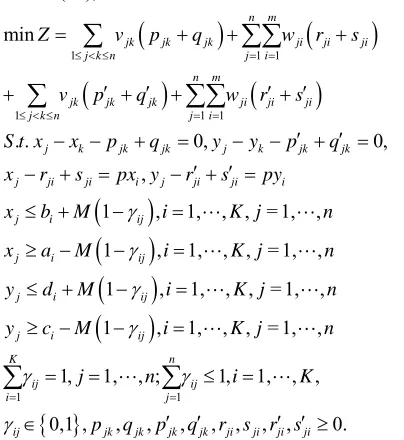
Note that the objective function of model (13) is nonlinear. However we can linearize it as follows. Let
j k jk jk
x x p q , yjyk pjkqjk,
j i ji ji
x px r s and yjpyk rjisj
m
i for i1, , , K j1, , , n k1, , .
If
0, 0, 0
jk jk jk jk
p q p q
in model (13), we have:
1 1 1
1 1 1
min
. . 0, 0,
,
1 , 1, , , = 1, ,
1 ,
n m
jk jk jk ji ji ji
j k n j i
n m
jk jk jk ji ji ji
j k n j i
j k jk jk j k jk jk j ji ji i j ji ji i
j i ij
j i ij
Z v p q w r s
v p q w r s
S t x x p q y y p q
x r s px y r s py
x b M i K j n
x a M i
1 1
1, , , = 1, , 1 , 1, , , = 1, , 1 , 1, , , = 1, , 1, 1, , ; 1, 1, , , 0,1 , , , , , , , , 0.
j i ij
j i ij
K n
ij ij
i j
ij jk jk jk jk ji ji ji ji
K j n
y d M i K j n
y c M i K j n
j n i K
p q p q r s r s
(14)
Note that we have deleted the sets of multiplicative constraints, p qjk jk 0 , p q jk jk 0 , r sjk jk 0 and . Since in solving model (14) by linear pro- gramming the theory of linear programming guarantees that some basic feasible solution, will be a minimum feasible solution. For any basic feasible solution, if
0 jk jk
r s
jk is in the basic feasible solution, jk will not be and vice p versa. Since variables not in the basic feasible solution, are zero, the multiplicative constraints will therefore be satisfied for every basic feasible solution. To see why both
q
jk and
p jk would not be in the same basic fea- sible solution , suppose that the first two sets of equality constraints of model (14) are written in matrix form; then the column of the matrix corresponding to
q
jk is −1 times the column corresponding to jk, so that the two p columns are linearly dependent. Likewise, the two col- umns corresponding to
q
ji and
r sji are linearly de- pendent but a basis consists of linearly independent vectors. If both pjk and jk were in the same basic feasible solution, the corresponding columns making up the basis would be linearly dependent which can not be.
q
3. Examples
In this section we give some examples for the mentioned models. We solve them by LINGO software.
Example 1. Consider the problem of locating a new machine in an existing layout consisting of five machines 1 5. The coordinate of machines are presented in the Table 1. Also consider the four possible regions 1 4, in order to locate two new machines in Table 2. The problem is to obtain an optimal location for the new machines in the region , so that the sum of the rectilinear distances of the new machines from the other machines is minimized.
, ,
P
, ,
S
Using model (14) we obtain X1
4,5 S3 ,
2 3,4 2
X S
*
Z
and the optimal value of objective function is =30.
Example 2. Consider six important industrial regions in a city which receive compulsory services from two fire stations. These industrial regions are shown in Table 3. Also three sites are considered for building fire stations according to Table 4. The problem is to determine two sites considering of three sites for building two fire sta- tions so that the sum of the distances of the fire stations from the six industrial regions is minimized. Let the dis- tances are measured by a block norm which its extreme points are
1 2 3
4
1 2
3 4
0,1 , 3 2,1 2 , 1, 0 , 3 2, 1 2 ,
0, 1 , 3 2, 1 2 , 1, 0 and 3 2,1 2 .
b b b
b
b b
b b
[image:4.595.65.267.96.316.2]Using model (12) we obtain the optimal solution
x y1, 1
12,18
S2,
x y2, 2
32,18
S3 andTable 1. The coordinate of machines.
1
P P2 P3 P4 P5
x 4 2 2 4 6
y 4 2 5 1 5
Table 2. The interval coordinates of regions.
L
x U
x L
y U
y
1
S 1 2 6 7
2
S 2 3 3 4
3
S 4 5 5 7
4
[image:4.595.308.539.475.736.2]S 5 6 2 3
Table 3. The coordinates of industrial regions.
A B C D E F
x 20 25 13 25 4 18
y 15 25 32 14 21 8
Table 4. The interval coordinates of sites.
P
4
S
, 1, 2,3, j
S j
L
x U
x L
y U
y
1
S 4 6 8 10
2
S 10 12 18 23
3
138.3539
Z . The weights of regions and sites are the
same.
4. Fuzzy Linear Programming
The concept of decision making in fuzzy environment was first proposed by Bellman and Zadeh [1]. Subse- quently, Tanaka et al. [15] made use of this concept in
mathematical programming (see also [16]). A Fuzzy Li- near Programming (FLP) is concerned with the optimiza- tion (minimization or maximization) of a fuzzy linear function while satisfying a set of linear equality and/or inequality fuzzy constraints. Fuzzy linear programming problem with fuzzy coefficients was proposed by Ne- goita [17]. A formulation of fuzzy linear programming with fuzzy constraints and a solution method were given by Tanaka and Asai [18]. Maleki et al. [19] introduced a
linear programming problem with fuzzy variables and proposed a method for solving it. Fang and Hu [20] con- sider linear programming with fuzzy constraint coeffi- cients (see also [21]). Gasimov and Yenilmez [22] dis- cuss solution of fuzzy linear programming problems us- ing linear membership functions (see also [23]). Maleki [24] used a certain ranking function to solve fuzzy linear programming problems. He also introduced a new me- thod for solving linear programming problems with va- gueness in constraints using a linear ranking function. Mishmast et al. [25] introduced the lexicographic rank-
ing function to order fuzzy numbers and solved fuzzy number linear programming problems by lexicographic ranking function. In this paper FLP with Right Hand So- lution (R.H.S) is considered.
An ordered pair of functions
,
,0T U r U r r 1,
is called a fuzzy number if and only if it satisfied in the following requirements.
1) U r
is a bounded left continues non decreasingfunction over
0,1 .2) U r
is a bounded left continues non increasingfunction over
0,1 .3) U r
and U r
are right continues in 0.4) U r
U r
,0 r 1 where
U r wr c w and
,0 1U r wr c w r ,
which c w, R c, Core
T andwW T
,
,w
0
T c is called Symmetric Triangular Fuzzy Num- ber (STFN). Let ST be the set of all STFN.
A crisp number is simply represented by
,0 1U r U r r .
The proofs of all the theorems in this section are given in [1].
4.1. Theorem
If T
c w1, 1
,U
c w2, 2
be STFNs,and A be a matrix then,
,
kR XST
1) T U if and only if c1c2andw1w2 2) T U
c1c w2, 1w2
3) kT
kc k w, 1
4) AX
ACore
X ;A W X
, which Aij aij .4.2. Definition
Let T
c w1, 1
,U
c w2, 2
be STFNs, we sayif and only if
<
T U 1) c1<c or
c c 2
1 2andw1 w
2) 2
T U
and if and only if T <U or T U.
Now consider fuzzy LP as follows
minCX S t AX . . b X, ST X, 0 (15) which ARm n , and b is an triangular fuzzy
vector. We reduce problem (15), to two following prob-lems.
n
cR
minCX S t AX. . Core b ,X 0 (16) and
minC Y S t. . A Y W b Y, 0 (17)
where Aij aij ,Ci ci .
4.3. Theorem
X is a feasible solution problem (15) if and only if
Core
X X is a feasible solution of problem (16) and
Y W X is feasible solution of problem (17). 4.4. Theorem
X is an optimal solution of problem (15) if and only if
Core
X X is an optimal solution of problem (16) and YW X
is an optimal solution of problem (17).4.5. Locating Multiple Facilities in Convex Sets with Fuzzy Data
Suppose that we have a set of machines in a work- shop for which the captured spaces are as intervals. As- sume that
m
px pyj, j
,j1,,m corresponding to theirlows:
, ,
for 1j j j j j
S x y a xb c yd j , , K
For the fuzzy block norm case we have the following model.
1
1 1
min
. . , 1, , , 1, ,
, 1, , , 1, , .
jk j k B j k n
n m
ji j i B j i
i j i i j i
Z v X X
w X P
S t a x b i K j n
c y d i K j n
(18) where a b cj, ,j j K
and djfor j1, , are triangular symmetric fuzzy numbers. It is obvious that
x y, alsois fuzzy numbers. Now, we want to find a point in one of the regions for a new machines such that the objec- tive function of our considered problem in fuzzy case is minimized.
K
Hosseinzadeh et al. [26] consider the single facility
case and present a linear programming for it. have the following model for fuzzy numbers: Equivalently, according model (14) in Section 2 we
1 1 1 1 1
1
1 min
. . ,
1 , 1, , , 1, ,
1 , 1, , , 1, ,
1
r n m r
jk gjk gjk ji gji gji j k n g j i g
r
j k gjk gjk g g
r
j i gji gji g g
j i ij j i ij j i
Z v w
S t X X b
X P b
x b M i K j n
x a M i K j n
y d M
1 1
, 1, , , 1, ,
1 , 1, , , 1, ,
1, 1, , ; 1, 1, , , 0,1 , , , , 0.
ij j i ij
K n
ij ij ij gjk gjk gji gji
i j
i K j n
y c M i K j n
j n i K
(19)
The problem (19) can be converted to standard form as follows.
1 1 1 1 1
1
1 min
. . ,
1 , 1, , , 1, ,
1 , 1, , , 1, ,
r n m r
jk gjk gjk ji gji gji j k n g j i g
r
j k gjk gjk g g
r
j i gji gji g g
j ij i ij j ij i ij
Z v w
S t X X b
X P b
x u b M i K j n
x u a M i K j n
1 1
1 , 1, , , 1, ,
1 , 1, , , 1, ,
1, 1, , ; 1, 1, , , 0,1 , , , , 0.
j ij i ij j ij i ij
K n
ij ij ij gjk gjk gji gji
i j
y v d M i K j n
y v c M i K j n
j n i K
(20)
1 1 1 1 1
1 1
min
. . , Core
Core( ) 1 , 1, , , 1, ,
Core( ) 1 , 1, , , 1, ,
r n m r
jk gjk gjk ji gji gji j k n g j i g
r r
j k gjk gjk g j i gji gji g
g g
j ij i ij j ij i ij j
Z v w
S t X X b X P b
x u b M i K j n
x u a M i K j n
y v
1 1
Core( ) 1 , 1, , , 1, ,
Core( ) 1 , 1, , , 1, ,
1 1, , ; 1 1, , , 0,1 , , , , 0, , , ,
ij i ij j ij i ij
K n
ij ij ij gjk gjk gji gji ij ij ij ij
i j
d M i K j n
y v c M i K j n
j n i K u u v v
, , 0
0
(21)
and
1 1 1 1 1
1 1
min
. . 0, 0
1 , 1, , , 1, ,
1 , 1, , , 1, ,
1
r n m r
jk gjk gjk ji gji gji j k n g j i g
r r
j k gjk gjk g j i gji gji g
g g
j ij ij i
j ij ij i
j ij ij
Z v w
S t X X b X W P b
x u M W b i K j n
x u M W a i K j n
y v M
1 1
, 1, , , 1, ,
1 , 1, , , 1, ,
1 1, , ; 1 1, , , 0,1 , , , , 0, , , ,
i
j ij ij i
K n
ij ij ij gjk gjk gji gji ij ij ij ij
i j
W d i K j n
y v M W c i K j n
j n i K u u v v
, ,
(22)
Note that Theorem 4.4 is hold when the optimal values of the variables ij in models (21) and (22) are the same.
In the case norm is rectelinear we have the following nonlinear model:
1 1 1 1 1 1
min
. . , 1, , , 1, , , , 1, , , 1, , .
n m n m
jk j k ji j i jk j k ji j i
j k n j i j k n j i
i j i i j i
Z v x x w x px v y y w y py
S t a x b i K j n
c y d i K j n
(23)
Equivalently, according model (12) in Section 2 we have the below model for fuzzy numbers:
1 1 1 1 1 1
min
. . 0, 0
,
1 ,
n m n m
jk jk jk ji ji ji jk jk jk ji ji jij k n j i j k n j i
j k jk jk j k jk jk j ji ji i j ji ji i
j i ij
Z v p q w r s v p q w r s
S t x x p q y y p q
x r s px y r s py
x b M i
1 1
1, , , 1, ,
1 , 1, , , 1, ,
1 , 1, , , 1, ,
1 , 1, , , 1, ,
1 1, , ; 1 1, , , 0,1 , , , , , , , ,
j i ij
j i ij
j i ij
K n
ij ij ij jk jk ij ij ji ji ij ij
i j
K j n
x a M i K j n
y d M i K j n
y c M i K j n
j n i K n p q p q r s r s
, , 0.
The problem (24) can be converted to standard form as:
1 1 1 1 1 1
min
. . 0, 0
, 1
n m n m
jk jk jk ji ji ji jk jk jk ji ji ji
j k n j i j k n j i
j k jk jk j k jk jk j ji ji i j ji ji i j ij i
Z v p q w r s v p q w r s
S t x x p q y y p q
x r s px y r s py
x u b M
1 1
, 1, , , 1, , 1 , 1, , , 1, , 1 , 1, , , 1, , 1 , 1, , , 1, ,
1 1, , ; 1 1, , , 0,1
, , , 0;
ij j ij i ij j ij i ij j ij i ij
K n
ij ij ij
i j
ij ij ij ij
i K j n
x u a M i K j n
x v d M i K j n
x v c M i K j n
j n i K
p q p q r
, ,
, , , 0; , , , 0. ij s r s ij ij ij u u v v ij ij ij ij
(25)
In order to obtain the optimal solution of problem (25), we solve two problems in below:
1 1 1 1 1 1
min
. . 0, 0
core , core
core 1 , 1, , , 1, ,
n m n m
jk jk jk ji ji ji jk jk jk ji ji ji
j k n j i j k n j i
j k jk jk j k jk jk j ji ji i j ji ji i
j ij i ij
Z v p q w r s v p q w r s
S t x x p q y y p q
x r s px y r s py
x u b M i K j n
1 1
core 1 , 1, , , 1, ,
core 1 , 1, , , 1, ,
core 1 , 1, , , 1, ,
1 1, , ; 1 1, , , 0,1
, , , 0; , , , 0; ,
j ij i ij
j ij i ij
j ij i ij
K n
ij ij ij
i j
ij ij ij ij ij ij ij ij ij
x u a M i K j n
y v d M i K j n
y v c M i K j n
j n i K
p q p q r s r s u
, ,
, , 0. ij ij ij
u v v
(26)
and
1 1 1 1 1 1
min
. . 0, 0
,
, 1, , , 1, ,
n m n m
jk jk jk ji ji ji jk jk jk ji ji ji
j k n j i j k n j i
j k jk jk j k jk jk j ji ji i j ji ji i j ij ij i
j ij
Z v p q w r s v p q w r s
S t x x p q y y p q
x r s W px y r s W py
x u M W b M i K j n
x u M
1 1
, 1, , , 1, , , 1, , , 1, , , 1, , , 1, ,
1 1, , ; 1 1, , , 0,1
, , , 0; , , , 0; , , , 0. ij i
j ij ij i j ij ij i
K n
ij ij ij
i j
jk jk jk jk ji ji ji ji ij ij ij ij
W a M i K j n
y v M W d M i K j n
y v M W c M i K j n
j n i K
p q p q r s r s u u v v
, ,
(27)
same.
5. Summary and Conclusion
In this paper we presented a linear model for finding op- timal locations for multiple facilities with respect to the other facilities and then use it for fuzzy data. Here we use block norm and rectilinear norm as a special case, for finding the optimal locations. Also in order to avoid con- gestion, we suppose that an eligible site must be as in- terval. Finally, in order to locate new facilities in convex sets, we suggest a model by which the weighted distance between new facilities and all the other existing facilities and the new ones is minimized.
REFERENCES
[1] R. E. Bellman and L. A. Zadeh, “Decision Making in a Fuzzy Environment,” Management Science, Vol. 17, No. 4, 1970, pp. 141-164. doi:10.1287/mnsc.17.4.B141
[2] Z. Drezner and H. Hamacher, “Facility Location: Appli- cations and Theory,” Springer-Verlag, Berlin, 2002. [3] A. Sarkar, R. Batta and R. Nagi, “Placing a Finite Size
Facility with a Center Objective on a Rectangular Plane with Barriers,” European Journal of Operational Resear- ch, Vol. 179, No. 3, 2007, pp. 1160-1176.
doi:10.1016/j.ejor.2005.08.029
[4] R. C. Larson and G. Sadiq, “Facility Locations with the Manhattan Metric in the Presence of Barriers to Travel,” Operations Research, Vol. 31, No. 4, 1983, pp. 652-669.
doi:10.1287/opre.31.4.652
[5] J. Muñoz-Pérez and J. J. Saameño-Rodrı́guez, “Location of an Undesirable Facility in a Polygonal Region with Forbidden Zones,” European Journal of Operational Re- search, Vol. 114, No. 2, 1999, pp. 372-379.
doi:10.1016/S0377-2217(98)00138-6
[6] U. Bhattacharya, J. R. Rao and R. N. Tiwari, “Fuzzy Multi-Criteria Facility Location Problem,” Fuzzy Sets and Systems, Vol. 51, No. 3, 1992, pp. 277-287.
doi:10.1016/0165-0114(92)90018-Y
[7] U. Bhattacharya, J. R. Rao and R. N. Tiwari, “Bi-Criteria Multi Facility Location Problem in Fuzzy Environment,” Fuzzy Sets and Systems, Vol. 56, No. 2, 1993, pp. 145- 153. doi:10.1016/0165-0114(93)90139-9
[8] S. M. A. Nayeem and M. Pal, “The p-Center Problem on Fuzzy Networks and Reduction of Cost,” Iranian Journal of Fuzzy Systems, Vol. 5, No. 1, 2008, pp. 1-26.
[9] R. Francis Jr., L. F. McGinnis and J. A. White, “Facility Layout and Location: An Analytical Approach,” Prentice Hall, Upper Saddle River, 1992.
[10] G. Y. Handler and P. B. Mirchandani, “Location on Net-works: Theory and Algorithms,” MIT Press, Cambridge, 1979.
[11] R. F. Love, J. G. Morris and G. O. Wesolowsky, “Facili-ties Location: Models and Methods,” North Holland
Pub-lishing Company, New York, 1988.
[12] P. B. Mirchandani and R. Francis, “Discrete Location Theory,”John Wiley & Sons, Hoboken, 1990.
[13] J. E. Ward and R. E. Wendell, “A New Norm for Meas- uring Distance Which Yields Linear Location Problems,” Operations Research, Vol. 28, No. 3, 1980, pp. 836-844.
doi:10.1287/opre.28.3.836
[14] J. E. Ward and R. E. Wendell, “Using Block Norms for Location Modeling,” Operations Research, Vol. 33, No. 5, 1985, pp. 1074-1090. doi:10.1287/opre.33.5.1074
[15] H. Tanaka, T. Okuda and K. Asai, “On Fuzzy Mathe- matical Programming,” Journal of Cybernetics, Vol. 3, No. 4, 1973, pp. 37-46. doi:10.1080/01969727308545912
[16] H. J. Zimmermann, “Fuzzy Mathematical Programming,” Computers & Operations Research Journal, Vol. 10, No. 4, 1993, pp. 291-298. doi:10.1016/0305-0548(83)90004-7
[17] C. V. Negoita, “Fuzziness in Management,” OPSA/TIMS, Miami, 1970.
[18] H. Tanaka and K. Asai, “Fuzzy Linear Programming Problems with Fuzzy Numbers,” Fuzzy Sets and Systems, Vol. 13, No. 1, 1984, pp. 1-10.
doi:10.1016/0165-0114(84)90022-8
[19] H. R. Maleki, M. Tata and M. Mashinchi, “Linear Pro- gramming with Fuzzy Variables,” Fuzzy Sets and Systems, Vol. 109, No. 1, 2000, pp. 21-33.
doi:10.1016/S0165-0114(98)00066-9
[20] S. C. Fang and C. F. Hu, “Linear Programming with Fuzzy Coefficients in Constraints,” Computers & Mathe- matics with Applications, Vol. 37, No. 10, 1999, pp. 63-76. doi:10.1016/S0898-1221(99)00126-1
[21] R. Fuller and H. J. Zimmermann, “Fuzzy Reasoning for Solving Fuzzy Mathematical Programming Problems,” Fuzzy Sets and Systems, Vol. 60, No. 2, 1993, pp. 121- 133. doi:10.1016/0165-0114(93)90341-E
[22] R. N. Gasimov and K. Yenilmez, “Solving Fuzzy Linear Programming Problems with Linear Membership Func- tion,” Turkish Journal of Mathematics, Vol. 26, No. 4, 2002, pp. 375-396.
[23] C. Garsia-Aguado and J. L. Verdegay, “On the Sensitivity of Membership Functions for Fuzzy Linear Programming Problems,” Fuzzy Sets and Systems, Vol. 56, No. 1, 1993, pp. 47-49. doi:10.1016/0165-0114(93)90184-J
[24] H. R. Maleki, “Ranking Functions and Their Applications to Fuzzy Linear Programming,” Far East Journal of Mathematical Sciences, Vol. 4, No. 3, 2002, pp. 283-301. [25] H. Mishmast Nehi, H. R. Maleki and M. Mashinchi,
“Solving Fuzzy Number Linear Programming Problem by Lexicographic Ranking Function,” Italian Journal of Pure and Applied Mathematics, Vol. 15, 2004, pp. 9-20. [26] F. Hosseinzadeh Lotfi, G. R. Jahanshahloo, F. Rezai Balf