Comparative Analysis of the Management Practices and
Behaviour of Small and Medium Information Technology
Enterprises
Taciana de Barros Jerônimo, Denise Dumke de Medeiros
Department of Production Engineering, Universidade Federal de Pernambuco, Recife, Brazil. Email: [email protected]
Received August 28th, 2012; revised September 28th, 2012; accepted October 22nd, 2012
ABSTRACT
This paper examines the role and influence of management practices and behaviour in successful small and medium sized information technology enterprises (SMET), based on the comprehensive concept of Mintzberg 5Ps of strategy (1992) [1]. The study employed a survey of 13 SMET with were examined on how closely they used best strategic practices in their management and how it is related to SMET performance. The discussion and conclusions highlight different ways of strategic thinking, the importance of the mutual trust and commitment between managers and em- ployees. Specifically, we determine three elements whose greater exploration can lead to a deeper understanding of how the strategic planning is influenced by the manager’s view, in order to encourage their competitiveness through market environmental uncertainties.
Keywords: Small and Medium Business; Strategic Thinking; Information Technology
1. Introduction
Small and medium businesses have become important in economic and social development [2], their main charac- teristics are: size, structure, culture and resource con- straints, entrepreneur types of behaviour or attitudes to- wards risk; tend to opt for informal practices, have an ad hoc entrepreneurial process and the management process and cultural dimension [3,4]. To Westhead et al. [5], en- trepreneurs have management based on flexibility and share knowledge with their employees to reduce the mar- ket risks. In order to identify the type of product to be produced, where and to whom it will be sold, and prod- uct features such as cost, customization, reliability and delivery [6] of small and medium information technology firms (SMET) prompt their strategy.
A considerable number of studies have been done to understand “what managers really strategizing” [7,8]. These studies including human capital [9,10], employees innovative behaviour [11-13], effective recruitment and selection practices [14], a good training and development. These issues are critical to support the strategic planning to create superior performance or competitive advantage through the process of transferring benefits from the companies to their customers [13]. However, various aspects related to SMET to avoid the strategic thinking: fear of the weaknesses, lack of knowledge of the strate-
gic planning process, fear to deal with market risks and uncertainties.
Our study concentrates on managers in (SMET), as a first step to elucidate their behaviour nature to develop strategic planning based on the five P-propositions [1]: Plan—This is a formal process or a course of action to deal with a situation. The manager is analytical and has ability to organize internal resources; Pattern—Is a stream of actions, the manager develop skills among work stra- tegies in the process of organizational learning; Posi-tion—Formal process to access excellence level to locate the product or services in certain markets conditions. The managers adjust their effort and skills; Perspective—The manager act in accordance with external environments; provide useful information to achieve external and inter-nal environment goals; Play or Ploy—Way of handle competitors and reduce the market threats, the manager articulate the strategic and motivate their employees.
agement and their members to promote valuable ideas to engage the innovation efforts [17] according to their in- novative behaviour and internal incentives [18].
2. Literature Review
Innovation has concentrated on firms’ financial perfor- mance, organizational incentives [19-21] and on the gen- eration of feasible ideas [12] relies on the creativity, transfer and retention of knowledge of individuals [22]. These SMET members learn together [23] as learning organization. They have different specialties and act like a horizontal networks relationship to choose a course of action [24], have a clear vision about their goals, and communicate to interact [25]. However, the innovation incentives have risk and unpredictable outcomes [26].
In this complex scenario, SMET must develop strate- gically to make the most effective use of its resources and capabilities in order to remain competitive. To Sam- bamurthy et al. [27] there are three distinct “logics of strategy” for SMEs: 1) positioning-to identify the forces of the industry, firms seek profitability, and use an inte- grated system of activities focus on external forces with- out reinforcing internal activities; 2) leverage-firms try to overcome the weakness by deploying their inimitable resources and competencies to reach a stable position; and 3) opportunity-ability to innovate and develop supe- rior market intelligence using the strategic planning, it builds strong external relationships, proper market re- sponsiveness [28], and enable agility and flexibility [29]. Committing resources can be an indicator of the orga- nisation’s strategic intent [30]. Training can affect these organizations, because individuals skills and creativity convert a new idea into a product or service, which cus- tomers need [31], towards meeting the organization’s objectives in a more systematic and effective way [32]. SMET needs an effective means of monitoring their in- ternal and external sources of opportunity to apply them into managerial practice to build partnership with firms having core competencies specializing in the other ele- ments in the information technology chain: testing, pro- duction, marketing, distribution, and logistics or distribu- tion.
Business partnerships combining or incorporating complementary components in each chain participant. This SMET characteristic is very complex, and requires external variety of knowledge and expertise.
3. Methodology
This descriptive and explanatory case study uses a quail- tative method of multiple-case studies [33,34]. It creates theoretical constructs and propositions based on empiri- cal evidence. Data were collected from semi-structured
interviews, questionnaires, analysis of company docu- ments, media communications and observation [35] that could prove or provide further explanations of the topics of the interviews. The structure of the questionnaire ad- dressed on nominal scale and open-ended questions with the empirical events interpretation [35] on a set of 13 case studies of Brazilian SMET. We considered size, dy- namic, capability perspective, exploratory and transfor- mative learning in changed environments. As well as, the strategic intent, since the leaders behaved differently from the ways [15] trying to create a powerful goal since individuals could share knowledge throughout the orga- nization. All respondents are managers; each interview lasted about 1 hour.
The protocol in this research relies on Yin model [17]. And the approach is based on Mintzberg 5Ps [14] to de-scribe what really happens in information technology organizations that tried to create successful strategic in- novation. Therefore, we opted to make a pre-test ques- tionnaire, using a pilot study with two managers that is not part of our sample. As a result of the refinements in this theoretical research validated and reduced resear- cher’s bias when interpreting the data. Accordingly, this study adopts five dimensions, including culture, man- agement, how the SMET members get the information, employees relation and innovation performance, in the construct of Mintzberg 5P strategic practices. The 5Ps are not mutually exclusive, can show evidence of more than one interpretation of strategy [14].
Data Sample
We observe the necessity to maintain SMET manager’s effort on customer and market requirements. Each man- ager has a lot of daily routine functions, concentrate in commercial, human resources, and financial areas. Su- pervising teams, managing people and teams, audit, qual- ity management and technical assistance activities are not attributed of these managers. SMET has heterogeneous cognitive ability to leadership and formulate innovative ideas. At the same time, it has difficulties to implement the communication between managers and employees.
The group has an average age of 32 years, 15.38% oc- cupy the position of IT manager and 84.62% are direc-tors. The average age of the companies operated by them is 13.1 years, and the time that these managers are work-ing in these companies ranged from 1 to 22 months. The current number of employees has average of 38 people per SMET.
The others, which do not develop strategic planning (30.8%), because: are unfamiliar with the technique, time priority to their customers; have internal structuring pro- cess. The main activities to develop strategic planning are: 15.38% SWOT analysis, 23.08% drawing up of the mission and vision and 61.54% controlling, monitoring or implementing the strategy. About 76.92% of SMETs analyse the market as following: 29.4% examining the contact through correspondence with the directors, 29.4% SMET search on web sites, 5.88% draw up a marketing survey and 35.29% do it during the contact with clients. Employees are not involved in strategic planning; but, three of the companies consider this involvement funda- mental.
The competitor analysis is performed by 69.3% of these companies: 33% study market changes and 20.83% from clients or competitor managers at events and meet- ings. The suppliers analysis is conducted by 53.8% of the companies, and 46.15% of SMETs do not do, because they are satisfied with the actual suppliers. However, in companies that do supplier analysis, 36.84% ask third- parties for recommendations, 5.26% experiment for a pe- riod, 5.26% consult a member of staff, 21.05% carry out searches by phone. However, the stakeholders informa- tion is partly neglected, 53.8% consider the views of their clients, 30.77% their competitors and 23.08% their sup- pliers and the market.
4. Minzterg Propositions of SMET
Strategy can be analysed by the manager’s view [36]. In this sense, we compare characteristics of the SMET man- agers according to the strategic view of Mitzberg, to him there are a large number of studies to prove that execu- tive’s activities are characterised by brevity, variety and discontinuity and strongly oriented to action, and no in-clination for reflection activities [36,37]. Appendix 1 compare 5P Minzterg’ propositions of each case study. The results show the mental evidence as a strategic per- spective was that they expect that the organisation’s ac- tivities will follow from what was drawn up when plan- ning according to the leadership style [14,36]. The devel- opment of strategic planning in the companies is not a static process, since 92.31% of the respondents of them analyse the market and use this to compose their market such that the characteristic of improving the organiza- tion’s relationship with the market. Allied to this, SMET identifies a set of strategic internal practices to elicit the willingness and motivation of employees to engage them to develop organizational expertise for business objec- tives [38] while contributing to improve the organisa- tion’s relationship with its employees and promoting a collective awareness. These factors give dynamism to the
design a clear direction for a SMET’s market position, and the possibility of constantly alternative strategies changing, without losing the final goal established by the SMET.
Information flown from executives suggests that they are influenced by external sources and are defined as the ability to organise people and resources to meet organ- izational objectives. But, Mintzberg [7,14] found that most of managers not have enough time to think strate- gically, they lost their time doing routine activities, such as calling, reading long reports, including ritual and cere- monies, trading and processing of small details that con-nect the organisation to its environment. However, the stakeholders and employees information is neglected, and some negative characteristics can contribute to SMET becoming vulnerable to the market risks, such as: lack of future vision; lack of time and resources, diffi- culty in establishing, monitoring and tracking the com- pany’s goals; employees lacking commitment. The boun- daries between the activities described will vary in each company used as a case study, in some cases there was the juxtaposition of functions due to the characteristics of the organization itself. In this sense, strategic planning becomes important for each organization.
The development of SMET strategic planning lies to improve the organization’s relationship with the market and with the future vision. SMET managers report that have difficulty to monitoring and to controlling strategies and their visions for stakeholders and employees [26]. Establishment of a shared ambition, development of col- lective identity and ability to give personal meaning, managers have to prompt the organisation to be on better strategic position. They claim mutual trust of SMET em- ployees, vertical relationship between their superior and subordinates and horizontal interactions across functions to develop a feeling of empowerment and commitment [38] among multi-skilled employees. To Rumelt [39] a result of individual initiative and mutual cooperation can protect organization from the structural limitation, global competition, market risk and technological innovation competition and shorter product or service life cycles on their products or services.
improve SMET performance. And company 12 described as Ploy systematic, because the strategic planning takes into the direct competition, where threats and various other manoeuvres are employed to gain advantage. analysing the scope and focus of the external course are
done to integrate and to provide better service, and to support strong and visionary leadership.
Companies 4 and 13 can be described as Position pro- position, because the main role is market domain where resources are concentrated with a root strategy [40]. The strategic planning is composed by three stages: formula- tion, implementation, and control. The managers learn with their internal reflection of their past decisions (right and wrong). Particularly useful in early stage of strategy development, when date must be analysed, those compa- nies survey customers through marketing research. Re- garding the activities of the competition they are also monitored through their Web sites, newspapers and magazines. Their suppliers also undergo an assessment, through experimentation of services and/or products for a certain time. Companies 2, 3, 7 and 9 are target as Pat- tern proposition. Strategy promotes action coordination, focus on SMET direct effort emerges from past organiza- tional behaviour to improvise actions to support the stra- tegic intent. The managers have fear to promote new strategies, focuses on short term results. Companies 5, 6 and 8 can be described as Perspective systematic propo- sition. SMET culture encourages innovation from em- ployees. Managers conduct a strategic planning, based on SWOT analysis, with an interconnect relationship with employees and stakeholders. The leadership is more de- mocratic, internal and external information are used to
These results demonstrate that each perspective can be used to structure theoretical arguments that explain sig- nificant levels of variation SMET strategic performance.
5. Discussion
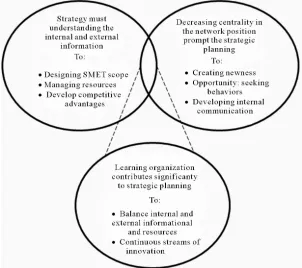
[image:4.595.146.448.449.717.2]The findings suggest that in the context of strategic plan- ning, assumptions on managers’ behaviour, network po- sition, and the sequence of learning processes need to be considered. It enriches the theoretical knowledge on rela- tionships between learning processes, strategic, new ideas, innovation, skills of managers and employees com- mitment. In order to explain how the necessary knowl- edge for strategic innovation is need, SMET must pro-vide an understanding of how learning processes and combinative capabilities contribute to develop the strate- gic planning. The Management Capabilities influence the SMET Performance though internal and external impor- tant capabilities as showed in Figure 1. While the enter- prise performance can be measured by various results: 1) financial; 2) human resource (employees and SMET man- agers); 3) organisational effectiveness. However, Enter-prise Performance is a perceived out-come of customer satisfaction, determined by the adequate use of SMET re- sources.
In the Figure 1 we observed three propositions of the SMET strategic planning, its effects refer to constraints which are necessary for taking advantage of the explora- tory learning processes. A strong formalisation of know- ledge sharing of problem-solving needs higher cognitive diversity, and horizontally decision-making authority. A number of factors affect the firm competes in a fast-cycle market. Few of today’s firms have been able to achieve an effective balance between internal and external infor- mation. Effective analyses of external (emerging trends in the technological, socio cultural, economic, political/ legal, demographic, and global arenas in which the firm competes) and internal environments are the foundation for discovering an ideal balance. Each firm has unique resources and capabilities, and different customers. The information drifted from them explain how and when SMET can do a service or product with their scarce re- sources. Based on the above discussion, we offer the first proposition: Proposition 1. Strategy must understand the internal and external information.
SMET should incorporate in their strategies, the sus- tainable development in two competitive ways. First, by altering the price structure of more efficient and flexible strategic actions [41] and second by enabling the creation of better IT services of greater quality. From this point of view, SMET should concentrate in the incentive schemes, to encourage skilled individuals to link their effort and compensation [23,42]. We believe that incentives will increase the ability of SMET to engage its members in innovative strategic actions. The exploration occurs when integrates diverse knowledge with existing knowledge stocks of their members, the staff skills would guide them to act in a sustainable way [38]. But, values cannot be imposed top-down, should emerge from the SMET staff. Hansen [43] believes that knowledge and culture can be shared to establishing a common language.
Therefore, Proposition 2: decreasing centrality in the network position prompt the strategic planning. Accord- ing to Mookherjee [44] decentralization of authority en- hances the potential effectiveness of a firm’s exploration behaviours in that it makes it possible for the firm to examine a relatively large number of potentially attrac- tive opportunities. Spreading power of making decision to the lower SMET levels. It will be possible for organi- zations to implement quickly and efficiently decisions; also minimizes the need for extensive tools to the internal communication.
SMET practices adapting internal requires an array of newness in the form of innovations to prompt the strate- gic planning. Absorbing new knowledge to which the firm gains access while exploitation new strategic actions. Consequently, will be difficult for competitors to imitate SMET’ new ideas. Under such conditions, learning proc-
esses are preceded by an assimilation of the newly ac- quired knowledge. It continues internal with the staff interacts from combinative capabilities of SMET mem- bers. SMET members capabilities and aspirations trans- forming their knowledge in strategic actions. Further- more, this factor supports the Proposition 3: Learning organization contributes significantly to strategic plan- ning. People continually expand their capacity together to create the results while they expansive patterns of thinking. SMET need to discover how to tap people’s commitment and capacity to learn [45]. The strategy needs all organizational functions developed in effective and integrated way [42]. Nonaka [46] recommended the use of metaphors and organizational redundancy to en- courage dialogue to understand new ideas.
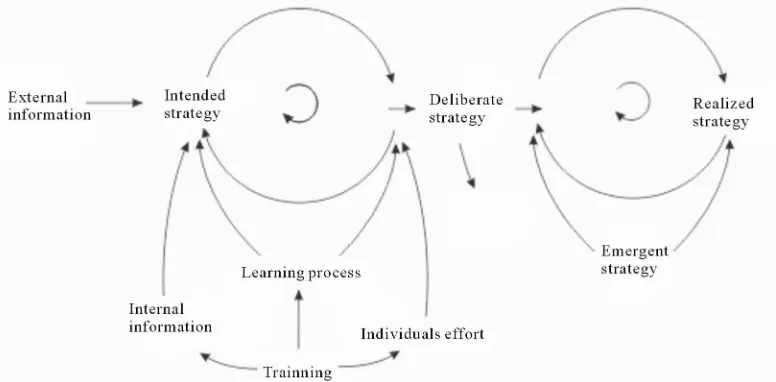
The key reasons for strategic planning, described in
Figure 2, have success include managers and employees with significantly correlated with job satisfaction, effec- tive leadership [47], support from the SMET employees, understand the customer’s changes requirements [48], the organizational size, complexity and resource constraints [49] and effective communication.
Those propositions of this study describes success and failure of strategic planning with the attitudes and per- spectives of manager, and their potential to better under- stand SMET structure, culture and organizational re- source constraints.
Therefore, the implementation of strategic planning has key strengths, such as: improves communication; promotes a collective awareness; increases the ability to take managerial decisions; improves the delegation of tasks; guides internal improvement programs; improves the relationship of the organisation with employees, im- proves the organisation’s relationship with the market; and prompts a company’s future vision.
6. Conclusions
Figure 2. SMET organisational strategy performance model.
an assessment of whether or not there is a viable align-ment between the mutual interests of SMET members. The process of strategic support requires constant effort and the search for agreement on the innovation applies to both internal and external people.
The practical implications of our findings can be vi- able to managerial recommendations for determining the relative importance of learning processes and combina- tive capabilities for SMET develop the strategic planning. The frequency with which it is performed or reviewed guarantees the market barriers that may arise suddenly or can stand out and make a contingency, achieving a com- petitive advantage that ensures success for organisations. But, the most of routine activities are performed by man- agers, it reduces their time to plan strategic actions
Managers should become aware of the fact that strate- gic results need a good coordination capability through enhancing participation in decision-processes, and in- creasing internal communication. And, connectedness to different external knowledge sources from their stake- holders.
Despite the managerial and theoretical implications, this study has some limitations. As with any qualitative research, we cannot ensure complete observation of 13 SMET, just on the phenomenon studied [50]. The first limitation is the individual response can represent the deliberate firm-level situations, due to the self-selection behaviours, emerging from the fact that not all firms are perfectly free to do their knowledge management and human resource practices choices given the particular contingencies they face [51]. To alleviate this problem, this study asks the executives who are familiar with the topic to complete the questionnaire.
We used only qualitative measures to capture three propositions of SMET strategic planning. Such qualita-
tive measures may be subject to research bias. Future research should, therefore, develop more quantifiable measures for testing our findings through quantitative data. The last limitation is the use of a cross-sectional research design. We chose the 13 cases for reasons of appropriateness, rather than of representativeness [52]. We provided a rich description of these 13 cases of stud- ies which other researchers and managers can evaluate the SMET managerial contexts. Future research might using longitudinal design to drawing causal inferences.
To conclude, human resources are valuable assets for firms desiring to achieve superior innovation and sus- tainable competitive advantages. The viewpoints of this study highlight the crucial importance of the knowledge management capacity when examining the relationship between strategic practices and innovation performance.
7. Acknowledgements
The authors would like to thank the anonymous review- ers for their constructive comments on an earlier version of this paper. This study is part of research funded by the Brazilian Research Council (CNPq).
REFERENCES
[1] H. Mintzberg, “Five Ps for Strategy,” In: H. Mintzberg and J. B. Quinn, Eds., The Strategy Process, Prentice- Hall International Editions, Englewood Cliffs, 1992, pp. 12-19.
[2] W. D. Bygrave, “The Entrepreneurial Process,” In: W. D. Bygrave and A. Zacharakis, Eds., The Portable MBA in Entrepreneurship, John Wiley & Sons, Hoboken, 2004.
[4] P. E. Petrakis, “Risk Perception, Risk Propensity and Entrepreneurial Behaviour: The Greek Case,” Journal of American Academy of Business, Vol. 7, No. 1, 2005, pp. 233-242.
[5] P. Westhead, D. Ucbasaran and M. Wright, “Decisions, Actions, and Performance: Do Novice, Serial, and Portfo- lio Entrepreneurs Differ?” Journal of Small Business Management, Vol. 43, No. 4, 2005, pp. 393-417. doi:10.1111/j.1540-627X.2005.00144.x
[6] V. Hanna and K. Walsh, “Small Firm Networks: A Suc- cessful Approach to Innovation?” R&D Management, Vol. 32, No. 3, 2002, pp. 201-207.
doi:10.1111/1467-9310.00253
[7] S. Carlson, “Executive Behaviour,” Stockholm, Ström-bergs, 1951.
[8] H. Mintzberg, “Managerial Work: Analysis from Obser- vation,” Management Science, Vol. 18, No. 2, 1971, pp. 97-110. doi:10.1287/mnsc.18.2.B97
[9] V. J. García-Morales, F. J. Lloréns-Montes and A. J. Verdú- Jover, “The Effects of Transformational Leadership on Organizational Performance through Knowledge and In- novation,” British Journal of Management, Vol. 19, No. 4, 2008, pp. 299-319.
doi:10.1111/j.1467-8551.2007.00547.x
[10] T. Kiessling, G. Richey, J. Meng and M. Dabic, “Explor- ing Knowledge Management to Organizational Perform- ance Outcomes in a Transitional Economy,” Journal of World Business, Vol. 44, No. 4, 2009, pp. 421-433. doi:10.1016/j.jwb.2008.11.006
[11] W. M. Cohen and H. Sauermann, “Schumpeter’s Proph- ecy and Individual Incentives as a Driver of Innovation,” In: F. Malerba and S. Brusoni, Eds., Perspectives on In- novation, Cambridge University Press, Cambridge, 2007. doi:10.1017/CBO9780511618390.006
[12] N. Foss, “Alternative Research Strategies in the Knowl-edge Movement: From Macro Bias to Micro-Foundations and Multi-Level Explanation,” European Management Review, Vol. 6, No. 1, 2009, pp. 16-28.
doi:10.1057/emr.2009.2
[13] J. Galende and J. M. De La Fuente, “Internal Factors De- termining a Firm’s Innovative Behaviour,” Research Pol- icy, Vol. 32, No. 5, 2003, pp. 715-736.
doi:10.1016/S0048-7333(02)00082-3
[14] D. Foray and E. Steinmueller, “The Economics of Knowl- edge Reproduction by Inscription,” Industrial & Corpo-rate Change, Vol. 12, No. 2, 2009, pp. 299-319.
doi:10.1093/icc/12.2.299
[15] G. Hamel and C. Prahalad, “Strategy as Stretch and Lev- erage,” Harvard Business Review, Vol. 71, No. 2, 1993, pp. 75-84.
[16] R. Yin, “Case Study Research Design and Methods,” Sage Publications, London, 2003.
[17] J. Corbin and A. Strauss, “Basics Qualitative Research,” SAGE Publications, London, 2008.
[18] T. Besley and M. Ghatak, “Status Incentives,” American Economic Review, Vol. 98, No. 2, 2008, pp. 206-211. doi:10.1257/aer.98.2.206
[19] C. B. Cadsby, F. Song and T. Francis, “Sorting and In- centive Effects of Pay for Performance: An Experimental Investigation,” Academy of Management Journal, Vol. 50, No. 2, 2007, pp. 387-405.
[20] J. Dow and C. C. Raposo, “CEO Compensation, Change, and Corporate Strategy,” Journal of Finance, Vol. 60, No. 6, 2005, pp. 2701-2727.
doi:10.1111/j.1540-6261.2005.00814.x
[21] M. Peng, T. Buck and I. Filatotchev, “Do outside Direc- tors and New Managers Help Improve Firm Performance? An Exploratory Study of Russian Privatization,” Journal of World Business, Vol. 38, No. 4, 2003, pp. 348-360. doi:10.1016/j.jwb.2003.08.020
[22] G. Friebel and M. Giannetti, “Fighting for Talent: Risk- Taking, Corporate Volatility and Organization Change,”
Economic Journal, Vol. 119, No. 540, 2009, pp. 1344- 1373.
[23] P. Senge, “The Fifth Discipline: The Art and Practice of the Learning Organization,” Doubleday Currency, New York, 1990.
[24] N. S. I. Karthik, “Learning in Strategic Alliances: An Evolutionary Perspective,” Academy of Marketing Sci- ence Review, Vol. 6, No. 5, 2002, pp. 1-14.
[25] I. Nonaka and H. Takeuchi, “The Knowledge-Creating Company,” Oxford University Press, New York, 1995.
[26] M. Holloway, “How Tangible Is Your Strategy? How Design Thinking Can Turn Your Strategy into Reality,”
Journal of Business Strategy, Vol. 30, No. 2, 2009, pp. 50-56. doi:10.1108/02756660910942463
[27] V. Sambamurthy, A. Bharadwaj and V. Grover, “Shaping Agility through Digital Options: Reconceptualising the Role of Information Technology in Contemporary Firms,”
MIS Quarterly, Vol. 27, No. 2, 2003, pp. 237-263.
[28] M. Wade and J. Hulland, “The Resource-Based View and Information Systems Research: Review, Extension, and Suggestions for Future Research,” MIS Quarterly, Vol. 28, No. 1, 2004, pp. 107-142.
[29] K. M. Eisenhardt and S. L. Brown, “Competing on the Edge: Strategy as Structured Chaos,” Long Range Plan-ning, Vol. 31, No. 5, 1999, pp. 786-789.
doi:10.1016/S0024-6301(98)00092-2
[30] A. Cottam, J. Ensor and C. Band, “A Benchmark Study of Strategic Commitment to Innovation,” European Journal of Innovation Management, Vol. 4, No. 2, 2001, pp. 88- 94. doi:10.1108/14601060110390594
[31] J. Adair, “The Challenge of Innovation,” The Talbot Adair Press, Surrey, 1990.
[32] P. Drucker, “Theory of the Business,” Harvard Business Review, Boston, 1994, pp. 95-106.
[33] J. Brannen, “Working Qualitatively and Quantitatively,” In: C. Seale, G. Gobo, J. F. Gubrium and D. Silverman, Eds., Qualitative Research Practice, Sage, London, 2004. [34] S. Kvale, “Interviews: An Introduction to Qualitative Re-
search Interviewing,” Sage, Thousand Oaks, 1996.
[36] H. Mintzberg, B. Ahlstrand and J. Lampel, “Strategy Sa- fari: A Guided Tour through the Wilds of Strategic Man- agement,” Prentice-Hall International Editions, Engle- wood Cliffs, 2002.
[37] T. R. Zenger, “Explaining Organizational Diseconomies of Scale in R&D: Agency Problems and the Allocation of Engineering Talent, Ideas, and Effort by Firm Size,” Ma- nagement Science, Vol. 40, No. 6, 1994, pp. 708-729. doi:10.1287/mnsc.40.6.708
[38] S. Ghoshal and C. A. Bartlett, “Linking Organizational Context and Managerial Action: The Dimensions of Qua- lity of Management,” Strategic Management Journal, Vol. 15, No. 5, 1994, pp. 91-112.
[39] R. Rumelt, “Strategy, Structure, and Economic Perform- ance,” Harvard Business School Press, Boston, 1974.
[40] T. McNichols, “Executive Policy and Strategic Planning,” McGraw-Hill, New York, 1983.
[41] V. Capkun, A. P. Hameri and L. A. Weiss, “On the Rela- tionship between Inventory and Financial Performance in Manufacturing Companies,” International Journal of Op- erations & Production Management, Vol. 29, No. 8, 2009, pp. 789-806. doi:10.1108/01443570910977698
[42] M. Saad, “Development through Technology Transfer,” Intellect Books, Bristol, 2000.
[43] M. T. Hansen, “Knowledge Networks: Explaining Effec-tive Knowledge Sharing in Multiunit Companies,” Or- ganization Science, Vol. 13, No. 3, 2002, pp. 232-248. doi:10.1287/orsc.13.3.232.2771
[44] D. Mookherjee, “Decentralization, Hierarchies, and In-centives: A Mechanism Design Perspective,” Journal of Economic Literature, Vol. 44, No. 2, 2006, pp. 367-390. doi:10.1257/jel.44.2.367
[45] P. M. Senge, “The Fifth Discipline: The Art and Practice of the Learning Organization,” Doubleday Currency, New York, 1990.
[46] I. Nonaka, “A Dynamic Theory of Organizational Knowl- edge Creation,” Organization Science, Vol. 5, No. 1, 1994, pp. 14-37. doi:10.1287/orsc.5.1.14
[47] M. A. Adeniyi, “Effective Leadership Management: An Integration of Styles, Skills & Character for Today’s CEO,” Author House, Bloomington, 2007.
[48] M. E. Porter, “Competitive Strategy: Techniques for Ana- lysing Industries and Competitors,” The Free Press, New York, 1980.
[49] O. Moen, “The Relationship between Firm Size, Compe- titive Advantages and Export Performance Revisited,” In- ternational Small Business Journal, Vol. 18, No. 1, 1999, pp. 53-72. doi:10.1177/0266242699181003
[50] Y. S. Lincoln and E. G. Guba, “Naturalistic Inquiry,” Sage Publications, Inc., Beverly Hills, 1985.
[51] B. H. Hamilton and J. A. Nickerson, “Correcting for En- dogeneity in Strategic Management Research,” Strategic Organization, Vol. 1, No. 1, 2003, pp. 53-80.
doi:10.1177/1476127003001001218
Appendix
Appendix 1. SMET Mintzberg’s 5Ps Strategy.
5 P’s Case study Culture Management Getting information Employees relation Innovation
Plan 1, 10, 11
Identification principles and general laws to explain the
organization’ working
Deal with a situation
Access ploys to outwit rivals and SMET threats
in a competitive bargaining
Collective bargaining with a managerial
rights and workplace
Standard ways of thinking
Position 4, 13
Emphasizes the ideas, values, norms, beliefs as the core of what people
have to conduct their effort
n-person games or many players do lead their effort
Avoid competition, use internal and external environment information
Ad hoc approach to
employment relations
Informal communicate to prompt new ideas to protect their SMET
position
Pattern 2, 3, 7, 9 Way of doing things
Manager imposes the consistency of behaviour
labelling it strategy
Encompasses the resulting consistency behaviour
Manager take control over employment
relations
Standard ways of thinking according
with SMET performance
Perspective 5, 6, 8
Each member has its own pattern of thinking, acting and feeling according their
stock of knowledge
SMET manager’s mental frame character strategies
Ways of acting and responding by observing
stakeholder strategizing
Multi-employees bargaining
Seeks understand and share new ideas
collectively
Play or
Ploy 12
Way of doing things of assigning short-term strategy
Manoeuvre intended to outwit a competitor
Decrease the price of their products to destabilize competitors
Skilful member performance to carry out the threat