Sentence-level Emotion Classification with Label and Context Dependence
Shoushan Li
†‡,
Lei Huang
†,
Rong Wang
†,
Guodong Zhou
†*†
Natural Language Processing Lab, Soochow University, China
‡
Collaborative Innovation Center of Novel Software Technology and Industrialization
{shoushan.li, lei.huang2013, wangrong2022}@gmail.com, [email protected]
Abstract
Predicting emotion categories, such as anger, joy, and anxiety, expressed by a sentence is challenging due to its inherent multi-label classification difficulty and data sparseness. In this paper, we address above two chal-lenges by incorporating the label dependence among the emotion labels and the context de-pendence among the contextual instances into a factor graph model. Specifically, we recast sentence-level emotion classification as a fac-tor graph inferring problem in which the label and context dependence are modeled as vari-ous factor functions. Empirical evaluation demonstrates the great potential and effective-ness of our proposed approach to sentence-level emotion classification. 1
1
Introduction
Predicting emotion categories, such as anger, joy, and anxiety, expressed by a piece of text encom-passes a variety of applications, such as online chatting (Galik et al., 2012), news classification (Liu et al., 2013) and stock marketing (Bollen et al., 2011). Over the past decade, there has been a substantial body of research on emotion classifi-cation, where a considerable amount of work has focused on document-level emotion classification.
Recently, the research community has become increasingly aware of the need on sentence-level emotion classification due to its wide potential ap-plications, e.g. the massively growing importance of analyzing short text in social media (Ki-ritchenko et al., 2014; Wen and Wan, 2014). In general, sentence-level emotion classification ex-hibits two challenges.
1 * Corresponding author
……
<S1>她们都睡了,我蹑手蹑脚摸黑上了
床,凑上去想亲嫣一下,她突然一个转身, 小手‘啪’地搭在了我的脸颊上。</S1> <S2> 现在我终于如愿以偿。</S2> <S3>感受着小手 的温度,享受着这份她对我的依恋,生怕动 一下,会让她的小手离我而去。</S3>……
(English: ……
<S1> The girls fall to sleep, so I make my way noiselessly onto the bed, wishing I could get a chance to give a kiss to Yan, suddenly she turn over to me and her little soft hand fall onto my face.</S1> <S2>Praise the Lord, that is all I want.</S2> <S3>Feeling the warm of her hand and the attachment she hold to me, I couldn’t af-ford to move even a little, fearing I may lost her hand.</S3>)……)
---Sentence-level Emotion Classification Input: S1, S2, S3
Output: S1 : joy, love
S2: joy
[image:1.595.307.521.273.543.2]S3: joy, love, anxiety
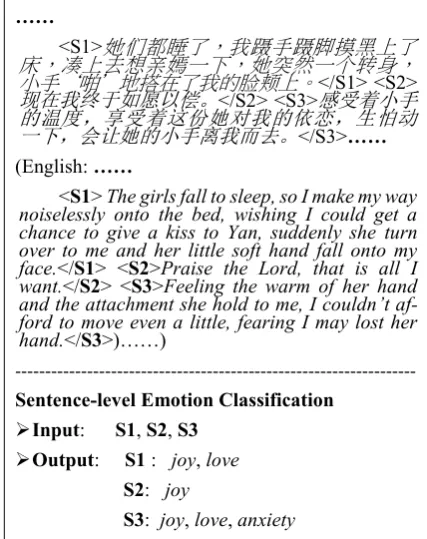
Figure 1: An example of a paragraph and the sentences therein with their emotion categories
from the corpus collected by Quan and Ren (2009)
On one hand, like document-level emotion classification, sentence-level emotion classifica-tion is naturally a multi-label classificaclassifica-tion prob-lem. That is, each sentence might involve more than one emotion category. For example, as shown in Figure 1, in one paragraph, two sen-tences, i.e., S1 and S3, have two and three emotion categories respectively. Automatically classifying instances with multiple possible categories is
sometimes much more difficult than classifying instances with a single label.
On the other hand, unlike document-level emo-tion classificaemo-tion, sentence-level emoemo-tion classi-fication is prone to the data sparseness problem because a sentence normally contains much less content. Given the short text of a sentence, it is often difficult to predict its emotion due to the limited information therein. For example, in S2, only one phrase “如愿以偿(that is all I want)” ex-presses the joy emotion. Once this phrase fails to appear in the training data, it will be hard for the classifier to give a correct prediction according to the limited content in this sentence.
In this paper, we address above two challenges in sentence-level emotion classification by mod-eling both the label and context dependence. Here, the label dependence indicates that multiple emo-tion labels of an instance are highly correlated to each other. For instance, the two positive emo-tions, joy and love, are more likely to appear at the same time than the two counterpart emotions, joy
and hate. The context dependence indicates that two neighboring sentences or two sentences in the same paragraph (or document) might share the same emotion categories. For instance, in Figure 1, S1, S2, and S3, from the same paragraph, all share the emotion category joy.
Specifically, we propose a factor graph, namely Dependence Factor Graph (DFG), to model the la-bel and context dependence in sentence-level emotion classification. In our DFG approach, both the label and context dependence are modeled as various factor functions and the learning task aims to maximize the joint probability of all these fac-tor functions. Empirical evaluation demonstrates the effectiveness of our DFG approach to captur-ing the inherent label and context dependence. To the best of our knowledge, this work is the first attempt to incorporate both the label and context dependence of sentence-level emotion classifica-tion into a unified framework.
The remainder of this paper is organized as fol-lows. Section 2 overviews related work on emo-tion analysis. Secemo-tion 3 presents our observaemo-tions on label and context dependence in the corpus. Section 4 proposes our DFG approach to sen-tence-level emotion classification. Section 5 eval-uates the proposed approach. Finally, Section 6 gives the conclusion and future work.
2
Related Work
Over the last decade, there has been an explosion of work exploring various aspects of emotion analysis, such as emotion resource creation (Wiebe et al., 2005; Quan and Ren, 2009; Xu et al., 2010), writer’s emotion vs. reader’s emotion analysis (Lin et al., 2008; Liu et al., 2013), emo-tion cause event analysis (Chen et al., 2010), doc-ument-level emotion classification (Alm et al., 2005; Li et al., 2014) and sentence-level or short text-level emotion classification (Tokushisa et al., 2008; Bhowmick et al., 2009; Xu et al., 2012). This work focuses on sentence-level emotion clas-sification.
Among the studies on sentence-level emotion classification, Tokushisa et al. (2008) propose a data-oriented method for inferring the emotion of an utterance sentence in a dialog system. They leverage a huge collection of emotion-provoking event instances from the Web to deal with the data sparseness problem in sentence-level emotion classification. Bhowmick et al. (2009) and Bhowmick et al. (2010) apply KNN-based classi-fication algorithms to classify news sentences into multiple reader emotion categories. Although the multi-label classification difficulty has been no-ticed in their study, the label dependence is not exploited. More recently, Xu et al. (2012) pro-poses a coarse-to-fine strategy for sentence-level emotion classification. They deal with the data sparseness problem by incorporating the transfer probabilities from the neighboring sentences to refine the emotion categories. To some extent, this can be seen a specific kind of context information. However, they ignore the label dependence by di-rectly applying Binary Relevance to overcome the multi-label classification difficulty.
Unlike all above studies, this paper emphasizes the importance of the label dependence and ex-ploits it in sentence-level emotion classification via a factor graph model. Moreover, besides the label dependence, our factor graph-based ap-proach incorporates the context dependence in a unified framework to further improve the perfor-mance of sentence-level emotion classification.
3
Observations
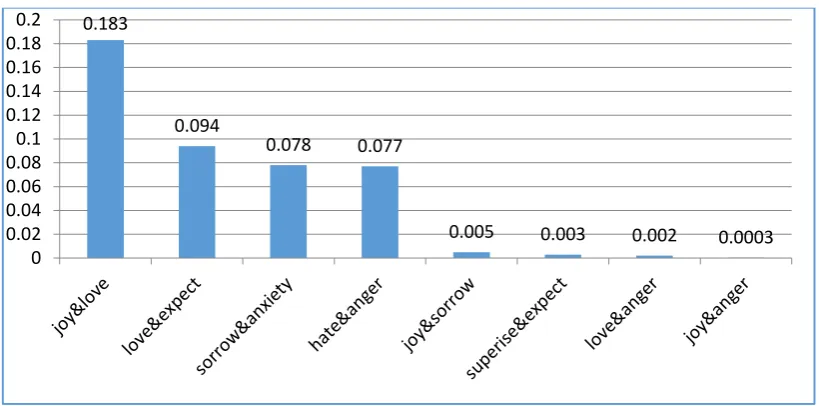
Figure 2: Probability distribution of most and least frequently-occurred pairs of emotion categories, with left four most frequently-occurred and right four least frequently-occurred, among all 28 pairs
The corpus contains 100 documents, randomly selected from Quan and Ren (2009). There are to-tally 2751 sentences and each of them is manually annotated with one or more emotion labels.
Table 1: The numbers of the sentences in each emotion category
Emotion #Sentence Emotion #Sentence
joy 691 anxiety 567
hate 532 surprise 180
love 1025 anger 287
[image:3.595.105.258.537.631.2]sorrow 611 expect 603
Table 2: The numbers of the sentences grouped by the emotion labels they contain
#Sentence
No Label 180
One Label 1096
Two Labels 1081
Three Labels 346
Four or more labels 48
ALL 2751
Table 1 shows the sentence distribution of the eight emotion categories. Obviously, the distribu-tion is a bit imbalanced. While about to one quar-ter of sentences express the emotion category love,
only ~6% and ~10% express surprise and anger respectively, with the remaining 5 emotion cate-gories distributed rather evenly from ~20% to
~25%. Table 2 shows the numbers of the sen-tences grouped by the emotion labels they contain. From this table, we can see that more than half sentences have two or more emotion labels. This indicates the popularity of the multi-label issue in sentence-level emotion classification.
To investigate the phenomenon of label de-pendence, we first assume that XRddenotes
an input domain of instances and Y{ , ,..., }l l1 2 lm
be a finite domain of possible emotion labels. Each instance is associated with a subset of Y and this subset is described as an m-dimensional vec-tor y{ ,y y1 2,...,ym} where yi=1 only if
in-stance x has label .li and yi=0 otherwise. Then, we can calculate the probability that an instance takes both emotion labels liand lj, denoted as
( , )i j
p l l . Figure 2 shows the probability distribu-tion of most and least frequently-occurred pairs of emotion categories, with left four most fre-quently-occurred and right four least frequently-occurred, among all 28 pairs. From this figure, we can see that some pairs, e.g., joy and love, are much more likely to be taken by one sentence than some other pairs, e.g. joy and anger.
Finally, we investigate the phenomenon of the context dependence by calculating the probabili-ties that two instances xkand xlhave at least one identical emotion label, i.e., (p yk yl ) in different settings.
0.183
0.094
0.078 0.077
0.005 0.003 0.002 0.0003
Figure 4: An example of DFG when two instances are involved: sentence-1 with the label vector [1, 0, 1] and sentence-2 with the label vector [1, 1, 0]
Note: each multi-label instance is transformed into three pseudo samples, represented as k ( 1,2,3) i
X k . ( )
[image:4.595.71.285.416.531.2]f represents a factor function for modeling textual features. ( )g represents a factor function for mod-eling the label dependence between two pseudo samples. ( )h represents a factor function for modeling the context dependence between two instances in the same context.
Figure 3: Probabilities that two instances have an identical emotion label in different settings
Figure 3 shows the probabilities that two in-stances have at least one identical emotion label in different settings, where neighbor, paragraph, document and random mean two neighboring in-stances, two instances from the same paragraph, two instances from the same document, and two instances from a random selection, respectively. From this figure, we can see that two instances from the same context are much more likely to take an identical emotion label than two random instances.
From above statistics, we come to two basic ob-servations:
1) Label dependency: One sentence is more likely to take some pair of emotion labels, e.g.,
hate and angry than some other pair of emo-tion labels, e.g., hate and happy.
2) Context dependency: Two instances from the same context are more likely to share the same emotion label than those from a random selec-tion.
4
Dependence Factor Graph Model
In this section, we propose a dependence factor graph (DFG) model for learning emotion labels of sentences with both label and context dependence.
4.1 Preliminary Factor Graph
A factor graph consists of two layers of nodes, i.e., variable nodes and factor nodes, with links be-tween them. The joint distribution over the whole set of variables can be factorized as a product of all factors. Figure 4 gives an example of our de-pendence factor graph (DFG) when two instances, i.e., sentence-1 and sentence-2 are involved.
Binary Relevance
A popular solution to multi-label classification is called binary relevance which constructs a binary classifier for each label, resulting a set of
inde-0.68 0.69
0.5
0.22
0 0.2 0.4 0.6 0.8
Neighbor Paragraph Document Random
2 1 y
f (X11,y11)
3 1
y
1 1 y
2 2 y
1 2 y
1 1,1 X l
2 1, 2 X l
2 2, 2 X l
1 2,1 X l
f ( 1 1 2, 2
X y )
3 1, 3 X l
3 2, 3 X l
3 2 y
g(y y11, 13)
g( 1 3 2, 2
y y )
3
l
2
l l1 3
l
1
l
2
l
Sentence-1
Sentence-2
DFG model
h( 2 2 1, 2
y y )
pendent binary classification problems (Tsouma-kas and Katakis, 2007; Tsouma(Tsouma-kas et al., 2009). In our approach, binary relevance is utilized as a preliminary step so that each original instance is transformed into K pseudo samples, where K is the number of categories. For example, in Figure 4, 1
1 X , 2
1
X , and 3 1
X represent the three pseudo samples, generated from the same original in-stance sentence-1.
4.2 Model Definition
Formally, letG
V E X, ,
represent an instance network, where V denotes a set of sentence in-stances. E V V is a set of relationships be-tween sentences. Two kinds of relationship exist in our instance network: One represents the label dependence between each two pseudo instances generated from the same original instance, while the other represents the context dependence when the two instances are from the same context, e.g., the same paragraph. X is the textual feature vec-tor associated with a sentence.We model the above network with a factor graph and our objective is to infer the emotion cat-egories of instances by learning the following joint distribution:
k, k
k,
k
k,
k
i i i i i i
k i
P Y G
f X y g y G y h y H y
(1)where three kinds of factor functions are used.
1) Textual feature factor function:
k, k
i i
f X y
denotes the traditional textual feature factor functions associated with each text k
i
X . The textual feature factor function is instantiated as follows:
1
1
, exp ,
k k k k
i i kj ij i
j
f X y x y
Z
(2)Where
k, k
ij ix y
is a feature function and k ij
x
represents a textual feature, i.e., a word feature in this study.
2) Label dependence factor function:
k, k
i i
g y G y denotes the additional label de-pendence relationship among the pseudo in-stances, where
ki
G y is the label set of the instances connected to k
i
y .
k iG y and k i
y are labels of the pseudo instances generated from the same original instance. The label depend-ence factor function is instantiated as follows:
2( ) 2
1
, ( ) exp
l k
i i
k k k l
i i ikl i i
y G y
g y G y y y
Z
(3) Where ikl is the weight of the function, rep-resenting the influence degree of the two in-stances ki
y and l i
y .
3) Context dependence factor function:
k, k
i i
h y H y denotes the additional context dependence relationship among the instances, where
ki
H y is the set of the instances con-nected to k
i
y .
k iH y and k i
y are the labels of the pseudo instances from the same context but generated from different original instances. The context dependence factor function is in-stantiated as follows:
2( ) 3
1
, ( ) exp
k k
j i
k k k k
i i ijk i j
y H y
h y H y y y
Z
(4) Where
ijk is the weight of the function, repre-senting the influence degree of the two in-stances ki
y and k j
y .
4.3 Model Learning
Learning the DFG model is to estimate the best parameter configuration ({ },{ },{ }) to maximize the log-likelihood objective function
log
L P Y G , i.e.,
* argmaxL
(5) In this study, we employ the gradient decent method to optimize the objective function. For ex-ample, we can write the gradient of each kjwith regard to the objective function:
|
, , kj k kij i P Y G ij i
kj
L
E x y E x y
(6)
Where
, k
ij i
E x y is the expectation of feature function
, k
ij i x y
given the data distribution.
|
,
kj
k ij i P Y G
E x y
is the expectation of feature
function
, k
ij i x y under the distribution
kjP Y G given by the estimated model. Figure 5
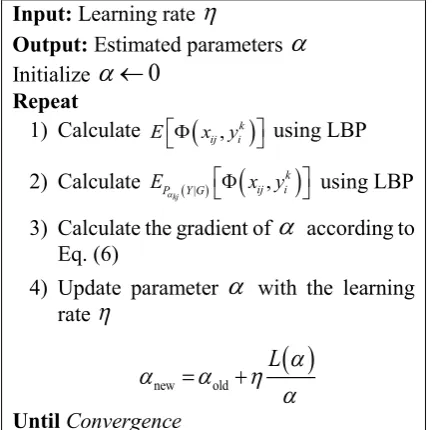
Belief Propagation (LBP) algorithm which is ap-plied to approximately infer the marginal distribu-tion in a factor graph (Frey and MacKay, 1998). A similar gradient can be derived for the other pa-rameters.
Input: Learning rate
Output: Estimated parameters
Initialize
0
Repeat
1) Calculate
, k
ij iE x y using LBP
2) Calculate |
,
kjk ij i P Y G
E x y
using LBP
3) Calculate the gradient of
according to Eq. (6)4) Update parameter
with the learning rate
new old
L
[image:6.595.73.290.147.362.2]UntilConvergence
Figure 5: The learning algorithm for DGP model
4.4 Model Prediction
With the learned parameter configuration , the prediction task is to find a YU* which optimizes
the objective function, i.e.,
* arg max , ,
U U L
Y P Y Y G (7) Where YU* are the labels of the instances in the
testing data.
Again, we utilize LBP to calculate the marginal probability of each instance
k L, ,
i
P y Y G and predict the label with the largest marginal proba-bility. As all instances in the test data are con-cerned, above prediction is performed in an itera-tion process until the results converge.
5
Experimentation
We have systematically evaluated our DFG ap-proach to sentence-level emotion classification.
5.1 Experimental Setting Corpus
The corpus contains 100 documents (2751 sen-tences) from the Ren-CECps corpus (Quan and
Ren, 2009). In our experiments, we use 80 docu-ments as the training data and the remaining 20 documents as the test data.
Features
Each instance is treated as a bag-of-words and transformed into a binary vector encoding the presence or absence of word unigrams.
Evaluation Metrics
In our study, we employ three evaluation metrics to measure the performances of different ap-proaches to sentence-level emotion classification. These metrics have been popularly used in some multi-label classification problems (Godbole and Sarawagi, 2004; Schapire and Singer, 2000). 1) Hamming loss: It evaluates how many times
an instance-label pair is misclassified consid-ering the predicted set of labels and the ground truth set of labels, i.e.,
'
1 1
1
1
1
j ji i
q m
y y i j
hloss
mq
(8)where q is the number of all test instances and
m is the number of all emotion labels. j'
i
y is the estimated label while j
i
y is the true label. 2) Accuracy: It gives an average degree of the
similarity between the predicted and the ground truth label sets of all test examples, i.e.,
'
' 1
1 q
i i
i i i
y y Accuracy
q y y
(9)3) F1-measure: It is the harmonic mean between precision and recall. It can be calculated from true positives, true negatives, false positive and false negatives based on the predictions and the corresponding actual values, i.e.,
'
' 1
1 q
i i
i i i
y y F1
q y y
(10) Note that smaller Hamming loss corresponds to better classification quality, while larger accuracyFigure 6: Performance comparison of different approaches to sentence-level emotion classification with the label dependence only
Figure 7: Performance comparison of different approaches to sentence-level emotion classification with the context dependence only
5.2 Experimental Results with Label De-pendence
In this section, we compare following approaches which only consider the label dependence among pseudo instances:
Baseline: As a baseline, this approach applies a maximum entropy (ME) classifier with only textual features, ignoring both the label and context dependence.
LabelD: As the state-of-the-art approach to handling multi-label classification, this ap-proach incorporates label dependence, as de-scribed in (Wang et al., 2014). Specifically, this approach first utilizes a Bayesian network to infer the relationship among the labels and then employ them in the classifier.
DFG-label: Our DFG approach with the label dependence.
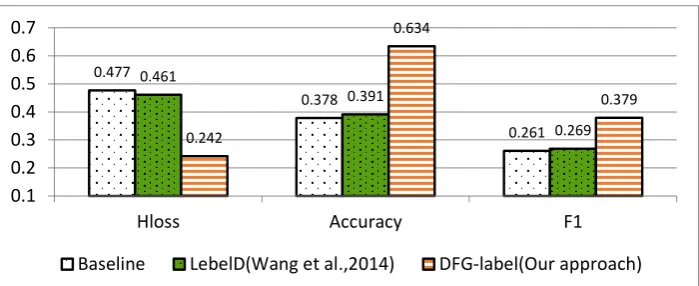
Figure 6 compares the performance of different approaches to sentence-level emotion classifica-tion with the label dependence. From this figure, we can see that our DFG approach improves the
baseline approach with an impressive improve-ment in all three kinds of evaluation metrics, i.e., 23.5% reduction in Hloss, 25.6% increase in Ac-curacy, and 11.8% increase in F1. This result ver-ifies the effectiveness of incorporating the label dependence in sentence-level emotion classifica-tion. Compared to the state-of-the-art LabelD ap-proach, our DFG approach is much superior. Sig-nificant test show that our DFG approach signifi-cantly outperforms both the baseline approach and LabelD (p-value<0.01). One reason that LabelD performs worse than our approach is possibly due to their separating learning on textual features and label relationships. Also, different from ours, their approach could not capture the information be-tween two conflict emotion labels, such as “happy” and “sad” (they are not possibly appearing to-gether).
5.3 Experimental Results with Context De-pendence
In this section, we compare following approaches which only consider the context dependence among pseudo instances:
0.477
0.378
0.261 0.461
0.391
0.269 0.242
0.634
0.379
0.1 0.2 0.3 0.4 0.5 0.6 0.7
Hloss Accuracy F1
Baseline LebelD(Wang et al.,2014) DFG-label(Our approach)
0.477
0.378
0.261 0.472
0.382
0.264
0.416 0.443
0.292 0.45
0.407
0.275 0.569
0.295
0.215
0.2 0.3 0.4 0.5 0.6
Hloss Accuracy F1
Baseline Tansfer(Xu et al.,2012) DFG-context(Neighbor)
Baseline: same as the one in Section 5.2, which applies a maximum entropy (ME) clas-sifier with only textual features, ignoring both the label and context dependence.
Transfer: As the state-of-the-art approach to incorporating contextual information in sen-tence-level emotion classification (Xu et al., 2012), this approach utilizes the label transfor-mation probability to refine the classification results.
DFG-label (Neighbor): Our DFG approach with the context dependence only. Specifically, the neighboring instances are considered as context.
DFG-label (Paragraph): Our DFG approach with the context dependence only. Specifically, the instances in the same paragraph are consid-ered as context.
DFG-label (Document): Our DFG approach with the context dependence only. Specifically, the instances in the same document are consid-ered as context.
Figure 7 compares the performance of different approaches to sentence-level emotion classifica-tion with the context dependence only. From this figure, we can see that our DFG approach consist-ently improves the state-of-the-art in all three kinds of evaluation metrics, i.e., 6.1% reduction in
Hloss, 6.5% increase in Accuracy, and 3.1% in-crease in F1 when the neighboring instances are considered as context. Among the three kinds of context, the neighboring setting performs best. We also find that using the whole document as the context is not helpful and it performs even worse than the baseline approach. Compared to the state-of-the-art Transfer approach, our DFG approach with the neighboring context dependence is much superior. Significant test show that our DFG ap-proach with the neighboring context dependence significantly outperforms the baseline approach and the state-of-the-art LabelD approach (p -value<0.01).
5.4 Experimental Results with Both Label and Context Dependence
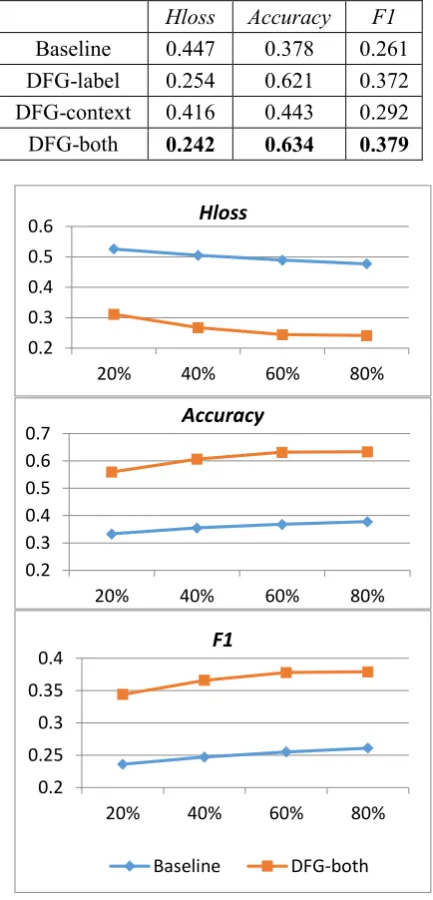
Table 3 shows the performance of our DFG ap-proach with both label and context dependence, denoted as DGF-both. From this table, we can see that using both label and context dependence fur-ther improves the performance.
Figure 8 shows the performance of our DGF-both approach when different sizes of training data are used to train the model. From this figure, we can see that incorporating both the label and context dependence consistently improves the
[image:8.595.310.527.140.591.2]performance with a large margin, irrespective of the amount of training data available.
Table 3: Performance of our DFG approach with both label and context dependence
Hloss Accuracy F1
Baseline 0.447 0.378 0.261
DFG-label 0.254 0.621 0.372
DFG-context 0.416 0.443 0.292
DFG-both 0.242 0.634 0.379
Figure 8: Performance of our DGF-both ap-proach when different sizes of training data are
used
6
Conclusion
In this paper, we propose a novel approach to sen-tence-level emotion classification by incorporat-ing both the label dependence among the emotion labels and the context dependence among the con-textual instances into a factor graph, where the la-bel and context dependence is modeled as various factor functions. Empirical evaluation shows that
0.2 0.3 0.4 0.5 0.6
20% 40% 60% 80%
Hloss
0.2 0.3 0.4 0.5 0.6 0.7
20% 40% 60% 80%
Accuracy
0.2 0.25 0.3 0.35 0.4
20% 40% 60% 80%
F1
our DFG approach performs significantly better than the state-of-the-art.
In the future work, we would like to explore bet-ter ways of modeling the label and context de-pendence and apply our DFG approach in more applications, e.g. micro-blogging emotion classi-fication.
Acknowledgments
This research work has been partially supported by three NSFC grants, No.61273320, No.61375073, No.61331011, and Collaborative Innovation Center of Novel Software Technology and Industrialization.
References
Alm C., D. Roth and R. Sproat. 2005. Emotions from Text: Machine Learning for Text-based Emotion Prediction. In Proceedings of EMNLP-05, pp.579-586.
Bhowmick P., A. Basu, P. Mitra, and A. Prasad. 2009. Multi-label Text Classification Approach for Sen-tence Level News Emotion Analysis. Pattern Recognition and Machine Intelligence. Lecture Notes in Computer Science, Volume 5909, pp 261-266.
Bhowmick P., A. Basu, P. Mitra, and A. Prasad. 2010. Sentence Level News Emotion Analysis in Fuzzy Multi-label Classification Framework. Research in Computing Science. Special Issue: Natural Lan-guage Processing and its Applications, pp.143-154. Bollen J., H. Mao, and X.-J. Zeng. 2011. Twitter Mood Predicts the Stock Market. Journal of Computa-tional Science, 2(1):1–8, 2011.
Chen Y., S. Lee, S. Li and C. Huang. 2010. Emotion Cause Detection with Linguistic Constructions. In Proceedings of COLING-10, pp.179-187.
Frey B. and D. MacKay. 1998. A Revolution: Belief Propagation in Graphs with Cycles. In Proceedings of NIPS-98, pp.479–485.
Galik M. and S. Rank. 2012. Modelling Emotional Tra-jectories of Individuals in an Online Chat. In Pro-ceedings of Springer-Verlag Berlin Heidelberg-12, pp.96-105.
Godbole S. and S. Sarawagi. 2004. Discriminative Methods for Multi-labeled Classification. In Ad-vances in knowledge discovery and data mining. pp. 22-30.
Kiritchenko S., X. Zhu, and S. Mohammad. 2014. Sen-timent Analysis of Short Informal Texts. Journal of Artificial Intelligence Research, 50(2014), pp.723-762.
Li C., H. Wu, and Q. Jin. 2014. Emotion Classification of Chinese Miroblog Text via Fusion of BoW and
eVector Feature Representations. In Proceedings of NLP&CC-14, pp.217-228.
Lin K., C. Yang, and H. Chen. 2008. Emotion Classi-fication of Online News Articles from the Reader’s Perspective. In Proceedings of the International Conference on Web Intelligence and Intelligent Agent Technology-08, pp.220-226.
Liu H., S. Li, G. Zhou, C. Huang, and P. Li. 2013. Joint Modeling of News Reader’s and Comment Writer’s Emotions. In Proceedings of ACL-13, short paper, pp.511-515.
Quan C. and F. Ren. 2009. Construction of a Blog Emotion Corpus for Chinese Emotional Expression Analysis. In Proceedings of EMNLP-09, pp.1446-1454.
Schapire R. E and Y. Singer. 2000. A Boosting-based System for Text Categorization. Machine learning, pp. 135-168
TOKUHISA R., K. Inui, and Y. Matsumoto. 2008. Emotion Classification Using Massive Examples Extracted from the Web. In Proceedings of COL-ING-2008, pp.881-888.
Tsoumakas G. and I. Katakis. 2007. Multi-label Clas-sification: An Overview. In Proceedings of Interna-tional Journal of Data Warehousing and Mining, 3(3), pp.1-13.
Tsoumakas G., I. Katakis, and I. Vlahavas. 2009. Min-ing Multi-label Data. Data MinMin-ing and Knowledge Discovery Handbook, pages 1–19.
Wen S. and X. Wan. 2014. Emotion Classification in Microblog Texts Using Class Sequential Rules. In Proceedings of AAAI-14, 187-193.
Wang S., J. Wang, Z. Wang, and Q. Ji. 2014. Enhanc-ing Multi-label Classification by ModelEnhanc-ing Depend-encies among Labels. Pattern Recognition. Vol. 47. Issue 10: 3405-3413, 2014.
Wiebe J., T. Wilson, and C. Cardie. 2005. Annotating Expressions of Opinions and Emotions in Language. Language Resources and Evaluation, 39, 65-210. Xu G., X. Meng and H. Wang. 2010. Build Chinese
Emotion Lexicons Using A Graph-based Algorithm and Multiple Resources. In Proceedings of COL-ING-10, pp.1209-1217.
![Figure 4: An example of DFG when two instances are involved: sentence-1 with the label vector [1, 0, 1] and sentence-2 with the label vector [1, 1, 0] ](https://thumb-us.123doks.com/thumbv2/123dok_us/197317.518690/4.595.72.525.68.309/figure-example-instances-involved-sentence-vector-sentence-vector.webp)