1980
Rumor Detection on Twitter with Tree-structured Recursive Neural
Networks
Jing Ma1, Wei Gao2, Kam-Fai Wong1,3
1The Chinese University of Hong Kong, Hong Kong SAR 2Victoria University of Wellington, New Zealand
3MoE Key Laboratory of High Confidence Software Technologies, China 1{majing,kfwong}@se.cuhk.edu.hk, 2[email protected]
Abstract
Automatic rumor detection is technically very challenging. In this work, we try to learn discriminative features from tweets content by following their non-sequential propagation structure and generate more powerful representations for identifying different type of rumors. We propose two recursive neural models based on a bottom-upand atop-downtree-structured neural networks for rumor representation learning and classification, which natu-rally conform to the propagation layout of tweets. Results on two public Twit-ter datasets demonstrate that our recursive neural models 1) achieve much better per-formance than state-of-the-art approaches; 2) demonstrate superior capacity on de-tecting rumors at very early stage.
1 Introduction
Rumors have always been a social disease. In re-cent years, it has become unprecedentedly conve-nient for the “evil-doers” to create and disseminate rumors in massive scale with low cost thanks to the popularity of social media outlets on Twitter, Facebook, etc. The worst effect of false rumors could be devastating to individual and/or society.
Research pertaining rumors spans multiple dis-ciplines, such as philosophy and humanities ( Di-Fonzo and Bordia,2007;Donovan,2007), social psychology (Allport and Postman, 1965; Jaeger et al., 1980; Rosnow and Foster, 2005), politi-cal studies (Allport and Postman, 1946; Berin-sky, 2017), management science (DiFonzo et al.,
1994;Kimmel, 2004) and recently computer sci-ence and artificial intelligsci-ence (Qazvinian et al.,
2011;Ratkiewicz et al.,2011;Castillo et al.,2011;
Hannak et al.,2014;Zhao et al.,2015;Ma et al.,
2015). Rumor is commonly defined as informa-tion that emerge and spread among people whose truth value is unverified or intentionally false ( Di-Fonzo and Bordia,2007;Qazvinian et al.,2011). Analysis shows that people tend to stop spread-ing a rumor if it is known as false (Zubiaga et al.,
2016b). However, identifying such misinforma-tion is non-trivial and needs investigative jour-nalism to fact check the suspected claim, which is labor-intensive and time-consuming. The pro-liferation of social media makes it worse due to the ever-increasing information load and dynam-ics. Therefore, it is necessary to develop automatic and assistant approaches to facilitate real-time ru-mor tracking and debunking.
For automating rumor detection, most of the previous studies focused on text mining from se-quential microblog streams using supervised mod-els based on feature engineering (Castillo et al.,
2011; Kwon et al., 2013; Liu et al., 2015; Ma et al.,2015), and more recently deep neural mod-els (Ma et al., 2016;Chen et al., 2017; Ruchan-sky et al., 2017). These methods largely ignore or oversimplify the structural information asso-ciated with message propagation which however has been shown conducive to provide useful clues for identifying rumors. Kernel-based method (Wu et al., 2015; Ma et al., 2017) was thus proposed to model the structure as propagation trees in or-der to differentiate rumorous and non-rumorous claims by comparing their tree-based similarities. But such kind of approach cannot directly classify a tree without pairwise comparison with all other trees imposing unnecessary overhead, and it also cannot automatically learn any high-level feature representations out of the noisy surface features.
were originally used to compose phrase or sen-tence representation for syntactic and semantic parsing (Socher et al.,2011,2012). Unlike pars-ing, the input into our model is a propagation tree rooted from a source post rather than the parse tree of an individual sentence, and each tree node is a responsive post instead of an individual words. The content semantics of posts and the responsive relationship among them can be jointly captured via the recursive feature learning process along the tree structure.
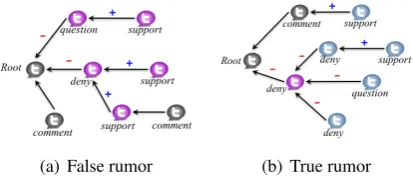
So, why can such neural model do better for the task? Analysis has generally found that Twit-ter could “self-correct” some inaccurate informa-tion as users share opinions, conjectures and evi-dences (Zubiaga et al.,2017). To illustrate our in-tuition, Figure1exemplifies the propagation trees of two rumors in our dataset, one being false and the other being true1. Structure-insensitive meth-ods basically relying on the relative ratio of differ-ent stances in the text cannot do well when such clue is unclear like this example. However, it can be seen that when a post denies the false rumor, it tends to spark supportive or affirmative replies confirming the denial; in contrast, denial to a true rumor tends to trigger question or denial in its replies. This observation may suggest a more gen-eral hypothesis that the repliers tend to disagree with (or question) who support a false rumor or deny a true rumor, and also they tend to agree with who deny a false rumor or support a true rumor. Meanwhile, a reply, rather than directly respond-ing to the source tweet (i.e., the root), is usually re-sponsive to its immediate ancestor (Lukasik et al.,
2016;Zubiaga et al., 2016a), suggesting obvious local characteristic of the interaction. The recur-sive network naturally models such structures for learning to capture the rumor indicative signals and enhance the representation by recursively ag-gregating the signals from different branches.
To this end, we extend the standard RvNN into two variants, i.e., abottom-up (BU) model and a top-down(TD) model, which represent the propa-gation tree structure from different angles, in order to visit the nodes and combine their representa-tions following distinct direcrepresenta-tions. The important merit of such architecture is that the node features can be selectively refined by the recursion given the connection and direction of all paths of the
1False (true) rumor means the veracity of the rumorous
claim is false (true).
[image:2.595.313.520.70.159.2](a) False rumor (b) True rumor
Figure 1: Propagation trees of two rumorous source tweets. Nodes may express stances on their parent as commenting, supporting, questioning or denying. The edge arrow indicates the direction from a response to its responded node, and the po-larity is marked as ‘+’ (‘-’) for support (denial). The same node color indicates the same stance on the veracity of root node (i.e., source tweet).
tree. As a result, it can be expected that the dis-criminative signals are better embedded into the learned representations.
We evaluate our proposed approach based on two public Twitter datasets. The results show that our method outperforms strong rumor detection baselines with large margin and also demonstrate much higher effectiveness for detection at early stage of propagation, which is promising for real-time intervention and debunking. Our contribu-tions are summarized as follows in three folds:
• This is the first study that deeply integrates both structure and content semantics based on tree-structured recursive neural networks for detecting rumors from microblog posts.
• We propose two variants of RvNN models based on bottom-up and top-down tree struc-tures to generate better integrated representa-tions for a claim by capturing both structural and textural properties signaling rumors.
• Our experiments based on real-world Twitter datasets achieve superior improvements over state-of-the-art baselines on both rumor clas-sification and early detection tasks. We make the source codes in our experiments publicly accessible2.
2 Related Work
Most previous automatic approaches for rumor de-tection (Castillo et al.,2011;Yang et al.,2012;Liu
2https://github.com/majingCUHK/Rumor_
et al.,2015) intended to learn a supervised classi-fier by utilizing a wide range of features crafted from post contents, user profiles and propagation patterns. Subsequent studies were then conducted to engineer new features such as those represent-ing rumor diffusion and cascades (Friggeri et al.,
2014;Hannak et al.,2014) characterized by com-ments with links to debunking websites. Kwon et al.(2013) introduced a time-series-fitting model based on the volume of tweets over time.Ma et al.
(2015) extended their model with more chronolog-ical social context features. These approaches typ-ically require heavy preprocessing and feature en-gineering.
Zhao et al.(2015) alleviated the engineering ef-fort by using a set of regular expressions (such as “really?”, “not true”, etc) to find questing and denying tweets, but the approach was oversimpli-fied and suffered from very low recall. Ma et al.
(2016) used recurrent neural networks (RNN) to learn automatically the representations from tweets content based on time series. Recently, they studied to mutually reinforce stance detection and rumor classification in a neural multi-task learn-ing framework (Ma et al., 2018). However, the approaches cannot embed features reflecting how the posts are propagated and requires careful data segmentation to prepare for time sequence.
Some kernel-based methods were exploited to model the propagation structure. Wu et al.(2015) proposed a hybrid SVM classifier which combines a RBF kernel and a random-walk-based graph ker-nel to capture both flat and propagation patterns for detecting rumors on Sina Weibo. Ma et al.
(2017) used tree kernel to capture the similarity of propagation trees by counting their similar sub-structures in order to identify different types of ru-mors on Twitter. Compared to their studies, our model can learn the useful features via a more nat-ural and general approach, i.e., the tree-structured neural network, to jointly generate representations from both structure and content.
RvNN has demonstrated state-of-the-art perfor-mances in a variety of tasks, e.g., images seg-mentation (Socher et al.,2011), phrase represen-tation from word vectors (Socher et al., 2012), and sentiment classification in sentences (Socher et al., 2013). More recently, a deep RvNN was proposed to model the compositionality in natu-ral language for fine-grained sentiment classifica-tion by stacking multiple recursive layers (Irsoy
and Cardie,2014). In order to avoid gradient van-ishing, some studies integrated Long Short Term Memory (LSTM) (Hochreiter and Schmidhuber,
1997) to RvNN (Zhu et al.,2015;Tai et al.,2015).
Mou et al. (2015) used a convolutional network over tree structures for syntactic tree parsing of natural language sentences.
3 Problem Statement
We define a Twitter rumor detection dataset as a set of claims C = {C1, C2,· · · , C|C|}, where each claim Ci corresponds to a source tweet ri
which consists of ideally all its relevant respon-sive tweets in chronological order, i.e., Ci = {ri, xi1, xi2,· · ·, xim}where eachxi∗is a respon-sive tweet of the root ri. Note that although the
tweets are notated sequentially, there are connec-tions among them based on their reply or repost relationships, which can form a propagation tree structure (Wu et al.,2015;Ma et al.,2017) withri
being the root node.
We formulate this task as a supervised classifi-cation problem, which learns a classifier f from labeled claims, that isf :Ci →Yi, whereYitakes one of the four finer-grained classes: non-rumor, false rumor,true rumor, andunverified rumorthat are introduced in the literature (Ma et al., 2017;
Zubiaga et al.,2016b).
An important issue of the tree structure is con-cerned about the direction of edges, which can re-sult in two different architectures of the model: 1) a bottom-up tree; 2) a top-down tree, which are defined as follows:
• Bottom-up tree takes the similar shape as shown in Figure 1, where responsive nodes always point to their responded nodes and leaf nodes not having any response are laid out at the furthest level. We represent a tree asTi = hVi, Eii, whereVi =Ci which
con-sists of all relevant posts as nodes, andEi
de-notes a set of all directed links, where for any
u, v ∈ Vi,u ← v exists ifvresponses tou. This structure is similar to a citation network where a response mimics a reference.
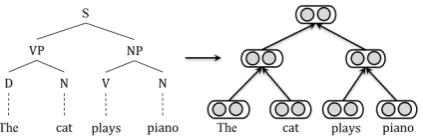
cas-Figure 2: A binarized sentence parse tree (left) and its corresponding RvNN architecture (right).
cades from a source tweet, i.e., the root, to all its receivers, i.e., the decedents, which is similar as (Wu et al.,2015;Ma et al.,2017).
4 RvNN-based Rumor Detection
The core idea of our method is to strengthen the high-level representation of tree nodes by the re-cursion following the propagation structure over different branches in the tree. For instance, the re-sponsive nodes confirming or supporting a node (e.g., “I agree”, “be right”, etc) can further rein-force the stance of that node while denial or ques-tioning responses (e.g., “disagree, “really?!) oth-erwise weaken its stance. Compared to the kernel-based method using propagation tree (Wu et al.,
2015;Ma et al.,2017), our method does not need pairwise comparison among large number of sub-trees, and can learn much stronger representation of content following the response structure.
In this section, we will describe our extension to the standard RvNN for modeling rumor detec-tion based on the bottom-up and top-down archi-tectures presented in Section3.
4.1 Standard Recursive Neural Networks
RvNN is a type of tree-structured neural networks. The original version of RvNN utilized binarized sentence parse trees (Socher et al.,2012), in which the representation associated with each node of a parse tree is computed from its direct children. The overall structure of the standard RvNN is il-lustrated as the right side of Figure2, correspond-ing to the input parse tree at the left side.
Leaf nodes are the words in an input sen-tence, each represented by a low-dimensional word embedding. Non-leaf nodes are sentence constituents, computed by recursion based on the presentations of child nodes. Letpbe the feature vector of a parent node whose children arec1 and
c2, the representation of the parent is computed by
p=f(W·[c1;c2]+b), wheref(·)is the activation
function withW andbas parameters. This compu-tation is done recursively over all tree nodes; the learned hidden vectors of the nodes can then be used for various classification tasks.
4.2 Bottom-up RvNN
The core idea of bottom-up model is to generate a feature vector for each subtree by recursively visit-ing every node from the leaves at the bottom to the root at the top. In this way, the subtrees with sim-ilar contexts, such as those subtrees having a de-nial parent and a set of supportive children, will be projected into the proximity in the representation space. And thus such local rumor indicative fea-tures are aggregated along different branches into some global representation of the whole tree.
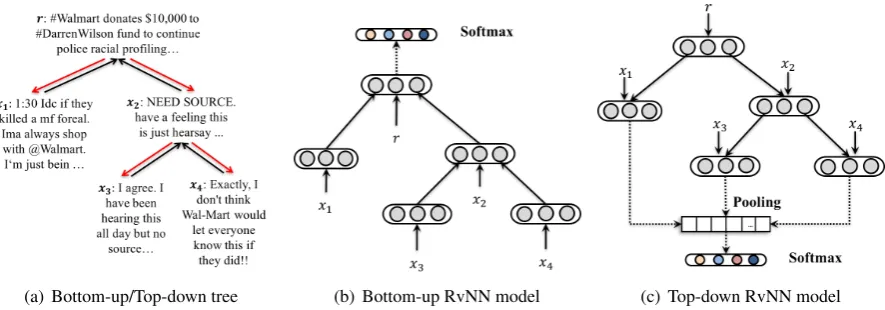
For this purpose, we make a natural extension to the original RvNN. The overall structure of our proposed bottom-up model is illustrated in Fig-ure3(b), taking a bottom-up tree (see Figure3(a)) as input. Different from the standard RvNN, the input of each node in the bottom-up model is a post represented as a vector of words in the vocab-ulary in terms oftf idf values. Here, every node has an input vector, and the number of children of nodes varies significantly3.
In rumor detection, long short-term memory (LSTM) (Hochreiter and Schmidhuber,1997) and gated recurrent units (GRU) (Cho et al., 2014) were used to learn textual representation, which adopts memory units to store information over long time steps (Ma et al., 2016). In this paper, we choose to extend GRU as hidden unit to model long-distance interactions over the tree nodes be-cause it is more efficient due to fewer parameters. Let S(j) denote the set of direct children of the nodej. The transition equations of node j in the bottom-up model are formulated as follows:
˜
xj =xjE
hS =
X
s∈S(j)
hs
rj =σ(Wrxj˜ +UrhS)
zj =σ(Wzxj˜ +UzhS)
˜
hj =tanh(Whx˜j +Uh(hSrj))
hj = (1−zj)hS+zjh˜j
(1)
3
[image:4.595.78.290.63.131.2](a) Bottom-up/Top-down tree (b) Bottom-up RvNN model (c) Top-down RvNN model
Figure 3: A bottom-up/top-down propagation tree and the corresponding RvNN-based models. The black-color and red-color edges differentiate the bottom-up and top-down tree in Figure3(a).
where xj is the original input vector of node j,
E denotes the parameter matrix for transforming this input post, x˜j is the transformed
representa-tion ofj,[W∗, U∗]are the weight connections in-side GRU, andhj andhsrefer to the hidden state
ofj and itss-th child. Thus hS denotes the sum of the hidden state of all the children ofj assum-ing that all children are equally important toj. As with the standard GRU, denotes element-wise multiplication; a reset gate rj determines how to combine the current inputx˜j with the memory of
children, and an update gatezj defines how much
memory from the children is cascaded into the cur-rent node; and˜hjdenotes the candidate activation
of the hidden state of the current node. Different from the standard GRU unit, the gating vectors in our variant of GRU are dependent on the states of many child units, allowing our model to incorpo-rate representations from different children.
After recursive aggregation from bottom to up, the state of root node (i.e., source tweet) can be re-gard as the representation of the whole tree which is used for supervised classification. So, an output layer is connected to the root node for predicting the class of the tree using a softmax function:
ˆ
y=Sof tmax(Vh0+b) (2)
whereh0is the learned hidden vector of root node;
V andbare the weights and bias in output layer.
4.3 Top-down RvNN
This model is designed to leverage the structure of top-down tree to capture complex propagation patterns for classifying rumorous claims, which is shown in Figure3(c). It models how the
informa-tion flows from source post to the current node. The idea of this top-down approach is to generate a strengthened feature vector for each post consid-ering its propagation path, where rumor-indicative features are aggregated along the propagation his-tory in the path. For example, if current post agree with its parent’s stance which denies the source post, the denial stance from the root node down to the current node on this path should be reinforced. Due to different branches of any non-leaf node, the top-down visit to its subtree nodes is also recur-sive. However, the nature of top-down tree lends this model different from the bottom-up one. The representation of each node is computed by com-bining its own input and its parent node instead of its children nodes. This process proceeds recur-sively from the root node to its children until all leaf nodes are reached.
Suppose that the hidden state of a non-leaf node can be passed synchronously to all its child nodes without loss. Then the hidden statehj of a node jcan be computed by combining the hidden state
hP(j) of its parent node P(j) and its own input vectorxj. Therefore, the transition equations of
nodejcan be formulated as a standard GRU:
˜
xj =xjE
rj =σ Wrxj˜ +UrhP(j)
zj =σ Wzx˜j+UzhP(j)
˜
hj =tanh Whxj˜ +Uh(hP(j)rj)
hj = (1−zj)hP(j)+zj˜hj
(3)
num-ber of leaf nodes varies, the resulting vectors can-not be directly fed into a fixed-size neural layer for output. Therefore, we add a max-pooling layer to take the maximum value of each dimension of the vectors over all the leaf nodes. This can also help capture the most appealing indicative features from all the propagation paths.
Based on the pooling result, we finally use a softmax function in the output layer to predict the label of the tree:
ˆ
y=Sof tmax(Vh∞+b) (4)
whereh∞is the pooling vector over all leaf nodes,
V andbare parameters in the output layer. Although both of the two RvNN models aim to capture the structural properties by recursively visiting all nodes, we can conjecture that the top-down model would be better. The hypothesis is that in the bottom-up case the final output relies on the representation of single root, and its informa-tion loss can be larger than the top-down one since in the top-down case the representations embed-ded into all leaf nodes along different propagation paths can be incorporated via pooling holistically.
4.4 Model Training
The model is trained to minimize the squared error between the probability distributions of the predic-tions and the ground truth:
L(y,yˆ) =
N
X
n=1
C
X
c=1
(yc−yˆc)2+λ||θ||22 (5)
where yc is the ground truth and ycˆ is the pre-diction probability of a class, N is the number of training claims,Cis the number of classes,||.||2is theL2 regularization term over all model parame-tersθ, andλis the trade-off coefficient.
During training, all the model parameters are updated using efficient back-propagation through structure (Goller and Kuchler,1996;Socher et al.,
2013), and the optimization is gradient-based fol-lowing the Ada-grad update rule (Duchi et al.,
2011) to speed up the convergence. We empiri-cally initialize the model parameters with uniform distribution and set the vocabulary size as 5,000, the size of embedding and hidden units as 100. We iterate over all the training examples in each epoch and continue until the loss value converges or the maximum epoch number is met.
5 Experiments and Results
5.1 Datasets
For experimental evaluation, we use two publicly available Twitter datasets released by Ma et al.
(2017), namely Twitter15 and Twitter164, which respectively contains 1,381 and 1,181 propagation trees (see (Ma et al.,2017) for detailed statistics). In each dataset, a group of wide spread source tweets along with their propagation threads, i.e., replies and retweets, are provided in the form of tree structure. Each tree is annotated with one of the four class labels, i.e., non-rumor, false ru-mor, true rumor and unverified rumor. We remove the retweets from the trees since they do not pro-vide any extra information or epro-vidence content-wise. We build two versions for each tree, one for the bottom-up tree and the other for the top-down tree, by flipping the edges’ direction.
5.2 Experimental Setup
We make comprehensive comparisons between our models and some state-of-the-art baselines on rumor classification and early detection tasks.
- DTR:Zhao et al.(2015) proposed a Decision-Tree-based Ranking model to identify trending ru-mors by searching for inquiry phrases.
- DTC: The information credibility model using a Decision-Tree Classifier (Castillo et al., 2011) based on manually engineering various statistical features of the tweets.
- RFC: The Random Forest Classier using 3 fit-ting parameters as temporal properties and a set of handcrafted features on user, linguistic and struc-tural properties (Kwon et al.,2013).
- SVM-TS: A linear SVM classifier that uses time-series to model the variation of handcrafted social context features (Ma et al.,2015).
- SVM-BOW: A naive baseline we built by rep-resenting text content using bag-of-words and us-ing linear SVM for rumor classification.
- SVM-TKandSVM-HK: SVM classifier uses a Tree Kernel (Ma et al.,2017) and that uses a Hy-brid Kernel (Wu et al.,2015), respectively, both of which model propagation structures with kernels.
- GRU-RNN: A detection model based on re-current neural networks (Ma et al., 2016) with GRU units for learning rumor representations by modeling sequential structure of relevant posts.
4https://www.dropbox.com/s/
(a) Twitter15 dataset
Method NR FR TR UR
Acc. F1 F1 F1 F1
DTR 0.409 0.501 0.311 0.364 0.473 DTC 0.454 0.733 0.355 0.317 0.415 RFC 0.565 0.810 0.422 0.401 0.543 SVM-TS 0.544 0.796 0.472 0.404 0.483 SVM-BOW 0.548 0.564 0.524 0.582 0.512 SVM-HK 0.493 0.650 0.439 0.342 0.336 SVM-TK 0.667 0.619 0.669 0.772 0.645 GRU-RNN 0.641 0.684 0.634 0.688 0.571 BU-RvNN 0.708 0.695 0.728 0.759 0.653 TD-RvNN 0.723 0.682 0.758 0.821 0.654
(b) Twitter16 dataset
Method NR FR TR UR
Acc. F1 F1 F1 F1
[image:7.595.74.293.63.342.2]DTR 0.414 0.394 0.273 0.630 0.344 DTC 0.465 0.643 0.393 0.419 0.403 RFC 0.585 0.752 0.415 0.547 0.563 SVM-TS 0.574 0.755 0.420 0.571 0.526 SVM-BOW 0.585 0.553 0.556 0.655 0.578 SVM-HK 0.511 0.648 0.434 0.473 0.451 SVM-TK 0.662 0.643 0.623 0.783 0.655 GRU-RNN 0.633 0.617 0.715 0.577 0.527 BU-RvNN 0.718 0.723 0.712 0.779 0.659 TD-RvNN 0.737 0.662 0.743 0.835 0.708
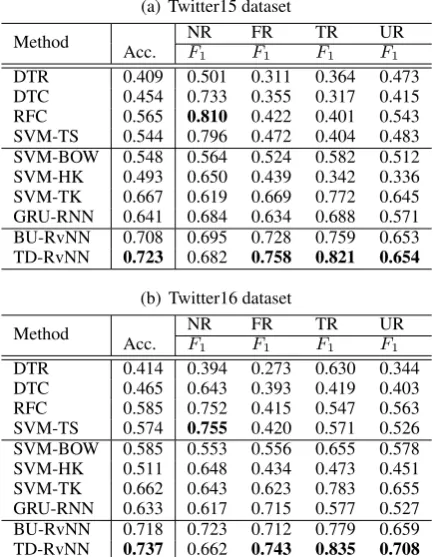
Table 1: Results of rumor detection. (NR: non-rumor; FR: false non-rumor; TR: true non-rumor; UR: un-verified rumor)
- BU-RvNN and TD-RvNN: Our bottom-up and top-down RvNN models, respectively.
We implement DTC and RFC using Weka5, SVM-based models using LibSVM6 and all neural-network-based models with Theano7. We conduct 5-fold cross-validation on the datasets and use accuracy over all the four categories and F1 measure on each class to evaluate the performance of models.
5.3 Rumor Classification Performance
As shown in Table 1, our proposed models ba-sically yield much better performance than other methods on both datasets via the modeling of in-teraction structures of posts in the propagation.
It is observed that the performance of the 4 baselines in the first group based on handcrafted features is obviously poor, varying between 0.409 and 0.585 in accuracy, indicating that they fail to generalize due to the lack of capacity capturing helpful features. Among these baselines, SVM-TS and RFC perform relatively better because they
5
www.cs.waikato.ac.nz/ml/weka
6
www.csie.ntu.edu.tw/˜cjlin/libsvm
7deeplearning.net/software/theano
use additional temporal traits, but they are still clearly worse than the models not relying on fea-ture engineering. DTR uses a set of regular ex-pressions indicative of stances. However, only 19.6% and 22.2% tweets in the two datasets con-tain strings covered by these regular expressions, rendering unsatisfactory result.
Among the two kernel methods that are based on comparing propagation structures, we observe that TK is much more effective than SVM-HK. There are two reasons: 1) SVM-HK was originally proposed and experimented on Sina Weibo (Wu et al.,2015), which may not be gener-alize well on Twitter. 2) SVM-HK loosely couples two separate kernels: a RBF kernel based on hand-crafted features, plus a random walk-based ker-nel which relies on a set of pre-defined keywords for jumping over the nodes probabilistically. This under utilizes the propagation information due to such oversimplified treatment of tree structure. In contrast, SVM-TK is an integrated kernel and can fully utilize the structure by comparing the trees based on both textual and structural similarities.
It appears that using bag-of-words is already a decent model evidenced as the fairly good perfor-mance of SVM-BOW which is even better than HK. This is because the features of SVM-HK are handcrafted for binary classification (i.e., non-rumor vs rumor), ignoring the importance of indicative words or units that benefit finer-grained classification which can be captured more effec-tively by SVM-BOW.
The sequential neural model GRU-RNN per-forms slightly worse than SVM-TK, but much worse than our recursive models. This is because it is a special case of the recursive model where each non-leaf node has only one child. It has to rely on a linear chain as input, which missed out valuable structural information. However, it does learn high-level features from the post content via hidden units of the neural model while SVM-TK cannot which can only evaluates similarities based on the overlapping words among subtrees. Our re-cursive models are inherently tree-structured and take advantages of representation learning follow-ing the propagation structure, thus beats SVM-TK.
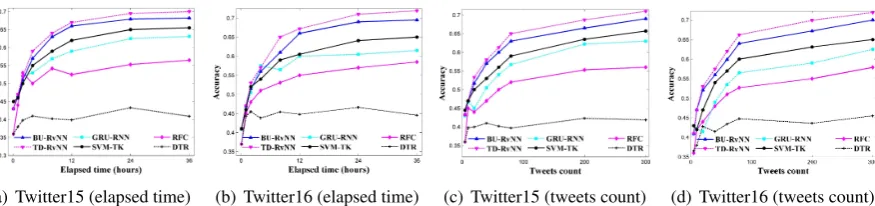
(a) Twitter15 (elapsed time) (b) Twitter16 (elapsed time) (c) Twitter15 (tweets count) (d) Twitter16 (tweets count)
[image:8.595.78.518.211.322.2]Figure 4: Early rumor detection accuracy at different checkpoints in terms of elapsed time (tweets count).
Figure 5: A correctly detected false rumor at early stage by both of our models, where propagation paths are marked with relevant stances. Note that edge direction is not shown as it applies to either case.
in the top-down model can effectively select im-portant features embedded into the leaf nodes.
For only the non-rumor class, it seems that our method does not perform so well as some feature-engineering baselines. This can be explained by the fact that these baselines are trained with ad-ditional features such as user information (e.g., profile, verification status, etc) which may contain clues for differentiating non-rumors from rumors. Also, the responses to non-rumors are usually much more diverse with little informative indi-cation, making identification of non-rumors more difficult based on content even with the structure.
5.4 Early Rumor Detection Performance
Detecting rumors at early state of propagation is important so that interventions can be made in a timely manner. We compared different methods in term of different time delays measured by ei-ther tweet count received or time elapsed since the source tweet is posted. The performance is evalu-ated by the accuracy obtained when we incremen-tally add test data up to the check point given the targeted time delay or tweets volume.
Figure4shows that the performance of our re-cursive models climbs more rapidly and starts to supersede the other models at the early stage. Al-though all the methods are getting to their best
per-formance in the end, TD-RvNN and BU-RvNN only need around 8 hours or about 90 tweets to achieve the comparable performance of the best baseline model, i.e., SVM-TK, which needs about 36 hours or around 300 posts, indicating superior early detection performance of our method.
Figure5shows a sample tree at the early stage of propagation that has been correctly classified as a false rumor by both recursive models. We can see that this false rumor demonstrates typical pat-terns in subtrees and propagation paths indicative of the falsehood, where a set of responses sup-porting the parent posts that deny or question the source post are captured by our bottom-up model. Similarly, some patterns of propagation from the root to leaf nodes like “support→deny→support” are also seized by our top-down model. In com-parison, sequential models may be confused be-cause the supportive key terms such as “be right”, “yeah”, “exactly!” dominate the responses, and the SVM-TK may miss similar subtrees by just comparing the surface words.
6 Conclusions and Future Work
inher-ent nature of recursive models allows them using propagation tree to guide the learning of represen-tations from tweets content, such as embedding various indicative signals hidden in the structure, for better identifying rumors. Results on two pub-lic Twitter datasets show that our method improves rumor detection performance in very large mar-gins as compared to state-of-the-art baselines.
In our future work, we plan to integrate other types of information such as user properties into the structured neural models to further enhance representation learning and detect rumor spread-ers at the same time. We also plan to use unsuper-vised models for the task by exploiting structural information.
Acknowledgment
This work is partly supported by Innovation and Technology Fund (ITF) Project No. 6904333, and General Research Fund (GRF) Project No. 14232816 (12183516). We would like to thank anonymous reviewers for the insightful comments.
References
Gordon W Allport and Leo Postman. 1946. An analy-sis of rumor. Public Opinion Quarterly10(4):501– 517.
G.W. Allport and L.J. Postman. 1965. The psychology of rumor. Russell & Russell.
Adam J. Berinsky. 2017. Rumors and health care reform: Experiments in political misinformation.
British Journal of Political Science47(2):241262.
Carlos Castillo, Marcelo Mendoza, and Barbara Poblete. 2011. Information credibility on twitter. In
Proceedings of WWW. pages 675–684.
Tong Chen, Lin Wu, Xue Li, Jun Zhang, Hongzhi Yin, and Yang Wang. 2017. Call attention to ru-mors: Deep attention based recurrent neural net-works for early rumor detection. arXiv preprint arXiv:1704.05973.
Kyunghyun Cho, Bart van Merri¨enboer, Dzmitry Bah-danau, and Yoshua Bengio. 2014. On the properties of neural machine translation: Encoder-decoder ap-proaches. arXiv preprint arXiv:1409.1259.
Nicholas DiFonzo and Prashant Bordia. 2007. Rumor, gossip and urban legends. Diogenes54(1):19–35.
Nicholas DiFonzo, Prashant Bordia, and Ralph L Ros-now. 1994. Reining in rumors. Organizational Dy-namics23(1):47–62.
Pamela Donovan. 2007. How idle is idle talk? one hun-dred years of rumor research. Diogenes54(1):59– 82.
John Duchi, Elad Hazan, and Yoram Singer. 2011. Adaptive subgradient methods for online learning and stochastic optimization. Journal of Machine Learning Research12(Jul):2121–2159.
Adrien Friggeri, Lada A Adamic, Dean Eckles, and Justin Cheng. 2014. Rumor cascades. In Proceed-ings of ICWSM.
Christoph Goller and Andreas Kuchler. 1996. Learning task-dependent distributed representations by back-propagation through structure. InNeural Networks, 1996., IEEE International Conference on. IEEE, volume 1, pages 347–352.
Aniko Hannak, Drew Margolin, Brian Keegan, and In-gmar Weber. 2014. Get back! you don’t know me like that: The social mediation of fact checking in-terventions in twitter conversations. InProceedings of ICWSM.
Sepp Hochreiter and J¨urgen Schmidhuber. 1997. Long short-term memory. Neural computation
9(8):1735–1780.
Ozan Irsoy and Claire Cardie. 2014. Deep recursive neural networks for compositionality in language. InProceedings of the 27th International Conference on Neural Information Processing Systems - Volume 2. NIPS’14, pages 2096–2104.
Marianne E Jaeger, Susan Anthony, and Ralph L Ros-now. 1980. Who hears what from whom and with what effect: A study of rumor. Personality and So-cial Psychology Bulletin6(3):473–478.
Allan J Kimmel. 2004. Rumors and rumor control: A manager’s guide to understanding and combatting rumors. Routledge.
Sejeong Kwon, Meeyoung Cha, Kyomin Jung, Wei Chen, and Yajun Wang. 2013. Prominent features of rumor propagation in online social media. In Pro-ceedings of ICDM. pages 1103–1108.
Xiaomo Liu, Armineh Nourbakhsh, Quanzhi Li, Rui Fang, and Sameena Shah. 2015. Real-time ru-mor debunking on twitter. In Proceedings of the 24th ACM International on Conference on Informa-tion and Knowledge Management. CIKM ’15, pages 1867–1870.
Jing Ma, Wei Gao, Prasenjit Mitra, Sejeong Kwon, Bernard J Jansen, Kam-Fai Wong, and Meeyoung Cha. 2016. Detecting rumors from microblogs with recurrent neural networks. In Proceedings of the Twenty-Fifth International Joint Conference on Ar-tificial Intelligence. IJCAI’16, pages 3818–3824.
Jing Ma, Wei Gao, Zhongyu Wei, Yueming Lu, and Kam-Fai Wong. 2015. Detect rumors using time se-ries of social context information on microblogging websites. In Proceedings of the 24th ACM Inter-national on Conference on Information and Knowl-edge Management. CIKM ’15, pages 1751–1754.
Jing Ma, Wei Gao, and Kam-Fai Wong. 2017. De-tect rumors in microblog posts using propagation structure via kernel learning. InProceedings of the 55th Annual Meeting of the Association for Compu-tational Linguistics (Volume 1: Long Papers). vol-ume 1, pages 708–717.
Jing Ma, Wei Gao, and Kam-Fai Wong. 2018. De-tect rumor and stance jointly by neural multi-task learning. InCompanion Proceedings of the The Web Conference 2018. WWW ’18, pages 585–593.
Lili Mou, Hao Peng, Ge Li, Yan Xu, Lu Zhang, and Zhi Jin. 2015. Discriminative neural sentence mod-eling by tree-based convolution. arXiv preprint arXiv:1504.01106.
Vahed Qazvinian, Emily Rosengren, Dragomir R Radev, and Qiaozhu Mei. 2011. Rumor has it: Iden-tifying misinformation in microblogs. In Proceed-ings of the Conference on Empirical Methods in Natural Language Processing. EMNLP ’11, pages 1589–1599.
Jacob Ratkiewicz, Michael Conover, Mark Meiss, Bruno Gonc¸alves, Snehal Patil, Alessandro Flam-mini, and Filippo Menczer. 2011. Truthy: mapping the spread of astroturf in microblog streams. In Pro-ceedings of the 20th International Conference Com-panion on World Wide Web. WWW ’11, pages 249– 252.
Ralph L Rosnow and Eric K Foster. 2005. Rumor and gossip research. Psychological Science Agenda
19(4).
Natali Ruchansky, Sungyong Seo, and Yan Liu. 2017. Csi: A hybrid deep model for fake news detec-tion. In Proceedings of the 2017 ACM on Confer-ence on Information and Knowledge Management. CIKM ’17, pages 797–806.
Richard Socher, Brody Huval, Christopher D Manning, and Andrew Y Ng. 2012. Semantic compositional-ity through recursive matrix-vector spaces. In Pro-ceedings of the 2012 Joint Conference on Empirical Methods in Natural Language Processing and Com-putational Natural Language Learning. EMNLP-CoNLL ’12, pages 1201–1211.
Richard Socher, Cliff C Lin, Chris Manning, and An-drew Y Ng. 2011. Parsing natural scenes and natu-ral language with recursive neunatu-ral networks. In Pro-ceedings of the 28th international conference on ma-chine learning (ICML-11). pages 129–136.
Richard Socher, Alex Perelygin, Jean Wu, Jason Chuang, Christopher D Manning, Andrew Ng, and Christopher Potts. 2013. Recursive deep models for semantic compositionality over a sentiment tree-bank. In Proceedings of the 2013 conference on empirical methods in natural language processing. pages 1631–1642.
Kai Sheng Tai, Richard Socher, and Christopher D Manning. 2015. Improved semantic representations from tree-structured long short-term memory net-works. arXiv preprint arXiv:1503.00075.
Ke Wu, Song Yang, and Kenny Q Zhu. 2015. False ru-mors detection on sina weibo by propagation struc-tures. InData Engineering (ICDE), 2015 IEEE 31st International Conference on. IEEE, pages 651–662.
Fan Yang, Yang Liu, Xiaohui Yu, and Min Yang. 2012. Automatic detection of rumor on sina weibo. In Pro-ceedings of the ACM SIGKDD Workshop on Mining Data Semantics. MDS ’12, pages 13:1–13:7.
Zhe Zhao, Paul Resnick, and Qiaozhu Mei. 2015. En-quiring minds: Early detection of rumors in social media from enquiry posts. In Proceedings of the 24th International Conference on World Wide Web. WWW ’15, pages 1395–1405.
Xiaodan Zhu, Parinaz Sobihani, and Hongyu Guo. 2015. Long short-term memory over recursive structures. InProceedings of the 32nd International Conference on Machine Learning. pages 1604– 1612.
Arkaitz Zubiaga, Ahmet Aker, Kalina Bontcheva, Maria Liakata, and Rob Procter. 2017. Detection and resolution of rumours in social media: A survey.
arXiv preprint arXiv:1704.00656.
Arkaitz Zubiaga, Elena Kochkina, Maria Liakata, Rob Procter, and Michal Lukasik. 2016a. Stance classifi-cation in rumours as a sequential task exploiting the tree structure of social media conversations. In Pro-ceedings of COLING 2016, the 26th International Conference on Computational Linguistics: Techni-cal Papers. pages 2438–2448.
Arkaitz Zubiaga, Maria Liakata, Rob Procter, Geral-dine Wong Sak Hoi, and Peter Tolmie. 2016b. Analysing how people orient to and spread rumours in social media by looking at conversational threads.