World Maritime University
The Maritime Commons: Digital Repository of the World
Maritime University
World Maritime University Dissertations Dissertations
2000
The role of maritime administration in ensuring
quality shipping services : a guide to Cape Verde
Maritime Administration
Joao Lopes do. Rosario World Maritime University
Follow this and additional works at:http://commons.wmu.se/all_dissertations
Part of thePublic Affairs, Public Policy and Public Administration Commons
This Dissertation is brought to you courtesy of Maritime Commons. Open Access items may be downloaded for non-commercial, fair use academic Recommended Citation
Rosario, Joao Lopes do., "The role of maritime administration in ensuring quality shipping services : a guide to Cape Verde Maritime Administration" (2000).World Maritime University Dissertations. 156.
WORLD MARITIME UNIVERSITY
Malmö, Sweden
THE ROLE OF THE MARITIME
ADMINISTRATION IN ENSURING QUALITY
SHIPPING SERVICES
A guide to Cape Verde Maritime Administration
By
JOÃO LOPES DO ROSÁRIO
Cape Verde
A dissertation submitted to the World Maritime University in partial fulfilment of the requirements for the award of the degree of
MASTER OF SCIENCE
In
DECLARATION
I certify that all the material in this dissertation that is not my own work has been identified, for which a degree has previously been conferred on me.
The contents of this dissertation reflect my own personnel views, and are not necessarily endorsed by the University or the Cape Verde Maritime Administration.
(Signature) ...
... (Data)
Supervised by: Mr. Richard Hodgson Associate Professor
World Maritime University
Assessor:
Ltd. Cdr. Max Mejia Lecturer
World Maritime University Co-assessor
Capt. Kjell Grahn Visiting Professor
ACKNOWLEDGEMENTS
I would like to express my gratitude to Antunio Barbosa, the General Manager of the General Directorate of Marine Affairs and Ports in Cape Verde, for nominating me for my course of studies at the World Maritime University. I would also like to thank the Ministry of Transport, Tourism and the Sea for supporting the application and making it possible for me to attend. My sincere thanks to the World Maritime University Special Fund for granting me this scholarship and financing me over the time of this course.
My sincere thanks and appreciation to Associate Professor Richard Hodgson, my supervisor, who showed patience and diligence in correcting, commenting on, and giving suggestions for improvements to this dissertation as it progressed. I wish to thank the entire staff of the University who helped me, and especially the staff of the Library, Susan Wangeci-Eklöw and Cecilia Denne who were on constant lookout for articles and other publications they thought might help me to complete the paper.
Special thanks to my friends from the City of Malmö, who helped to make my stay much more comfortable, as they provided that ‘home’ away from home. Thanks also to my colleagues at the University who in many ways supported and encouraged me during my time studying there.
ABSTRACT
Title of Dissertation: The Role of the Maritime Administration in Ensuring Quality Shipping Services: A Guide to Cape Verde Maritime Administration
Degree: MSc
This dissertation examines the state of Cape Verde Maritime Administration and looks at the management tool ‘quality’ as a means to develop its management and operations in order to ensure quality shipping services.
Cape Verde is an archipelago, and its strategic geographical location has made the country an important transit point for decades as it is situated upon one of the main transit routes. The danger posed by ships either passing or using the Cape Verdean ports, the urgent need for improved quality driven by customers’ demands, and the recent focus on it by most globalised organisations are obvious reasons to improve and ensure quality for the country’s well being.
Regulatory issues as they relate to legislation at the national level, and rules and guidelines as stipulated by IMO for addressing economic, social and technical aspects are addressed. Finally, service issues relating to economic, safety and environment prevention and response are analysed.
The reshaping of the old Maritime Administration is also looked at with a view of developing an Administration that will keep pace with modern maritime thinking. Proposed mandate, mission, objectives and short and long term strategies are developed and are offered as a guide for the development of the new Cape Verde Maritime Administration.
The need for an integrated relationship is also evaluated, as it is realised that, in order for quality to be maintained within the maritime administration, the support of all parties involved is required in the maritime business such as shipowners, charterers, insurers, port authorities, classification societies as well as the International Maritime Organisation.
In conclusion, both short and long term strategies, as they relate to administrative management, safety and environment protection and public maritime services are recommended with the aim of improving and ensuring quality within the overall maritime management of Cape Verde.
TABLE OF CONTENTS
Declaration ii
Acknowledgements iii
Abstract iv
Table of Contents vi
List of figures x
List of Abbreviations x
1 Introduction 1
1.1 Scope of the Study 4
2 An Overview of Cape Verde 6
2.1 Overview 6
2.2 Population 7
2.3 The Economy 7
2.5.2 National Fleet 14 2.5.3 Training Institute 15 2.5.4 Port Authority 15 2.6 Maritime Administration 16 2.6.1 Organisation Chart 18 2.6.2 Departmental Functions 19 2.6.2.1 Inspection and Registry Department 19 2.6.2.2 Merchant Marine Services Department 19 2.6.2.3 Legal Department 20 2.6.2.4 Administrative Service and Finance Department 21 2.6.2.5 Port Captaincies 21
2.7. SWOT Analysis 22
2.7.1 Internal Environment 22 2.7.1.1 Strengths 22 2.7.1.2 Weaknesses 23 2.7.2 External Environment 24 2.7.2.1 Opportunities 24
2.7.2.2 Threats 24
3 Quality Maritime Management-Issues, Challenges 26
3.1 Economic Issues 27
3.1.1 Liberalism 27
3.1.2 Protectionism 28 3.2 Safety and Environment Protection Issues 30 3.2.1 Quality and Safety in the Management of Ship Operations 31 3.2.2 Protecting the Marine Environment from Ship-based
3.2.2.3 Reducing the Consequences of Pollution 39 3.2.2.4 Compensation for Pollution 40 3.2.2.5 Risks and Near-Miss Analyses 41 3.2.3 Emergency Preparedness against Accidents and Pollution 42 3.3 Regulatory Issues 44 3.3.1 Technical Regulation 44 3.3.1.1 Registration of Ships 45 3.3.2 Economic Regulation 46 3.3.3 Social Regulation 47
3.4 Service Issues 48
3.4.1 Safety Prevention and Response 48 3.4.2 Environment Protection and Response 50 3.4.3 Economic Services 51
4. Development of a New Cape Verde “MARAD” 53
4.1 Mandate 54
4.2 Mission 54
4.3 Objectives 54
4.4 Strategies/Long-term Directions 56 4.4.1 Economic, Safety, Environment Protection and
Administrative Strategic Directions 57 4.4.1.1 Economic Strategic Direction 57 4.4.1.2 Safety Strategic Direction 57 4.4.1.3 Environment Protection Strategic Direction 58 4.4.1.4 Administrative Strategic Direction 59 4.4.2 Developing the Maritime Administration 61 4.4.3 The Need to Follow-up on the Ratification of
4.4.5 Maritime Policy Formulation 63 4.4.6 Strict Conditions for Ship Registration 65 4.4.7 Bilateral Maritime Agreements 66
5 A Quality Maritime Administration as it Relates to Interested Parties 69
5.1 Relationship with Ports 70 5.2. Human Element and Competency 71 5.3 International Maritime Organisation (IMO) 73 5.4 Classification Societies through IACS 74
5.5 Charterers 75
5.6 Insurers 75
5.7 Shipowners 76
6. Conclusions and Recommendations 77
6.1 Conclusions 77
6.2 Recommendations 78 6.2.1 Administrative Management 78 6.2.2 Safety and Marine Environment Protection 80 6.2.3 Public Maritime Services 81
References 83
LIST OF FIGURES AND LIST OF ABBREVIATIONS
LIST OF FIGURES
Figure 2.1 Cargo movement within Cape Verde Ports 13 Figure 2.2 Cape Verde Maritime
Administration-Organisation Chart 18
LISTS OF ABBREVIATIONS
BCH Code The Code for the Construction and Equipment of Ships Carrying Dangerous Chemicals in Bulk
CLC Civil Liability Convention
CMI Committee Maritime International COLREG Collision Regulation
DGMP General Directorate of Marine Affairs and Ports DGPS Differential Global Positioning System
DOC Document of Compliance
EEZ Economic Exclusive Zone
EIU Economist Intelligence Unit Limited
FAL Facilitation Convention FSI Flag State Implementation FSQC Flag State Quality Control
GATT General Agreement on Tariffs and Trade GDP Gross Domestic Product
IACS International Association of Classification Societies IAMSAR International Aviation & Maritime Search and Rescue IG International Group
ILO International Labour Organisation IMO International Maritime Organisation ISM Code International Safety Management Code ISO International Organisation for Standardisation ITF International Workers Federation
LDC London Dumping Convention LL Load Lines
MARAD Maritime Administration MFN Most Favoured Nations
MOU Memorandum of Understanding
MTTS Ministry of Transport, Tourism and the Sea
OECD Organisation for Economic Co-operation and Development OPA Oil Pollution Act
OPRC Oil pollution Response, Preparedness and Co-operation
P&I Protection & Indemnity Club
SAR Search and Rescue
SMS Safety Management System SOLAS Safety of Life at Sea
SOx Sulphur Oxide
STCW Standards of Training, Certification and Watchkeeping for Seafarers
SWOT Strengths, Weakness, Opportunities and Threats
UNCLOS United Conventions on the Law of the Sea
UNCTAD United Nations Conventions on Trade and Development
VTS Vessel Traffic System
CHAPTER 1
INTRODUCTION
Quality is a long-term goal, which is as a result of a series of well thought out initiatives by all parties involved. The maritime industry is no exception. Thus quality-shipping services require quality thinking by quality managers within a maritime administration and by all interested parties in the maritime sector.
Maritime Administrations by themselves cannot ensure quality, thus they require support from governments in seeing to the speedy ratification and implementation of conventions. The slower countries are in implementing these conventions the less control they have over the maritime affairs within their countries and those that are internationally driven. Cape Verde over the years has paid very little attention and has been slow in the implementation of conventions, which are the main tools for ensuring quality shipping service within the country on a unilateral basis.
The United States for example implemented OPA 90 which requires ships using their ports to comply with different standards from what is achieved globally, thus making trading internationally more difficult.
The normal economic interests of the United States dominated its interactions rather than what is practical for all. Frankel (1995) stated, “It appears that the OPA 90 and the related regulations are economically bad deals, as they are introduced to counter public concern and are essentially political measures to calm waters without tackling the basic problem of safety of navigation and the so-called freedom of the seas”. Instead there should be a universal consensus where private players and governments operate within the same legal framework. The Hague, Hague-Visby and Hamburg rules are rules, within the carriage of goods by sea, which aid in bringing about equity and enforcing quality standards within the shipping industry.
Over the years due to individualistic behaviour and non-implementation of conventions, protocols, rules etc. by countries worldwide, the output of quality shipping has been unsatisfactory. Safety performance as it relates to humans, ship operations and environmental protection are of major concern to IMO and other regulatory bodies. It was realised that most of the safety inputs are driven by accidents and are not so much as a result of the flaws of the system. Governments are urged to control the output by managing the inputs, enforcing harmonised rules and securing a sound economic development within the shipping industry through full enforcement of these conventions. IMO and ILO are busy introducing new safety inputs into the system through more rules and enforcement.
the economic effects of flagging-out.
Governments of the traditional maritime countries are known for implementing such strategies which oftentimes lead to uncoordinated economic and safety measures within the system. Similarly, open registration also gives rise to uncoordinated inputs, with emphasis on those economic inputs that create the conditions for sub-standard shipping. Governments are also sometimes guilty of failing to co-ordinate safety and economic inputs that will provide the right mix of both national and global efforts.
Conflicting and uncoordinated inputs often lead to unexpected and unwanted results. In the sphere of shipping, all players have their own private economic interest in the safety output, i.e. the safety performance standards of shipping. Port States for example, are more concerned with survival. There is however a legal framework, which addresses conflicts and disputes. The legal framework is meant however, to handle claims and not prevention. Moreover, due to limitation of liability and compensation, the framework may even hamper prevention. The current legal framework might well be an obstacle to self-regulation.
countries.
1.1 Scope of the Study
This dissertation should be of interest to anyone who is involved in maritime administration. However, the focus is on Cape Verde Maritime Administration. Its main aims are:
• To identify and analyse shipping activities as they relate to the day to day functions of the Cape Verde Maritime Administration;
• To formulate policies and identify strategies to be employed in addressing both short and long-term problems;
• To propose, suggest and recommend the strategies for the development of a new Cape Verde Maritime Administration.
Chapter Two provides an overview of Cape Verde which looks at the geographical location, the national economy and the legislative system, with a brief reference to the procedures for maritime legislation and the status of the country’s involvement in international fora. Shipping activities are identified, such as the national fleet, training, repair facilities, etc. and analysed. Last but by no means least, the Maritime Administration’s current situation is presented and analysed, as well as its strengths, weaknesses, opportunities and threats.
Chapter Four proposes vision and mission statements and objectives as well as both long-term and short-term strategies (economic, safety, environmental and administrative) for the development of a new Cape Verde Maritime Administration.
Maritime policy formulation, conditions for ship registration, the need to follow-up on the ratification of conventions and the country’s relations in a global sense are identified as key areas for attention.
Chapter Five looks at the Maritime Administration and its relationship with various external parties (shipowners, charterers, port authorities, insurers, classification societies, etc.) in ensuring quality shipping service. The Port, Flag and Coastal State authorities serve as controlling bodies within the Maritime Administration.
CHAPTER 2
AN OVERVIEW OF CAPE VERDE
2.1 Overview
The Republic of Cape Verde (See Appendix 1) is an archipelago that measures 4,033 square km in land area, which originally emerged following volcanic activity. The islands that make up the archipelago are located about 450 Km west of Dakar, the capital of Senegal off the West Coast of Africa ranging from longitude 22 to 26 degrees West and from 14.5 to 17.5 degrees North. The country consists of 10 islands and eight islets. The islands were discovered in 1456 by the Portuguese and were subsequently colonised by them. Cape Verde became independent in July 1975.
The archipelago is divided into two groups: The Windward group (Barlavento), which comprises of the islands of Santo Antão, Sao Vicente, Santa Luzia, Boavista, Sal and São Nicolau, and the Leeward group (Sotavento), which is composed of the islands of Santiago, Maio, Fogo, and Brava. Generally, the country is lacking in greenery as the entire land area is characterised by dry weather and volcanic soil.
With the entry into force of the United Nations Convention on the Law of the Sea (UNCLOS-82) in November 1994 the Economic Exclusive Zone (E.E.Z) is about 734,265 square kilometres. Notwithstanding the mentioned above information, the country has ambitions in the maritime field, although it remains a somewhat distant prospect
2.2 Population
Nine of the ten islands are inhabited, with an estimated population of about 390,000 people, and with a growth rate 2% per annum. Since the 19th century Cape Verdeans began emigrating to seek employment, and many worked on US whaling ships and settled in New England, Boston, where there is still a large Cape Verdean community. When immigration to the USA became more tightly regulated early this century, Cape Verdeans sought better fortune in South America (particularly Brazil) and in other Portuguese colonies in Africa. Since the Second World War most have gone to Europe in search of a better life. As a result there are today many more Cape Verdeans abroad than in the archipelago and the economy is heavily dependent on remittances from migrant workers. Some 600,000 Cape Verdeans are estimated to be living abroad (principally in the USA, Portugal, France, Latin America, Senegal, Guinea-Bissau, and others African and European countries). Recently, annual emigration has fallen below 2,000 people having been over 10,000 during the 1970s. (EIU-The economist Intelligence Unit Limited country profile 1993-1994 pp. 84 and 87).
2.3 The Economy
During the period 1981 to 1989, real GDP grew unevenly but at an average rate of 7%. It slowed to 2.4% in 1990, remaining a bit stronger than the growth rate of the country’s population.
In 1991, the government developed the following strategies for stimulating growth in the economy:
• Adopt market-oriented, outward-looking policies;
Liberalise the economy and open it up to foreign and domestic private investment;
• Take steps to diversify the economy and reduce its dependence on services.
2.3.1 Main Economic Sectors
Cape Verde’s open economy allows for the free flow of goods and services to and from the country. Cape Verde’s strategic geographical location has made the country an important transit point for decades as it sits astride major shipping and air routes. Services for ships and aeroplanes remain a significant economic activity.
In the early 1990s the government targeted light manufacturing, fishing, and tourism as sectors promising the highest growth. Activities currently generating interest among investors include clothing and footwear production, fish processing, and hotel development. Cape Verde’s large exclusive economic zone, is still today, one of the last significantly under-used fisheries in the world.
45,000 tons/year.
Cape Verde presently offers foreign investors major advantages in a number of markets, especially in the growth areas of light manufacturing, tourism, fisheries, transportation, and communications, PROMEX’S Guide for investors p-12).
2.4 The Legislative System
2.4.1 The Constitution
A new constitution for the Cape Verde Republic came into force on 25th September 1992.
The constitution defines Cape Verde as a sovereign, unitary and democratic republic. It guarantees respect for human dignity and recognises the inviolable and inalienable protection of human rights as a fundamental principle of humanity, peace and justice. It also recognises the equality of all citizens before the law, without distinction of social origin, social conditions, economic status, race, sex, religion, political convictions or ideologies, and promises transparency for all citizens in the practising of fundamental liberties.
Under the Constitution the Republic of Cape Verde commits to creating, progressively, the necessary conditions for the removal of all obstacles which impede the development of mankind or limit the equality of citizens and their effective participation in the political, economic, social and cultural organisations of the State and Cape Verdean society.
21 days and is contested by the two candidates who received the highest number of votes in the first round. Voting is conducted by secret ballot.
Legislative power is vested in the National People’s Assembly, which is also elected by universal adult suffrage. The Prime Minister is nominated by the National People’s Assembly, to which he is responsible. The Prime Minister appoints the Council of Ministers, whose members must be elected deputies of the National People’s Assembly. There are 16 local government councils, which are elected for a period of five years.
There are, at present, a number of Ministries and some of them are involved with shipping matters in one way or another. The basic instructions given to the Maritime Administration are in principle determined by the division of work between the Ministry for Maritime Affairs and other Ministries. The following are some of the issues, which may be handled separately or shared by the various Ministries.
• Matters concerning budgets and legislation, international agreements and all matters, which are to put forward to the Government, or to Parliament.
• Appointments, and dismissals and the other personnel matters which, pursuant to the provisions in force, rest with the Ministry for Maritime affairs.
• Matters of priority and general public interest.
2.4.2 Procedures for Generating Maritime Legislation in Cape Verde
For the implementation of any IMO Convention, it is necessary for the Maritime Administration, shipowners, inspectors, ship officers and crew to be fully aware of its provisions and to bear in mind that a Convention is legally binding.
• Government of the State (the political body having power to conclude international agreements);
• Legal administration;
• Maritime Administration;
• Shipowners;
• Port Authorities
Each sector should know exactly what its responsibilities are as well as those of its staff and the requirements to be imposed on ships and ports. In Cape Verde the administrative measures related to maritime affairs are taken by the government through the General Directorate of Marine Affairs and Ports, which see to the implementation of Conventions.
Although some Conventions stipulate that maritime administrations should provide advice to the legal department, Government, the shipping industry and the port authorities, it does not work quite like that in Cape Verde. Instead the following procedures are utilised:
• First, the proposal is developed by the Administration and submitted to the Minister for Maritime Affairs, who in turn seeks approval from the Minister’s Council;
• If the Minister’s Council accept, the document is further submitted to the government for their approval;
• Once the government approves, a Bill is presented to the National Assembly where further discussion takes place;
• Once finalised, the National Assembly prepares a Law and this Decree-Law will contain details regarding principles and provisions.
2.4.3 The Involvement of Cape Verde in International Fora
legislation on several other important conventions, including:
• FAL/65 Convention;
• SOLAS/74 Convention;
• COLREG/72 Convention;
• LL/66 Convention; and
• LDC/72 Convention. Source: (IMO, 1998)
2.5 Shipping Activity
Although Cape Verde only has a small national shipping fleet that meets the essential needs of the country, there continues to be a substantial amount of traffic that contributes to the country’s economic growth and touches every sphere of the society.
Over the last five years, the ports of Cape Verde have received a considerable amount of ship calls, reflecting an annual increase of 6%.
This increase is attributed to the progressive growth in transhipment activity, transit passage for supply of bunkers and tourist activities. The growth in the country’s import of goods has also contributed to the above-mentioned increase in ship calls.
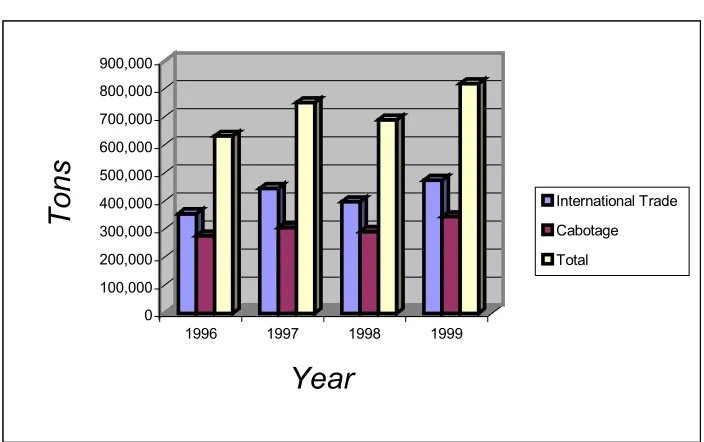
The maritime transportation sector has been growing rapidly in Cape Verde reflecting an annual increase of 5% GDP in recent years. One of the sectors that have grown in tandem with this increase is the activity within the Ports. In 1970 the gross domestic product was US$312 million compared to approximately US$940 million today. The total volume of cargo handled by Cape Verde’s ports in 1999 amounted to 820,535 tons. Of this total, international trade for both import and export cargoes was 573,446 tons, an increase of 6.94% when compared with the total in 1996 (See graph 1). Cargo transported annually depends mainly on the nation’s purchasing power, rainfall, and the progress of development projects being undertaken.
is carried out entirely by vessels registered for this purpose and all are registered in the country’s conventional registry. In 1995 inter-island trade totalled 267,174 tons of cargo, while in 1999, 345,404 tons of cargo were handled, an increase of 29.3 % when compared to the period in 1995. Source: (ENAPOR, 2000)
Due to the number of islands within the country, the demand for ports to serve the island’s population is relatively high.
Each island unavoidably needs at least one port. Cape Verde has two international ports located on the major populated islands (Santiago and Sao Vincent islands), and a considerable number of national ports in the smaller islands.
Figure 2.1 Cargo Movement within Cape Verde Ports
0 100,000 200,000 300,000 400,000 500,000 600,000 700,000 800,000 900,000
Tons
1996 1997 1998 1999
Year
2.5.1 Ship Repair Facilities
Ship repair facilities in the Republic of Cape Verde are concentrated in Mindelo (Sao Vicente Island), which holds the country’s foremost harbour facilities where many ocean-going and domestic ships call. CABNAVE shipyard is capable of undertaking full-scale repairs on large deep-sea ships, while LUSONAVE shipyard repairs mostly fishing boats.
CABNAVE dockyard was established in 1985 and is joint ventures between the government of Cape Verde; LISNAVE, a Portuguese Dockyard; DEVAL, a Dutch corporation; and private organisations within the republic of Cape Verde. Actual operations got under way in 1986 with the focus on repair work.
As a semi-governmental enterprise, CABNAVE is currently managed under a lease contract with CABMAR. The company is 87.5% owned by the State and 12.5% by individuals.
CABNAVE dockyard can undertake slipway lifting of ships up to 110 metres, 18 meters wide, and with hull weight of 2,800 tons. It is equipped with a slipway system and six dry ship-parking work areas where dry ships undergo repair work. To carry out rubber docking repairs or prepare for hoisting by the slipway (draft and trim adjusting, etc.), CABNAVE has a wharf measuring 130 metres long and 8 metres deep. Plants including an iron works, a mechanical workshop, a pipe works, and a paint works are available. In addition, there is a warehouse, a technical training centre, mobile cranes, gas, electricity and water facilities.
2.5.2 National Fleet
The government decided to eliminate the vessels engaged in international trade in the first phase and the domestic fleet in the second phase, due to poor management and maintenance of the fleet coupled with the non-viability of the company. The government is imploring the private sector to explore the potential for maritime trade both nationally and internationally. However there are no incentives, (e.g. subsidies) available in the maritime sector to stimulate and support national ship owners. There are some joint-venture shipping companies that are operating their vessels under bare-boat chartering arrangement and is using Cape Verde as a second registry. The government has approved the creation of an international ship registry, which it is now in the process of implementing to deal specifically with foreign owned vessels.
2.5.3 Training Institute
The Training Institution (ISECMAR) was established in 1984 with the aid of the Norwegian government, and to-date has trained many key-shipping personnel to handle maritime transportation activities within the country. In 1991 a five-year plan with the aim of expanding the centre was initiated and financed by the Norwegian government. Along with the training of all-shipping personnel and harbour-related technical personnel, the institution has recently set up a new research organisation, established another radio-electronics department and inaugurated a research consultancy course for ship owners.
2.5.4 Port Authority
• The management and control of port services;
• Organising the use of the ports and planning their development;
• The management and control of port services;
• Elaborating projects for the construction of necessary installations;
• Elaborating port regulations in co-ordination with the Maritime Administration (MARAD);
• Authorising port services to be realised by personnel not belonging to the Port Authority;
• Controlling within port areas and ensuring compliance with the regulations as stipulated by the dangerous goods code;
• Approving taxes for the different services provided by the ports;
• Promoting the training of port personnel and carrying out research and development projects related to port productivity.
2.6 Maritime Administration
For many years the Cape Verde Maritime Administration has been based on the old Portuguese legislation and it focus of responsibility has frequently changed from one Ministry to another. In 1995 the Ministry of the Sea was created as a government consultative organ to deal with all matters related to the use of the sea and its exploitation. Two years later a law on ports and the merchant marine was approved, which is now used as the guide in maritime affairs and ports. In 1999 the Ministry was renamed the Ministry of Transport, Tourism and the Sea (MTTS). This Ministry is charged with elaborating proposing and executing the development policies and strategies in all marine sectors of maritime transport and navigation, ports and fishing.
The Maritime Administration (MARAD) is responsible for applying and executing the Ministry’s policy for the sectors of ports, marine transport and maritime navigation. In fulfilment of these responsibilities it has the following functions:
• To contribute to the definition of national shipping and port policies;
• To formulate general development policies for maritime transport, navigation and ports;
• To propose broad definitions for areas of port jurisdiction, considering the existing zones for future expansion;
• To ensure compliance with national regulations;
• To authorise the exercise of maritime activities and local traffic, commercial, recreation, etc.;
• To monitor the activities related to the international register of ships;
• To organise and maintain shipowners, ship managers, charterers, fleet and shipping agents registry;
• To promote seafarers training, specialisation, certification and all the seafarers’ management activities.
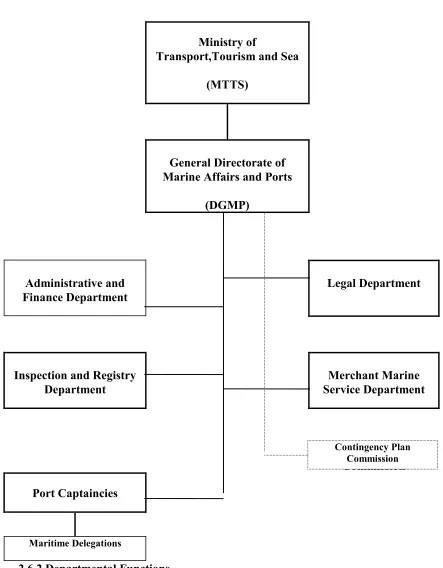
Figure 2.2
2.6.1 Cape Verde Maritime Administration-Organisation Chart
Ministry of
Transport,Tourism and Sea
(MTTS)
General Directorate of Marine Affairs and Ports
(DGMP)
Administrative and Finance Department
Legal Department
Inspection and Registry Department
Merchant Marine Service Department
Contingency Plan Commission
Port Captaincies
Maritime Delegations
2.6.2 Departmental Functions
2.6.2.1 Inspection and Registry Department
The Inspection and Registry Department is the central body in charge of the inspection of ships and overseeing the registration of ships. It has the following functions:
• To oversee the process related to the manning of ships and issuance of ships’ passports as required;
• To organise the technical characteristics of the national fleet and the inspections to be carried out;
• To inspect, license and identify the ship radio stations, and approve the radio-communication and the navigational equipment in co-operation with the central communication system of the country;
• To maintain, administer and control the national registry of ships including the names and the characteristics of ships that fly the national flag;
• To promote inspection and ship safety;
• To organise the registry of ship-owners, ship managers, ship charterers as well as maritime agents;
• To establish the minimum manning safety standards for ships;
• To conduct inquiries into maritime incidents;
• To approve plans, projects and other technical documentation and inspect their direct application in order to ensure conformity with approved documents.
2.6.2.2 Merchant Marine Services Department
The Merchant Marine Services Department is the central body in charge of the initiatives and execution of the activities in the domain of ports, transport and maritime navigation. Its functions are:
• To co-ordinate the exercise of matters related to merchant shipping and recreational activities etc.;
• To ensure the application of all administrative and technical procedures in the ambit of competency of DGMP;
• To oversee the registration of seafarers and the issuance of certificates of professional competency to people employed on fishing and merchant ships;
• To participate in the process of acceptance, ratification and implementation of international maritime conventions;
• To promote and control maritime transport and navigation;
• To promote and control hydrographic and ocean cartography activities;
• To co-operate with different agencies in dealing with marine accident investigation;
• To plan, promote and follow the process of training and specialisation of seafarers in order to create basic conditions of efficiency, competition and development in the shipping industry;
• To promote and support techno-economic development of the maritime activity;
• To plan, co-ordinate and maintain the maritime navigation services of the country;
• To organise and maintain the registry of all port infrastructures and equipment existing in the country;
• To verify and control the services provided by other entities within the port jurisdiction area.
2.6.2.3 Legal Department
The Legal Department is responsible for providing legal advice to the Maritime Administration in all matters concerning disputes, accidents and any other areas that may require its support.
2.6.2.4 Administrative Service and Finance Department
personnel, logistics support, material purchase and matters related to the salaries of personnel.
2.6.2.5 Port Captaincies
Due to the fact that the country has two main island groups (Barlavento and Sotavento), the Port Captaincies’ role is divided into two with the captains being located in the two main ports of the county. Representatives are however used in the smaller ports that report to the port captains.
The Port Captains are given the task of co-ordinating regionally the functions of the maritime administration by making sure that the laws and regulations are complied with in their respective areas of jurisdiction. They are also responsible for:
• Promoting the safety of navigation, the safety of life at sea, the protection of the marine environment and the welfare of those working on board ship including improvements in their working conditions;
• Promoting, in co-ordination and co-operation with other entities involved in shipping activities, the execution of measures to prevent and combat marine pollution, namely, the management of garbage, atomic and industrial residues, safeguarding seabed resources, and under-water cultural heritage;
• Implementing preventive measures against acts of damage to the national heritage both within sea water and on the seabed;
• Co-operating with other authorities in prosecuting acts by ships which violate the national law;
• Participating in the development of maritime and port information systems;
• Supervising the registration and certification of marine personnel;
• Overseen provisions of port pilotage services.
Alongside the Maritime Administration is a Contingency Plan Commission established to respond to emergencies as it relates to the search and rescue of human life and property at sea, preservation of the marine environment and the safety of navigation. There are several representatives from different maritime entities who participate in, and provide recommendations as to, the functioning of this commission. The General Director of the Maritime Administration is the head of this commission.
2.7 SWOT Analysis
A detailed audit of Cape Verde Maritime Administration and its environs is imperative at this point in order to ascertain the Administration’s distinctive competencies. These competencies are concerned with identifying those particular strengths and weaknesses, which are internal, and the opportunities and threats which are external to the Administration. The SWOT analysis is a technique, which is used for comparing both the internal or controllable environment and the external or uncontrollable environment so as to have a clearer picture of the Administration’s position as it relates to the market.
2.7.1 Internal Environment
2.7.1.1 Strengths
• Several members of the top management team have been with the organisation for over ten years, from its inception.
• There has been continuous training at the supervisory level, the latest being for Port State Control surveyors and Flag State implementation.
• Cape Verde is strategically located, and is situated upon one of the main transit route for many vessels.
benefits and pitfalls as they trade internationally.
• An agreement was forged with neighbouring countries recently to co-ordinate efforts and share resources, should there be a need for a search and rescue (SAR) operation.
• There is an adequate system of short-range aids, which includes lighthouses and floating aids.
• High quality Pilotage service is provided by the Administration.
• A comprehensive study is available for an integrated coastal zone management.
2.7.1.2 Weaknesses
• Lack of foresight as to the benefits that can be derived from Conventions, thus Cape Verde has been slow in the ratification and implementation of Conventions.
• The non-implementation of Conventions has made it difficult for the Administration to enforce rules as it affects charterers, shipowners and other interested parties.
• The country has no active participation in IMO meetings.
• Poor management techniques which manifest themselves in the following ways: a) No succession planning
b) Being reactive rather than proactive c) Lack of motivation and reward d) High staff turnover
e) Lack of transparency
• Lack of financial resources, which handicaps the development and maintenance of certain infrastructure.
• There is no formal system in place to gather and analyse customer reactions to the services offered.
• Lack of training at the clerical level which would aid in the understanding of certain maritime terms.
• Poor relationship among organisations in co-ordinating the search and rescue mission.
• There is a clear need for a more modern style of managing the Administration’s affairs, which should be customer driven.
• The span of control is too wide and a recommended span of 5-6 persons is advised.
• There is no effective national contingency plan to respond to and combat oil spills.
2.7.2 External Environment
2.7.2.1 Opportunities
• There is a potential for the expansion of the fleet due to the international registry, which is to come on stream soon.
• Joining the West Central African Region Memorandum of understanding (WCAR-MOU) provides the Cape Verdean Port State Control personnel with more power to act.
• Cape Verde has a well-established Maritime Institution, which will allow for easier supervision.
• A commercial service e.g. SAR could result in added resources e.g. preparedness fee.
• Emphasis on a national awareness and education program could bring about a better understanding in the maritime industry.
• Early impact assessment programs would help the Administration in recognising problems from the outset.
2.7.2.2 Threats
• There is a lack of shipping expertise, which has resulted in low competition and the difficulty in attracting investment funding.
• High fleet maintenance cost are being endured by shipping companies and shipowners which may result in a reduction of ships flying the national flag.
among port users.
• There have been a considerable number of sub-standard ships calling at the ports.
• There has been an increase in the number of accidents among fishing and recreational vessels.
• Cape Verde is likely to make the “Black List” due to the non-ratification of STCW/ 95.
• There is a serious concern about the toxicity of anti-fouling paints and the care and handling of dangerous goods.
• There is a loud public outcry about the impact of shipping activities on the environment; thus the need for marine protected areas.
CHAPTER 3
QUALITY MARITIME MANAGEMENT - ISSUES, CHALLENGES
Quality is one of the most important short-term goals of the Cape Verde Maritime Administration. Customers’ demands and the recent focus of most globalised organisations have driven the urgent need. This is not only crucial to the administration’s management success but also for developing better relationships with customers. Thus the administration has no other alternative but to implement a Quality Management System.
The basis for a Quality Management System varies according to various popular theories. It is basically a system where formalised procedures are designed to achieve objectives, and where the effectiveness of the procedures and their applications is measured.
The International Organisation for Standardisation (ISO) has produced a set of standards for quality systems. These standards cover many kinds of organisation, and can be applied to management within any Maritime Administration.
The ISO Standards embody a rationalisation of the many and varied national approaches in the sphere of quality systems. In any administration providing services to the shipping sector, job specifications may not in themselves guarantee that the customer’s requirements will be consistently met.
service, and there may be little or no feedback as to its effectiveness.
Thus this has led to the development of quality management systems, standards and guidelines.
The development of quality systems is strongly influenced by the objectives of the organisation, and maritime administrations are no different. The policies and objectives should seek to cover areas of safety, pollution prevention, competition regulation, risk management, training programs, customer satisfaction, etc.
The functions of a maritime administration (MARAD) are those assigned to it, within the framework of the government’s overall maritime development policy and which is duly reflected in its maritime legislation. It is therefore important for the Cape Verde MARAD to look carefully at the country’s maritime legislation so as to identify any shortcomings, which may impede it in carrying out its daily functions. The present maritime development policy includes, among many other things, a definition of “shipping policy” and it encompasses principal elements as to the implementation of certain policy issues and customers to which the policy applies. A good maritime development policy should at least address the following issues:
3.1 Economic Issues
There are two main types of economic practice in the shipping business. These are liberalism and protectionism.
3.1.1 Liberalism
The Code stipulates that:
• No government should apply any pressure on shippers as to the choice of ship for carrying their cargoes; this choice should be a matter of normal commercial consideration;
• Governments should refrain from discrimination against importers/exporters, who wish to “ship foreign” by imposing export/import licences, refusing to grant them foreign exchange or forcing them to employ home-flag vessels;
• Even Government controlled organisations should conduct their business on the basis of normal commercial principles.
Today’s shipping liberalism has lost its active character and is mainly limited to objections to any sign of shipping protectionism. The principles of liberal policy in shipping still have meaning, and the countries which advocate these principles, even if they only constitute half of the world’s maritime nations, control a major part of the world’s shipping tonnage.
3.1.2 Protectionism
Protectionism is a policy aimed at protecting the national industries from external competition. The objectives of a protectionist policy in shipping are:
• To maintain the already established position of a country’s merchant marine; or
• To expand the merchant fleet to the size and structure desired, as determined by the needs of the national economy of that country.
There are numerous forms of protectionism but three basic forms are:
• Direct or indirect financial assistance/subsidies by the State to private ship owners;
• Other forms of active support for shipping in the form of administrative and legal measures which bring definite advantages to ship owners, but which do not take the form of financial assistance; and
a) Financial Assistance to Shipping
There are many forms of financial subsidies. Some are aimed at the development of shipping activities, while others are used to maintain the established level of development of the merchant fleet. Among the many forms of subsidies, the ones most often used are based on direct and indirect financing. Directly financed subsidies may appear in the form of:
• Construction subsidies;
• Operating subsidies;
• Scrap and building subsidies
• Credit facilities;
• Guarantees of profits, share of loss, etc.;
• Subsidies of special marine insurance;
• Lease of ships belonging to the State to private companies; and
• Sale of ships belonging to the State to private companies.
Indirectly financed subsidies may be in the form of:
• Subsidies to shipbuilding industries;
• Customs reductions;
• Tax and depreciation allowances;
• Subsidies to immigrant’s fares; and
• Reduction in port and other charges.
Other forms of governmental support in shipping are as listed:
• Preferential treatment of own shipping in domestic ports;
• Cargo reservation; and
• Control of foreign exchange.
berths is concerned.
Cargo reservation is aimed at reserving for the domestic carriers the largest possible share of the country’s sea-borne trade. Cargo preference is used when a country adopts various forms of economic and non-economic measures, which create better conditions for its own ships to carry the country’s trade. These cargo preference measures do not eliminate foreign shipping, which can still compete for the cargoes.
Control of foreign exchange may appear in the form of the country’s monetary policy. Nearly all countries try to reduce the outflow of foreign exchange by introducing export or import licences that restrict the availability of foreign exchange. In this way the State can force its importers or exporters to use the country’s ships exclusively to move its cargoes.
b) Government’s Direct Involvement in Shipping
The principal reason for State involvement in shipping activities in developing countries is due to the fact that the private sectors in these countries are usually financially weak and are reluctant to become involved in an industry they believe will offer only a low rate of return on invested capital. Since shipping is capital intensive and profits are modest, it does not attract private operators who have more lucrative options. Therefore, governments, being aware of the role and importance of shipping in the national economy, are left with no other choice than to assist with sufficient funding to make the venture worthwhile. Whatever the reason and scope for governments’ involvement in shipping, it is most often directed at increasing economic activity.
3.2 Safety and Environment Protection Issues
incorporated in numerous safety conventions and recommendations.
It is often said that the safer a ship, the less likely it is to be involved in an accident. The measures involve such matters as construction; equipment; navigation procedures; communications, and crew standards.
The international convention for the safety of life at sea (SOLAS) in successive forms is generally regarded as the most important of all international treaties concerning the safety of merchant ships, the first version of which was adopted in 1914. The main objective of the SOLAS convention is to achieve the highest practicable standards for the construction, equipping and operation of ships.
Also crucial to the prevention of marine pollution, in the event of an accident at sea, are improvements in the safe routing of ships through areas of heavy traffic, and avoidance of hazards to navigation in certain areas and associated threats to the marine environment. IMO regularly promulgates directives for ships’ routing, traffic separation schemes, deep-water routes and areas to be avoided. Avoiding certain areas, which may, for example, be particularly environmentally sensitive, should reduce the risk of pollution due to hazardous cargoes.
3.2.1 Quality and Safety in the Management of Ship Operations
Providing quality is a very important condition for doing business in the maritime industry. Quality requires certain choices and it also has supplementary benefits besides increasing safety and improving on overall operational performance. Indeed, a demonstration of quality indicates those companies that are competent, and this image gradually brings its own rewards.
Recently all participants in shipping activities were called upon to improve safety and avoid pollution to the environment by implementing the ISM Code, which was made mandatory for all.
In response to the growing concern over declining vessel operating standards and major accidents, such as the “Herald of Free Enterprise” and the “Scandinavian Star”, and the need for the shipping industry to achieve and maintain a high standard of safety and environmental protection, the International Maritime Organisation (IMO) approved the incorporation of the International Safety Management Code (ISM Code), as a new chapter to the Safety of Life at Sea Convention (SOLAS 74/78).
The (ISM) Code is of major significance within the international shipping community and can be regarded as a major step in the right direction by IMO in raising safety standards within the shipping industry of the Member States.
The Code attempts to apply a structured approach to the whole business of maritime safety management, which in the past was as a result of lessons learned either directly or indirectly. It provides an international standard for the operation of ships and for pollution prevention. The ISM Code, as stated in Annex I/2 of SOLAS Convention will apply to:
• passenger ships, including passenger high-speed craft, ro-ro passenger vessels, oil tanker, chemical tankers, gas carriers and cargo high-speed craft of 500 gross tonnage and above, no later than 1 July 1998;
• Other cargo ships and mobile offshore drilling units of 500 gross tonnage and above, no later than 1 July 2002.
b) Safety Management System
A Safety Management System (SMS), as stipulated by the ISM Code is a control system, constructed as a part of an individual company’s overall management structure. The system should be an integral part of the Quality Management System of the company, and contain a sufficient safety organisation capable of handling all matters concerning safety, health and environmental protection.
The SMS addresses the company’s safety policy objectives (ISM 2.1). It defines relationships and the authorities and responsibilities of relevant persons within the company (ISM 3.2). It also includes procedures for internal auditing (ISM 12.1), management review (ISM 9.1), contingency planning (ISM 9), and preparation and response to emergency situations (ISM 8). Personnel ashore must be familiar with the company’s management policies, procedures and daily working instructions (ISM 2.2).
The appropriate management organisation, both ashore and on board, is needed to ensure adequate safety standards. A systematic approach to management by those responsible for the management of ships is therefore required. The objectives of the mandatory application of the ISM Code are to ensure the following:
“Compliance with mandatory rules and regulations related to the safe operation of ships and protection of the environment, and the effective implementation and enforcement therefore by the administrations.” (ISM, 1994, 2)
The mandatory application of the ISM Code should ensure that applicable codes, guidelines and standards recommended by IMO, Classification Societies and Maritime Industry Organisations are taken to account.
The Administration is responsible for verifying compliance with the requirements of the ISM Code and issuing Documents of Compliance (DOC) to companies and safety Management Certificates to ships. As paragraph 13.5 of the ISM Code states “ The Administration should periodically verify the proper functioning of the ship’s SMS as approved”, (IMO 1995a).
3.2.2 Protecting the Marine Environment from Ship-based Sources of Pollution
Over the course of the last several decades the pollution of the world’s oceans has become a matter of increasing international concern. Most of it comes from land-based sources, which include by-products of industry, run-off from agricultural pesticides and herbicides and effluents discharged from urban areas. Nevertheless, a significant amount of pollution is caused by shipping and maritime activities. In tonnage terms, the most damaging pollutants resulting from shipping operations are crude oil and its by-products. Both operational discharge and accidental pollution will be discussed below in more detail. The need for reducing the consequences and the level of compensation will also be discussed.
3.2.2.1 Preventing Operational Discharges
• Oil
is a large one and the accident occurs close to the coast.
A much greater quantity of oil enters the sea as a result of normal tanker operations, usually associated with the cleaning of cargo residues (clingage), which takes place when the ship is returning from the port of discharge to take on another type of oil. Lately the so-called “load on top” has mitigated this system whereby the washings are pumped into slop tanks for the separation of oil from the water. On completing this exercise, fresh crude oil can then be loaded. Other causes of oil pollution include tank cleaning in connection with dry-docking; and bilge and fuel oil from dry cargo ships as well as tankers. Today MARPOL 73/78 greatly limits the amount of oil that may be operationally discharged, and bans it completely in some areas.
• Noxious Liquid Substances
Although most public concern regarding marine pollution is focused on problems associated with oil, many of the chemicals carried by sea are far more dangerous to the environment, extremely hazardous to ships, and equipment, and more so to people. Fortunately, the amount of noxious substances carried at sea is only a small fraction of the amount of oil transported each year. Most of these substances are carried in bulk form in tankers specially designed for the purpose. Other chemical substances are carried in packaged form, such as in drums or portable tanks. Again, the environmental threat, which some of these substances represent bears no relation to the size of the unit in which they are carried. As an example, polychlorinated biphenyls are potentially so harmful that IMO has recommended that their carriage in bulk form by ship should be banned.
MARPOL 73/78, which entered into force in April 1987.
Noxious liquid substances are evaluated for their potential hazards to the environment and are grouped into categories A, B, C and D with A being the most toxic.
• Garbage
Garbage from ships has traditionally been dumped into the sea. Compared with the amount of wastes poured into the sea each year from land, the quantities in the past were not considered excessive. Today, however, the situation is very different. One reason is the growing, everyday usage of plastic products, which are non-biodegradable. Once thrown into the sea they remain there for many years because of the length of time needed for breakdown.
December 31, 1998, a fifth Annex to MARPOL 73/78 entered into force, which covers the total prohibition of the disposal of plastics anywhere into the sea, and prohibits the discharge of other garbage from ships into coastal waters and “ Special areas”.
• Sewage
In a number of countries, large quantities of industrial and municipal waste (mainly sewage) generated on-shore is disposed of at sea. Most of these materials are such that the marine environment can assimilate them without much harm being done, although the sheer scale of dumping operations has caused concern in some areas. MARPOL 73/78, Annex IV states that ships are not permitted to discharge sewage within four miles of the nearest land, unless they have in operation an approved treatment plant.
• Air Pollution
In 1988 IMO agreed that air pollution should be added to its work programme.
The use of halogenated hydrocarbons (halons) as a fire-fighting agent was discontinued because of the damage they cause to the ozone layer, which absorbs harmful ultra-violet radiation from the sun. A new Annex to the MARPOL Convention was adopted in 1997, which also introduced measures to reduce pollution by sulphur oxides (S0x) and nitrogen oxides (N0x) found in ships’ exhaust emissions.
• Dumping
The main instrument regulating the deliberate disposal at sea of dredged material and land-generated waste is the 1972 London Convention on the Prevention of Marine Pollution by Dumping of Wastes and other matters. It bans or regulates the dumping of wastes depending on their danger to the environment. According to MARPOL, Annex I additional to the above, crude oil and petroleum products, mercury, cadmium, radioactive wastes, plastics and others are prohibited from dumping.
Annex II of the MARPOL Convention states that a special permit is needed before materials such as arsenic, lead, copper, fluoride, zinc, pesticides, etc. can be dumped. The dumping of all other wastes requires a prior general permit issued on the authority of a Contracting Party.
A protocol to the Dumping Convention, adopted in 1996, prohibits any dumping, except for certain exempted substances. It also adopts a precautionary approach, making it necessary for those wishing to carry out a dumping operation to prove that it is safe, rather than for those opposing to prove that is unsafe.
• Ballast Water
Increasing concern has arisen in recent years regarding the discharge of ballast water, as alien organisms are transferred in the process, putting at risk species in the natural environment. This has led to actions by certain governments and also by the IMO, which in 1991 adopted a resolution containing “guidelines” regarding ballast water management practices. Exchanging ballast water at sea can threaten the stability of a ship, especially in heavy weather, and is not always effective in removing contaminated sediment from ballast spaces.
It must be noted that no matter what substance is involved, marine pollution is an international problem. The risk of a major tanker accident is greater in some areas than in others, but pollution can happen almost anywhere and can affect coastlines, which are often many miles from the incident.
3.2.2.2 Preventing Accidental Pollution
The most important of all conventions adopted by IMO is SOLAS, which includes special requirements for tankers.
Fire safety provisions, for example, are much more stringent for tankers than for ordinary dry cargo ships, since the danger of fire on- board ships carrying oil and refined products is much greater.
Inert gas is required to be provided on all new tankers and most existing tankers of 20,000 dwt and above.
Another safety convention which is of particular importance is the International Regulation for the Prevention of Collisions at Sea, 1972, which contains special provisions for ships such as tankers that, by virtue of their draught, have a reduced ability to manoeuvre. The International Convention on Standards of Training, Certification and Watchkeeping for Seafarers, STCW 78/95, also stipulates several requirements that are designed specifically for those working on tankers.
3.2.2.3 Reducing the Consequences of Pollution
Other measures adopted by IMO are designed to limit the damage, which can be caused to the marine environment following an accident. MARPOL 73/78 stipulates that new tankers must meet certain requirements regarding subdivision and stability, which are intended to ensure that, in any loading condition, the ship can survive after being involved in a collision or stranding. The 78 MARPOL Protocol introduced a further element. This is the concept known as protective location of segregated ballast tanks. It means that the ballast tanks, which are empty on the cargo-carrying leg of the voyage, are positioned where the impact of a collision or grounding is most likely to be the greatest. In this way the amount of cargo spilled after such an accident will be greatly reduced. The 1993 MARPOL amendments also ban the carriage of oil in the forepeak tank, which is the ship’s most vulnerable point in the event of a collision.
The Intervention Convention of 1969 was designed to enable governments to take action when the threat occurs outside their territorial waters. Until the adoption of this Convention there were considerable legal difficulties involved in taking such action, since countries operated on the high seas.
Convention was designed to enable them to do so.
In 1992, MARPOL was amended to make it mandatory for new tankers to be fitted with double hulls, or an alternative design approved by IMO. This applies to all tankers ordered after 6 July 1993 and is being phased in for existing ships from 1995 onwards. But the adoption of internationally agreed standards is only part of the battle. Legislation alone cannot prevent accidents occurring. For this reason IMO has initiated various procedures, which are designed to help nations fight pollution if and when it takes place.
A treaty designed to help Governments combat major oil pollution incidents became international law on 13 of May 1995. The treaty is the International Convention on Oil Pollution Preparedness, Response and Co-operation (OPRC) which was adopted in November 1990 by a conference convened by IMO.
The Convention is designed to facilitate international co-operation and mutual assistance in preparing for, and responding to, a major oil pollution incident and to encourage States to deal with oil pollution emergencies. It requires governments to establish a national system for responding promptly and effectively to oil pollution incidents. This includes, as a minimum, the creation of a national contingency plan, designated national authorities and operational focal points responsible for oil pollution preparedness and response, reporting and handling requests for assistance.
Co-operation is encouraged so as to promote regular international symposia on technological advances in oil pollution response techniques, and exchange of the results of research and development programmes in oil pollution preparedness and response.
3.2.2.4 Compensation for Pollution
organisation has also taken steps to ensure that adequate compensation is paid to those who suffer when pollution does occur.
The introduction of the 1969 Civil Liability Convention (CLC) was adopted and its main purpose was to put the onus of paying compensation on the ship owner.
The 1971 Fund Convention also extended additional liability to oil importers, who paid into a central fund an amount, which, depends upon the amount of oil they import.
The joint system works in such a way that, under the Civil Liability Convention, those affected by oil pollution are able to claim damages from the shipowner whose ship is judged to be responsible for the pollution. When the damage exceeds the limit of the shipowner, the Fund Protocol provides an additional source of compensation. The basic coverage including the liability under the CLC Protocol will be limited to a maximum amount, when certain additional conditions are met. The shipowner, however, is able to limit his liability. This is so that he can obtain insurance cover. If there were no limits on the amount of compensation payable, the shipowner would not be able to insure himself, and a major claim could prove financially disastrous. In practice, such a system is financially impracticable.
The original ceiling as provided by the Civil Liability Convention proved to be inadequate in cases of major pollution incidents due to the increases in inflation and other factors. In 1992 the liability limits in the two conventions were increased for ships of 140,000 grt and above. Nowadays victims of oil pollution can claim additional compensation, payable under the Civil Liability Convention.
3.2.2.5 Risks and Near-miss Analyses
and severity of various occurrences and the probability and severity of actual or theoretical losses. The use of probability data is beneficial for verifying the effect of certain control measures.
The cost of control can be compared with the cost of not controlling, i.e. the cost of loss found statistically by inputting the maximum extent of loss and the probability of its occurrence. Therefore, for risk assessment to be valuable, it is necessary to have a substantial database of losses, probabilities, etc. A systematic management standard to ISO 9002 will ensure that losses and “near-misses” are accurately reported, as corrective action for conformance. The idea behind this is to report any non-conforming occurrences with the aim of preventing further repetition. The reporting needs proper investigation and accurate description, as well as a statement of steps taken, to ensure no repetition of non-conformance.
3.2.3 Emergency Preparedness against Accidents and Pollution
A Flag State is responsible for enacting and enforcing all design and equipment standards, all safety standards, crew certification and training, and for issuing certificates provided for by international conventions. It also sets minimum staffing levels and standards relating to the prevention of collisions and pollution, and exercises jurisdiction and control over the ship while it is on the high seas. A country should clearly do its utmost to put all these preventative measures in place, but there are no guarantees that accidents and pollution will not still occur. Governments must therefore also put in place emergency systems to deal with eventual occurrences.
In addition, most States with sizeable fleets have made provision for holding a marine inquiry when there is a serious loss of life. Under regulation I/21 of SOLAS 1974, a flag State should also assist in determining what changes in the SOLAS regulations might be desirable.
Apart from the 1978 SOLAS Protocol, the International Convention on Load Lines 1966 (LL/66) and the MARPOL 73/78, no other international convention currently in force make extensive provisions for holding marine inquiries.
The Oil Pollution Response and Co-operation, OPRC 1990, Article 6 and 7 respectively stipulates that:
• A national system should be established for responding promptly and effectively to an oil pollution incident which, as a minimum should include a national contingency plan which designates national authorities and operational focal points responsible for reporting and handling requests for assistance;
• Within its capabilities, either individually or through bilateral or multilateral co-operation with the oil and shipping industries and other relevant entities, establish a minimum level of pre-positioned oil spill response equipment, proportionate to the risk involved, and programmes for its use; and
• Commit to co-operate and render assistance to deal with oil pollution incidents, subject to the capability and availability of relevant resources.