Proceedings of the 56th Annual Meeting of the Association for Computational Linguistics (Long Papers), pages 1222–1231 1222
Word Embedding and WordNet Based
Metaphor Identification and Interpretation
Rui Mao, Chenghua LinandFrank Guerin
Department of Computing Science University of Aberdeen Aberdeen, United Kingdom
{r03rm16, chenghua.lin, f.guerin}@abdn.ac.uk
Abstract
Metaphoric expressions are widespread in natural language, posing a significant chal-lenge for various natural language pro-cessing tasks such as Machine Translation. Current word embedding based metaphor identification models cannot identify the exact metaphorical words within a sen-tence. In this paper, we propose an un-supervised learning method that identi-fies and interprets metaphors at word-level without any preprocessing, outperforming strong baselines in the metaphor identifi-cation task. Our model extends to inter-pret the identified metaphors, paraphras-ing them into their literal counterparts, so that they can be better translated by ma-chines. We evaluated this with two popu-lar translation systems for English to Chi-nese, showing that our model improved the systems significantly.
1 Introduction
Metaphor enriches language, playing a significant role in communication, cognition, and decision making. Relevant statistics illustrate that about one third of sentences in typical corpora contain metaphor expressions (Cameron, 2003; Martin,
2006;Steen et al.,2010;Shutova,2016). Linguis-tically, metaphor is defined as a language expres-sion that uses one or several words to represent an-other concept, rather than taking their literal mean-ings of the given words in the context (Lagerwerf and Meijers,2008). Computational metaphor pro-cessing refers to modelling non-literal expressions (e.g., metaphor, metonymy, and personification) and is useful for improving many NLP tasks such as Machine Translation (MT) and Sentiment Anal-ysis (Rentoumi et al.,2012). For instance, Google
Translate failed in translatingdevourwithin a sen-tence, “She devoured his novels.” (Mohammad et al.,2016), into Chinese. The term was translated into吞噬, which takes the literal sense ofswallow
and is not understandable in Chinese. Interpreting metaphors allows us to paraphrase them into literal expressions which maintain the intended meaning and are easier to translate.
Metaphor identification approaches based on word embeddings have become popular (Tsvetkov et al., 2014; Shutova et al., 2016; Rei et al.,
2017) as they do not rely on hand-crafted knowl-edge for training. These models follow a sim-ilar paradigm in which input sentences are first parsed into phrases and then the metaphoricity of the phrases is identified; they do not tackle word-level metaphor. E.g., given the former sen-tence “She devoured his novels.”, the aforemen-tioned methods will first parse the sentence into a verb-direct object phrase devour novel, and then detect the clash between devour and novel, flag-ging this phrase as a likely metaphor. However, which component word is metaphorical cannot be identified, as important contextual words in the sentence were excluded while processing these phrases. Discarding contextual information also leads to a failure to identify a metaphor when both words in the phrase are metaphorical, but taken out of context they appear literal. E.g., “This young man knows how to climb the social ladder.”( Mo-hammad et al.,2016) is a metaphorical expression. However, when the sentence is parsed into a verb-direct object phrase, climb ladder, it appears lit-eral.
re-lation acquisition. Our model is distinguished from existing methods in two aspects. First, our model is generic which does not constrain the source domain of metaphor. Second, the devel-oped model does not rely on any labelled data for model training, but rather captures metaphor in an unsupervised, data-driven manner. Linguistic metaphors are identified by modelling the distance (in vector space) between the target word’s literal and metaphorical senses. The metaphorical sense within a sentence is identified by its surrounding context within the sentence, using word embed-ding representations and WordNet. This novel ap-proach allows our model to operate at the sentence level without any preprocessing, e.g., dependency parsing. Taking contexts into account also ad-dresses the issue that a two-word phrase appears literal, but it is metaphoric within a sentence (e.g., theclimb ladderexample).
We evaluate our model against three strong baselines (Melamud et al., 2016; Shutova et al.,
2016; Rei et al., 2017) on the task of metaphor identification. Extensive experimentation con-ducted on a publicly available dataset ( Moham-mad et al., 2016) shows that our model sig-nificantly outperforms the unsupervised learning baselines (Melamud et al., 2016; Shutova et al.,
2016) on both phrase and sentence evaluation, and achieves equivalent performance to the state-of-the-art deep learning baseline (Rei et al., 2017) on phrase-level evaluation. In addition, while most of the existing works on metaphor processing solely evaluate the model performance in terms of metaphor classification accuracy, we further con-ducted another set of experiments to evaluate how metaphor processing can be used for supporting the task of MT. Human evaluation shows that our model improves the metaphoric translation sig-nificantly, by testing on two prominent transla-tion systems, namely, Google Translate1and Bing Translator2. To our best knowledge, this is the first metaphor processing model that is evaluated on MT.
To summarise, the contributions of this paper are two-fold: (1) we proposed a novel frame-work for metaphor identification which does not require any preprocessing or annotated corpora for training; (2) we conducted, to our knowledge, the first metaphor interpretation study of
apply-1
https://translate.google.co.uk
2https://www.bing.com/translator
ing metaphor processing for supporting MT. We describe related work in §2, followed by our la-belling method in §4, experimental design in §5, results in §6and conclusions in §7.
2 Related Work
A wide range of methods have been applied for computational metaphor processing. Turney et al.
(2011);Neuman et al.(2013);Assaf et al.(2013) and Tsvetkov et al. (2014) identified metaphors by modelling the abstractness and concreteness of metaphors and non-metaphors, using a ma-chine usable dictionary called MRC Psycholin-guistic Database (Coltheart, 1981). They be-lieved that metaphorical words would be more ab-stract than literal ones. Some researchers used topic models to identify metaphors. For instance,
Heintz et al.(2013) used Latent Dirichlet Alloca-tion (LDA) (Blei et al.,2003) to model source and target domains, and assumed that sentences con-taining words from both domains are metaphor-ical. Strzalkowski et al. (2013) assumed that metaphorical terms occur out of the topic chain, where a topic chain is constructed by topical words that reveal the core discussion of the text.
Shutova et al.(2017) performed metaphorical con-cept mappings between the source and target do-mains in multi-languages using both unsupervised and semi-supervised learning approaches. The source and target domains are represented by se-mantic clusters, which are derived through the dis-tribution of the co-occurrences of words. They also assumed that when contextual vocabularies are from different domains then there is likely to be a metaphor.
There is another line of approaches based on word embeddings. Generally, these works are not limited by conceptual domains and hand-crafted knowledge. Shutova et al. (2016) proposed a model that identified metaphors by employing
word and image embeddings. The model first
in-T
..
C1
… Cn
… Cm
..
Input Hidden Output CBOW
W i Wo
C1
… Cn
… Cm
..
T
..
Input Hidden Output Skip-gram
[image:3.595.79.292.65.154.2]W i Wo
Figure 1:CBOW and Skip-gram framework.
formation in the vector of one word in a phrase, projecting the word vector into another space via a sigmoid activation function. The metaphoricity of the phrases was learnt via training a supervised deep neural network.
The above word embedding based models, while demonstrating some success in metaphor identification, only explored using input vectors, which might hinder their performance. In addi-tion, metaphor identification is highly dependent on its context. Therefore, phrase-level models (e.g.,Tsvetkov et al.(2014);Shutova et al.(2016);
Rei et al.(2017)) are likely to fail in the metaphor identification task if important contexts are ex-cluded. In contrast, our model can operate at the sentence level which takes into account rich con-text and hence can improve the performance of metaphor identification.
3 Preliminary: CBOW and Skip-gram
Our metaphor identification framework is built upon word embedding, which is based on Con-tinuous Bag of Words (CBOW) and Skip-gram (Mikolov et al.,2013).
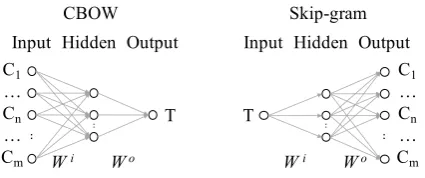
In CBOW (see Figure1), the input and output lay-ers are context (C) and centre word (T) one-hot encodings, respectively. The model is trained by maximizing the probability of predicting a centre word, given its context (Rong,2014):
arg maxp(t|c1, ..., cn, ..., cm) (1)
wheretis a centre word,cnis thenth context word of t within a sentence, totally m context words. CBOW’s hidden layer is defined as:
HCBOW = 1 m ×W
i>×
m X
n=1
Cn
= 1
m ×
m X
n=1
vic,n> (2)
whereCnis the one-hot encoding of thenth con-text word, vic,n is thenth context word row vec-tor (input vecvec-tor) inWi which is a weight matrix between input and hidden layers. Thus, the hid-den layer is the transpose of the average of input vectors of context words. The probability of pre-dicting a centre word in its context is given by a softmax function below:
ut=Wto
>×
HCBOW =vot
>×
HCBOW (3)
p(t|c1, ..., cn, ..., cm) =
exp(ut) PV
j=1exp(uj) (4)
where Wo
t is equivalent to the output vector vot which is essentially a column vector in a weight matrixWothat is between hidden and output lay-ers, aligning with the centre wordt. V is the size of vocabulary in the corpus.
The output is a one-hot encoding of the centre word. Wi and Wo are updated via back propa-gation of errors. Therefore, only the value of the position that represents the centre word’s probabil-ity, i.e.,p(t|c1, ..., cn, ..., cm), will get close to the value of 1. In contrast, the probability of the rest of the words in the vocabulary will be close to 0 in every centre word training.Wiembeds context words. Vectors withinWi can be viewed as con-text word embeddings. Wo embeds centre words, vectors inWo can be viewed as centre word em-beddings.
Skip-gram is the reverse of CBOW (see Fig-ure1). The input and output layers are centre word and context word one-hot encodings, respectively. The target is to maximize the probability of pre-dicting each context word, given a centre word:
arg maxp(c1, ..., cn, ..., cm|t) (5)
Skip-gram’s hidden layer is defined as:
HSG =Wi>×T =vti> (6)
where T is the one-hot encoding of the centre word t. Skip-gram’s hidden layer is equal to the transpose of a centre word’s input vector vt, as only the tth row are kept by the operation. The probability of a context word is:
uc,n=Wc,no>×HSG=vc,no>×HSG (7)
p(cn|t) =
exp(uc,n) PV
j=1exp(uj)
(4) S = cos(w*, wt)
literal, if S> threshold metaphoric, otherwise (1) Word Embedding Wiki train w1 w2 w3 … wn .. w1 w2 w3 … wn .. ..
(2) Look up
WordNet A sentence: {wc1, wc2, wtwc3…}
Context words: {wc1, wc2, wc3…}
Target word: {wt}
Synonyms: {s1, s2…}
Hypernyms: {h1, h2…} Candidate word set W
(3) wt s1 s2 … hj .. wc1 wc2 wc3 … wcm .. ..
cos(wt ,context) cos(s1 ,context)
cos(s2 ,context) …
cos(hj ,context)
agrmax w* ∈W
[image:4.595.74.292.63.244.2]Best fit word
Figure 2: Metaphor identification framework. NB:w∗ =
best fit word,wt=target word.
wherec, nis thenth context word, given a centre word. In Skip-gram, Wi aligns to centre words, while Wo aligns to context words. Because the names of centre word and context word embed-dings are reversed in CBOW and Skip-gram, we will uniformly call vectors inWiinput vectorsvi, and vectors inWooutput vectorsvoin the remaing sections. Word embeddremaings represent both in-put and outin-put vectors.
4 Methodology
In this section, we present the technical details of our metaphor processing framework, built upon two hypotheses. Our first hypothesis (H1) is that a metaphorical word can be identified, if the sense the word takes within its context and its lit-eral sense come from different domains. Such a hypothesis is based on the theory of Selectional Preference Violation (Wilks, 1975, 1978) that a metaphorical item can be found in a violation of selectional restrictions, where a word does not sat-isfy its semantic constrains within a context. Our second hypothesis (H2) is that the literal senses of words occur more commonly in corpora than their metaphoric senses (Cameron,2003;Martin,2006;
Steen et al.,2010;Shutova,2016).
Figure 2 depicts an overview of our metaphor identification framework. The workflow of our framework is as follows. Step (1) involves training
word embeddings based on a Wikipedia dump3
for obtaining input and output vectors of words.
3https://dumps.wikimedia.org/enwiki/
20170920/
She devoured his novels.
Sense 1 • devour • devoured • … HYPERNYMS • destroy • destroyed • … • ruin • ruined • … • … Sense 2 • devour • devoured • … HYPERNYMS • enjoy •enjoyed •… • bask •basked •… •… Sense 3 • devour •devoured •… HYPERNYMS •eat up
•… •… SYNONYMS •down •… •… Sense 4 • devour • devoured • … HYPERNYMS • raven • ravened • … •pig •pigged •… • … … She his novels devour devoured enjoy enjoyed … C andi da te se t W C ont ext w or ds
Figure 3: Given CBOW trained input and output vec-tors, a target word of devoured, and a context of
She [ ] his novels, cos(vdevouredo , v i
context) = −0.01,
cos(vo
enjoyed, vicontext) = 0.02.
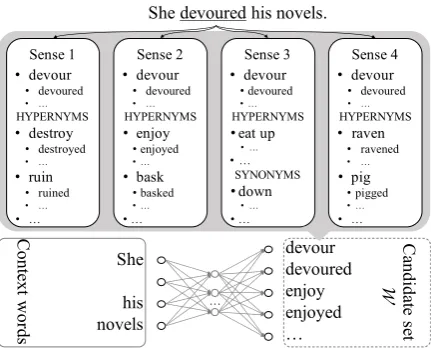
In Step (2), given an input sentence, the target word (i.e., the word in the original text whose metaphoricity is to be determined) and its con-text words (i.e., all other words in the sentence excluding the target word) are separated. We con-struct a candidate word set W which represents all the possible senses of the target word. This is achieved by first extracting the synonyms and di-rect hypernyms of the target word from WordNet, and then augmenting the set with the inflections of the extracted synonyms and hypernyms, as well as the target word and its inflections. Auxiliary verbs are excluded from this set, as these words frequently appear in most sentences with little lex-ical meaning. In Step (3), we identify the best fit word, which is defined as the word that represents the literal sense that the target word is most likely taking given its context. Finally, in Step (4), we compute the cosine similarity between the target word and the best fit word. If the similarity is above a threshold, the target word will be identi-fied as literal, otherwise metaphoric (i.e., based on H1). We will discuss in detail Step (3) and Step (4) in §4.1.
4.1 Metaphor identification
[image:4.595.309.525.65.240.2]Figure 3. Also note that the best fit word could be the target word itself if the target word is used literally.
Given a sentence s, let wt be the target word of the sentence, w∗ ∈ W the best fit word for
wt, and wcontext the surrounding context forwt, i.e., all the words insexcludingwt. We compute the context embedding vcontexti by averaging out the input vectors of each context word ofwcontext, based on Eq. 2. Next, we rank each candidate word k ∈ W by measuring its similarity to the context input vector vicontext in the vector space. The candidate word with the highest similarity to the context is then selected as the best fit word.
w∗ = arg max
k SIM(vk, vcontext) (9) where vk is the vector of a candidate word k ∈ W. In contrast to existing word embedding based methods for metaphor identification which only make use of input vectors (Shutova et al., 2016;
Rei et al., 2017), we explore using both input and output vectors of CBOW and Skip-gram em-beddings when measuring the similarity between
a candidate word and the context. We expect
that using a combination of input and output vec-tors might work better. Specifically, we have ex-perimented with four different model variants as shown below.
SIM-CBOWI =cos(vk,cbowi , vcontext,cbowi ) (10)
SIM-CBOWI+O=cos(vk,cbowo , vcontext,cbowi ) (11)
SIM-SGI =cos(vk,sgi , vcontext,sgi ) (12)
SIM-SGI+O=cos(vk,sgo , vcontext,sgi ) (13)
Here, cos(·) is cosine similarity,cbow is CBOW word embeddings, sg is Skip-gram word embed-dings. We have also tried other model variants us-ing output vectors forvcontext. However, we found that the models using output vectors for vcontext (both CBOW and Skip-gram embeddings) do not improve our framework performance. Due to the page limit we omitted the results of those models in this paper.
Step (4): Given a predicted best fit word w∗
identified in Step (3), we then compute the cosine similarity between the lemmatizations of w∗ and the target wordwtusing their input vectors.
SIM(w∗, wt) =cos(vwi∗, vwi
t) (14)
We give a detailed discussion in §4.2of our ratio-nale for using input vectors for Eq.14.
If the similarity is higher than a threshold (τ) the target word is considered as literal, otherwise, metaphorical (based on H1). One benefit of our approach is that it allows one to paraphrase the identified metaphorical target word into the best fit word, representing its literal sense in the context. Such a feature is useful for supporting other NLP tasks such as Machine Translation, which we will explore in §6. In terms of the value of threshold (τ), it is empirically determined based on a devel-opment set. Please refer to §5for details.
To better explain the workflow of our frame-work, we now go through an example as illus-trated in Figure 3. The target word of the input sentence,“She devoured his novels.” isdevoured, and its the lemmatised formdevourhas four verbal senses in WordNet, i.e.,destroy completely,enjoy avidly,eat up completely with great appetite, and
eat greedily. Each of these senses has a set of cor-responding synonyms and hypernyms. E.g., Sense 3 (eat up completely with great appetite) has syn-onymsdemolish,down,consume, and hypernyms
go through,eat up,finish, andpolish off. We then construct a candidate word setW by including the synonyms and direct hypernyms of the target word from WordNet, and then augmenting the set with the inflections of the extracted synonyms and hy-pernyms, as well as the target word devour and its inflections. We then identify the best fit word given the contextshe[ ]his novelsbased on Eq.9. Based on H2, literal expressions are more com-mon than metaphoric ones in corpora. Therefore, the best fit word is expected to frequently appear within the given context, and thus represents the most likely sense of the target word. For exam-ple, the similarity betweenenjoy(i.e., the best fit word) and the the context is higher than that of de-vour(i.e., the target word), as shown in Figure3.
4.2 Word embedding: output vectors vs.
in-put vectors
sub-apple
orange drink
juice
CBOW
[image:6.595.82.283.66.152.2]Output vec Input vec Output vec Input vec Skip-gram
Figure 4: Input and output vector visualization. The bluer, the more negative. The redder, the more positive.
optimal, as words with different POS normally have different semantics. They tend to be distant from each other in the input vector space. Tak-ing Skip-gram for example, empirically, input vec-tors of words with the same POS, occurring within the same contexts tend to be close in the vector space (Mikolov et al.,2013), as they are frequently updated by back propagating the errors from the same context words. In contrast, input vectors of words with different POS, playing different se-mantic and syntactic roles tend to be distant from each other, as they seldom occur within the same contexts, resulting in their input vectors rarely be-ing updated equally. Our observation is also in line withNalisnick et al.(2016), who examine IN-IN, OUT-OUT and IN-OUT vectors to measure simi-larity between two words.Nalisnick et al. discov-ered that two words which are similar by function or type have higher cosine similarity with IN-IN or OUT-OUT vectors, while using input and output vectors for two words (IN-OUT) that frequently co-occur in the same context (e.g., a sentence) can obtain a higher similarity score.
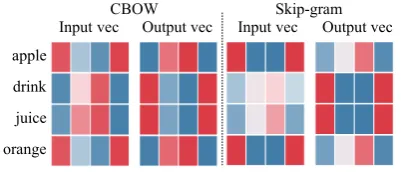
For illustrative purpose, we visualize the CBOW and Skip-gram updates between 4-dimensional input and output vectors by Wevi4 (Rong, 2014), using a two-sentence corpus,
“Drink apple juice.” and“Drink orange juice.”. We feed these two sentences to CBOW and Skip-gram with 500 iterations. As seen Figure4, the in-put vectors ofappleandorangeare similar in both CBOW and Skip-gram, which are different from the input vectors of their context words (drinkand
juice). However, the output vectors ofapple and
orangeare similar to the input vectors ofdrinkand
juice.
To summarise, using input vectors to compare similarity between the best fit word and the tar-get word is more appropriate (cf. Eq.14), as they
4https://ronxin.github.io/wevi/
tend to have the same types of POS. When measur-ing the similarity between candidate words and the context, using output vectors for the former and in-put vectors for the latter seems to better predict the best fit word.
5 Experimental settings
Baselines. We compare the performance of
our framework for metaphor identification against three strong baselines, namely, an unsupervised word embedding based model by Shutova et al.
(2016), a supervised deep learning model by Rei et al.(2017), and the Context2Vec model5( Mela-mud et al.,2016) which achieves the best perfor-mance on Microsoft Sentence Completion Chal-lenge (Zweig and Burges, 2011). Context2Vec was not designed for processing metaphors, in or-der to use it for this we plug it into a very similar framework to that described in Figure2. We use Context2Vec to predict the best fit word from the candidate set, as it similarly uses context to predict the most likely centre word but with bidirectional LSTM based context embedding method. After locating the best fit word with Context2Vec, we identify the metaphoricity of a target word with the same method (see Step (4) in §4), so that we can also apply it for metaphor interpretation. Note that whileShutova et al. andRei et al. de-tect metaphors at the phrase level by identifying metaphorical phrases,Melamud et al.’s model can perform metaphor identification and interpretation on sentences.
Dataset. Evaluation was conducted based on a
dataset developed by Mohammad et al. (2016). This dataset6, containing 1,230 literal and 409 metaphor sentences, has been widely used for metaphor identification related research (Shutova et al.,2016;Rei et al.,2017). There is a verbal tar-get word annotated by 10 annotators in each sen-tence. We use two subsets of theMohammad et al.
set, one for phrase evaluation and one for sentence evaluation. The phrase evaluation dataset was kindly provided by Shutova, which consists of 316 metaphorical and 331 literal phrases (subject-verb and verb-direct object word pairs), parsed from
Mohammad et al.’s dataset. Similar to Shutova et al.(2016), we use 40 metaphoric and 40 literal phrases as a development set and the rest as a test
5
http://u.cs.biu.ac.il/˜nlp/resources/ downloads/context2vec/
6http://saifmohammad.com/WebPages/
Method P R F1
Phrase
Shutova et al.(2016) 0.67 0.76 0.71
Rei et al.(2017) 0.74 0.76 0.74
SIM-CBOWI+O 0.66 0.78 0.72
SIM-SGI+O 0.68 0.82 0.74*
Sent.
Melamud et al.(2016) 0.60 0.80 0.69
SIM-SGI 0.56 0.95 0.70
SIM-SGI+O 0.62 0.89 0.73
SIM-CBOWI 0.59 0.91 0.72
[image:7.595.74.288.61.165.2]SIM-CBOWI+O 0.66 0.88 0.75*
Table 1:Metaphor identification results. NB: * denotes that our model outperforms the baseline significantly, based on two-tailed paired t-test withp <0.001.
set.
For sentence evaluation, we select 212
metaphorical sentences whose target words are
annotated with at least 70% agreement. We
also add 212 literal sentences with the highest agreement. Among the 424 sentences, we form our development set with 12 randomly selected metaphoric and 12 literal instances to identify the threshold for detecting metaphors. The remaining 400 sentences are our testing set.
Word embedding training. We train CBOW and
Skip-gram models on a Wikipedia dump with the same settings asShutova et al.(2016) andRei et al.
(2017). That is, CBOW and Skip-gram models are trained iteratively 3 times on Wikipedia with a context window of 5 to learn 100-dimensional word input and output vectors. We exclude words with total frequency less than 100. 10 negative samples are randomly selected for each centre word training. The word down-sampling rate is 10-5. We use Stanford CoreNLP (Manning et al.,
2014) lemmatized Wikipedia to train word embed-dings for phrase level evaluation, which is in line withShutova et al.(2016). In sentence evaluation, we use the original Wikipedia for training word embeddings.
6 Experimental Results
6.1 Metaphor identification
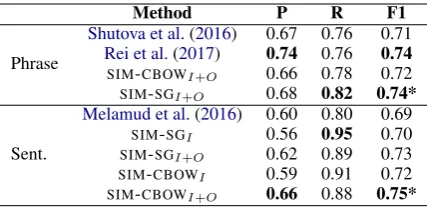
Table1shows the performance of our model and the baselines on the task of metaphor identifica-tion. All the results for our models are based on a threshold of 0.6, which is empirically de-termined based on the developing set. For sen-tence level metaphor identification, it can be ob-served that all our models outperform the baseline (Melamud et al.,2016), withSIM-CBOWI+O giv-ing the highest F1 score of 75% which is a 6% gain over the baseline. We also see that
mod-els based on both input and output vectors (i.e.,
SIM-CBOWI+O andSIM-SGI+O) yield better per-formance than the models based on input vectors only (i.e.,SIM-CBOWIandSIM-SGI). Such an ob-servation supports our assumption that using in-put and outin-put vectors can better model similarity between words that have different types of POS, than simply using input vectors. When compar-ing CBOW and Skip-gram based models, we see that CBOW based models generally achieve bet-ter performance in precision whereas Skip-gram based models perform better in recall.
In terms of phrase level metaphor identifica-tion, we compare our best performing models (i.e.,
SIM-CBOWI+O and SIM-SGI+O) against the ap-proaches of Shutova et al. (2016) and Rei et al.
(2017). In contrast to the sentence level eval-uation in which SIM-CBOWI+O gives the best performance, SIM-SGI+O performs best for the phrase level evaluation. This is likely due to the fact that Skip-gram is trained by using a centre word to maximise the probability of each context word, whereas CBOW uses the average of context word input vectors to maximise the probability of the centre word. Thus, Skip-gram performs bet-ter in modelling one-word context, while CBOW has better performance in modelling multi-context
words. When comparing to the baselines, our
model SIM-SGI+O significantly outperforms the word embedding based approach byShutova et al.
(2016), and gives the same performance as the deep supervised method (Rei et al., 2017) which requires a large amount of labelled data for train-ing and cost in traintrain-ing time.
SIM-CBOWI+OandSIM-SGI+Oare also evalu-ated with different thresholds for both phrase and sentence level metaphor identification. As can be seen from Table 2, the results are fairly stable when the threshold is set between 0.5 and 0.9 in terms of F1.
6.2 Metaphor processing for MT
We believe that one of the key purposes of metaphor processing is to support other NLP tasks. Therefore, we conducted another set of ex-periments to evaluate how metaphor processing can be used to support English-Chinese machine translation.
τ Sentence Phrase
P R F1 F1SIM-CBOWI+OF1SIM-SGI+O
0.3 0.75 0.60 0.67 0.56 0.46 0.4 0.69 0.75 0.72 0.65 0.63 0.5 0.67 0.82 0.74 0.71 0.72
0.6 0.66 0.88 0.75 0.72 0.74
[image:8.595.74.291.60.163.2]0.7 0.64 0.88 0.74 0.72 0.73 0.8 0.63 0.89 0.74 0.72 0.73 0.9 0.63 0.89 0.74 0.71 0.73 1.0 0.50 1.00 0.67 0.65 0.65
Table 2: Model performance vs. different threshold (τ) settings. NB: the sentence level results are based on
SIM-CBOWI+O.
0.3 0.4 0.5 0.6 0.7 0.8
Literal Metaphoric Overall Literal Metaphoric Overall
T
ra
ns
la
ti
on
ac
cur
ac
y
Google Bing
Original sentence Paraphrased by our model
Paraphrased by the baseline (Melamud et al. 2016)
+0.26
+0.24
+0.11 +0.09
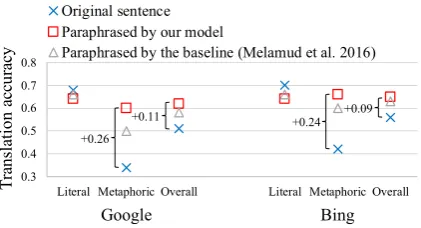
Figure 5:Accuracy of metaphor interpretation, evaluated on Google and Bing Translation.
200 literal sentences, we randomly selected 50 metaphoric and 50 literal sentences to construct a set SM for the Machine Translation (MT)
evalu-ation task. For each sentence in SM, if it is
pre-dicted as literal by our model, the sentence is kept unchanged; otherwise, the target word of the sen-tence is paraphrased with the best fit word (refer to §4.1for details). The metaphor identification step resulted in 42 True Positive (TP) instances where the ground truth label is metaphoric and 19 False Positive (FP) instances where the ground truth la-bel is literal, resulting in a total of 61 instances predicted as metaphorical by our model. We also run one of our baseline models, Context2Vec, on the 61 sentences to predict the best fit words for comparison. Our hypothesis is that by paraphras-ing the metaphorically used target word with the best fit word which expresses the target word’s real meaning, the performance of translation engines can be improved.
We test our hypothesis on two popular English-Chinese MT systems, i.e., the Google and Bing Translators. We recruited from a UK university 5 Computing Science postgraduate students who are Chinese native speakers to participate the English-Chinese MT evaluation task. During the evalua-tion, subjects were presented with a questionnaire
The ex-boxer's job is to bouncepeople who want to enter this private club.
bounce: eject from the premises
1. 前拳击手的工作是反弹人谁想要进入这个私人俱乐部。 2. 前拳击手的工作是让想要进入这个私人俱乐部的人弹跳。 3. 前拳击手的工作是拒绝谁想要进入这个私人俱乐部的人。 4. 前拳击手的工作是拒绝那些想进入这个私人俱乐部的人。 5. 前拳击手的工作是打人谁想要进入这个私人俱乐部。 6. 前拳击手的工作是打击那些想进入这个私人俱乐部的人。
[image:8.595.310.524.67.154.2]Good / Bad Sample Questionnaire
Figure 6:MT-based metaphor interpretation questionnaire.
Acc-met. Acc-lit. Acc-overall
Orig. Sent. 0.34 0.68 0.51 Context2Vec 0.50 0.66 0.58
SIM-CBOWI+O 0.60 0.64 0.62
Bing
Orig. Sent. 0.42 0.70 0.56 Context2Vec 0.60 0.66 0.63
SIM-CBOWI+O 0.66 0.64 0.65
Table 3: Accuracy of metaphor interpretation, evaluated on Google and Bing Translation.
containing English-Chinese translations of each of the 100 randomly selected sentences. For each sentence predicted as literal (39 out of 100 sen-tences), there are two corresponding translations by Google and Bing respectively. For each tence predicted as metaphoric (61 out of 100 sen-tences), there are 6 corresponding translations.
An example of the evaluation task is shown in Figure 6, in which “The ex-boxer’s job is to bounce people who want to enter this private club.” is the original sentence, followed by an WordNet explanation of the target word of the sentence (i.e., bounce: eject from the premises). There are 6 translations. No. 1-2 are the orig-inal sentence translations, translated by Google Translate (GT) and Bing Translator (BT). The tar-get word, bounce, is translated, taking the sense of (1) physically rebounding like a ball (反弹), (2) jumping(弹跳). No. 3-4 are SIM-CBOWI+O paraphrased sentences, translated by GT and BT, respectively, taking the sense of refusing (拒绝). No. 5-6 are Context2Vec paraphrased sentences, translated by GT and BT, respectively, taking the sense ofhitting(5.打; 6.打击).
[image:8.595.307.524.187.260.2] [image:8.595.75.286.226.340.2]based on our observation, there is always a Chi-nese word corresponding to an English target word in MT, as the annotated target word normally rep-resents important information in the sentence in the applied dataset.
We use translation accuracy as a measure to evaluate the improvement on MT systems after
metaphor processing. The accuracy is
calcu-lated by dividing the number of correctly trans-lated instances by the total number of instances. As can be seen in Figure 5 and Table 3, after paraphrasing the metaphorical sentences with the
SIM-CBOWI+O model, the translation improve-ment for the metaphorical class is dramatic for both MT systems, i.e., 26% improvement for Google Translate and 24% for Bing Translate. In terms of the literal class, there is some small drop (i.e., 4-6%) in accuracy. This is due to the fact that some literals were wrongly identified as metaphors and hence error was introduced dur-ing paraphrasdur-ing. Nevertheless, with our model, the overall translation performance of both Google and Bing Translate are significantly improved by 11% and 9%, respectively. Our baseline model Context2Vec also improves the translation accu-racy, but is 2-4 % lower than our model in terms of overall accuracy. In summary, the experimental re-sults show the effectiveness of applying metaphor processing for supporting Machine Translation.
7 Conclusion
We proposed a framework that identifies and in-terprets metaphors at word-level with an unsuper-vised learning approach. Our model outperforms the unsupervised baselines in both sentence and phrase evaluations. The interpretation of the iden-tified metaphorical words given by our model also contributes to Google and Bing translation sys-tems with 11% and 9% accuracy improvements.
The experiments show that using words’ hy-pernyms and synonyms in WordNet can para-phrase metaphors into their literal counterparts, so that the metaphors can be correctly identified and translated. To our knowledge, this is the first study that evaluates a metaphor processing method on Machine Translation. We believe that compared with simply identifying metaphors, metaphor pro-cessing applied in practical tasks, can be more valuable in the real world. Additionally, our ex-periments demonstrate that using a candidate word output vector instead of its input vector to model the similarity between the candidate word and its
context yields better results in the best fit word (the literal counterpart of the metaphor) identification.
CBOW and Skip-gram do not consider the dis-tance between a context word and a centre word in a sentence, i.e., context word contributes to pre-dict the centre word equally. Future work will in-troduce weighted CBOW and Skip-gram to learn positional information within sentences.
Acknowledgments
This work is supported by the award made by the UK Engineering and Physical Sciences Research Council (Grant number: EP/P005810/1).
References
Dan Assaf, Yair Neuman, Yohai Cohen, Shlomo Arg-amon, Newton Howard, Mark Last, Ophir Frieder,
and Moshe Koppel. 2013. Why “dark thoughts”
aren’t really dark: A novel algorithm for metaphor
identification. InComputational Intelligence,
Cog-nitive Algorithms, Mind, and Brain (CCMB), 2013 IEEE Symposium on. IEEE, pages 60–65.
David M Blei, Andrew Y Ng, and Michael I Jordan.
2003. Latent Dirichlet allocation. Journal of
ma-chine Learning research3(Jan):993–1022.
Lynne Cameron. 2003. Metaphor in educational
dis-course. A&C Black.
Max Coltheart. 1981. The MRC psycholinguistic
database. The Quarterly Journal of Experimental
Psychology33(4):497–505.
Christiane Fellbaum. 1998. WordNet: An Electronic
Lexical Database. Bradford Books.
Ilana Heintz, Ryan Gabbard, Mahesh Srinivasan, David Barner, Donald S Black, Marjorie Freedman, and Ralph Weischedel. 2013. Automatic extraction of linguistic metaphor with LDA topic modeling. In
Proceedings of the First Workshop on Metaphor in NLP (ACL 2013). pages 58–66.
Luuk Lagerwerf and Anoe Meijers. 2008.
Open-ness in metaphorical and straightforward
advertise-ments: Appreciation effects. Journal of Advertising
37(2):19–30.
Christopher Manning, Mihai Surdeanu, John Bauer, Jenny Finkel, Steven Bethard, and David McClosky. 2014. The Stanford CoreNLP natural language
pro-cessing toolkit. In Proceedings of 52nd Annual
Meeting of the Association for Computational Lin-guistics: System Demonstrations. pages 55–60.
James H Martin. 2006. A corpus-based analysis of
Oren Melamud, Jacob Goldberger, and Ido Dagan. 2016. context2vec: Learning generic context
em-bedding with bidirectional LSTM. InProceedings
of the 20th SIGNLL Conference on Computational Natural Language Learning (CoNLL 2016). pages 51–61.
Tomas Mikolov, Kai Chen, Greg Corrado, and Jef-frey Dean. 2013. Efficient estimation of word
rep-resentations in vector space. Proceedings of
Inter-national Conference on Learning Representations (ICLR 2013).
Saif M Mohammad, Ekaterina Shutova, and Peter D
Turney. 2016. Metaphor as a medium for
emo-tion: An empirical study. Proceedings of the Joint
Conference on Lexical and Computational Seman-tics (*SEM 2016)page 23.
Eric Nalisnick, Bhaskar Mitra, Nick Craswell, and Rich Caruana. 2016. Improving document ranking
with dual word embeddings. InProceedings of the
25th International Conference Companion on World Wide Web. International World Wide Web Confer-ences Steering Committee, pages 83–84.
Yair Neuman, Dan Assaf, Yohai Cohen, Mark Last, Shlomo Argamon, Newton Howard, and Ophir Frieder. 2013. Metaphor identification in large texts
corpora. PloS one8(4):e62343.
Radim ˇReh˚uˇrek and Petr Sojka. 2010. Software
frame-work for topic modelling with large corpora. In
Proceedings of the LREC 2010 Workshop on New Challenges for NLP Frameworks. ELRA, Valletta,
Malta, pages 45–50. http://is.muni.cz/
publication/884893/en.
Marek Rei, Luana Bulat, Douwe Kiela, and Ekaterina
Shutova. 2017. Grasping the finer point: A
su-pervised similarity network for metaphor detection.
Proceedings of the 2017 Conference on Empirical Methods in Natural Language Processing (EMNLP 2017)pages 1537–1546.
Vassiliki Rentoumi, George A Vouros, Vangelis
Karkaletsis, and Amalia Moser. 2012. Investigat-ing metaphorical language in sentiment analysis: A
sense-to-sentiment perspective. ACM Transactions
on Speech and Language Processing (TSLP)9(3):6.
Xin Rong. 2014. word2vec parameter learning
ex-plained.arXiv preprint arXiv:1411.2738.
Ekaterina Shutova. 2016. Design and evaluation of
metaphor processing systems. Computational
Lin-guistics.
Ekaterina Shutova, Douwe Kiela, and Jean Maillard.
2016. Black holes and white rabbits: Metaphor
identification with visual features. Proceedings of
the 15th Annual Conference of the North American Chapter of the Association for Computational Lin-guistics: Human Language Technologies (NAACL-HLT 2016)pages 160–170.
Ekaterina Shutova, Lin Sun, Elkin Dar´ıo Guti´errez, Pa-tricia Lichtenstein, and Srini Narayanan. 2017. Mul-tilingual metaphor processing: Experiments with
semi-supervised and unsupervised learning.
Com-putational Linguistics43(1):71–123.
Gerard J Steen, Aletta G Dorst, J Berenike Herrmann, Anna Kaal, Tina Krennmayr, and Trijntje Pasma.
2010. A method for linguistic metaphor
identifica-tion: From MIP to MIPVU, volume 14. John Ben-jamins Publishing.
Tomek Strzalkowski, George Aaron Broadwell, Sarah Taylor, Laurie Feldman, Samira Shaikh, Ting Liu, Boris Yamrom, Kit Cho, Umit Boz, Ignacio Cases,
et al. 2013. Robust extraction of metaphor from
novel data. In Proceedings of the First Workshop
on Metaphor in NLP (ACL 2013). pages 67–76.
Yulia Tsvetkov, Leonid Boytsov, Anatole Gershman, Eric Nyberg, and Chris Dyer. 2014. Metaphor
detec-tion with cross-lingual model transfer. Proceedings
of the 52nd Annual Meeting of the Association for Computational Linguistics (ACL 2014)pages 248– 258.
Peter D Turney, Yair Neuman, Dan Assaf, and Yohai Cohen. 2011. Literal and metaphorical sense
identi-fication through concrete and abstract context.
Pro-ceedings of the Conference on Empirical Methods in Natural Language Processing (EMNLP 2011)pages 680–690.
Yorick Wilks. 1975. A preferential, pattern-seeking,
semantics for natural language inference. Artificial
Intelligence6(1):53–74.
Yorick Wilks. 1978. Making preferences more active.
Artificial Intelligence11(3):197–223.