Munich Personal RePEc Archive
Explaining the Persistent Effect of
Demand Uncertainty on Firm Growth
Bricongne, Jean-Charles and Gigout, Timothee
Collège de France, Banque de France
1 May 2019
Online at
https://mpra.ub.uni-muenchen.de/97563/
Explaining the Persistent E
ff
ect of Demand
Uncertainty on Firm Growth
Jean-Charles Bricongne
*Timothee Gigout
†May 30, 2019
Abstract
We study the effect of demand uncertainty on firm growth. We use product-level bi-lateral trade data to build an exogenous firm-level measure of the uncertainty of demand shocks. We match it with exhaustive custom and fiscal data between 1996 and 2013. An increase in uncertainty has a negative and persistent impact on the growth of exposed firms. This suggests a different underlying mechanism from a simple real-option effect. Financially constrained firms experience a much sharper and longer slowdown. Sectoral comovement is also a key factor explaining the persistent effect of uncertainty.
JEL classification:F23, D81, D22, F61
Keywords:Uncertainty; demand shock; Firm-level; Dynamics; Heterogeneity.
Acknowledgement: We thank participants of the 18th Doctoral Meetings in International
Trade and International Finance, the 2018 Meetings of the French Economic Associa-tion, the Banque de France PhD seminar and the 2018 CREA-IZA Workshop. In par-ticular, we are grateful to Clement Malgouyres, Antonin Bergeaud, Simon Ray, Matthieu Lequien, Nicolas Coeurdacier, Jose De Sousa, Gonzague Vannoorenberghe, Matthieu Bus-sière, Michel Beine and Thierry Mayer.
*Banque de France - Commission Européenne - Sciences-Po Paris, LIEPP - Université de Tours, LEO, Email:
1
Introduction
The increase in cross-border trade and financial linkages since the 1990’s has led to a greater
exposure of domestic agents to shocks abroad. More firms are now dependent on inherently
uncertain demand conditions. In this paper, we investigate how the uncertainty around the
real-ization of demand shocks affects the growth dynamic of French manufacturing firms between
1996 and 2013. We build a measure of demand uncertainty by computing the dispersion of
estimated demand shocks from the highly dis-aggregated BACI bilateral trade database. We
then document the effect of an increase in demand uncertainty on employment and investment
growth using French fiscal data. A striking result is the persistent negative effect of a one-time
uncertainty shock. The effect lasts for up to 5 years for both investment and employment. It is
not followed by a period of compensation which makes those losses permanent. We find that
losses are magnified for financially constrained firms and firms with high correlation to their
industry.
The starting point of our paper is to compute a firm-level measure that captures the
uncer-tainty of demand shocks. Some studies use aggregate measures of unceruncer-tainty (Baker et al.
(2016),Julio and Yook(2012) orBussiere et al.(2015))). Others use stock market based
firm-level measures (Bloom et al.(2007), Barrero et al.(2017) orHassan et al.(2017)). We choose
instead to measure uncertainty using the firm exposure to the dispersion of estimated foreign
demand shocks. It has three distinct advantages. First, it allows us to focus on one properly
identified form of uncertainty, i.e. demand uncertainty. Second, it provides an exogenous
firm-level measure that we can causally link to the firm outcomes. Lastly, we obtain a wider and
more representative sample than one obtained using publicly listed firms.
To compute this measure, we follow a recent strand of literature relying on the computation
of foreign demand shocks. See Esposito(2018) for a review. Using the highly disagregated
database BACI (Gaulier and Zignago,2010), we first estimateproduct×exporting-country×
importing-country×yearidiosyncratic demand shocks. We then aggregate those shocks by
measuring their mean and dispersion at thesector×importing-country×yearlevel. We
use the dispersion as a proxy for uncertainty. Exports from France are excluded to prevent
en-dogeneity in the variations of those measures. To illustrate, the country-sector with the highest
demand uncertainty in our sample is the manufacture of coke and petroleum in Nigeria in 2010
which coincides with the death of the sitting president and the beginning of the first major terror
attacks by Boko Harram. We typically observe the highest values for other emerging countries
(Mali, Syria, Central African Republic) in raw material transformation sectors (manufacture of
wood, manufacture of other transport equipment, manufacture of paper, etc.). Finally, to obtain
a firm-level measure, we use a weighting scheme instrument as in Aghion et al. (2017) and
Mayer et al.(2016). We exploit differences in the firms’ initial exposures to the mean and
dis-persion of shocks associated with their own sector in any given importing country. The mean
represents the firm specific foreign demand, whereas the dispersion represents the firm specific
uncertainty of this demand.
We then regress several outcomes related to firm growth (Employment, investment, debt,
etc.) on this measure of uncertainty. We use Local Projections methods (Jordà,2005) to assess
the persistence of the effect a one time change in uncertainty. Local Projections have recently
been introduced for micro data where they provide a parsimonious and tractable alternative to
VAR models to compute impulse response functions in the presence of potential non-linearities
(seeFavara and Imbs(2015), Crouzet et al.(2017) and Cezar et al.(2017)). We find that
fol-lowing a one standard deviation increase in uncertainty, firms lower their investment growth
by -0.453 (s.e.= 0.114) percentage point and their employment growth by -0.581 (s.e.= 0.095)
percentage point. The negative effect lasts for 5 years for both investment and employment.
It does not exhibit any evidence of post-shock compensation (i.e. a positive value of the
co-efficient of uncertainty). Taken together, those results show that uncertainty has a permanent
negative effect on firm growth. Our key result contrasts with a central prediction from the
real-option theory. The value of the real-option of waiting should only temporally increase while there
is uncertainty about future outcomes. In this model, firms should then postpone investment
and compensate once the uncertainty is resolved (Bernanke,1983). We show that some of the
finan-cial frictions. However, even non finanfinan-cially constrained firms still experience a slight growth
slowdown. The ability to reverse the decision to scale up by selling the newly acquired
pro-duction capacity on a secondary is another candidate explanation. We also find that firms with
low irreversability (measured by the correlation of the firm with the sales of its industry) do
not suffer persistent effects from uncertainty. Whereas firms with high correlation experience a
much longer downturn.
A tangential benefit of our approach of using foreign demand shocks is to allow us to
mea-sure the effect of the transmission of uncertainty abroad on the growth of domestic firms. Our
study contributes to the debate of the effect of trade on firm dynamics. Many studies have now
documented the importance of idiosyncratic demand shocks to aggregate fluctuations. Garin
et al.(2017) investigate the impact of idiosyncratic foreign demand shocks on firm output and
workers individual wages. di Giovanni et al. (2017) show how idiosyncratic shock drives
ag-gregate fluctuations through large firms. Hummels et al.(2014) find that an exogeneous rise
in foreign demand increases employment and wages for both skilled and non skilled workers.
Other studies have focused on how idiosyncratic shock uncertainty affects exporters’ behavior.
It leads to lower than optimal size of supplier to allow for diversification (Gervais,2018). Only
large firms really benefit from diversification opportunities (Vannoorenberghe et al., 2016).
WhileEsposito(2018) shows that risk diversification leads to wellfare gains. Vannoorenberghe
(2012) shows that higher export share implies higher volatility of domestic sales. De Sousa
et al. (2016) find that expenditure uncertainty reduces exports. Especially, more productive
firms tend to abandon market shares in volatile destinations to less productive firms. Our study
complements those results by showing that losses caused by a 2nd moment shock (i.e. higher
uncertainty) may potentially offset gains from a 1st moment shock (i.e. higher demand). We
show that the uncertainty of demand has long lasting consequence for the growth of
manufac-turing firms. The failure to take into account demand uncertainty could lead to overestimating
gains from trade.
The reminder of the paper is organized as follows. Section 2 describes the data and our
methodology to compute the uncertainty of idiosyncratic demand shocks. Section3provides
our empirical results regarding the effect of uncertainty on firm growth. We show the robustness
of our results in Section4. Section5concludes.
2
Data
In the following subsections, we describe our data sources as well as the construction of our
variables of interest. We then provide some stylized facts concerning our new variables.
2.1
Data Sources
We build a database of matching fiscal, export and employment benefit data of French firms
between 1995 and 2013. We use export data from the French customs database to compute
firm-level exposure to foreign demand shocks and uncertainty. Firm accounting data come
from the French fiscal database FARE and FICUS. We use it to compute most of our control
(eg. productivity, cash flow, etc.) and dependent variables (investment, employment). It also
provides us with the firm primary sector of activity. Employee level data comes from the annual
social data declaration DADS. It allows us to decompose how firms arbitrage between
work-force size, structure and wages. It contains one observation per work contract with information
regarding the type of contract and various employee (age, gender, etc.) plus firm characteristics
(size, county, etc.). We calculate individual hourly wage growth rates then we average them
at the firm level. We use LIFI to control whether the firm belongs to a group. We use BACI
(Gaulier and Zignago, 2010) to compute import demand moments, including our uncertainty
proxy. BACI is a product-level bilateral trade database maintained by the CEPII. Finally, we
collect various country characteristics from the World Bank, the International Monetary Fund
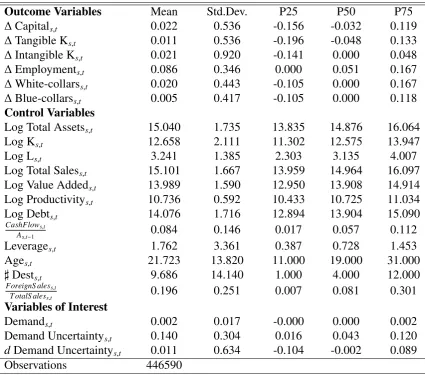
and a few other ancillary sources. We present summary statistics in Table1. We follow about
Table 1:Firm characteristics
Outcome Variables Mean Std.Dev. P25 P50 P75
∆Capitals,t 0.022 0.536 -0.156 -0.032 0.119
∆Tangible Ks,t 0.011 0.536 -0.196 -0.048 0.133
∆Intangible Ks,t 0.021 0.920 -0.141 0.000 0.048
∆Employments,t 0.086 0.346 0.000 0.051 0.167
∆White-collarss,t 0.020 0.443 -0.105 0.000 0.167
∆Blue-collarss,t 0.005 0.417 -0.105 0.000 0.118
Control Variables
Log Total Assetss,t 15.040 1.735 13.835 14.876 16.064
Log Ks,t 12.658 2.111 11.302 12.575 13.947
Log Ls,t 3.241 1.385 2.303 3.135 4.007
Log Total Saless,t 15.101 1.667 13.959 14.964 16.097
Log Value Addeds,t 13.989 1.590 12.950 13.908 14.914
Log Productivitys,t 10.736 0.592 10.433 10.725 11.034
Log Debts,t 14.076 1.716 12.894 13.904 15.090
CashFlows,t
As,t−1 0.084 0.146 0.017 0.057 0.112
Leverages,t 1.762 3.361 0.387 0.728 1.453
Ages,t 21.723 13.820 11.000 19.000 31.000
♯Dests,t 9.686 14.140 1.000 4.000 12.000
ForeignS aless,t
T otalS aless,t 0.196 0.251 0.007 0.081 0.301
Variables of Interest
Demands,t 0.002 0.017 -0.000 0.000 0.002
Demand Uncertaintys,t 0.140 0.304 0.016 0.043 0.120
dDemand Uncertaintys,t 0.011 0.634 -0.104 -0.002 0.089
Observations 446590
NOTES: All outcome and control variables are computed using either fiscal (FARE, FICUS), social (DADS) or customs databases.
∆ Capitals,t is the log difference of the stock of non financial capital assets net of depreciation. ∆ Employments,t is the log difference of the number of employees (fiscal data). ∆Hourly Wages,t is the log difference of the firm average hourly wage. Log Productivitys,tis the log value added per worker. Log Ks,t is the log of tangible assets. Log Ls,t is measured in full-time equivalent workers at the end of the year. CashFlows,t
As,t−1 is the cash flow measured by operating income over lagged total assets. Leverages,t is the
leverage ratio measured by debt over equity. Log Debts,t is the log of total debt liabilities. Ages,t is in years.ForeignS aless,t
T otalS aless,t is the share of exports relative to total sales. ♯Dests,t is the number of foreign markets serviced by the firm. The variables of interest are computed using the bilateral product level database BACI. See Section2.2for the construction of the moments of the distribution of demand shocks. sandtindex firms
and years respectively..
2.2
Demand shocks and Uncertainty
The first step is to isolate demand shocks in the bilateral trade data. We follow a methodology
similar toGarin et al.(2017) andEsposito(2018). We have a set of countries J that import a
set of products Pfrom a set of countries I \ {i = FRA}. Let Vp,i,j,t be the imports of product
p from country i by country j in year t and ∆Vp,i,j,t be its log 1st difference. Then υp,i,j,t is
the idiosyncratic demand shock, computed as the residual of estimating the following equation
country by country:
∆Vp,i,j,t =β j
1∆Vp,i,t+β j
2∆Vp,j,t+α j j,t
| {z } Market Fundamentals
+ αpj,i,j
|{z}
Bilateral Product Trend
+υp,i,j,t
|{z}
Idiosyncratic Demand Shock
(1)
The intuition behind this 1ststage is the following1. The fixed effectαj
p,i,jremoves any bilateral
product trend that could generate increasing dispersion within an industry while being perfectly
"certain". For instance, it controls for heterogeneity between technologies: demand for old
products may decline relatively to new ones. The two aggregate growth rates can be thought
off as the market fundamentals on the demand and supply side for any particular year and
product. ∆Vp,j,t controls for the growth rate of imports of product pfrom the rest of the world
by country j. We are interested in the specific demand from j to i relative to that aggregate
fluctuation. All other things equal, the greater the residualυp,i,j,t, the more jwants pfromias
opposed to pfrom the rest of the worldI\ {i}. ∆Vp,i,t controls for the growth of exports ofiof
p to the rest of the world. All other things equal, if igets better at producing p, the residual
will be smaller. It therefore controls for supply shocks in i. The αjj,t fixed effect controls for
aggregate conditions in the importing country jin yeart.
The residualsυp,i,j,t are by construction the variance that cannot be explained by either the
relevant trend or market fundamentals. Their first moment corresponds to the intensity of the
demand signal originating from that market. Their dispersion then tells us its noisiness, that
is how uncertain the signal would appear to an outside observer. We use this variable as our
time and country varying proxy for demand uncertainty. We compute the mean (DM1
k,j,t) for each
sector-import-year.Pp∈k,i,t is a counter for the number of non-zero trade flows in that triplet. Let
υkp,j,t be the pthpercentile of the distribution of allυ
h,i,FRAfor each sector-importer-year (k, j,t).
LetDM2
k,j,t be the 2
nd moment of the distribution of the idiosyncratic demand shocks of product
pfrom sectorkin countryi(excluding France) into country j:
Mean: DkM,j1,t = 1
Pp∈k,i,t−1
X
i,FRA,p∈k
υp,j,i,t (2)
Dispersion: DkM,j2,t = υ75k,j,t−υ25k,j,t (3)
This step provides robust and fairly intuitive measures of the shape of the distribution of demand
shocks. The higherDM1
k,j,t , the more intense the signal from that market. The higher the value
ofDM2
k,j,t, the wider the distribution and the nosier the signal. We compute alternative measures
using the spread betweenυ10k,j,tandυ90k,j,torυ5k,j,tandυ95k,j,tand confirm that our results are virtually
the same.
We now transform our sector-country-year measures into firm-year specific variables. We
follow the standard method in the literature (SeeAghion et al.(2017), Mayer et al.(2016) or
Berthou and Dhyne(2018)). We weight each of our demand distribution variable by the firm
initial market share and export intensity. The weights are necessary to account for the across
firms variations in market diversification. However by using the initial firm weights, we
en-sure that any across time fluctuations are only caused by variations of the demand distribution
measures and not by any endogenous firm reaction. In equation (4), we first weight our
sures on the initial share of country j in firm f export portfolio (Xj,f,t0
Xf,t0 ). We then average this
firm-destination level weighted variable across the export portfolio of firm f (Jf). Finally, we
weight this measure over the initial export intensity of the firm (computed as Foreign Sales
(X∗
f,t0) over Total Sales (Y
∗ f,t0).
DMf,t{1,2}= X ∗ f,t0 Y∗f,t0
|{z}
1 Jf
! Jf
X
j=1
Xj,f,t0 Xf,t0
|{z}
DkM={k1,2}
f,j,t
Export Intensity Country Weight
(4)
2.3
Stylized Facts
Table2reports the 10 highest value of Demand Uncertainty in our sample. The country sector
with the highest value is the manufacture of coke and petroleum in Nigeria in 2010. It coincides
with the death of the sitting president and the beginning of the first major terror attacks by
Boko Harram. The next two values are Manufacture of other transport equipment in Iran 1997
(two massive earthquakes and a presidential election) and Rwanda 2010 (contested presidential
election). In Figure1, we plot the median value of the time series of each sector-by-country
panel. The color of the cell indicates the decile of uncertainty the country-sector belongs to.
Bright red indicates higher uncertainty and dark blue low uncertainty. Some countries like
Iran or Irak have a high demand uncertainty across most of their sectors while others like most
island nations have typically low demand uncertainty. Sectors like the machine manufacturing
industry (28), the car industry (29) and transport equipment industry (30) usually exhibit high
uncertainty across countries (SeeA.0.3for a list of all manufacturing sectors). There is however
plenty of variations within country or within sector.
In Figure2a, we plot the distribution of those idiosyncratic demand shocks for the car
p
Figure 1:Heatmap of the median value of demand uncertainty by sector and country
Afgha nistan Al geria Andorra Angui lla Arge ntina Aruba Aust ria Baha mas Bangl adesh Belarus Belize Bermuda Bol ivia Bra zil Brune i Burki na Fa so Cambodi a Canada Caym an Isl ands Chad China Cocos Isl
ands Com oros Cook Isl ands Cot e d'Ivoi re Cuba Czech R
epubl ic De nm ark Dom inica Ecuador El Sa lvador Eritrea Ethiopi a Fiji Fra nce Gabon Ge orgi a Gha na Gre ece Gre nada Gua temala Gui nea-B issa u Ha iti Hong Kong Iceland Indone sia Iraq Isra el Jam aica Jorda n Kenya Kuwa it Laos Lebanon Libya Ma cao Ma daga scar Ma laysi a Ma li Ma rsha ll Isl ands Ma uri tius Mi crone sia Mongol ia Mont serra t Moz am bique Nauru Ne the rlands Ne w C aledoni a Ni caragua Ni geria Nort h Kore a Om an Pa lau Pa nama Pa ragua y Phi lippi nes Port uga l Rom ania Rwanda Sa int Ki tts a nd Ne vis Sa int Pi erre and Mi que lon Sa moa Sao T om
e and Pri ncipe Se negal Sierra Leone Slova k R epubl ic Sol om on Isl ands Sout h Afri ca Sout h Suda n Sri Lanka Suri name Swi tzerland Tajiki stan Tha iland Togo Trini dad a nd T oba go Turke y Turks a nd C aicos Isl ands Uga nda Uni ted Ara b E mirates Uni ted St ates Uz beki stan Ve nezuela Wallis a
nd Fut una Yugosl avia Zim babwe Albani a Ameri can Sa moa Angol a Antigua and B arbuda Armeni a Austral ia Azerba ijan Bahra in Barba dos Belgi um Benin Bhut an Bosni a and He
rzegovi na
British Vi rgin Isl
ands Bulgari a Burundi Came roon Cape Ve
rde Centra l Afri can R epubl ic Chile Christm as Isl ands Colom bia Congo Costa R
ica Croa
tia Cyprus
Democ ratic R
epubl ic of C
ongo Djibout i Domini can R epubl ic Egypt Equa
torial Gui nea Estoni a Falkl and Isl ands Finland French Pol
ynesia Gambi a Germ any Gibra ltar Greenl and Guam Guinea Guya na Hondura s Hunga ry India Iran Ireland Italy Japan Kazakhst an Kiriba ti Kyrgyz Republ ic Latvi a Liberia Lithua nia Macedoni a Malawi Maldi ves Malta Mauri tania Mexic o Moldova Mont enegro Moroc co Myanm ar Nepal Nethe rlands Ant
illes New Z
ealNiand ger Niue Norwa y Pakist an Palest ine Papua New Gui
nea Peru Poland Qatar Russi a Saint Helena Saint Lucia Saint Vince
nt and t he Gre
nadines San Ma
rino Saudi Arabia Seyche lles Singa pore Slove nia Somali a South Kore
a Spain Suda n Sweden Syria Tanza nia Timor Tonga Tunisia Turkm enista n Tuva lu Ukra ine
United Ki ngdom Urugua y Vanua tu Vietna m Yeme n Zambi a
10 15 20 25 30
Sector (NAF 2-digit Code) 1 2 3 4 5 6 7 8 9 10
NOTE: See Section2.2for the construction method and the appendix for the description of the NAF sectors.
Table 2:Top 10 uncertain markets
DkM,2j,t
1996 - Yemen - Manufacture of paper and paper products 9.62
1997 - Iran - Manufacture of other transport equipment 10.42
2002 - Cameroon - Manufacture of wood and of products of woo (...) 9.74
2003 - Central African Republic - Manufacture of other trans (...) 9.87
2007 - Equatorial Guinea - Manufacture of wood and of produc (...) 9.83
2009 - Vanuatu - Manufacture of other transport equipment 9.86
2010 - Nigeria - Manufacture of coke and refined petroleum p (...) 13.31
2010 - Rwanda - Manufacture of other transport equipment 10.17
2013 - Mali - Manufacture of wood and of products of wood an (...) 9.86
2013 - Syria - Manufacture of other transport equipment 10.14
in the USA and Germany mostly follows a normal shaped density function while it fluctuates
across time. Whereas demand from Columbia and China appears much noisier. We exploit
those time and geographical variations in the uncertainty of demand shocks to identify them.
Figure 2:Time-varying distribution of demand shocks for the car industry (1996-2015)
(a)3d density plot
Demand Shocks 1 25 De nsi ty 501996 2005 2015 4 5 6 USA Demand Shocks 1 25 De nsi ty 501996 2005 2015 4 5 6 DEU Demand Shocks 1 25 De nsi ty 501996 2005 2015 4 5 6 COL Demand Shocks 1 25 De nsi ty 501996 2005 2015 4 5 6 CHN
(b)Dispersion and Skewness
-.3 -.2 -.1 0 .1 .2 2 2.2 2.4 2.6 2.8 3
1995 2000 2005 2010 2015
USA -.3 -.2 -.1 0 .1 .2 2 2.2 2.4 2.6 2.8 3
1995 2000 2005 2010 2015
DEU -.3 -.2 -.1 0 .1 .2 2 2.2 2.4 2.6 2.8 3
1995 2000 2005 2010 2015
COL -.3 -.2 -.1 0 .1 .2 2 2.2 2.4 2.6 2.8 3
1995 2000 2005 2010 2015
CHN
Demand Uncertainty Idiosyncratic Demand Skewness
NOTE: Those figures show the time-varying shape of the distribution of demand shocks in the car industry for four countries. The left sub-figure presents the density for every duo-percentile of the distributions of demand shocks (eg. 25 is the median) for every year. The right sub-figure shows the 2nd and 3rd moment of the same distributions. See Section2.2for the construction method.
To illustrate our firm-level measure of demand uncertainty, Figure 3 plots the time series
of DMf,t2 for three synthetic firms. We see that because of their different initial exposure to
foreign markets, each firm is experiencing a different evolution of demand uncertainty. Firm
[image:12.595.81.502.418.601.2]Figure 3:Firm Level Demand Uncertainty 1996 1996 1996 1996 1996 1996 1996 1996 1996 1996 1997 1997 1997 1997 1997 1997 1997 1997 1997 1997 1998 1998 1998 1998 1998 1998 1998 1998 1998 1998 1999 1999 1999 1999 1999 1999 1999 1999 1999 1999 2000 2000 2000 2000 2000 2000 2000 2000 2000 20002001200120012001200120012001200120012001
2002 2002 2002 2002 2002 2002 2002 2002 2002 20022003200320032003200320032003200320032003
2004 2004 2004 2004 2004 2004 2004 2004 2004 2004 2005 2005 2005 2005 2005 2005 2005 2005 2005 2005 2006 2006 2006 2006 2006 2006 2006 2006 2006 2006 2007 2007 2007 2007 2007 2007 2007 2007 2007
2007200820082008200820082008200820082008200820092009201020092009200920092009200920092009201020102010201020102010201020102010 2011 2011 2011 2011 2011 2011 2011 2011 2011 20112012201220122012201220122012201220122012
2013 2013 2013 2013 2013 2013 2013 2013 2013 20132014201420142014201420142014201420142014
1996 1996 1996 1996 1996 1996 1996 1996 1996 1996 1997 1997 1997 1997 1997 1997 1997 1997 1997 1997 1998 1998 1998 1998 1998 1998 1998 1998 1998 1998 1999 1999 1999 1999 1999 1999 1999 1999 1999 1999 2000 2000 2000 2000 2000 2000 2000 2000 2000 2000 2001 2001 2001 2001 2001 2001 2001 2001 2001
2001200220022002200220022002200220022002200220032003200320032003200320032003200320032004200420042004200420042004200420042004 2005 2005 2005 2005 2005 2005 2005 2005 2005 20052006200620062006200620062006200620062006
2007 2007 2007 2007 2007 2007 2007 2007 2007 2007 2008 2008 2008 2008 2008 2008 2008 2008 2008 2008 2009 2009 2009 2009 2009 2009 2009 2009 2009 20092010201020102010201020102010201020102010
2011 2011 2011 2011 2011 2011 2011 2011 2011 20112012201220122012201220122012201220122012
2013 2013 2013 2013 2013 2013 2013 2013 2013 2013 2014 2014 2014 2014 2014 2014 2014 2014 2014 2014 1996 1996 1996 1996 1996 1996 1996 1996 1996 1996 1997 1997 1997 1997 1997 1997 1997 1997 1997 1997 1998 1998 1998 1998 1998 1998 1998 1998 1998 19981999199919991999199919991999199919991999
2000 2000 2000 2000 2000 2000 2000 2000 2000 20002001200120012001200120012001200120012001
2002 2002 2002 2002 2002 2002 2002 2002 2002 2002 2003 2003 2003 2003 2003 2003 2003 2003 2003 2003 2004 2004 2004 2004 2004 2004 2004 2004 2004 2004 2005 2005 2005 2005 2005 2005 2005 2005 2005
20052006200620062006200620062006200620062006200720072008200720072007200720072007200720072008200820092008200820082008200820082008200920092009200920092009200920092009 2010 2010 2010 2010 2010 2010 2010 2010 2010 2010 2011 2011 2011 2011 2011 2011 2011 2011 2011 2011 2012 2012 2012 2012 2012 2012 2012 2012 2012 201220132013201320132013201420132013201320132013201420142014201420142014201420142014
.05 .1 .15 .2
1995 2000 2005 2010 2015
Synthetic Firm n°1 (export intensity 1995 = 16.79%) Synthetic Firm n°2 (export intensity 1995 = 21.34%) Synthetic Firm n°3 (export intensity 1995 = 17.15%)
NOTE: This figure shows our firm-level measure of demand uncertainty (DM2f,t) for three synthetic
firms. In order to satisfy anonymity requirements, each point is computed as the average value of uncertainty for 10 firms selected based on their closeness to the sample mean in terms of size and growth.
crisis. no2 then deals with high uncertainty throughout the entire period. Meanwhile, firm
no1’s uncertainty returns to a more moderate level, with spikes around 2004, 2006 and 2013.
Whereas, firmno3 exhibits a much lower level of uncertainty as well as lower volatility.
3
Impact of Demand Uncertainty on Firm Growth
In this section, we first provide estimates of the firm growth path around an increase in demand
uncertainty using local projections. We then show how financial constraints and irreversibility
compound the effect of uncertainty.
3.1
Baseline Regressions
We use the Local Projections (LP) method as inJordà(2005) to recover the dynamic effect of
demand uncertainty on firm growth. We estimate its impact at up to 8 years after the initial
impulse and 6 years prior. Our variable of interest is the first simple difference of Demand
Uncertainty: dDM2
f,t. This variable has little correlation. We show the absence of
auto-correlation in FigureA.0.13for the same three synthetic firms as in Figure3. We confirm this
in a more generalized way with the Auto-Correlation Function in Figure A.0.14). The weak
auto-correlation dDMf,t2 allows us to measure the effect of a one time increase in uncertainty.
Let:
Gf,t ={Capital,Employment}
then:
∆Gf,t+h =log
Gf,t+h
Gf,t−1
= αh
1Xf,t−1+αh2DMf,t1+β h
1dDMf,t2+γ
h k,t+γ
h
f +ǫf,t+h (5)
forh ∈ {−6,8}and where∆Gf,t+h denotes the cumulative change in outcome variableG from
time t to t + h. We use the log difference as in Bloom et al. (2007). We add a vector of
lagged controlsXf,t−1to capture relevant firm characteristics for investment (e.g. Gilchrist and
Himmelberg(1995),Bloom et al.(2007) andGala and Julio(2016)). By default, we include the
log ofGf,t−1, the lagged growth rate and level of foreign sales and the lagged level of demand
uncertainty (DMf,t2−1). We also control for the current foreign demand signal (DMf,t1). We add a
firm fixed effect to capture the time-invariant heterogeneity of firm dynamics. Finally, we add
a sector-time fixed effect to capture the sector business cycle. We cluster the standard errors at
the firm-level to account for potential within firm serial correlation in the error term (Bertrand
et al.,2004).
Figure4shows the effect of a one-standard deviation increase from the mean value ofdDM2
f,t
for investment and employment relative to the year before the shock. Both outcomes exhibit
little anticipatory response to the shock. On the left panel of Figure4, the impact on the stock
Figure 4: Demand Uncertainty and Firm Growth
(a)Investment
-0.09 0.05
-0.08 0.16 0.17
0.00
-0.45 -0.48 -0.22 -0.25
-0.31 0.02
-0.07 0.05
-0.20
-1 -.5 0 .5
-6 -4 -2 0 2 4 6 8
(b)Employment
0.01 0.11
0.06 0.09
0.05 0.00
-0.47 -0.39 -0.33
-0.19
-0.25 0.02
-0.03 -0.02
-0.11
-.6 -.4 -.2 0 .2 .4
-6 -4 -2 0 2 4 6 8
NOTE: Those figures present estimates of the coefficientβh
1∗100 associated with demand uncertainty from estimating this equation:∆Gf,t+h=αh1Xf,t−1+αh2DM1f,t +βh1dDM2f,t +γhk,t+γhf+ǫf,t+h. 90%, 95% and 99% error
bands, computed with robust standard errors clustered at the firm-level, are displayed in shades of blue. The size of the shock is set at one standard deviation. E.g.: a one standard deviation uncertainty shock decreases investment growth by 0.45 percentage point the year of the shock.
However, only the first two years are significantly different from zero. It then reverts back to
approximately zero until the end of the eight-year window. A standard deviation size increase in
uncertainty results in a contemporaneous 0.45 percentage point lower growth rate of investment
(compared to a sample mean growth rate of 2.2%). Four years later, this increase still results in
a 0.31 p.p. lower growth rate. The effect on employment growth is negative until the fifth year
while it slowly reverts back to zero. It then remains at zero until the end of the time-window.
The contemporaneous effect is equal to 0.47 percentage point lower growth rate (compared to
a sample mean of 8.6% and an effect of -0.25 p.p. four years later).
Figure A.0.15presents the result from the same specification on other outcome variables.
The effect on tangible investment is stronger than the effect on intangible. The effect on debt
growth follows a very similar pattern as the effect on investment. We confirm the pattern and
magnitude of our result on employment by using data from the DADS social declarations rather
than from the fiscal declarations. We also find that the employment of white-collar workers is
somewhat more sensitive to uncertainty than the employment of blue-collar workers.
This persistent negative effect from a one time increase in uncertainty contrasts with the
wait-and-see effect predicted by the literature. We now examine two potential explanations. In
the next section, we show that this persistence is partially explained by firms facing financial
constraints prior to the shock. Then, we present results indicating that differences across firms
in the irreversibility of the growth decision is also driving some of the dynamic of the effect of
uncertainty.
3.2
Persistent E
ff
ect of Uncertainty under Financial Constraint
As we are interested in how firm-level financial frictions may change the firm response to
uncertainty and explain the persistence of its effect, we interact our variable of interest with two
different measures indicating that the firm was financially constrained in the previous period.
The ability to generate cash-flow is a strong indicator of the ability to self-finance growth
or access external financing (Gala and Julio, 2016). Additionally, cash-flows can be used as
insurance against future shocks. The more financially constrained a firm is, the stronger and
more persistent its reaction to demand uncertainty should be. If a firm fears that drawing a
bad demand shock could lead to its default then its return on the option of waiting is higher. It
should therefore increase the effect of uncertainty. We estimate the following equation:
∆Gf,t+h =αh1Xf,t−1+αh2DMf,t1
+βh
1dDMf,t2+β h
2(dDMf,t2×CFf,t−1)+βh3CFf,t−1
+γh k,t+γ
h
f +ǫf,t+h
(6)
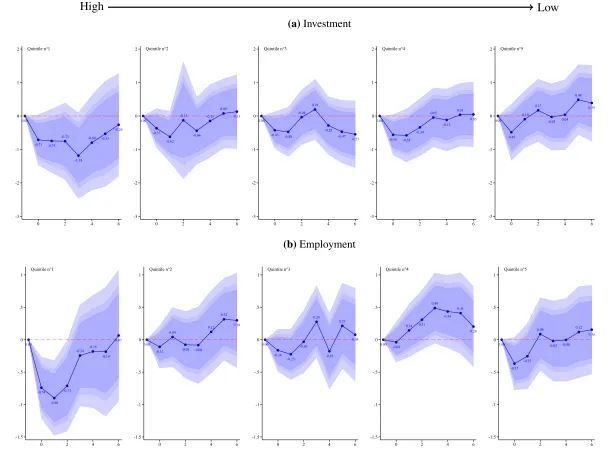
In Figure 5, we present the effect of demand uncertainty at various levels of the cash-flow
distribution. We use lagged cash-flow normalized over lagged assets trimmed at the 0.5 and
99.5 percentile. It excludes any observation where this measure is bellow -47% and above
46%. We then follow the methodology detailed byHainmueller et al. (2019). We allow the
coefficient βh
2 to vary across each quintiles of lagged cash-flow over assets. We then show
the effect of a standard deviation uncertainty shock estimated at the median of each quintile.
We focus once again on investment (first row) and employment (second row). The lower the
Figure 5:Demand Uncertainty and Cash Constraint High Low (a)Investment 0.00 -0.71 -0.75 -0.75 -1.18 -0.80 -0.53 -0.26 -3 -2 -1 0 1 2
0 2 4 6
Quintile n°1 0.00 -0.37 -0.62 -0.13 -0.44 -0.15 0.08 0.13 -3 -2 -1 0 1 2
0 2 4 6
Quintile n°2 0.00 -0.43 -0.48 -0.04 0.19 -0.28 -0.47 -0.55 -3 -2 -1 0 1 2
0 2 4 6
Quintile n°3 0.00 -0.56 -0.58 -0.34 -0.05 -0.12 0.03 0.05 -3 -2 -1 0 1 2
0 2 4 6
Quintile n°4 0.00 -0.49 -0.10 0.17 -0.03 0.04 0.48 0.39 -3 -2 -1 0 1 2
0 2 4 6
Quintile n°5 (b)Employment 0.00 -0.74 -0.90 -0.71 -0.24 -0.18 -0.19 0.07 -1.5 -1 -.5 0 .5 1
0 2 4 6
Quintile n°1 0.00 -0.11 0.04 -0.08 -0.08 0.12 0.32 0.30 -1.5 -1 -.5 0 .5 1
0 2 4 6
Quintile n°2 0.00 -0.16 -0.23 -0.03 0.28 -0.18 0.21 0.08 -1.5 -1 -.5 0 .5 1
0 2 4 6
Quintile n°3 0.00 -0.04 0.14 0.31 0.49 0.44 0.41 0.20 -1.5 -1 -.5 0 .5 1
0 2 4 6
Quintile n°4 0.00 -0.37 -0.25 0.09 -0.02 -0.00 0.12 0.16 -1.5 -1 -.5 0 .5 1
0 2 4 6
Quintile n°5
NOTE: Those figure present estimates ofβh
2from estimating this equation:∆Gf,t+h=αh1Xf,t−1+αh2DM1f,t+βh1dDM2f,t+βh2(dDM2f,t×CFf,t−1)+βh3CFf,t−1+γkh,t+γ h
f+ǫf,t+h. 90%, 95% and 99% error bands, computed with robust standard errors clustered at the firm-level, are displayed in shades of blue.
When we allow the coefficients βh
2 to vary depending on the firm ability to generate
cash-flow, we find that the most financially constrained firms experience a somewhat sharper and
longer slowdown. The contemporaneous effect on investment is moderately bigger (0.71 vs
-0.49 p.p. for the bottom and top quintile respectively) Firms in the lowest quintile are still 1.18
percentage p.p. bellow their counter-factual investment growth rate 3 years after the shock.
Meanwhile, firms in the rest of the distributions are no longer suffering any effects. For
em-ployment growth, losses appear once again to be concentrated in the lowest quintile. The
contemporeneous effect is -0.74 p.p. for the 1st quintile versus approximately 0 for the next
three quintiles and -0.37 for the top quintile. Whereas the impact either reverts back to 0 or
turns positive for the top 4 quintiles, it remains negative for at least 3 periods for the bottom
bin of the cash-flow distribution.
The ability to generate cash flow only represents one facet of being financially constrained.
To investigate further, we repeat the same exercise for the firm’s stock of debt. We divide all
firms in 5 quintiles based on their ex-ante debt-to-asset ratio. We trim the ratio at the 99.5
percentile level. It excludes any observations with a ratio above 153% . We then estimate the
following equation:
∆Gf,t+h= αh1Xf,t−1+αh2DMf,t1
+βh
1dDMf,t2+β h
2(dDMf,t2×DAf,t−1)+βh3DAf,t−1
+γh k,t +γ
h
f +ǫf,t+h
(7)
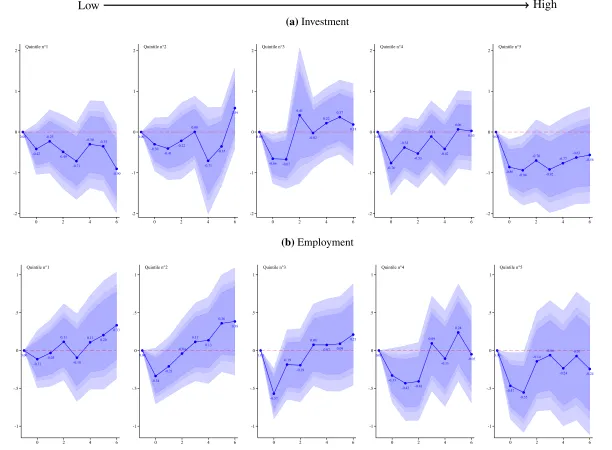
and we plot the results in Figure6. The higher the quintile, the more financially constrained the
firm is. The investment of firms in the 1st two bins experiences a contemporaneous effect that
is lower than the sample average estimated earlier (-0.42 and -0.30 vs -0.45 p.p.) whereas firms
in the next three bins experience losses ranging from 0.66 to 0.86 percentage point. Moreover,
the investment of firms in the highest debt-to-asset bin has not recovered by the end of the
6-year window. The employment growth of firms in the lowest bin does not suffer. Firms in the
shock. Firms in the top two bins suffer severe losses (from -0.33 to -0.55 p.p.) for 2 to 3 years.
The effect then dies out in the following years unlike for investment.
Controlling for various forms of financial constraints does not reduce the estimated effect
of uncertainty by any substantive amount. However, the response to uncertainty does exhibit
strong non-linearity along either the debt or cash to asset ratio. The contemporaneous response
is usually barely distinguishable from zero for low constraints firms and does not exhibit any
persistence. Those results support the view that financial frictions are at least one of the reasons
behind the lack of a rebound effect expected after the resolution of an uncertainty shock.
Figure 6: Demand Uncertainty and Debt Constraint Low High (a)Investment 0.00 -0.42 -0.23 -0.49 -0.71 -0.30 -0.35 -0.90 -2 -1 0 1 2
0 2 4 6
Quintile n°1 0.00 -0.30 -0.41 -0.22 0.00 -0.71 -0.35 0.59 -2 -1 0 1 2
0 2 4 6
Quintile n°2 0.00 -0.66 -0.67 0.41 -0.02 0.22 0.37 0.18 -2 -1 0 1 2
0 2 4 6
Quintile n°3 0.00 -0.76 -0.38 -0.53 -0.11 -0.42 0.06 0.03 -2 -1 0 1 2
0 2 4 6
Quintile n°4 0.00 -0.86 -0.94 -0.70 -0.92 -0.77 -0.63 -0.56 -2 -1 0 1 2
0 2 4 6
Quintile n°5 (b)Employment 0.00 -0.11 -0.03 0.11 -0.10 0.11 0.20 0.33 -1 -.5 0 .5 1
0 2 4 6
Quintile n°1 0.00 -0.34 -0.21 -0.04 0.11 0.13 0.36 0.38 -1 -.5 0 .5 1
0 2 4 6
Quintile n°2 0.00 -0.57 -0.19 -0.19 0.08 0.07 0.09 0.21 -1 -.5 0 .5 1
0 2 4 6
Quintile n°3 0.00 -0.33 -0.43 -0.41 0.09 -0.11 0.24 -0.05 -1 -.5 0 .5 1
0 2 4 6
Quintile n°4 0.00 -0.47 -0.55 -0.14 -0.06 -0.24 -0.07 -0.24 -1 -.5 0 .5 1
0 2 4 6
Quintile n°5
NOTE: Those figures present estimates of from estimating this equation: M1 M2 ( M2 1)
3.3
Sectoral Comovement and the Persistent E
ff
ect of Uncertainty
Another potential explanation to the persistence of the effect of an uncertainty shock lies in the
degree of reversibility of the decision to grow. The more irreversible the decision to grow is,
the higher the return on the option of waiting and the stronger the initial impact of uncertainty
should be. Firms that are positively correlated with their sector will find it harder to sell or buy
on the secondary market. All firms in that sector are also more likely to face the same
uncer-tainty. Therefore no firms should be able to take advantage of this situation to acquire market
shares. In such a situation, an uncertainty shock may even trigger a sector-wide downturn. The
persistence of the estimated effect of the 2nd moment shock may include the 1st moment of
the second round effects. Firms with a negative correlation to their sector should benefit from
having a low option value when facing uncertainty. At the same time, their competitors are less
likely to face a similar uncertainty and should therefore be in a position to acquire market share
at the expanse of the uncertain. This mechanism should prevent firm-level uncertainty from
generating any aggregate fluctuations. Finally, firms that are neither positively or negatively
correlated with their sector are both benefiting from a low option value of waiting and little risk
of an uncertainty generated aggregate downturn.
We followGuiso and Parigi (1999) to construct our measure of firm specific irreversibility
IRRf. We compute the correlation between the growth rate of the firm’s domestic sales and
the growth rate of the domestic sales of its industry. Formally, we compute for each firm-year
the average of the growth rate of sales for all other firms in the industry. Then, we compute
the pearson correlation coefficientIRRf = ρ(∆Yf,t,∆Ykf\f,t). This measure is bounded between
{−1,1}with 1 indicating a high irreversibility. As in the previous sections, we divide it in 5
quintiles and estimate the effect of uncertainty at the median of each quintile:
∆Gf,t+h =αh1Xf,t−1+αh2DMf,t1
+βh
1dDMf,t2+β h
2(dDMf,t2×IRRf)+βh3IRRf,t−1
+γh k,t+γ
h
f +ǫf,t+h
(8)
Our measure of irreversibility is not time-varying so its direct effect is absorbed by the firm fixed
effect. We plot the effect of its interaction with uncertainty in Figure7. Three striking results
emerge: (1) The investment and employment of firms with neither positive nor negative sectoral
co-movement (quintile no3) do not suffer much from an uncertainty shock, if anything they
increase their employment in the longer run. (2) Firms with a negative correlation experience
a negative contemporaneous impact that quickly reverts back to zero. (3) Firms with high
sectoral correlation of their sales suffer from a more persistent slowdown. One explanation for
this would be that in a highly-correlated sector, the cost of drawing a bad demand shock would
be disproportionate as the firm would suspect that the other firms in the sector are drawing
similarly bad shocks. A rise in its uncertainty would make the firm cautious of the risk of a
sector-wide slowdown. In fact, if the other firms in the industry act in a similar fashion, it might
Figure 7:Demand Uncertainty and Sectoral Comovement
Negative Zero Positive
(a)Investment 0.00 -0.98 -0.55 -0.19 -0.58 -0.35 0.04 -0.17 -3 -2 -1 0 1 2
0 2 4 6
Quintile n°1 0.00 -0.58 -0.71 0.30 -0.68 -1.31 -0.56 -0.28 -3 -2 -1 0 1 2
0 2 4 6
Quintile n°2
0.00
-0.35 -0.38 -0.37 -0.21 -0.18 -0.35 -0.06 -3 -2 -1 0 1 2
0 2 4 6
Quintile n°3 0.00 -0.34 -0.80 -0.92 -0.54 -0.25 0.30 0.33 -3 -2 -1 0 1 2
0 2 4 6
Quintile n°4 0.00 -0.63 -0.54 -0.57 -0.57 -0.31 -0.15 -0.38 -3 -2 -1 0 1 2
0 2 4 6
Quintile n°5 (b)Employment 0.00 -0.56 -0.41 -0.28 0.23 0.05 0.52 0.28 -1 -.5 0 .5 1 1.5
0 2 4 6
Quintile n°1 0.00 -0.55 -0.40 -0.30 -0.18 0.00 0.11 -0.07 -1 -.5 0 .5 1 1.5
0 2 4 6
Quintile n°2 0.00 -0.14 0.05 0.21 0.34 0.22 0.50 0.42 -1 -.5 0 .5 1 1.5
0 2 4 6
Quintile n°3 0.00 -0.29 -0.52 -0.38 -0.41 -0.45 -0.12 0.05 -1 -.5 0 .5 1 1.5
0 2 4 6
Quintile n°4 0.00 -0.57 -0.49 -0.35 -0.42 -0.38 -0.28 -0.10 -1 -.5 0 .5 1 1.5
0 2 4 6
Quintile n°5
NOTE: Those figures present estimates ofβh
2from estimating this equation:∆Gf,t+h=αh1Xf,t−1+αh2DM1f,t+βh1dDM2f,t+βh2(dDM2f,t×IRRf)+βh3IRRf,t−1+γkh,t+γ h
f+ǫf,t+h. 90%, 95% and 99% error bands, computed with robust standard errors clustered at the firm-level, are displayed in shades of blue.
4
Robustness
4.1
Placebo Inference
In the baseline specification, we clustered standard errors at the firm level. This provided us
with standard errors that are asymptotically robust to serial auto-correlation in the error term.
Here we implementChetty et al.(2009)’s non-parametric permutation test2ofβh>0
1 =0.
To do so, we randomly reassign the uncertainty time serie across firms and then we
re-estimate the baseline regression. We repeat this process 2000 times in order to obtain an
em-pirical distribution of the placebo coefficients ˆβh1,p. If demand uncertainty had no effect on
firm growth, we would expect our baseline estimate to fall somewhere in the middle of the
distribution of the coefficients of the placebo coefficients ˆβh1,p. Since that test does not rely
on any parametric assumption regarding the structure of the error term, it is immune to the
[image:24.595.88.519.449.616.2]over-rejection of the null hypothesis highlighted byBertrand et al.(2004).
Figure 8: Distribution of Placebo Estimates
(a)Investment
-0.4 -0.2 0.0 0.2 0.4
-6 -4 -2 0 2 4 6 8
(b)Employment
-0.4 -0.2 0.0 0.2 0.4
-6 -4 -2 0 2 4 6 8
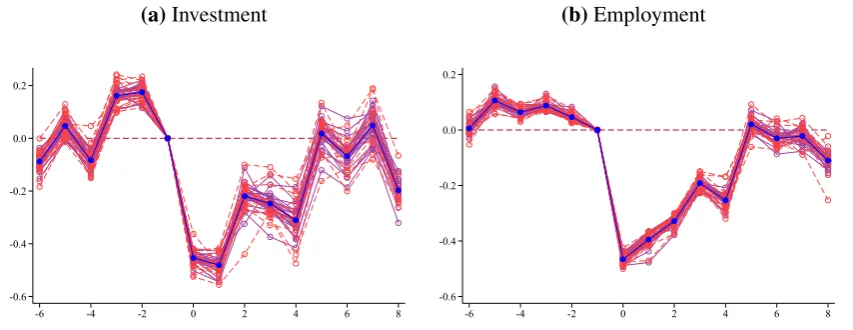
NOTE: Those figures present each half percentile of the distribution of 2000 estimates of the coefficient ˆβh1,p
of Demand Uncertainty after performing a random permutation.
We plot the distribution of the placebo coefficients in Figure8. The figure confirms that our
coefficients of interestβh>0
1 (the blue connected markers) lie outside of the [p0.5,p99.5] interval
(the light blue lines) of the distribution of placebo coefficients. Meanwhile, the estimates of
βh<0
1 fall within the bounds of the distribution of placebos, albeit narrowly so in some cases.
This exercise confirms that uncertainty has a negative effect on firm growth.
4.2
Sensitivity
Since our sample includes events such as the Great Financial Crisis (2008 and 2009), we wish
to check whether our results are robust to the omission of any particular year. We run the same
baseline regressions while omitting turn by turn any year between 1996 and 2013. We plot the
results in Figure 10 in red. We find results that are quantitatively and qualitatively the same
as on the full sample. It shows that our specification satisfyingly accounts for the complex
dynamics of our sample period. We repeat this procedure for the sectors and plot the results
in purple in figure10. This estimate is also statistically highly significant and robust to taking
out any sectors (NAF 2 digit). Finally, we also demonstrate that this estimate is robust to the
[image:25.595.88.515.455.620.2]inclusion of various observable characteristics in Figure9.
Figure 9:Sensitivity to sample selection
(a)Investment
-0.6 -0.4 -0.2 0.0 0.2
-6 -4 -2 0 2 4 6 8
(b)Employment
-0.6 -0.4 -0.2 0.0 0.2
-6 -4 -2 0 2 4 6 8
NOTE: Those figures present estimates of the coefficientβ1of Demand Uncertainty after subtracting either a year or a sector at a time. We estimate the following equation:∆Gf,t+h=α1hXf,t−1+βh1dDM2f,t +γhk,t+γhf+ǫf,t+h.
4.3
Validation
To validate our measure of demand uncertainty, we check that an increase in demand has an
effect on firm growth. Given the existing literature on exports dynamics and productivity, we
Figure 10: Sensitivity to different specifications
(a)Investment
-0.60 -0.40 -0.20 0.00 0.20
-6 -4 -2 0 2 4 6 8
(b)Employment
-0.60 -0.40 -0.20 0.00 0.20
-6 -4 -2 0 2 4 6 8
NOTE: Those figures present estimates of the coefficientβ1of Demand Uncertainty after adding one extra control variable at a time. We estimate the following equation:∆Gf,t+h=α1hXf,t−1+βh1dDM2f,t+γkh,t+γhf+ǫf,t+h.
and add one of the following variable at a time: DM1f,t, Lagged Cash-flow to asset ratio, a dummy variable
indicating whether the firm belongs to a group, lagged debt to asset ratio, lagged sales to asset ratio and lagged productivity.
suspect that the average firm’s response is not linear. We therefore regress firm capital and
employment growth on the 1st moment of foreign demand shocks interacted with lagged
pro-ductivity (value-added over employees). We estimate the following equation:
Gf,t+h= αh1Xf,t−1+αh2DMf,t1+α h
3(DMf,t1×PRODf,t−1)+βh3PRODf,t−1+γhk,t+γhf +ǫf,t+h (9)
. We plot the results in Figure 11. The effect of a positive demand signal has little
short-run effect for investment. In the longer run (4 to 6 years), we see a sizable increase (about 1
percentage point per year for all terciles). The effect on employment is more contrasted. The
contemporaneous effect for firms in the lowest third of the productivity distribution is negative
(about 1/3rd of a p.p.). The effect then reverts back to zero and becomes positive in the next
3 years with a low statistical significance. The effect for the middle tercile is negative but
not significant for the first 2 years. It then becomes positive in the last 3 years. Firms with
the highest productivity increase their employment throughout the entire window. This result
matches the pattern highlighted byAghion et al.(2018). We therefore establish that firms react
Figure 11:Firm Growth, Foreign Demand Signal and Productivity
Low High
(a)Investment
-1 0 1 2 3
0 2 4 6
Tercile n°1
-1 0 1 2 3
0 2 4 6
Tercile n°2
-1 0 1 2 3
0 2 4 6
Tercile n°3
(b)Employment
-1 -.5 0 .5 1 1.5
0 2 4 6
Tercile n°1
-1 -.5 0 .5 1 1.5
0 2 4 6
Tercile n°2
-1 -.5 0 .5 1 1.5
0 2 4 6
Tercile n°3
NOTE: Those figures present estimates ofαh
3from estimating this equation:∆Gf,t+h=αh1Xf,t−1+αh2DM1f,t+α3h(DM1f,t ×PRODf,t−1)+βh3PRODf,t−1+γkh,t+γ h
f+ǫf,t+h. The 90% error band computed with robust standard errors clustered at the firm-level is displayed in blue.
5
Conclusion
The increase in cross-border trade and financial linkages since the 1990’s has led to a greater
exposure of domestic agents to shocks abroad. More firms are now dependent on inherently
uncertain demand conditions. In this paper, we investigate how the uncertainty around the
real-ization of demand shocks affects the growth dynamic of French manufacturing firms between
1996 and 2013. We build a measure of demand uncertainty by computing the dispersion of
esti-mated demand shocks from a highly dis-aggregated bilateral trade database. We then document
the effect of an increase in demand uncertainty on employment and investment growth using
French fiscal data. A striking result is the persistent negative effect of a one-time uncertainty
shock. The effect lasts for up to 5 years for both investment and employment. It does not
ex-hibit any evidence of post-shock compensation which makes those losses permanent. We find
that losses are magnified for financially constrained firms and firms with high sales correlation
with their sector.
Losses due to uncertainty are concentrated on the most financially constrained firms which
suggests that aggregate losses may be rather modest. However, our results show much more
persistent effect of uncertainty on the growth of firms than the temporary losses predicted by
the real-option theory. Policies that help reduce firm financial and information frictions would
therefore be an appropriate response to periods of high uncertainty by reducing permanent
losses among financially constrained firms, assuming those constraints are not correlated to
productivity. This implication seems particularly relevant given the current uncertainty around
A
Appendix
Figure A.0.12:Demand Signal to Noise
β = -0.014*** (s.e.= 0.005)
-5 0 5 10 De m and Unc ert ai nt y (st anda rdi ze d)
-10 -5 0 5 10 15
Demand Signal (standardized)
NOTE: This figure shows the correlation between the 1st and 2nd moment of the distribution of demand shocks. See Section2.2for the construction method.
Figure A.0.13:Firm Specific Demand Uncertainty - 1st difference
1997 1997 1997 1997 1997 1997 1997 1997 1997 1997 1998 1998 1998 1998 1998 1998 1998 1998 1998 1998 1999199919991999199919991999199919991999
2000 2000 2000 2000 2000 2000 2000 2000 2000 2000 2001 2001 2001 2001 2001 2001 2001 2001 2001 2001 2002 2002 2002 2002 2002 2002 2002 2002 2002 2002 2003 2003 2003 2003 2003 2003 2003 2003 2003 2003 2004 2004 2004 2004 2004 2004 2004 2004 2004 2004 2005 2005 2005 2005 2005 2005 2005 2005 2005 2005 2006 2006 2006 2006 2006 2006 2006 2006 2006 20062007200720072007200720072007200720072007
2008 2008 2008 2008 2008 2008 2008 2008 2008 2008 2009 2009 2009 2009 2009 2009 2009 2009 2009 2009 2010 2010 2010 2010 2010 2010 2010 2010 2010 2010 2011 2011 2011 2011 2011 2011 2011 2011 2011 2011 2012 2012 2012 2012 2012 2012 2012 2012 2012 2012 2013 2013 2013 2013 2013 2013 2013 2013 2013 2013 2014 2014 2014 2014 2014 2014 2014 2014 2014 2014 -.4 -.2 0 .2 .4
1995 2000 2005 2010 2015
Synthetic Firm n°1 (export intensity 1995 = 16.79%) Synthetic Firm n°2 (export intensity 1995 = 21.34%) Synthetic Firm n°3 (export intensity 1995 = 17.15%)
NOTE: This figures shows our firm-level measure of demand uncertainty (DM2f,t) for three synthetic firms. In order to satisfy anonymity
Figure A.0.14: Demand Uncertainty Shock Local Projection
-.5 0 .5 1
-6 -4 -2 0 2 4 6 8
NOTE: This figure plots the coefficientsβh obtained from estimating the local projection of the first difference of Demand Uncertainty dDM2f,t+h =
βhdDM2 f,t +γ
h k,t+γ
h
f +ǫf,t+h.
Figure A.0.15:Demand Uncertainty and Firm Growth (a)Debt 0.05 0.08 0.22 0.08 0.05 0.00 -0.47 -0.53 -0.37 -0.17 -0.24 -0.21 0.00 0.03 -0.10 -1 -.5 0 .5
-6 -4 -2 0 2 4 6 8
(b)Employment (Social Security sources)
-0.00 -0.06 -0.02 -0.13 -0.20 0.00 -0.58 -0.48 -0.36 -0.22 -0.17 0.08 -0.03 0.10 -0.01 -1 -.5 0 .5
-6 -4 -2 0 2 4 6 8
(c)White-collar -0.26 -0.18 -0.19 -0.07 -0.08 0.00
-0.40 -0.45 -0.39 -0.13 0.08 -0.08 -0.28 -0.17 0.21 -1 -.5 0 .5 1
-6 -4 -2 0 2 4 6 8
(d)Blue-Collar
-0.07 -0.04
0.03 0.05 0.04 0.00
-0.40 -0.22 -0.26 -0.13 -0.16 0.04 -0.16 -0.10 -0.20 -1 -.5 0 .5
-6 -4 -2 0 2 4 6 8
(e)Tangible Investment
-0.19 0.04 -0.17 0.18 0.11 0.00 -0.54 -0.49 -0.44 -0.30 -0.12 0.13 -0.15 0.01 -0.03 -1 -.5 0 .5 1
-6 -4 -2 0 2 4 6 8
(f)Intangible Investment
0.41 0.48 -0.03 0.16 0.25 0.00 -0.50 -0.37 -0.16 -0.37 0.20 0.06 0.08 -0.36 0.01 -1.5 -1 -.5 0 .5 1
-6 -4 -2 0 2 4 6 8
NOTE: This figure presents estimates of the coefficientβh
1∗100 associated with demand uncertainty from estimating this equation:∆Gf,t+h=αh1Xf,t−1+αh2DM1f,t +βh1dDM2f,t +γhk,t+γhf+ǫf,t+h. 90%, 95% and 99% error
Table A.0.3: List of Sectors
10 Manufacture of food products
11 Manufacture of beverages
12 Manufacture of tobacco products
13 Manufacture of textiles
14 Manufacture of wearing apparel
15 Manufacture of leather and related products
16 Manufacture of wood and of products of wood and cork, except furniture;
manufacture of articles of straw and plaiting materials
17 Manufacture of paper and paper products
18 Printing and reproduction of recorded media
19 Manufacture of coke and refined petroleum products
20 Manufacture of chemicals and chemical products
21 Manufacture of basic pharmaceutical products and pharmaceutical preparations
22 Manufacture of rubber and plastic products
23 Manufacture of other non-metallic mineral products
24 Manufacture of basic metals
25 Manufacture of fabricated metal products, except machinery and equipment
26 Manufacture of computer, electronic and optical products
27 Manufacture of electrical equipment
28 Manufacture of machinery and equipment n.e.c.
29 Manufacture of motor vehicles, trailers and semi-trailers
30 Manufacture of other transport equipment
31 Manufacture of furniture
32 Other manufacturing
References
Aghion, P., A. Bergeaud, M. Lequien, and M. Melitz (2017). The Impact of Exports on
Inno-vation: Theory and Evidence. Technical report, working paper.
Aghion, P., A. Bergeaud, M. Lequien, and M. J. Melitz (2018). The impact of exports on
innovation: Theory and evidence. Technical report, National Bureau of Economic Research.
Baker, S. R., N. Bloom, and S. J. Davis (2016). Measuring economic policy uncertainty. The
Quarterly Journal of Economics 131(4), 1593–1636.
Barrero, J. M., N. Bloom, and I. Wright (2017). Short and long run uncertainty. Technical
report, National Bureau of Economic Research.
Bernanke, B. S. (1983). Irreversibility, uncertainty, and cyclical investment. The Quarterly
Journal of Economics 98(1), 85–106.
Berthou, A. and E. Dhyne (2018). Exchange Rate Movements, Firm-Level Exports and
Het-erogeneity.
Bertrand, M., E. Duflo, and S. Mullainathan (2004). How much should we trust diff
erences-in-differences estimates? The Quarterly journal of economics 119(1), 249–275.
Bloom, N., S. Bond, and J. Van Reenen (2007). Uncertainty and Investment Dynamics. The
review of economic studies 74(2), 391–415.
Bussiere, M., L. Ferrara, and J. Milovich (2015). Explaining the Recent Slump in Investment:
The Role of Expected Demand and Uncertainty. Technical report, Banque de France
Work-ing Paper.
Cezar, R., T. Gigout, and F. Tripier (2017). FDI and Uncertainty: Evidence from French
Multinational Firms. Technical report, Working Paper.
Chetty, R., A. Looney, and K. Kroft (2009). Salience and taxation: Theory and evidence.
Crouzet, N., N. R. Mehrotra, et al. (2017). Small and Large Firms Over the Business Cycle.
Technical report.
De Sousa, J., A.-C. Disdier, and C. Gaigné (2016). Export decision under risk.
di Giovanni, J., A. A. Levchenko, and I. Mejean (2017). Large firms and international business
cycle comovement. American Economic Review 107(5), 598–602.
Esposito, F. (2018). Entrepreneurial Risk and Diversification through Trade.
Favara, G. and J. Imbs (2015). Credit supply and the price of housing. American Economic
Review 105(3), 958–92.
Gala, V. and B. Julio (2016). Firm Size and Corporate Investment.
Garin, A., F. Silverio, et al. (2017). How Does Firm Performance Affect Wages? Evidence
from Idiosyncratic Export Shocks. Technical report, Job Market Papers.
Gaulier, G. and S. Zignago (2010). BACI: international trade database at the product-level (the
1994-2007 version).
Gervais, A. (2018). Uncertainty, risk aversion and international trade. Journal of International
Economics 115, 145–158.
Gilchrist, S. and C. P. Himmelberg (1995). Evidence on the role of cash flow for investment.
Journal of Monetary Economics 36(3), 541–572.
Guiso, L. and G. Parigi (1999). Investment and demand uncertainty. The Quarterly Journal of
Economics 114(1), 185–227.
Hainmueller, J., J. Mummolo, and Y. Xu (2019). How much should we trust estimates from
multiplicative interaction models? Simple tools to improve empirical practice. Political
Analysis 27(2), 163–192.
Hassan, T. A., S. Hollander, L. van Lent, and A. Tahoun (2017). Firm-level political risk:
Measurement and effects. Technical report, National Bureau of Economic Research.
Hummels, D., R. Jørgensen, J. Munch, and C. Xiang (2014). The wage effects of offshoring:
Evidence from danish matched worker-firm data.American Economic Review 104(6), 1597–
1629.
Jordà, Ò. (2005). Estimation and inference of impulse responses by local projections.American
Economic Review 95(1), 161–182.
Julio, B. and Y. Yook (2012). Political uncertainty and corporate investment cycles.The Journal
of Finance 67(1), 45–83.
Khwaja, A. I. and A. Mian (2008). Tracing the impact of bank liquidity shocks: Evidence from
an emerging market. American Economic Review 98(4), 1413–42.
Mayer, T., M. J. Melitz, and G. I. Ottaviano (2016). Product mix and firm productivity
re-sponses to trade competition. Technical report, National Bureau of Economic Research.
Vannoorenberghe, G. (2012). Firm-level volatility and exports. Journal of International
Eco-nomics 86(1), 57–67.
Vannoorenberghe, G., Z. Wang, and Z. Yu (2016). Volatility and diversification of exports: