N
-gram language models for massively parallel devices
Nikolay Bogoychev and Adam Lopez University of Edinburgh
Edinburgh, United Kingdom
Abstract
For many applications, the query speed of
N-gram language models is a computa-tional bottleneck. Although massively par-allel hardware like GPUs offer a poten-tial solution to this bottleneck, exploiting this hardware requires a careful rethink-ing of basic algorithms and data structures. We present the first language model de-signed for such hardware, using B-trees to maximize data parallelism and minimize memory footprint and latency. Compared with a single-threaded instance of KenLM (Heafield, 2011), a highly optimized CPU-based language model, our GPU imple-mentation produces identical results with a smaller memory footprint and a sixfold increase in throughput on a batch query task. When we saturate both devices, the GPU delivers nearly twice the throughput per hardware dollar even when the CPU implementation uses faster data structures. Our implementation is freely available at https://github.com/XapaJIaMnu/gLM
1 Introduction
N-gram language models are ubiquitous in speech and language processing applications such as ma-chine translation, speech recognition, optical char-acter recognition, and predictive text. Because they operate over large vocabularies, they are often a computational bottleneck. For example, in ma-chine translation, Heafield (2013) estimates that decoding a single sentence requires a million lan-guage model queries, and Green et al. (2014) esti-mate that this accounts for more than 50% of de-coding CPU time.
To address this problem, we turn to mas-sively parallel hardware architectures,
exempli-Figure 1: Theoretical floating point performance of CPU and GPU hardware over time (Nvidia Cor-poration, 2015).
fied by general purpose graphics processing units (GPUs), whose memory bandwidth and compu-tational throughput has rapidly outpaced that of CPUs over the last decade (Figure 1). Exploiting this increased power is a tantalizing prospect for any computation-bound problem, so GPUs have begun to attract attention in natural language pro-cessing, in problems such as parsing (Canny et al., 2013; Hall et al., 2014), speech recognition (Chong et al., 2009; Chong et al., 2008), and phrase extraction for machine translation (He et al., 2015). As these efforts have shown, it is not trivial to exploit this computational power, be-cause the GPU computational model rewards data parallelism, minimal branching, and minimal ac-cess to global memory, patterns ignored by many classic NLP algorithms (Section 2).
We present the first language model data struc-ture designed for this computational model. Our data structure is a trie in which individual nodes are represented by B-trees, which are searched in parallel (Section 3) and arranged compactly in
[image:1.595.310.516.223.387.2]memory (Section 4). Our experiments across a range of parameters in a batch query setting show that this design achieves a throughput six times higher than KenLM (Heafield, 2011), a highly effi-cient CPU implementation (Section 5). They also show the effects of device saturation and of data structure design decisions.
2 GPU computational model
GPUs and other parallel hardware devices have a different computational profile from widely-used x86 CPUs, so data structures designed for serial models of computation are not appropriate. To produce efficient software for a GPU we must be familiar with its design (Figure 2).
2.1 GPU design
A GPU consists of many simple computational
cores, which have neither complex caches nor branch predictors to hide latencies. Because they have far fewer circuits than CPU cores, GPU cores are much smaller, and many more of them can fit on a device. So the higher throughput of a GPU is due to the sheer number of cores, each executing a singlethreadof computation (Figure 2). Each core belongs to aStreaming Multiprocessor (SM), and all cores belonging to a SM must execute the same instruction at each time step, with exceptions for branching described below. This execution model is very similar to single instruction, multiple data (SIMD) parallelism.1
Computation on a GPU is performed by an in-herently parallel function orkernel, which defines agridof data elements to which it will be applied, each processed by a block of parallel threads. Once scheduled, the kernel executes in parallel on all cores allocated to blocks in the grid. At min-imum, it is allocated to a single warp—32 cores on our experimental GPU. If fewer cores are re-quested, a full warp is still allocated, and the un-used cores idle.
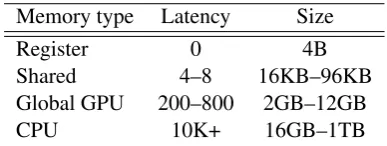
A GPU offers several memory types, which dif-fer in size and latency (Table 1). Unlike a CPU program, which can treat memory abstractly, a GPU program must explicitly specify in which physical memory each data element resides. This choice has important implications for efficiency that entail design tradeoffs, since memory closer
1Due to differences in register usage and exceptions for
[image:2.595.312.515.59.220.2]branching, this model is not pure SIMD. Nvidia calls it SIMT (single instruction, multiple threads).
Figure 2: GPU memory hierarchy and computa-tional model (Nvidia Corporation, 2015).
Memory type Latency Size
Register 0 4B
Shared 4–8 16KB–96KB Global GPU 200–800 2GB–12GB
CPU 10K+ 16GB–1TB
Table 1: Latency (in clock cycles) and size of dif-ferent GPU memory types. Estimates are adapted from Nvidia Corporation (2015) and depend on several aspects of hardware configuration.
to a core is small and fast, while memory further away is large and slow (Table 1).
2.2 Designing efficient GPU algorithms
To design an efficient GPU application we must observe the constraints imposed by the hardware, which dictate several important design principles.
Avoid branching instructions. If a branching instruction occurs, threads that meet the branch condition run while the remainder idle (awarp di-vergence). When the branch completes, threads that don’t meet the condition run while the first group idles. So, to maximize performance, code must be designed with little or no branching.
Use small data structures. Total memory on a state-of-the-art GPU is 12GB, expected to rise to 24GB in the next generation. Language models that run on CPU frequently exceed these sizes, so our data structures must have the smallest possible memory footprint.
[image:2.595.319.513.275.348.2]Data structure Size Query Ease of Construction Lossless speed backoff time
Trie (Heafield, 2011) Small Fast Yes Fast Yes Probing hash table (Heafield, 2011) Larger Faster Yes Fast Yes Double array (Yasuhara et al., 2013) Larger Fastest Yes Very slow Yes Bloom filter (Talbot and Osborne, 2007) Small Slow No Fast No Table 2: A survey of language model data structures and their computational properties.
reside in global GPU memory, latency is high, so wherever possible, data should be accessed from shared or register memory.
Access memory with coalesced reads. When a thread requests a byte from global memory, it is copied to shared memory along with many surrounding bytes (between 32 and 128 depending on the architecture). So, if consecutive threads request consecutive data elements, the data is copied in a single operation (a coalesced read), and the delay due to latency is incurred only once for all threads, increasing throughput.
3 A massively parallel language model Let wbe a sentence, wi its ith word, and N the order of our model. AnN-gram language model defines the probability ofwas:
P(w) =
|w|
Y
i=1
P(wi|wi−1...wi−N+1) (1)
A backoff language model (Chen and Goodman, 1999) is defined in terms of n-gram probabil-ities P(wi|wi−1...wi−n+1) for all n from 1 to
N, which are in turn defined by n-gram pa-rametersPˆ(wi...wi−n+1) and backoff parameters
β(wi−1...wi−n+1). Usually Pˆ(wi...wi−n+1) and
β(wi−1...wi−n+1) are probabilities conditioned
on wi−1...wi−n+1, but to simplify the following
exposition, we will simply treat them as numeric parameters, each indexed by a reversedn-gram. If parameterPˆ(wi...wi−n+1)is nonzero, then:
P(wi|wi−1...wi−n+1) = ˆP(wi...wi−n+1)
Otherwise:
P(wi|wi−1...wi−n+1) =
P(wi|wi−1...wi−n+2)×β(wi−1...wi−n+1)
This recursive definition means that the probabil-ityP(wi|wi−1...wi−N+1)required for Equation 1
may depend on multiple parameters. Ifr(< N) is
the largest value for which Pˆ(wi|wi−1...wi−r+1)
is nonzero, then we have:
P(wi|wi−1...wi−N+1) = (2)
ˆ
P(wi...wi−r+1)
N
Y
n=r+1
β(wi−1...wi−n+1)
Our data structure must be able to efficiently ac-cess these parameters.
3.1 Trie language models
With this computation in mind, we surveyed sev-eral popular data structures that have been used to implementN-gram language models on CPU, considering their suitability for adaptation to GPU (Table 2). Since a small memory footprint is cru-cial, we implemented a variant of the trie data structure of Heafield (2011). We hypothesized that its slower query speed compared to a probing hash table would be compensated for by the throughput of the GPU, a question we return to in Section 5.
A trie language model exploits two impor-tant guarantees of backoff estimators: first, if
ˆ
P(wi...wi−n+1)is nonzero, thenPˆ(wi...wi−m+1)
is also nonzero, for all m < n; second, if
β(wi−1...wi−n+1)is one, then β(wi−1...wi−p+1)
is one, for all p > n. Zero-valued n -gram parameters and one-valued backoff pa-rameters are not explicitly stored. To com-puteP(wi|wi−1...wi−N+1), we iteratively retrieve
ˆ
P(wi...wi−m+1) for increasing values of m
un-til we fail to find a match, with the final nonzero value becoming Pˆ(wi...wi−r+1) in Equation 2.
We then iteratively retrieveβ(wi−1...wi−n+1)for
increasing values of n starting from r + 1 and continuing until n = N or we fail to find a match, multiplying all retrieved terms to compute
P(wi|wi−1...wi−N+1) (Equation 2). The trie is
designed to execute these iterative parameter re-trievals efficiently.
Australia is
of
one
many
one
human Poland
are is
are
is
[image:4.595.75.288.66.188.2]exist is
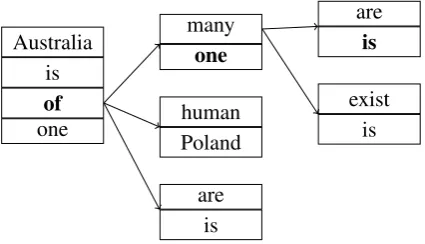
Figure 3: Fragment of a trie showing the path of
N-gramis one ofin bold. A query for theN-gram
every one oftraverses the same path, but since ev-eryis not among the keys in the final node, it re-turns then-gram parameterPˆ(of|one)and returns to the root to seek the backoff parameterβ(every one). Based on image from Federico et al. (2008).
set Σ1 ∪ ... ∪ ΣN. Given an n-gram key
wi...wi−n+1 ∈ Σ[N], our goal is to retrievevalue
hPˆ(wi...wi−n+1), β(wi...wi−n+1)i. We assume a
bijection fromΣto integers in the range1, ...,|Σ|, so in practice all keys are sequences of integers.
Whenn= 1, the set of all possible keys is just
Σ. For this case, we can store keys with nontriv-ial values in a sorted arrayAand their associated values in an arrayV of equal length so thatV[j]is the value associated with keyA[j]. To retrieve the value associated with keyk, we seek jfor which
A[j] = k and returnV[j]. Since A is sorted, j
can be found efficiently with binary or interpolated search (Figure 4).
When n > 1, queries are recursive. For
n < N, for every wi...wi−n+1 for which
ˆ
P(wi...wi−n+1) > 0 or β(wi...wi−n+1) <
1, our data structure contains associated arrays
Kwi...wi−n+1 and Vwi...wi−n+1. When key k
is located in Awi...wi−n+1[j], the value stored
at Vwi...wi−n+1[j] includes the address of arrays Awi...wi−n+1kandVwi...wi−n+1k. To find the values
associated with an n-gram wi...wi−n+1, we first
search the root arrayAforj1such thatA[j1] =wi. We retrieve the address ofAwifromV[j1], and we
then search forj2 such that Awi[j2] = wi−1. We
continue to iterate this process until we find the value associated with the longest suffix of ourn -gram stored in the trie. We therefore iteratively retrieve the parameters needed to compute Equa-tion 2, returning to the root exactly once if backoff parameters are required.
3.1.1 K-ary search and B-trees
On a GPU, the trie search algorithm described above is not efficient because it makes extensive use of binary search, an inherently serial algo-rithm. However, there is a natural extension of binary search that is well-suited to GPU: K-ary search (Hwu, 2011). Rather than divide an array in two as in binary search,K-ary search divides it into K equal parts and performs K−1 compar-isons simultaneously (Figure 5).
To accommodate large language models, the complete trie must reside in global memory, and in this setting, K-ary search on an array is inef-ficient, since the parallel threads will access non-consecutive memory locations. To avoid this, we require a data structure that places theKelements compared byK-ary search in consecutive memory locations so that they can be copied from global to shared memory with a coalesced read. This data structure is a B-tree (Bayer and McCreight, 1970), which is widely used in databases, filesystems and information retrieval.
Informally, a B-tree generalizes binary trees in exactly the same way that K-ary search general-izes binary search (Figure 6). More formally, a B-tree is a recursive data structure that replaces arrays A and V at each node of the trie. A B-tree node of sizeK consists of three arrays: a 1-indexed arrayBofK−1keys; a 1-indexed array
V ofK −1associated values so that V[j]is the value associated with keyB[j]; and, if the node is not a leaf, a 0-indexed arrayC ofK addresses to child B-trees. The keys in B are sorted, and the subtree at address pointed to by childC[j] repre-sents only key-value pairs for keys betweenB[j]
andB[j + 1] when 1 ≤ j < K, keys less than
B[1]whenj = 0, or keys greater thanB[K]when
j=K.
To find a key k in a B-tree, we start at the root node, and we seekj such that B[j] ≤ k < B[j+ 1]. IfB[j] =kwe returnV[j], otherwise if the node is not a leaf node we return the result of recursively querying the B-tree node at the address
C[j](C[0]ifk < B[1]orC[K]ifk > B[K]). If the key is not found in arrayB of a leaf, the query fails.
Figure 4: Execution of a binary search for key 15. Each row represents a time step and highlights the element compared to the key. Finding key 15 requires four time steps and four comparisons.
Figure 5: Execution ofK-ary search with the same input as Figure 4, forK = 8. The first time step executes seven comparisons in parallel, and the query is recovered in two time steps.
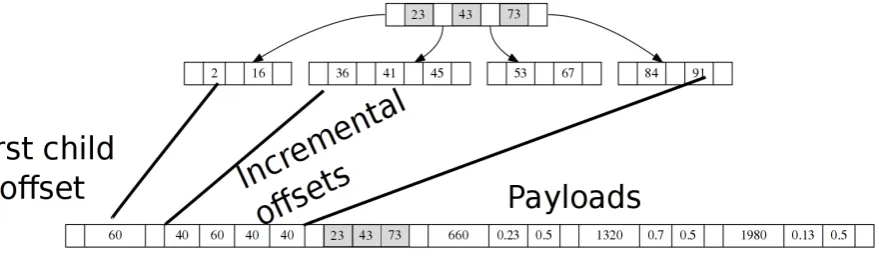
Figure 6: In a B-tree, the elements compared inK-ary search are consecutive in memory. We also show the layout of an individual entry.
4 Memory layout and implementation Each trie node represents a unique n-gram
wi...wi−n+1, and if a B-tree node within the
trie node contains key wi−n, then it must also contain the associated values Pˆ(wi...wi−n),
β(wi...wi−n), and the address of the trie node rep-resentingwi...wi−n(Figure 6, Figure 3). The en-tire language model is laid out in memory as a single byte array in which trie nodes are visited in breadth-first order and the B-tree representation of each node is also visited in breadth-first order (Figure 7).
Since our device has a 64-bit architecture, point-ers can address 18.1 exabytes of memory, far more than available. To save space, our data struc-ture does not store global addresses; it instead stores the difference in addresses between the par-ent node and each child. Since the array is aligned to four bytes, these relative addresses are divided by four in the representation, and multiplied by four at runtime to obtain the true offset. This en-ables us to encode relative addresses of 16GB, still larger than the actual device memory. We esti-mate that relative addresses of this size allow us
to store a model containing around one billionn -grams.2 Unlike CPU language model
implementa-tions such as those of Heafield (2011) and Watan-abe et al. (2009), we do not employ further com-pression techniques such as variable-byte encod-ing or LOUDS, because their runtime decompres-sion algorithms require branching code, which our implementation must avoid.
We optimize the node representation for coa-lesced reads by storing the keys of each B-tree consecutively in memory, followed by the corre-sponding values, also stored consecutively (Figure 6). When the data structure is traversed, only key arrays are iteratively copied to shared memory un-til a value array is needed. This design minimizes the number of reads from global memory.
4.1 Construction
The canonical B-tree construction algorithm (Cor-men et al., 2009) produces nodes that are not fully saturated, which is desirable for B-trees that
2We estimate this by observing that a model containing 423M
Figure 7: Illustration of the complete data structure, showing a root trie node as an array representing unigrams, and nine B-trees, each representing a single trie node. The trie nodes are numbered according to the order in which they are laid out in memory.
Figure 8: Layout of a single B-tree node forK = 4. Relative addresses of the four child B-tree nodes (arrayC) are followed by three keys (arrayB), and three values (arrayV), each consisting of ann-gram probability, backoff, and address of the child trie node.
support insertion. However, our B-trees are im-mutable, and unsaturated nodes of unpredictable size lead to underutilization of threads, warp di-vergence, and deeper trees that require more iter-ations to query. So, we use a construction algo-rithm inspired by Cesarini and Soda (1983) and Rosenberg and Snyder (1981). It is implemented on CPU, and the resulting array is copied to GPU memory to perform queries.
Since the entire set of keys and values is known in advance for eachn-gram, our construction al-gorithm receives them in sorted order as the array
A described in Section 3.1. The procedure then splits this array into K consecutive subarrays of equal size, leavingK−1individual keys between each subarray.3TheseK−1keys become the keys
of the root B-tree. The procedure is then applied recursively to each subarray. When applied to an array whose size is less thanK, the algorithm re-turns a leaf node. When applied to an array whose
3Since the size of the array may not be exactly divisible by
K, some subarrays may differ in length by one.
size is greater than or equal toKbut less than2K, it splits the array into a node containing the first
K−1keys, and a single leaf node containing the remaining keys, which becomes a child of the first.
4.2 Batch queries
To fully saturate our GPU we execute many queries simultaneously. A grid receives the com-plete set of N-gram queries and each block pro-cesses a single query by performing a sequence of
K-ary searches on B-tree nodes.
5 Experiments
We compared our open-source GPU language model gLM with the CPU language model KenLM (Heafield, 2011).45 KenLM can use two
quite different language model data structures: a fast probing hash table, and a more compact but slower trie, which inspired our own language model design. Except where noted, our B-tree
4https://github.com/XapaJIaMnu/gLM
[image:6.595.86.526.258.386.2]node size K = 31, and we measure throughput in terms of query speed, which does not include the cost of initializing or copying data structures, or the cost of moving data to or from the GPU.
We performed our GPU experiments on an Nvidia Geforce GTX, a state-of-the-art GPU, re-leased in the first quarter of 2015 and costing 1000 USD. Our CPU experiments were performed on two different devices: one for single-threaded tests and one for multi-threaded tests. For the single-threaded CPU tests, we used an Intel Quad Core i7 4720HQ CPU released in the first quarter of 2015, costing 280 USD, and achieving 85% of the speed of a state-of-the-art consumer-grade CPU when single-threaded. For the multi-threaded CPU tests we used two Intel Xeon E5-2680 CPUs, offering a combined 16 cores and 32 threads, costing at the time of their release 3,500 USD together. To-gether, their performance specifications are sim-ilar to the recently released Intel Xeon E5-2698 v3 (16 cores, 32 threads, costing 3,500USD). The different CPU configurations are favorable to the CPU implementation in their tested condition: the consumer-grade CPU has higher clock speeds in single-threaded mode than the professional-grade CPU; while the professional-grade CPUs provide many more cores (though at lower clock speeds) when fully saturated. Except where noted, CPU throughput is reported for the single-threaded con-dition.
Except where noted, our language model is the Moses 3.0 release English 5-gram language model, containing 88 million n-grams.6 Our
benchmark task computes perplexity on data ex-tracted from the Common Crawl dataset used for the 2013 Workshop on Machine Translation, which contains 74 million words across 3.2 mil-lion sentences.7 Both gLM and KenLM produce
identical perplexities, so we are certain that our implementation is correct. Except where noted, the faster KenLM Probing backend is used. The perplexity task has been used as a basic test of other language model implementations (Osborne et al., 2014; Heafield et al., 2015).
5.1 Query speed
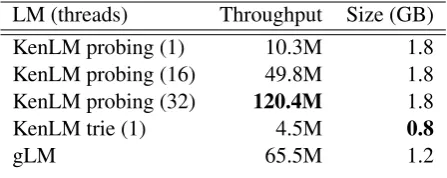
When compared to single-threaded KenLM, our results (Table 3) show that gLM is just over six
6
http://www.statmt.org/moses/RELEASE-3.0/models/fr-en/lm/europarl.lm.1
7
http://www.statmt.org/wmt13/training-parallel-commoncrawl.tgz
LM (threads) Throughput Size (GB) KenLM probing (1) 10.3M 1.8 KenLM probing (16) 49.8M 1.8 KenLM probing (32) 120.4M 1.8 KenLM trie (1) 4.5M 0.8
[image:7.595.307.531.62.151.2]gLM 65.5M 1.2
Table 3: Comparison of gLM and KenLM on throughput (N-gram queries per second) and data structure size.
times faster than the fast probing hash table, and nearly fifteen times faster than the trie data struc-ture, which is quite similar to our own, though slightly smaller due to the use of compression. The raw speed of the GPU is apparent, since we were able to obtain our results with a relatively short engineering effort when compared to that of KenLM, which has been optimized over several years.
When we fully saturate our professional-grade CPU, using all sixteen cores and sixteen hyper-threads, KenLM is about twice as fast as gLM. However, our CPU costs nearly four times as much as our GPU, so economically, this comparison fa-vors the GPU.
On first glance, the scaling from one to six-teen threads is surprisingly sublinear. This is not due to vastly different computational power of the individual cores, which are actually very simi-lar. It is instead due to scheduling, cache con-tention, and—most importantly—the fact that our CPUs implementdynamic overclocking: the base clock rate of 2.7 GHz at full saturation increases to 3.5 GHz when the professional CPU is under-utilized, as when single-threaded; the rates for the consumer-grade CPU similarly increase from 2.6 to 3.6 GHz.8
5.2 Effect of B-tree node size
What is the optimalK for our B-tree node size? We hypothesized that the optimal size would be one that approaches the size of a coalesced mem-ory read, which should allow us to maximize parallelism while minimizing global memory ac-cesses and B-tree depth. Since the size of a coa-lesced read is 128 bytes and keys are four bytes, we hypothesized that the optimal node size would be around K = 32, which is also the size of a warp. We tested this by running experiments
Figure 9: Effect of BTree node size on throughput (ngram queries per second)
that varied K from 5 to 59, and the results (Fig-ure 9) confirmed our hypothesis. As the node size increases, throughput increases until we reach a node size of 33, where it steeply drops. This re-sult highlights the importance of designing data structures that minimize global memory access and maximize parallelism.
We were curious about what effect this node size had on the depth of the B-trees representing each trie node. Measuring this, we discovered that for bigrams, 88% of the trie nodes have a depth of one—we call theseB-stumps, and they can be ex-haustively searched in a single parallel operation. For trigrams, 97% of trie nodes are B-stumps, and for higher order n-grams the percentage exceeds 99%.
5.3 Saturating the GPU
A limitation of our approach is that it is only ef-fective in high-throughput situations that continu-ally saturate the GPU. In situations where a lan-guage model is queried only intermittently or only in short bursts, a GPU implementation may not be useful. We wanted to understand the point at which this saturation occurs, so we ran ex-periments varying the batch size sent to our lan-guage model, comparing its behavior with that of KenLM. To understand situations in which the GPU hosts the language model for query by an external GPU, we measure query speed with and without the cost of copying queries to the device.
[image:8.595.73.286.62.200.2]Our results (Figure 10) suggest that the device is nearly saturated once the batch size reaches a thousand queries, and fully saturated by ten thou-sand queries. Throughput remains steady as batch size increases beyond this point. Even with the cost of copying batch queries to GPU memory,
Figure 10: Throughput (N-gram queries per sec-ond) vs. batch size for gLM, KenLM probing, and KenLM trie.
Regular LM Big LM
KenLM 10.2M 8.2M
KenLM Trie 4.5M 3.0M
gLM 65.5M 55M
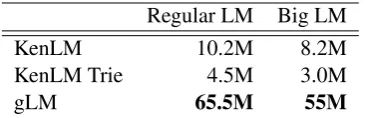
Table 4: Throughput comparison (ngram queries per second) betweengLMandKenLM with a 5 times larger model and a regular language model.
throughput is more than three times higher than that of single threaded KenLM. We have not in-cluded results of multi-threaded KenLM scaling on Figure 10 but they are similar to the single-threaded case: throughput (as shown on Table 3) plateaus at around one hundred sentences per thread.
5.4 Effect of model size
To understand the effect of model size on query speed, we built a language model with 423 million
n-grams, five times larger than our basic model. The results (Table 4) show an 18% slowdown for gLM and 20% slowdown for KenLM, showing that model size affects both implementations sim-ilarly.
5.5 Effect ofN-gram order on performance
[image:8.595.326.510.251.310.2]5-gram 4-gram 3-gram KenLM 10.2M 9.8M 11.5M KenLM Trie 4.5M 4.5M 5.2M
[image:9.595.83.282.63.120.2]gLM 65.5M 71.9M 93.7M
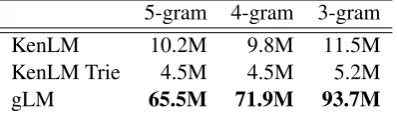
Table 5: Throughput comparison (ngram queries per second) achieved using lower order ngram models.
5.6 Effect of templated code
Our implementation initially relied on hard-coded values for parameters such as B-tree node size andN-gram order, which we later replaced with parameters. Surprisingly, we observed that this led to a reduction in throughput from 65.6 mil-lion queries per second to 59.0 milmil-lion, which we traced back to the use of dynamically allocated shared memory, as well as compiler optimizations that only apply to compile-time constants. To re-move this effect, we heavily templated our code, using as many compile-time constants as possi-ble, which improves throughput but enables us to change parameters through recompilation.
5.7 Bottlenecks: computation or memory?
On CPU, language models are typically memory-bound: most cycles are spent in random mem-ory accesses, with little computation between ac-cesses. To see if this is true in gLM we exper-imented with two variants of the benchmark in Figure 3: one in which the GPU core was under-clocked, and one in which the memory was un-derclocked. This effectively simulates two varia-tions in our hardware: A GPU with slower cores but identical memory, and one with slower mem-ory, but identical processing speed. We found that throughput decreases by about 10% when under-clocking the cores by 10%. On the other hand, underclocking memory by 25% reduced through-put by 1%. We therefore conclude that gLM is computation-bound. We expect that gLM will continue to improve on parallel devices offering higher theoretical floating point performance.
6 Conclusion
Our language model is implemented on a GPU, but its general design (and much of the actual code) is likely to be useful to other hardware that supports SIMD parallelism, such as the Xeon Phi. Because it uses batch processing, our on-chip language model could be integrated into a
ma-chine translation decoder using strategies similar to those used to integrate an on-network language model nearly a decade ago (Brants et al., 2007). An alternative method of integration would be to move the decoder itself to GPU. For phrase-based translation, this would require a translation model and dynamic programming search algorithm on GPU. Translation models have been implemented on GPU by He et al. (2015), while related search algorithms for (Chong et al., 2009; Chong et al., 2008) and parsing (Canny et al., 2013; Hall et al., 2014) have been developed for GPU. We intend to explore these possibilities in future work.
Acknowledgements
This work was conducted within the scope of the Horizon 2020 Innovation Ac-tionModern MT, which has received funding from the European Unions Horizon 2020 research and innovation programme under grant agreement No 645487.
We thank Kenneth Heafield, Ulrich Germann, Rico Sennrich, Hieu Hoang, Federico Fancellu, Nathan Schneider, Naomi Saphra, Sorcha Gilroy, Clara Vania and the anonymous reviewers for pro-ductive discussion of this work and helpful com-ments on previous drafts of the paper. Any errors are our own.
References
R. Bayer and E. McCreight. 1970. Organization and maintenance of large ordered indices. In Proceed-ings of the 1970 ACM SIGFIDET (Now SIGMOD) Workshop on Data Description, Access and Control, SIGFIDET ’70, pages 107–141.
T. Brants, A. C. Popat, P. Xu, F. J. Och, and J. Dean. 2007. Large language models in machine transla-tion. InIn Proceedings of EMNLP-CoNLL.
J. Canny, D. Hall, and D. Klein. 2013. A multi-teraflop constituency parser using GPUs. InProceedings of EMNLP.
F. Cesarini and G. Soda. 1983. An algorithm to con-struct a compact B-tree in case of ordered keys. In-formation Processing Letters, 17(1):13–16.
S. F. Chen and J. Goodman. 1999. An empirical study of smoothing techniques for language model-ing. Computer Speech & Language, 13(4):359–393.
speech recognition on graphics processors. Techni-cal Report UCB/EECS-2008-69, EECS Department, University of California, Berkeley, May.
J. Chong, E. Gonina, Y. Yi, and K. Keutzer. 2009. A fully data parallel WFST-based large vocabulary continuous speech recognition on a graphics pro-cessing unit. InProceedings of Interspeech.
T. H. Cormen, C. E. Leiserson, R. L. Rivest, and C. Stein. 2009. Introduction to Algorithms, Third Edition. The MIT Press, 3rd edition.
M. Federico, N. Bertoldi, and M. Cettolo. 2008. IRSTLM: an open source toolkit for handling large scale language models. In Proceedings of Inter-speech, pages 1618–1621. ISCA.
S. Green, D. Cer, and C. Manning. 2014. Phrasal: A toolkit for new directions in statistical machine translation. InProceedings of WMT.
D. Hall, T. Berg-Kirkpatrick, and D. Klein. 2014. Sparser, better, faster GPU parsing. InProceedings of ACL.
H. He, J. Lin, and A. Lopez. 2015. Gappy pattern matching on GPUs for on-demand extraction of hi-erarchical translation grammars. TACL, 3:87–100.
K. Heafield, R. Kshirsagar, and S. Barona. 2015. Language identification and modeling in specialized hardware. InProceedings of ACL-IJCNLP, July.
K. Heafield. 2011. KenLM: faster and smaller lan-guage model queries. In Proceedings of WMT, pages 187–197, July.
K. Heafield. 2013. Efficient Language Modeling Al-gorithms with Applications to Statistical Machine Translation. Ph.D. thesis, Carnegie Mellon Univer-sity, September.
W.-m. W. Hwu. 2011. GPU Computing Gems Emer-ald Edition. Morgan Kaufmann Publishers Inc., San Francisco, CA, USA, 1st edition.
Nvidia Corporation. 2015. Nvidia CUDA Compute Unified Device Architecture
Pro-gramming Guide. Nvidia Corporation.
https://docs.nvidia.com/cuda/cuda-c-programming-guide/.
M. Osborne, A. Lall, and B. V. Durme. 2014. Ex-ponential reservoir sampling for streaming language models. InProceedings of ACL, pages 687–692.
A. L. Rosenberg and L. Snyder. 1981. Time- and space-optimality in B-trees. ACM Trans. Database Syst., 6(1):174–193, Mar.
D. Talbot and M. Osborne. 2007. Smoothed Bloom fil-ter language models: Tera-scale LMs on the cheap. InProceedings of EMNLP-CoNLL, pages 468–476.
T. Watanabe, H. Tsukada, and H. Isozaki. 2009. A succinct N-gram language model. InProc. of ACL-IJCNLP.