Semantic Interpretation of Superlative Expressions
via Structured Knowledge Bases
Sheng Zhang1, Yansong Feng1∗, Songfang Huang2, Kun Xu1, Zhe Han1 and Dongyan Zhao1 1ICST, Peking University, Beijing, China
2IBM China Research Lab, Beijing, China
{evancheung, fengyansong, xukun, zhehan1992, zhaodongyan}@pku.edu.cn [email protected]
Abstract
This paper addresses a novel task of se-mantically analyzing the comparative con-structions inherent in attributive superla-tive expressions against structured knowl-edge bases (KBs). The task can be de-fined in two-fold: first, selecting the com-parison dimension against a KB, on which the involved items are compared; and sec-ond, determining the ranking order, in which the items are ranked (ascending or descending). We exploit Wikipedia and Freebase to collect training data in an un-supervised manner, where a neural net-work model is then learnt to select, from Freebase predicates, the most appropriate comparison dimension for a given superla-tive expression, and further determine its ranking order heuristically. Experimen-tal results show that it is possible to learn from coarsely obtained training data to semantically characterize the comparative constructions involved in attributive su-perlative expressions.
1 Introduction
Superlatives are fairly common in natural lan-guages and play an essential role in daily commu-nications, when in conveying comparisons among a set of items or degrees of certain properties. Properly analyzing superlative expressions holds the promise for many applications such as ques-tion answering (QA), text entailment, sentiment analysis and so on. In literature, analysis of superlatives has drawn more interests from both formal linguistics and semantics(Szabolcsi, 1986; Gawron, 1995; Heim, 1999; Farkas and Kiss, 2000), but relatively less attention from the com-putational linguistics and NLP communities(Bos and Nissim, 2006; Jindal and Liu, 2006; Scheible, 2007; Scheible, 2009).
Earlier computational treatments to superlatives focus on the categorizations of superlatives(Bos and Nissim, 2006; Scheible, 2009), where the most common but important type is being part of a noun phrase or describing certain properties or attributes of the subjects, named as attribu-tive superlaattribu-tives or ISA-superlatives, accounting for around 90% of appearances in newswire. A typical example isNile is the longest river in the world.
In most cases, the gist behind such superlative expressions is the comparative constructions that the utterance intends to convey to readers, e.g., in the Nile example, Nile is longer than any other rivers in the world. Semantically understanding such attributive superlative expressions boils down to interpreting the comparative construction in-volved in the utterance in the following four as-pects:
1. Target: one or more items that work as the protagonist of the utterance, and are being compared within the comparative construc-tion, e.g.,Nile;
2. Comparison set: the set of items that are being compared against in the utterance(Bos and Nissim, 2006), e.g., all rivers in the world;
3. Comparison dimension: the attribute or
property that the items are compared upon, e.g.,the length of a river;
4. Ranking order: the order in which the items in the comparison set are sorted according to the dimension, in an ascending or descending order, e.g., we should rank all rivers regard-ing their lengths in adescendingorder to get thelongestat the top.
So far, there have been only a few computa-tional treatments for superlatives, addressing the
importance of categorizing superlatives, identify-ing the target and comparison set(Bos and Nissim, 2006; Jindal and Liu, 2006; Scheible, 2009), while putting less attention on other aspects.
In fact, grounding the comparison dimension into a canonical predicate of a KB can help pro-vide more accurate interpretations for the involved comparative constructions. In question answering over structured KBs, accurate treatments for su-perlatives will not only help build more precise of structured queries, but also support shallow func-tional reasoning, e.g., formally analyzingthe fifth longest river in the world, will explore the most of the structured nature of KBs, and is advantageous to traditional IR based methods.
However, selecting an appropriate comparison dimension against a structured KB is not a trivial task. Usually, the numbers of adjective superla-tives and gradable KB predicates are large, so that it is impossible to craft mapping rules to cover every pair of adjective superlative and predicate. Consequently, preparing wide-coverage annotated data to help automate this procedure is also labor-intensive and time consuming. Moreover, some adjectives are widely used, but often vague to de-cide a dimension by themselves(Bos and Nissim, 2006). One may need to draw support from their context and even common sense knowledge.
In this paper, we propose a novel task, se-mantically interpreting the comparative construc-tions inherent in attributive superlative expres-sions again structured KBs, e.g., Freebase(Google, 2013), specifically, focusing on selecting appro-priate comparison dimensions and corresponding ranking orders. To this end, we collect training data from roughly aligned Wikipedia resources and knowledge facts in Freebase, from which we build a neural network model to reveal the un-derlying correspondence between the comparative construction, as well as its context, and a Freebase predicate. Our method leverages the potentials of structured KBs and large amount of text resources in Wikipedia without relying on human annotated data.
We evaluate our interpretation of superlatives in two tasks, and experimental results show that it is possible to learn the comparison dimensions in form of canonical knowledge bases predicates from roughly collected training data, which is noisy in nature but provides the essentials to se-mantically characterize superlative expressions.
2 The Task
Given a sentence with an attributive superlative ex-pression, our task is to find on which dimension the comparison happens against a KB and how the comparison results are arranged, i.e., (1) Dimen-sion Selection: decide the dimension on which the involved items are compared, and ground the selected dimension into Freebase predicates. (2)
Ranking Order Determination: given the
com-parison set and the selected dimension, determine theorder in which the involved items are ranked within the comparisons, in an ascending or de-scendingorder? For superlatives coupled with or-dinals, we also need to assign the standing in the rankings.
In the Nile example, we expect to in-terpret the longest river into a vector
<fb:geography.river.length, descending, 1>, where allrivers in the world are compared upon Freebase predicate fb:geography.river.length, sorted in a descending order and the referred target ranks thefirst.
3 The WikiDiF Dataset
Previous superlative datasets are built to facili-tate superlative extraction, classification, and com-parison set identification(Bos and Nissim, 2006; Scheible, 2012). There are currently no available datasets that can be used directly for our task, es-pecially no annotations against structured KBs.
We therefore present a distantly supervised method to collect annotated training data from rich text resources of Wikipedia and the help of Free-base, without much human involvement. Thekey assumptionbehind our method is that if a superla-tive expression frequently appears in a context that may describe a KB predicate, then this predi-cate probably plays an important role in the com-parative construction triggered by this superlative. Inspired by recent advances in relation extrac-tion(Mintz et al., 2009), given a Freebase predi-cate, we are able to collect many sentences from Wikipedia pages, which more or less describe this predicate, without extra human annotation. These sentences in turn can be used to collect the co-occurrences between a superlative expression and this predicate.
differ-ent rivers can be compared with each other. In practice, we simply treat all Freebase predicates that take objects of type ∈ {/type/int, /type/float,
/type/datetime} as gradable predicates. In total, we collect 8,968,383<subj, rel, obj>triples cov-ering all 1,795gradablepredicates from Freebase dump.
Next, we extract, from Wikipedia pages, all sen-tences containing superlative expressions, as well as their±3context sentences1. To detect
superla-tives, we rely on part-of-speech tags (JJS, RBS) which can achieve a high recall in practice accord-ing to (Jindal and Liu, 2006). By doaccord-ing so, we col-lect 7,734,006 sentences with superlative expres-sions from Wikipedia.
Finally, for each collected triple <subj, rel, obj> , we match subj and obj into our sentence collection, including those contextual sentences. This gives us 20,609 sentences with superlative expressions that potentially describe our collected knowledge triples with gradable predicates. For example, the following sentences from the page of
Nile in Wikipedia may describes a Freebase fact
<Nile, fb:geography.river.length, 6,853>: “The Nile is a major north-flowing river in northeastern Africa, generally re-garded as the longest river in the world. It is 6,853 km (4,258 miles) long.”
where we can see thatlongesthas implied a com-parative construction among allrivers in the world
andfb:geography.river.lengthis the involved hid-den comparison dimension.
Our resulting dataset, WikiDiF, contains20,609
sentences paired with Freebase predicates, cov-ering 2,335 superlative words and 340 Freebase predicates2. In WikiDiF, there are on average 8.8
sentences per superlative word targeting for about 2 predicates, and for commonly seen superlatives, e.g., largest or biggest, there are on average 70 sentences per superlative word targeting for 30 predicates. Compared to other human annotated datasets, WikiDiF is admittedly noisy in nature,
1In Wikipedia, sentences with superlative expressions may not always contain the knowledge facts that support the superlative constructions, which often appear in their neigh-bouring sentences. For example,highest, and its supporting fact, (Everest,8,848 metres), are not in the same sentence, but indeed very near: Mount Everest, also known ..., is Earth’s
highestmountain. It is located in ... of the Himalayas. Its peak is8,848 metres(29,029 ft) above sea level.
2We also filter out predicates whose objects are very com-mon in the documents, e.g., 1 or 2, which is difficult to collect training data.
but exploits the underlying connections between knowledge facts and their possibly correspond-ing textual descriptions, where the pseudo co-occurrences of superlative expressions and Free-base predicates will work as a proxy for us to for-mally analyze the involved comparative construc-tions.
4 Comparison Dimension Selection
Our WikiDiF dataset contains utterances with roughly annotated superlative-predicate pairs, which helps us to model the dimension selection task as a classification problem. Given a superla-tive wordSand its contextC, our goal is to find a
gradableFreebase predicateRthat maximizes the conditional probabilityP(R|C, S):
R∗= arg max
R∈candS
P(R|C, S)
where we can limit our search space to a candi-date setcandS according to the domain and type
constraints regarding the comparison set.
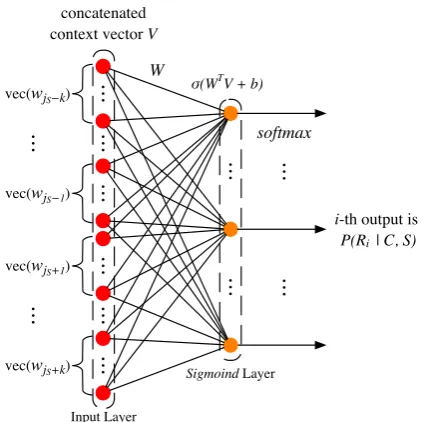
Currently, our WikiDiF covers limited predi-cates and training instances for each superlativeS, traditional classification models may suffer from the coverage and data sparsity issues. Here, we adopt a classic one-layer neural network (NN) model with the help of word embeddings to predict how likely a predicateRcan work as the compar-ison dimension givenSand its context vector.
We start by constructing vector representations of words and store them in a table L. We use the publicly available word embeddings trained by
SENNA (Collobert et al., 2011), with 50
dimen-sions throughout our experiments.
We construct the context vector for each in-stance by concatenating the vectors of context words within a window of ±k. If there are not enough words within the window, special filling vectors will be used.
V = (wjS−k, ..., wjS−1, wjS+1, ..., wjS+k)
wherejS is the index of superlativeS in the
sen-tence, andwis the vector of context word or spe-cial filling parameter.
The output layer of the NN model is a standard
softmax function, which takes a sigmoid nonlin-earity of the context vectors as input. Therefore, the probability ofith predicate in Freebase is cho-sen as the comparison dimension given superlative
Sand its contextCcan be written as:
P(Ri|C, S) = e zi
Pq=1
i-th output is P(Ri | C, S) softmax
W concatenated context vector V
σ(WTV + b)
vec(wjS−1) vec(wjS−k)
vec(wjS+k) vec(wjS+1)
Input Layer
[image:4.595.74.287.62.273.2]Sigmoind Layer
Figure 1: Neural network for dimension selection.
whereziis estimated using asigmoidfunction:
zi=σi(WmT×nV +b)
wherenis the number of candidate predicates for superlativeS,mis the length of concatenated vec-torV,Wm×nis the parameter matrix,bis the bias
vector, andσi is thesigmoidfunction that applies
to thei-th element of argument vector.
Training this standard one-layer neural network model can be straightforward, and the parame-tersW,band filling vectors can be updated using stochastic gradient descent (SGD).
5 Ranking Order Determination
To exploit the most from a structured KB, we use an effective heuristic method to decide the ranking order when a superlative expression S
triggers a comparative construction regarding a KB predicate R. For each pair of (S, R), we first find fromR’s supporting sentences the ones that contain superlative S, and further trace the
<subj∗, R, obj∗> tuples from the KB which
these sentences are assumed to describe. We next look up into the KB, and find other tuples
<subjo, R, objo>with the same predicate R. If
subjo and subj∗ are of the same type, and most objo< obj∗, we will say the ranking order for
ex-pressionSisdescendingwhen implying predicate
R, otherwise,ascendingorder.
In the Nile example, if we find in our KB that nearly all other entities of typeriverhave smaller
values than6,853infb:geography.river.length, we can conclude that the ranking order forlongest re-garding fb:geography.river.lengthis descending, i.e., we should rank all riversdescendingly to get thelongestone at the top.
Ordinals are processed as a post-processing step to interpret ordinals into a numerical values.
6 Experiments
The main purposes of this work is to answer the following two questions: (1) can we learn from noisy training data without much human involve-ment to semantically interpret attributive superla-tive expressions via structured KBs? (2) can our semantic analysis help better understand utter-ances with superlative expressions?
6.1 Interpreting Superlative Comparisons
We first evaluate our models in the vanilla setup defined in Section 23, in terms of accuracy of
di-mension selection (Accd), precision of predicates
covered by WikiDiF (Pd), and precision of
rank-ing order determination (Po).
Datasets: We manually annotate superlative ex-pressions from QALD-4 evaluation dataset(Unger et al., 2014) and TREC QA (2002, 2003) datasets(NIST, 2003), and guarantee that all the labeled superlative instances can be grounded to gradable Freebase predicates. The resulting ques-tion dataset contains 135 quesques-tions covering 44 Freebase predicates. Additionally, we manu-ally annotate 77 declarative sentences covering 24 Freebase predicates from WSJ and Wikipedia as the declarative dataset.
We build a Na¨ıve Bayes model using co-occurrences as a baseline to predict proper dimen-sions. We further implement a simple baseline to decide the ranking order, by measuring the relat-edness between a superlative word and two sets of seed words using word embeddings. The two seed sets, {most, more, much, many} and{least, less, few, little}, potentially indicate two ranking orders, respectively.
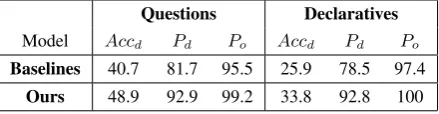
We can see in Table 1 that our method can better capture the underlying connections between su-perlative expressions and KB predicates. Com-paring with the baseline, our model benefits from the NN architecture and distributional word rep-resentations and avoids data sparsity to some
Questions Declaratives
Model Accd Pd Po Accd Pd Po
Baselines 40.7 81.7 95.5 25.9 78.5 97.4
[image:5.595.73.293.64.121.2]Ours 48.9 92.9 99.2 33.8 92.8 100
Table 1: Performances of superlative interpreta-tions on two datasets
tent. Our model achieves over 90% of precision on the predicates covered by our training data, show-ing that it is possible to learn from noisy train-ing data to characterize comparison dimensions against a KB. However, the relatively lower ac-curacy is mainly due to that some predicates in the testing data are not covered by our WikiDiF, which only covers 19% of gradable Freebase pred-icates. Regarding the ranking order determination, our simple heuristic method makes the most of Freebase triples, and outperforms the relatedness based baseline, which does not take Freebase into account.
By looking at the different performances on question and declarative sentences, we can see that our method performs better on relatively sim-pler and shorter questions, while a slightly worse on longer declarative sentences. This is not sur-prising, since questions are often simple in struc-ture and ask for a straightforward property about the target, while declarative sentences are usu-ally complicated in syntax, which a ±5 context words window may not be able to capture. An-other reason is that for newswire, there are many predicates that are similar in definitions but with tiny differences, which often confuse our methods, e.g., fb:business.business operation.assets and
fb:business.business operation.current assets.
6.2 Question Answering over Freebase
We also investigate how our semantic analysis for superlatives can help improve question an-swering on two benchmark datasets, Free917(Cai and Yates, 2013) and WebQuestions(Berant et al., 2013), which contain 35 questions with attributive superlative expressions in total. We inject our for-mal analysis as superlative-triggered aggregation operations into an existing system, Xu14(Xu et al., 2014). Note that we leave the comparison set to be decided by Xu14’s parser.
The 35 superlative-triggered complex questions can not be correctly answered by most state-of-the-art systems(Berant et al., 2013; Yao and
Van Durme, 2014; Xu et al., 2014), since they can not properly analyze the superlative-triggered functions. When integrated with our analysis, Xu14 is able to correctly answer 14 out of 35
such questions (40%), significantly outperform-ing other systems. The remainoutperform-ing 21 questions are mainly idiomatic usage, e.g., the Best Actor Award, or with predicates not covered by WikiDiF. The result shows that our analysis can help QA systems better handle superlative-triggered aggre-gation functions, which previous works fail to do. This also gives a good reason to introduce the analysis for comparison constructions into the QA community, which will leverage the potentials of structured KBs to better deal with complex ques-tions.
7 Conclusion
In this paper, we present a novel attempt to se-mantically analyze the comparisons involved in attributive superlative expressions by investigat-ing on which dimension the comparative construc-tion works and how the comparison results are ar-ranged. We leverage Freebase and their roughly aligned textural descriptions from Wikipedia, and learn from such training data to characterize a comparative construction in two aspects, the di-mension of the comparison and its ranking order.
Currently, our analysis suffers from the limited coverage of our WikiDiF. In the future, it would be interesting to improve our method to cover more KB predicates, and extend our NN model with more advanced structures to further improve the performances and also simultaneously character-ize the target and comparison set involved.
Acknowledgments
References
Jonathan Berant, Andrew Chou, Roy Frostig, and Percy Liang. 2013. Semantic parsing on freebase from question-answer pairs. In EMNLP, pages 1533– 1544.
Johan Bos and Malvina Nissim. 2006. An empiri-cal approach to the interpretation of superlatives. In
EMNLP 2007, Proceedings of the 2006 Conference on Empirical Methods in Natural Language Pro-cessing, 22-23 July 2006, Sydney, Australia, pages 9–17.
Qingqing Cai and Alexander Yates. 2013. Semantic Parsing Freebase: Towards Open-domain Semantic Parsing. In Proceedings of the Second Joint Con-ference on Lexical and Computational Semantics (*SEM).
Ronan Collobert, Jason Weston, L´eon Bottou, Michael Karlen, Koray Kavukcuoglu, and Pavel Kuksa. 2011. Natural language processing (almost) from scratch. The Journal of Machine Learning Re-search, 12:2493–2537.
Donka F Farkas and Katalin ´E Kiss. 2000. On the comparative and absolute readings of superlatives.
Natural Language & Linguistic Theory, 18(3):417– 455.
Jean Mark Gawron. 1995. Comparatives, superla-tives, and resolution. Linguistics and Philosophy, 18(4):333–380.
Google. 2013. Freebase data dumps.
https://developers.google.com/
freebase/data.
Irene Heim. 1999. Notes on superlatives.
Nitin Jindal and Bing Liu. 2006. Mining compara-tive sentences and relations. In Proceedings, The Twenty-First National Conference on Artificial In-telligence and the Eighteenth Innovative Applica-tions of Artificial Intelligence Conference, July 16-20, 2006, Boston, Massachusetts, USA, pages 1331– 1336.
Mike Mintz, Steven Bills, Rion Snow, and Dan Ju-rafsky. 2009. Distant supervision for relation ex-traction without labeled data. InProceedings of the Joint Conference of the 47th Annual Meeting of the ACL and the 4th IJCNLP of the AFNLP: Volume 2 -Volume 2, ACL ’09, pages 1003–1011.
NIST. 2003. Text retrieval conference question an-swering track.
Silke Scheible. 2007. Towards a computational treat-ment of superlatives. InProceedings of the 45th An-nual Meeting of the ACL: Student Research Work-shop, ACL ’07, pages 67–72, Stroudsburg, PA, USA. Association for Computational Linguistics. Silke Scheible. 2009. A Computational Treatment of
Superlatives. Ph.D. thesis, University of Edinburgh.
Silke Scheible. 2012. Textwiki: a superlative resource.
Language Resources and Evaluation, 46(4):635– 666.
Anna Szabolcsi. 1986. Comparative superlatives. MIT Working papers in Linguistics, 8:245–265.
Christina Unger, Corina Forascu, Vanessa Lopez, Axel Cyrille Ngonga Ngomo, Elena Cabrio, Philipp Cimiano, and Sebastian Walter. 2014. Question an-swering over linked data (qald-4). InProceedings of the CLEF 2014, pages 1172–1180.
Kun Xu, Sheng Zhang, Yansong Feng, and Dongyan Zhao. 2014. Answering natural language questions via phrasal semantic parsing. InProceedings of the 2014 Conference on Natural Language Processing and Chinese Computing (NLPCC), pages 333–344. Xuchen Yao and Benjamin Van Durme. 2014.