• No results found

fire toadflax

N/A
N/A
Protected

Academic year: 2020

Share "fire toadflax"

Copied!
5
0
0

Loading.... (view fulltext now)

Full text

(1)

J. Range Manage.

56:193-197 March 2003

Prescribed fire effects on dalmation toadflax

JAMES S. JACOBS AND ROGER L. SHELEYI

'Authors are Research Assistant Professor and Associate Professor, Department of Land Resources and Environmental Sciences, Montana State University, Bozeman, Mont. 59717.

Abstract

Prescribed fires are important for rangeland restoration and affect plant community composition and species interactions.

Many rangeland plant communities have been, or are under the threat of noxious weed invasion, however there is little informa- tion on how fire effects weeds. Our objective was to determine the effects of prescribed rangeland fire on dalmatian toadflax [Linaria dalmatica (L.) Miller] density, cover, biomass, and seed production. These plant characteristics, as well as density, cover, and biomass of perennial grasses and forbs were measured with- in burned and adjacent not-burned areas on 3 Artemisia tridenta- ta/Agropyron spicatum habitat types in Montana. Areas were burned in the spring and measured in the fall 1999. Comparisons of plant characteristics between the burned and not-burned sites were made using t-tests and non-parametric Wilcoxon Rank Sum tests. After 1 growing season, fire did not affect density or cover of dalmatian toadflax. Burning increased dalmatian toadflax bio- mass per square meter at 2 sites, and per plant biomass at all 3 sites. Seed production of dalmatian toadflax was increased by fire at all 3 sites. Fire reduced forb cover at 1 site and increased grass biomass at 2 sites. The increases in dalmatian toadflax bio- mass and seed production suggest that fire used to restore healthy plant communities may increase dalmatian toadflax dominance. We recommend weed management procedures, such as herbicide control and seeding desirable species, be integrated with prescribed fire where dalmatian toadflax is present in the plant community.

Key words: Linarea dalmatica, noxious rangelands weeds, inte- grated weed management.

Dalmatian toadflax [Linaria dalmatica (L.) Miller] is a rhi- zomatous, perennial weed native to the Mediterranean region. It was brought to the west coast of North America as an ornamental about 1874 and has spread throughout the western states, British Columbia and Alberta (Alex 1962). Because of high genetic vari- ability, dalmatian toadflax is adapted to a wide variety of habitat conditions but favors well-drained, relatively coarse-textured soils (Lajeunesse 1999). Dalmatian toadflax is an aggressive competitor because of early spring regeneration from vegetative buds on root stocks and rhizomes buried in the soil, and because

Funding for this study was provided by the USDI Bureau of Land Management and the Rocky Mountain Elk Foundation. Study sites were contributed by the USD1 Bureau of Land Management and USDA Forest Service. Personnel and resources for conducting the burns were contributed by the USDI Bureau of Land Management and USDA Forest Service.

Manuscript accepted 29 May 2002.

Resumen

Los fuegos prescritos son importantes para la restauracion de los pastizales y afectan a la composicion de las comunidades de plantas y la interaccion entre especies. Muchas comunidades vegetales de pastizal han sido invadidas o estan bajo la amenaza de ser invadidas por malezas nocivas, sin embargo, hay poca informacion sobre como el fuego afecta las malezas. Nuestro objetivo fue determinar los efectos del fuego prescrito en el pasti- zal sobre la densidad, cobertura, biomasa y produccion de semil- la de "Dalmatian toadflax" [Linaria dalmatica (L.) Miller]. Estas caracteristicas de la planta, asi como la densidad, cobertura y biomasa de zacates perennes y hierbas, se midieron dentro de areas quemadas adyacentes a areas no quemadas en 3 habitats del tipo Artemisia tridentata/Agropyron spicatum de Montana.

Las areas fueron quemadas en primavera y medidas en otoi o de 1999. Las comparaciones de las caracteristicas de las plantas entre los sitios quemados y no quemados se realizaron mediante pruebas de t y la prueba no parametricas de la Suma del Rango de Wilcoxon. Despues de una estacion de crecimiento, el fuego no afecto la densidad o cobertura del "Dalmatian toadflax". La quema incremento la biomasa por metro cuadrado de

"Dalmatian toadflax" en 2 sitios y la biomasa por planta en los 3 sitios. La produccion de semilla de "Dalmatian toadflax" se incremento con el fuego en todos los sitios. El fuego redujo la cobertura de hierbas en un sitio a incremento la biomasa de zacates en 2 sitios. El incremento de biomasa y produccion de semilla de "Dalmatian toadflax" sugieren que el fuego utilizado para restaurar comunidades vegetales saludables puede incre- mentar la dominancia de "Dalmatian toadflax". Nosotros recomendamos que donde el "Dalmatian toadflax" este presente en la comunidad vegetal se integren procedimientos de manejo de maleza, tales como control con herbicidas y siembras de especies deseables, con el fuego

of its high seed production. Infestations of dalmatian toadflax may reduce desirable plants causing loss of winter forage for wildlife (Lajeunesse 1999), reduce cattle-carrying capacity, and reduced appraised rangeland value (Lacey and Olsen 1991).

Cattle occasionally browse flowering shoots, but usually avoid this weed (Harris and Carter 1971).

Fire is a natural disturbance of ecosystems that can change community structure and function, at least in the short-term (Ueckert et al. 1978, Sharrow and Wright 1977, Whittaker 1961).

Prescribed burning has been used to increase diversity, reduce

shrub and tree encroachment, and control excess litter buildup on

rangeland for centuries. In most cases, the target species for man-

agement with fire have been indigenous, including junipers

(Juniperus) and pines (Pinaceae). During the last 50 years, many

(2)

North American rangelands have been invaded by, or are under the threat of inva- sion by non-indigenous species. There are few studies, however, that quantify the effects of fire on noxious rangeland weeds, and no studies on fire effects on dalmatian toadflax.

Alterations in community structure and function caused by rangeland fire may affect invasibility of an ecosystem or the ability of an existing invader to reach dominant status. On Artemisia steppe communities, establishment of cheatgrass (Bromus tectorum L.) communities can be enhanced by fire. Increased build-up of the continuity of fine fuels from cheatgrass causes self perpetuating, larger, and more frequent fires that favors cheatgrass repro- duction and suppresses native perennial grasses (Pellant 1990, Peters and Bunting 1994). A single low intensity fire

increased the cover and density of diffuse (Centaurea diffusa Lam.) and spotted knapweeds (C. maculosa Lam.) in north- em Washington (Sheley and Roche 1982).

In Montana, there is evidence that spotted knapweed increased sixfold within 2 years after a controlled fire on a forested site (Rice and Sacco 1995). Nutrients released from plant litter, and the disturbance creat- ed by fire may favor growth and reproduc- tion of weedy species with early germina- tion and rapid growth characteristics

(Sheley et al. 1998). The objectives of this study were to determine the short-term effects of a single spring prescribed fire on the cover, density, biomass, and seed pro- duction of dalmatian toadflax. We hypoth- esized that dalmatian toadflax cover, den- sity, biomass and seed production would increase after burning.

Methods Study Sites

The study was conducted within an Artemisia tridentata/Agropyron spicatum (Mueggler and Stewart 1980) habitat type on 3 sites located in the foothills of the Elkhorn Mountains, southeast of Boulder, Mont. The area was managed for elk (Cervus elaphus) range and had not been grazed by livestock for 10 years.

Prescribed burns in the area were designed to improve wildlife habitat by creating a diverse mosaic of open parks, and the pre- scription to burn was based on the pres- ence of woody species. Targeted encroachment tree and shrub species including limber pine (Pinus flexilis James), Rocky Mountain juniper (Juniperus scopulorum Sarg.), Douglas fir

Table 1. Monthly summary from 1998, 1999, and the 30-year average of precipitation (mm) for Elk Horn, Mont., the area of the 3 sites.

1998 1999 30 Yr Average (mm) ---

January 6 4

February 2 4 9

March

3 1

April 12 14

May 34 39

June 87 65

July 32 9

August 13 63

September 29 6

October 9

1

November

1.6

6

December 12 4

Annual 256 214

(Pseudotsuga menziesii (Mirb.) Franco), big sagebrush (Artemisia tridentata Nutt.) and rubber rabbitbrush (Chrysothamnus nauseosus (Pallas ex Pursh) Britt).

Monthly summaries for precipitation in the area encompassing all 3 sites are summa- rized for the year before the burn (1998), the year of the burn (1999), and the 30 year (1961-1990) average (Table 1).

Site

1

was located in Wood Gulch (46°

13.002' N, 111 ° 5.094' W ) at an elevation of 1,750 m. Slope ranged from 15 to 35%

with a southern aspect. Soils were

Maiden-Lap-rock outcrop complex con- sisting of loamy-skeletal, carbonatic Typic Calciborolls. The predominant grasses at Wood Gulch were bluebunch wheatgrass (Agropyron spicatum (Prush) Scribn. &

Smith) and Idaho fescue (Festuca ida- hoensis Elmer). Site 2 was in Upper Horse Gulch (46° 12.140' N, 111 ° 55.408' W) at an elevation of 1,825 m. Slope ranged from 15 to 45% with an eastern aspect.

Upper Horse Gulch soils were Whitcow, Bouldery-Shawmut, very bouldery-rock outcrop complex consisting of loamy- skeletal, mixed Typic Argiborolls and loamy-skeletal, carbonatic, frigid Calcic Ustochrepts. Grasses were predominantly

bluebunch wheatgrass and prairie Junegrass (Koeleria macrantha (Ledeb.) Schultes). Site 3 was in Lower Horse Gulch (46° 13.348' N, 111 ° 55.111' W) at an elevation of 1,635 m. Slope averaged 15% and the aspect was southeast. Soils were Windham-Lap very cobbly loamy consisting of loamy-skeletal, carbonatic Typic Calciborolls. Grasses were blue- bunch wheatgrass, prairie Junegrass, blue grama (Bouteloua gracilis (H.B.K.) Lag.

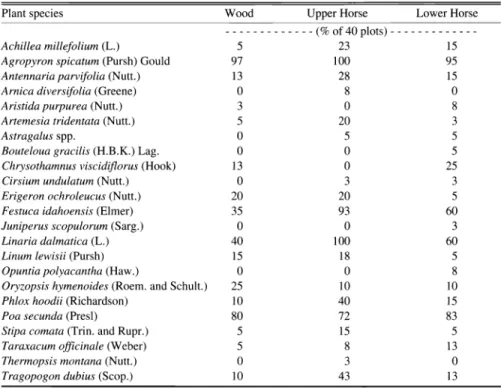
Ex Griffiths), and red threeawn (Aristida prupurea Nutt). Plant species present at the time of sampling for the 3 sites are list- ed in Table 2.

Experimental Design and Sampling

The experimental design was a compar- ison of 2 treatments, burned and not-

Table 2. Plant species present (% of 40 plots) at Wood Gulch, Upper Horse Gulch and Lower Horse Gulch sites at the time of sampling.

Plant species Wood Upper Horse Lower Horse

---(%of40 plots) ---

Achillea millefolium (L.) 5 23

Agropyron spicatum (Pursh) Gould 97 100

Antennaria parvifolia (Nutt.) 13 28

Arnica diversifolia (Greene) 0 8 0

Aristida purpurea (Nutt.) 3 0 8

Artemesia tridentata (Nutt.)

5

20

3

Astragalus spp. 0 5 5

Bouteloua gracilis (H.B.K.) Lag. 0 0 5

Chrysothamnus viscidiflorus (Hook) 13 0

Cirsium undulatum (Nutt.) 0 3 3

Erigeron ochroleucus (Nutt.) 20 20

5

Festuca idahoensis (Elmer) 35 93

0 0 3

Linaria dalmatica (L.) 40 100

Linum lewisii (Pursh) 15 18 5

Opuntia polyacantha (Haw.) 0 0 8

Oryzopsis hymenoides (Roem. and Schult.) 25 10

Phlox hoodii (Richardson) 10 40

Poa secunda (Presl) 80 72

Stipa comata (Trip. and Rupr.)

5 15 5

Taraxacum officinale (Weber) 5 8

3 0

Tragopogon dubius (Stop.) 10 43

194 JOURNAL OF RANGE MANAGEMENT 56(2) March 2003

(3)

Table 3. Prescribed burn conditions at the 3 sites.

Site Size Date of burn temp.

length of spread

(ha) (km hr) (°C) hr)

Wood Gulch 80 11/3199

Upper Horse Gulch 60 16/3/99 Lower Horse Gulch 40 16/3/99

burned. The bum treatments for the 3 sites are described in Table 3. Comparisons were made by sampling 20 randomly selected 0.44 m2 circular plots within the burns and 20 independent randomly

selected plots within immediately adjacent non-burned areas at each of the 3 sites.

Soil and species composition in the burned and non-burned areas were identical at each site. Sites were sampled from 29 September through 8 October 1999. The experiment was not replicated in time because of the aggressive herbicide con- trol of the dalmatian toadflax, and there- fore it was replicated in space by using 3

sites. All species were counted within sample plots and the area of ground cov- ered by species was visually estimated as a percent of the total area. Each dalmatian toadflax rosette or flowering stem was counted as an individual. Each bunchgrass was counted as an individual. All plants within the circle were then clipped to ground level by species, oven dried (60°C) to constant weight and weighed. Seed pods of dalmatian toadflax were separated from other vegetative material and seeds were extracted and counted.

Data Analysis

Sites differed in dalmatian toadflax density and were analyzed separately.

Differences between burned and non- burned treatments in density, cover, bio- mass per square meter, per plant biomass, per plant seed production of dalmatian toadflax, and density, cover and biomass of perennial grass and perennial forbs other than dalmatian toadflax were deter- mined using a 2 sample t-test procedure (SAS Institute Inc. 1990). An F' (folded) statistic was calculated to test for equality of the 2 variances. When normality or equality of variances were not reasonable

(Prob. F < 0.05), data were analyzed using the non-parametric Wilcoxon Rank Sum

test (SAS Institute Inc. 1990).

Results Precipitation

The 30 year average annual precipita- tion for the area was 297 mm (Table 1).

Annual precipitation in 1998, the year before the prescribed burns was 14 %

below the 30-year average and 28% lower in 1999, the year of the burns.

Precipitation during June and August of 1999 were 29 and 79% above the 30-year average, for those months, respectively

Density

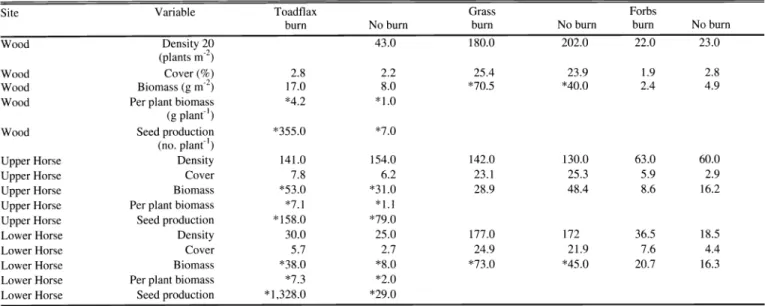
Burning did not affect dalmatian toad- flax density the season following burning at any of the 3 sites (P > 0.05, Table 4).

Rosette and mature stem density responses were similar to total density and therefore only total density is presented. At Wood Gulch, dalmatian toadflax was present in 40% of the plots sampled with mean den- sity of 20 plants m

2

in the burned plots and 43 plants m

2

in the not-burned plots.

Dalmatian toadflax was present in 100%

of the plots at Upper Horse Gulch and its density was 141 and 154 plants m

2

in the burned and not-burned plots, respectively.

At Lower Horse Gulch, dalmatian toad- flax was present in 60% of the plots sam- pled with mean density of 30 plants m

2

in the burned plots and 25 plants m

2

in the not-burned plots. There was no difference between the burn treatments in the density of perennial grass or perennial forbs (Table 4).

Cover

Burning did not affect dalmatian toad- flax cover the season following burning at any of the 3 sites (P > 0.05, Table 4). At Wood Gulch, dalmatian toadflax cover averaged 2.8% in the burned plots and 2.2% in the not-burned plots. Dalmatian

Table 4. Means of density (m 2), cover (%), biomass (m2 and per plant for toadflax), and toadflax seed production (per plant) for dalmatian toadflax, perennial grass, and perennial forbs at Wood Gulch, Upper Horse Gulch and Lower Horse Gulch for the burn and not-burn treatments. Differences between burn and not-burn treatments are indicated by an asterisk before the means.

Site Variable Toadflax

burn burn burn burn burn burn

Wood Density 20 43.0

Wood

(plants m 2)

Cover (%)

Wood Biomass (g m 2) 17.0

Wood Per plant biomass *4.2

Wood

(g plant') Seed production

Upper Horse

(no. plant') Density

Upper Horse Cover 7.8

Upper Horse Biomass *53.0

Upper Horse Per plant biomass *7.1

Upper Horse Seed production *1580

Lower Horse Density 30.0

Lower Horse Cover 5.7

Lower Horse Biomass *38.0

Lower Horse Per plant biomass *7.3

Lower Horse Seed production *1,328.0

(4)

toadflax cover at Upper Horse Gulch was 6.2 and 7.8% in the not-burned and burned plots, respectively. Cover at Lower Horse Gulch averaged 2.7 and 5.7% in the not- burned and burned plots, respectively.

Burning did not affect perennial grass cover at any site. Perennial forb cover was reduced by burning from 5.9% in the plots that were not burned to 2.8 in the burned plots at Upper Horse Gulch (Table 4).

Biomass

The influence of fire on dalmatian toad- flax biomass per square meter varied depending on site (Table 4). At Wood Gulch where dalmatian toadflax was absent from 60% of the plots, the fire effect was not significant even though the biomass was twice as high on plots that burned (17 g m 2) compared to those that did not (8 g m 2). On Upper Horse Gulch where dalmatian toadflax occurred on all plots, fire increased dalmatian toadflax biomass from 31 g m

2

where there was no fire to 53 g m

2

where there was fire. Fire increased dalmatian toadflax biomass from 8 to 38 g m

2

on the not-burned plots compared to burned plots at Lower Horse Gulch where dalmatian toadflax occurred on 60% of the plots.

Fire increased dalmatian toadflax per plant biomass at all sites (Table 4). At Wood Gulch, dalmatian toadflax biomass was 1.0 g per plant in the plots that were not burned and 4.2 g per plant in the burned plots. Dalmatian toadflax increased from 1.1 to 1.7 g per plant in the not- burned and burned plots, respectively, at Upper Horse Gulch. Dalmatian toadflax biomass in the not-burned plots at Lower Horse Gulch was 2.0 g per plant compared to 7.3 g per plant in the burned plots.

Fire increased perennial grass biomass at Wood and Lower Horse Gulches, but there was no difference at Upper Horse Gulch. Perennial grass biomass production at Wood Gulch was 40.8 g m

2

where there was no burning and 70.5 g m

2

where it was burned. Upper Horse Gulch perennial grass biomass was 28.9 and 48.4 g m

2

in the burned compared to not-burned plots, respectively. At Lower Horse Gulch, perennial grass biomass increased from 45.1 to 73.0 g m

2

in the not-burned com- pared to the burned treatments. Fire did not affect perennial forb biomass (Table 4).

Dalmatian Toadflax Seed Production

Burning dramatically increased dalmat- ian toadflax seed production per plant at all 3 sites (Table 4). Burning increased seed production from 7 to 355 seeds per

plant at Wood Gulch, from 79 to 158 seeds per plant at Upper Horse Gulch, and from 29 to 1,328 seeds per plant at Lower Horse Gulch.

Discussion

It is not surprising that there was no short-term burning effect on dalmatian toadflax, perennial grass, or perennial forb density. The heat intensities of the burns at the 3 sites were considered normal for spring fires by technicians conducting the burns (USDA Forest service, personal communication). Many bunchgrass clumps and dalmatian toadflax rosettes were still green after burning and dalmat- ian toadflax rhizomes were generally below 10 mm of soil and not damaged by fire generated heat (Hayward 1938). It is doubtful that the thermal death point for plant tissue was reached during the fires

(Write 1970, Wright et al. 1976).

Maximum temperatures in shrubland fires are always near the top of the vegeta- tion (Bailey and Anderson 1980, Whittaker 1961), killing shrub and tree species with perennating buds in this zone.

The removal of big sagebrush and pine species by the prescribed burns in this study opened niches once occupied by these species and made available resources they used. The reduced competition for resources could partly explain the increase in biomass of dalmatian toadflax and perennial grass, and the increased seed production of dalmatian toadflax in the burned areas. We expect future increases of dalmatian toadflax because large areas once occupied by trees and shrubs were left open to invasion by high seed produc- ing dalmatian toadflax especially on the Upper Horse Gulch site where there were fewer perennial grasses to fill open niches.

On semi-arid rangelands, nutrients bound in living and dead biomass are made available for plant growth by fire (DeBano and Conrad 1978). In addition, soil conditions after burning often favor nitrification (Sharrow and Wright 1977).

Increases in dalmatian toadflax and grass biomass in the burned areas may have occurred because of increased nutrients.

On a different burn under similar condi- tions, nitrate increased (P = 0.002) from 3.3 mg kg' on plots that did not burn to 7.6 mg kg' on plots that burned (Jacobs unpublished data). This offers another explanation to the increase in dalmatian toadflax and grass biomass in the burned areas. The lack of grass response at Upper Horse Gulch suggests that there was less

grass present to respond to increased nutri- ents, or dalmatian toadflax was dense enough to overwhelm the grass. Nitrate is

mobile and rapidly used by plants and therefore high nitrate conditions may favor weeds with early and rapid growth charac- teristics (Sheley et al. 1998) over native grasses that tend to have less aggressive growth characteristics.

The more robust dalmatian toadflax plants produced 2- to 10-fold more seeds in the burned areas compared to areas not- burned. While we did not detect increases in dalmatian toadflax density in the season following fire, increased seed production suggests that we can expect increases in toadflax density and spread on these sites in the future. Increases in the density of other invasive non-indigenous species have been reported. Sheley and Roche (1982) found increased cover and density of diffuse and spotted knapweeds in north- ern Washington, and Rice and Sacco (1995) report a sixfold spotted knapweed increase in Montana within 2 years after a controlled fire on a forested site.

Conclusions

Our results suggest fire will not reduce dalmatian toadflax populations on range- land and may increase the dominance of this weed. We recommend implementing an integrated dalmatian toadflax manage- ment program when conducting a pre- scribed burn for restoring native plant communities and controlling encroaching undesirable plants. Integrated practices could include herbicide application to reduce dalmatian toadflax density and seed production, and seeding with desirable plant species to fill niches opened by fire.

Literature Cited

Alex, J.F. 1962. The taxonomy, history, and distribution of Linaria dalmatica. Can. J.

Bot. 40:295-307.

Bailey, A.W. and M.L. Anderson. 1980. Fire temperatures in grass, shrub, and aspen forest communities of Central Alberta. J. Range Manage. 3:37-40.

DeBano, L.F. and C.E. Conrad. 1978. The effect of fire on nutrients in a chaparral ecosystem. Ecol. 59:489-497.

Harris, P. and A.C. Carter. 1971. Linaria vul- garis mill., yellow toadflax, and L. dalmatica (L.) Mill., broad-leaved toadflax (Scrophulariaceae). In: Biological control programmes against insects and weeds in Canada 1959-1968. Commonwealth Agr.

Bureaux, Slough, England. 94-97.

196 JOURNAL OF RANGE MANAGEMENT 56(2) March 2003

(5)

Hayward, F. 1938. Soil temperatures during forest fires in longleaf pine region. J. For.

36:478-491.

Lacey, J. and B. Olsen. 1991. Environmental and economic impacts of noxious rangeland weeds. In: L.F. James, J.O. Evans, M.H.

Ralphs, R.D. Child (eds.) Noxious Rangeland Weeds. Westview Press, Boulder, Colo. 5-16.

Lajeunesse, S. 1999. Dalmatian and Yellow Toadflax. In. Sheley, R.L. and J.K. Petroff (eds.). Biology and Management of Noxious Rangeland Weeds. Oregon State Press, Corvallis, Ore.. p.249-260.

Mueggler, W.F. and W.L. Stewart. 1980.

Grassland and shrubland habitat types of Western Montana. Intermountain Forest and Range Experiment Station. USDA-FS.

Ogden, Utah. 154 pp.

Pellant, M. 1990. The cheatgrass-wildfire cycle-are there any solutions? In: E.D.

McArthur, E.M. Romney, S.D. Smith, and P.T. Tueller (eds.) Proc. Symp. on cheatgrass invasion, shrub die-off, and other aspects of shrub biology and management. USDA For.

Ser. Gen. Tech. Rep. INT-276,11-18.

Peters, E.F. and S.C. Bunting. 1994. Fire con- ditions pre- and postoccurrence of annual grasses on the Snake River Plain. In: S.B.

Monson and S.G. Kitchen (eds.) Proc.

Ecology and management of annual range- lands. USDA For. Ser. Gen. Tech. Rep. INT- GTR-313, 31-36.

Rice, P. and R. Sacco. 1995. Appendix E.

Spotted knapweed response to Burning.

Manuscript. Division of Biology, University of Montana, Missoula. p. 100-102.

SAS Institute Inc. 1990. SAS/STAT user's guide, ver 6. Vol. 2. Cary, NC. 920 p.

Sharrow, S.H. and H.A. Wright. 1977.

Effects of fire, ash, and litter on soil nitrate, temperature, moisture and tobosagrass pro- duction in the Rolling Plains. J. Range Manage. 30:266-270.

Sheley, R.L. and BF. Roche, Jr. 1982.

Rehabilitation of spotted knapweed infested rangeland in northeastern Washington. Abstr.

of papers, W. Soc. Weed Sci., Denver, Colo.

Sheley, R.L., J.S. Jacobs, and M.L.

Carpinelli. 1998. Distribution, biology, and management of diffuse (Centaurea diffusa) and spotted knapweed (Centaurea macu- losa). Weed Technol.12:353-362.

Ueckert, D.N., T.L. Whigham, and B.M.

Spears. 1978. Effect of burning on infiltra- tion, sediment, and other soil properties in a mesquite-tobosagrass community. J. Range Manage. 31:420-425.

Whittaker, E. 1961. Temperature in heath fires. J. Ecol. 49:709-715.

Write, H.A. 1970. A method to determine heat-caused mortality in bunchgrass. Ecol.

51:582-587.

Wright, H.A., S.C. Bunting, and L.F.

Neunschwander. 1976. Effect of fire on honey mesquite. J. Range Manage.

29:467-471.

Figure

Table  2.  Plant  species  present  (%  of  40  plots)  at  Wood  Gulch,  Upper  Horse  Gulch and  Lower  Horse Gulch sites  at  the time of sampling
Table  4.  Means  of density  (m  2),  cover (%), biomass  (m2  and per plant for  toadflax),  and toadflax seed  production (per plant) for  dalmatian toadflax,  perennial  grass,  and perennial forbs at Wood Gulch,  Upper Horse Gulch and Lower Horse Gulc

References

Related documents

The goodwill of the Russian business was written down by EUR 10.6 (EUR 26.1 million), mainly due to the rise in the discount rate used in the testing of the logistics business.

To avoid contention for JDBC connections, don’t reuse an application DataSource or the WebSphere Application Server repository for persistent session data.. Figure 1a

The index for the present study was derived from the walkability component scores of all constituent administrative areas – wards – for the spatially contiguous

The President shall (a) act as the principal executive officer of the Association, (b) chair all meetings of the Board, (b) sign, with the Secretary or any other officer of

1–3 The adoption of electronic medical records (EMRs) in primary care has been associated with expecta- tions that these applications would support quality improve- ment efforts

Marianna University School of Medicine Hospital, Kanagawa Children’s Medical Center, Tokai University, Kitazato University, Odawara Municipal Hospital, Nippon Medical School

 Visit  gayleannweinstein.net  for