warwick.ac.uk/lib-publications
Original citation:
Kuzmich, Alina, Padula, Daniele, Ma, Haibo and Troisi, Alessandro. (2017) Trends in the electronic and geometric structure of non-fullerene based acceptors for organic solar cells. Energy & Environmental Science. doi: 10.1039/C6EE03654F
Permanent WRAP URL:
http://wrap.warwick.ac.uk/85118
Copyright and reuse:
The Warwick Research Archive Portal (WRAP) makes this work of researchers of the University of Warwick available open access under the following conditions. Copyright © and all moral rights to the version of the paper presented here belong to the individual author(s) and/or other copyright owners. To the extent reasonable and practicable the material made available in WRAP has been checked for eligibility before being made available.
Copies of full items can be used for personal research or study, educational, or not-for-profit purposes without prior permission or charge. Provided that the authors, title and full bibliographic details are credited, a hyperlink and/or URL is given for the original metadata page and the content is not changed in any way.
Publisher statement:
First published by Royal Society of Chemistry 2017
http://dx.doi.org/10.1039/C6EE03654F
A note on versions:
The version presented here may differ from the published version or, version of record, if you wish to cite this item you are advised to consult the publisher’s version. Please see the ‘permanent WRAP url’ above for details on accessing the published version and note that access may require a subscription.
1
Trends in the electronic and geometric structure of non-fullerene based
acceptors for organic solar cells
Alina Kuzmich,
1Daniele Padula,
1Haibo Ma,
2Alessandro Troisi
1*
1Department of Chemistry, University of Warwick, CV4 7AL Coventry, United Kingdom
2Key Laboratory of Mesoscopic Chemistry of MOE, Key Laboratory of Mesoscopic Chemistry of MOE, School of Chemistry and Chemical Engineering, Nanjing University, Nanjing 210023, China
*Email: [email protected]
Broader Context
In just 5 years the maximum efficiency of organic solar cells containing non-fullerene electron acceptors has increased from ~3% to ~12% thanks to the substantial progress in both materials and device optimization. There are now close to a hundreds of non-fullerene acceptors used in high efficiency solar cells, based on a number of different chemical designs. It seems appropriate at this point in time to analyse these compounds in search of some unifying chemical principle and to combine such an exploration with the physical ideas that have guided the design so far. We have found that all high efficiency acceptors are characterized by unusually small energy difference between the two lowest unoccupied orbitals.
Abstract
We constructed a database of 80 high performing non-fullerene electron acceptors and studied the common electronic and geometric properties in search of unifying design rules. We discovered that, without exception, all high performing materials are characterized by very low gap between LUMO and LUMO+1 orbitals, a feature that is consistent with microscopic models and seems to be true for all classes of compounds considered. We also confirmed that non-planarity of the acceptor is beneficial but not for all classes of acceptors. We suggested that by building similar databases and keeping it up to date it will be possible to identify statistically meaningful structure-property relations.
TOC Entry: High power conversion efficiency are displayed by organic solar cells with small energy
gap between LUMO+1 and LUMO orbitals
Energy
&
Environmental
Science
Accepted
Manuscript
Published on 17 January 2017. Downloaded by University of Warwick on 17/01/2017 17:44:33.
2
Fullerene electron acceptors have been present in all efficiency record breaking organic solar cells since their initial development.1 It was recognized by many that having electron acceptors with
different chemistry could bring many benefits in terms of light harvesting efficiency, manufacturing cost and, ultimately, commercial viability of the technology.2-6 A review of the field in 20117 reported
only 4 non-fullerene acceptors used in cells with power conversion efficiency (PCE) between 3% and 4% and none with PCE above 4. Today there are close to one hundred different acceptors with efficiency between 3% and 12% and the field is one of the most active in the area of organic solar cells because of the very promising rate of progress.
A number of more recent reviews attempt a classification of the chemistry of the main acceptors2, 3
and explain the pace of improvement in terms of our greater understanding of the process of cell optimization including optical modelling, use of additives to improve the morphology and energy level matching with an always increasing library of electron donors. However, it is also clear that the best performing acceptors belong to different chemical class and the strategies pursued to improve them are different. For example a promising family of acceptors based on the perylene diimide (PDI) dye was built on the observation that the isolated PDI molecule forms too large aggregates, a process that can be avoided by substitution with branched side chains or synthesis of non-planar dimers or oligomers.8-10 A rather different group of acceptors is based on linear oligomers, synthesized with
techniques developed in the area of polymeric semiconductors and often using similar building blocks as benzothiadiazole (BTD),11 diketopyrrolopyrrole (DPP)12, indacenodithiophene (IDT)13 or
indacenodithienothiophene (IC).14 For other type of acceptors (subphthalocyanine (SubPc),15
tetraazabenzodifluoranthene diimide (BFI)16) there are for the moment fewer instances, but equally
very promising.
Given the large number of high efficiency (molecular) acceptors now known and the substantial chemical difference among them, it is possibly appropriate at this point in time to analyse the electronic structure properties of the high performing acceptors in search of some common features. The analysis of large databases in search of structure-property relations is very common in the pharmaceutical sciences17 and is gradually emerging as a useful tool also in the area of organic and
hybrid electronics.18-20 In a recent survey of organic dyes used in dye sensitized solar cells it emerged
that, contrary to expectation, the donor-pi-acceptor character of the dye is not correlated with the solar cell efficiency.21 On the other hand, the expected correlation was found with the reorganization
energy and the oxidation free energy.22
In this work we will build an unbiased large set of electron acceptors reported in literature and, after evaluating their electronic structure and geometry with computational methods, we test few hypotheses on the relation between electronic structure and efficiency in a solar cell. The database is made available in the supporting information to test further hypotheses and/or update it with new compounds.
The selection of the compounds to be included in such a database should be based on a systematic and reproducible procedure to avoid any possible bias. However, one should recognize that very poorly performing solar cells are not reported in literature and those that are deemed to be not very promising are not fully optimized. We therefore construct a database trying to capture as many acceptors as possible displaying (average) PCE above 3%. We proceeded as follows:
(a) We performed various searches using the Web of Science Database in the 2010-2016 time window, using keywords such as “high-efficiency semiconductor”, “efficient nonfullerene acceptor”, and related keywords. The searches returned a total of 379 articles, of which 26 reporting acceptors with PCE ≥ 3%.
(b) 15 of the 26 articles selected above reported PCE ≥ 5%. All papers citing these 15 articles have
been included in the database, bringing the total number of article evaluated to 456.
Energy
&
Environmental
Science
Accepted
Manuscript
Published on 17 January 2017. Downloaded by University of Warwick on 17/01/2017 17:44:33.
3
(c) In the total database of 456 articles, we identified 39 papers reporting acceptors with PCE ≥ 3%, for a total of 80 distinct acceptors. In case of review papers reporting the maximum PCE, we checked the original paper cited and used the average PCE value from that source.
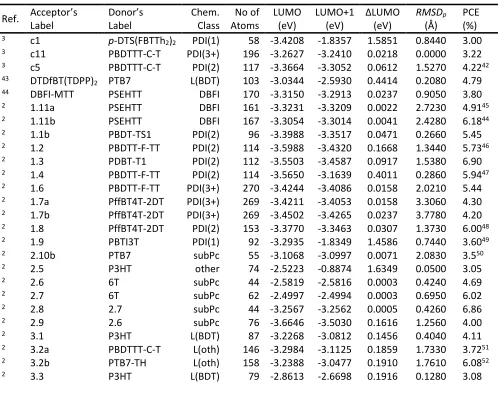
Table 1 reports the list of considered acceptors in the form of a literature reference and the label used in the original paper. We have used the average PCE when average and maximum were given, and the largest average if a compound was used in different studies or with different devices. The donor used in the best preforming cell is also reported. In the table we have also introduced a rough classification of the acceptors to help the discussion of the results. We have considered the group of acceptors containing PDI and, within this group, noted if PDI appears are monomer (PDI(1)), dimer PDI(2), trimer or larger (PDI(3+)). We have then considered the molecules formed by linearly coupled oligomers in a pattern ABA and labelled them as L(IDT), L(BDT), L(DPP) or L(oth) if they contained the IDT, BDT, DPP or none of these fragments respectively (the acceptors with highest PCE belong to this class and contain indacenodithienothiophene monomer). We have also labelled the subphthalocyanines (SubPc) and the acceptors containing the DBFI fragment.
Standard density functional theory optimization in the gas phase has been performed for all acceptors at the 6-31G*/B3LYP level and the electronic and geometric properties have been evaluated on the optimized geometries.23 To make the calculation feasible and since the focus is on the conjugated core
of the molecules rather than the side chains added to improve the solubility, we removed long alkylic chains according to the following criteria: (i) linear alkyl chains with more than two carbons or branched chains where the branching is not on the first carbon atom are replaced by an ethyl group; (ii) side chains with branching on the first carbon atom are replaced by an isopropyl group; (iii) alkoxylic side chains are replaced by the methoxy group; (iv) side chains containing the ether group are treated as other alkyl chains.
All acceptors in the database have been used in conjunction with suitable donor materials in organic solar cells, i.e. a good alignment is a prerequisite for all good acceptors but clearly not what makes a material particularly good. A critical property is the ability of the acceptor to form phase separated morphologies with the donor, ideally of the same characteristic size of the exciton diffusion length. This property is clearly not easy to derive from the geometric and electronic structure of the isolated acceptor and it is also fairly difficult to design from chemical intuition (besides the usual means proposed to modify the solubility in different solvent by changing the side groups). However, many authors have proposed that non-planarity of the molecule is beneficial because it promotes amorphous phases, prevents strong aggregation and facilitates charge transport in three dimensions.24 Such property can be easily monitored across the database and it is relatively easy to
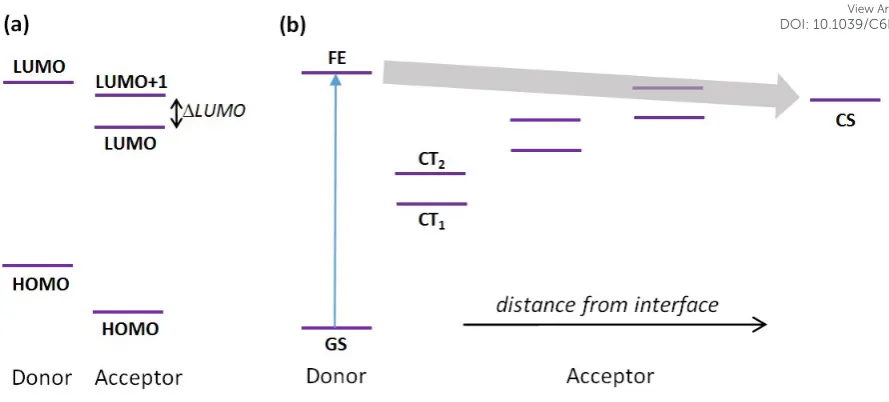
incorporate in the design of new molecular electron acceptors. Another proposal is that the ideal acceptor has a low lying LUMO+1 level, which accelerates the charge separation at the interface (see energy level diagram in Figure 1). This proposal, originally based on a very simple dimer model,25 was
generalized for more realistic interfaces and more advanced physical models.26, 27 Also this property is
simple to assess from the electronic properties of the isolated donor and it can be easily built in the acceptor by design. It can be noted that fullerene derivatives, non-planar and with quasi degenerate low-lying virtual orbitals, satisfy both criteria - as it should be.
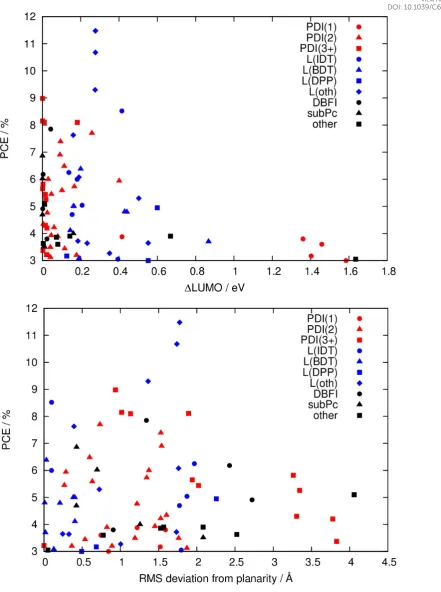
In the Table and the related Figure 2, we report the energy difference between LUMO+1 and LUMO orbitals computed for the neutral molecule. As a measure of the planarity of the conjugated core we report the root mean square distance of the sp2 carbon atoms from the best plane passing across
them, RMSDp. For a planar molecule the plane is the one perpendicular to the principal axis of inertia
with the largest angular moment of inertia. The same plane defines the “best” fitting plane across a number of points, i.e. that one minimizing the sum of the squared distance between the plane and all
points. Alternative measures of non-planarity do not change the results and are not reported.
Energy
&
Environmental
Science
Accepted
Manuscript
Published on 17 January 2017. Downloaded by University of Warwick on 17/01/2017 17:44:33.
4
Figure 2a illustrates the correlation between the energy difference between LUMO+1 and LUMO (referred to as LUMO) and the PCE reported for the selected electron acceptors. The main striking
feature is that all the 22 acceptors with PCE larger than 6% have LUMO smaller than 0.5 eV and for
21 of them LUMO is smaller than 0.3 eV. First of all, one should note that this is not typical of
molecular semiconductors, for example all the 5 acceptors considered in a similar analysis25 (and
based on pre-2012 papers) have all LUMO larger than 0.9 eV. A second important point is that all
the efficient molecular semiconductors belong to different chemical classes and they have low LUMO
for different reasons. Some of them are weakly interacting dimers or trimers of PDI and they are obviously expected to have low LUMO as suggested for example in ref. 25. Many of them are more
difficult to consider as weakly interacting dimers but, being formed by an ABA sequence of monomers, they may have some built-in tendency to have LUMO and LUMO+1 of similar energies. For others (e.g. the DBFI molecule) the small LUMO could not be easily predicted without an electronic structure
calculation. Overall the data seems to suggest that a low LUMO is a necessary condition for high
performing electron acceptors (while clearly not a sufficient one). One may also argue, but the data are possibly not dense enough, that a small LUMO in the 0.2-0.3 eV range is preferable to a vanishing LUMO.
The analysis of the non-planarity gives less clear-cut indications. From the data in Figure 2b it seems that both planar and non-planar molecules are equally likely to give high performing materials, or, more precisely, about half of the molecules with PCE larger than 5% show a deviation from planarity of more than 1 Å. The data may suggest that there is no special electronic advantage in having non-planar molecules but a degree of non-non-planarity could have a beneficial effect on the morphology of the blend. Such property is however a solid state property of the mixture rather than a true molecular property.
There is a well-known risk that one can find misleading correlations between physical quantities, which are not particularly helpful in informing the synthesis and the physical understanding. A small
LUMO, proposed here to be necessary condition for high performance electron acceptors, could be
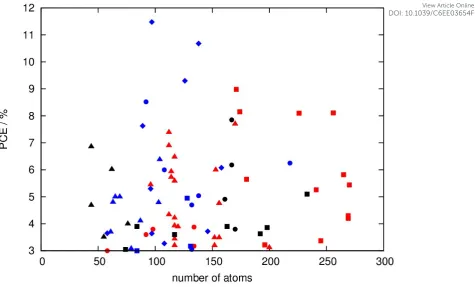
in principle associated simply with larger molecules, which in turn could be better because of greater delocalization and smaller reorganization energy. In Figure 3 we show that there is no correlation in the data set between size of the molecule and PCE, i.e. it is not the molecular size but the actual position of the LUMO+1 energy level that makes an acceptor potentially better.
It is to some extent surprising that correlations could be found between an isolated acceptor property and device efficiency, while it is very well established that the morphology of the blend and the correct alignment of the donor and acceptor energy levels are expected to be more important.28-31 It should
be stressed that these remain the most critical parameters for the efficiency of the cell if one considers a random sample of devices. In order for a property of the isolated electron acceptor to emerge so clearly from the data set one must assume that the efficiency for each acceptor has been at least partially optimized with respect to the rest of the parameter space. In practice, all the reported data points correspond to the best average efficiency of a single acceptor after testing it with a number of alternative donors and experimental conditions. In many cases the other donors are reported in the published works, but it is to be expected that very poor devices (because of poor energy alignment or poor morphology) were not reported. The only reason for being able to focus on an acceptor-only property is because we have selected data points that have been (to some extent) optimized for other relevant properties.
Similarly, the key elementary processes in organic solar cells (charge generation at the interface, charge diffusion away from the interface, geminate and non-geminate recombination) are properties of the donor-acceptor interface, not the acceptor alone. Recent works highlight the difficulty in modelling the interface geometrical and electronic structure,32-35 its electrostatics36 and the quantum
dynamics of the elementary processes.37-41 A large collection of electronic structure calculations like
the one presented here cannot replace a detailed physical modelling of the interfacial processes but
Energy
&
Environmental
Science
Accepted
Manuscript
Published on 17 January 2017. Downloaded by University of Warwick on 17/01/2017 17:44:33.
5
can nevertheless provide useful insights. For example, our data suggest that the modelling of charge generation at the interface with fullerene derivatives or these high efficiency acceptors should include a number of virtual orbitals per molecule, and not just the LUMO.
This work demonstrates once more that a productive approach in material science development is to combine bottom-up approaches, where physical principles are used to suggest mechanisms and design, and top-down approaches, where a large set of experimental data set is used to test hypotheses on structure property relations. We have now a strong indication from the combination of both approaches that high efficiency electron acceptors should have low energy LUMO+1 orbitals, a property easy to build in new efficient acceptors or to test on hypothetical compounds before they are synthesised.
Supporting Information. The Cartesian coordinates of all acceptors considered are provided in a
format suitable for alternative analyses.
Acknowledgments. This work was supported by EPRSC (EP/N021754/1), ERC (Grant No. 615834). H.
M. thanks the Institute of Advanced Studies in University of Warwick and China Scholarship Council for the financial support for his visit to University of Warwick. A.K. was supported by the URSS scheme of the University of Warwick.
Energy
&
Environmental
Science
Accepted
Manuscript
Published on 17 January 2017. Downloaded by University of Warwick on 17/01/2017 17:44:33.
6
Energy
&
Environmental
Science
Accepted
Manuscript
Published on 17 January 2017. Downloaded by University of Warwick on 17/01/2017 17:44:33.
7
Figure 1. (a) One-electron energy levels of isolated electron donor and acceptor. If LUMO+1 of the
acceptor is sufficiently low it can accept an electron from the LUMO of the donor. (b) Electronic state energy level diagram showing the ground state (GS), the Frenkel exciton localised on the donor (FE) and the charge transfer states (CTi) of increasingly high energy at higher distance from the interface.
According to ref. 25-27 the efficient formation of charge separated (CS) state (grey arrow) can be helped by the presence of higher energy CT states, promoted by low LUMO gap.
Energy
&
Environmental
Science
Accepted
Manuscript
Published on 17 January 2017. Downloaded by University of Warwick on 17/01/2017 17:44:33.
[image:8.595.76.521.72.273.2]8
Figure 2. (top) Computed difference between LUMO+1 and LUMO energy versus experimental PCE
for a device containing a given electron acceptor. The acceptors are classified as described in the
text. (bottom) Computed deviation from the molecular plane versus experimental PCE.
Energy
&
Environmental
Science
Accepted
Manuscript
Published on 17 January 2017. Downloaded by University of Warwick on 17/01/2017 17:44:33.
[image:9.595.78.520.77.670.2]9
Figure 3. (Lack of) correlation between molecular size and measured PCE for the considered data
set. The point symbols/colours have the same meaning than Figure 1.
Energy
&
Environmental
Science
Accepted
Manuscript
Published on 17 January 2017. Downloaded by University of Warwick on 17/01/2017 17:44:33.
[image:10.595.77.553.71.358.2]10
Table 1. List of acceptors and associated properties. The acceptor is identified by the label used for it in the reference given in the first column. If a larger
PCE was later reported an additional reference is given after the PCE value in the last column. The donor is the one used for the reported PCE. The chemical classification in the 4th column is explained in the main text. The number of atoms refer to the acceptor after reduction of side-chain length. RMSDp defined
in the text.
Ref. Acceptor’s Label Donor’s Label Chem. Class No of Atoms LUMO (eV) LUMO+1 (eV) ΔLUMO (eV) RMSDp (Å) PCE (%)
3 c1 p-DTS(FBTTh
2)2 PDI(1) 58 -3.4208 -1.8357 1.5851 0.8440 3.00
3 c11 PBDTTT-C-T PDI(3+) 196 -3.2627 -3.2410 0.0218 0.0000 3.22
3 c5 PBDTTT-C-T PDI(2) 117 -3.3664 -3.3052 0.0612 1.5270 4.2242
43 DTDfBT(TDPP)
2 PTB7 L(BDT) 103 -3.0344 -2.5930 0.4414 0.2080 4.79
44 DBFI-MTT PSEHTT DBFI 170 -3.3150 -3.2913 0.0237 0.9050 3.80
2 1.11a PSEHTT DBFI 161 -3.3231 -3.3209 0.0022 2.7230 4.9145
2 1.11b PSEHTT DBFI 167 -3.3054 -3.3014 0.0041 2.4280 6.1844
2 1.1b PBDT-TS1 PDI(2) 96 -3.3988 -3.3517 0.0471 0.2660 5.45
2 1.2 PBDTT-F-TT PDI(2) 114 -3.5988 -3.4320 0.1668 1.3440 5.7346
2 1.3 PDBT-T1 PDI(2) 112 -3.5503 -3.4587 0.0917 1.5380 6.90
2 1.4 PBDTT-F-TT PDI(2) 114 -3.5650 -3.1639 0.4011 0.2860 5.9447
2 1.6 PBDTT-F-TT PDI(3+) 270 -3.4244 -3.4086 0.0158 2.0210 5.44
2 1.7a PffBT4T-2DT PDI(3+) 269 -3.4211 -3.4053 0.0158 3.3060 4.30
2 1.7b PffBT4T-2DT PDI(3+) 269 -3.4502 -3.4265 0.0237 3.7780 4.20
2 1.8 PffBT4T-2DT PDI(2) 153 -3.3770 -3.3463 0.0307 1.3730 6.0048
2 1.9 PBTI3T PDI(1) 92 -3.2935 -1.8349 1.4586 0.7440 3.6049
2 2.10b PTB7 subPc 55 -3.1068 -3.0997 0.0071 2.0830 3.550
2 2.5 P3HT other 74 -2.5223 -0.8874 1.6349 0.0500 3.05
2 2.6 6T subPc 44 -2.5819 -2.5816 0.0003 0.4240 4.69
2 2.7 6T subPc 62 -2.4997 -2.4994 0.0003 0.6950 6.02
2 2.8 2.7 subPc 44 -3.2567 -3.2562 0.0005 0.4260 6.86
2 2.9 2.6 subPc 76 -3.6646 -3.5030 0.1616 1.2560 4.00
2 3.1 P3HT L(BDT) 87 -3.2268 -3.0812 0.1456 0.4040 4.11
2 3.2a PBDTTT-C-T L(oth) 146 -3.2984 -3.1125 0.1859 1.7330 3.7251
2 3.2b PTB7-TH L(oth) 158 -3.2388 -3.0477 0.1910 1.7610 6.0852
2 3.3 P3HT L(BDT) 79 -2.8613 -2.6698 0.1916 0.1280 3.08
Page 12 of 17 Energy & Environmental Science
Energy
&
Environmental
Science
Accepted
Manuscript
11
2 3.4 PBDB-T L(oth) 138 -3.3449 -3.0676 0.2773 1.7390 10.6853
2 3.5 P3HT L(DPP) 131 -2.5892 -2.4619 0.1274 0.6840 3.17
2 3.6 p-DTS(FBTTh2)2 L(oth) 96 -3.1460 -2.6428 0.5031 0.7240 5.30
2 3.7a P3HT L(BDT) 104 -3.3120 -3.1120 0.2000 0.0310 6.38
54 TPB PTB7-Th PDI(3+) 256 -3.5041 -3.4943 0.0098 1.8920 8.11
55 f7 Molecule T PDI(1) 134 -3.1016 -1.6986 1.4030 1.5210 3.17
55 f8 Se-SM PDI(1) 134 -3.6192 -3.2034 0.4158 1.2190 3.88
56 2c PTB7-Th PDI(2) 112 -3.4195 -3.4146 0.0049 1.6020 4.34
12 DPP5 P(PTQD-BDT) other 84 -3.4448 -2.7762 0.6686 1.5660 3.90
12 DPP6 P(PTQD-BDT) L(DPP) 128 -3.8802 -3.2799 0.6003 2.2550 4.95
8 alphaPBDT PBT7-Th PDI(2) 156 -3.4295 -3.4040 0.0256 1.2170 4.76
8 alphaPPID PBT7-Th PDI(2) 152 -3.4829 -3.4693 0.0136 1.1900 3.49
8 betaPBDT PBT7-Th PDI(2) 156 -3.4320 -3.3901 0.0419 1.7630 3.49
8 betaPPID PBT7-Th PDI(2) 152 -3.4742 -3.4434 0.0307 0.8900 3.20
57 SdIPBI-Se PDBT-T1 PDI(2) 112 -3.5237 -3.4290 0.0947 1.5290 7.39
10 SF-PDI4 PV4T2FBT PDI(3+) 265 -3.4241 -3.4203 0.0038 3.2630 5.82
9 SBF-PDI4 PTB7-Th PDI(3+) 241 -3.4693 -3.4513 0.0180 3.3450 5.26
58 NI-AA-NI P2 L(oth) 58 -3.1479 -2.5957 0.5521 0.2440 3.65
59 DPP-PHt2 P3HT L(DPP) 84 -3.0739 -2.5217 0.5521 0.4930 3.00
60 TP-PDI PTB7-Th PDI(1) 98 -3.2505 -1.8901 1.3603 1.5900 3.80
4 M10 P3HT other 163 -2.8676 -2.7242 0.1434 2.0820 3.9024
4 M18 P3HT L(BDT) 61 -3.1318 -2.2646 0.8672 0.0180 3.70
4 M32 DBP other 117 -3.0627 -2.9822 0.0805 0.7750 3.60
4 PDI6d PBDTTT-C-T PDI(2) 117 -3.3520 -3.3057 0.0463 1.4520 3.9361
4 PDI9 BDT-T-DPP PDI(2) 200 -3.2752 -3.2331 0.0422 1.8690 3.1262
14 ITIC-Th PTBT-T1 L(oth) 126 -3.3454 -3.0698 0.2757 1.3620 9.30
63 CBM PCE10 L(BDT) 65 -3.6478 -3.4834 0.1644 0.3830 5.00
63 CDTBM PCE10 L(BDT) 63 -3.8968 -3.4674 0.4294 0.0080 4.80
63 FBM PCE10 L(BDT) 69 -3.6597 -3.4976 0.1622 0.4030 5.00
13 IDT-IC PTB7-Th L(IDT) 132 -3.4001 -3.0061 0.3940 1.7960 3.05
13 IDTIDT-IC PTB7-Th L(IDT) 218 -3.1302 -2.9920 0.1382 1.9670 6.25
64 NIDCSN p-DTS(FBTTh
2)2 L(oth) 108 -3.0393 -2.6886 0.3508 1.0030 3.27
5 IC-C6IDT-IC PDBT-T1 L(IDT) 92 -3.4978 -3.0829 0.4150 0.0990 8.52
Page 13 of 17 Energy & Environmental Science
Energy
&
Environmental
Science
Accepted
Manuscript
12
5 M10 P3HT other 192 -2.6442 -2.6393 0.0049 2.5230 3.63
65 DTBTF DR3TSBDT L(oth) 97 -3.0758 -2.8423 0.2335 0.3260 3.64
66 IDTT-2BM PBDTTT-C-T L(IDT) 132 -3.6102 -3.4546 0.1557 1.7720 4.70
6 FPDI-F PTB7-Th PDI(2) 117 -3.4314 -3.2535 0.1780 0.3640 3.2067
6 FPDI-Se PTB7-Th PDI(2) 117 -3.3890 -3.2864 0.1026 0.6320 5.5967
6 FPDI-T PTB7-Th PDI(2) 117 -3.4056 -3.2913 0.1143 0.5960 6.4867
6 hPDI3 PTB7-Th PDI(2) 170 -3.6336 -3.3748 0.2588 0.7310 7.7068
6 hPDI4 PTB7-Th PDI(3+) 226 -3.6723 -3.4899 0.1823 1.1320 8.1068
6 tetra-PDI PTB7-Th PDI(3+) 245 -3.4692 -3.4660 0.0032 3.8290 3.3769
70 BPDI3 PTB7-Th PDI(3+) 180 -3.5234 -3.5223 0.0011 1.9410 5.65
71 SFDPPB4 P3HT other 233 -2.6075 -2.5957 0.0117 4.0590 5.10
72 EH-IDTBR P3HT L(IDT) 108 -2.9536 -2.7718 0.1818 0.0980 6.00
73 DICTF PTB7-Th L(oth) 89 -3.3248 -3.1637 0.1611 0.3920 7.63
74 4D P3HT other 198 -2.6581 -2.5849 0.0732 1.5260 3.86
75 Ph2a PBDTT-FTTE PDI(2) 120 -3.3746 -3.2943 0.0803 0.8230 3.89
75 T2 PBDTT-FTTE PDI(2) 117 -3.4026 -3.2861 0.1165 0.5370 3.44
76 4a PDBT-T1 PDI(3+) 174 -3.4344 -3.4336 0.0008 1.0160 8.15
76 6a PDBT-T1 PDI(3+) 171 -3.4358 -3.4350 0.0008 0.9350 8.98
16 DBFI-EDOT PSEHTT DBFI 167 -3.3101 -3.2668 0.0433 1.3390 7.85
77 IDT-2BR P3HT L(IDT) 138 -3.3248 -3.1174 0.2074 1.8710 5.04
78 IT-M PBDB-T L(oth) 144 -3.3079 -3.0309 0.2770 1.7755 11.48
Page 14 of 17 Energy & Environmental Science
Energy
&
Environmental
Science
Accepted
Manuscript
13
References.
1. G. Yu, J. Gao, J. C. Hummelen, F. Wudl and A. J. Heeger, Science, 1995, 270, 1789-1791. 2. C. B. Nielsen, S. Holliday, H. Y. Chen, S. J. Cryer and I. McCulloch, Acc. Chem. Res., 2015, 48,
2803-2812.
3. Y. Lin and X. Zhan, Mater. Horiz., 2014, 1, 470.
4. C. Zhan, X. Zhang and J. Yao, RSC Adv., 2015, 5, 93002-93026.
5. Y. Lin, Q. He, F. Zhao, L. Huo, J. Mai, X. Lu, C. J. Su, T. Li, J. Wang, J. Zhu, Y. Sun, C. Wang and X. Zhan, J. Am. Chem. Soc., 2016, 138, 2973-2976.
6. F. Fernández-Lázaro, N. Zink-Lorre and Á. Sastre-Santos, J. Mater. Chem. A, 2016, 4, 9336-9346.
7. P. Sonar, J. P. F. Lim and K. L. Chan, Energy Environ. Sci., 2011, 4, 1558-1574.
8. D. Zhao, Q. Wu, Z. Cai, T. Zheng, W. Chen, J. Lu and L. Yu, Chem. Mater., 2016, 28, 1139-1146.
9. J. Yi, Y. Wang, Q. Luo, Y. Lin, H. Tan, H. Wang and C. Q. Ma, Chem. Comm., 2016, 52, 1649-1652.
10. J. Lee, R. Singh, D. H. Sin, H. G. Kim, K. C. Song and K. Cho, Adv. Mater., 2016, 28, 69-76. 11. P. Johari and S. P. Singh, J. Phys. Chem. C, 2015, 119, 14890-14899.
12. Y. Patil, R. Misra, M. L. Keshtov and G. D. Sharma, J. Phys. Chem. C, 2016, 120, 6324-6335. 13. Y. Li, X. Liu, F.-P. Wu, Y. Zhou, Z.-Q. Jiang, B. Song, Y. Xia, Z.-G. Zhang, F. Gao, O. Inganäs, Y. Li
and L.-S. Liao, J. Mater. Chem. A, 2016, 4, 5890-5897.
14. Y. Lin, F. Zhao, Q. He, L. Huo, Y. Wu, T. C. Parker, W. Ma, Y. Sun, C. Wang, D. Zhu, A. J. Heeger, S. R. Marder and X. Zhan, J. Am. Chem. Soc., 2016, 138, 4955-4961.
15. K. Cnops, B. P. Rand, D. Cheyns, B. Verreet, M. A. Empl and P. Heremans, Nat Commun, 2014, 5, 3406.
16. Y. J. Hwang, H. Li, B. A. Courtright, S. Subramaniyan and S. A. Jenekhe, Adv. Mater., 2016, 28, 124-131.
17. P. Gramatica, Qsar & Combinatorial Science, 2007, 26, 694-701.
18. J. Hachmann, R. Olivares-Amaya, S. Atahan-Evrenk, C. Amador-Bedolla, R. S. Sanchez-Carrera, A. Gold-Parker, L. Vogt, A. M. Brockway and A. Aspuru-Guzik, J. Phys. Chem. Lett., 2011, 2, 2241-2251.
19. R. Gomez-Bombarelli, J. Aguilera-Iparraguirre, T. D. Hirzel, D. Duvenaud, D. Maclaurin, M. A. Blood-Forsythe, H. S. Chae, M. Einzinger, D. G. Ha, T. Wu, G. Markopoulos, S. Jeon, H. Kang, H. Miyazaki, M. Numata, S. Kim, W. L. Huang, S. I. Hong, M. Baldo, R. P. Adams and A. Aspuru-Guzik, Nat. Mater., 2016, 15, 1120-+.
20. T. Bereau, D. Andrienko and K. Kremer, APL Mater., 2016, 4, 053101. 21. C. M. Ip and A. Troisi, J. Phys. Chem. Lett., 2016, 7, 2989-2993.
22. C. M. Ip, A. Eleuteri and A. Troisi, Phys. Chem. Chem. Phys., 2014, 16, 19106-19110. 23. Gaussian 03, Revision C.02, M. J. Frisch and e. al.
24. Z. Mao, W. Senevirathna, J. Y. Liao, J. Gu, S. V. Kesava, C. Guo, E. D. Gomez and G. Sauve,
Adv. Mater., 2014, 26, 6290-6294.
25. T. Liu and A. Troisi, Adv. Mater., 2013, 25, 1038-1041.
26. H. B. Ma and A. Troisi, J. Phys. Chem. C, 2014, 118, 27272-27280. 27. S. L. Smith and A. W. Chin, Phys. Rev. B, 2015, 91.
28. S. Few, J. M. Frost and J. Nelson, Phys. Chem. Chem. Phys., 2015, 17, 2311-2325.
29. G. J. Hedley, A. J. Ward, A. Alekseev, C. T. Howells, E. R. Martins, L. A. Serrano, G. Cooke, A. Ruseckas and I. D. W. Samuel, Nat. Comm., 2013, 4.
30. Y. H. Liu, J. B. Zhao, Z. K. Li, C. Mu, W. Ma, H. W. Hu, K. Jiang, H. R. Lin, H. Ade and H. Yan,
Nat. Comm., 2014, 5.
31. D. Deng, Y. J. Zhang, J. Q. Zhang, Z. Y. Wang, L. Y. Zhu, J. Fang, B. Z. Xia, Z. Wang, K. Lu, W. Ma and Z. X. Wei, Nat. Comm., 2016, 7.
Energy
&
Environmental
Science
Accepted
Manuscript
Published on 17 January 2017. Downloaded by University of Warwick on 17/01/2017 17:44:33.
14
32. K. M. Pelzer and S. B. Darlin, Mol. Sys. Des. Eng., 2016, 1, 10-24.
33. D. P. McMahon, D. L. Cheung and A. Troisi, J. Phys. Chem. Lett., 2011, 2, 2737-2741. 34. G. D'Avino, L. Muccioli, Y. Olivier and D. Beljonne, J. Phys. Chem. Lett., 2016, 7, 536-540. 35. H. B. Ma and A. Troisi, Adv. Mater., 2014, 26, 6163-6167.
36. C. Poelking and D. Andrienko, J. Am. Chem. Soc., 2015, 137, 6320-6326. 37. Y. Yao, X. Y. Xie and H. B. Ma, J. Phys. Chem. Lett., 2016, 7, 4830-4835.
38. H. M. Heitzer, B. M. Savoie, T. J. Marks and M. A. Ratner, Angew. Chem. Int. Ed., 2014, 53, 7456-7460.
39. H. Tamura and I. Burghardt, J. Am. Chem. Soc., 2013, 135, 16364-16367. 40. A. Troisi, Faraday Disc., 2013, 163, 377-392.
41. S. L. Smith and A. W. Chin, Phys. Chem. Chem. Phys., 2014, 16, 20305-20309.
42. Z. Lu, B. Jiang, X. Zhang, A. Tang, L. Chen, C. Zhan and J. Yao, Chem. Mater., 2014, 26, 2907-2914.
43. J. W. Jung and W. H. Jo, Chem. Mater., 2015, 27, 6038-6043.
44. H. Li, Y. J. Hwang, B. A. Courtright, F. N. Eberle, S. Subramaniyan and S. A. Jenekhe, Adv.
Mater., 2015, 27, 3266-3272.
45. H. Li, T. Earmme, G. Ren, A. Saeki, S. Yoshikawa, N. M. Murari, S. Subramaniyan, M. J. Crane, S. Seki and S. A. Jenekhe, J. Am. Chem. Soc., 2014, 136, 14589-14597.
46. Y. Zang, C. Z. Li, C. C. Chueh, S. T. Williams, W. Jiang, Z. H. Wang, J. S. Yu and A. K. Jen, Adv.
Mater., 2014, 26, 5708-5714.
47. Y. Zhong, M. T. Trinh, R. Chen, W. Wang, P. P. Khlyabich, B. Kumar, Q. Xu, C. Y. Nam, M. Y. Sfeir, C. Black, M. L. Steigerwald, Y. L. Loo, S. Xiao, F. Ng, X. Y. Zhu and C. Nuckolls, J. Am.
Chem. Soc., 2014, 136, 15215-15221.
48. J. Zhao, Y. Li, H. Lin, Y. Liu, K. Jiang, C. Mu, T. Ma, J. Y. Lin Lai, H. Hu, D. Yu and H. Yan, Energy
Environ. Sci., 2015, 8, 520-525.
49. P. E. Hartnett, A. Timalsina, H. S. Matte, N. Zhou, X. Guo, W. Zhao, A. Facchetti, R. P. Chang, M. C. Hersam, M. R. Wasielewski and T. J. Marks, J. Am. Chem. Soc., 2014, 136, 16345-16356. 50. B. Ebenhoch, N. B. A. Prasetya, V. M. Rotello, G. Cooke and I. D. W. Samuel, J. Mater. Chem.
A, 2015, 3, 7345-7352.
51. H. Bai, Y. Wang, P. Cheng, J. Wang, Y. Wu, J. Hou and X. Zhan, Journal of Materials Chemistry
A, 2015, 3, 1910-1914.
52. Y. Lin, Z.-G. Zhang, H. Bai, J. Wang, Y. Yao, Y. Li, D. Zhu and X. Zhan, Energy Environ. Sci., 2015, 8, 610-616.
53. W. Zhao, D. Qian, S. Zhang, S. Li, O. Inganas, F. Gao and J. Hou, Adv. Mater., 2016, 28, 4734-4739.
54. Q. Wu, D. Zhao, A. M. Schneider, W. Chen and L. Yu, J. Am. Chem. Soc., 2016, 138, 7248-7251.
55. Y. Lin, Y. Li and X. Zhan, Chem. Soc. Rev., 2012, 41, 4245-4272.
56. G. Gao, X. Zhang, D. Meng, A. Zhang, Y. Liu, W. Jiang, Y. Sun and Z. Wang, RSC Adv., 2016, 6, 14027-14033.
57. D. Meng, D. Sun, C. Zhong, T. Liu, B. Fan, L. Huo, Y. Li, W. Jiang, H. Choi, T. Kim, J. Y. Kim, Y. Sun, Z. Wang and A. J. Heeger, J. Am. Chem. Soc., 2016, 138, 375-380.
58. J. Zhang, X. Zhang, G. Li, H. Xiao, W. Li, S. Xie, C. Li and Z. Bo, Chem. Comm., 2016, 52, 469-472.
59. P. Josse, C. Dalinot, Y. Jiang, S. Dabos-Seignon, J. Roncali, P. Blanchard and C. Cabanetos, J.
Mater. Chem. A, 2016, 4, 250-256.
60. Y. Cai, L. Huo, X. Sun, D. Wei, M. Tang and Y. Sun, Adv. Energy Mater., 2015, 5, 1500032. 61. X. Zhang, J. Yao and C. Zhan, Chem. Comm., 2015, 51, 1058-1061.
62. Y. Lin, J. Wang, S. Dai, Y. Li, D. Zhu and X. Zhan, Adv. Energy Mater., 2014, 4, 1400420. 63. K. Wang, Y. Firdaus, M. Babics, F. Cruciani, Q. Saleem, A. El Labban, M. A. Alamoudi, T.
Marszalek, W. Pisula, F. Laquai and P. M. Beaujuge, Chem. Mater., 2016, 28, 2200-2208.
Energy
&
Environmental
Science
Accepted
Manuscript
Published on 17 January 2017. Downloaded by University of Warwick on 17/01/2017 17:44:33.
15
64. O. K. Kwon, J.-H. Park and S. Y. Park, Org. Electr., 2016, 30, 105-111.
65. W. Ni, M. Li, B. Kan, F. Liu, X. Wan, Q. Zhang, H. Zhang, T. P. Russell and Y. Chen, Chem.
Comm., 2016, 52, 465-468.
66. H. Bai, Y. Wu, Y. Wang, Y. Wu, R. Li, P. Cheng, M. Zhang, J. Wang, W. Ma and X. Zhan, J.
Mater. Chem. A, 2015, 3, 20758-20766.
67. H. Zhong, C. H. Wu, C. Z. Li, J. Carpenter, C. C. Chueh, J. Y. Chen, H. Ade and A. K. Jen, Adv.
Mater., 2016, 28, 951-958.
68. Y. Zhong, M. T. Trinh, R. Chen, G. E. Purdum, P. P. Khlyabich, M. Sezen, S. Oh, H. Zhu, B. Fowler, B. Zhang, W. Wang, C. Y. Nam, M. Y. Sfeir, C. T. Black, M. L. Steigerwald, Y. L. Loo, F. Ng, X. Y. Zhu and C. Nuckolls, Nat Commun, 2015, 6, 8242.
69. S.-Y. Liu, C.-H. Wu, C.-Z. Li, S.-Q. Liu, K.-H. Wei, H.-Z. Chen and A. K. Y. Jen, Adv. Sci., 2015, 2, 1500014.
70. S. Li, W. Liu, C.-Z. Li, F. Liu, Y. Zhang, M. Shi, H. Chen and T. P. Russell, J. Mater. Chem. A, 2016, 4, 10659-10665.
71. S. Li, W. Liu, M. Shi, J. Mai, T.-K. Lau, J. Wan, X. Lu, C.-Z. Li and H. Chen, Energy Environ. Sci., 2016, 9, 604-610.
72. S. Holliday, R. S. Ashraf, A. Wadsworth, D. Baran, S. A. Yousaf, C. B. Nielsen, C. H. Tan, S. D. Dimitrov, Z. Shang, N. Gasparini, M. Alamoudi, F. Laquai, C. J. Brabec, A. Salleo, J. R. Durrant and I. McCulloch, Nat Commun, 2016, 7, 11585.
73. M. Li, Y. Liu, W. Ni, F. Liu, H. Feng, Y. Zhang, T. Liu, H. Zhang, X. Wan, B. Kan, Q. Zhang, T. P. Russell and Y. Chen, J. Mater. Chem. A, 2016, 4, 10409-10413.
74. A. Rananaware, A. Gupta, J. Li, A. Bilic, L. Jones, S. Bhargava and S. V. Bhosale, Chem. Comm., 2016, 52, 8522-8525.
75. P. E. Hartnett, H. S. S. R. Matte, N. D. Eastham, N. E. Jackson, Y. Wu, L. X. Chen, M. A. Ratner, R. P. H. Chang, M. C. Hersam, M. R. Wasielewski and T. J. Marks, Chem. Sci., 2016, 7, 3543-3555.
76. D. Meng, H. Fu, C. Xiao, X. Meng, T. Winands, W. Ma, W. Wei, B. Fan, L. Huo, N. L. Doltsinis, Y. Li, Y. Sun and Z. Wang, J. Am. Chem. Soc., 2016, 138, 10184-10190.
77. Y. Wu, H. Bai, Z. Wang, P. Cheng, S. Zhu, Y. Wang, W. Ma and X. Zhan, Energy Environ. Sci., 2015, 8, 3215-3221.
78. S. Li, L. Ye, W. Zhao, S. Zhang, S. Mukherjee, H. Ade and J. Hou, Adv. Mater., 2016, 28, 9423-9429.
Energy
&
Environmental
Science
Accepted
Manuscript
Published on 17 January 2017. Downloaded by University of Warwick on 17/01/2017 17:44:33.