Dependable Information Exchange for the Next Generation
Mobile Cyber-Physical Systems
Keivan Navaie1, Senior Member, IEEE, Hamid Aghvami, Fellow, IEEE
Abstract: Mobile cyber-physical systems (M-CPSs) are envisaged as integral part of our digital future. Dependability of M-CPSs is subject to timely, reliable and secure information exchange among M-CPS’s entities. Information exchange provisioning in such systems is conventionally built upon sole reliance on wireless connectivity. The conventional approaches fail to efficiently exploit dynamism and heterogeneity, and to incorporate computing/cooperation as alternative system-wide tools for information exchange. To address these issues, we approach M-CPSs dependability from the information exchange perspective and define dependable-exchange-of-information (DeX) indicating collective M-CPS capability of information-exchange provisioning. We then propose a cloud-based architecture for DeX-provisioning-as-a-service to facilitate versatile development of Dependable M-CPSs.
1.INTRODUCTION
The next decades will be the epoch of the internet-of-thing (IoT), where billions of objects, e.g., devices, sensors, wearables computers, and autonomous physical systems will be connected via communication networks. IoT-based systems are further empowered by cloud computing, which enables efficient resource utilisation, agility, resilience, and ability to learn and adapt. This will ultimately enable the formation of dynamic networks of complex objects, and development of self-organised and sustainable smart cyber-physical systems (CPSs) that act like natural ecosystems [1].
One of the main challenges in the CPSs is to design, program, and implement highly distributed and connected digital technologies that are embedded in a multitude of increasingly autonomous physical systems. Development of CPSs will have significant impact on sustainability and quality of life. The CPSs also need to satisfy multiple essential constraints including safety, security, energy efficiency, high performance, as well as proper size and affordable cost. The CPS sector has also significant economic and societal impacts with over $500 billion market and millions of jobs [2].
Recent developments in pervasive mobile communications, as the core enabler, has opened the door to the growth of mobile cyber-physical systems (M-CPSs). M-CPS is generally referred to a network of heterogeneous mobile objects connected to each other and to the cloud, through a heterogeneous network of wireless access technologies. M-CPS is the base of technologies such as smart grids, smart homes, ambient assisted living, intelligent transportation, pervasive e-health,
immersive communications and smart cities. 1.1. Dependable M-CPSs
In many applications, the first and foremost requirement for M-CPSs is its dependability. Consider, for instance, an automatic transportation system as an M-CPS in which the driverless/semi-automatic cars are not provided with the required capabilities for exchange of information with, e.g., the road signalling infrastructure. Such system is not possibly dependable and may even cause severe safety issues.
In the wider context of systems engineering, dependability is a measure of a system's availability, reliability, safety, integrity and maintainability [3]. In cases where mission-critical tasks are involved lack of dependability is a major impediment to wide acceptance of the M-CPSs. We refer to such systems as Dependable M-CPS, where any failure can have severe human/economic consequences.
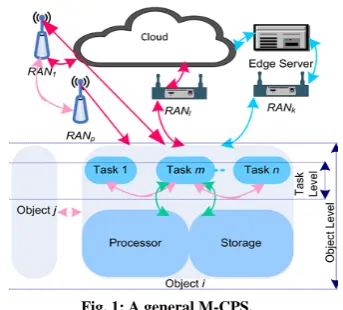
A high-level model for M-CPSs illustrated in Fig.1 which includes objects, often perform a set of tasks, where each generates and/or consumes information which needs to be exchanged with the rest of the M-CPS.
1 K. Navaie is with Lancaster University, LA1 4WA, UK ([email protected]). H. Aghvami is with Kings College
[image:1.595.359.531.507.662.2]London, UK ([email protected]). This work has been supported by the EPSRC. Grant EP/K/022725/1.
The cloud comprises of any available off-board (of the objects) computational capabilities, and fixed comm. infrastructure including the Internet. The main two features of M-CPSs are heterogeneity due to serving billions of different objects and tasks through diverse wireless access networks, and dynamism due to the time-varying nature of tasks, wireless channels, and objects’ mobility.
The task’s performance and consequently M-CPS dependability are both subject to timely, reliable and secure availability of the required information. Information exchange becomes yet more challenging in future M-CPSs with billions of objects.
The conventional approach to provisioning information exchange capability in M-CPSs is solely built upon wireless communications, where available radio resources are allocated to the tasks enabling the required information exchange. Available resources however are time-varying due to heterogeneity and dynamic nature of M-CPSs. Based on this approach, the information exchange provisioning is then reduced into a cross layer radio resource allocation problem covering mechanisms mainly in physical, data-link and network layers. Based on this approach, continuous efforts are being made on the development of new technologies with a higher capacity and enhanced coverage.
In the long-run however, the development of dependable M-CPSs will become unsustainable due to high deployment cost, lack of forward/backward compatibility, and complex interworking protocols. We argue that the solution to these issues is not just about devising new techniques and protocols for improving the quality of the wireless connections. Rather, there is a need to fundamentally rethink the information exchange capability in the wider context of dependable M-CPS. Hence, for versatile development of dependable M-CPSs, there is an immediate and crucial need to seek fresh perspectives on provisioning of information exchange capability which results in low required capital and operational expenditures by exploiting systems intrinsic characteristics. Lack of such fresh perspectives will restrict innovation and competition in the development of dependable M-CPSs.
1.2. Information Exchange Provisioning: Example
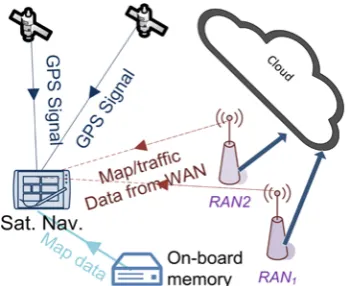
Before elaborating on our proposed approach, we would like to briefly look at the above issues in the context of digital navigation as a task in a smart phone (Fig.2). As it is seen, navigation required the location information as well as digital map and information related to routes and traffic. This information is provided by a combination of Global Positioning Systems, a reference digitized map, which is either stored in the cloud or on-board, and a navigation algorithm, which is also run either on the cloud or on-board. The navigation task is further developed by incorporating the on-line traffic data provided by the cloud. Cloud is accessed through various wireless cellular networks. If connectivity to the satellite signals is lost, the navigation task dependability is
maintained through alternative way of providing the required location data (or a good estimation). Disconnected from the cloud, an alternative is to generate the location information through an on-board geolocation algorithm based on the received signals from nearby WiFi access points.
Interruption of cellular connectivity can be also covered by either switching to an alternative wireless access or standalone operation based on the on-board map data and satellite signal. As it is seen, dependable information exchange to the navigation task can be provided through a flexible adoption of the available system capabilities including on-/off-board data and processing power, and collaboration among various pathways of providing the required information (or part of that).
[image:2.595.342.519.366.509.2]In the other words, although the information exchange for the above system requires strict quality attributes, the way it is provided, as a combination of connectivity, collaboration and on- and off- board computing, is rather flexible (Fig.2). This flexibility introduces new degrees-of-freedom which if recognised and utilised efficiently, are capable of exploiting M-CPSs’ heterogeneity and dynamism of M-CPSs. Extending the above observation, this paper proposes general architectures and concepts which enable dependable provisioning of information exchange to the M-CPS objects. In our approach information exchange provisioning is a capability which is an efficient combination of the on- and off-board processing, storage and communication resources. Dependable information exchange is a collective system capability which enables flexible and efficient exploitation of M-CPS heterogeneity and dynamism which is otherwise overlooked and results in inefficient/failure to provide dependable information exchange in the conventional
approach. This will become even more challenging in Dependable M-CPSs requiring stringent information exchange provisioning to huge number of mobile objects.
1.3. Organisation of the Paper
Here we briefly review the state-of-the-art and look at the role of on- and off-board computing in information exchange provisioning. We then propose a holistic task-centric approach that incorporates the dynamism and heterogeneity of the M-CPSs into the conventional notion of wireless connectivity by conceptualising dependable-exchange of information (DeX). DeX enables exploiting flexibilities in information exchange provisioning, for which we then propose a cloud-base service-oriented solution, DeX-provisioning-as-a-service which enables horizontal scalability and forward compatibility.
2.STATE-OF-THE-ART
The conventional approach on provisioning information exchange capability in M-CPSs is built upon wireless connectivity. The main challenge is to efficiently allocate the limited time-varying radio and network resources to multiple users with different requirements. Heterogeneity and dynamism of wireless systems are generally exploited through opportunistic resource allocation and/or cooperative communications. In the following we review the state-of-the-art from technological and theoretical perspectives.
2.1. Technological Perspective: Interworking and Integration
The earliest works on providing information exchange capability are based on seamless handover among Radio Access Networks (RANs) provided by interworking. Mobile data offloading is an instance of this approach, where complementary network technologies such as wireless LAN (WiFi) are used for delivering data originally targeted for cellular mobile networks [4]. Offloading reduces the amount of data being carried by the mobile system, freeing radio resources for other users. Such approach is also used to address poor indoor radio coverage. Since each of the access technologies have been designed based on different mindsets, interworking among them requires sophisticated protocols and imposes significant signalling overhead, thus might further increase the corresponding end-to-end latency. Interworking techniques result in a complicated mesh of access technologies [5] thus compromise efficiency and horizontal scalability which is crucial in versatile development of M-CPSs [2].
To address the internetworking issues, as well as the exponential growth of information exchange demand on one hand, and the scarcity of radio spectrum on the other, extensive efforts have been made on the integration approach. This approach results in introducing a new generation of mobile systems almost every 10 years. In this approach, various information exchange capabilities ranging from voice, and interactive video, all the way to the short low-latency signalling messages for sensing applications are integrated in a new unified wireless access technology built upon new techniques and protocols. The third generation (3G) cellular systems and later technologies such as LTE, LTE-A, and more recently research on 5G [1] are the artefacts of integration approach. In addition to significant cost of migration to new technologies, the main concern is whether the integration approach can keep up with the pace of changes in both the context and applications of information exchange in M-CPSs, or would act as a bottleneck.
2.2. Theoretical Perspective: Opportunistic Resource Allocation and Cooperation
In both interworking and integration approaches, the information exchange provisioning is often reduced to a resource allocation problem in which resources across RANs and other network resources are adaptively allocated to maximize a collective performance objective. Instances of such performance objectives include energy and spectral efficiency, coverage, cost, and equipment size. Based on this approach, continuous efforts have been made on the development of advanced communication technologies capable of offering higher capacity and enhanced coverage together with various techniques to find an optimum setting for a more efficient radio resource allocation. From the theoretical point of view such techniques can be generally categorized into opportunistic resource allocation, and
cooperative communications. These techniques are developed to exploit the degrees-of-freedom due the heterogeneity and dynamism of wireless systems.
be provided using a lower share of the resources. The retained resources are then allocated to the users with urgent need to ensure their quality. Techniques including multi-user-diversity [6] and multi-access-point-diversity [7] in 3G and 4G technologies are built upon this concept.
This approach is further extended by recognizing new degrees-of-freedom (DoF) across protocol layers based on the cross layer design techniques [8] which form an important part of the related literature. The state-of-the-art in opportunistic resource allocation is mainly focused on providing the information exchange capability solely based on connectivity and often ignores to incorporate objects’ on-board resources, opportunities in the network (i.e., cloud and edge) and tasks’ dynamics. Incorporating these new dimensions requires a holistic approach that enables inclusion of system dynamics in the resource allocation which in practice, needs access to the status information of the system entities. Such an access however imposes intensive signalling.
2.2.2. Cooperation among mobile objects is also utilised in the related literature to further improve connectivity as the main vehicle of providing information exchange capabilities [9]. The simplest cooperative communication setting consists of three entities namely, source, destination, and a set of objects/network entities which act as relays. Instead of providing a direct wireless link between the source and destination, relays located in better circumstances (e.g., closer to the base station) are utilized to improve the source-destination connectivity. Exploiting new DoF provided by cooperation, the same level of end-to-end information exchange quality is achieved by relaying [10]. There have been intensive research activities on the physical layer techniques of cooperative communications. In most of the previous works however, the overall system throughput is traded for a higher information exchange reliability [9].
2.2.3. Combination of opportunistic and cooperative techniques further leads to a variety of multi-hop cooperative radio resource allocation techniques, in which the main challenge is to address the fundamental trade-offs between reliability and throughput on one hand, and signalling overhead and computing complexity, on the other. The cooperative approach also finds its way into higher layers of protocol stack. In such cases cooperation is combined with interworking. For instance, routing and access point selection, as a network layer function, are considered together with the physical layer techniques, to improve the overall information exchange performance [10]. Inter-RAN cooperation also added new dimensions to interworking [4], however for multiple RANs such cooperation techniques will reduce system scalability and impose a higher latency.
As it is seen, the main source of achieving performance improvement in provisioning information exchange capability is to recognise system’s degrees-of-freedom. Techniques are then devised to exploit DoF without compromising other performance objectives in the system. Having a huge number of mobile objects with a wide range of information exchange requirements on one hand, and multiple RANs with their own performance objectives on the other, results in highly complex and computationally intensive protocols with significant signalling overhead. The result is a crucial technical challenge in provisioning of information exchange capabilities in M-CPSs, which become even more complex—also more promising—noting new dimensions added due to the advanced computing technologies.
3.THE ROLE OF ON- AND OFF-BOARD COMPUTING
The processing power and computational capability in mobile objects have been also fundamentally changed due to the emerging solid-state technologies. This enable cost- and energy-efficient access to storage and processing power. which could be utilized in facilitating even more efficient information exchange in M-CPSs.
Back to the example in Section 1.2, the mobile objects could be provided with detailed instruction for navigation through an extensive information exchange with the rest of M-CPS. Another strategy would be to use the location of the adjacent mobile objects as location references, map data stored on-board of the object, and the computing power on the object for evaluating the route, and communication can be only used for sending the updates to the network.
network. Such techniques however, have not yet considered a holistic cooperative framework for improving the information exchange provisioning.
In other words, the state-of-the-art in the cooperative communication is mainly focused on exploiting cooperation opportunities to reduce the required resources for more reliable information exchange among mobile objects. Therefore, they widely overlook settings in which information exchange can be partly substituted with data aggregation [12], on- or off-board computing, and cached contents.
The phenomenal growth in cloud computing technology also brings new prospects to the information exchange in which components of integration and interworking approach could be opportunistically handpicked in favour of more efficient information exchange. Cloud radio access network (CRAN) combines access technology and cloud computing [13] by virtualizing access point functions into the cloud. This leverages cloud computing agility to exploit the system dynamism by creating new DoF which has significant potential in improving resource utilization. Virtualization in CRAN further enables efficient interworking among multiple RANs based on network-wide knowledge which could efficiently be used to adopt cloud computing techniques and generate extra degrees-of-freedom. By focusing solely on the access points, CRAN however fails to exploit dynamism and heterogeneity in the object and task levels.
The current state-of-the-art however lacks a system-wide perspective in which degrees-of-freedom could be recognised and exploited for further improvement of the information exchange provisioning.
4.DEPENDABILITY AND INFORMATION EXCHANGE CAPABILITY
For M-CPSs with dependable tasks, reliability is only one part of the information exchange requirements as, in many cases, latency and security of the information exchange are equally important for dependability of the M-CPS system. An immediate solution is to reengineer the existing RANs and add the required components. Reengineering however adds extra complexity and is even, in many cases, impossible [14]. Another solution is adding such capabilities in the next generation of access technologies based on the integration approach which eventually results in high deployment cost and requires further interworking with the legacy systems. This is in addition to the time needed for such technologies to be made widely available. The result is that M-CPSs are often developed in an ad-hoc manner, creating mash-ups using a variety of different technologies, and being exposed to and having to manage the underlying complexity of multiple access technologies. Another alternative is to design customised access networks, although this is subject to the same argument as above and further delays versatile deployment of Dependable M-CPSs.
We argue that, in principal, lack of ability to fully exploit system’s DoF is due to the connectivity-centric approach in the conventional paradigm which ignores the role of computing and fails to efficiently substitute data transfer with a combination of computing, storage and transferring part of the information (Fig.2). Therefore, extensions to the conventional paradigm are needed in which instead of allocating resources to transfer the information, resource are allocated enabling the tasks to obtain the required information through any possible means, e.g., processing, cooperation in different levels among task, objects, RANs, and computing. While there have been some developments in information exchange provisioning no-one has looked at all these perspectives in tandem. To address this issue, DeX is defined which brings these techniques together and offers a manifesto for development of the dependable M-CPSs.
5.DEPENDABLE INFORMATION EXCHANGE
We define DeX as a task-centric multi-faceted measure indicating the collective system capability to provide the task’s required information. The required DeX is provided through multi-level cooperation among tasks, objects, and radio access technologies as a combination of physical connectivity, on-board processing, collaborations with other system components, and aggregation of the data available on-board or in the cloud.
Let ΩijO, ΩijR, ΩijC be respectively sets of resources in objects, RANs, and Cloud, which are collectively
capable of providing the required DeX to task i. In this formulation, j indexes alternative combination of resources allocated in M-CPS entities, (ΩijR,ΩijR,ΩijO), which are equivalently capable of providing the same
required DeX to task i. Number of such alternative combinations, Ni, is a function of the task’s nature as well as the M-CPS capability to recognise and implement cooperation in different levels, and to utilise computation as an alternative for communication.
For a task i, the minimum required DeX, and actual experienced information exchange quality are defined as
Ni-tuple vectors, Γ=(Γi1,…,ΓiNi), and γ=(γi1,…,γiNi), respectively. In this formulation, Γil (γil) is the minimum
loss ratio). The M-CPS remains dependable if the probability of violating DeX constraints is kept below a given system parameter, ξ, i.e.,Pr{γ<Γ}≤ξ, where γ<Γ indicates that Γi1<γi1,…,ΓiNi<γiNi.
The M-CPS function is then formulated as a multi-objective-optimisation (MO): Opt. ΘO
,ΘR,ΘC (1)
s.t. Pr{γ<Γ}≤ξ,
ΣΣΩijO≤ΩO,ΣΣΩijR≤ΩR,ΣΣΩijC≤ΩC,
(1-a) (1-b)
where ΘO, ΘR, and ΘC represent the performance objectives of the objects, RANs and Cloud, respectively, e.g., minimising on-board required resources and/or connectivity cost, maximising energy efficiency and/or total revenue. Constraint (1-a) is replaced with a set of constraints if different classes of DeX is required for different tasks. In (1), a larger Ni results in a higher DoF, thus the achievable system performance would most likely be higher. Constraints in (1-b) represent the limited resources in three system including entities, objects, RANs, and Cloud e.g., transmit power, computational capacity, radio spectrum, storage capacity, etc.
The MO problem in (1) provides crucial guidelines on how to design the M-CPS entities. The solution to (1) is not a single optimal solution, but a set of achievable trade-offs which is often characterised by a Pareto set [15]. Varieties of algorithms are available to obtain/approximate the corresponding Pareto set. Analysing the corresponding MO and its Pareto optimal set also
provides quantitative insight on the capacity of a dependable M-CPS. Selecting different objectives for M-CPS entities in (1), one can also obtain justified system designs for scenarios, e.g., energy/cost/coverage efficiency.
5.1. Case Study
We consider a network covered by a WiFi hub and a 4G base-station (BS), serving 50 objects each running three task (Table 1). For brevity, we exclude the role of cloud computing. The total running cost of RANs [16] is considered as weighted linear combination of the number of active transmitters in the 4G BS, and their transmission power (Watts), where the former (latter) is weighted by 5[$/no. of active transmitters] (1[$/Watt]). The total running cost of the objects is also a weighted linear combination of computational power (mega flops), and the number of communication modules required for cooperative communications, where the former (latter) is weighted by 1(10). Objects are randomly distributed in the coverage area, where time-varying large (Log-normal shadowing with zero mean and standard deviation of 8db) and short scale (Rayleigh) fading also affect the air interfaces.
In the simulations, the base-station maximum transmit
power is 10 W and WiFi maximum transmit power is 12.5 mw.
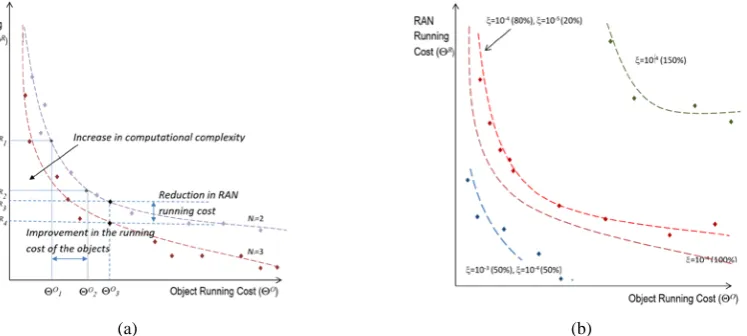
RANs and objects are both managed based on (1), where the objectives are minimizing the running cost of the objects and RANs.Fig.3 demonstrates the normalised total RAN running cost versus normalised object running cost for Ni= 2, 3. The dashed-line plots in Fig.3 are the Pareto sets corresponding to (1) for the above objectives and constraints and the solid points are the actual system operating point. Any point on the Pareto boundary is potentially an optimal operating point, and it can be further utilised to devise adaptive trade-off management schemes. Note that in each system operating points all the objects can perform their tasks with the required DeX quality.
[image:6.595.103.477.54.222.2](a) (b)
Fig 3. RANs’ vs. Objects’ running cost for (a) Ni=2,3, ξ=10-4, (b) Ni=3, combinations of objects with ξ=10-3, 10-4, 10-5, for 50
(100%), and 75 (150%) objects.
Table 1: Tasks and their DeX requirements
Average bit-rate latency Task 1: Variable bit-rate
streaming 10Mb/s 25ms
Fig.3(a) shows that by increasing Ni from 2 to 3, the same object running cost results in a lower RAN running cost, however the complexity of finding the optimal solutions is slightly higher. Fig.3(a) also provides important design insights, e.g., if ΘOfor Ni=3, namely(ΘO
3) is too high, the same DeX can be provided so that
ΘO
2< ΘO3, where the RAN running cost is increased from ΘR3 to ΘR2. It is also seen that increasing Ni, reduces
the running cost of both RANs and Objects for providing the same level of dependable information exchange. This releases resources which could be then allocated to other functions while the information exchange quality is kept constant. The cost however is an increase in the computational complexity and signalling overhead.
In Fig.3(b) Pareto optimal sets are obtained for Ni=3, and various combinations of the objects with different dependable information exchange requirements, ξ=10-3,10-4. As it
is seen, the level of RANs’ and objects’ running cost are both related to the number of the objects, and ξ.
Increasing the
number of objects increases the demand for system
resources. This means that the running cost of the RANs
and Objects will be increased. The same happens where
ξ
is
reduced (tighter DeX requirements). By reducing
ξ
the
network needs to provide a higher level of resources, which
increases the running cost. Fig.3 also
provides quantitative insights on the way number of the objects with different DeX
requirements can be flexibly adjusted.
6.DEX-PROVISIONING-AS-A-SERVICE
Efficient DeX provisioning in dependable M-CPSs requires
access to advanced techniques and a broad skill set. Therefore, without a large market it will be rather expensive for small and medium size enterprises and public end-users to adopt DeX as the core enabler for developing innovative services/applications in dependable M-CPSs.
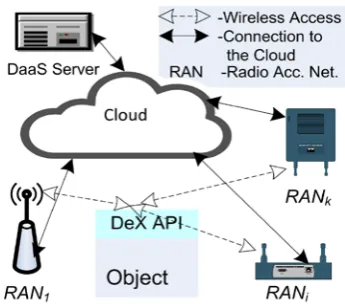
To address this issue, we propose an innovation framework for DeX provisioning-as-a-service (see Fig.4) which acts as a digital ecosystem [1]. An essential enabler for an ecosystem is a well-designed Application-Programming-Interface (API), which plays an important role in the up taking among the stakeholders. An API enables integration of DeX provisioning into various Dependable M-CPS use cases and offer the prospect of commercialisation in a relatively short timescale. A DeXaaS server orchestrates system entities, where the object is communicating to this server through the cloud.
Virtualisation as an integral part of the system will enable the development of continuous DeX monitoring techniques and further prediction of variations in supply of the resources and the corresponding demands. A combination of a priori knowledge, e.g., RANs’ radio coverage map, information provided by the other objects (i.e., crowd-sourcing techniques), and RANs’ status data will be utilised to predict the supply-and-demand behaviour. Based on this new information, DeX provisioning-as-a-service is also capable of running reactive and proactive schemes to ensure resilient DeX provisioning and asses the cost of different levels of DeX provisioning resiliency using MO-based analytical framework.
7.CONCLUSIONS
We proposed DeX as a task-centric measure indicating collective M-CPS capability of information-exchange provisioning. The formulation developed based on DeX provide quantitative insights on the impact of system parameter on the whole system performance which could be utilised in designing more efficient dependable M-CPSs systems. DeX-provisioning-as-a-service was also proposed as a digital-ecosystem to facilitate versatile development of Dependable M-CPSs.
References
[1] P. Demestichas, et al.,"Intelligent 5G Networks: Managing 5G Wireless/Mobile Broadband," IEEE VTech. Magazine, vol.10, pp.41-50, 2015.
[2] Horizon2020 Work Programme 2016–2017: Information and Communication Technologies, available online: http://ec.europa.eu/research/participants/data/ref/h2020/wp/2016_2017/main/h2020-wp1617-leit-ict_en.pdf
[image:7.595.367.540.187.341.2][3] A. Avizienis, et al.,"Basic Concepts and Taxonomy of Dependable and Secure Computing", IEEE TDSC, vol.1,
Fig. 4: DeX-Provisioning-as-a-Service (DeXaaS)
pp.11-33, 2004.
[4] Y. Li, et al.,"Multiple Mobile Data Offloading Through Disruption Tolerant Networks", IEEE TMC, vol.13, pp.1579-1596, 2014.
[5] S. Andreev, et al.,"Intelligent access network selection in converged multi-radio heterogeneous networks," IEEE Wireless Communications, vol.21, pp.86 - 96, 2014.
[6] P. Viswanath, et al.,"Opportunistic beamforming using dumb antennas," IEEE Transactions on Information Theory, vol.48, pp.1277-1294, 2002.
[7] K. Navaie, H. Yanikomeruglu,"Optimal downlink resource allocation for non-realtime traffic in cellular CDMA/TDMA networks," IEEE CommLetters, vol.10, pp.278-280, 2006.
[8] N. Chakchouk,"A Survey on Opportunistic Routing in Wireless Communication Networks," IEEE CST, vol.17, pp.2214-2241, 2015.
[9] G. Bradford, J. Laneman,"A survey of implementation efforts and experimental design for cooperative communications" in Proceedings of ICASSP’10, pp.5602-5605, 2010.
[10] F. Mansourkiaie, M. Ahmed,"Cooperative Routing in Wireless Networks: A Comprehensive Survey," IEEE CST, vol.17, pp.604-626, 2015.
[11] F. Guidolin, et al."Context-Aware Handover Policies in HetNets," IEEE TWC, vol.15, pp.1895-1960, 2015. [12] M. Bagaa, et al.,"Data Aggregation Scheduling Algorithms in Wireless Sensor Networks: Solutions and
Challenges," IEEE CST, vol.16, pp.1339-1368, 2014.
[13] X. Wang, et al.,"Energy-Efficient Virtual Base Station Formation in Optical-Access-Enabled Cloud-RAN," IEEE JSAC, vol.34, pp.1130–1139, 2016.
[14] The Tactile Internet, ITU-T Technology Watch Report, August 2014, available online: http://www.itu.int/dms_pub/itu-t/oth/23/01/T23010000230001PDFE.pdf
[15] Z. Song, et al.,"On the Spectral-Energy Efficiency and Rate Fairness Trade-off in Relay-Aided Cooperative OFDMA Systems," IEEE TWC, vol.15, pp.6342-6355, 2016.