Function Assistant: A Tool for NL Querying of APIs
Kyle Richardson and Jonas Kuhn Institute for Natural Language Processing
University of Stuttgart
Abstract
In this paper, we describe Function Assistant, a lightweight Python-based toolkit for querying and exploring source code repositories using natural language. The toolkit is designed to help end-users of a target API quickly find information about functions through high-level natu-ral language queries and descriptions. For a given text query and background API, the tool finds candidate functions by per-forming a translation from the text to known representations in the API using the semantic parsing approach of Richard-son and Kuhn (2017). Translations are automatically learned from example text-code pairs in example APIs. The toolkit includes features for building translation pipelines and query engines for arbitrary source code projects. To explore this last feature, we perform new experiments on 27 well-known Python projects hosted on Github.
1 Introduction
Software developers frequently shift between us-ing different third-party software libraries, or APIs, when developing new applications. Much of the development time is dedicated to understand-ing the structure of these APIs, figurunderstand-ing out where the target functionality lies, and learning about the peculiarities of how such software is structured or how naming conventions work. When the target API is large, finding the desired functionality can be a formidable and time consuming task. Of-ten developers resort to resources like Google or StackOverflow to find (usually indirect) answers to questions.
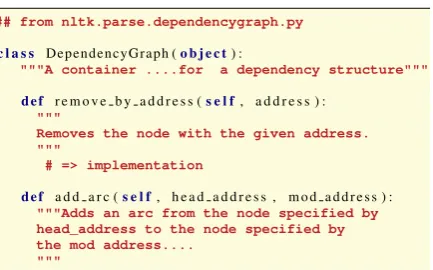
We illustrate these issues in Figure 1 using two
## from nltk.parse.dependencygraph.py
c l a s s DependencyGraph (o b j e c t) :
"""A container ....for a dependency structure"""
def r e m o v e b y a d d r e s s (s e l f, a d d r e s s ) :
"""
Removes the node with the given address. """
# => implementation
def a d d a r c (s e l f, h e a d a d d r e s s , mod address ) :
"""Adds an arc from the node specified by head_address to the node specified by the mod address....
"""
Figure 1: Example function documentation in Python NLTK about dependency graphs.
example functions from the well-known NLTK toolkit. Each function is paired with a short
docstring, i.e., the quoted description under each function, which provides a user of the software a description of what the function does. While understanding the documentation and code re-quires technical knowledge of dependency pars-ing and graphs, even with such knowledge, the function naming conventions are rather arbitrary. The function add arc could just as well be calledcreate arc. An end-user expecting an-other naming convention might be left astray when searching for this functionality. Similarly, the available description might deviate from how an end-user would describe such functionality.
Understanding the remove by address function, in contrast, requires knowing the details of the particular DependencyGraph implementation being used. Nonetheless, the function corresponds to the standard operation of
removing a nodefrom a dependency graph. Here, the technical details about how this removal is specific to a given address might obfuscate the overall purpose of the function, making it hard to find or understand.
[image:1.595.310.527.221.356.2]At a first approximation, navigating a given API requires knowing correspondences between tex-tual descriptions and source code representations. For example, knowing that the English expression
Adds an arcin Figure 1 translates (somewhat ar-bitrarily) toadd arc, or thatgiven address trans-lates to address. One must also know how to detect paraphrases of certain target entities or ac-tions, for example that adding an arc means the same as creating an arc in this context. Other technical correspondences, such as the relation be-tween an address and the target dependency graph implementation, must be learned.
In our previous work (Richardson and Kuhn (2017), henceforth RK), we look at learning these types of correspondences from example API col-lections in a variety of programming languages and source natural languages. We treat each given API, consisting of text and function rep-resentation pairs, as a parallel corpus for train-ing a simple semantic parstrain-ing model. In addi-tion to learning translaaddi-tional correspondences, of the type described above, we achieve improve-ments by adding document-level features that help to learn other technical correspondences.
In this paper, we focus on using our models as a tool for querying API collections. Given a tar-get API, our model learns an MT-based seman-tic parser that translates text to code representa-tions in the API. End-users can formulate natural language queries to the background API, which our model will translate into candidate function representations with the goal of finding the de-sired functionality. Our tool, called Function Assistantcan be used in two ways: as a black-box pipeline for building models directly from ar-bitrary API collections. As well, it can be cus-tomized and integrated with other outside compo-nents or models using the tool’s flexible internal Python API.
In this paper, we focus on the first usage of our tool. To explore building models for new API col-lections, we run our pipeline on 27 open source Python projects from the well-known Awesome Python project list.1 As in previous work, we perform synthetic experiments on these datasets, which measure how well our models can generate function representations for unseen API descrip-tions, which mimic user queries.
1github.com/vinta/awesome-python
2 Related Work
Natural language querying of APIs has long been a goal in software engineering, related to the gen-eral problem of software reuse (Krueger, 1992). To date, a number of industrial scale products are available in this area.2To our knowledge, most implementations use shallow term match-ing and/or information-extraction techniques (Lv et al.,2015), differing from our methods that use more conventional NLP components and tech-niques. As we show in this paper and in RK, term matching and related techniques can sometimes serve as a competitive baseline, but are almost al-ways outperformed by our translation approach.
More recently, there has been increased interest in machine learning on learning code representa-tions from APIs, especially using resources such as GitHub or StackOverflow. However, this work tends to look at learning from many API collec-tions (Gu et al.,2016), making such systems hard to evaluate and to apply to querying specific APIs. Other work looks at learning to generate longer code from source code annotations for natural lan-guage programming (Allamanis et al.,2015), of-ten focusing narrowly on a specific programming language (e.g., Java) or set of APIs. To our knowl-edge, none of these approaches include companion software that facilitate building custom pipelines for specific APIs and querying.
Technically, our approach is related to work on semantic parsing, which looks at generating formal representations from text input for natu-ral language understanding applications, notably question-answering. Many existing methods take direct inspiration from work on MT (Wong and Mooney, 2006) and parsing (Zettlemoyer and Collins,2009). Please see RK for more discussion and pointers to related work.
3 Technical Approach
In this paper, we focus on learning to generate function representations from textual descriptions inside of source code collections, or APIs. We will refer to these target function representations asAPI components. Each component specifies a function name, a list of arguments, and other op-tional information such as a namespace.
Given a set of example text-component pairs from an example API,D={(xi, zi)}ni=1, the goal
is to learn how to generate correct, well-formed componentsz ∈ C for each textx. When viewed as a semantic parsing problem, we can view eachz
as analogous to a target logical form. In this paper, we focus narrowly on Python source code projects, and thus Python functionsz, however our methods are agnostic to the input natural language and out-put programming language as shown in RK.
When used for querying, our model takes a text input and attempts to generate the desired func-tion representafunc-tion. Technically, our approach fol-lows our previous work and has two components: a simple and lightweight word-based translation model that generates candidate API components, and a discriminative model that reranks the trans-lation model output using additional phrase and document-level features. All of these models are implemented natively in our tool, and we describe each part in turn.
3.1 Translation Model
Given an input text (or query) sequence x =
w1, .., w|x|, the goal is to generate an output API
componentz = ui, .., u|z|, which involves learn-ing a conditional distributionp(z |x). We pursue a noisy-channel approach, where
p(z|x)∝p(x|z)p(z)
By assuming a uniform prior p(z) on output components, the model therefore involves com-putingp(x | z), which under a word-based trans-lation model can be expressed as:
p(x|z) =X
a
p(x, a|z)
where the summation ranges over the set of all many-to-one (word) alignmentsafromx→z.
While many different formulations of word-based models exist, we previously found that the simplest lexical translation model, or IBM Model 1 (Brown et al.,1993), outperforms even higher-order alignment models with location parameters. This model computes all alignments exactly using the following equation:
p(x|z)≈
|x|
Y
j=1 |z|
X
i=0
pt(wj |ui) (1)
whereptdefines a multinomial distribution over a
given component termuj for all wordswj.
While many parameter estimation strategies ex-ist for training word-based models, we similarly found that the simplest EM procedure of Brown et al.(1993) works the best. In RK, we describe a linear-time decoding strategy (i.e., for generating components from input) over the number of com-ponentsC, which we use in this paper. Our tool also implements our types of conventional MT de-coding strategies that are better suited for large APIs and more complex semantic languages.
3.2 Discriminative Reranking
Following most semantic parsing approaches (Zettlemoyer and Collins, 2009), we use a dis-criminative log-linear model to rerank the com-ponents generated from the underlying translation model. Such a model defines a conditional distri-bution:p(z|x;θ)∝eθ·φ(x,z), for a parameter vec-torθ∈Rb, and a set of feature functionsφ(x, z).
Our tool implements several different training and optimization methods. For the purpose of this paper, we train our models using an online, stochastic gradient ascent algorithm under a max-imum conditional log-likelihood objective.
3.2.1 Features
For a given text input x and output component
z, φ(x, z) defines a set of features between these two items. By default, our pipeline implementa-tion uses three classes of features, identical to the feature set used in RK. The first class includes ad-ditional word-level features, such as word/compo-nent match, overlap, compoword/compo-nent syntax informa-tion, and so on. The second includes phrase and hierarchical phrase features between text and com-ponent candidates, which are extracted standardly from symmetric word-level alignment heuristics.
The other category of features includes document-level features. This includes informa-tion about the underlying API class hierarchy, and relations between words/phrases and abstract classes within this hierarchy. Also, we use additional textual description of parameters in the docstrings to indicate whether word-components candidate pairs overlap in these descriptions.
4 Implementation and Usage
## pipeline parameters
params = [
(”−b a s e l i n e ”,” b a s e l i n e ”, False ,” bool ”,
”Use b a s e l i n e model [ d e f a u l t = F al s e ] ”,” GPipeline ”) ]
## Zubr pipeline tasks
t a s k s = [
” zubr . d o c e x t r a c t o r . DocExtractor ”,# extract docs
” p r o c e s s d a t a ”, # custom function.
” zubr . SymmetricAlignment ”,# learn trans. model.
” zubr . Dataset ”, # build dataset obj.
” zubr . FeatureExtractor ”, ## build extractor obj.
” zubr . Optimizer ”, ## train reranking model
” zubr . QueryInterface ”, # build query interface
” zubr . web . QueryServer ”, # launch HTTP server
]
def p r o c e s s d a t a ( c o n f i g ) :
"""Preprocess the extracted data using a custom function or outside library (e.g., nltk)
:param config: The global configuration """
[image:4.595.72.290.58.274.2]p r e p r o c e s s f u n c t i o n ( c o n f i g , . . . )
Figure 2: An example pipeline script for building a translation model and query server.
functionality is written in Cython 3, which is a compiled superset of the Python language that fa-cilitates native C/C++ integration.
The tool is designed to be used in two ways: first, as a black-box pipeline to build custom trans-lation pipelines and API query engines. The tool can also be integrated with other components us-ing our Cython and Python API. We focus on the first type of functionality.
4.1 Library Design and Pipelines
Our library uses dependency-injection OOP de-sign principles. All of the core components are implemented as wholly independent classes, each of which has a number of associated configura-tion values. These components interact via a class called Pipeline, which glues together various user-specified components and dependencies, and builds a global configuration from these compo-nents. Subsequent instantiation and sharing of ob-jects is dictated, orinjected, by these global con-figurations settings, which can change dynami-cally throughout a pipeline run.
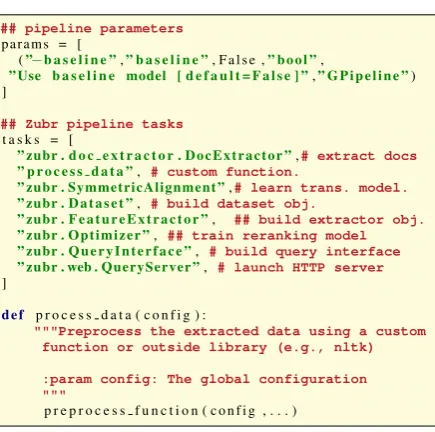
Pipelines are created by writing pipeline scripts, such as the one shown in Figure 2. This file is an ordinary Python file, with two mandatory vari-ables. The first params variable specifies vari-ous high-level configuration parameters associated with the pipeline. In this case, there is a set-ting --baseline, which can be evoked to run
3http://cython.org/
a baseline experiment, and will effect the subse-quent processing pipeline.
The second, and most important, variable is called tasks, and this specifies an ordering of subprocesses that should be executed. The fields in this list are pointers to either core utilities in the underlying Zubr toolkit (each with the pre-fix zubr.), or user defined functions. This par-ticular pipeline starts by building a dataset from a user specified source code repository, using DocExtractor, then builds a symmetric trans-lation model SymmetricAlignment, a fea-ture extractorFeatureExtractor, a discrim-inative rerankerOptimizer, all via various in-termediate steps. It finishes by building a query interface and query server, QueryInterface andQueryServer, which can then be used for querying the input API.
As noted already, each subprocesses has a num-ber of associated configuration settings, which are joined into a global configuration object by the Pipelineinstance. For the translation model, settings include, for example, the type of trans-lation model to use, the number of iterations to use when training models, and so on. All of these settings can be specified on the terminal, or in a separate configuration file. As well, the user is free to define custom functions, such as process data, or classes which can be used to modify the default processing pipeline or imple-ment new ML features.
4.2 Web Server
The last step in this pipeline builds an HTTP web server that can be used to query the input API. In-ternally, the server makes calls to the trained trans-lation model and discriminative reranker, which takes user queries and attempts to translate them into API function representations. These candi-date translations are then returned to the user as potential answers to the query. Depending on the outcome, the user can either rephrase his/her question if the target function is not found, or look closer at the implementation by linking to the function’s source code.
Figure 3: An example screen shot of theFunction Assistantweb server.
Project # Pairs # Symbols # Words Vocab.
scapy 757 1,029 7,839 1,576
zipline 753 1,122 8,184 1,517
biopython 2,496 2,224 20,532 2,586
renpy 912 889 10,183 1,540
pyglet 1,400 1,354 12,218 2,181
kivy 820 861 7,621 1,456
pip 1,292 1,359 13,011 2,201
twisted 5,137 3,129 49,457 4,830
vispy 1,094 1,026 9,744 1,740
orange 1,392 1,125 11,596 1,761
tensorflow 5,724 4,321 45,006 4,672
pandas 1,969 1,517 17,816 2,371
sqlalchemy 1,737 1,374 15,606 2,039
pyspark 1,851 1,276 18,775 2,200
nupic 1,663 1,533 16,750 2,135
astropy 2,325 2,054 24,567 3,007
sympy 5,523 3,201 52,236 4,777
ipython 1,034 1,115 9,114 1,771
orator 817 499 6,511 670
obspy 1,577 1,861 14,847 2,169
rdkit 1,006 1,380 9,758 1,739
django 2,790 2,026 31,531 3,484
ansible 2,124 1,884 20,677 2,593
statsmodels 2,357 2,352 21,716 2,733
theano 1,223 1,364 12,018 2,152
nltk 2,383 2,324 25,823 3,151
sklearn 1,532 1,519 13,897 2,115
Table 1: New English Github datasets.
side of the image shows the hyperlink path to the original source in Github for thetrainfunction.
5 Experiments
Our current DocExtractor implementation supports building parallel datasets from raw Python source code collections. Internally, the tool reads source code using the abstract syntax tree utility, ast, in the Python standard library, and extracts sets of function and description pairs. In addition, the tool also extracts class descrip-tions, parameter and return value descripdescrip-tions, and
information about the API’s internal class hierar-chy. This last type of information is then used to define document-level features.
To experiment with this feature, we built pipelines and ran experiments for 27 popular Python projects. The goal of these experiments is to test the robustness of our extractor, and see how well our models answer unseen queries for these resources using our previous experimental setup.
5.1 Datasets
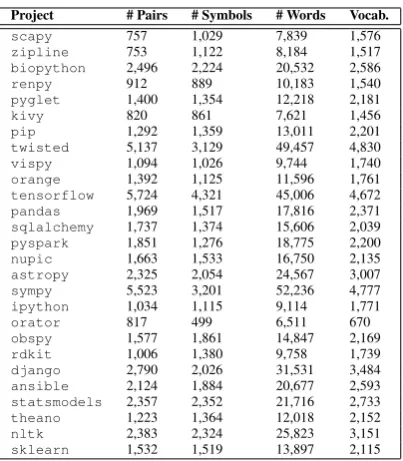
The example projects are shown in Table 1. Each dataset is quantified in terms of # Pairs, or the number of parallel function-component represen-tations, the # Symbols in the component output language, the#(NL)WordsandVocabsize.
5.2 Experimental Setup
Each dataset is randomly split into train, test, and dev. sets using a 70%-30% (or 15%/15%) split. We can think of the held-out sets as mimicking queries that users might ask the model. Stan-dardly, all models are trained on the training sets, and hyper-parameters are tuned to the dev. sets.
For a unseen text input during testing, the model generates a candidate list of component outputs. An output is considered correct if it matches ex-actlythe gold function representation. As before, we measure the Accuracy @1, accuracy within top ten (Accuracy @10), and theMRR.
[image:5.595.81.283.323.554.2]Method scapy zipline biopython renpy pyglet kivy pip twisted vispy
BoW 00.0 51.3 17.4 01.7 38.3 12.9 05.8 54.8 20.4 06.6 41.1 16.6 05.7 52.3 19.2 07.3 53.6 22.0 06.2 40.9 17.1 06.6 38.8 16.9 07.3 48.7 18.6
Term Match 21.243.3 28.7 28.5 50.8 36.2 23.5 48.1 31.7 25.7 59.5 38.7 20.4 50.9 31.2 30.0 62.6 41.3 19.1 50.2 30.7 17.6 44.1 26.2 29.2 64.0 41.1
Translation 20.3 61.9 34.7 27.6 62.5 40.7 29.6 75.6 45.8 30.8 61.7 42.0 26.1 69.5 41.3 33.3 67.4 45.3 18.6 56.4 32.3 27.7 61.4 39.4 28.6 70.1 42.3
Reranker 21.2 67.2 37.2 30.3 70.5 45.3 32.3 79.1 48.6 38.9 73.5 48.9 29.0 77.1 45.5 35.7 75.6 49.1 25.9 65.8 39.9 28.8 65.8 42.2 33.5 80.4 50.3
Method orange tensorflow pandas sqlalchemy pyspark nupic astropy sympy ipython
BoW 13.4 60.5 29.1 09.4 47.4 21.2 03.7 40.6 15.6 07.3 45.0 18.4 07.5 50.9 20.8 06.4 55.0 22.8 07.7 52.0 21.1 06.4 44.4 18.5 01.9 41.2 13.9
Term Match 37.9 69.7 49.3 25.2 48.7 33.5 19.3 43.7 27.9 17.3 48.4 26.6 20.5 46.9 29.1 23.6 51.0 33.1 26.1 49.1 34.3 20.2 44.9 28.8 23.8 56.7 33.8
Translation 40.3 78.3 54.0 35.3 71.5 48.0 29.1 62.7 41.0 28.8 70.3 43.0 37.1 78.7 52.1 30.969.8 44.6 30.7 66.6 43.4 32.870.2 45.5 24.5 59.3 36.5
Reranker 45.1 84.1 59.9 38.4 77.7 51.8 31.1 66.1 43.1 35.0 76.1 49.7 41.5 81.5 55.3 29.376.7 45.6 33.9 74.4 47.4 32.175.0 46.6 29.6 66.4 42.3
Method orator obspy rdkit django ansible statsmodels theano nltk sklearn
BoW 10.6 66.3 28.6 06.7 49.5 20.2 05.3 40.6 17.1 04.5 40.9 16.2 17.9 55.3 30.5 05.6 46.1 18.6 03.2 43.7 16.2 05.0 44.2 16.3 05.2 45.8 17.7
Term Match 31.9 64.7 43.7 19.9 46.6 30.0 13.3 46.6 23.9 19.3 48.0 29.1 24.8 54.0 35.8 16.7 39.9 25.1 16.3 37.1 24.0 19.8 45.6 28.4 24.4 50.6 32.5
Translation 32.779.5 47.5 33.8 75.8 48.3 25.360.6 37.2 22.9 57.8 34.6 35.5 71.6 47.5 25.4 64.8 37.8 26.2 58.4 37.8 28.2 68.0 41.5 27.9 67.6 41.3
[image:6.595.87.521.60.203.2]Reranker 32.7 82.7 49.7 37.7 80.0 52.3 25.3 63.3 39.6 25.8 64.5 39.4 40.5 77.0 53.1 28.8 69.1 41.7 27.3 66.1 39.9 31.6 72.5 45.7 29.2 75.5 44.5 Accuracy @1 Accuracy @10 Mean Reciprocal Rank (MRR)
Table 2: Test results on our new Github datasets.
(BoW) model, which uses word-component pairs as features. The second is aTerm Matchbaseline, which ranks candidates according to the number of matches between input words and component words. We also compare the results of the Trans-lation(model) without the reranker.
6 Results and Discussion
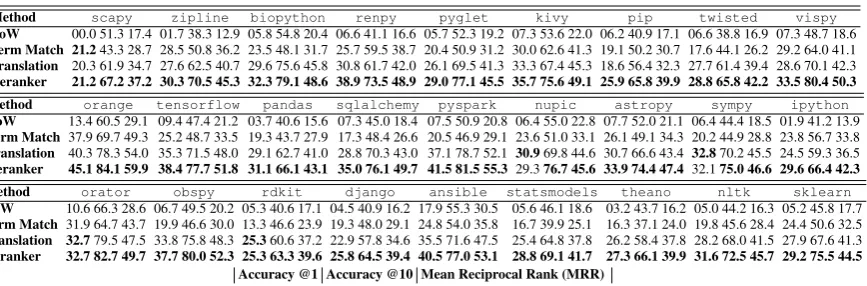
Test results are shown in Table 2, and largely conform to our previous findings. The BoW
and Term Matchbaselines are outperformed by all other models, which again shows that API querying is more complicated than simple word-component matching. TheRerankermodel leads to improvements on all datasets as compared with only using theTranslationmodel, indicating that document-level and phrase features can help.
We note that these experiments are synthetic, in the sense that it’s unclear whether the held-out examples bear any resemblance to actual user queries. Assuming, however, that each held-out set is a representative sample of the queries that real users would ask, we can then interpret the re-sults as indicating how well our models answer queries. Whether or not these held-out examples reflectrealqueries, we believe that they still pro-vide a good benchmark for model construction. All code and data will be released to facilitate fur-ther experimentation and application building. Fu-ture work will look at eliciting more naturalistic queries (e.g., through StackOverflow), and doing usage studies via a permanent web demo4.
7 Conclusion
We introduce Function Assistant, a lightweight tool for querying API collections using
uncon-4see demo here:http://zubr.ims.uni-stuttgart.de/
strained natural language. Users can supply our tool with target source code projects and build cus-tom translation or processing pipelines and query servers from scratch. In addition to the tool, we also created new resources for studying API querying, in the form of datasets built from 27 popular Github projects. While our approach uses simple components, we hope will that our tool and resources will serve as a benchmark for fu-ture work in this area, and ultimately help to solve everyday software search and reusability issues.
References
Miltiadis Allamanis, Daniel Tarlow, Andrew D Gor-don, and Yi Wei. 2015. Bimodal modelling of source code and NL. InProceedings of ICML. Peter F Brown, Vincent J Della Pietra, Stephen A Della
Pietra, and Robert L Mercer. 1993. The mathemat-ics of SMT. Computational linguistics, 19(2). Xiaodong Gu, Hongyu Zhang, Dongmei Zhang, and
Sunghun Kim. 2016. Deep API Learning. arXiv preprint arXiv:1605.08535.
Charles W. Krueger. 1992. Software reuse. ACM Com-puting Surveys (CSUR), 24(2).
Fei Lv, Hongyu Zhang, Jian-guang Lou, Shaowei Wang, Dongmei Zhang, and Jianjun Zhao. 2015. Codehow: Effective code search based on api under-standing and extended boolean model (e). In Pro-ceedings of ASE.
Kyle Richardson and Jonas Kuhn. 2017. Learning Se-mantic Correspondences in Technical Documenta-tion. InProceedings of ACL.
Yuk Wah Wong and Raymond J. Mooney. 2006. Learn-ing for Semantic ParsLearn-ing with Statistical Machine Translation. InProceedings of HLT-NAACL. Luke S. Zettlemoyer and Michael Collins. 2009.