Language Development of Individuals Who Require Aided Communication: Reflections on State of the Science and Future Research Directions
Martine M. Smith Trinity College Dublin, Ireland
Martine Smith, Ph.D., Clinical Speech & Language Studies, 7-9 South Leinster Street, Trinity College Dublin, Ireland.
Abstract
Language acquisition theories differ in the importance they assign to production as a learning mechanism. This review summarizes some of the theoretical issues linked to this debate and considers their implications for children with severe speech and physical impairments. The unique aspects of the language-learning contexts of these children are explored. Drawing largely on papers published within the journal Augmentative and Alternative Communication, this review summarizes features of language development that have been described over the past 3 decades and considers how these findings might illuminate our understanding of language development across both spoken and aided modalities. Implications for assessment, intervention and for further research are suggested.
Language Development of Individuals Who Require Aided Communication:
Reflections on State of the Science and Future Research Directions
This review of language development in individuals who require AAC is selective in scope. It focuses primarily on language development in children with severe speech and physical impairments whose cognitive abilities are presumed to be close to the average range, similar to the children described by Light, Collier, and Parnes (1985a) in the first issue of Augmentative and Alternative Communication. Over the decades since that first issue, much
has changed, including awareness of communication rights, conceptualizations of disability, and the penetration of technology into every aspect of daily life. The emergence of new technologies has reduced some of the communication barriers experienced by the pioneering individuals using aided communication. However, symbol boards and books have maintained their place, perhaps reflecting their reliability (Shepherd, Campbell, Renzoni, & Sloan, 2009; Smith & Connolly, 2008) and the unique communication space they offer in interactions (Iacono, Lyon, Johnson, & West, 2013; Murphy, 2004). In all of these developments, the AAC journal has played a pivotal role. Partly for this reason, this review draws heavily on
papers published within AAC, in particular two special issues (Light, 1992; Paul, 1997a) that focused on language development and highlighted the challenges of describing and
understanding language in children whose access to conventional expressive communication is limited.
A Starting Point
relatively late in developmental terms. They may have few role models and rarely interact with more expert aided communicators (Light, 1988). Against this backdrop, they engage with multiple modalities and use complex and contrasting symbol systems to become creative and often exceptional language users. This paper focuses on some of the challenges they must overcome and explores how understanding their journey might inform not only our
interventions but also our understanding of language and language development. Valian (2014) suggests that describing (syntactic) language acquisition requires specification of four interrelated dimensions: (a) the child’s innate endowment; (b) the final state, or adult’s knowledge; (c) the internal mechanism(s) that gets the learner from the initial to the final state; and (d) the role of input in that process. While debate continues on how best to specify each component, considerable progress has been made in understanding language, learning mechanisms, and the role of input for spoken and signed language development. However, the picture in relation to aided communication is far less clear. Consider, for example, the following extracts of conversations. The first (see Table 1) is between a child without speech difficulties and his caregiver (Saxton, 2000, p. 229).
Insert Table 1 here
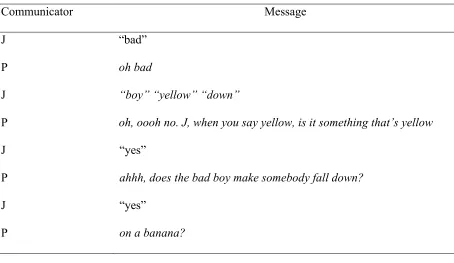
Contrast the child and adult roles and contributions in Table 1 with the extract in Table 2, where J, a young boy using aided communication, described events in a video to his educational assistant (Smith, Murray, & von Tetzchner, 2014). Vertical constructions
(Scollon, 1976), such as those represented in this extract are a common feature of interactions involving aided communication, with messages constructed across multiple turns and glossed expansively by speaking partners, making it difficult to determine where utterance
the extract in Table 1. In fact, it is difficult to determine what aspects of the agreed message in the interaction in Table 2 are owned by the child using aided communication.
Insert Table 2 here
In a similar example from McCord and Soto (2004), a researcher asked Andrea what she liked about her speech generating device (see Table 3). In this extract, the question arises: Is the agreed gloss really what Andrea is saying, even if it is what she is meaning?
Insert Table 3 here
In the extract in Table 1, inferences can be made about the child’s current language knowledge and the target final state. Various interpretations can be offered for the intent and impact of the adult input (“You lost your hands?”) and what that may mean for the learning mechanisms supporting transition from the child’s state to an adult state of language
knowledge. However, in the extracts in Tables 2 and 3, such inferences are much more difficult. For one thing, less is known about the possible final state, or adult knowledge of graphic symbol or aided communication. Indeed it is far from clear whether is it reasonable to talk about a final state of aided communication separate from spoken language, or whether it is conceivable that for some individuals, graphic symbol communication develops as a complementary system for linguistic communication, rather than a sub-set of a spoken language competence. What might the sequences of symbols/words in Tables 2 and 3
represent, what might they reflect of a child’s underlying language abilities, and what are the implications of these kinds of language experiences for the language and communication development of children using aided communication systems?
and aided language learning. Consequently, the study of language development in children with severe speech impairments can guide decisions for individual children, but may also help illuminate theoretical questions on language and language development (Sutton, Soto, & Blockberger, 2002). The rest of this paper explores some of these issues. It is structured in five sections: theoretical considerations, the final state of spoken and aided language
knowledge, language learning mechanisms, the role of communication partners, and clinical and research implications.
Throughout the paper, the focus is primarily on children described by von Tetzchner and Martinsen (2000) as expressive language users of aided communication: those with a motor impairment and limited or no functional speech, but who are presumed to be
developing receptive spoken language. However, even this selective focus captures a wide diversity of abilities, not only in physical, sensory, and cognitive resources but also in terms of speech production abilities - factors to consider in interpreting the findings presented in this paper. The scope of the discussion is further restricted in that it does not include literacy development, but focuses instead on development of spoken language comprehension and expressive use of aided communication. Given the breadth of the discussion, the emphasis is further constrained to what might be considered early stages of expressive language
Theoretical Considerations
Theories that ascribe language-specific knowledge to the child’s initial state (e.g., Chomsky, 1986; Pinker, 1994) endorse highly specific learning mechanisms, triggered largely by exposure to input, to explain the transition from a child to an adult state of language knowledge. For example, there is some evidence that children who undergo a tracheostomy shortly after birth go on to develop speech and language skills, despite lack of access to speech production (Adamson & Dunbar, 1991; Bohm, Nelson, Driver, & Green, 2010). Language acquisition in this view is something that happens to the child, rather than something a child does (Hockema & Smith, 2009). While final language knowledge states may differ within certain parameters, particularly if the developmental context is atypical, such differences should logically be individual, shaped by an individual’s endowment. Shared or common patterns of difference across groups of individuals with constrained speech production abilities are not predicted.
In addition to potentially informing our understanding of language learning
mechanisms, exploration of the development of aided communication competence may help identify what Goldwin-Meadow (2014), describes as resilient properties of language, those properties that emerge most consistently and early in development, even where conventional forms of language production are not easily accessible. If patterns of language production can be identified across the output of individuals using aided communication, such patterns seem to be potential candidates for resilient properties. Therefore, studying the language
development of children who use aided communication can potentially shed light on the role of production as a language learning mechanism as well as some of the properties of
language itself.
Towards a Final State of Language Knowledge
Bloom and Lahey (1978) described language in terms of three intersecting domains: language content (semantic components including vocabulary knowledge); language form (the structural aspects of language including syntax, morphology and phonology); and language use (the ability to use language in context for social purposes). Children learning language who use aided communication are developing competence in each of these aspects of spoken language, while simultaneously learning how their aided language system
interfaces and integrates with their spoken language competence. In so doing, they face a number of challenges. The interface between their spoken language resources and their aided system may not be straightforward. Their aided vocabulary may represent only a small subset of their spoken language content, may include vocabulary not yet within their spoken
morphemes of spoken language. Furthermore, aided language symbols may represent only one aspect of language form in complex multimodal systems that include body movements, gestures, and manual signs.
Finally, as outlined by Light (1997), effective use of aided communication may require specific use knowledge beyond that which supports spoken language competence. Given these differences, it seems unlikely that spoken language competence will be mirrored fully in aided communication output. In the sections that follow, consideration is given separately to spoken language comprehension and aided language production, despite the fact that children are presumed to be developing both simultaneously.
Spoken Language Comprehension
For many aided communicators, receptive language skills may be a strength relative to other aspects of cognitive functioning (Berninger & Gans, 1986; Ross & Cress, 2006), and perhaps a more reliable measure of overall cognitive ability in very young children
Spoken language content. Language content comprises the meaning aspects of
language (literal and non-literal), including vocabulary and knowledge of objects and events. Vocabulary development accelerates across the preschool years and extends across the lifespan (P. Bloom, 2000), driving structural changes in language and interacting in complex ways with literacy learning and academic attainment (e.g., Nagy & Anderson, 1984; Paul & Norbury, 2012). Children with physical impairments may have different experiences from their peers and hence may infer different meanings that are relevant and salient for them. As with all children, they have to learn how those meanings map onto words. Although language skills may be a relative strength for individuals who use aided communication, where
vocabulary scores from formal assessments are reported, they are often unexpectedly low (Blockberger & Johnston, 2003; Bruno & Trembath, 2006; Kent-Walsh, Binger, & Hasham, 2010). For example, the mean vocabulary standard score of the seven participants described by Lund and Light (2006) was 66 (range 44-77), and even Josh, who was described as an academically competitive high school student, achieved a standard score of 77.
Explanations for such differences in spoken vocabulary knowledge are probably multidimensional, but different language, literacy, and academic experiences are likely part of the picture. Given the potential importance of vocabulary to literacy development, further attention to the learning mechanisms and input necessary to support effective spoken
language vocabulary learning seems warranted.
Spoken language form: Comprehension of syntax and morphology. Children with
revealed in carefully constructed probes, for example, using grammaticality judgment tasks (e.g., Berninger & Gans, 1986). Grammaticality judgments draw primarily on implicit
knowledge (participants can recognize an error but may not be able to explain why a structure is ungrammatical) and are a widely used tool for measuring sensitivity to grammatical
principles (Weinert, 2009). Children (Blockberger & Johnston, 2003), adolescents (Redmond & Johnston, 2001) and adults (Sutton & Gallagher, 1993) who use aided communication have been found to have specific difficulties with a range of morphosyntactic judgments, including marking of obligatory inflections (e.g., she fall; Redmond & Johnston, 2001) and recognition and application of regular/irregular verb class distinctions (Sutton & Gallagher, 1993). Blockberger and Johnston (2003) found that even when matched for vocabulary with peers with language delay, children with severe speech impairments made more errors across a range of receptive morphology measures. These findings suggest that there may be specific aspects of the language learning experiences associated with speech production difficulties that make it more difficult to construct a fully specified final state of knowledge of language structure – a theme re-visited in the discussion of language learning mechanisms in the section on the role of communication partners.
Aided Language Production
Although it has been argued that a developmental model may not be entirely
satisfactory in capturing expressive language development in aided communication (Gerber & Kraat, 1992), given the different developmental experiences and language resources, it nonetheless may be a useful reference point in interventions with children who use aided communication (Bedrosian, 1997; Harris, Skarakis-Doyle, & Haaf, 1996). However, how should developmental progressions in aided communication be mapped? In part, the answer to this question rests on what we consider to be the underlying mechanisms in aided
Underlying mechanisms in aided language production. One possibility is that
individuals generate a message from a spoken language base and convert the intended message into an aided form through processes variously described as translation (Smith & Grove, 1999), transposing (Sutton & Morford, 1998), or paraphrasing (Hjelmquist, Dahlgren-Sandberg, & Hedelin, 1994). An alternate view is that lexical items may be represented internally in multiple modes, and messages might be encoded within the aided modality from the outset (e.g., Loncke, VanderBeken, & Lloyd, 1997; Smith, 1996). Whether encoded in graphic symbols or recoded into that form, it seems plausible that the message is influenced by the modality itself in a number of ways, in terms of the content and form of expressions (see Light, 1997; Smith & Grove, 2003; Trudeau, Sutton, & Morford, 2014).
In picture-like graphic symbols, information is presented simultaneously rather than temporally: the verb “to sit” is represented by a person sitting; “throw” is represented by a person throwing and/or an object being thrown. The simultaneous presence of agents and actions within one symbol may blur distinctions about the dimension of the symbol in focus or whether or not a single dimension should be extracted. The temporal ordering of spoken language reflects the nature of the tools available, just as organization of manual sign languages maximizes spatio-temporal parameters. Graphic-based communication systems may bias children towards alternative organizational structures – the need to temporally sequence items may not be obvious.
construct relative clauses using a limited set of symbols, varied word order and created adjacency pairs to reduce potential semantic ambiguities. Another way the modality can affect word order is through the organization principles of the system itself. For example, tense may be marked by selecting a tense marker before a verb, unlike the post-verbal tense marking of English. Aided communication may reflect this word order even in written output (Hjelmquist et al., 1994; Soto & Toro-Zambrana, 1995; Sutton & Gallagher, 1993).
Finally, as evident in the extracts in Tables 2 and 3, speaking partners play a
significant role in shaping how aided communication messages are structured and interpreted. These factors combine to temper the inferences to be drawn about the links between the content and structure of aided communication output, what it may represent of a child’s spoken language knowledge, and how developmental progressions may best be mapped.
Aided language content. In addition to developing a system of meanings and
Much of the early research on symbols explored how the perceptual match between graphic symbols and referents might influence children’s learning of symbol meanings (Mizuko, 1987; Yovetich & Young, 1988), leading to a productive research focus on the impact of iconicity on learnability and retention of symbols (Alant, Zheng, Harty, & Lloyd, 2013; Dada, Huguet, & Bornman, 2013) and, more recently, on the impact of animation (Fujisawa, Inoue, Yamana, & Hayashi, 2011; Schlosser et al., 2012). There is now considerable evidence that symbols that are highly iconic are more easily learned and remembered, but Stephenson (2009) cautions that iconicity is, to a certain extent, in the eye of the beholder, influenced by prior experience with picture recognition and use.
Longitudinal research with children with significant disabilities indicates that from an early developmental age, children can learn to use abstract graphic symbols for communication, if given the appropriate supports (Adamson, Romski, Bakeman, & Sevcik, 2010; Barton, Sevcik, & Romski, 2006; Romski & Sevcik, 1989; Sevcik, Romski, & Wilkinson, 1991). Learning what a symbol represents (means) is not the same as learning what it is for, and evidence of a differential impact of iconicity on how children learn to use graphic symbols remains elusive.
DeLoache (2000) has argued that in order to use a picture as a symbol, children must be able to perceive it as an object and as something that represents another object (see
The question arises then, what do children perceive the symbols on a communication board to be? Are they pictures? Or “words” with a relationship to specific referents
comparable to spoken words? Or symbols that share perceptual attributes with certain things but have a symbolic relationship that is much broader than the perceptual base might imply? Speaking partners may also be unclear as to the meanings graphic symbols encode. For example, Basil (1992) described how a boy pointed to the graphic symbol SAD on his communication board; his mother commented on the “sad doll” and asked him to find a happy doll, as if he were referring to the picture referentially rather than using a symbol to express that something was wrong. Access to speech output from an early age may be useful in clarifying this symbolic role, partly through applying the spoken label that Callaghan (2000) suggests primes children to attend to pictures as symbols. Simultaneously, speech output may highlight the communicative purpose of symbols to the interaction partner.
Even where the communication function of graphic symbols is understood, it may be very difficult to construct a shared understanding of what is being talked about with a limited set of symbols that forces extension of symbol meaning far beyond the transient phase of over-extension reported for speaking children (Clark, 2003). For example, Mike, a 3-year-old child described by Gerber and Kraat (1992), was reported by his mother to point to WATER repeatedly and “out of the blue.” She was frustrated at not being able to determine what he meant, and suspected he was playing games rather than having something to say. It emerged that Mike was referring to a favorite activity of playing at a water fountain. Far from
randomly pointing at symbols, he was engaging in independent talk about events displaced in time and location.
Examples of collaborative construction of referents across sequences of dialogue are evident in many extracts of talk between aided and natural speakers (e.g., Clarke &
perhaps better construed as “referring expressions” (Collins, 1996, p. 89), whose function is to identify the topic of conversation so that speaking partners may elaborate (Hjelmquist, 1999; von Tetzchner & Martinsen, 1996). In this context, single symbols selected in aided interactions are not easily comparable to the early single word utterances of speaking children. The content-use relationships may fundamentally differ from spoken language word-meaning pairings, with inevitable implications for the form or structures produced. Meaning-making processes in interactions involving aided communication may differ in important ways from spoken language as well, a theme re-visited later.
Multimodal content. A final complication in relation to content aspects of the output
of children who use aided communication is that aided symbols may account for only a small proportion of their expressive communication (Clarke & Wilkinson, 2007; Light, Collier, & Parnes, 1985c; Simpson, Beukelman, & Sharpe, 2000; Smith 1994). In addition to developing spoken language and learning aided communication, children may develop complex unaided communication systems across a range of modalities, with ways of encoding meanings that are interpretable by only a small number of communication partners (see, for example, L.M. described by Trefler & Crislip, 1985). Remarkably few studies have focused on how these multi-modal systems develop and change over time (for one example, see Heim & Baker-Mills, 1996), making it difficult to construct a clear picture of what a final state of aided language content knowledge could or should look like. Longitudinal studies are only now emerging (Hunt-Berg, 2005; Lund & Light, 2007a), despite the call by Warrick (1988) almost 30 years ago to harness the insights of individuals who were pioneers in the use of aided communication to guide interventions.
Aided language form. Given the many differences outlined previously in the content
children were simply expressing an underlying spoken language message. These differences include both the nature of the representational forms available for expressing meanings and the structure of the forms generated in expressive output.
Forms available and forms generated. For children developing spoken language,
progressions from single- to multi-word utterances, simple to complex language, brief to extended stretches of narrative and expository discourse, and spoken to written language, all reflect transitions where skills from an earlier stage are configured and expanded, re-organized, re-structured, or re-described representationally (Karmiloff-Smith, 1992) to maximize system efficiency (Hohenberger & Peltzer-Karpf, 2009). These processes all build on the same set of linguistic tools: phonemes and morphemes. However, children using aided communication may engage with a wide range of diverse symbol forms. Their aided
language tool-box may include photos, line-drawings, conventionalized graphic symbols drawn from a range of different symbols sets as well as written words (e.g., Binger & Light, 2007). These symbol forms may share little structural similarity and may be organized in unrelated schema (e.g., Smith-Lewis, 1994). The implications of such discontinuities of symbol forms for the development of aided communication remain largely unexplored (Light, 1997; Smith 2006). Four main patterns are commonly reported in language forms generated in aided communication output: a dominance of single-symbol output, persistence of simple clause structures, word order changes, and errors in inflectional morphology.
Single-symbol utterances. Young children developing spoken language do so
symbol combinations and hierarchical relationships seems to be one of the resilient aspects of language (Goldwin-Meadow, 2014). However, for children communicating using graphic symbols, output is frequently described as dominated by single-symbols (Basil, 1992; Binger & Light, 2008; Gerber & Kraat, 1992; Harris et al., 1996; Udwin & Yule, 1990), long past the stage where more complex output would be expected. If the ability to generate
combinations of symbols is a robust feature of language as proposed by Goldwin-Meadow, why is this feature not evident in graphic symbol output? Does a developmental expectation of symbol sequencing not fit the modality? Is a new developmental map needed?
inferences about what single-symbol output represents in relation to a final state knowledge of language should be tempered with caution.
Simple clauses. Although single-symbol output is commonly reported, children using
aided communication also combine symbols. When more than one element is produced, simple clause structures have been reported as dominating (Sutton, Soto et al., 2002), and within these simple structures, key elements may be omitted (Binger & Light, 2008; Blischak & Lloyd, 1996; Bruno & Trembath, 2006; Sutton, Trudeau, Morford, Rios, & Poirier, 2010), attracting use of the term telegraphic (Soto, Hartmann, & Wilkins, 2006). Elements with relatively low semantic and perceptual salience, such as articles, prepositions, auxiliaries and obligatory infinitives, are frequently missing, as in the following examples: THEY SINGING (Binger et al., 2011); I CHANGE SCHOOLS SEPTEMBER (Lund & Light, 2007b); and “Do you want watch” (Lund & Light, 2003). These error patterns are similar to those reported in
speaking children with language impairments (Moyle, Stokes, & Klee, 2011). Given the low semantic valence and the potential effort involved in their production, such omissions may at least in part reflect strategic efficiency. However, thematic role elements may also be lacking, a pattern far less commonly reported in children with language impairments, but evident even in the aided communication of speaking children without disabilities.
transitions to more extended discourse such as narratives, seem even more difficult (e.g., Paul, 1997b; Soto et al., 2006).
Word order changes. Within multi-symbol utterances, word order may not reflect that
of the ambient spoken language (Binger & Light, 2008; Binger, Maguire-Marshall, & Kent-Walsh, 2011; Sutton et al., 2000; Sutton, Soto et al., 2002). Ian, a 9-year-old boy with cerebral palsy described by Binger et al. (2011), produced utterances such as “he the look monkey’s” and “he cat kick the ball.” Certain syntactic structures have been reported as
particularly problematic, such as subject-verb inversion for question formation (see, for example, J described in Lund & Light, 2007a) and relative clause formation (Sutton et al., 2000). Children acquiring languages such as English, where word order is relatively fixed, seem to pay attention to this feature from an early developmental stage (e.g., Pinker, 1994), so it is somewhat surprising that this aspect of language organization has been reported as problematic in the output of children using aided communication. However, Tomasello (2001) has argued that early word order principles are linked to lexical items, rather than principled generalizations. Up to the age of 3 years, children who respect word order
requirements with familiar verbs may apply alternate word orders to novel word forms (e.g., Big Bird the grapes gopping) if the input they receive is under-specified (Ahktar, 1999). The
speaking children described by Sutton and Morford (1998) used a high proportion of Object Verb order in their symbol utterances, and the most frequent symbol combination constructed by the preschool children described in Sutton et al. (2010) was Noun Noun Verb. For these young children, familiar verb forms presented in a novel modality may be analogous to novel verb forms and therefore less constrained by principles of word order.
2007). In one of the few cross-linguistic studies of word order, Nakamura, Newell, Alm, and Waller (1998) found that the order of graphic symbol sentences generated by Japanese-speaking adults differed from those produced by English speakers, suggesting that mirroring word order of a spoken message becomes easier over time.
Inflectional morphology. Another feature commonly reported in aided
communication output is an absence of, or errors within, inflectional morphology (e.g., marking of tense, plurality) (Binger & Light, 2008; Blockberger & Johnston, 2003; Bruno & Trembath, 2006; Kelford-Smith, Thurston, Light, Parnes, & O'Keefe, 1989). However, it is not always clear that the necessary tools are available to mark obligatory inflections in aided communication, and findings are drawn largely (though not exclusively) from English-language research. Cross-linguistic studies are needed to establish whether these patterns occur as frequently in inflectionally rich languages (Sutton, Soto et al., 2002) and the extent to which they are determined by the forms available to, rather than the language knowledge accessed by, children using aided communication.
The patterns described here (dominance of single-symbol or simple-clause utterances, word order changes, and limited inflectional morphology) may reflect a number of
underlying factors: The necessary resources may not be available or may not be known to the child using aided communication. Alternatively, the skills needed to achieve an accurate map between the form of a spoken and aided communication message may not be sufficiently developed. The efficiency derived from the syntactic organization of spoken language may not map well onto aided language forms, and modality-driven influences may also influence the structure of aided output. Such possibilities raise questions about the nature of the
structures have typically been demonstrated in written output or in elicitation tasks (Kelford-Smith et al., 1989; Soto & Toro-Zambrana, 1995; Sutton, 1989). For example, Soto et al., (2006) reported that 8-year-old Heidi used single words in conversations in school, but full sentences in writing, further evidence that aided language performance may offer at best a very indirect window on underlying language knowledge (Bedrosian, 1997), and that language structure must be interpreted in light of the context in which it is being used.
Aided language use. While individuals using aided communication have sometimes
been described as responders in interactions, asking few questions and setting few topics (e.g., Clarke & Kirton, 2003; Light, 1988), it is clear that children can fulfill a wide range of communication functions using aided communication (e.g., Light, Collier, & Parnes, 1985b). Both individuals using aided communication and their partners may assign specific roles to aided communication in interaction (e.g., McCall, Marková, Murphy, Moodie, & Collins, 1997; Smith 1994; Smith & Connolly, 2008), so that competence in use of spoken language may be insufficient to guide effective use of aided communication.
strategies to signal transfer of speaker turn, (Clarke, Bloch, & Wilkinson, 2013) or assign specific roles within conversation to the aided mode (Hornmeyer & Renner, 2013), in order to limit communication breakdown and maximize intelligibility. Both participants may, therefore, define the function of the aided communication mode and set expectations for what kind of message can be encoded.
Even if an utterance is intelligible, however, it may not be easily understood. In order to understand an utterance in conversation, a listener has to understand not just the words and the grammar but also how that utterance fits and what it means in terms of the interaction up to that point. The more opaque the relationship between the latest turn and those preceding it, the less understandable a turn becomes, even if the utterance has been entirely intelligible (Bloch & Wilkinson, 2004). For example, Clarke and Wilkinson (2008, p. 8) describe an interaction between Lucy and Tina, who used a speech generating device. Tina’s contribution of “green” was intelligible, but could not be understood by Lucy because she incorrectly assumed it was linked to an immediately preceding turn (focused on clothes). In fact, it represented a mistimed sequential relationship with an earlier turn (focused on dinner). A series of studies (Clarke et al., 2013; Clarke & Wilkinson, 2007, 2008; Collins, 1996;
Hornmeyer & Renner, 2013) have drawn attention to the different insights that can be gained when aided communication output is viewed, not through a structural linguistics lens, but rather as conversational moves that occur as part of a shared communication problem space, where collaboration is essential if meaning is to be progressed. In this view, the function or use of output from communication devices or communication boards is not simply an alternative expressive mode to bypass speech difficulties. Instead, it is a shared
this perspective, aided communication output may have a tenuous relationship with structural language knowledge in any individual child. The question then arises as to whether or not the learning mechanisms that support spoken language development are equally available, necessary, and helpful for the development of aided communication – the focus of the next section.
Learning Mechanisms
There are three main ways in which learning mechanisms that support transition from initial to final states of knowledge of language may be different for children who use aided communication: (a) they may not have access to the full range of conventional learning mechanisms to support the development of spoken language; (b) use of aided communication may place additional pressure on conventional learning mechanisms, creating tensions
between developmental demands and capacities; and, (c) novel learning mechanisms may be required in order to develop and use aided communication.
Access to Conventional Learning Mechanisms
Significant physical and speech impairments compromise not only children’s gross physical explorations of their world but also the motor bases of their communicative signals, with implications for the interaction experiences in which their language learning is
grounded. As noted earlier, the learning mechanisms that support their development of spoken language may lack robustness for aspects of both vocabulary and syntax-morphology acquisition. Although different life experiences might logically lead to differences in
error forms, unintelligible utterances, and incomplete structures (see Table 1). These
immature forms elicit potentially corrective responses from communication partners (Saxton, 2000), offering children opportunities to reflect on their own expressions and to contrast them to more mature forms, (i.e., modified input) to scaffold learning (Strapp, Bleakney, Helmick, & Tonkovich, 2008). If children are not able to produce such immature forms and thereby elicit this kind of negative evidence to guide their construction of a spoken language grammar, they may need explicit learning opportunities to support the development of the syntax-morphology proficiency that peers seem to learn largely implicitly (Weinert, 2009).
Written language provides an additional context where implicit grammatical knowledge may become more explicit. For example, –ed marking past tense in English captures a wide range of phonetic realizations that up to that point may not have been recognized as linked. Non-salient auxiliary forms (is, are) or articles (a, the) may attract explicit attention as spelling targets. While written language may support acquisition of morphological insights, morphological awareness is also important to success in reading, spelling, and vocabulary development (Nagy, Berninger, & Abbott, 2006; Nunes & Bryant, 2006) - itself entwined in a reciprocal relationship with reading (Nagy & Scott, 2000). Thus, children who use aided communication may be doubly disadvantaged since they lack access to speech production and have fewer opportunities and less success in engaging with reading and spelling (e.g., Dahlgren-Sandberg & Hjelmquist, 1996; Vandervelden & Siegel, 1999). Exceptional Demands on Learning Mechanisms
The intrinsic resources, learning mechanisms, or foundations (Paul, 1997b) on which children using aided communication build their language skills include not only their sensory, motor, and language skills but also a wide range of cognitive abilities (Murray & Goldbart, 2009); learning styles (Basil, 1992; Iacono, 1992); personal preferences (Clarke,
motivation (Light & McNaughton, 2014; Raghavendra, Bornman, Granlund, & Bjorck-Akesson, 2007). Over the past 3 decades, much has been learned about the demands that aided communication places on these domains.
Cognitive demands. From a social constructivist point of view (Tomasello, 2003) the
ability of young children to engage in joint attention activities with supportive adults is a key foundation for the emergence of communication. From the earliest stages of communication development, positioning of aided communication devices extends the traditional frame of joint attention from triadic (i.e., the child, the adult, and the focus of attention) to quadratic (i.e., child, adult, shared activity, and aided AAC system; Benigno, Bennett, McCarthy, & Smith, 2011; Smith, McCarthy, & Benigno, 2009), placing unique demands on attention resources that may be especially vulnerable (Murray & Goldbart, 2009).
Navigating aided communication systems, whether high-tech or communication boards, places a considerable load on executive functions (Stadskleiv et al., 2014) and many aspects of attention and memory (Thistle & Wilkinson, 2013). Children using aided
communication need to sustain attention over prolonged periods as they shift between a target message, a communication partner, and a communication display (Murray & Goldbart, 2009), whether static or dynamic (Light & Lindsay, 1991; Wilkinson & Jagaroo, 2004). At the same time, they must process complex navigation systems to access vocabulary
(Robillard, Mayer-Crittenden, Roy-Charland, Minor-Corriveau, & Bélanger, 2013), with all the working memory demands this entails (Murray & Goldbart, 2011). These demands are difficult even for speaking children with no physical impairments (Wagner & Jackson, 2006), especially if scanning is required (White, Carney, & Reichle, 2010). Preliminary findings suggest that working memory skills may be vulnerable in those with significant speech and physical impairments (Larsson & Dahlgren-Sandberg, 2008) and so children may need
Thus, even if children have access to conventional learning mechanisms, the multiple demands of learning to use aided communication may compromise their availability for language learning. In 1997, Light called for increased efforts to develop what she termed velcro solutions for aided communication systems – easy-to-use systems to allow children who may never develop skills equivalent to tying shoelaces or fastening buttons and zips to nonetheless achieve a desired goal of mastering the operational demands of aided
communication systems. The evidence to date suggests these solutions remain elusive. Non-Conventional Learning Mechanisms Required
Although young children using aided communication may be immersed in spoken language experiences, including countless unplanned, incidental learning opportunities (e.g., Ahktar, 2005), their encounters with aided communication may occur primarily in explicit, structured learning contexts (von Tetzchner & Grove, 2003). Thus, the processes underlying their development of spoken language and their learning of a graphic-based language system (von Tetzchner & Grove, 2003), may differ in intentionality and conscious attention, calling additional learning mechanisms into play, or extending the role of conventional mechanisms. In particular, the explicit nature of aided communication may place exceptional demands on meta-cognitive skills.
Meta-linguistic demands. Meta-linguistic skills - the ability to reflect consciously on
language as an object for reflection - emerge relatively late in developmental terms, towards the end of the pre-school years, long after children have become competent at expressing meanings through words and sentences. However, for children who use aided
develop. Three-year-old children can identify equivalence of meaning across paraphrased forms, but it takes almost another 3 years before they can reliably separate form and meaning and determine that sentences, even if they mean the same thing, are not identical. Hjelmquist and colleagues (1994) found that even adolescents who were competent in using Blissymbols sometimes found it difficult to determine the accuracy of fit of a symbol-based paraphrase of a spoken utterance. Although speaking adults can translate spoken messages into symbol forms that can be relatively easily interpreted by partners, adults have both the language and metalinguistic skills needed for this task. These abilities emerge over time (see Trudeau et al., 2014, for a review), and the difficulties reported for preschool children in transposing even simple spoken forms into graphic symbols may relate to the relatively late emergence of requisite meta-linguistic skills. Alternatively, early use of picture symbols for communication may not represent a paraphrase of a spoken message but rather may reflect usage-based item learning (see Tomasello, 2003).
organization, although a resilient property of language, may require lexical growth to trigger the emergence of hierarchically structured relationships.
Support for the view that graphic symbols may not be re-ordered into a higher-level system comes from evidence that even when 3- and 4-year-olds can identify the meaning of individual symbols, they cannot necessarily interpret meanings of ordered sequences of those same symbols (Trudeau, Morford, & Sutton, 2010). Interpreting such sequences requires an understanding of relationships between the symbols, in addition to the meaning of individual symbols. A few studies have explored how children who use aided communication interpret sequences of symbols produced within their own communication system (Hjelmquist et al., 1994; Smith, 1996; Sutton, Gallagher, Morford, & Shahnaz, 2002). These studies suggest a disconnect between comprehension and production of symbol sequences, with children producing more complex sequences than they could interpret, somewhat different to what might be expected in spoken language. The promising evidence that interventions that incorporate modeling on the child’s own aided communication system are effective (e.g., Binger & Light, 2007) may be linked to increased indirect opportunities for the development of comprehension prior to an emphasis on production.
Finally, children using aided communication must attend not only to the content but also to the process of their conversations. Determining how best to express meanings from limited resources, monitoring how communication partners understand potentially ambiguous messages that may be compromised in intelligibility, all place additional burdens on meta-interaction abilities (Clarke et al., 2013) for those using aided communication and their partners. The latter are the focus of the next discussion.
Input, Interactions, and the Role of Communication Partners
It is generally agreed that language development is grounded in interactions and that the interaction experiences of young children with severe speech and physical impairments may differ from their peers in terms of who they interact with, how aided communication is incorporated into interactions, and how interactions are structured.
Diversity of Communication Partners
While all children rely heavily on adults in their early interactions, peers become increasingly important social partners across the preschool and school years. Exposure to a range of different partners and increasing interaction demands may offer children important language learning opportunities (Berko-Gleason, 1975; Tomasello, Conti-Ramsden, & Ewert, 1990). However, a number of studies (e.g., Clarke & Kirton, 2003; Simpson et al., 2000) suggest that adult-child interactions may continue to dominate the experiences of children who use aided communication. For example, Simpson et al. recorded the interaction patterns of Seth, an 11 year-old student in school, and found that of almost 2,800 interaction
instances, only 0.8% were with peers.
Roles Assigned to Aided Communication Modes
impact on intelligibility (Drager, Reichle, & Pinkoski, 2010) and cosmetic acceptability of devices (e.g., Light, Drager, & Nemser, 2004), individuals who use aided communication and their communication partners may differ greatly in their views on whether or when using aided communication is desirable or acceptable (e.g., Iacono et al., 2013). Some partners may place a high value on aided communication. For example, one of the parents interviewed by Goldbart and Marshall (2004) commented, “We know how much language we want our son to have access to, so the only way he can have access to that is if we keyboard it in” (p. 205). Others may insist that a child or adult re-formulate a message that has already been
understood, with demands such as, “Say it on your board” or “Use your device” (e.g., Smith, 2003; Smith-Lewis & Ford, 1987). Many of the parents interviewed by McCord and Soto (2004) had very different views about the value of speech output, with one parent
commenting, “I prefer that she use her voice and her signs to communicate with us. But the machine, that’s of no use for talking” (p. 217). Such views clearly have implications for the opportunities a child gets to learn to use aided communication.
Communication Partner Behaviors
reflective of what happens when individuals using aided communication interact together (Müller & Soto, 2002). Nonetheless, as noted earlier, they may impose respondent roles on children, offering them different input experiences to their speaking peers and restricting the range or salience of communicative functions onto which they can map language learning.
Concerns about the potentially restrictive impact of asymmetric interaction patterns on the language learning opportunities of children using aided communication (Calculator, 1997) have led to richly productive lines of clinical research exploring whether such patterns of communication could be altered, and if so, whether these changes might lead to
measurable differences in the nature and structure of aided communication. There now exists a substantial body of evidence that speaking partners can learn to alter their interaction style (e.g., Binger, Walsh, Ewing, & Taylor, 2010; Broberg, Ferm, & Thunberg, 2012; Kent-Walsh et al., 2010; Kent-Kent-Walsh & McNaughton, 2005) and that when they do, conversational imbalance can be reduced and children using aided communication can increase the
frequency and complexity of their expressive communication (Binger, Berens, Kent-Walsh, & Taylor, 2008; Binger et al., 2011; Drager et al., 2006). These findings have been replicated across a diverse range of children and adults with a range of disabilities in both descriptive (Harris et al., 1996; Pennington, Thomson, James, Martin, & McNally, 2009) and
A number of reasons have been proposed to explain the facilitative effect of partner modeling of aided communication (Binger & Light, 2007). One is that it slows the pace of communication, as speaking partners map speech onto graphic symbols. A second is that it re-balances input–output asymmetries in communication modes. Using a child’s aided communication system may help speaking partners understand the demands of using such systems. As partners search for symbols, they can verbalize and make explicit their search strategies, thereby scaffolding the development of children’s navigation strategies.
Furthermore, in modeling use of a child’s aided system, partners validate that system of communication as acceptable and effective, a powerful sociolinguistic message.
Re-interpreting communication partner behaviors. Over the past decade, another
strand of enquiry has focused on how aided and natural speakers influence each other in interactions (Bloch & Wilkinson, 2004; Clarke & Wilkinson, 2008; Hornmeyer & Renner, 2013). Conversational Analysis concerns itself with how speakers design their turns-at-talk and maintain structure and order within a conversation. Each speaker’s latest turn illustrates how he or she has understood the previous turn and “implicates a particular class of next turn” (Clarke & Wilkinson, 2008, p. 4). Careful analysis of the sequence of turns and the structural organization of speaker transfer have illustrated that interactions, that may at first glance appear to be imbalanced and dominated by natural speakers, may reflect fine-tuned and nuanced conversational behaviors when more detailed analysis is undertaken (e.g., Clarke et al., 2013).
Summary
communication. Research over the past decades into the demands of generating
communication through aided communication has greatly illuminated the complexity of this task. The current evidence suggests that preschool children, with or without disabilities, produce symbol utterances that share a number of common features, so that explanations for atypical structural features cannot be explained by focusing only on the language skills of children who need to use aided communication. In addition, it seems clear that lack of opportunities to produce language may have implications for the language system that children can construct. The next section explores some of the clinical implications of the themes discussed thus far.
Clinical and Research Implications
Implications for Assessment
communication), or evidence of a new function in an existing unaided form. Fourth, language sampling across a range of contexts is an invaluable tool in exploring language skills, but its real potential relies on evaluation of both participants in the dialogue. Given the permeability of turns involving aided communication (Clarke & Wilkinson, 2007), such output can only be interpreted within the context of the full dialogue. Furthermore, given the findings that
complex language structures may only be evident if specifically required, written language samples (including elicitation tasks that require these structures) should be included in assessment where possible, to capture the full range of language skills available. Finally, exploring metalinguistic abilities (e.g., paraphrasing) may provide useful insights into children’s explicit understanding of the nature of the demands of aided communication. Implications for Devising Interventions
interventions may be a particularly useful way of fostering both explicit and implicit learning (e.g., Bruno & Trembath, 2006; Dodd & Gorey, 2014; van der Schuit, Segert, van Balkom, Stoep, & Verhoeven, 2010).
Explicit skill development may also be essential. Children may require support to develop effective memory strategies (Oxley & Norris, 2000). They may need to become meta-aware. This may involve incorporating an explicit focus on language structure (e.g., inflectional morphology, grammatical structures) or on the nature of the task (i.e., encoding a spoken message into another modality as a task in itself, rather than as a communicative event). There is growing evidence that aided language modeling by a speaking partner is a key intervention strategy (e.g., Binger & Light, 2007; Drager et al., 2006). Explicit attention to written language may provide another hook on which to hang explicit knowledge of morphology or syntax, in addition to all the other benefits arising from such experiences.
Available evidence suggests production is at least facilitative in language learning. Logically, therefore, increasing the frequency and the range of opportunities for production should be an important intervention target, as well as increasing the diversity of
communication partners. Further support for this view comes from evidence that intervention that provides explicit opportunities to produce target syntactic and morphological forms can be effective (Binger et al., 2011; Lund & Light, 2003).
In spoken language, children’s single-word productions increase in frequency prior to the emergence of multi-term utterances (L. Bloom, 1993). Hierarchical second-order
may provide important insights into the nature and stage of development of the system being constructed and its synergy and compatibility with their spoken language system.
Implications for Research
Despite the growing research base, it is clear that many questions remain unanswered. The call for a single unifying theory of language in aided communication (Light, 1997; Sutton, Soto et al., 2002) continues to echo. In contrast to the landmark studies of children developing spoken language (e.g., Brown, 1976), there remain remarkably few detailed longitudinal studies of children who use aided communication against which to reference individual children, calibrate expectations for long-term outcomes, and identify the extent to which developmental spoken language milestones are mapped in aided communication development. Critical gaps in knowledge, such as rate of vocabulary learning, the nature and consistency of symbol forms, and the extent of discontinuity in aided communication
systems, can best be filled by detailed case descriptions. Such case studies should track change both in spoken and written language, as these become increasingly inseparable. Consensus on the level of detail to include (Pennington, Marshall, & Goldbart, 2007) or application of an agreed template such as that devised by Communication Matters (ISAAC-UK) (2012), would assist in systematizing the knowledge base. The challenges and
opportunities associated with communication through social media are also ripe for further exploration.
Full description of face-to-face aided communication requires detailed multi-modal transcription (Bedrosian, 1997; Light, 1997). Although there has been considerable progress in extending notation conventions to meet a range of analysis needs, (e.g., Clarke &
as to highlight specific needs of individual children. While detailed transcriptions may be beyond the requirements of daily intervention planning, they represent the cornerstone of linguistic enquiry.
Much of the evidence reviewed here relates to children becoming aided
communicators in an English-language environment. As noted earlier, cross-linguistic studies across different language typologies can illuminate the specificity of some of the reported word order and morphological characteristics reviewed. Furthermore, such cross-linguistic cooperation offers opportunities to pool data sets and support more robust inferences about which aspects of difference reflect individual variation, language background influences, or common underlying processes underpinning development in using aided communication.
Many of the clinical implications suggested in this paper rest on a promising but limited evidence base. Further research is needed, for example, to explore whether an explicit meta-focus in intervention supports children in generalizing spoken language knowledge to an aided mode. There are theoretically plausible reasons for including implicit learning and/or written language in interventions, but the validity of these approaches requires experimental evaluation. The unique contribution of speech output in making explicit the communicative and symbolic function of graphic symbols and re-aligning possible input-output modality asymmetries is also a largely unexplored area. It may be, as Bruno and Trembath (2006) suggest, that the navigation demands of speech generating devices trade off against the potential benefit of accessing speech output, but carefully controlled experiments should allow closer inspection of these competing demands.
The operational demands of aided communication are still a far cry from the velcro solution requested by Light (1997), despite many extraordinary innovations. It is unclear how important it may be that such solutions include the possibility to make mistakes –
opportunities are available to speaking children, then it seems prudent to ensure children who have as many additional challenges as faced by those using aided communication share the same access.
Summary and Conclusions
References
Adamson, L. B., & Dunbar, B. (1991). Communication development of young children with tracheostomies. Augmentative and Alternative Communication, 7, 275-283.
Adamson, L. B., Romski, M., Bakeman, R., & Sevcik, R. A. (2010). Augmented language intervention and the emergence of symbol-infused joint engagement. Journal of Speech Language and Hearing Research, 53, 1769-1773.
Ahktar, N. (1999). Acquiring basic word order: Evidence for data-driven learning of syntatic structure. Journal of Child Language, 26, 339-356.
Ahktar, N. (2005). The robustness of learning through overhearing. Developmental Science, 8, 199-209.
Alant, E., Zheng, W., Harty, M., & Lloyd, L. (2013). Translucency ratings of Blissymbls over repeated exposures by children with autism. Augmentative and Alternative Communication, 29, 272-283.
Balandin, S., & Iacono, T. (1998). A few well-chosen words. Augmentative and Alternative Communication, 14, 147-161.
Barton, A., Sevcik, R. A., & Romski, M. (2006). Exploring visual-graphic symbol acquisition by pre-school age children with developmental and language delays. Augmentative and Alternative Communication, 22, 10-20.
Basil, C. (1992). Social interaction and learned helplessness in severely disabled children. Augmentative and Alternative Communication, 8, 188-199.
Bedrosian, J. (1997). Language acquisition in young AAC system users: Issues and directions for future research. Augmentative and Alternative Communication, 13, 179-185. Benigno, J., Bennett, J., McCarthy, J., & Smith, J. L. (2011). Situational and psychosocial
Augmentative and Alternative Communication, 27, 67-76. doi:
10.3109/07434618.2012.654191
Berko-Gleason, J. (1975). Fathers and other strangers: Men's speech to young children. Washington DC: Georgetown University Press.
Berninger, V., & Gans, B. (1986). Language profiles in nonspeaking individuals of normal intelligence with severe cerebral palsy. Augmentative and Alternative
Communication, 2, 45-50.
Binger, C., Berens, J., Kent-Walsh, J., & Taylor, S. (2008). The effects of aided AAC interventions on AAC use, speech, and symbolic gestures. Seminars in Speech and Language, 29, 101-111. doi: 10.1055/s-2008-1079124
Binger, C., Kent-Walsh, J., Ewing, C., & Taylor, S. (2010). Teaching educational assistants to facilitate the multisymbol message productions of young students who require augmentative and alternative communication. American Journal of Speech-Language Pathology, 19, 108-120.
Binger, C., & Light, J. (2007). The effect of aided AAC modeling on the expression of multi-symbol messages by preschoolers who use AAC. Augmentative and Alternative Communication, 23, 30-43.
Binger, C., & Light, J. (2008). The morphology and syntax of individuals who use AAC: research review and implications for effective practice. Augmentative and Alternative Communication, 24, 123-138. doi: 790496493 [pii] 10.1080/07434610701830587
Binger, C., Maguire-Marshall, M., & Kent-Walsh, J. (2011). Using aided AAC models, recasts and contrastive targets to teach grammatical morphemes to children who use AAC. Journal of Speech Language and Hearing Research, 54, 160-176.
Bloch, S., & Wilkinson, R. (2004). The understandability of AAC: A conversation analysis study of acquired dysarthria. Augmentative and Alternative Communication, 20, 272-282.
Blockberger, S., & Johnston, J. (2003). Grammatical morphology acquisition by children with complex communication needs. Augmentative and Alternative Communication, 19, 207-221.
Bloom, L. (1993). The transition from infancy to language. Cambridge.: Cambridge University Press.
Bloom, L., & Lahey, M. (1978). Language development and language disorders. New York: John Wiley & Sons.
Bloom, P. (2000). How children learn the meanings of words. Cambridge, MA: MIT Press. Bohm, L. A., Nelson, M. E., Driver, L. E., & Green, G. E. (2010). Babbling, vegetative
function and language development after cricotracheal resection in aphonic children. Laryngoscope, 120, 2494-2497.
Brady, N., Thiemann-Bourque, K., Fleming, K., & Matthews, K. (2013). Predicting language outcomes for children learning augmentative and alternative communication: Child and environmental factors. Journal of Speech Language and Hearing Research, 56, 1569-1612. doi: 10.1044/1092-4388(2013/12-0102)
Broberg, M., Ferm, U., & Thunberg, G. (2012). Measuring responsive style in parents who use AAC with their children: Development and evaluation of a new instrument. Augmentative and Alternative Communication, 28, 243-253.
Bruno, J., & Trembath, D. (2006). Use of aided language stimulation to improve syntactic performance during a weeklong intervention program. Augmentative and Alternative Communication, 22, 300-313.
Calculator, S., N. (1997). Fostering early language acquisition and AAC use: Exploring reciprocal influences between children and their environments. Augmentative and Alternative Communication, 13, 149-157.
Callaghan, T. C. (2000). Factors affecting chidren's graphic symbol use in the third year: Language, similarity and iconicity. Cognitive Development, 15, 185-214.
Callaghan, T. C., & Rankin, M. (2002). Emergence of graphic symbol functioning and the question of domain specificity: A longitudinal training study. Child Development, 73, 359-376.
Carter, M., & Iacono, T. A. (2002). Professional judgments of the intentionality of
communicative acts. Augmentative and Alternative Communication, 18, 177-186. Chomsky, N. (1986). Knowledge of language: Its nature, origins and use. London: Praeger
Press.
Clark, E. (2003). Early words. In E. Clark (Ed.), First language acquisition (pp. 79-92). Cambridge MA: Cambridge University Press.
Clarke, M., Bloch, S., & Wilkinson, R. (2013). Speaker transfer in children's peer
conversation: Completing communication-aid-mediated contributions. Augmentative and Alternative Communication, 20, 37-53. doi: 10.3109/07434618.2013.767490
Clarke, M., McConachie, H., Price, K., & Wood, P. (2001). Views of young people using augmentative and alternative communication systems. International Journal of Language and Communication Disorders, 36, 107-115.
Clarke, M., & Wilkinson, R. (2007). Interaction between children with cerebral palsy and their peers 1: Organizing and understanding VOCA use. Augmentative and
Alternative Communication, 23, 336-348.
Clarke, M., & Wilkinson, R. (2008). Interaction between children with cerebral palsy and their peers 2: Understanding initiated VOCA-mediated turns. Augmentative and Alternative Communication, 24, 3-15.
Collins, S. (1996). Referring expressions in conversations between aided and natural speakers. In S. von Tetzchner & M. Jensen (Eds.), Augmentative and Alternative Communication: European perspectives. (pp. 89-100). London: Whurr.
Communication Matters, ISAAC-UK. (2012). Single case study template. From http://www.communicationmatters.org.uk/page/single-case-study-template Dada, S., & Alant, E. (2009). The effect of aided language stimulation on vocabulary
acquisition in children with little or no functional speech. American Journal of Speech-Language Pathology, 18, 50-64.
Dada, S., Huguet, A., & Bornman, J. (2013). The iconicity of Picture Communication
Symbols for children wiht English additional language and mild intellectual disability. Augmentative and Alternative Communication, 29, 360-373.
Dahlgren-Sandberg, A., & Liliedahl, M. (2008). Patterns in early interaction between young preschool children with severe speech and physical impairments and their parents. Child Language Teaching and Therapy, 24, 9-30. doi: 10.1177/0265659007083566
de Loache, J. (2000). Dual representation and young children's use of scale models. Child Development, 71, 329-338.
DeVeney, S., Hoffman, L., & Cress, C. (2012). Communication-based assessment of developmental age for young children with developmental disabilities. Journal of Speech Language and Hearing Research, 55, 695-707. doi:
10.1044/1092-4388(2011/10-0148)
Dodd, J. L., & Gorey, M. (2014). AAC intervention as an immersion model. Communication Disorders Quarterly, 35, 103-107. doi: 10.1177/1525740113504242
Drager, K. D., Postal, V., Carrolus, L., Castellano, M., Gagliano, C., & Glynn, J. (2006). The effect of aided language modeling on symbol comprehension and production in two preschoolers with autism. American Journal of Speech-Language Pathology, 15, 112-125.
Drager, K. D., Reichle, J., & Pinkoski, C. (2010). Synthesized speech output and children: A scoping review. American Journal of Speech-Language Pathology, 19, 259-273. doi: 10.1044/1058-0360(2010/09-0024)
Fey, M. E., Cleave, P. L., Long, S. H., & Hughes, D. L. (1993). Two approaches to the facilitation of grammar in children with language impairment: An experimental evaluation. Journal of Speech Language and Hearing Research, 36, 141-157. Fujisawa, K., Inoue, T., Yamana, Y., & Hayashi, H. (2011). The effect of animation on
Ganea, P., Allen, M., Butler, L., Carey, S., & de Loache, J. (2009). Toddlers' referential understanding of pictures. Journal of Experimental Child Psychology, 104, 283-295. doi: 10.1016/j.jecp.2009.05.008
Geraghty, K., Waxman, S. R., & Gelman, S. A. (2014). Learning words from pictures: 15- and 17-month-old infants appreciate the referential and symbolic links among words, pictures and objects. Cognitive Development, 32, 1-11.
Gerber, S., & Kraat, A. (1992). Use of a developmental model of language acquisition: Applications to children using AAC systems. Augmentative and Alternative Communication, 8, 19-32.
Geytenbeek, J., Mokkink, L., Knol, D., Vermeulen, R., & Oostrom, K. (2014). Reliability and validity of the C-BiLLT: A new instrument to assess comprehension of spoken language in young chidren with cerebral palsy and complex communication needs. Augmentative and Alternative Communication, 30, 252-266.. doi:
10.3109/07434618.2014.924992
Goldbart, J., & Marshall, J. (2004). "Pushes and Pulls" on the parents of children who use AAC. Augmentative and Alternative Communication, 20, 194-200.
Goldwin-Meadow, S. (2014). In search of resilient and fragile properties of language.
Journal of Child Language, 41 (Supp. S1), 64-77. doi: 10.1017/S030500091400021X
Goossens, C., & Crain, S. (1988). Augmentative Communication: Intervention Resource. Wauconda, IL: Don Johnston Developmental Equipment.
Harris, L., Skarakis-Doyle, E., & Haaf, R. (1996). Language treatment approach for users of AAC: Experimental single-subject investigation. Augmentative and Alternative Communication, 12, 230-243.
Tetzchner & M. Jensen (Eds.), Augmentative and Alternative Communication: European perspectives (pp. 232-248). London: Whurr.
Hjelmquist, E. (1999). Form and meaning in alternative language development. In L. Filip, Clibbens John, H. Arvidson, & L. Lloyd (Eds.), Augmentative and Alternative Communication: New directions in research and practice. (pp. 31-39). London:
Whurr.
Hjelmquist, E., Dahlgren-Sandberg, A., & Hedelin, L. (1994). Linguistics, AAC and metalinguistics in communicatively handicapped adolescents. Augmentative and Alternative Communication, 10, 169-183.
Hockema, S. A., & Smith, L. B. (2009). Learning your language, outside-in and inside-out. Linguistics, 47, 453-479. doi: 10.1515/LING.2009.016
Hohenberger, A., & Peltzer-Karpf, A. (2009). Language learning from the perspective of nonlinear dynamic systems. Linguistics, 47, 481-511. doi: 10.1515/LING.2009.017 Hornmeyer, I., & Renner, G. (2013). Confirming and denying in co-construction processes:
A case study of an adult with cerebral palsy and two familiar partners. Augmentative and Alternative Communication, 29, 259-271. doi: 10.3109/07434618.2013.813968
Hunt-Berg, M. (2005). The Bridge School: Educational inclusion outcomes over 15 years. Augmentative and Alternative Communication, 21, 116-131.
Iacono, T. A. (1992). Individual language learning styles and Augmentative and Alternative Communication. Augmentative and Alternative Communication, 8, 33-40.
Iacono, T. A., Lyon, K., Johnson, H., & West, D. (2013). Experiences of adults with complex communication needs receiving and using low tech AAC: an Australian context. Disability and Rehabilitation: Assistive Technology, 8, 392-401.