Breaking Out of Local Optima with Count Transforms
and Model Recombination: A Study in Grammar Induction
Valentin I. Spitkovsky [email protected]
Hiyan Alshawi [email protected]
Daniel Jurafsky [email protected]
Abstract
Many statistical learning problems in NLP call for local model search methods. But accu-racy tends to suffer with current techniques, which often explore either too narrowly or too broadly: hill-climbers can get stuck in local optima, whereas samplers may be inefficient. We propose to arrange individual local opti-mizers into organized networks. Our building blocks are operators of two types: (i)
trans-form, which suggests new places to search, via
non-random restarts from already-found local optima; and (ii) join, which merges candidate solutions to find better optima. Experiments on grammar induction show that pursuing dif-ferent transforms (e.g., discarding parts of a learned model or ignoring portions of train-ing data) results in improvements. Groups of locally-optimal solutions can be further per-turbed jointly, by constructing mixtures. Us-ing these tools, we designed several modu-lar dependency grammar induction networks of increasing complexity. Our complete sys-tem achieves 48.6% accuracy (directed depen-dency macro-average over all 19 languages in the 2006/7 CoNLL data) — more than 5% higher than the previous state-of-the-art.
1 Introduction
Statistical methods for grammar induction often boil down to solving non-convex optimization problems. Early work attempted to locally maximize the likeli-hood of a corpus, using EM to estimate probabilities of dependency arcs between word bigrams (Paskin 2001a; 2001b). That parsing model has since been extended to make unsupervised learning more feasi-ble (Klein and Manning, 2004; Headden et al., 2009; Spitkovsky et al., 2012b). But even the latest tech-niques can be quite error-prone and sensitive to ini-tialization, because of approximate, local search.
In theory, global optima can be found by enumer-ating all parse forests that derive a corpus, though this is usually prohibitively expensive in practice. A
preferable brute force approach is sampling, as in Markov-chain Monte Carlo (MCMC) and random restarts (Hu et al., 1994), which hit exact solutions eventually. Restarts can be giant steps in a parameter space that undo all previous work. At the other ex-treme, MCMC may cling to a neighborhood, reject-ing most proposed moves that would escape a local attractor. Sampling methods thus take unbounded time to solve a problem (and can’t certify optimal-ity) but are useful for finding approximate solutions to grammar induction (Cohn et al., 2011; Mareˇcek
and ˇZabokrtsk´y, 2011; Naseem and Barzilay, 2011).
We propose an alternative (deterministic) search heuristic that combines local optimization via EM with non-random restarts. Its new starting places are informed by previously found solutions, unlike con-ventional restarts, but may not resemble their prede-cessors, unlike typical MCMC moves. We show that one good way to construct such steps in a parame-ter space is by forgetting some aspects of a learned model. Another is by merging promising solutions, since even simple interpolation (Jelinek and Mercer, 1980) of local optima may be superior to all of the originals. Informed restarts can make it possible to explore a combinatorial search space more rapidly and thoroughly than with traditional methods alone.
2 Abstract Operators
Let C be a collection of counts — the sufficient
statistics from which a candidate solution to an optimization problem could be computed, e.g., by smoothing and normalizing to yield probabilities. The counts may be fractional and solutions could take the form of multinomial distributions. A local
optimizerL will convertC intoC∗ = L
D(C)— an
updated collection of counts, resulting in a proba-bilistic model that is no less (and hopefully more)
consistent with a data setDthan the originalC:
(1) LD
C C∗
Unless C∗ is a global optimum, we should be able
to make further improvements. But ifLis
idempo-tent (and ran to convergence) thenL(L(C)) =L(C).
Given onlyCandLD, the single-node optimization
network above would be the minimal search pattern worth considering. However, if we had another
opti-mizerL′— or a fresh starting pointC′ — then more
complicated networks could become useful.
2.1 Transforms (Unary)
New starts could be chosen by perturbing an existing solution, as in MCMC, or independently of previous results, as in random restarts. We focus on
interme-diate changes toC, without injecting randomness.
All of our transforms involve selective forgetting or filtering. For example, if the probabilistic model that is being estimated decomposes into independent constituents (e.g., several multinomials) then a sub-set of them can be resub-set to uniform distributions, by
discarding associated counts fromC. In text
classifi-cation, this could correspond to eliminating frequent or rare tokens from bags-of-words. We use circular shapes to represent such model ablation operators:
(2) C
An orthogonal approach might separate out
vari-ous counts in C by their provenance. For instance,
ifDconsisted of several heterogeneous data sources,
then the counts from some of them could be ignored: a classifier might be estimated from just news text. We will use squares to represent data-set filtering:
(3) C
Finally, ifCrepresents a mixture of possible
inter-pretations overD— e.g., because it captures the
out-put of a “soft” EM algorithm — contributions from less likely, noisier completions could also be sup-pressed (and their weights redistributed to the more likely ones), as in “hard” EM. Diamonds will repre-sent plain (single) steps of Viterbi training:
(4) C
2.2 Joins (Binary)
Starting from different initializers, say C1 and C2,
it may be possible for L to arrive at distinct local
optima, C∗
1 6= C2∗. The better of the two solutions,
according to likelihood LD ofD, could then be
se-lected — as is standard practice when sampling.
Our joining technique could do better than either
C∗
1 or C2∗, by entertaining also a third possibility,
which combines the two candidates. We construct a mixture model by adding together all counts from
C∗
1 andC2∗intoC+=C1∗+C2∗. Original initializers
C1, C2will, this way, have equal pull on the merged
model,1 regardless of nominal size (becauseC∗
1, C2∗
will have converged using a shared training set,D).
We return the best ofC∗
1,C2∗andC+∗ =L(C+). This approach may uncover more (and never returns less)
likely solutions than choosing amongC∗
1, C2∗alone:
(5)
LD
LD
LD
+
ar
g
M
A
X
L
D
C1
C∗
1 =L(C1)
C2
C∗
2 =L(C2)
C∗
1 +C2∗=C+
We will use a short-hand notation to represent the combiner network diagrammed above, less clutter:
(6) LD
C2
C1
3 The Task and Methodology
We apply transform and join paradigms to grammar induction, an important problem of computational linguistics that involves notoriously difficult objec-tives (Pereira and Schabes, 1992; de Marcken, 1995; Gimpel and Smith, 2012, inter alia). The goal is to induce grammars capable of parsing unseen text. In-put, in both training and testing, is a sequence of to-kens labeled as: (i) a lexical item and its category,
(w, cw); (ii) a punctuation mark; or (iii) a sentence
boundary. Output is unlabeled dependency trees.
3.1 Models and Data
We constrain all parse structures to be projective, via dependency-and-boundary grammars (Spitkovsky et al., 2012a; 2012b): DBMs 0–3 are head-outward generative parsing models (Alshawi, 1996) that dis-tinguish complete sentences from incomplete
frag-ments in a corpusD:Dcompcomprises inputs ending
with punctuation; Dfrag =D − Dcompis everything
1
If desired, a scaling factor could be used to biasC+towards eitherC∗
else. The “complete” subset is further partitioned
into simple sentences,Dsimp⊆ Dcomp, with no
inter-nal punctuation, and others, which may be complex. As an example, consider the beginning of an arti-cle from (simple) Wikipedia: (i) Linguistics (ii) Lin-guistics (sometimes called philology) is the science that studies language. (iii) Scientists who study lan-guage are called linguists. Since the title does not
end with punctuation, it would be relegated toDfrag.
But two complete sentences would be inDcomp, with
the last also filed underDsimp, as it has only a
trail-ing punctuation mark. Spitkovsky et al. suggested two curriculum learning strategies: (i) one in which
induction begins with clean, simple data,Dsimp, and
a basic model, DBM-1 (2012b); and (ii) an alterna-tive bootstrapping approach: starting with still more, simpler data — namely, short inter-punctuation
frag-ments up to length l = 15,Dl
split ⊇ D
l
simp — and a
bare-bones model, DBM-0 (2012a). In our example,
Dsplitwould hold five text snippets: (i) Linguistics; (ii) Linguistics; (iii) sometimes called philology; (iv) is the science that studies language; and (v) Sci-entists who study language are called linguists. Only the last piece of text would still be considered complete, isolating its contribution to sentence root and boundary word distributions from those of in-complete fragments. The sparse model, DBM-0, as-sumes a uniform distribution for roots of incomplete inputs and reduces conditioning contexts of stopping probabilities, which works well with split data. We
will exploit both DBM-0 and the full DBM,2
draw-ing also on split, simple and raw views of input text. All experiments prior to final multi-lingual eval-uation will use the Penn English Treebank’s Wall Street Journal (WSJ) portion (Marcus et al., 1993) as the underlying tokenized and sentence-broken
cor-pusD. Instead of gold parts-of-speech, we plugged
in 200 context-sensitive unsupervised tags, from
Spitkovsky et al. (2011c),3for the word categories.
3.2 Smoothing and Lexicalization
All unlexicalized instances of DBMs will be esti-mated with “add one” (a.k.a. Laplace) smoothing,
2We use the short-hand DBM to refer to DBM-3, which is
equivalent to DBM-2 if Dhas no internally-punctuated sen-tences (D=Dsplit), and DBM-1 if all inputs also have trailing punctuation (D=Dsimp); DBM0is our short-hand for DBM-0.
3
http://nlp.stanford.edu/pubs/goldtags-data.tar.bz2
using only the word categorycwto represent a token.
Fully-lexicalized grammars (L-DBM) are left un-smoothed, and represent each token as both a word and its category, i.e., the whole pair(w, cw). To
eval-uate a lexicalized parsing model, we will always ob-tain a delexicalized-and-smoothed instance first.
3.3 Optimization and Viterbi Decoding
We use “early-switching lateen” EM (Spitkovsky et
al., 2011a,§2.4) to train unlexicalized models,
alter-nating between the objectives of ordinary (soft) and hard EM algorithms, until neither can improve its own objective without harming the other’s. This ap-proach does not require tuning termination thresh-olds, allowing optimizers to run to numerical con-vergence if necessary, and handles only our shorter
inputs (l ≤ 15), starting with soft EM (L=SL, for
“soft lateen”). Lexicalized models will cover full
data (l ≤ 45) and employ “early-stopping lateen”
EM (2011a, §2.3), re-estimating via hard EM until
soft EM’s objective suffers. Alternating EMs would
be expensive here, since updates take (at least)O(l3)
time, and hard EM’s objective (L = H) is the one
better suited to long inputs (Spitkovsky et al., 2010). Our decoders always force an inter-punctuation fragment to derive itself (Spitkovsky et al., 2011b,
§2.2).4 In evaluation, such (loose) constraints may
help attach sometimes and philology to called (and the science... to is). In training, stronger (strict) constraints also disallow attachment of fragments’ heads by non-heads, to connect Linguistics, called and is (assuming each piece got parsed correctly).
3.4 Final Evaluation and Metrics
Evaluation is against held-out CoNLL shared task data (Buchholz and Marsi, 2006; Nivre et al., 2007), spanning 19 languages. We compute performance as directed dependency accuracies (DDA), fractions of correct unlabeled arcs in parsed output (an
extrin-sic metric).5 For most WSJ experiments we include
also sentence and parse tree cross-entropies (soft and hard EMs’ intrinsic metrics), in bits per token (bpt).
4
But these constraints do not impact training with shorter inputs, since there is no internal punctuation inDsplitorDsimp.
5We converted gold labeled constituents in WSJ to unlabeled
4 Concrete Operators
We will now instantiate the operators sketched out
in§2 specifically for the grammar induction task.
Throughout, we repeatedly employ single steps of Viterbi training to transfer information between sub-networks in a model-independent way: when a mod-ule’s output is a set of (Viterbi) parse trees, it necsarily contains sufficient information required to
es-timate an arbitrarily-factored model down-stream.6
4.1 Transform #1: A Simple Filter
Given a model that was estimated from (and
there-fore parses) a data set D, the simple filter (F)
at-tempts to extract a cleaner model, based on the
sim-pler complete sentences ofDsimp. It is implemented
as a single (unlexicalized) step of Viterbi training:
(7)
C F
The idea here is to focus on sentences that are not too complicated yet grammatical. This punctuation-sensitive heuristic may steer a learner towards easy but representative training text and, we showed, aids
grammar induction (Spitkovsky et al., 2012b,§7.1).
4.2 Transform #2: A Symmetrizer
The symmetrizer (S) reduces input models to sets of
word association scores. It blurs all details of
in-duced parses in a data set D, except the number of
times each (ordered) word pair participates in a de-pendency relation. We implemented symmetrization also as a single unlexicalized Viterbi training step, but now with proposed parse trees’ scores, for a
sen-tence inD, proportional to a product over non-root
dependency arcs of one plus how often the left and right tokens (are expected to) appear connected:
(8)
C S
The idea behind the symmetrizer is to glean infor-mation from skeleton parses. Grammar inducers can sometimes make good progress in resolving undi-rected parse structures despite being wrong about the polarities of most arcs (Spitkovsky et al., 2009, Figure 3: Uninformed). Symmetrization offers an extra chance to make heads or tails of syntactic rela-tions, after learning which words tend to go together.
6
A related approach — initializing EM training with an M-step — was advocated by Klein and Manning (2004,§3).
At each instance where a word a attaches z on
(say) the right, our implementation attributes half its
weight to the intended construction,ayz, reserving
the other half for the symmetric structure,z
attach-inga to its left: x
a
z. For the desired effect, these
aggregated counts are left unnormalized, while all other counts (of word fertilities and sentence roots) get discarded. To see why we don’t turn word attach-ment scores into probabilities, consider sentences
a
z and c z. The fact thatz co-occurs with a
introduces an asymmetry intoz’s relation with c:
P(z |c) = 1differs fromP(c |z) = 1/2.
Normal-izing might force the interpretation y
c
z (and also
y
a
z), not because there is evidence in the data, but
as a side-effect of a model’s head-driven nature (i.e., factored with dependents conditioned on heads). Al-ways branching right would be a mistake, however,
for example ifz is a noun, since either of a orc
could be a determiner, with the other a verb.
4.3 Join: A Combiner
The combiner must admit arbitrary inputs,
includ-ing models not estimated fromD, unlike the
trans-forms. Consequently, as a preliminary step, we
con-vert each inputCi into parse trees ofD, with counts
C′
i, via Viterbi-decoding with a smoothed,
unlexical-ized version of the corresponding incoming model. Actual combination is then performed in a more
pre-cise (unsmoothed) fashion: C∗
i are the (lexicalized)
solutions starting fromC′
i; andC+∗ is initialized with
their sum,PiCi∗. Counts of the lexicalized model
with lowest cross-entropy onDbecome the output:7
(9)
LD
C2
C1
5 Basic Networks
We are ready to propose a non-trivial subnetwork for grammar induction, based on the transform and join operators, which we will reuse in larger networks.
5.1 Fork/Join (FJ)
Given a model that parses a base data set D0, the
fork/join subnetwork will output an adaptation of
that model forD. It could facilitate a grammar
in-duction process, e.g., by advancing it from smaller
7
to larger — or possibly more complex — data sets. We first fork off two variations of the incoming
model based on D0: (i) a filtered view, which
fo-cuses on cleaner, simpler data (transform #1); and (ii) a symmetrized view that backs off to word asso-ciations (transform #2). Next is grammar induction
over D. We optimize a full DBM instance starting
from the first fork, and bootstrap a reduced DBM0
from the second. Finally, the two new induced sets
of parse trees, forD, are merged (lexicalized join):
(10)
HL·DBMD
SLDBMD
SLDBM0 D C
F
S
D0
C1
C2
C′
1
C′
2
The idea here is to prepare for two scenarios: an
incoming grammar that is either good or bad forD.
If the model is good, DBM should be able to hang on to it and make improvements. But if it is bad,
DBM could get stuck fitting noise, whereas DBM0
might be more likely to ramp up to a good alterna-tive. Since we can’t know ahead of time which is the true case, we pursue both optimization paths simul-taneously and let a combiner later decide for us.
Note that the forks start (and end) optimizing with soft EM. This is because soft EM integrates previ-ously unseen tokens into new grammars better than hard EM, as evidenced by our failed attempt to re-produce the “baby steps” strategy with Viterbi train-ing (Spitkovsky et al., 2010, Figure 4). A combiner then executes hard EM, and since outputs of trans-forms are trees, the end-to-end process is a chain of lateen alternations that starts and ends with hard EM. We will use a “grammar inductor” to represent
subnetworks that transition fromDl
splittoD
l+1
split, by taking transformed parse trees of inter-punctuation
fragments up to length l (base data set, D0) to
ini-tialize training over fragments up to lengthl+ 1:
(11) C l+1
The FJ network instantiates a grammar inductor
withl= 14, thus training on inter-punctuation
frag-ments up to length 15, as in previous work, starting
from an empty set of counts, C = ∅. Smoothing
causes initial parse trees to be chosen uniformly at random, as suggested by Cohen and Smith (2010):
(12)
∅ 15
5.2 Iterated Fork/Join (IFJ)
Our second network daisy-chains grammar induc-tors, starting from the single-word inter-punctuation
fragments inD1
split, then retraining onD2split, and so
forth, until finally stopping atD15
split, as before:
(13)
1 2 14 15
We diagrammed this system as not taking an input, since the first inductor’s output is fully determined by unique parse trees of single-token strings. This iterative approach to optimization is akin to deter-ministic annealing (Rose, 1998), and is patterned
af-ter “baby steps” (Spitkovsky et al., 2009,§4.2).
Unlike the basic FJ, where symmetrization was a
no-op (since there were no counts in C = ∅), IFJ
makes use of symmetrizers — e.g., in the third in-ductor, whose input is based on strings with up to
two tokens. Although it should be easy to learn
words that go together from very short fragments, extracting correct polarities of their relations could be a challenge: to a large extent, outputs of early in-ductors may be artifacts of how our generative
mod-els factor (see§4.2) or how ties are broken in
opti-mization (Spitkovsky et al., 2012a, Appendix B). We therefore expect symmetrization to be crucial in ear-lier stages but to weaken any high quality grammars, nearer the end; it will be up to combiners to handle such phase transitions correctly (or gracefully).
5.3 Grounded Iterated Fork/Join (GIFJ)
So far, our networks have been either purely itera-tive (IFJ) or static (FJ). These two approaches can also be combined, by injecting FJ’s solutions into IFJ’s more dynamic stream. Our new transition sub-network will join outputs of grammar inductors that either (i) continue a previous solution (as in IFJ); or (ii) start over from scratch (“grounding” to an FJ):
(14)
HL·DBM
Dlsplit+1
∅
Cl
Cl+1 l+1
l+1
The full GIFJ network can then be obtained by
WSJ15
split WSJ15simp
Instance Label Model hsents htrees DDA hsents htrees DDA TA Description
DBM 6.54 6.75 83.7 6.05 6.21 85.1 42.7 Supervised(MLE of WSJ45)
∅=C — 8.76 10.46 21.4 8.58 10.52 20.7 3.9 Random Projective Parses
SL(S(C)) =C2 DBM0 6.18 6.39 57.0 5.90 6.11 57.5 10.4 B
A
Unlexicalized Baselines
SL(F(C)) =C1 DBM 5.89 5.99 62.2 5.79 5.90 60.9 12.0
H(C′
2) =C2∗ L-DBM 7.28 7.30 59.2 6.87 6.88 58.6 10.4
Fork/Join
Baseline Combination
H(C′
1) =C1∗ L-DBM 7.07 7.08 62.3 6.72 6.73 60.8 12.0 C∗
1+C2∗=C+ L-DBM 7.20 7.27 64.0 6.82 6.88 62.5 12.3
H(C+) =C∗
+ L-DBM 7.02 7.04 64.2 6.64 6.65 62.7 12.8
L-DBM 6.95 6.96 70.5 6.55 6.56 68.2 14.9 Iterated Fork/Join (IFJ) L-DBM 6.91 6.92 71.4 6.52 6.52 69.2 15.6 Grounded Iterated Fork/Join L-DBM 6.83 6.83 72.3 6.41 6.41 70.2 17.9 Grammar Transformer (GT) L-DBM 6.92 6.93 71.9 6.53 6.53 69.8 16.7 IFJ
GT
w/Iterated Combiners
[image:6.612.80.533.56.229.2]L-DBM 6.83 6.83 72.9 6.41 6.41 70.6 18.0
Table 1: Sentence string and parse tree cross-entropies (in bpt), and accuracies (DDA), on inter-punctuation fragments up to length 15 (WSJ15split) and its subset of simple, complete sentences (WSJ15simp, with exact tree accuracies — TA).
6 Performance of Basic Networks
We compared our three networks’ performance on
their final training sets,WSJ15split(see Table 1, which
also tabulates results for a cleaner subset,WSJ15simp).
The first network starts fromC = ∅, helping us
es-tablish several straw-man baselines. Its empty ini-tializer corresponds to guessing (projective) parse trees uniformly at random, which has 21.4% accu-racy and sentence string cross-entropy of 8.76bpt.
6.1 Fork/Join (FJ)
FJ’s symmetrizer yields random parses ofWSJ14split,
which initialize training of DBM0. This baseline (B)
lowers cross-entropy to 6.18bpt and scores 57.0%. FJ’s filter starts from parse trees ofWSJ14simponly, and trains up a full DBM. This choice makes a stronger baseline (A), with 5.89bpt cross-entropy, at 62.2%.
The join operator uses counts from A and B, C1
and C2, to obtain parse trees whose own counts C1′
andC′
2initialize lexicalized training. From eachCi′,
an optimizer arrives atC∗
i. Grammars corresponding
to these counts have higher cross-entropies, because of vastly larger vocabularies, but also better
accura-cies: 59.2 and 62.3%. Their mixtureC+is a simple
sum of counts inC∗
1 andC2∗: it is not expected to be an improvement but happens to be a good move, re-sulting in a grammar with higher accuracy (64.0%), though not better Viterbi cross-entropy (7.27 falls between 7.08 and 7.30bpt) than both sources. The
combiner’s third alternative, a locally optimalC∗
+, is
then obtained by re-optimizing fromC+. This
so-lution performs slightly better (64.2%) and will be the local optimum returned by FJ’s join operator, be-cause it attains the lowest cross-entropy (7.04bpt).
6.2 Iterated Fork/Join (IFJ)
IFJ’s iterative approach results in an improvement: 70.5% accuracy and 6.96bpt cross-entropy. To test how much of this performance could be obtained by a simpler iterated network, we experimented with ablated systems that don’t fork or join, i.e., our clas-sic “baby steps” schema (chaining together 15
op-timizers), using both DBM and DBM0, with and
without a transform in-between. However, all such “linear” networks scored well below 50%. We con-clude from these results that an ability to branch out into different promising regions of a solution space, and to merge solutions of varying quality into better models, are important properties of FJ subnetworks.
6.3 Grounded Iterated Fork/Join (GIFJ)
Grounding improves GIFJ’s performance further, to 71.4% accuracy and 6.92bpt cross-entropy. This re-sult shows that fresh perspectives from optimizers that start over can make search efforts more fruitful.
7 Enhanced Subnetworks
7.1 An Iterative Combiner (IC)
Our basic combiner introduced a third option, C∗
+,
into a pool of candidate solutions, {C∗
1, C2∗}. This new entry may not be a simple mixture of the
orig-inals, because of non-linear effects from applyingL
toC∗
1 +C2∗, but could most likely still be improved.
Rather than stop atC∗
+, when it is better than both
originals, we could recombine it with a next best so-lution, continuing until no further improvement is made. Iterating can’t harm a given combiner’s cross-entropy (e.g., it lowers FJ’s from 7.04 to 7.00bpt), and its advantages can be realized more fully in the larger networks (albeit without any end-to-end guar-antees): upgrading all 15 combiners in IFJ would improve performance (slightly) more than ground-ing (71.5 vs. 71.4%), and lower cross-entropy (from 6.96 to 6.93bpt). But this approach is still a bit timid.
A more greedy way is to proceed so long as C∗
+ is not worse than both predecessors. We shall now state our most general iterative combiner (IC)
algo-rithm: Start with a solution poolp={C∗
i} n
i=1. Next,
constructp′by addingC∗
+=L(
Pn
i=1Ci∗)topand
re-moving the worst ofn+ 1candidates in the new set.
Finally, ifp=p′, return the best of the solutions inp;
otherwise, repeat fromp:=p′. Atn= 2, one could
think of takingL(C∗
1+C2∗)as performing a kind of
bisection search in some (strange) space. With these new and improved combiners, the IFJ network per-forms better: 71.9% (up from 70.5 — see Table 1), lowering cross-entropy (down from 6.96 to 6.93bpt). We propose a distinguished notation for the ICs:
(15)
*
C2
C1
7.2 A Grammar Transformer (GT)
The levels of our systems’ performance at grammar induction thus far suggest that the space of possible
networks (say, with up tokcomponents) may itself
be worth exploring more thoroughly. We leave this exercise to future work, ending with two relatively straight-forward extensions for grounded systems.
Our static bootstrapping mechanism (“ground” of GIFJ) can be improved by pretraining with simple sentences first — as in the curriculum for learning
DBM-1 (Spitkovsky et al., 2012b, §7.1), but now
with a variable length cut-offl(much lower than the
original 45) — instead of starting from∅directly:
(16) SDBMDl
simp
∅ l+1
l
The output of this subnetwork can then be refined, by reconciling it with a previous dynamic solution. We perform a mini-join of a new ground’s counts
with Cl, using the filter transform (single steps of
lexicalized Viterbi training on clean, simple data), ahead of the main join (over more training data):
(17)
HL·DBM
Dlsplit+1
Cl Cl+1
l+1
F
l
This template can be unrolled, as before, to obtain our last network (GT), which achieves 72.9% racy and 6.83bpt cross-entropy (slightly less accu-rate with basic combiners, at 72.3% — see Table 1).
8 Full Training and System Combination
All systems that we described so far stop training at
D15
split. We will use a two-stage adaptor network to
transition their grammars to a full data set,D45:
(18)
HL·DBMD45
split H L·DBM D45 C
The first stage exposes grammar inducers to longer inputs (inter-punctuation fragments with up to 45 tokens); the second stage, at last, reassembles text
snippets into actual sentences (also up tol= 45).8
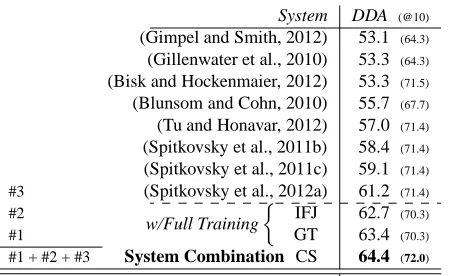
After full training, our IFJ and GT systems parse Section 23 of WSJ at 62.7 and 63.4% accuracy, bet-ter than the previous state-of-the-art (61.2% — see Table 2). To test the generalized IC algorithm, we merged our implementations of these three strong grammar induction pipelines into a combined sys-tem (CS). It scored highest: 64.4%.
(19)
HLD·45DBM (GT)(IFJ)#1#2
#3
CS
The quality of bracketings corresponding to (non-trivial) spans derived by heads of our dependency structures is competitive with the state-of-the-art in unsupervised constituent parsing. On the WSJ sen-tences up to length 40 in Section 23, CS attains
sim-ilarF1-measure (54.2 vs. 54.6, with higher recall) to
8Note that smoothing in the final (unlexicalized) Viterbi step
System DDA (@10)
(Gimpel and Smith, 2012) 53.1 (64.3)
(Gillenwater et al., 2010) 53.3 (64.3)
(Bisk and Hockenmaier, 2012) 53.3 (71.5)
(Blunsom and Cohn, 2010) 55.7 (67.7)
(Tu and Honavar, 2012) 57.0 (71.4)
(Spitkovsky et al., 2011b) 58.4 (71.4)
(Spitkovsky et al., 2011c) 59.1 (71.4)
#3 (Spitkovsky et al., 2012a) 61.2 (71.4)
#2
w/Full Training
IFJ GT
62.7 (70.3)
#1 63.4 (70.3)
#1 + #2 + #3 System Combination CS 64.4 (72.0)
[image:8.612.319.537.54.204.2]Supervised DBM (also with loose decoding) 76.3 (85.4)
Table 2: Directed dependency accuracies (DDA) on Sec-tion 23 of WSJ (all sentences and up to length ten) for recent systems, our full networks (IFJ and GT), and three-way combination (CS) with the previous state-of-the-art.
PRLG (Ponvert et al., 2011), which is the strongest
system of which we are aware (see Table 3).9
9 Multi-Lingual Evaluation
Last, we checked how our algorithms generalize out-side English WSJ, by testing in 23 more set-ups: all 2006/7 CoNLL test sets (Buchholz and Marsi, 2006; Nivre et al., 2007), spanning 19 languages. Most re-cent work evaluates against this multi-lingual data, with the unrealistic assumption of part-of-speech tags. But since inducing high quality word clusters for many languages would be beyond the scope of our paper, here we too plugged in gold tags for word
categories (instead of unsupervised tags, as in§3–8).
We compared to the two strongest systems we
knew:10 MZ (Mareˇcek and ˇZabokrtsk´y, 2012) and
SAJ(Spitkovsky et al., 2012b), which report average
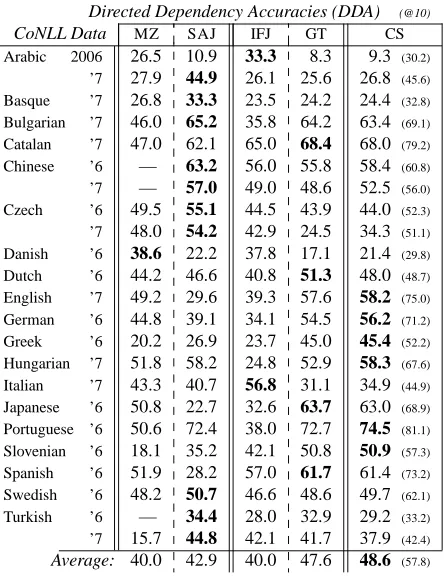
accuracies of 40.0 and 42.9% for CoNLL data (see Table 4). Our fully-trained IFJ and GT systems score 40.0 and 47.6%. As before, combining these net-works with our own implementation of the best
pre-vious state-of-the-art system (SAJ) yields a further
improvement, increasing final accuracy to 48.6%.
9
These numbers differ from Ponvert et al.’s (2011, Table 6) for the full Section 23 because we restricted theireval-ps.py
script to a maximum length of 40 words, in our evaluation, to match other previous work: Golland et al.’s (2012, Figure 1) for CCM and LLCCM; Huang et al.’s (2012, Table 2) for the rest.
10During review, another strong system (Mareˇcek and Straka,
2013, scoring 48.7%) of possible interest to the reader came out, exploiting prior knowledge of stopping probabilities (estimated from large POS-tagged corpora, via reducibility principles).
System F1
Binary-Branching Upper Bound 85.7 Left-Branching Baseline 12.0 CCM (Klein and Manning, 2002) 33.7 Right-Branching Baseline 40.7 F-CCM (Huang et al., 2012) 45.1 HMM (Ponvert et al., 2011) 46.3
LLCCM (Golland et al., 2012) 47.6 P R CCL (Seginer, 2007) 52.8 54.6 51.1 PRLG (Ponvert et al., 2011) 54.6 60.4 49.8 CS System Combination 54.2 55.6 52.8
Supervised DBM Skyline 59.3 65.7 54.1 Dependency-Based Upper Bound 87.2 100 77.3
Table 3: Harmonic mean (F1) of precision (P) and re-call (R) for unlabeled constituent bracketings on Section 23 of WSJ (sentences up to length 40) for our combined system (CS), recent state-of-the-art and the baselines.
10 Discussion
CoNLL training sets were intended for comparing supervised systems, and aren’t all suitable for unsu-pervised learning: 12 languages have under 10,000 sentences (with Arabic, Basque, Danish, Greek, Ital-ian, SlovenItal-ian, Spanish and Turkish particularly small), compared to WSJ’s nearly 50,000. In some treebanks sentences are very short (e.g., Chinese and Japanese, which appear to have been split on punc-tuation), and in others extremely long (e.g., Arabic). Even gold tags aren’t always helpful, as their num-ber is rarely ideal for grammar induction (e.g., 42 vs. 200 for English). These factors contribute to high variances of our (and previous) results (see Table 4). Nevertheless, if we look at the more stable aver-age accuracies, we see a positive trend as we move from a simpler fully-trained system (IFJ, 40.0%), to a more complex system (GT, 47.6%), to system combination (CS, 48.6%). Grounding seems to be more important for the CoNLL sets, possibly be-cause of data sparsity or availability of gold tags.
11 Related Work
[image:8.612.76.301.55.193.2]Directed Dependency Accuracies (DDA) (@10)
CoNLL Data MZ SAJ IFJ GT CS
Arabic 2006 26.5 10.9 33.3 8.3 9.3 (30.2)
’7 27.9 44.9 26.1 25.6 26.8 (45.6)
Basque ’7 26.8 33.3 23.5 24.2 24.4 (32.8)
Bulgarian ’7 46.0 65.2 35.8 64.2 63.4 (69.1)
Catalan ’7 47.0 62.1 65.0 68.4 68.0 (79.2)
Chinese ’6 — 63.2 56.0 55.8 58.4 (60.8)
’7 — 57.0 49.0 48.6 52.5 (56.0)
Czech ’6 49.5 55.1 44.5 43.9 44.0 (52.3)
’7 48.0 54.2 42.9 24.5 34.3 (51.1)
Danish ’6 38.6 22.2 37.8 17.1 21.4 (29.8)
Dutch ’6 44.2 46.6 40.8 51.3 48.0 (48.7)
English ’7 49.2 29.6 39.3 57.6 58.2 (75.0)
German ’6 44.8 39.1 34.1 54.5 56.2 (71.2)
Greek ’6 20.2 26.9 23.7 45.0 45.4 (52.2)
Hungarian ’7 51.8 58.2 24.8 52.9 58.3 (67.6)
Italian ’7 43.3 40.7 56.8 31.1 34.9 (44.9)
Japanese ’6 50.8 22.7 32.6 63.7 63.0 (68.9)
Portuguese ’6 50.6 72.4 38.0 72.7 74.5 (81.1)
Slovenian ’6 18.1 35.2 42.1 50.8 50.9 (57.3)
Spanish ’6 51.9 28.2 57.0 61.7 61.4 (73.2)
Swedish ’6 48.2 50.7 46.6 48.6 49.7 (62.1)
Turkish ’6 — 34.4 28.0 32.9 29.2 (33.2)
’7 15.7 44.8 42.1 41.7 37.9 (42.4)
[image:9.612.77.299.57.347.2]Average: 40.0 42.9 40.0 47.6 48.6 (57.8)
Table 4: Blind evaluation on 2006/7 CoNLL test sets (all sentences) for our full networks (IFJ and GT), previous state-of-the-art systems of Spitkovsky et al. (2012b) and Mareˇcek and ˇZabokrtsk ´y (2012), and three-way combi-nation withSAJ(CS, including results up to length ten).
a search algorithm for encoding decipherment prob-lems that guarantees to quickly converge on optimal solutions. Convexity can be ideal for comparative analyses, by eliminating dependence on initial con-ditions. But for many NLP tasks, including grammar induction, the most relevant known objective func-tions are still riddled with local optima. Renewed ef-forts to find exact solutions (Eisner, 2012; Gormley and Eisner, 2013) may be a good fit for the smaller and simpler, earlier stages of our iterative networks. Multi-start methods (Solis and Wets, 1981) can recover certain global extrema almost surely (i.e., with probability approaching one). Moreover, ran-dom restarts via uniform probability measures can be optimal, in a worst-case-analysis sense, with par-allel processing sometimes leading to exponential speed-ups (Hu et al., 1994). This approach is rarely emphasized in NLP literature. For instance, Moore and Quirk (2008) demonstrated consistent, substan-tial gains from random restarts in statistical machine
translation (but also suggested better and faster re-placements — see below); Ravi and Knight (2009,
§5, Figure 8) found random restarts for EM to be
crucial in parts-of-speech disambiguation. However, other reviews are few and generally negative (Kim and Mooney, 2010; Martin-Brualla et al., 2010).
Iterated local search methods (Hoos and St¨utzle, 2004; Johnson et al., 1988, inter alia) escape lo-cal basins of attraction by perturbing candidate so-lutions, without undoing all previous work. “Large-step” moves can come from jittering (Hinton and Roweis, 2003), dithering (Price et al., 2005, Ch. 2) or smoothing (Bhargava and Kondrak, 2009). Non-improving “sideways” moves offer substantial help with hard satisfiability problems (Selman et al., 1992); and injecting non-random noise (Selman et al., 1994), by introducing “uphill” moves via mix-tures of random walks and greedy search strate-gies, does better than random noise alone or simu-lated annealing (Kirkpatrick et al., 1983). In NLP, Moore and Quirk’s (2008) random walks from pre-vious local optima were faster than uniform sam-pling and also increased BLEU scores; Elsner and Schudy (2009) showed that local search can outper-form greedy solutions for document clustering and chat disentanglement tasks; and Mei et al. (2001) incorporated tabu search (Glover, 1989; Glover and Laguna, 1993, Ch. 3) into HMM training for ASR.
Genetic algorithms are a fusion of what’s best in local search and multi-start methods (Houck et al., 1996), exploiting a problem’s structure to combine valid parts of any partial solutions (Holland, 1975;
Goldberg, 1989). Evolutionary heuristics proved
objec-tives: good sets of parse trees must make sense both lexicalized and with word categories, to rich and im-poverished models of grammar, and for both long, complex sentences and short, simple text fragments. This selection of text filters is a specialized case of more general “data perturbation” techniques — even cycling over randomly chosen mini-batches that partition a data set helps avoid some local op-tima (Liang and Klein, 2009). Elidan et al. (2002) suggested how example-reweighing could cause “in-formed” changes, rather than arbitrary damage, to a hypothesis. Their (adversarial) training scheme guided learning toward improved generalizations, robust against input fluctuations. Language learn-ing has a rich history of reweighlearn-ing data via (co-operative) “starting small” strategies (Elman, 1993), beginning from simpler or more certain cases. This family of techniques has met with success in semi-supervised named entity classification (Collins and
Singer, 1999; Yarowsky, 1995),11 parts-of-speech
induction (Clark, 2000; 2003), and language model-ing (Krueger and Dayan, 2009; Bengio et al., 2009), in addition to unsupervised parsing (Spitkovsky et al., 2009; Tu and Honavar, 2011; Cohn et al., 2011).
12 Conclusion
We proposed several simple algorithms for combin-ing grammars and showed their usefulness in merg-ing the outputs of iterative and static grammar in-duction systems. Unlike conventional system com-bination methods, e.g., in machine translation (Xiao et al., 2010), ours do not require incoming mod-els to be of similar quality to make improvements. We exploited these properties of the combiners to reconcile grammars induced by different views of data (Blum and Mitchell, 1998). One such view re-tains just the simple sentences, making it easier to recognize root words. Another splits text into many inter-punctuation fragments, helping learn word as-sociations. The induced dependency trees can them-selves also be viewed not only as directed structures but also as skeleton parses, facilitating the recovery of correct polarities for unlabeled dependency arcs.
By reusing templates, as in dynamic Bayesian network (DBN) frameworks (Koller and Friedman,
11
The so-called Yarowsky-cautious modification of the orig-inal algorithm for unsupervised word-sense disambiguation.
2009, §6.2.2), we managed to specify relatively
“deep” learning architectures without sacrificing (too much) clarity or simplicity. On a still more speculative note, we see two (admittedly, tenuous) connections to human cognition. First, the benefits of not normalizing probabilities, when symmetriz-ing, might be related to human language process-ing through the base-rate fallacy (Bar-Hillel, 1980; Kahneman and Tversky, 1982) and the availability heuristic (Chapman, 1967; Tversky and Kahneman, 1973), since people are notoriously bad at probabil-ity (Attneave, 1953; Kahneman and Tversky, 1972; Kahneman and Tversky, 1973). And second, inter-mittent “unlearning” — though perhaps not of the kind that takes place inside of our transforms — is an adaptation that can be essential to cognitive development in general, as evidenced by neuronal pruning in mammals (Craik and Bialystok, 2006; Low and Cheng, 2006). “Forgetful EM” strategies that reset subsets of parameters may thus, possibly, be no less relevant to unsupervised learning than is “partial EM,” which only suppresses updates, other EM variants (Neal and Hinton, 1999), or “dropout training” (Hinton et al., 2012; Wang and Manning, 2013), which is important in supervised settings.
Acknowledgments
We thank Yun-Hsuan Sung, for early-stage discussions on ways of extending “baby steps,” Elias Ponvert, for sharing all of the relevant experimental results and eval-uation scripts from his work with Jason Baldridge and Katrin Erk, and the anonymous reviewers, for their helpful comments on the draft version of this paper. Funded, in part, by Defense Advanced Research Projects Agency (DARPA) Deep Exploration and Filtering of Text (DEFT) Program, under Air Force Research Lab-oratory (AFRL) prime contract no. FA8750-13-2-0040. Any opinions, findings, and conclusion or recommen-dations expressed in this material are those of the au-thors and do not necessarily reflect the view of the DARPA, AFRL, or the US government. Once again, the first author thanks Moofus.
References
H. Alshawi. 1996. Head automata for speech translation. In
ICSLP.
F. Attneave. 1953. Psychological probability as a function of experienced frequency. Experimental Psychology, 46. M. Bar-Hillel. 1980. The base-rate fallacy in probability
judg-ments. Acta Psychologica, 44.
A. Belz. 1998. Discovering phonotactic finite-state automata by genetic search. In COLING-ACL.
Y. Bengio, J. Louradour, R. Collobert, and J. Weston. 2009. Curriculum learning. In ICML.
A. Bhargava and G. Kondrak. 2009. Multiple word alignment with profile hidden Markov models. In NAACL-HLT:
Stu-dent Research and Doctoral Consortium.
Y. Bisk and J. Hockenmaier. 2012. Simple robust grammar induction with combinatory categorial grammars. In AAAI. A. Blum and T. Mitchell. 1998. Combining labeled and
unla-beled data with co-training. In COLT.
P. Blunsom and T. Cohn. 2010. Unsupervised induction of tree substitution grammars for dependency parsing. In EMNLP. S. Buchholz and E. Marsi. 2006. CoNLL-X shared task on
multilingual dependency parsing. In CoNLL.
X. Carreras and L. M`arquez. 2005. Introduction to the CoNLL-2005 shared task: Semantic role labeling. In CoNLL. L. J. Chapman. 1967. Illusory correlation in observational
re-port. Verbal Learning and Verbal Behavior, 6.
A. Clark. 2000. Inducing syntactic categories by context distri-bution clustering. In CoNLL-LLL.
A. Clark. 2003. Combining distributional and morphological information for part of speech induction. In EACL. S. B. Cohen and N. A. Smith. 2010. Viterbi training for PCFGs:
Hardness results and competitiveness of uniform initializa-tion. In ACL.
T. Cohn, P. Blunsom, and S. Goldwater. 2011. Inducing tree-substitution grammars. JMLR.
M. Collins and Y. Singer. 1999. Unsupervised models for named entity classification. In EMNLP.
M. Collins. 1999. Head-Driven Statistical Models for Natural
Language Parsing. Ph.D. thesis, University of Pennsylvania.
E. Corlett and G. Penn. 2010. An exact A∗method for
deci-phering letter-substitution ciphers. In ACL.
F. I. M. Craik and E. Bialystok. 2006. Cognition through the lifespan: mechanisms of change. TRENDS in Cognitive
Sci-ences, 10.
C. de Marcken. 1995. Lexical heads, phrase structure and the induction of grammar. In WVLC.
K. Duh and K. Kirchhoff. 2004. Automatic learning of lan-guage model structure. In COLING.
J. Eisner. 2012. Grammar induction: Beyond local search. In
ICGI.
G. Elidan, M. Ninio, N. Friedman, and D. Schuurmans. 2002. Data perturbation for escaping local maxima in learning. In
AAAI.
J. L. Elman. 1993. Learning and development in neural net-works: The importance of starting small. Cognition, 48. M. Elsner and W. Schudy. 2009. Bounding and comparing
methods for correlation clustering beyond ILP. In
NAACL-HLT: Integer Linear Programming for NLP.
C. M. Fonseca and P. J. Fleming. 1993. Genetic algorithms for multiobjective optimization: Formulation, discussion and generalization. In ICGA.
C. J. Geyer. 1991. Markov chain Monte Carlo maximum like-lihood. In Interface Symposium.
J. Gillenwater, K. Ganchev, J. Grac¸a, F. Pereira, and B. Taskar. 2010. Posterior sparsity in unsupervised dependency pars-ing. Technical report, University of Pennsylvania.
K. Gimpel and N. A. Smith. 2012. Concavity and initialization for unsupervised dependency parsing. In NAACL-HLT. F. Glover and M. Laguna. 1993. Tabu search. In C. R.
Reeves, editor, Modern Heuristic Techniques for
Combina-torial Problems. Blackwell Scientific Publications.
F. Glover. 1989. Tabu search — Part I. ORSA Journal on
Computing, 1.
D. E. Goldberg. 1989. Genetic Algorithms in Search,
Opti-mization & Machine Learning. Addison-Wesley.
D. Golland, J. DeNero, and J. Uszkoreit. 2012. A feature-rich constituent context model for grammar induction. In
EMNLP-CoNLL.
M. R. Gormley and J. Eisner. 2013. Nonconvex global opti-mization for latent-variable models. In ACL.
W. P. Headden, III, M. Johnson, and D. McClosky. 2009. Im-proving unsupervised dependency parsing with richer con-texts and smoothing. In NAACL-HLT.
G. Hinton and S. Roweis. 2003. Stochastic neighbor embed-ding. In NIPS.
G. E. Hinton, N. Srivastava, A. Krizhevsky, I. Sutskever, and R. R. Salakhutdinov. 2012. Improving neural networks by preventing co-adaptation of feature detectors. In ArXiv. J. H. Holland. 1975. Adaptation in Natural and Artificial
Sys-tems: An Introductory Analysis with Applications to Biology, Control, and Artificial Intelligence. University of Michigan
Press.
H. H. Hoos and T. St¨utzle. 2004. Stochastic Local Search:
C. R. Houck, J. A. Joines, and M. G. Kay. 1996. Comparison of genetic algorithms, random restart, and two-opt switching for solving large location-allocation problems. Computers
& Operations Research, 23.
X. Hu, R. Shonkwiler, and M. C. Spruill. 1994. Random restarts in global optimization. Technical report, GT. Y. Huang, M. Zhang, and C. L. Tan. 2012. Improved
con-stituent context model with features. In PACLIC.
F. Jelinek and R. L. Mercer. 1980. Interpolated estimation of Markov source parameters from sparse data. In Pattern
Recognition in Practice.
D. S. Johnson, C. H. Papadimitriou, and M. Yannakakis. 1988. How easy is local search? Journal of Computer and System
Sciences, 37.
D. Kahneman and A. Tversky. 1972. Subjective probability: A judgment of representativeness. Cognitive Psychology, 3. D. Kahneman and A. Tversky. 1973. On the psychology of
prediction. Psychological Review, 80.
D. Kahneman and A. Tversky. 1982. Evidential impact of base rates. In D. Kahneman, P. Slovic, and A. Tversky, editors,
Judgment under uncertainty: Heuristics and biases.
Cam-bridge University Press.
J. Ke, M. Ogura, and W. S.-Y. Wang. 2003. Optimization mod-els of sound systems using genetic algorithms.
Computa-tional Linguistics, 29.
J. Kim and R. J. Mooney. 2010. Generative alignment and semantic parsing for learning from ambiguous supervision. In COLING.
S. Kirkpatrick, C. D. Gelatt, Jr., and M. P. Vecchi. 1983. Opti-mization by simulated annealing. Science, 220.
D. Klein and C. D. Manning. 2002. A generative constituent-context model for improved grammar induction. In ACL. D. Klein and C. D. Manning. 2004. Corpus-based induction of
syntactic structure: Models of dependency and constituency. In ACL.
D. Koller and N. Friedman. 2009. Probabilistic Graphical
Models: Principles and Techniques. MIT Press.
K. A. Krueger and P. Dayan. 2009. Flexible shaping: How learning in small steps helps. Cognition, 110.
D. Lashkari and P. Golland. 2008. Convex clustering with exemplar-based models. In NIPS.
P. Liang and D. Klein. 2009. Online EM for unsupervised models. In NAACL-HLT.
L. K. Low and H.-J. Cheng. 2006. Axon pruning: an essen-tial step underlying the developmental plasticity of neuronal connections. Royal Society of London Philosophical
Trans-actions Series B, 361.
M. P. Marcus, B. Santorini, and M. A. Marcinkiewicz. 1993. Building a large annotated corpus of English: The Penn Treebank. Computational Linguistics, 19.
D. Mareˇcek and M. Straka. 2013. Stop-probability estimates computed on a large corpus improve unsupervised depen-dency parsing. In ACL.
D. Mareˇcek and Z. ˇZabokrtsk´y. 2011. Gibbs sampling with treeness constraint in unsupervised dependency parsing. In
ROBUS.
D. Mareˇcek and Z. ˇZabokrtsk´y. 2012. Exploiting reducibility in unsupervised dependency parsing. In EMNLP-CoNLL.
R. Martin-Brualla, E. Alfonseca, M. Pasca, K. Hall, E. Robledo-Arnuncio, and M. Ciaramita. 2010. Instance sense induction from attribute sets. In COLING.
N. McIntyre and M. Lapata. 2010. Plot induction and evolu-tionary search for story generation. In ACL.
X.-d. Mei, S.-h. Sun, J.-s. Pan, and T.-Y. Chen. 2001. Op-timization of HMM by the tabu search algorithm. In
RO-CLING.
C. Mellish, A. Knott, J. Oberlander, and M. O’Donnell. 1998. Experiments using stochastic search for text planning. In
INLG.
R. C. Moore and C. Quirk. 2008. Random restarts in min-imum error rate training for statistical machine translation. In COLING.
T. Naseem and R. Barzilay. 2011. Using semantic cues to learn syntax. In AAAI.
R. M. Neal and G. E. Hinton. 1999. A view of the EM al-gorithm that justifies incremental, sparse, and other variants. In M. I. Jordan, editor, Learning in Graphical Models. MIT Press.
J. Nivre, J. Hall, S. K¨ubler, R. McDonald, J. Nilsson, S. Riedel, and D. Yuret. 2007. The CoNLL 2007 shared task on de-pendency parsing. In EMNLP-CoNLL.
M. A. Paskin. 2001a. Cubic-time parsing and learning algo-rithms for grammatical bigram models. Technical report, UCB.
M. A. Paskin. 2001b. Grammatical bigrams. In NIPS. F. Pereira and Y. Schabes. 1992. Inside-outside reestimation
from partially bracketed corpora. In ACL.
S. Petrov. 2010. Products of random latent variable grammars. In NAACL-HLT.
E. Ponvert, J. Baldridge, and K. Erk. 2011. Simple unsuper-vised grammar induction from raw text with cascaded finite state models. In ACL-HLT.
K. V. Price, R. M. Storn, and J. A. Lampinen. 2005.
Differ-ential Evolution: A Practical Approach to Global Optimiza-tion. Springer.
S. Ravi and K. Knight. 2009. Minimized models for unsuper-vised part-of-speech tagging. In ACL-IJCNLP.
K. Rose. 1998. Deterministic annealing for clustering, com-pression, classification, regression and related optmization problems. Proceedings of the IEEE, 86.
Y. Seginer. 2007. Fast unsupervised incremental parsing. In
ACL.
B. Selman, H. Levesque, and D. Mitchell. 1992. A new method for solving hard satisfiability problems. In AAAI.
B. Selman, H. A. Kautz, and B. Cohen. 1994. Noise strategies for improving local search. In AAAI.
F. J. Solis and R. J.-B. Wets. 1981. Minimization by random search techniques. Mathematics of Operations Research, 6. V. I. Spitkovsky, H. Alshawi, and D. Jurafsky. 2009. Baby
Steps: How “Less is More” in unsupervised dependency parsing. In GRLL.
V. I. Spitkovsky, H. Alshawi, and D. Jurafsky. 2011a. Lateen EM: Unsupervised training with multiple objectives, applied to dependency grammar induction. In EMNLP.
V. I. Spitkovsky, H. Alshawi, and D. Jurafsky. 2011b. Punctu-ation: Making a point in unsupervised dependency parsing. In CoNLL.
V. I. Spitkovsky, A. X. Chang, H. Alshawi, and D. Jurafsky. 2011c. Unsupervised dependency parsing without gold part-of-speech tags. In EMNLP.
V. I. Spitkovsky, H. Alshawi, and D. Jurafsky. 2012a. Boot-strapping dependency grammar inducers from incomplete sentence fragments via austere models. In ICGI.
V. I. Spitkovsky, H. Alshawi, and D. Jurafsky. 2012b. Three dependency-and-boundary models for grammar induction. In EMNLP-CoNLL.
W. Stadler, editor. 1988. Multicriteria Optimization in
Engi-neering and in the Sciences. Plenum Press.
A. Sun, R. Grishman, and S. Sekine. 2011. Semi-supervised relation extraction with large-scale word clustering. In ACL. M. Surdeanu and C. D. Manning. 2010. Ensemble models for
dependency parsing: Cheap and good? In NAACL-HLT. K. Tu and V. Honavar. 2011. On the utility of curricula in
unsupervised learning of probabilistic grammars. In IJCAI. K. Tu and V. Honavar. 2012. Unambiguity regularization
for unsupervised learning of probabilistic grammars. In
EMNLP-CoNLL.
A. Tversky and D. Kahneman. 1973. Availability: A heuristic for judging frequency and probability. Cognitive
Psychol-ogy, 5.
S. I. Wang and C. D. Manning. 2013. Fast dropout training. In
ICML.
Q. I. Wang, D. Schuurmans, and D. Lin. 2008. Semi-supervised convex training for dependency parsing. In
HLT-ACL.
T. Xiao, J. Zhu, M. Zhu, and H. Wang. 2010. Boosting-based system combination for machine translation. In ACL. D. Yarowsky. 1995. Unsupervised word sense disambiguation