A Tree-based Decoder for Neural Machine Translation
Xinyi Wang1, Hieu Pham1,2, Pengcheng Yin1, Graham Neubig1
{xinyiw1,hyhieu,pcyin,gneubig}@cs.cmu.edu
1Language Technology Institute, Carnegie Mellon University, Pittsburgh, PA 15213 2Google Brain, Mountain View, CA 94043
Abstract
Recent advances in Neural Machine Transla-tion (NMT) show that adding syntactic infor-mation to NMT systems can improve the qual-ity of their translations. Most existing work utilizes some specific types of linguistically-inspired tree structures, like constituency and dependency parse trees. This is often done via a standard RNN decoder that operates on a lin-earized target tree structure. However, it is an open question of what specific linguistic for-malism, if any, is the best structural represen-tation for NMT. In this paper, we (1) propose an NMT model that can naturally generate the topology of an arbitrary tree structure on the target side, and (2) experiment with various target tree structures. Our experiments show the surprising result that our model delivers the best improvements with balanced binary trees constructedwithoutany linguistic knowledge; this model outperforms standardseq2seq mod-els by up to 2.1 BLEU points, and other meth-ods for incorporating target-side syntax by up to 0.7 BLEU.1
1 Introduction
Most NMT methods use sequence-to-sequence (seq2seq) models, taking in a sequence of source words and generating a sequence of tar-get words (Kalchbrenner and Blunsom, 2013; Sutskever et al., 2014; Bahdanau et al., 2015). Whileseq2seqmodels canimplicitlydiscover syn-tactic properties of the source language (Shi et al., 2016), they do not explicitly model and leverage such information. Motivated by the success of adding syntactic information to Statistical Machine Translation (SMT) (Galley et al.,2004;Menezes and Quirk,2007;Galley et al.,2006), recent works have established that explicitly leveraging syn-tactic information can improve NMT quality, ei-1Our code is available at https://github.com/ cindyxinyiwang/TrDec_pytorch.
ther through syntactic encoders (Li et al., 2017; Eriguchi et al.,2016), multi-task learning objec-tives (Chen et al.,2017;Eriguchi et al.,2017), or direct addition of syntactic tokens to the target se-quence (Nadejde et al.,2017;Aharoni and Gold-berg, 2017). However, these syntax-aware mod-els only employ the standard decoding process of seq2seqmodels,i.e.generating one target word at a time. One exception isWu et al.(2017), which uti-lizes two RNNs for generating target dependency trees. Nevertheless, Wu et al. (2017) is specifi-cally designed for dependency tree structures and is not trivially applicable to other varieties of trees such as phrase-structure trees, which have been used more widely in other works on syntax-based machine translation. One potential reason for the dearth of work on syntactic decoders is that such parse tree structures are not friendly to recurrent neural networks (RNNs).
In this paper, we proposeTrDec, a method for incorporating tree structures in NMT. TrDec simul-taneously generates a target-side tree topology and a translation, using the partially-generated tree to guide the translation process (§ 2). TrDec employs two RNNs: arule RNN,which tracks the topology of the tree based on rules defined by a Context Free Grammar (CFG), and aword RNN,which tracks words at the leaves of the tree (§ 3). This model is similar to neural models of tree-structured data from syntactic and semantic parsing (Dyer et al., 2016;Alvarez-Melis and Jaakkola,2017;Yin and Neubig,2017), but with the addition of the word RNN, which is especially important for MT where fluency of transitions over the words is critical.
com-Figure 1: An example generation process of TrDec.Left: A target parse tree. The green squares represent preterminal nodes.Right:How our RNNs generate the parse tree on the left. The blue cells represent the activities of the rule RNN, while the grey cells represent the activities of the word RNN.heopiandheosiare theend-of-phraseandend-of-sentencetokens. Best viewed in color.
pare and contrast different structural representa-tions for NMT.
In our experiments (§ 5), we evaluate TrDec us-ing both syntax-driven and syntax-free tree repre-sentations. We benchmark TrDec on three tasks: Japanese-English and German-English translation with medium-sized datasets, and Oromo-English translation with an extremely small dataset. Our findings are surprising – TrDec performs well, but it performs the best with balanced binary trees con-structedwithoutany linguistic guidance.
2 Generation Process
TrDec simultaneously generates the target se-quence and its corresponding tree structure. We first discuss the high-level generation process using an example, before describing the prediction model (§ 3) and the types of trees used by TrDec (§ 4).
Fig. 1 illustrates the generation process of the sentence “_The _cat _eat s _fi sh _.”, where the sentence is split into subword units, de-limited by the underscore “_” (Sennrich et al., 2016). The example uses a syntactic parse tree as the intermediate tree representation, but the pro-cess of generating with other tree representations, e.g.syntax-free trees, follows the same procedure. Trees used in TrDec have two types of nodes: terminal nodes,i.e. the leaf nodes that represent subword units; andnonterminal nodes,i.e.the non-leaf nodes that represent a span of subwords. Ad-ditionally, we define a preterminal node to be a nonterminal node whose children are all terminal nodes. InFig. 1Left, the green squares represent preterminal nodes.
TrDec generates a tree in a top-down, left-to-right order. The generation process is guided by a CFG over target trees, which is constructed by taking all production rules extracted from the trees
of all sentences in the training corpus. Specifically, arule RNNfirst generates the top of the tree struc-ture, and continues until a preterminal is reached. Then, aword RNN fills out the words under the preterminal. The model switches back to therule RNN after theword RNN finishes. This process is illustrated inFig. 1Right. Details are as follows: Step 1.The source sentence is encoded by a se-quential RNN encoder, producing the hidden states. Step 2.The generation starts with a derivation tree with only aRootnode. Arule RNN,initialized by the last encoder hidden state computes the prob-ability distribution over all CFG rules whose left hand side (LHS) isRoot, and selects a rule to apply to the derivation. In our example, the rule RNN selectsROOT7!S.
Step 3.The rule RNN applies production rules to the derivation in a top-down, left-to-right order, ex-panding the currentopening nonterminalusing a CFG rule whose LHS is the opening nonterminal. In the next two steps, TrDec applies the rulesS7! NP VP PUNCandNP7!preto the opening nonter-minalsSandNP, respectively. Note that after these two steps a preterminal nodepreis created. Step 4a. Upon seeing a preterminal node as the current opening nonterminal, TrDec switches to using aword RNN, initialized by the last state of the encoder, to populate this empty preterminal with phrase tokens, similar to aseq2seqdecoder. For example the subword units_Theand_catare generated by the word RNN, ending with a special end-of-phrasetoken,i.e.heopi.
[image:2.595.77.525.61.168.2]off. In our example, this next stage is the opening nonterminal nodeVP. From here, TrDec chooses the ruleVP7!pre NP.
TrDec repeats the process above, intermingling the rule RNN and the word RNN as described, and halts when the rule RNN generates the end-of-sentencetokenheosi, completing the derivation.
3 Model
We now describe the computations during the gen-eration process discussed in§ 2. At first, a source sentencex, which is split into subwords, is encoded using a standard bi-directional Long Short-Term Memory (LSTM) network (Hochreiter and Schmid-huber,1997). This bi-directional LSTM outputs a set of hidden states, which TrDec will reference using an attention function (Bahdanau et al.,2015).
As discussed, TrDec uses two RNNs to generate a target parse tree. In our work, both of these RNNs use LSTMs, but with different parameters.
Rule RNN. At any time steptin the rule RNN,
there are two possible actions. If at the previous time stept 1, TrDec generated a CFG rule, then the statestreet is computed by:
street =LSTM([ytCFG1;ct 1;streep ;swordt ],street 1)
whereyCFGt 1 is the embedding of the CFG rule at
time stept 1;ct 1is the context vector computed
by attention atstreet 1,i.e.input feeding (Luong et al.,
2015);streep is the hidden state at the time step that
generates the parent of the current node in the par-tial tree;swordt is the hidden state of the most recent
time step beforetthat generated a subword (note
thatswordt comes from the word RNN, discussed
below); and[·]denotes a concatenation.
Meanwhile, if at the previous time stept 1,
TrDec did not generate a CFG rule, then the update at time stept must come from a subword being
generated by the word RNN. In that case, we also update the rule RNN similarly by replacing the embedding of the CFG rule with the embedding of the subword.
Word RNN. At any time stept, if the word RNN
is invoked, its hidden stateswordt is:
swordt =LSTM([streep ;wt 1;ct 1],swordt 1),
where streep is the hidden state of rule RNN that
generated the CFG rule above the current terminal;
wt 1 is the embedding of the word generated at
time stept 1; andct 1 is the attention context
[image:3.595.307.523.67.232.2]computed at the previous word RNN time stept 1.
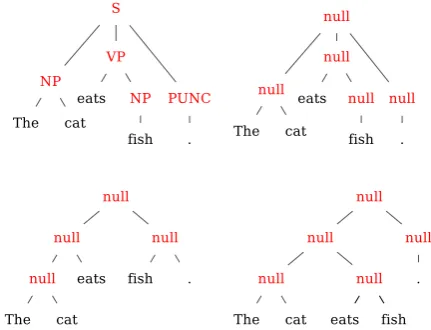
[image:3.595.307.526.285.354.2]Figure 2: An example of four tree structures (Details of preter-minals and subword units omitted for illustration purpose).
Figure 3: Conversion of a dependency tree for TrDec.Left:
original dependency tree.Right:after conversion.
Softmax. At any stept, our softmax logits are W·tanh [street ,swordt ], whereWvaries depending
on whether a rule or a subword unit is needed.
4 Tree Structures
Unlike prior work on syntactic decoders designed for utilizing a specific type of syntactic informa-tion (Wu et al.,2017), TrDec is a flexible NMT model that can utilize any tree structure. Here we consider two categories of tree structures:
Syntactic Trees are generated using a third-party parser, such as Berkeley parser (Petrov et al., 2006;Petrov and Klein,2007). Fig. 2Top Left illustrates an example constituency parse tree. We also consider a variation of standard constituency parse trees where all of their nonterminal tags are replaced by a null tag, which is visualized inFig. 2Top Right.
Balanced Binary Trees are syntax-free trees constructed without any linguistic guidance. We use two slightly different versions of binary trees. Version 1 (Fig. 2 Bottom Left) is constructed by recursively splitting the target sentence in half and creating left and right subtrees from the left and right halves of the sentence respectively. Version 2 (Fig. 2Bottom Right), is constructed by apply-ing Version 1 on a list of nodes where consecutive words are combined together. All tree nodes in both versions have the null tag. We discuss these con-struction processes in more detail in AppendixA.1. In the experiments detailed later, we evaluated TrDec with four different settings of tree structures: 1) the fully syntactic constituency parse trees; 2) constituency parse trees with null tags; 3) depen-dency parse trees; 4) a concatenation of both ver-sion 1 and verver-sion 2 of the binary trees, (which effectively doubles the amount of the training data and leads to slight increases in accuracy).
5 Experiments
Datasets. We evaluate TrDec on three datasets: 1) the KFTT (ja-en) dataset (Neubig, 2011), which consists of Japanese-English Wikipedia arti-cles; 2) the IWSLT2016 German-English (de-en) dataset (Cettolo et al., 2016), which consists of TED Talks transcriptions; and 3) the LORELEI Oromo-English (or-en) dataset2, which largely
con-sists of texts from the Bible. Details are inTab. 1. English sentences are parsed using Ckylark (Oda et al.,2015) for the constituency parse trees, and Stanford Parser (de Marneffe et al.,2006;Chen and Manning,2014) for the dependency parse trees. We use byte-pair encoding (Sennrich et al.,2016) with 8K merge operations on ja-en, 4K merge operations on or-en, and 24K merge operations on de-en.
Dataset Train Dev Test
ja-en 405K 1166 1160 de-en 200K 1024 1333 or-en 6.5K 358 359
Table 1: # sentences in each dataset.
Baselines. We compare TrDec against three base-lines: 1) seq2seq: the standard seq2seq model with attention; 2) CCG: a syntax-aware transla-tion model that interleaves Combinatory Categorial Grammar (CCG) tags with words on the target side
2LDC2017E29
of aseq2seqmodel (Nadejde et al.,2017); 3) CCG-null: the same model with CCG, but all syntactic tags are replaced by a null tag; and 4) LIN: a stan-dardseq2seqmodel that generates linearized parse trees on the target side (Aharoni and Goldberg, 2017).
Results. Tab. 2presents the performance of our model and the three baselines. For our model, we report the performance of TrDec-con, TrDec-con-null, TrDec-dep, and TrDec-binary (settings 1,2,3,4 in§ 4). On the low-resource or-en dataset, we ob-serve a large variance with different random seeds, so we run each model with6different seeds, and
re-port the mean and standard deviation of these runs. TrDec-con-null and TrDec-con achieved compa-rable results, indicating that the syntactic labels have neither a large positive nor negative impact on TrDec. For ja-en and or-en, syntax-free TrDec out-performs all baselines. On de-en, TrDec loses to CCG-null, but the difference is not statistically sig-nificant (p >0.1).
Model ja-en de-en (meanor-en
±std)
seq2seq 21.10 32.26 10.90±0.57
CCG 22.44 32.84 12.55±0.60
CCG-null 21.31 33.10 11.96±0.57
LIN 21.55 31.79 12.66±0.61
TrDec-con 21.59 31.93 11.43±0.58
TrDec-con-null 22.72 31.21 11.35±0.55
TrDec-dep 21.41 31.23 8.40±0.5
TrDec-binary 23.14⇤ 32.65 13.10⇤⇤±0.61
Table 2: BLEU scores of TrDec and other baselines. Sta-tistical significance is indicated with⇤(p < 0.05) and⇤⇤
(p <0.001), compared with the best baseline.
bet-ter at capturing long-bet-term dependencies during de-coding. Surprisingly, TrDec-binary, which does not utilize any linguistic information, outperforms TrDec-con for all sentence length categories.
Second,Fig. 5shows a histogram of translations by the length difference between the generated out-put and the reference. This provides an explanation of the difficulty of using parse trees. Ideally, this distribution will be focused around zero, indicat-ing that the MT system is generatindicat-ing translations about the same length as the reference. However, the distribution of TrDec-con is more spread out than TrDec-binary, which indicates that it is more difficult for TrDec-con to generate sentences with appropriate target length. This is probably because constituency parse trees of sentences with similar number of words can have very different depth, and thus larger variance in the number of generation steps, likely making it difficult for the MT model to plan the sentence structure a-prior before actually generating the child sentences.
<15 15 25 25 35 >35
Sentence Length
1 0 1 2
G
ai
n
in
BL
E
U
TrDec-binary TrDec-con
[image:5.595.86.277.356.448.2]CCG
Figure 4: The gains of BLEU score overseq2seq.
-8 -7 -6 -5 -4 -3 -2 -1 0 1 2 3 4 5 6 7 8 Length Di↵erence from Reference 50
100 150
Se
nt
enc
e
C
oun
t TrDec-binary
TrDec-con CCG
Figure 5: Distribution of length difference from reference.
6 Conclusion
We propose TrDec, a novel tree-based decoder for NMT, that generates translations along with the tar-get side tree topology. We evaluate TrDec on both linguistically-inspired parse trees and synthetic, syntax-free binary trees. Our model, when used with synthetic balanced binary trees, outperforms CCG, the existing state-of-the-art in incorporating syntax in NMT models.
The interesting result that syntax-free trees out-perform their syntax-driven counterparts elicits a
natural question for future work: how do we bet-ter model syntactic structure in these models? It would also be interesting to study the effect of us-ing source-side syntax together with the target-side syntax supported by TrDec.
Acknowledgements
This material is based upon work supported in part by the Defense Advanced Research Projects Agency Information Innovation Office (I2O) Low Resource Languages for Emergent In-cidents (LORELEI) program under Contract No. HR0011-15-C0114, and the National Science Foun-dation under Grant No. 1815287. The views and conclusions contained in this document are those of the authors and should not be interpreted as rep-resenting the official policies, either expressed or implied, of the U.S. Government. The U.S. Gov-ernment is authorized to reproduce and distribute reprints for Government purposes notwithstanding any copyright notation here on.
References
Roee Aharoni and Yoav Goldberg. 2017. Towards string-to-tree neural machine translation. InACL.
David Alvarez-Melis and Tommi S. Jaakkola. 2017. Tree-structured decoding with doubly recurrent neu-ral network. InICLR.
Dzmitry Bahdanau, Kyunghyun Cho, and Yoshua Ben-gio. 2015. Neural machine translation by jointly learning to align and translate. InICLR.
M. Cettolo, J. Niehues, S. Stuker, L. Bentivogli, R. Cat-toni, and M. Federico. 2016. The iwslt 2016 evalua-tion campaign. InIWSLT.
Danqi Chen and Christopher D. Manning. 2014. A fast and accurate dependency parser using neural net-works. InACL.
Huadong Chen, Shujian Huang, David Chiang, and Ji-ajun Chen. 2017. Improved neural machine transla-tion with a syntax-aware encoder and decoder. In ACL.
Chris Dyer, Adhiguna Kuncoro, Miguel Ballesteros, and Noah A. Smith. 2016. Recurrent neural network grammars. InACL.
Akiko Eriguchi, Kazuma Hashimoto, and Yoshimasa Tsuruoka. 2016. Tree-to-sequence attentional neural machine translation. InACL.
[image:5.595.83.278.486.575.2]Michel Galley, Jonathan Graehl, Kevin Knight, Daniel Marcu, Steve DeNeefe, Wei Wang, and Ignacio Thayer. 2006. Scalable inference and training of context-rich syntactic translation models. InACL. Michel Galley, Mark Hopkins, Kevin Knight, and
Daniel Marcu. 2004. What’s in a translation rule? InNAACL.
Sepp Hochreiter and Jürgen Schmidhuber. 1997. Long short-term memory. InNeural Computations. Nal Kalchbrenner and Phil Blunsom. 2013. Recurrent
continuous translation models. InEMNLP.
Junhui Li, Xiong Deyi, Zhaopeng Tu, Muhua Zhu, Min Zhang, and Guodong Zhou. 2017. Modeling source syntax for neural machine translation. InACL. Minh-Thang Luong, Hieu Pham, and Christopher D.
Manning. 2015. Effective approaches to attention-based neural machine translation. InEMNLP. Marie-Catherine de Marneffe, Bill MacCartney, and
Christopher D. Manning. 2006. Generating typed dependency parses from phrase structure parses. In LREC.
Arul Menezes and Chris Quirk. 2007. Using depen-dency order templates to improve generality in trans-lation. InWMT.
Maria Nadejde, Siva Reddy, Rico Sennrich, Tomasz Dwojak, Marcin Junczys-Dowmunt, Philipp Koehn, and Alexandra Birch. 2017. Predicting target lan-guage CCG supertags improves neural machine translation. InWMT.
Graham Neubig. 2011. The Kyoto free translation task. http://www.phontron.com/kftt.
Yusuke Oda, Graham Neubig, Sakriani Sakti, Tomoki Toda, and Satoshi Nakamura. 2015. Ckylark: A more robust pcfg-la parser. In NAACL Software Demonstration.
Slav Petrov, Leon Barrett, Romain Thibaux, and Dan Klein. 2006. Learning accurate, compact, and inter-pretable tree annotation. InCOLING-ACL.
Slav Petrov and Dan Klein. 2007. Improved inference for unlexicalized parsing. InHLT-NAACL.
Rico Sennrich, Barry Haddow, and Alexandra Birch. 2016. Neural machine translation of rare words with subword units. InACL.
Xing Shi, Inkit Padhi, and Kevin Knight. 2016. Does string-based neural mt learn source syntax? In EMNLP.
Ilya Sutskever, Oriol Vinyals, and Quoc V. Le. 2014. Sequence to sequence learning with neural networks. InNIPS.
Shuangzhi Wu, Dongdong Zhang, Nan Yang, Mu Li, and Ming Zhou. 2017. Sequence-to-dependency neural machine translation. InACL.