A Geometric Approach to
Mapping B i t e x t Correspondence
I . D a n M e l a m e d
D e p t . o f C o m p u t e r a n d I n f o r m a t i o n S c i e n c e U n i v e r s i t y o f P e n n s y l v a n i a
P h i l a d e l p h i a , P A , 19104, U . S . A . melamed©unagi, cis. upenn, edu
A b s t r a c t
T h e f i r s t s t e p i n m o s t c o r p u s - b a s e d m u l - t i l i n g u a l N L P w o r k is t o c o n s t r u c t a de- t a i l e d m a p o f t h e c o r r e s p o n d e n c e b e t w e e n a t e x t a n d i t s t r a n s l a t i o n . S e v e r a l a u t o - m a t i c m e t h o d s f o r t h i s t a s k h a v e b e e n p r o - p o s e d i n r e c e n t y e a r s . "Yet e v e n t h e b e s t o f t h e s e m e t h o d s c a n e r r b y s e v e r a l t y p e s e t p a g e s . T h e S m o o t h I n j e c t i v e M a p R e c o g - n i z e r ( S I M R ) is a n e w b i t e x t m a p p i n g al- g o r i t h m . S I M R ' s e r r o r s a r e s m a l l e r t h a n t h o s e o f t h e p r e v i o u s f r o n t - r u n n e r b y m o r e t h a n a f a c t o r o f 4. I t s r o b u s t n e s s h a s en- a b l e d n e w c o m m e r c i a l - q u a l i t y a p p l i c a t i o n s . T h e g r e e d y n a t u r e o f t h e a l g o r i t h m m a k e s it i n d e p e n d e n t o f m e m o r y r e s o u r c e s . U n l i k e o t h e r b i t e x t m a p p i n g a l g o r i t h m s , S I M R al- lows c r o s s i n g c o r r e s p o n d e n c e s t o a c c o u n t f o r w o r d o r d e r d i f f e r e n c e s . I t s o u t p u t c a n b e c o n v e r t e d q u i c k l y a n d e a s i l y i n t o a sen- t e n c e a l i g n m e n t . S I M R ' s o u t p u t h a s b e e n u s e d t o a l i g n m o r e t h a n 200 m e g a b y t e s o f t h e C a n a d i a n H a n s a r d s f o r p u b l i c a t i o n b y t h e L i n g u i s t i c D a t a C o n s o r t i u m .
1. I n t r o d u c t i o n
The first step in most corpus-based multilin- gual NLP work is to construct a detailed map of the correspondence between a text and its translation (a b i t e x t m a p ) . Several auto- matic methods have been proposed for this task in recent years. However, most of these methods address only the sub-problem of align- ment (Catizone et al. 1989, Brown et al. 1991, Gale & Church 1991, Debili & Sammouda 1992, Simard et al. 1992, Kay & RSscheisen 1993, Wu 1994). Alignment algorithms assume the availability of text unit boundary information and their o u t p u t has less expressive power than a gen- eral bitext map. The only published solution to the more difficult general bitext mapping problem (Church 1993) can err by several typeset pages. Such frailty can expose lexicographers and ter-
minologists to spurious concordances, feed noisy training data into statistical translation models, and degrade the performance of corpus-based ma- chine translation. Some multilingual NLP tasks, such as automatic validation of terminological con- sistency (Macklovitch 1995) and automatic detec- tion of omissions in translations (implemented for the first time in (Melamed 1996)), have been tech- nologically impossible until now, because they are highly sensitive to large errors in the bitext map.
The Smooth Injective Map Recognizer (SIMR) is a greedy algorithm for mapping bitext correspondence. SIMR borrows several insights from previous work. Like Gale & Church (1991) and Brown et al. (1991), SIMR relies on the high correlation between the lengths of mutual trans- lations. Like char_.align (Church 1993), SIMR infers bitext maps from likely points of correspon- dence between the two texts, points that are plot- ted in a two-dimensional space of possibilities. Un- like previous methods, SIMR searches for only a handful of points of correspondence at a time.
Each set of correspondence points is found in two steps. First, SIMR generates a number of possible points of correspondence between the two texts, as described in Section 3.1. Second, SIMR selects those points whose geometric ar- rangement most resembles the typical arrange- ment of true points of correspondence. This selec- tion involves localized pattern recognition heuris- tics, which Section 3.2 refers to collectively as the c h a i n r e c o g n i t i o n h e u r i s t i c . SIMR then inter- polates between successive selected points to pro- duce a bitext map, as described in Section 3.3.
2. D e f i n i t i o n s
O4
._C C 0
0 Q.
-8
II >.,
terminus
~
diagona
origin
x = character
position
in text 1
Figure 1: a bi~ext space
and height of the rectangle are the lengths of the two c o m p o n e n t texts, in characters. T h e lower left corner of the rectangle is the o r i g i n of the bitext space and represents the two texts' begin- nings. T h e upper right corner is the t e r m i n u s and represents the t e x t s ' ends. T h e line between the origin and the terminus is the m a i n d i a g o - n a l . T h e slope of the m a i n diagonal is the b i t e x t s l o p e .
Each bitext space contains a n u m b e r of t r u e p o i n t s o f c o r r e s p o n d e n c e ( T P C s ) , other t h a n the origin and the terminus. For example, if a to- ken at position p on the x-axis and a token at posi- tion q on the y-axis are translations of each other, then the coordinate (p, q) in the bitext space is a T P C 1. T P C s also exist at corresponding bound- aries of text units such as sentences, paragraphs, and sections. Groups of T P C s with a roughly linear a r r a n g e m e n t in the bitext space are called c h a i n s .
B i t e x t m a p s are bijective functions in bitext spaces. For each b i t e x t , the t r u e b i t e x t m a p ( T B M ) is the shortest bitext m a p t h a t runs through all the T P C s . T h e purpose of a b i t e x t m a p p i n g a l g o r i t h m is to produce bitext m a p s t h a t are the best possible a p p r o x i m a t i o n s of each b i t e x t ' s T B M .
3. S I M R
Most of S I M R ' s effort is spent searching for T P C s , one short chain at a time. T h e search for each chain begins in a small rectangular region of the bitext space, whose dimensions are proportional to those of the whole bitext space. Within this search
1Since distances in the bitext space are measured in characters, the position of a token is defined to be the mean position of its characters.
rectangle, the search alternates between a gener- ation phase and a recognition phase, which are described in more detail in Sections 3.1 and 3.2. In the generation phase, S I M R generates all the points of correspondence t h a t satisfy the supplied matching predicate (explained below). In the recognition phase, S I M R calls the chain recogni- tion heuristic to search for suitable chains a m o n g the generated points. If no suitable chains are found, the search rectangle is proportionally ex- panded up and to the right and the generation- recognition cycle is repeated. T h e rectangle keeps expanding until at least one acceptable chain is found. If more t h a n one chain is found, S I M R ac- cepts the chain whose points are least dispersed around its least-squares line. Then, S I M R selects another region of the bitext space to search for the next chain.
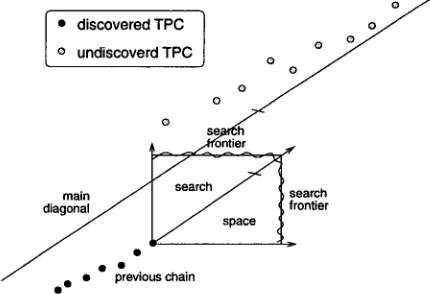
SIMR employs a simple heuristic to select re- gions of the bitext space to search. To a first approximation, T B M s are monotonically increas- ing functions. This means t h a t if S I M R accepts a chain, it should look for others either above and to the right or below and to the left of the one it has just located. All S I M R needs is a place to start the trace, and a good place to s t a r t is at the beginning. T h e origin of the bitext space is always a T P C . So, the first search rectangle is anchored at the origin. Subsequent search rectangles are anchored at the top right corner of the previously found chain, as shown in Figure 2.
[e disc°veredTPC 1
o ° ~
o undiscoverdTPC |
o 7
main ~ s e a r c h - ~
search
J • •
~reviouschain
Figure 2: S I M R ' s "expanding rectangle" search
strategy. The search reclangle is anchored at the
top right corner of the previously found chain. Its diagonal remains parallel to the main diagonal.
[image:2.612.77.293.75.250.2] [image:2.612.328.543.433.580.2]the discontinuity is quite large (Melamed 1996). Section 3.8 explains why SIMR will not be led astray by false points of correspondence.
3.1 P o i n t G e n e r a t i o n
A m a t c h i n g p r e d i c a t e is a heuristic for guess- ing whether a given point in the bitext space is a T P C . I have considered only token-based match- ing predicates, which can only return T R U E for a point (x, y) if x is the position of a token e on the x-axis and y is the position of a token f on the y- axis. For each such point, the matching predicate must decide whether the e and f are likely to be mutual translations.
Various knowledge sources can be brought to bear on the decision. The most universal knowledge source is a translation lexicon. Trans- lation lexicons can be extracted from machine- readable bilingual dictionaries (MRBDs), in the rare cases where MRBDs are available. In other cases, they can be induced automatically using any of several existing methods (Dagan et al. 1993, Fung ~ Church 1991, Melamed 1995). Since the matching predicate does not require perfect ac- curacy, the induced lexicons need not be perfect. When a large translation lexicon is not available, a small hand-constructed translation lexicon for the key terms in a given bitext may suffice to produce a rough map for that bitext.
If the languages involved have similar alpha- bets, then it m a y be possible to construct a match- ing predicate with very little effort, using the m e t h o d of cognates. Cognates are words with a common etymology and a similar meaning in different languages. The etymological similar- ity is often reflected in the words' orthography a n d / o r pronunciation. Languages that are closely related will often share a large number of cog- nates. For example, in the non-technical Cana- dian Hansards (parliamentary debate transcripts available in English and French), cognates can be found for roughly one quarter of all text tokens (Melamed 1995). A cognate-based matching pred- icate will generate more points for more similar language pairs, and for text genres where more word borrowing occurs, such as technical texts. For English and French, such a matching predicate can generate enough points in the bitext space to obviate the need for a translation lexicon.
Phonetic cognates can be used to map be- tween language pairs with dissimilar alphabets, even when the languages are not closely related. When language L1 borrows a word from language L2, the word is usually written in L1 similarly to the way it sounds in L2. Thus, French and Russian / p ~ r t m o n e / are cognates, as are English / s I s t o m / a n d J a p a n e s e / ~ i s u t e m u / . For many lan-
3
9 8 4 0 0 9 8 2 0 0 9 8 0 0 0 9 7 8 0 0
. ~ 9 7 6 0 0 9 7 4 0 0 9 7 2 0 0 9 7 0 0 0 9 6 8 0 0
1 0 9 0 0 0
°*
o o ,
e* e
o~ o % .
e . , o o .
* o
oo °~ * o o .o o
i i
1 0 9 5 0 0 1 1 0 0 0 0
position in text 1
*e
0
0
i
1 1 0 5 0 0 1 1 1 0 0 0
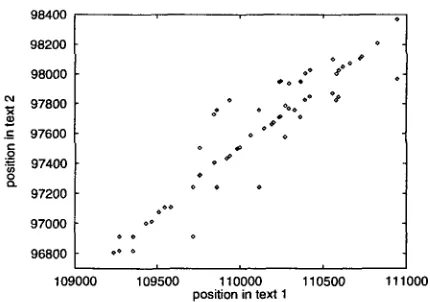
Figure 3: Part of a typical scatterplot in bitext space, the true points of correspondence trace the true bitext map parallel to the main diagonal.
guages, it is not difficult to construct an approxi- mate mapping from the orthography to its under- lying phonological form. Given such a mapping for L1 and L2, it is possible to identify cognates despite incomparable orthographies.
SIMR was tested on French and English with two different matching predicates. The first matching predicate relies on orthographic cog- nates and a stop-list of closed-class words for both languages. SIMR judges the cognateness of each token pair by their Longest C o m m o n Subsequence Ratio (LCSR). The LCSR of a token pair is the number of characters that appear in the same or- der in both tokens divided by the length of the longer token (Melamed 1995). The common char- acters need not be contiguous. The matching predicate considers a token pair cognates if their LCSR exceeds a certain threshold. The LCSR threshold was optimized together with SIMR's other parameters, as described in Section 3.7. The stop-list of closed-class words made the match- ing predicate more accurate, because closed-class words are unlikely to have cognates. On the con- trary, they often produce spurious matches. Ex- amples for French and English include a, an, o n
and par.
The second matching predicate was just like the first, except that it also evaluated to T R U E whenever the input token pair appeared as an en- try in a translation lexicon. The translation lexi- con was automatically extracted from an MRBD (Cousin et al. 1991).
3.2 P o i n t S e l e c t i o n
[image:3.612.314.529.76.227.2]• L i n e a r i t y : T P C s tend to line up straight. Sets of points with a roughly linear arrangement are called
chains.
• C o n s t a n t S l o p e : T h e slope of a T P C chain is rarely much different from the bitext slope.
• I n j e c t i v i t y : No two points in a chain of T P C s can have the s a m e x - or y-co-ordinates.
S I M R exploits these properties to decide which chains in the scatterplot might be T P C chains. T h e chain recognition heuristic involves two threshold parameters: m a x i m u m p o i n t dis- p e r s a l and m a x i m u m a n g l e d e v i a t i o n . Each threshold is used to filter candidate chains. First, the linearity of each chain is judged by measur- ing the root m e a n squared distance of the chain's points f r o m the chain's least-squares line. If this distance exceeds the m a x i m u m point dispersal threshold, the chain is rejected. Second, the an- gle of each chain's least-squares line is compared to the arctangent of the bitext slope. If the difference exceeds the m a x i m u m angle deviation threshold, the chain is rejected. Lastly, chains t h a t lack the injectivity p r o p e r t y are rejected.
3.3 R e d u c i n g t h e Search Space
In a region of the scatterplot containing n points, there are 2 n possible chains - - too m a n y to search by brute force. T h e . p r o p e r t i e s of T P C s listed above provide two ways to constrain the search.
T h e Linearity property leads to a constraint on the chain size. Chains of only a few points are unreliable, because they often line up straight by coincidence. Chains t h a t are too big will span too long a segment of the T B M to be well approxi- m a t e d by a line. S I M R chooses a fixed chain size k, 6 < k < 9. Fixing the chain size at k reduces the n u m b e r of candidate chains to
k
(n
F o r t y p i c a l v a l u e s o f n a n d k , ( n ) k can still
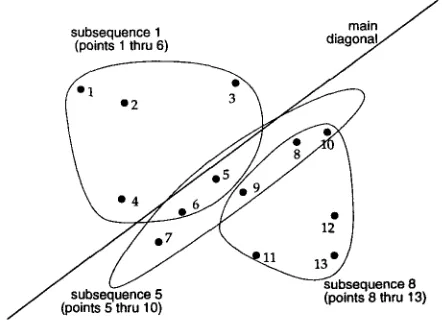
reach into the millions. T h e Constant Slope prop- erty suggests another constraint: S I M R should consider only chains t h a t are roughly parallel to the m a i n diagonal. T w o lines are parallel if the perpendicular displacement between t h e m is con- stant. So, if we want to find chains t h a t are roughly parallel to the m a i n diagonal, we should look for chains whose points all have roughly the same displacement 2 from the m a i n diagonal. Points with similar displacement can be grouped together by sorting, as illustrated in Figure 4. Then, chains t h a t are m o s t parallel to the m a i n
2Displacement can be negative.
subsequence 1 ~i m n a i l ~ J
(points 1 thru 6) a ~
subsequence 8
(points 5 thru 10) " "
Figure 4: The points of correspondence are num- bered according to their displacement from the
main diagonal. The chain most parallel to the
main diagonal is always one of the contiguous sub- sequences of this ordering. For a fixed chain size of 6, there are 13 - 6 + 1 = 8 contiguous subse- quences in this region of 13 points. Of these 8, subsequence 5 is the best chain.
diagonal will be contiguous subsequences of the sorted point sequence. In a region of the scatter- plot containing n points, there will be only n - k + l
such subsequences of length k. Sorting the points by their displacement is the m o s t c o m p u t a t i o n a l l y expensive step in the recognition process.
S I M R ' s chain recognition heuristic accepts non-monotonic chains. This is a desirable prop- erty, because even languages with similar syntax, like French and English, have well-known differ- ences in word order. For example, English (ad- jective, noun) pairs usually correspond to French (noun, adjective) pairs. Such inversions result in chains t h a t contain a p a t t e r n like points 5 and 9 in Figure 4. S I M R has no p r o b l e m accepting the inverted points, unlike bitext m a p p i n g algorithms t h a t try to minimize the distance between T P C s . To m y knowledge, no other bitext m a p p i n g algo- r i t h m allows non-monotonic m a p segments.
[image:4.612.325.546.78.238.2]a
a a a
~ a
tlJ
h h h
F r e n c h t e x t
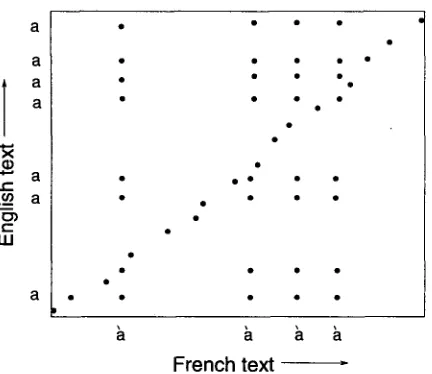
Figure 5: Frequent token types cause false points of correspondence that line up in rows and columns.
3.4 R e d u c i n g N o i s e
T h e Injectivity property also leads to a heuris- tic which reduces the n u m b e r of candidate chains, although the chief aim of this heuristic is to in- crease the signal-to-noise ratio in the scatterplot. T h e heuristic was introduced after inspection of several scatterplots in bitext spaces revealed a re- curring noise pattern. This noise p a t t e r n is illus- trated in Figure 5. It consists of correspondence points t h a t line up in rows or columns associated with frequent token types. Token types like the English article "a" can produce one or more cor- respondence points for almost every sentence in the opposite text. Since only one of these corre- spondence points can be correct, all but one of the points in each row and column are noise. I t ' s difficult to measure exactly how much noise is gen- erated by frequent tokens, and of course the pro- portion is different for every bitext. Visual inspec- tion of some scatterplots indicated t h a t frequent tokens are often responsible for the lion's share of the noise. Reducing this source of noise makes it much easier for S I M R to stay on track.
Other bitext m a p p i n g algorithms mitigate this source of noise either by assigning lower weights to correspondence points associated with frequent token types (Church 1993) or by sim- ply deleting frequent token types from the bitext (Dagan et al. 1993). However, a frequent token type can be rare in some parts of the text. In those parts, the token type can provide valuable clues to correspondence. On the other hand, m a n y tokens of a relatively rare type can be concentrated in a short segment of the text, resulting in m a n y false correspondence points. The varying concentration of identical tokens suggests t h a t more localized
*
G)
1-
I I I
M2 . •
ML""
.'" , . ' "
d' M2 L MER
I
I . . . Sentence A . . . I
Figure 6: Two text segments at the end of Sen- fence A were switched during translation, resulting in a non-monotonic segment. To interpolate in- jective bitext maps, non-monotonic segments must be encapsulated in Minimum Enclosing Rectangles (MERs). A unique bitext map can then be in- terpolated by using the lower left and upper right corners of the MER (map M2), instead of using the non-monotonic correspondence points (func- tion M1).
noise filters would be more effective. S I M R ' s lo- calized search strategy provides the perfect vehicle for a localized noise filter.
The filter is based on another threshold pa- rameter, the m a x i m u m p o i n t a m b i g u i t y l e v e l ( M a x P A L ) . For each point p = (x, y), let X be the number of points in column x within the search rectangle, and let Y be the n u m b e r of points in row y within the search rectangle. Then,
ambiguity level of p = X + Y - 2. Thus, if p is the only point in its row and col- umn, its ambiguity level is zero. S I M R ignores points whose ambiguity level exceeds the MaxPAL threshold. W h a t makes this a localized filter is t h a t only points within the search rectangle count towards each other's ambiguity level. This means t h a t the ambiguity level of a given point can in- crease as the search rectangle expands; the set of points t h a t S I M R ignores can change dynamically.
3.5 I n t e r p o l a t i o n
[image:5.612.310.519.73.238.2] [image:5.612.64.280.76.263.2]as shown in Figure 6. A unique bitext m a p can be interpolated by using the lower left and up- per right corners of the MER, instead of using the non-monotonic correspondence points.
3 . 6 E n h a n c e m e n t s
There are m a n y possible enhancements to the al- g o r i t h m outlined above. T h e following subsections describe but two of the more interesting extensions in the current i m p l e m e n t a t i o n .
L a r g e N o n - m o n o t o n i c S e g m e n t s SIMR has no p r o b l e m with small non-monotonic segments inside chains. However, the expanding rectangle search strategy can miss larger non-monotonic seg- ments, which cannot fit inside one chain. If a more precise m a p is desired, these larger non-monotonic segments can be easily recovered during a second sweep through the bitext space•
• T P C
]i
--- SIMR', /:: . / "
firstpass J: .
. . . ; . . . . . .
=-&- .... /.
. . .I i • I
t j
... i~s~.g.~i_ii_ii~~!.i
i=
i ...
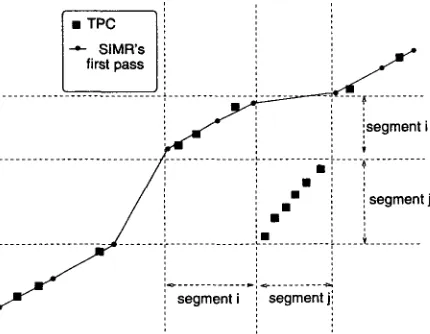
Figure 7: Segments i and j switched placed dur- ing translation. I f a more precise map is desired, these larger non-monotonic segments can be easily recovered during a second sweep through the bitext space. A n y non-monotonic segment of the T B M will occupy the intersection of a vertical gap and a horizontal gap in the monotonic first-pass map.
Non-monotonic T B M segments result in a characteristic m a p pattern, as a consequence of the injectivity of bitext maps. In Figure 7, the vertical range of segment j corresponds to a ver- tical gap in S I M R ' s first-pass m a p . T h e horizon- tal range of segment j corresponds to a horizon- tal gap in S I M R ' s first-pass m a p . Similarly, any non-monotonic segment of the T B M will occupy the intersection of a vertical gap and a horizon- tal gap in the monotonic first-pass m a p . Further- more, switched segments are almost always adja- cent and relatively short. Therefore, to recover non-monotonic segments of the T B M , S I M R needs only to search gap intersections t h a t are close to
the first-pass m a p . There are usually very few such intersections t h a t are also large enough to ac- c o m m o d a t e new chains, so the second-pass search requires only a small fraction of the c o m p u t a t i o n a l effort of the first pass.
L o c a l S l o p e V a r i a t i o n To ensure t h a t S I M R rejects spurious chains, the m a x i m u m angle devi- ation threshold m u s t be set low. However, like any heuristic filter, this one will reject some perfectly valid candidates. T h e injectivity of bitext m a p s enables a m e t h o d for recovering some of the re- jected valid chains. Valid chains t h a t are rejected by the angle deviation filter sometimes occur be- tween two accepted chains, as shown in Figure 8. If chains C and D are accepted as valid, then the
e > maximum angle
. mam.
deviation threshold
cllagonal/•..ii ,,.
I
@ .-'" OT
l ' e ~
~hain x /
• • J ~ 2 n d p a s s
search
spaceFigure 8: Chain X is perfectly valid, even t h o u g h it has a highly deviant slope. Such chains can be recovered by re-searching regions between accepted
chains. The slope of the local main diagonal can
be quite different from the slope of the global main
diagonal.
slope of the T B M between the end of Chain C and the start of Chain D m u s t be much closer to the slope of Chain X t h a n to the slope of the m a i n di- agonal. Chain X should be accepted. W h e n S I M R makes its second-pass search for non-monotonic segments, it also searches for sandwiched chains in any space between two accepted chains t h a t is large enough to a c c o m m o d a t e another chain. This subspace of the bitext space will have its own m a i n diagonal. T h e slope of this local m a i n diagonal can be quite different from the slope of the global m a i n diagonal.
[image:6.612.328.539.264.393.2] [image:6.612.75.290.304.471.2]Table 1: Comparison of error distributions for SIMR and c h a r _ a l i g n , in characters.
bitext "easy" Hansard (7123 ref. pts.)
"hard" Hansard (2693 ref. pts.)
algorithm
char_align
SIMR SIMR with MRBD
char_align
SIMR SIMR with M R B Dmedian absolute error
not reported 0.49 0.61 18 0.48 0.60
99th percentile
200 50 49 200
55 44
root mean squared error
57 13 13 46 9.8 8.6
m a p between "linguistic" parts of the bitext has a very different slope. Sometimes, the translation of non-linguistic text is completely erratic, especially where white space is concerned. Not surprisingly, S I M R cannot perform well on such text.
It should not be difficult to recognize bitext sections t h a t consist of "non-linguistic" text. Then, S I M R will be better able to follow the vari- ations in the slope of the TBM. This extension to S I M R is next in line.
3 . 7
Evaluation
T h e s t a n d a r d m e t h o d of evaluating bitext m a p - ping algorithms is to compare their output to a hand-constructed reference set of TPCs. Michel Simard of C I T I graciously provided me with sev- eral such reference sets for French-English bi- texts, including the same "easy" and "hard" Hansard bitexts t h a t have been used to evaluate other bitext m a p p i n g and alignment algorithms in the literature (Church 1993, Simard et al. 1992, Dagan et al. 1993). A non-Hansard reference set was used for S I M R ' s development. All of SIMR's parameters, namely the thresholds for m a x i m u m point dispersal, m a x i m u m angle deviation, maxi- m u m point ambiguity, and the LCSR used in the matching predicate, as well as the fixed chain size, were simultaneously optimized on this d a t a set us- ing simulated annealing (Vidal 1993). Different p a r a m e t e r settings considered by the optimization process resulted in different bitext m a p s for the development bitext. Each set of p a r a m e t e r values was scored according to the root mean squared error between the resulting bitext m a p and the reference set of T P C s . The best-scoring set of pa- r a m e t e r values was used to evaluate SIMR.
S I M R was evaluated on the "easy" and "hard" Hansard bitexts. Note t h a t these bitexts are so n a m e d because one was easier t h a n the other for the alignment algorithm t h a t was first eval- uated on them. There is no a priori reason to believe t h a t one or the other will be easier for SIMR. Table 1 compares SIMR's error distribu- tion on these bitexts with t h a t of the previous front-runner, char._al:i.gn, as reported by Church
7
(1993). SIMR's RMS error is lower by more than a factor of 4. SIMR is also much more robust: it rarely errs by more than half the length of an average sentence. Such robustness has enabled at least one new commercial-quality application - - a u t o m a t i c detection of omissions in translations (Melamed 1996). This task was impossible until now, because it cannot tolerate even a few wild errors, such as those produced by an independent implementation of char_al:i.gn (Simard 1995).
Note t h a t the error between a bitext m a p and each reference point can be defined as the hori- zontal distance, the vertical distance, or the dis- tance perpendicular to the m a i n diagonal. T h e latter distance will always be shortest, on aver- age. Church (1993) did not specify which metric he used. Of the three possibilities, Table 1 con- servatively reports the highest error estimates for SIMR. The lowest estimates for S I M R without the translation lexicon are an RMS error of 6.1 for the "easy" bitext and 5.4 for the "hard" bitext. With the translation lexicon, the lowest error estimates drop to 6.0 for the "easy" bitext and 4.6 for the "hard" bitext.
3 . 8
Discussion
One concern about greedy algorithms is t h a t if they wander off track, they m a y not be able to find their way back. There is no guarantee t h a t this will never happen with SIMR. However, there is evidence t h a t it is extremely unlikely. First, SIMR can wander off the right track only if there is an alternative (wrong) track. T h e noise re- duction heuristics mentioned in Section 3.5 en- sure t h a t very few points of correspondence can be generated away from the T B M trace. Those points that are generated are extremely unlikely to be sufficiently linear and to have the proper slope to fool the chain recognition heuristic. T h e fixed chain size p a r a m e t e r also plays a role. T h e longer the chain, the less probable it is t h a t a set of false points of correspondence will take on a valid-looking arrangement.
40000 words. During the optimization, SIMR oc- casionally veered off course when the fixed chain size was 5 or less. It rarely got lost with a fixed chain size of 6 and never with a fixed chain size of 7 or more. T h e o p t i m a l fixed chain size with respect to the RMS error metric was 9 when the transla- tion lexicon was used, and 8 when it was not. The chances of 8 or 9 false points of correspondence sat- isfying the m a x i m u m point dispersal, m a x i m u m angle deviation, and m a x i m u m point ambiguity level thresholds are negligible.
Finally, if S I M R does get lost, the result- ing bitext m a p will contain telltale discontinuities. Such discontinuities can be automatically detected with high reliability (Melamed 1996). With this sanity check in place, m a n u a l verification should never be necessary.
4. A l i g n m e n t
S I M R has no idea t h a t words are often used to m a k e sentences. It just o u t p u t s a series of cor- responding token positions, leaving users free to draw their own conclusions a b o u t how the texts' larger units correspond. However, m a n y existing translators' tools and machine translation strate- gies are based on aligned sentences. W h a t can S I M R do for t h e m ?
There are several papers in the literature a b o u t bitext alignment. T h e algorithms t h a t seem to work best rely on the high correlation between the lengths of corresponding sentences (Brown et al. 1991, Gale & Church 1991). How- ever, these algorithms can fumble in bitext sec- tions t h a t contain m a n y sentences of very similar length, like this vote record:
English French
Mr. McInnis? Yes.
Mr. Saunders? No.
Mr. Cossitt?
YeS.
M. Mclnnis? Oui.
M. Saunders?
Non.
M. Cossitt? Oui.
Source: (Chen 1993)
T h e only way to ensure a correct alignment in such regions is to look at the words. For this reason, Chen (1993) adds a statistical translation model to the Brown et al. alignment algorithm, and Wu (1994) adds a translation lexicon to the Gale & Church alignment algorithm.
A set of points of correspondence leads to alignment more directly t h a n a translation model or a translation lexicon, because points of corre-
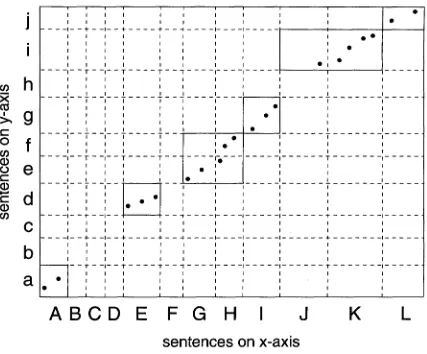
spondence are a relation between token instances, not between token types. Moreover, a set of cor- respondence points, supplemented with sentence boundary information, expresses s e n t e n c e c o r - r e s p o n d e n c e , which is a richer representation than sentence alignment. Figure 9 illustrates how sentence boundaries form a grid over the bitext space 3. Each cell in the grid represents the in- tersection of two sentences, one f r o m each com- ponent text. A point of correspondence inside cell (X,y) indicates t h a t some token in sentence X cor- responds with some token in sentence y; i.e. sen- tences X and y correspond. Thus, Figure 9 indi- cates t h a t sentence e corresponds with sentences G and H.
In contrast to a correspondence relation, "an
a l i g n m e n t is a segmentation of the two texts such t h a t the n t h segment of one text is the translation of the n t h segment of the other." (Simard et al. 1992) For example, given the to- ken correspondences in Figure 9, the segment (G, H ) should be aligned with the segment (e, f ) . If sentences ( X i , . . . , X n ) align with sentences ( y l , . . . , y , ~ ) , then ( ( X 1 , . . . , X , ~ ) , ( y l , . . . , y , ~ ) ) is an a l i g n e d b l o c k . In geometric terms, aligned blocks are rectangular regions of the bitext space, such t h a t the sides of the rectangles coincide with sentence boundaries, and such t h a t no two rectan- gles overlap either vertically or horizontally. T h e aligned blocks in Figure 9 are outlined with solid lines.
S I M R ' s initial o u t p u t has more expressive power t h a n the alignment t h a t can be derived f r o m it. One illustration of this difference is t h a t sen- tence correspondence can express inversions, but sentence alignment cannot. Inversions occur sur- prisingly often in real bitexts, even for sentence- size text units. Figure 9 provides another illustra- tion. If, instead of the point in cell (I-I,e), there was a point in cell (G,f), the correct alignment for t h a t region would still be ((G, g ) , (e, f ) ) . If there were points of correspondence in b o t h (HI,e) and (G,f), the correct alignment would still be the same. Yet, the three cases are clearly different. If a lexicographer wanted to see a word in sentence G in its bilingual context, it would be useful to know whether sentence f is relevant.
Converting from sentence correspondence to sentence alignment is of dubious practical value. Nevertheless, in order to facilitate comparison of the geometric approach with other alignment al- gorithms, I have designed the G e o m e t r i c S e n - t e n c e A l i g n m e n t ( G S A ) algorithm to reduce
h
f
=o e
d
C
b
a
i i i i i i i
I I I I I I I @
I I I I I I I •
. . . . I-- -- -F -- --I-- -- + . . . . -I- -- -- '-t . . . . I . . . . I . . . .
I • @
I
I •
I •
I @
. . . T . . . . I
I I
. . .
T~,,i
.... T,,,~
.... Tj,,i
. . . " ~ • . . .T,~,,
. . . .- - T, - • • - -
I
. . . T . . . . T . . . I~ . . . T . . .
I I I I
I I I • I
I I I • I
. . . .
,"--T--~--,"
,~' • • •1 ...
T,,,
. . .--I- -- 1- -- --I . . . . -I . . . . I . . . . I . . . I . . . 1- . . . I . . .
I I I I I I I I I I I
I I I I I I I I I I I
. . . . I-- -- $ -- --I-- -- 4,- . . . . '4. -- -- .4 . . . . I . . . . I . . . I . . . 4- . . . I . . .
I I I I I I I I I I I
I I I I I I I I I I I
I I I I I I I I I I I
" ~ ] - - -- 1" -- --I-- -- T . . . . T -- -- I . . . . I . . . . I . . . I . . . T . . . I . . .
I I I I I I I I I I
I I I I I I I I I I
I I I I I I I I I I
I I I I I I I I I I
A B C D
E
F G
H
I
J
K
L
sentences on x-axis
Figure 9: Sentence boundaries f o r m a grid over the bitext space. Each cell in the grid represents the product of two sentences, one from each component text. A point of correspondence inside cell (X, y) indicates that some token in sentence X corresponds with some token in sentence y; i.e. the sentences X and y correspond. So, for example, sentence E corresponds with sentence d. The aligned blocks are outlined with solid lines.
sets of correspondence points to alignments. The algorithm's first step is to perform a transitive clo- sure over the input correspondence relation. For instance, if the input contains (G,e), (H,e), and (H,f), then GSA adds the pairing (G,f). Next, GSA forces all segments to be contiguous: If sen- tence Y corresponds with sentences x and z, but not y, the pairing (Y,y) is added. In geomet- ric terms, these two operations arrange all cells that contain points of correspondence into non- overlapping rectangles, while adding as few cells as possible. The result is an alignment relation.
A complete set of TPCs, together with appro- priate boundary information, guarantees a perfect alignment. Alas, the points of correspondence pos- tulated by SIMR are neither complete nor noise- free. Fortunately, the noise in SIMR's output causes alignment errors in very predictable ways. GSA employs a couple of backing-off heuristics to elimninate most of the errors.
SIMR makes errors of omission and errors of commission. Typical errors of commission are stray points of correspondence like the one in cell (H, e) in Figure 9. This point indicates that (G, H) and (e, f ) should form a 2x2 aligned block, whereas the lengths of the component sentences suggest that a pair of l x l blocks is more likely. In a separate development bitext, I have found that SIMR is usually wrong in these cases. To com- bat such errors, GSA re-aligns any aligned block that is not l x l , using the Gale & Church length- based alignment algorithm (Gale & Church 1991, Simard 1995). Whenever the component sentence lengths suggest a more fine-grained alignment, SIMR's output is not trusted.
Typical errors of omission are illustrated in Figure 9 by the complete absence of correspon- dence points between sentences ( B , C , D ) and (b, c). This block of sentences is sandwiched be- tween aligned blocks. It is highly likely that at
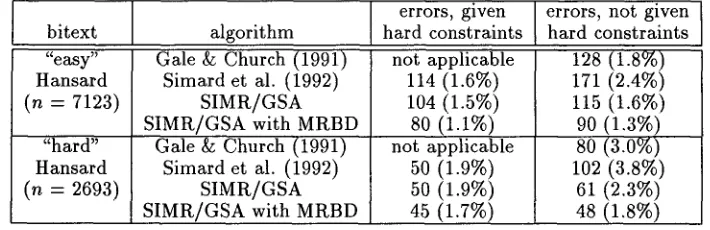
[image:9.612.90.517.73.427.2]Table 2: Comparison of alignment algorithms. One error is counted for each aligned block in the reference alignment that is missing from the test alignment.
errors, given errors, not given bitext algorithm hard constraints hard constraints "easy"
Hansard (n =
7123)
"hard" Hansard (n = 2693)
Gale & Church (1991) Simard et al. (1992)
S I M R / G S A S I M R / G S A with MRBD
Gale & Church (1991) Simard et al. (1992)
S I M R / G S A
S I M R / G S A with M R B D
not applicable 114 (1.6%) 104 (1.5%) 80 (1.1%) not applicable
50 (1.9%) 50 (1.9%)
45 (:.7%)
128 (1.8%)
171 (2.4%):15 (:.6%)
90 (1.3%)
80 (3.0%)
102 (3.8%)
61 (2.3%) 48 (1.8%)
least some of these sentences are mutual transla- tions, despite SIMR's failure to find any points of correspondence between them. Therefore, GSA treats all e m p t y blocks just like aligned blocks. If an e m p t y block is not l x l , GSA re-aligns it using a length-based algorithm, just like it would re-align any other m a n y - t o - m a n y aligned block.
The most difficult problem occurs when an er- ror of omission occurs next to an error of commis- sion, like in blocks ((), (h)) and ((J, K), (i)). If the point in cell (J,i) should really be in cell (J,h), re- alignment inside the erroneous blocks would not solve the problem. A naive solution is to merge these blocks and then to re-align them using a length-based method. Unfortunately, this kind of alignment pattern, i.e. 0xl followed by 2xl, is surprisingly often correct. Length-based meth- ods assign very low probabilities to such pattern sequences and usually get them wrong. There- fore, GSA also considers the confidence level with which the length-based alignment algorithm re- ports its re-alignment. If this confidence level is sufficiently high, GSA accepts the length-based re-alignment; otherwise, the alignment indicated by SIMR's points of correspondence is retained. The m i n i m u m confidence at which GSA trusts the length-based re-alignment is a GSA parameter, which has been optimized on a separate develop- ment bitext.
Due to the paucity of development resources at my disposal, GSA's backing-off heuristics are somewhat ad hoc. Even so, GSA performs at least as well as other alignment algorithms, and usu- ally better. Table 2 compares SIMR's accuracy on the "easy" and "hard" reference bitexts with the accuracy of two other alignment algorithms, as reported by Simard et al. (1992). The error metric counts one error for each aligned block in the reference alignment that is missing from the test alignment. T h e hard constraints correspond to paragraph boundaries.
More important than GSA's current perfor- mance is GSA's potential performance. With a bigger development bitext, more effective backing- off heuristics can be developed. More precise input would also make a big difference: GSA's perfor- mance will improve whenever SIMR's performance improves.
Although GSA sometimes backs off to a quadratic-time alignment algorithm, in practice its running time is linear in the number of in- put sentences. The points of correspondence in SIMR's o u t p u t are sufficiently dense and precise that GSA backs off only for very small aligned blocks. When the translation lexicon was used in SIMR's matching predicate, the largest aligned block that needed to be re-aligned in the "easy" and "hard" test bitexts was 5x5. W i t h o u t the translation lexicon, the largest re-aligned block was 7x7. So, GSA's running time is O(kn), where n is the number of input sentences and k is a small constant proportional to the size of the largest re- aligned block.
Admittedly, GSA is only useful when a good bitext map is available. In such cases, there are three reasons to favor GSA over other options for alignment: One, it is simply more accurate. Two, its running time is linear in the number of sentences, faster than dynamic programming methods. Therefore, three, it is not necessary to manually segment the component texts into smaller units before input to GSA. GSA works almost as well without such "hard constraints." Hard constraints are necessary for alignment algo- rithms that use dynamic programming, in order to maintain an acceptable running time on longer bitexts(Gale & Church 1991, Simard et al. 1992).
[image:10.612.131.486.109.224.2]5. C o n c l u s i o n
The Smooth Injective Map Recognizer (SIMR) has five advantages over previous bitext mapping al- gorithms. First, it lowers average errors by more than a factor of 4. Second, it avoids very large errors, improving robustness to a level that en- ables new commercial-quality applications. Third, it does not require large amounts of computer memory to run. Fourth, it accepts non-monotonic segments to account for inversions and word or- der differences. Fifth, its output can be converted quickly and easily into an accurate sentence align- ment.
There are many possible extensions to this work. One interesting observation is that aligned sentences can be used to induce translation lex- icons, and translation lexicons are an important information source for bitext mapping and align- ment (Kay & RSscheisen 1993, Chen 1993). I plan to explore an interactive loop between SIMR, GSA and my algorithm for inducing translation lexicons (Melamed 1995).
It would also be interesting to experiment with SIMR and GSA on language pairs that are not as closely related as English and French. The only technique for mapping between more dis- parate languages that has been rigorously evalu- ated (Wu 1994) relies on length correlations sprin- kled with some lexical information. From this point of view, Wu's technique is similar to the one used by Simard et al. (1992). So, I am eager to see whether the geometric approach will compare as favorably to Wu's results on English and Chinese as it has to Simard et al.'s results on English and French.
Acknowledgments
This research began while I was a visitor at the Centre d'Innovation en Technologies de l'Information in Laval, Canada. I am indebted to Pierre Isabelle for informing me that the bitext mapping problem is far from being solved. This paper has benefited tremendously from the in- sights and comments of the following people: Mike Collins, Jason Eisner, George Foster, Pierre Is- abelle, Elliott Macklovitch, Mitch Marcus, Ad- wait Ratnaparkhi, Michel Simard, Eero Simon- celli, Matthew Stone, Lyle Ungar and three anony- mous reviewers. My work was partially funded by ARO grant DAAL03-89-C0031 PRIME and by ARPA grants N00014-90-J-1863 and N6600194C 6043.
11
References
[Brown et al. 1991] P. F. Brown, J. C. Lai ~ R. L. Mercer, "Aligning Sentences in Parallel Cor- pora," Proceedings of the 29th Annual Meet- ing of the Association for Computational Lin- guistics, Berkeley, CA, 1991.
[Catizone et al. 1989] R. Catizone, G. Russell & S. Warwick "Deriving Translation Data from Bilingual Texts," Proceedings of the First International Lexical Acquisition Workshop,
Detroit, MI, 1993.
[Chen 1993] S. Chen, "Aligning Sentences in Bilingual Corpora Using Lexical Informa- tion," Proceedings of the 31st Annual Meet- ing of the Association for Computational Lin- guistics, Columbus, OH, 1993.
[Church 1993] K. W. Church, "Char_align: A Program for Aligning Parallel Texts at the Character Level," Proceedings of the 31st An- nual Meeting of the Association for Compu- tational Linguistics, Columbus, OH, 1993. [Cousin et al. 1991] P. g. Cousin, L. Sinclair, J.
F. Allain & C. E. Love, The Collins Paper- back French Dictionary, Harper Collins Pub- lishers, Glasgow, 1991.
[Dagan et al. 1993] I. Dagan, K. Church, & W. Gale, "Robust Word Alignment for Machine Aided Translation," Proceedings of the Work- shop on Very Large Corpora: Academic and Industrial Perspectives, available from the ACL, 1993.
[Debili & Sammouda 1992] F. Debili & E. Sam- mouda "Appariement des Phrases de Textes Bilingues," Proceedings of the 14th Interna- tional Conference on Computational Linguis- tics, Nantes, France, 1992.
[Fung L: Church 1991] P. Fung & K. W. Church, "K-vec: A New Approach for Aligning Par- allel Texts," Proceedings of the 15th Interna- tional Conference on Computational Linguis- tics, Kyoto, Japan, 1994.
[Gale & Church 1991] W. Gale & K. W. Church, "A Program for Aligning Sentences in Bilin- gual Corpora," Proceedings of the 29th An- nual Meeting of the Association for Compu- tational Linguistics, Berkeley, CA, 1991. [Harris 1988] B. Harris, "Bi-Text, a New Concept
in Translation Theory," Language Monthly
#54, 1988.
[Isabelle 1995] P. Isabelle, personal communica- tion, 1995.
[Kay & RSscheisen 1993]
M. Kay & M. R6scheisen "Text-Translation Alignment," Computational Linguistics 19:1,
[Macklovitch 1995] E, Macklovitch, "Peut-on ver- ifier automatiquement la coherence ter-
minologique?" Proceedings of the I V e~
Journdes scientifiques, Lexicommalique et Dictionnairiques, organized by AUPELF- UREF, Lyon, France, 1995.
[Melamed 1995] I. D. Melamed "Automatic Eval- uation and Uniform Filter Cascades for In-
ducing N-best Translation Lexicons," Pro-
ceedings of the Third Workshop on Very Large Corpora, Boston, MA, 1995.
[Melamed 1996] I. D. Melamed "Automatic De-
tection of Omissions in Translations," Pro-
ceedings of the 16th International Conference on Computational Linguistics, Copenhagen, Denmark, 1996.
[Simard et al. 1992] M. Simard, G. F. Foster & P. Isabelle, "Using Cognates to Align Sentences
in Bilingual Corpora," in Proceedings of the
Fourth International Conference on Theorel- ical and Methodological Issues in Machine Translation, Montreal, Canada, 1992. [Simard 1995] M. Simard, personal communica-
tion, 1995.
[Vidal 1993] R. V. V. Vidal, Applied Simulated
Annealing, Springer-Verlag, Heidelberg, Ger- many, 1993.
[Wu 1994] D. Wu, "Aligning a Parallel English- Chinese Corpus Statistically with Lexical Cri-
teria," Proceedings of the 32nd Annual Meet-