Large-scale Expected BLEU Training of Phrase-based Reordering Models
Michael Auli, Michel Galley, Jianfeng Gao Microsoft Research
Redmond, WA, USA
{michael.auli,mgalley,jfgao}@microsoft.com
Abstract
Recent work by Cherry (2013) has shown that directly optimizing phrase-based re-ordering models towards BLEU can lead to significant gains. Their approach is lim-ited to small training sets of a few thou-sand sentences and a similar number of sparse features. We show how the ex-pected BLEU objective allows us to train a simple linear discriminative reordering model with millions of sparse features on hundreds of thousands of sentences re-sulting in significant improvements. A comparison to likelihood training demon-strates that expected BLEU is vastly more effective. Our best results improve a hi-erarchical lexicalized reordering baseline by up to 2.0 BLEU in a single-reference setting on a French-English WMT 2012 setup.
1 Introduction
Modeling reordering for phrase-based machine translation has been a long standing problem. Contrary to synchronous context free grammar-based translation models (Wu, 1997; Galley et al., 2004; Galley et al., 2006; Chiang, 2007), phrase-based models (Koehn et al., 2003; Och and Ney, 2004) have no in-built notion of reordering beyond what is captured in a single phrase pair, and the first phrase-based decoders simply scored inter-phrase reorderings using a restricted linear dis-tortion feature, which scores a phrase reordering proportionally to the length of its displacement. While phrase-based models allow in theory com-pletely unrestricted reordering patterns, move-ments are generally limited to a finite distance for complexity reasons. To address this limitation, extensive prior work focused on richer feature sets, in particular on lexicalized reordering
mod-els trained with maximum likelihood-based ap-proaches (Tillmann, 2003; Xiong et al., 2006; Gal-ley and Manning, 2008; Nguyen et al.,2009;§2).
More recently, Cherry (2013) proposed a very effective sparse ordering model relying on a set of only a few thousand indicator features which are trained towards a task-specific metric such as BLEU (Papineni et al., 2002). These features are simply added to the log-linear framework of translation that is trained with the Margin Infused Relaxed Algorithm (MIRA; Chiang et al., 2009) on a small development set of a few thousand sentences. While simple, the approach outper-forms the state-of-the-art hierarchical reordering model of Galley and Manning (2008), a maximum likelihood-based model trained on millions of sen-tences to fit millions of parameters.
Ideally, we would like to scale sparse reorder-ing models to similar dimensions but recent at-tempts to increase the amount of training data for MIRA was met with little success (Eidelman et al., 2013). In this paper we propose much larger sparse ordering models that combine the scalabil-ity of likelihood-based approaches with the higher accuracy of maximum BLEU training (§3). We train on the output of a hierarchical reordering model-based system and scale to millions of fea-tures learned on hundreds of thousands of sen-tences (§4). Specifically, we use the expected BLEU objective function (Rosti et al., 2010; Rosti et al., 2011; He and Deng, 2012; Gao and He, 2013; Gao et al., 2014; Green et al., 2014) which allows us to train models that use training data and feature sets that are two to three orders of magni-tudes larger than in previous work (§5).
Our models significantly outperform the state-of-the-art hierarchical lexicalized reordering model on two language pairs and we demonstrate that richer feature sets result in significantly higher accuracy than with a feature set similar to Cherry (2013). We also demonstrate that our
approach greatly benefits from more training data than is typically used for maximum BLEU training. Previous work concluded that sparse reordering models perform better than maximum entropy models, however, the two approaches do not only differ in the objective function but also the type of training data (Cherry, 2013). Our analysis isolates the objective function and shows that expected BLEU optimization is the most important factor to train accurate ordering models. Finally, we compare expected BLEU training to pair-wise ranked optimization (PRO) on a feature set similar to Cherry (2013;§7).
2 Reordering Models
Reordering models for phrase-based translation are typically part of the log-linear framework which forms the basis of many statistical machine translation systems (Och and Ney, 2004).
Formally, we are given K training pairs D = (f(1), e(1))...(f(K), e(K)), where each f(i) ∈ F
is drawn from a set of possible foreign sentences, and each English sentencee(i)∈ E(f(i))is drawn
from a set of possible English translations off(i).
The log-linear model is parameterized by m pa-rameters θ where each θk ∈ θ is the weight of an associated featurehk(f, e)such as a language
model or a reordering model. Function h(f, e)
maps foreign and English sentences to the vector
h1(f, e)...hm(f, e), and we usually choose
trans-lationsˆeaccording to the following decision rule:
ˆ
e= arg max
e∈ E(f) θ
Th(f, e) (1)
In practice, computingeˆexactly is intractable and we resort to an approximate but more efficient beam search (Och and Ney, 2004).
Early phrase-based models simply relied on a linear distortion feature, which measures the dis-tance between the first word of the current source phrase and the last word of the previous source phrase (Koehn et al., 2003; Och and Ney, 2004). Unfortunately, this approach is agnostic to the ac-tual phrases being reordered, and does not take into account that certain phrases are more likely to be reordered than others. This shortcoming led to a range of lexicalized reordering models that capture exactly those preferences for individual phrases (Tillmann, 2003; Koehn et al., 2007).
Reordering models generally assume a se-quence of English phrases e = {e¯1, . . . ,e¯n}
cur-rently hypothesized by the decoder, a phrase align-ment a = {a1, . . . , an} that defines a foreign
phrasef¯ai for each English phrase¯ei, and an
ori-entation oi which describes how a phrase pair should be reordered with respect to the previous phrases. There are typically three orientation types and the exact definition depends on the specific models which we describe below. Orientations can be determined during decoding and from word-aligned training corpora. Most models estimate a probability distributionp(oi|ppi, a1, . . . , ai)for
thei-th phrase pairppi = he¯i,f¯aii and the
align-mentsa1, . . . , aiof the previous target phrases.
Lexicalized Reordering. This model defines the three orientation types based only on the posi-tion of the current and previously translated source phraseai andai−1, respectively (Tillmann, 2003;
Koehn et al., 2007). The orientation types gen-erally are: monotone (M), indicating thatai−1 is
directly followed byai. swap (S) assumes thatai
precedes ai−1, i.e., the two phrases swap places.
Finally, discontinuous (D) indicates that ai is not
adjacent toai−1. The probability distribution over
these reordering events is based on a maximum likelihood estimate:
p(o|pp, ai−1, ai) = cntcnt(o, pp(pp)) (2)
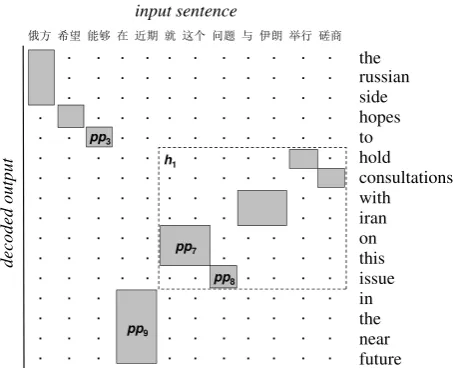
whereo ∈ {M, S, D}and cntreturns smoothed frequency counts over a word-aligned corpus. Hierarchical Reordering. An extension of the lexicalized reordering model better handles long-distance reordering by conditioning the orientation of the current phrase on a context larger than just the previous phrase (Galley and Manning, 2008). In particular, the hierarchical reordering model does so by building a compact representations of the preceding context using an efficient shift-reduce parser. During translation new phrases get moved on a stack and are then combined with any previous phrase if they are adjacent. Figure 1 shows an illustrative example: when the decoder shifts phrasepp8onto the stack, this phrase is then
merged with pp7 (reduce operation), which then
can be merged with previous phrases to finally form a hierarchical blockh1. These merge
opera-tions stop once we reach a phrase (here,pp3) that
is not contiguous with the current block. Then, as another phrase (pp9) is hypothesized, the decoder
״ᯩ ᐼᵋ 㜭ཏ ൘ 䘁ᵏ ቡ 䘉њ 䰞仈 о Ժᵇ Ѯ㹼 ୶ the russian side hopes to hold consultations with iran on this issue in the near future . . . . . . . . . . . . . . . . . . . . . . . . . . . . . . . . . . . . . . . . . . . . . . . . . . . . . . . . . . . . . . . . . . . . . . . . . . . . . . . . . . . . . . . . . . . . . . . . . . . . . . . . . . . . . . . . . . . . . . . . . . . . . . . . . . . . . . . . . . . . . . . . . . . . . . . . . . . . . . . . . . . . . . . . . . . . . . . . . . . . . . . . . . . . . . . . h1 pp9 pp8 pp7 pp3 de c ode d out put input sentence
Figure 1: The hierarchical reordering model (HRM) analyzes a non-local context to determine the orientation of the current phrase. For exam-ple, the phrase pair pp9 has a swap orientation
(o9 =S) with respect to a hierarchical block (h1)
that comprises the five preceding phrase pairs.
phrasepp9, which in this case is a swap (S)
orien-tation.1 The model has the advantage that the
ori-entations computed are more robust to derivational ambiguity of the underlying translation model. A given surface translation may be derived through different phrases but the shift-reduce parser com-bines them into a single representation which is more consistent with the orientations observed in the word-aligned training data.
Maximum Entropy-based models. The statis-tics used to estimate the lexicalized and the hierar-chical reordering models are based on very sparse estimates, simply because certain phrases are not very frequent. Maximum entropy models address this problem by estimating Eq. 2 through sparse indicator features over phrase pairs instead, but prior work with such models still relies on word aligned corpora for estimation (Xiong et al., 2006; Nguyen et al., 2009). However, recent evalua-tions of the approach show little gain over the sim-pler frequency-based estimation method (Cherry, 2013).
Sparse Hierarchical Reordering model. All of the models so far are trained to maximize the like-lihood of reordering decisions observed in word aligned corpora. Cherry (2013) argues that it is probably too difficult to learn human reorder-ing patterns through noisy word alignments that
1Galley and Manning (2008) provide a more formal
ex-planation.
were generated by unsupervised methods. Instead, he proposes to learn a discriminative reordering model based on the outputs of the actual machine translation system, adjusting the feature weights to maximize a task-specific objective, which is BLEU in their case. Their model is based on a set of sparse features derived from the hierarchi-cal reordering model which we shierarchi-cale to millions of features (§6).
3 A Simple Linear Reordering Model Our reordering model is defined as a simple linear model over the basic orientation types, similar to Cherry (2013). In particular, our model defines scoresφ(o, e, f)over orientationso={M, S, D}, and a sentence pair{e, f, a}with alignmentaas a linear combination of weighted indicator features:
sφ(o, e, f, a) =φTu(o, e, f, a)
=XI
i=1
φTu(o, ppi, ci)
= I
X
i=1
sφ(o, ppi, ci) (3)
where φ is a vector of weights, {ppi}I i=1 is a
set of phrases that decompose the sentence pair {e, f, a}, andu(o, ppi, ci)is a function that maps
orientationo, phrase pairppi and local contextci
to a sparse vector of indicator features. The lo-cal context ci represents information used by the
model that is in addition to the phrase pair. For example, the features of Cherry (2013) condition on the top-stack of the hierarchical shift reduce parser, information that is non-local with respect to the phrase pair. In our experiments, we use fea-tures that go beyond the top-stack, in order to con-dition on various parts of the source and target side contexts (§7).
4 Model Training
Optimization of our model is based on standard stochastic gradient descent (SGD; Bottou, 2004) with an expected BLEU lossl(φ)which we detail next (§5). The update is:
φt=φt−1−µ∂l∂φ(φt−1)
t−1 (4)
whereφtandφt−1are model weights at timetand t−1respectively, andµis a learning rate.
[image:3.595.72.299.61.245.2](Eq. 1). Specifically, we extend them baseline features by a set of new featureshm+1, . . . , hm+j,
where each represents a linear combination of sparse indicator features corresponding to one of the orientation types. Exposing each orientation as a separate dense feature within the log-linear model is common practice for lexicalized reorder-ing models (Koehn et al., 2005):
hm+j =sφ(oj, e, f, a)
whereoj ∈ {M, S, D}.
The translation model is then parameterized by bothθ, the log-linear weights of the baseline fea-tures, as well asφ, the weights of the reordering model. The reordering model is learned as follows (Gao and He, 2013; Gao et al., 2014):
1. We first train a baseline translation system to learnθ, without the discriminative reordering model, i.e., we setθm+1 = 0, . . . , θm+j = 0.
2. Using these weights, we generate n-best lists for the foreign sentences in the training data using the setup described in the experimental section (§7). The n-best lists serve as an ap-proximation toE(f), the set of possible trans-lations off, used in the next step for expected BLEU training of the reordering model (§5). 3. Next, we fixθ, setθm+1 = 1, . . . θm+j = 1
and optimizeφwith respect to the loss func-tion on the training data using stochastic gra-dient descent.2
4. Finally, we fix φ and re-optimize θ in the presence of the discriminative reordering model using Minimum Error Rate Training (MERT; Och 2003;§7).
We found that re-optimizingθ after a few iter-ations of stochastic gradient descent in step 3 did not improve accuracy.
5 Expected BLEU Objective Function The expected BLEU objective (Gao and He, 2013; Gao et al., 2014) allows us to efficiently optimize a large scale discriminative reordering model to-wards the desired task-specific metric, which in our setting is BLEU.
2We tuned θ
m+1, . . . θm+j on the development set but
found that setting them uniformly to one resulted in faster training and equal accuracy.
Formally, we define our loss function l(φ) as the negative expected BLEU score, denoted as xBLEU(φ), for a given foreign sentence f and a log-linear parameter setθ:
l(φ) =−xBLEU(φ)
=− X
e∈E(f)
pθ,φ(e|f)sBLEU(e, e(i)) (5)
where sBLEU(e, e(i)) is a smoothed
sentence-level BLEU score with respect to the reference translatione(i), andE(f)is the generation set
ap-proximated by an n-best list. In our experiments we use n-best lists with unique entries and there-fore our definitions do not take into account mul-tiple derivations of the same translation. Specif-ically, our n-best lists are generated by choosing the highest scoring derivation ˆe amongst string identical translationseforf. We use a sentence-level BLEU approximation similar to Gao et al. (2014).3Finally,pθ,φ(e|f)is the normalized
prob-ability of translationegivenf, defined as:
pθ,φ(e|f) = P exp{γθTh(f, e)}
e0∈E(f)exp{γθTh(f, e0)} (6)
where θTh(f, e) includes the discriminative
re-ordering model hm+1(e, f), . . . , hm+j(e, f)
pa-rameterized byφ, andγ ∈[0,inf)is a tuned scal-ing factor that flattens the distribution forγ < 1
and sharpens it forγ >1(Tromble et al., 2008).4
Next, we define the gradient of the expected BLEU loss functionl(φ). To simplify our notation we omit the local contextcinsφ(o, pp, c)(Eq. 3)
from now on and assume it to be part ofpp. Us-ing the observation that the loss does not explicitly depend onφ, we get:
∂l(φ)
∂φ =
X
o,pp
∂l(φ) ∂sφ(o, pp)
∂sφ(o, pp) ∂φ
=X
o,pp
−δo,ppu(o, pp)
where δo,pp is theerror term for orientationo of
phrase pairpp:
δo,pp=−∂s∂l(φ) φ(o, pp)
3We found in early experiments that the BLEU+1
approx-imation used by Liang et al. (2006) and Nakov et. al (2012) worked equally well in our setting.
The error term indicates how the expected BLEU loss changes with the reordering score which we derive in the next section.
Finally, the gradient of the reordering score
sφ(o, pp)with respect toφis simply given by this: ∂sφ(o, pp)
∂φ =
∂φTu(o, pp)
∂φ =u(o, pp)
5.1 Derivation of the Error Termδo,pp
We rewrite the loss function (Eq. 5) using Eq. 6 and separate it into two termsG(φ)andZ(φ):
l(φ) =−xBLEU(φ) =−G(φ)
Z(φ) (7)
=−
P
e∈E(fP)exp{γθTh(f, e)}sBLEU(e, e(i)) e0∈E(f)exp{γθTh(f, e0)}
Next, we apply the quotient rule of differentiation:
δo,pp = ∂∂sxBLEU(φ) φ(o, pp) =
∂(G(φ)/Z(φ)) ∂sφ(o, pp)
= Z(1φ)
∂G(φ) ∂sφ(o, pp) −
∂Z(φ)
∂sφ(o, pp)xBLEU(φ)
The gradients forG(φ)andZ(φ)with respect to
sφ(o, pp)are: ∂G(φ) ∂sφ(o, pp) =
X
e∈E(f)
sBLEU(e, e(i))
∂exp{γθTh(f, e)} ∂sφ(o, pp) ∂Z(φ)
∂sφ(o, pp) =
X
e∈E(f)
∂exp{γθTh(f, e)} ∂sφ(o, pp)
By using the following definition:
U(φ, e) =sBLEU(e, e(i))−xBLEU(φ)
together with the chain rule, Eq. 6 and Eq. 7, we can rewriteδo,ppas follows:
δo,pp = Z(1φ)
X
e∈E(f)
∂exp{γθTh(f, e)}
∂sφ(o, pp) U(φ, e)
= X
e∈E(f)
pθ,φ(e|f)∂γθ
Th(f, e)
∂sφ(o, pp) U(φ, e)
Because φ is only relevant to the reordering model, represented byhm+1, . . . , hm+j, we have:
∂γθTh(f, e) ∂sφ(o, pp) =γλk
∂hk(e, f) ∂sφ(o, pp) =γλkN(o, pp, e, f)
1: functionTRAINSGD(D,µ) 2: t←0
3: for all(f(i), e(i))inDdo
4: xBLEU=0 .Compute xBLEU 5: for alleinE(f(i))do
6: wBLEU←pθ,φt(e|f)sBLEU(e, e(i))
7: xBLEU←xBLEU+wBLEU 8: end for
9: for alleinE(f(i))do
10: D=sBLEU(e, e(i))−xBLEU 11: for allo, ppinhe, f(i)ido 12: N =N(o, pp, e, f)
13: δo,pp =pθ,φt(e|f(i))γλkND 14: φt+1=φt−µδo,ppu(o, pp))
15: end for
[image:5.595.310.528.58.318.2]16: end for 17: t←t+ 1 18: end for 19: end function
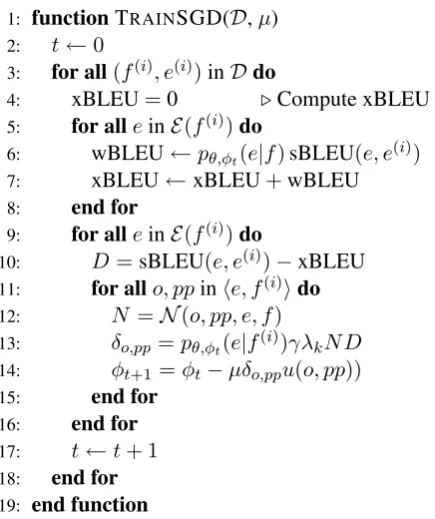
Figure 2: Algorithm for computing the expected BLEU loss with SGD updates (Eq. 4) based on training dataDand learning rateµ.
wherem+ 1≤k ≤m+jandN(o, pp, e, f)is the number of timesppwith orientation ooccurs in the current sentence pair.
This simplifies the error term to:
δo,pp=
X
e∈E(f)
pθ,φ(e|f)γλkN(o, pp, e, f)U(φ, e)
(8) whereλkis the weight of the dense feature sum-marizing orientationoin the log-linear model. We use Eq. 8 in a simple algorithm to train our model (Figure 2). Our SGD trainer uses a mini-batch size of a single sentence (§7) which entails all hypoth-esis in the n-best list for this sentence and the pa-rameters are updated after each mini-batch. 6 Feature Sets
Our features are inspired by Cherry (2013) who bases his features on the local phrase-pair
pp=h¯e,f¯ias well as the top stack of the shift re-duce parser of the baseline hierarchical ordering model. We experiment with these variants and ex-tensions:
consists of features over the first and last word of both the source and target phrase.5
We use four different word representations: The word identity itself, but only for the 80 most common source and target language words. The three other word representations are based on Brown clustering with either 20, 50 or 80 classes (Brown et al., 1992). There is one feature for every orientation type. • SparseHRM: The main feature set of Cherry
(2013). This is an extension of SparseHRM-Local adding features based on the first and
last word of both the source and the target of the hierarchical block at the top of the stack. There are also features based on the source wordsin-betweenthe current phrase and the hierarchical block at the top of the stack. • SparseHRM+UncommonWords: This set is
identical to SparseHRM, except that
word-identity features are not restricted to the 80 most frequent words, but can be instantiated for all words, regardless of frequency. • SparseHRM+BiPhrases: This augments
SparseHRM by phrase-identity features re-sulting in millions of instances compared to only a few thousand forSparseHRM. We add
three features for each possible phrase pair: the source phrase, the target phrase, and the whole phrase pair.
The baseline hierarchical lexicalized reorder-ing model is most similar toSparseHRM+BiPhrases
feature set since both have parameters for phrase, orientation pairs.6 The feature set closest to
Cherry (2013) is SparseHRM. However, while
Cherry had to severely restrict his features for batch lattice MIRA-based training, our maximum expected BLEU approach can handle millions of features.
7 Experiments
Baseline. We experiment with a phrase-based system similar to Moses (Koehn et al., 2007),
5Phrase-local features allow pcomputation which
re-sults in significant speed-ups at run-time. Cherry (2013) shows that local features are responsible for most of his gains.
6Although, our model is likely to learn significantly fewer
parameters since many phrase, orientation pairs will only be seen in the word-aligned data but not in actual machine trans-lation output.
scoring translations by a set of common fea-tures including maximum likelihood estimates of source given target phrases pMLE(e|f) and vice versa, pMLE(f|e), lexically weighted
esti-matespLW(e|f)andpLW(f|e), word and
phrase-penalties, as well as a linear distortion feature. The baseline uses a hierarchical reordering model with five orientation types, including monotone and swap, described in§2, as well as two discon-tinuous orientations, distinguishing if the previous phrase is to the left or right of the current phrase. Finally, monotone global indicates that all previ-ous phrases can be combined into a single hier-archical block. The baseline includes a modified Kneser-Ney word-based language model trained on the target-side of the parallel data, which is de-scribed below. Log-linear weights are estimated with MERT (Och, 2003). We regard the 1-best output of the phrase-based decoder with the hierar-chical reordering model as the baseline accuracy. Evaluation. We use training and test data from the WMT 2012 campaign and report results on French-English and German-English translation (Callison-Burch et al., 2012). Translation mod-els are estimated on 102M words of parallel data for French-English and 91M words for German-English; between 7.5-8.2M words are newswire, depending on the language pair, and the remainder are parliamentary proceedings. All discrimina-tive reordering models are trained on the newswire subset since we found this portion of the data to be most useful in initial experiments. We evaluate on six newswire domain test sets from 2008, 2010 to 2013 as well as the 2010 system combination test set containing between 2034 to 3003 sentences. Log-linear weights are estimated on the 2009 data set comprising 2525 sentences. We evaluate using BLEU with a single reference.
Discriminative Reordering Model.We use 100-best lists generated by the phrase-based decoder to train the discriminative reordering model. The n-best lists are generated by ten systems, each trained on 90% of the available data in order to de-code the remaining 10%. The purpose of this pro-cedure is to avoid a bias introduced by generating n-best lists for sentences on which the translation model was previously trained.7 Unless otherwise
7Later, we found that the bias has only a negligible effect
dev 2008 2010 sc2010 2011 2012 2013 AllTest FeatTypes
noRM 23.37 20.18 24.24 24.18 24.83 24.23 24.85 23.93
-HRM(baseline) 24.11 20.85 24.92 24.83 25.68 25.11 25.76 24.72
-SparseHRMLocal 25.24 21.26 25.99 25.93 26.98 26.34 26.77 25.77 4,407
SparseHRM 25.29 21.43 26.17 26.14 26.99 26.63 27.01 25.95 9,463
+UncommonWords 25.32 21.76 26.30 26.29 27.15 26.77 27.18 26.12 897,537
+BiPhrases 25.46 21.67 26.19 26.19 27.55 27.07 27.41 26.26 3,043,053
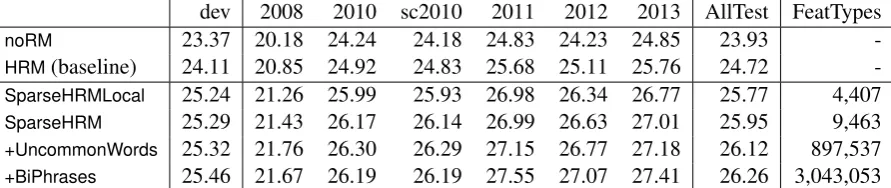
Table 1: French-English results of expected BLEU trained sparse reordering models compared to no reordering model at all (noRM) and the likelihood trained baseline hierarchical reordering model (HRM)
on WMT test sets; sc2010 is the 2010 system combination test set. FeatTypes is the number of different types and AllTest is the average BLEU score over all the test sets, weighted by corpus size. All results for our sparse reordering models include a likelihood-trained hierarchical reordering model.
dev 2008 2010 sc2010 2011 2012 2013 AllTest FeatTypes
noRM 18.54 19.28 20.14 20.01 18.90 18.87 21.60 19.81
-HRM(baseline) 19.35 19.96 20.87 20.66 19.60 19.80 22.48 20.58
-SparseHRMLocal 19.89 19.86 21.11 20.84 20.04 20.21 22.93 20.88 4,410
SparseHRM 19.83 20.27 21.26 21.05 20.22 20.44 23.17 21.11 9,477
+UncommonWords 20.06 20.35 21.45 21.31 20.28 20.55 23.30 21.24 1,136,248
[image:7.595.77.523.63.157.2]+BiPhrases 20.09 20.33 21.62 21.47 20.66 20.75 23.27 21.40 3,640,693
Table 2: German-English results of expected BLEU trained sparse reordering models (cf. Table 1).
mentioned, we train our reordering model on the news portion of the parallel data, corresponding to 136K-150K sentences, depending on the language pair. We tuned the various hyper-parameters on a held-out set, including the learning rate, for which we found a simple setting of 0.1 to be useful. To prevent overfitting, we experimented with`2
regu-larization, but found that it did not improve test ac-curacy. We also tuned the probability scaling pa-rameterγ(Eq. 6) but foundγ = 1to be very good among other settings. We evaluate the perfor-mance on a held-out validation set during training and stop whenever the objective changes less than a factor of 0.0003. For ourPRO experiments, we tuned three hyper-parameters controlling `2
reg-ularization, sentence-level BLEU smoothing, and length. The latter is important to eliminate PRO’s tendency to produce too short translations (Nakov et al., 2012).
7.1 Scaling the Feature Set
We first compare our baseline, a likelihood trained hierarchical reordering model (HRM; Galley & Manning, 2008), to various expected BLEU trained models, starting with SparseHRMLocal,
inspired by Cherry (2013) and compare it to
SparseHRM+BiPhrases, a set that is three orders of
magnitudes larger.
Our results on French-English translation (Ta-ble 1) and German-English translation (Ta(Ta-ble 2) show that the expected BLEU trained models scale to millions of features and that we outperform the baseline by up to 2.0 BLEU on newstest2012 for French-English and by up to 1.1 BLEU on new-stest2011 for German-English.8 Increasing the
size of the feature set improves accuracy across the board: The average accuracy over all test sets improves from 1.0 BLEU for the most basic fea-ture set to 1.5 BLEU for the largest feafea-ture set on French-English and from 0.3 BLEU to 0.8 BLEU on German-English.9 The most
compa-rable setting to Cherry (2013) is the feature set
SparseHRM, which we outperform by up to 0.5
BLEU on French-English and by 0.3 BLEU on av-erage on both language pairs, demonstrating the benefit of being able to effectively train large fea-ture sets. Furthermore, the increase in the num-ber of features does not affect runtime, since most
8Different to the setups of Galley & Manning (2008) and
Cherry (2013) our WMT evaluation framework uses only one instead of four references, which makes our BLEU score im-provements not directly comparable.
9We attribute smaller improvements on German-English
features can be pre-computed and stored in the phrase-table, only requiring a constant time table-lookup, similar to traditional reordering models.
Another appeal of our approach is that train-ing is very fast given a set of n-best lists for the training data. The SparseHRM model with 4,407
features is trained in only 26 minutes, while the
SparseHRM+BiPhrases model with over three
mil-lion parameters can be trained in just over two hours (136K sentences and 100 epochs in both cases). We attribute this to the training regime (§4), which does not iteratively re-decode the training data for expected BLEU training.10
7.2 Varying Training Set Size
Previous work on sparse reordering models was restricted to small data sets (Cherry, 2013) due to the limited ability of standard machine trans-lation optimizers to handle more than a few thou-sand sentences. In particular, recent attempts to scale the margin-infused relaxation algorithm, a variation which was also used by Cherry (2013), to larger data sets showed that more data does not necessarily help to improve test set accuracy for large feature sets (Eidelman et al., 2013).
In the next set of experiments, we shed light on the advantage of training discriminative reordering models with expected BLEU on large training sets. Specifically, we start off by estimating a reorder-ing model on only 2,000 sentences, similar to the size of the development set used by Cherry (2013), and incrementally increase the amount of training data to nearly three hundred thousand sentences. To avoid overfitting to small data sets we experi-ment with our most basic feature set SparseHRM-Local, comprising of just over 4,400 types.
For this experiment only, we measure accuracy in a re-ranking framework for faster experimen-tation where we use the 100-best output of the baseline system relying on a likelihood-based hi-erarchical reordering model. We re-estimate the log-linear weights by running a further iteration of MERT on the n-best list of the development set which is augmented by scores corresponding to the discriminative reordering model. The weights of those features are initially set to one and we use 20 random restarts for MERT. At test time we rescore the 100-best list of the test set using the new set of log-linear weights learned previously.
10We would expect better accuracy when iteratively
decod-ing the traindecod-ing data but did not do so in this study for effi-ciency reasons.
24.4 24.6 24.8 25.0 25.2
2K 4K 8K 16K 32K 64K 136K 272K
BLEU
Training set size
dev
26.6
Training set size
25.6 25.8 26.0 26.2 26.4 26.6
2K 4K 8K 16K 32K 64K 136K 272K
B
LEU
Training set size
[image:8.595.306.533.62.252.2]news2011
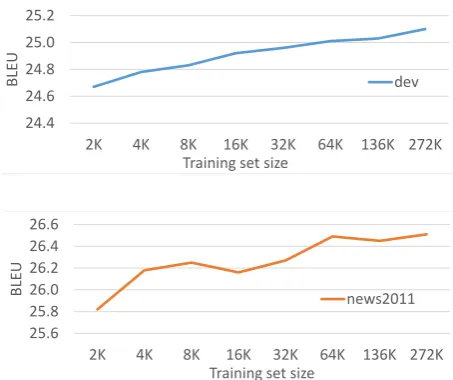
Figure 3: Effect of increasing the training set size from 2,000 to 272,000 sentences measured on the dev set (top) and news2011 (bottom) in an n-best list rescoring setting.
Figure 3 confirms that more training data in-creases accuracy and that the best model requires a substantially larger amount of training data than what is typically used for maximum BLEU train-ing. We expect an even steeper curve for larger feature sets where more parameters need to be es-timated and where the amount of training data is likely to have an even larger effect.
7.3 Likelihood versus BLEU Optimization Previous research has shown that directly training a reordering model for BLEU can vastly outper-form a likelihood trained maximum entropy re-ordering model (Cherry, 2013). However, the two approaches do not only differ in the objectives used, but also in the type of training data. The maximum entropy reordering model is trained on a word-aligned corpus, trying to learn human re-ordering patterns, whereas the sparse rere-ordering model is trained on machine translation output, trying to learn from the mistakes made by the ac-tual system. It is therefore not clear how much either one contributes to good accuracy.
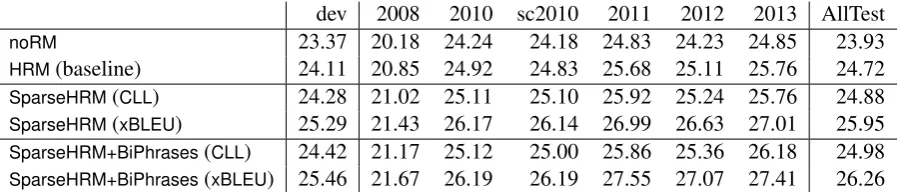
dev 2008 2010 sc2010 2011 2012 2013 AllTest
noRM 23.37 20.18 24.24 24.18 24.83 24.23 24.85 23.93
HRM(baseline) 24.11 20.85 24.92 24.83 25.68 25.11 25.76 24.72
SparseHRM(CLL) 24.28 21.02 25.11 25.10 25.92 25.24 25.76 24.88
SparseHRM(xBLEU) 25.29 21.43 26.17 26.14 26.99 26.63 27.01 25.95
SparseHRM+BiPhrases(CLL) 24.42 21.17 25.12 25.00 25.86 25.36 26.18 24.98 SparseHRM+BiPhrases(xBLEU) 25.46 21.67 26.19 26.19 27.55 27.07 27.41 26.26 Table 3: French-English results comparing the baseline hierarchical reordering model (HRM) to sparse reordering model trained towards conditional log-likelihood (CLL) and expected BLEU (xBLEU).
dev 2008 2010 sc2010 2011 2012 2013 AllTest
PRO 24.05 20.90 25.42 25.28 25.79 25.09 26.07 24.94
[image:9.595.75.525.62.158.2]xBLEU 25.24 21.26 25.99 25.93 26.98 26.34 26.77 25.77
Table 4: French-English results on theSparseHRMLocal feature set when when trained with pair-wise
ranked optimization (PRO) and expected BLEU (xBLEU).
a large feature setting of over 3M features (SparseHRM+BiPhrases). In the CLL setting, we
maximize the likelihood of the hypothesis with the highest BLEU score in the n-best list of each train-ing sentence.
Our results (Table 3) show that CLL training achieves only a fraction of the gains yielded by the expected BLEU objective. For SparseHRM,
CLL improves the baseline by less than 0.2 BLEU on average across all test sets, whereas expected BLEU achieves 1.2 BLEU. Increasing the number of features to 3M (SparseHRM+BiPhrases) results
in a slightly better average gain of 0.3 BLEU for CLL but but expected BLEU still achieves a much higher improvement of 1.5 BLEU. Because our gains with likelihood training are similar to what Cherry (2013) reported for his maximum entropy model, we conclude that the objective function is the most important factor to achieving good accu-racy.
7.4 Comparison to PRO
In our final experiment we compare expected BLEU training to pair-wise ranked optimization (PRO), a popular off the shelf trainer for ma-chine translation models with large feature sets (Hopkins and May, 2011).11 Previous work has
shown that PRO does not scale to truly large fea-ture sets with millions of types (Yu et al., 2013) and we therefore restrict ourselves to our smallest
11MIRA is another popular optimizer but as previously
mentioned, even the best publicly available implementation does not scale to large training sets (Eidelman et al., 2013).
set (SparseHRMLocal) of just over 4.4K features.
We train PRO on the development set compris-ing of 2,525 sentences, a setup that is commonly used by standard machine translation optimizers. In this setting, PRO directly learns weights for the baseline features (§7) as well as the 4.4K indica-tor features corresponding to the sparse reordering model. For expected BLEU training we use the full 136K sentences from the training data. The results (Table 4) demonstrate that expected BLEU outperforms a typical setup commonly used to train large feature sets.
8 Conclusion and Future Work
The expected BLEU objective is a simple and ef-fective approach to train large-scale discriminative reordering models. We have demonstrated that it scales to millions of features, which is orders of magnitudes larger than other modern machine translation optimizers can currently handle.
is usually done. We attribute this to the fact that likelihood is a strict zero-one loss that does not as-sign credit to partially correct solutions, whereas expected BLEU does.
In future work we plan to extend expected BLEU training to lattices and to evaluate the ef-fect of estimating weights for the dense baseline features as well. Our current training procedure (Gao and He, 2013; Gao et al., 2014) decodes the training data only once. In future work, we would like to compare this to repeated decoding as done by conventional optimization methods as well as other large-scale discriminative training approaches (Yu et al., 2013). We expect this to yield additional accuracy gains.
Acknowledgements
We would like to thank Arul Menezes and Xi-aodong He for helpful discussion related to this work and the three anonymous reviewers for their comments.
References
L´eon Bottou. 2004. Stochastic learning. In
Olivier Bousquet and Ulrike von Luxburg,
edi-tors,Advanced Lectures in Machine Learning,
Lec-ture Notes in Artificial Intelligence, pages 146–168. Springer Verlag, Berlin.
Peter F. Brown, Peter V. deSouza, Robert L. Mer-cer, Vincent J. Della Pietra, and Jenifer C. Lai.
1992. Class-based n-gram models of natural
lan-guage. Computational Linguistics, 18(4):467–479,
Dec.
Chris Callison-Burch, Philipp Koehn, Christof Monz, Matt Post, Radu Soricut, and Lucia Specia. 2012. Findings of the 2012 Workshop on Statistical
Ma-chine Translation. In Proc. of WMT, pages 10–51.
Association for Computational Linguistics, June. Colin Cherry. 2013. Improved Reordering for
Phrase-Based Translation using Sparse Features. InProc. of
NAACL, pages 9–14. Association for Computational Linguistics, June.
David Chiang, Kevin Knight, and Wei Wang. 2009. 11,001 New Features for Statistical Machine
Trans-lation. InProc. of NAACL, pages 218–226.
Associ-ation for ComputAssoci-ational Linguistics, June.
David Chiang. 2007. Hierarchical phrase-based
trans-lation. Computational Linguistics, 33(2):201–228.
Vladimir Eidelman, Ke Wu, Ferhan Ture1, Philip
Resnik, and Jimmy Lin. 2013. Mr. MIRA:
Open-Source Large-Margin Structured Learning on
MapReduce. InProc. of ACL, pages 199–204.
As-sociation for Computational Linguistics, August.
Michel Galley and Christopher D. Manning. 2008. A Simple and Effective Hierarchical Phrase
Reorder-ing Model. InProc. of EMNLP, pages 848–856.
Michel Galley, Mark Hopkins, Kevin Knight, and Daniel Marcu. 2004. What’s in a translation rule? In Proc. of HLT-NAACL, pages 273–280, Boston, MA, USA, May.
Michel Galley, Jonathan Graehl, Kevin Knight, Daniel Marcu, Steve DeNeefe, Wei Wang, and Ignacio Thayer. 2006. Scalable Inference and Training of Context-Rich Syntactic Translation Models. In
Proc. of ACL, pages 961–968, Sydney, Australia, June.
Jianfeng Gao and Xiaodong He. 2013. Training MRF-Based Phrase Translation Models using Gradient
Ascent. InProc. of NAACL-HLT, pages 450–459.
Association for Computational Linguistics, June. Jianfeng Gao, Xiaodong He, Scott Wen tau Yih, and
Li Deng. 2014. Learning Continuous Phrase
Rep-resentations for Translation Modeling. In Proc.
of ACL. Association for Computational Linguistics, June.
Spence Green, Daniel Cer, and Christopher Manning. 2014. An Empirical Comparison of Features and Tuning for Phrase-based Machine Translation. In
Proc. of WMT. Association for Computational Lin-guistics, June.
Xiaodong He and Li Deng. 2012. Maximum Expected BLEU Training of Phrase and Lexicon Translation
Models. InProc. of ACL, pages 8–14. Association
for Computational Linguistics, July.
Mark Hopkins and Jonathan May. 2011. Tuning as
ranking. InProc. of EMNLP. Association for
Com-putational Linguistics, July.
Philipp Koehn, Franz Josef Och, and Daniel Marcu. 2003. Statistical Phrase-Based Translation. In
Proc. of HLT-NAACL, pages 127–133, Edmonton, Canada, May.
Philipp Koehn, Amittai Axelrod, Alexandra Birch Mayne, Chris Callison-Burch, Miles Osborne, and David Talbot. 2005. Edinburgh System Description for the 2005 IWSLT Speech Translation Evaluation. InProc. of IWSLT.
Philipp Koehn, Hieu Hoang, Alexandra Birch, Chris Callison-Burch, Marcello Federico, Nicola Bertoldi, Brooke Cowan, Wade Shen, Christine Moran, Richard Zens, Chris Dyer, Ondrej Bojar, Alexandra Constantin, and Evan Herbst. 2007. Moses: Open Source Toolkit for Statistical Machine Translation. In Proc. of ACL Demo and Poster Sessions, pages 177–180, Prague, Czech Republic, Jun.
Percy Liang, Alexandre Bouchard-Cˆot´e, Ben Taskar, and Dan Klein. 2006. An end-to-end discriminative
approach to machine translation. In Proc. of
Preslav Nakov, Francisco Guzman, and Stephan Vo-gel. 2012. Optimizing for Sentence-Level BLEU+1
Yields Short Translations. InProc. of COLING.
As-sociation for Computational Linguistics.
Vinh Van Nguyen, Akira Shimazu, Minh Le Nguyen, and Thai Phuong Nguyen. 2009. Improving A Lex-icalized Hierarchical Reordering Model Using
Max-imum Entropy. InMT Summit XII. Association for
Computational Linguistics, August.
Franz Josef Och and Hermann Ney. 2004. The alignment template approach to machine translation.
Computational Linguistics, 30(4):417–449, June. Franz Josef Och. 2003. Minimum Error Rate Training
in Statistical Machine Translation. InProc. of ACL,
pages 160–167, Sapporo, Japan, July.
Kishore Papineni, Salim Roukos, Todd Ward, and Wei-Jing Zhu. 2002. BLEU: a method for automatic
evaluation of machine translation. InProc. of ACL,
pages 311–318, Philadelphia, PA, USA, Jul. Antti-Veikko I Rosti, Bing Zhang, Spyros Matsoukas,
and Richard Schwartz. 2010. BBN System De-scription for WMT10 System Combination Task. In Proc. of WMT, pages 321–326. Association for Computational Linguistics, July.
Antti-Veikko I Rosti, Bing Zhang, Spyros Matsoukas, and Richard Schwartz. 2011. Expected BLEU Training for Graphs: BBN System Description for
WMT11 System Combination Task. In Proc. of
WMT, pages 159–165. Association for
Computa-tional Linguistics, July.
Christoph Tillmann. 2003. A Unigram Orientation
Model for Statistical Machine Translation. InProc.
of NAACL, pages 106–108. Association for Compu-tational Linguistics, June.
Roy W. Tromble, Shankar Kumar, Franz Och, and
Wolfgang Macherey. 2008. Lattice Minimum
Bayes-Risk Decoding for Statistical Machine
Trans-lation. InProc. of EMNLP, pages 620–629.
Associ-ation for ComputAssoci-ational Linguistics, October. Dekai Wu. 1997. Stochastic inversion transduction
grammars and bilingual parsing of parallel corpora.
Computational Linguistics, 23(3):377–403.
Deyi Xiong, Qun Liu, and Shouxun Lin. 2006. Max-imum entropy based phrase reordering model for
statistical machine translation. In Proc. of
ACL-COLING, pages 521–528, Sydney, Jul.
Heng Yu, Liang Huang, Haitao Mi, and Kai Zhao. 2013. Max-Violation Perceptron and Forced
Decod-ing for Scalable MT TrainDecod-ing. InProc. of EMNLP,