Syntax-based Rewriting for Simultaneous Machine Translation
He He Computer Science University of Maryland
Alvin Grissom II, Jordan Boyd-Graber Computer Science
University of Colorado {Alvin.Grissom, Jordan.Boyd.Graber}
@colorado.edu
Hal Daumé III
Computer Science andUMIACS University of Maryland
Abstract
Divergent word order between languages causes delay in simultaneous machine translation. We present a sentence rewrit-ing method that generates more mono-tonic translations to improve the speed-accuracy tradeoff. We design grammati-cality and meaning-preserving syntactic transformation rules that operate on con-stituent parse trees. We apply the rules to reference translations to make their word order closer to the source language word order. On Japanese-English transla-tion (two languages with substantially dif-ferent structure), incorporating the rewrit-ten, more monotonic reference translation into a phrase-based machine translation system enables better translations faster than a baseline system that only uses gold reference translations.
1 Introduction
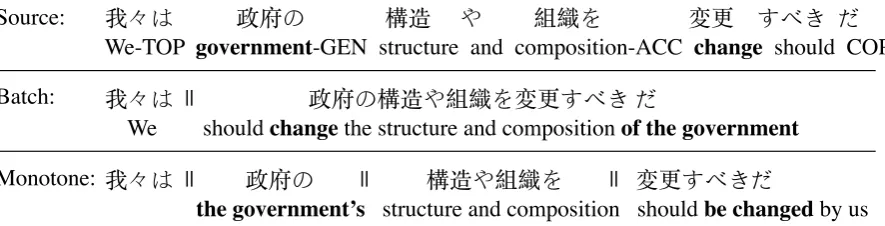
Simultaneous interpretation is challenging because it demands both quality and speed. Conventional batchtranslation waits until the entire sentence is completed before starting to translate. This merely optimizes translation quality and often introduces undesirable lag between the speaker and the audi-ence. Simultaneous interpretation instead requires a tradeoff between quality and speed. A common strategy is to translate independently translatable segments as soon as possible. Various segmenta-tion methods (Fujita et al., 2013; Oda et al., 2014) reduce translation delay; they are limited, however, by the unavoidable word reordering between lan-guages with drastically different word orders. We show an example of Japanese-English translation in Figure 1. Consider thebatchtranslation: in En-glish, the verbchangecomes immediately after the subjectWe, whereas in Japanese it comes at the end
of the sentence; therefore, to produce an intelligible English sentence, we must translate the object after the final verb is observed, resulting in one large and painfully delayed segment.
To reduce structural discrepancy, we can apply syntactic transformations to make the word order of one language closer to the other. Consider the monotonetranslation in Figure 1. By passivizing the English sentence, we can cache the subject and begin translating before observing the final verb. Furthermore, by using the English possessive, we mimic the order of the Japanese genitive construc-tion. These transformations enable us to divide the input into shorter segments, thus reducing transla-tion delay.
To produce such monotone translations, a straightforward approach is to incorporate inter-pretation data into the learning of a machine trans-lation (MT) system, because human interpreters use a variety of strategies (Shimizu et al., 2014; Camayd-Freixas, 2011; Tohyama and Matsubara, 2006) to fine-tune the word order. Shimizu et al. (2013) shows that this approach improves the speed-accuracy tradeoff. However, existing paral-lel simultaneous interpretation corpora (Shimizu et al., 2014; Matsubara et al., 2002; Bendazzoli and Sandrelli, 2005) are often small, and collecting new data is expensive due to the inherent costs of recording and transcribing speeches (Paulik and Waibel, 2010). In addition, due to the intense time pressure during interpretation, human interpreta-tion has the disadvantage of simpler, less precise diction (Camayd-Freixas, 2011; Al-Khanji et al., 2000) compared to human translations done at the translator’s leisure, allowing for more introspection and precise word choice.
We aim to address the data scarcity problem and combine translators’ lexical precision and inter-preters’ syntactic flexibility. We propose torewrite the reference translationin a way that uses the original lexicon, obeys standard grammar rules of
! We-TOP government-GEN structure and composition-ACC change should COP Source:
|| !
We should change the structure and composition of the government
|| || || !
the government’s structure and composition should be changed by us Batch:
Monotone:
Figure 1: Divergent word order between language pairs can cause long delays in simultaneous translation: Segments (||) mark the portions of the sentence that can be translated together. (Case markers: topic (TOP), genitive (GEN), accusative (ACC), copula (COP).)
the target language, preserves the original seman-tics, and yields more monotonic translations. We then train the MT system with the rewritten refer-ences so that it learns how to produce low-latency translations from the data. A data-driven approach to learning these rewriting rules is hampered by the dearth of parallel data: we have few examples of text that have been both interpreted and trans-lated. Therefore, we design syntactic transforma-tion rules based on linguistic analysis of the source and the target languages. We apply these rules to parsed text and decide whether to accept the rewrit-ten senrewrit-tence based on the amount of delay reduc-tion. In this work, we focus on Japanese to English translation, because (i) Japanese and English have significantly different word orders (SOVvs.SVO);
and consequently, (ii) the syntactic constituents re-quired earlier by an English sentence often come late in the corresponding Japanese sentence.
We evaluate our approach using standard ma-chine translation data (the Reuters newsfeed Japanese-English corpus) in a simultaneous trans-lation setting. Our experimental results show that including the rewritten references into the learning of a phrase-based MT system results in a better speed-accuracy tradeoff against both the original and the rewritten reference translations.
2 The Problem of Delay Reduction
Simultaneous interpretation has two goals: produc-ing good translationsandproducing them promptly. However, most existing parallel corpora and MT systems do not address the issue ofdelayduring translation. We explicitly adapt the training data by rewriting rules to reduce delay. We first define translation delay and describe—in general terms— our rewriting rules. In the next section, we describe the rules in more detail.
While we are motivated by real-time interpreta-tion, to simplify our problem, we assume that we have perfect text input. Given this constraint, a typ-ical simultaneous interpretation system (Sridhar et al., 2013; Fujita et al., 2013; Oda et al., 2014) pro-duces partial translations of consecutive segments in the source sentence and concatenates them to produce a complete translation. We define the trans-lation delayof a sentence as the average number of tokens the system has to observe between trans-lation of two consecutive segments (denoted by # words/seg).1 For instance, the minimum delay of 1 word/seg is achieved when we translate immedi-ately upon hearing a word. At test time, when the input is segmented, the delay is the average seg-ment length. During the data preprocessing step of rewriting, we calculate delay from word alignments (Section 4).
Given a reference batch translation x, we ap-ply a set of rewriting rulesRtoxto minimize its delay. A rewriting ruler ∈ R is a mapping that takes the constituent parse tree ofxas input and outputs a modified parse tree, which specifies a rewritten sentencex0. The tree-editing operation
includes node deletion, insertion, and swapping, as well as induced changes of word form and node label. A valid transformation rule should rearrange constituents inxto follow the word order of the input sentence as closely as possible, subject to grammatical constraints and preservation of the original meaning.
3 Transformation Rules
We design a variety of syntactic transformation rules for Japanese-English translation motivated by their structural differences. Our rules cover verb, noun, and clause reordering. While we specifi-cally focus on Japanese to English, many rules are broadly applicable toSOVtoSVOlanguages.
3.1 Verb Phrases
The most significant difference between Japanese and English is that the head of a verb phrase comes at the end of Japanese sentences. In English, it occu-pies one of the initial positions. We now introduce rules that can postpone a head verb.
Passivization and Activization In Japanese, the standard structure of a sentence isNP1NP2verb,
where case markers following the verb indicate the voice of the sentence. However, in English, we haveNP1 verb NP2, where the form of the verb
indicates its voice. Changing the voice is particu-larly useful when NP2 (object in an active-voice
sentence and subject in a passive-voice sentence) is long. By reversing positions ofverbandNP2,
we are not held back by the upcoming verb and can start to translateNP2immediately. Figure 1 shows
an example in which passive voice can help make the target and source word orders more compatible, but it is not the case that passivizing every sentence would be a good idea; sometimes making a pas-sive sentence active makes the word orders more compatible if the objects are relatively short:
O: The talk was denied by the boycott group spokesman.
R: The boycott group spokesmandeniedthe talk.
Quotative Verbs Quotativeverbs are verbs that, syntactically and semantically, resemblesaidand often start an independent clause. Such verbs are frequent, especially in news, and can be moved to the end of a sentence:
O: They announcedthat the president will re-structure the division.
R: The president will restructure the division, they announced.
In addition to quotative verbs, candidates typi-cally include factive (e.g.,know,realize,observe), factive-like (e.g.,announce,determine), belief (e.g., believe,think,suspect), and antifactive (e.g.,doubt, deny) verbs. When these verbs are followed by a
clause (SorSBAR), we move the verb and its sub-ject to the end of the clause.
While some exploratory work automatically ex-tracts factive verbs, to our knowledge, an exhaus-tive list does not exist. To obtain a list with rea-sonable coverage, we exploit the fact that Japanese has an unambiguous quotative particle,to, that pre-cedes such verbs.2We identify all of the verbs in the Kyoto corpus (Neubig, 2011) marked by the quotative particle and translate them into English. We then use these as our quotative verbs.3
3.2 Noun Phrases
Another difference between Japanese and English lies in the order of adjectives and the nouns they modify. We identify two situations where we can take advantage of the flexibility of English gram-mar to favor sentence structures consistent with positions of nouns in Japanese.
Genitive Reordering In Japanese, genitive con-structions always occur in the form of X no Y, where Y belongs to X. In English, however, the order may be reversed through theof construction. Therefore, we transform constructionsNP1ofNP2
to possessives using the apostrophe-s,NP2’(s)NP1
(Figure 1). We use simple heuristics to decide if such a transformation is valid. For example, when X / Y contains proper nouns (e.g.,the City of New York), numbers (e.g.,seven pounds of sugar), or pronouns (e.g.,most of them), changing them to the possessive case is not legal.
thatClause In English, clauses are often modi-fied through a pleonastic pronoun. E.g.,It isADJP to/thatSBAR/S. In Japanese, however, the subject (clause) is usually put at the beginning. To be con-sistent with the Japanese word order, we move the modified clause to the start of the sentence: To S/SBARisADJP. The rewritten English sentence is still grammatical, although its structure is less frequent in common English usage. For example,
O: It is importantto remain watchful. R: To remain watchfulis important.
2We use a morphological analyzer to distinguish between the conjunction and quotative particles. Examples of words marked by this particle include見られる (expect), 言う (say), 思われる (seem), する (assume), 信じる(believe) and so on.
VB* NP1 VP
NP2
S
We PRP
the DT love VBP NP VP
new JJ
world NN NP
S (a) Detection: Input:
swap NP1 and NP2! insert “be” before VB*!
insert “by” before NP2
(b) Modification:
PRP NP the
DT
VBN VP NP VP
new JJ
world NN
PP S
is VBZ
IN
by loved
us (c) Evaluation:
We new world the love Source:
Delay:
We love the new world Target:
1 4
We new world the love Source:
Delay:
The new world is loved by us New target:
[image:4.595.72.523.66.263.2]2 1 2
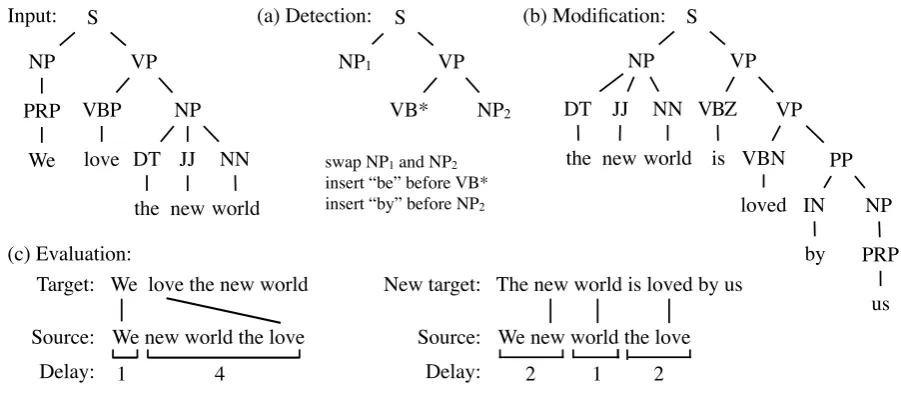
Figure 2: An example of applying the passivization rule to create a translation reference that is more monotonic.
3.3 Conjunction Clause
In Japanese, clausal conjunctions are often marked at the end of the initial clause of a compound sen-tence. In English, however, the order of clauses is more flexible. We can therefore reduce delay by reordering the English clauses to mirror how they typically appear in Japanese. Below we describe rules reversing the order of clauses connected by these conjunctions:
• Clausal conjunctions:because (of),in order to
• Contrastive conjunctions: despite, even though,although
• Conditionals:(even) if,as a result (of) • Misc:according to
In standard Japanese, such conjunctions include no de,kara,de moand so on. The sentence often appears in the form ofS2 conj, S1. In English,
however, two common constructions are
S1conj S2: We should marchbecause
win-ter is coming.
conj S2,S1:Becausewinter is coming, we
should march.
To follow the Japanese clause order, we adapt the above two constructions to
S2,conj’ S1: Winter is coming,because of
this, we should march.
Here conj’represents the original conjunction word appended with simple pronouns/phrases to refer toS2. For example,because→because of
this,even if →even if this is the case.
4 Sentence Rewriting Process
We now turn our attention to the implementation of the syntactic transformation rules described above. Applying a transformation consists of three steps:
1. Detection:Identify nodes in the parse tree for which the transformation is applicable; 2. Modification:Transform nodes and labels; 3. Evaluation:Compute delay reduction, and
decide whether to accept the rewritten sen-tence.
Figure 2 illustrates the process using passivization as an example. In the detection step, we find the subtree that satisfies the condition of applying a rule. In this case, we look for anSnode whose chil-dren include anNP(denoted byNP1), the subject,
and a VPto its right, such that the VPnode has a leafVB*, the main verb,4 followed by another NP(denoted byNP2), the object. We allow the
par-ent nodes (SandVP) to have additional children besides the matched ones. They are not affected during the transformation. In the modification step, we swap the subject node and object node; we add the verbbein its correct form by checking the tense of the verb and the form ofNP2;5and we add the
prepositionbybefore the subject. The process is executed recursively throughout the parse tree.
4The main verb excludesbeandhavewhen it indicates tense (e.g.,have done).
5We use the Nodebox linguistic library (https://www.
Although our rules are designed to minimize long range reordering, there are exceptions.6Thus applying a rule does not always reduce delay. In the evaluation step, we compare translation delay before and after applying the rule. We accept a rewritten sentence if its delay is reduced; other-wise, we revert to the input sentence. Since we do not segment sentences during rewriting, we must estimate the delay.
To estimate the delay, we use word alignments. Figure 2c shows the source Japanese sentence in its word-for-word English translation and align-ments from the target words to the source words. The first English word,We, is aligned to the first Japanese word; it can thus be treated as an inde-pendent segment and translated immediately. The second English word, love, is aligned to the last Japanese word, which means the system cannot start to translate until four more Japanese words are revealed. This alignment therefore forms a seg-ment with delay of four words/seg. Alignseg-ments of the following words come before the source word aligned tolove; hence, they are already translated in the previous segment and we do not double count their delay. In this example, the delay of the orig-inal sentence is 2.5 word/seg; after rewriting, it is reduced to 1.7 word/seg. Therefore, we accept the rewritten sentence. However, when the subject phrase is long and the object phrase is short, a swap may not reduce delay.
We can now formally define thedelay. Leteibe
theith target word in the input sentencexandai
be the maximum index among indices of source words thateialigned to. We define the delay ofei
asdi= max(0, ai−maxj<iaj). The delay ofxis
thenPNi=1di/N, where the sum is over all aligned
words except punctuation and stopwords.
Given a set of rules, we need to decide which rules to apply and in what order. Fortunately, our rules have little interaction with each other, and the order of application has a negligible effect. We apply the rules, roughly, sequentially in order of complexity: if the output of current rule is not ac-cepted, the sentence is reverted to the last accepted version.
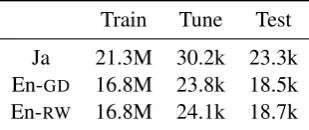
Train Tune Test Ja 21.3M 30.2k 23.3k En-GD 16.8M 23.8k 18.5k
[image:5.595.339.494.63.128.2]En-RW 16.8M 24.1k 18.7k
Table 1: Number of words in the training, tuning, and test datasets. En-GDand En-RWrepresent the
gold reference set and the rewritten reference set.
5 Experiments
We evaluate our method on the Reuters Japanese-English corpus of news articles (Utiyama and Isa-hara, 2003). For training the MT system, we also include the EIJIRO dictionary entries and the
ac-companying example sentences.7Statistics of the dataset are shown in Table 1. The rewritten trans-lation is generally slightly longer than the gold translation because our rewriting often involves inserting pronouns (e.g.it,this) for antecedents.
We use the TreebankWordTokenizer from NLTK (Bird et al., 2009) to tokenize
En-glish sentences and Kuromoji Japanese mor-phological analyzer8 to tokenize Japanese sen-tences. Our phrase-based MT system is trained by Moses (Koehn et al., 2003) with standard parameters settings. We use GIZA++ (Och and Ney, 2003) for word alignment andk-best batch MIRA (Cherry and Foster, 2012) for tuning. The translation quality is evaluated byBLEU(Papineni
et al., 2002) andRIBES(Isozaki et al., 2010).9To
obtain the parse trees for English sentences, we use the Stanford Parser (Klein and Manning, 2003) and the included English model.
5.1 Quality of Rewritten Translations
After applying the rewriting rules (Section 4), Ta-ble 2 shows the percentage of sentences that are candidates and how many rewrites are accepted. The most generalizable rules are passivization and delaying quotative verbs. We rewrite 32.2% of sen-tences, reducing the delay from 9.9 words/seg to 6.3 words/seg per segment for rewritten sentences and from 7.8 words/seg to 6.7 words/seg overall.
6For example, in clause transformation, the Japanese con-junctionmoshi, which is clause initial, may appear at the beginning of a sentence to emphasize conditionals, although its appearance is relatively rare.
7Available athttp://eijiro.jp
verb voice noun conj. Applicable % 39.9 50.0 26.4 4.8 Accepted % 22.5 24.0 51.2 38.4
Table 2: Percentage of sentences that each rule category can be applied to (Applicable) and the percentage of sentences for which the rule results in a more monotonic sentence (Accepted).
We evaluate the quality of our rewritten sen-tences from two perspectives: grammaticality and preserved semantics. To examine how close the rewritten sentences are to standard English, we train a 5-gram language model using the English data from the Europarl corpus, consisting of 46 million words, and use it to compute perplexity. Rewriting references increases the perplexity un-der the language model only slightly: from 332.0 to 335.4. To ensure that rewrites leave meaning unchanged, we use the SEMAFOR semantic role
labeler (Das et al., 2014) on the original and mod-ified sentence; for each role-labeled token in the reference sentence, we examine its corresponding role in the rewritten sentence and calculate the aver-age accuracy acrosss all sentences. Even ignoring benign lexical changes—for example,he becom-ing him in a passivized sentence—95.5% of the words retain their semantic roles in the rewritten sentences.
Although our rules are conservative to minimize corruption, some errors are unavoidable propaga-tion of parser errors. For example, the sentencethe London Stock Exchange closes at 1230 GMT today is parsed as:10
(S (NP the London Stock Exchange) (VP (VBZ closes)
(PP at 1230) (NP GMT today)))
GMT todayis separated from thePPas anNPand is mistaken as the object. The passive version is then GMT today is closed at 1230 by the London Stock Exchange. Such errors could be reduced by skip-ping nodes with low inside/outside scores given by the parser, or skipping low-frequency patterns. However, we leave this for future work.
5.2 Segmentation
At test time, we use right probability (Fujita et al., 2013,RP) to decide when to start translating a
10For simplicity we show the shallow parse only.
sentence. As we read in the source Japanese sen-tence, if the input segment matches an entry in the learned phrase table, we query the RP of the
Japanese/English phrase pair. A higherRPindicates
that the English translation of this Japanese phrase will likely be followed by the translation of the next Japanese phrase. In other words, translation of the two consecutive Japanese phrases is mono-tonic, thus, we can begin translating immediately. Following (Fujita et al., 2013), if the RP of the
current phrase is lower than a fixed threshold, we cache the current phrase and wait for more words from the source sentence; otherwise, we translate all cached phrases. Finally, translations of segments are concatenated to form a complete translation of the input sentence.
5.3 Speed/Accuracy Trade-off
To show the effect of rewritten references, we com-pare the followingMTsystems:
• GD:only gold reference translations;
• RW:only rewritten reference translations;
• RW+GD: both gold and the rewritten
refer-ences; and
• RW-LM+GD: using gold reference
transla-tions but using the rewritten references for training theLMand for tuning.
ForRW+GD andRW-LM+GD, we interpolate the
language models of GD and RW. The
interpolat-ing weight is tuned with the rewritten sentences. ForRW+GD, we combine the translation models
(phrase tables and reordering tables) of RW and GD by fill-up combination (Bisazza et al., 2011),
where all entries in the tables ofRWare preserved
and entries from the tables ofGDare added if new.
Increasing theRPthreshold increases
interpreta-tion delay but improves the quality of the transla-tion. We set the RPthreshold at 0.0, 0.2, 0.4, 0.8
and finally 1.0 (equivalent to batch translation). Figure 3 shows the BLEU/RIBES scores vs. the
number of words per segement as we increase the threshold. Rewritten sentences alone do not sig-nificantly improve over the baseline. We suspect this is because the transformation rules sometimes generate ungrammatical sentences due to parsing errors, which impairs learning. However, combin-ingRWandGDresults in a better speed-accuracy
tradeoff: theRW+GDcurve completely dominates
0 5 10 15 20 25 30 35
Average # of words per segment
1112 13 14 15 16 17 18
BLEU
RW+GD RW-LM+GD RW GD
(a)BLEUw.r.t. gold ref
0 5 10 15 20 25 30 35
Average # of words per segment
59.560.0 60.5 61.0 61.5 62.0 62.5
RIBES
RW+GD RW-LM+GD RW GD
(b)RIBESw.r.t. gold ref
0 5 10 15 20 25 30 35
Average # of words per segment
1011 12 13 14 15 16 17 18
BLEU
RW+GD RW-LM+GD RW GD
(c)BLEUw.r.t. rewritten ref
0 5 10 15 20 25 30 35
Average # of words per segment
59.560.0 60.5 61.0 61.5 62.0 62.5
RIBES
RW+GD RW-LM+GD RW GD
[image:7.595.84.521.63.417.2](d)RIBESw.r.t. rewritten ref
Figure 3: Speed/accuracy tradeoff curves:BLEU(left) /RIBES(right) versus translation delay (average
number of words per segment).
the same as GD, the major improvement likely
comes from the translation model from rewritten sentences.
The right two plots recapitulate the evaluation with theRIBESmetric. This result is less clear, as MT systems are optimized for BLEU and RIBES
penalizes word reordering, making it difficult to compare systems that intentionally change word order. Nevertheless,RW is comparable toGD on
gold references and superior to the baseline on rewritten references.
5.4 Effect on Verbs
Rewriting training data not only creates lower la-tency simultaneous translations, but it also im-provesbatchtranslation. One reason is that SOV
toSVOtranslation often drops the verb because of
long range reordering. (We see this for Japanese here, but this is also true for German.) Similar word orders in the source and target results in less re-ordering and improves phrase-basedMT(Collins
Translation
GD RW RW+GD Gold ref
# of verbs 1971 2050 2224 2731
Table 3: Number of verbs in the test set transla-tion produced by different models and the gold reference translation. Boldface indicates the num-ber is significantly larger than others (excluding the gold ref) according to two-samplet-tests with
p <0.001.
et al., 2005; Xu et al., 2009). Table 3 shows the number of verbs in the translations of the test sen-tences produced byGD,RW, RW+GD, as well as
the number in the gold reference translation. Both
RWandRW+GDproduce more verbs (a statistically
significant result), althoughRW+GDcaptures the
Ref
he also saidthat the real dangers for the euro lay in the potential for divergences in the domestic policy needs among the various participating nations of the single currency.
GD
healso for the euro, is a real danger to launch a single currency in many different countries and domestic policies on the need for the possibility of a difference.
RW
healso for the euro is a real danger to launch a single currency in many different countries and domestic policies to the needs of the possibility of a difference, he said.
Table 4: Example of translation produced by GD
andRW.
5.5 Error Analysis
Table 4 compares translations byGDandRW.RW
correctly puts the verbsaidat the end, while GD
drops the final verb. However,RWstill produceshe
at the beginning (also the first word in the Japanese source sentence). This is because our current seg-mentation strategy do not preserve words forlater translation—a note-taking strategy used by human interpreters.
6 Related Work
Previous approaches to simultaneous machine translation have employed explicit interpretation strategies for coping with delay. Two major ap-proaches are segmentation and prediction.
Most segmentation strategies are based on heuristics, such as pauses in speech (Fügen et al., 2007; Bangalore et al., 2009), comma predic-tion (Sridhar et al., 2013) and phrase reordering probability (Fujita et al., 2013). Learning-based methods have also been proposed. Oda et al. (2014) find segmentations that maximize theBLEUscore
of the final concatenated translation by dynamic programming. Grissom II et al. (2014) formulate simultaneous translation as a sequential decision making problem and uses reinforcement learning to decide when to translate. One limitation of these methods is that when learning with standard batch
MTcorpus, their gain can be restricted by natural
word reordering between the source and the target sentences, as explained in Section 1.
In anSOV-SVOcontext, methods to predict
un-seen words are proposed to alleviate the above re-striction. Matsubara et al. (1999) predict the En-glish verb in the target sentence and integrates it syntactically. Grissom II et al. (2014) predict the fi-nal verb in the source sentence and decide when to use the predicted verb with reinforcement learning.
Nevertheless, unless the predictor considers con-textual and background information, which human interpreters often rely on for prediction (Hönig, 1997; Camayd-Freixas, 2011), such a prediction task is inherently hard.
Unlike previous approaches to simultaneous translation, we directly adapt the training data and transform a translated sentence to an “interpreted” one. We can, therefore, take advantage of the abun-dance of parallel batch-translated corpora for train-ing a simultaneousMTsystem. In addition, as a data
preprocessing step, our approach is orthogonal to the others, with which it can be easily combined.
This work is also related to preprocessing re-ordering approaches (Xu et al., 2009; Collins et al., 2005; Galley and Manning, 2008; Hoshino et al., 2013; Hoshino et al., 2014) in batch MT for
language pairs with substantially different word or-ders. However, our problem is different in several ways. First, while the approaches resemble each other, our motivation is to reduce translation delay. Second, they reorder the source sentence, which is nontrivial and time-consuming when the sentence is incrementally revealed. Third, rewriting the tar-get sentence requires the output to be grammatical (for it to be used as reference translation), which is not a concern when rewriting source sentences.
7 Conclusion
Training MT systems with more monotonic
(interpretation-like) sentences improves the speed-accuracy tradeoff for simultaneous machine trans-lation. By designing syntactic transformations and rewriting batch translations into more monotonic translations, we reduce the translation delay.MT
systems trained on the rewritten reference transla-tions learn interpretation strategies implicitly from the data.
Our rewrites are based on linguistic knowledge and inspired by techniques used by human inter-preters. They cover a wide range of reordering phe-nomena between Japanese and English, and more generally, betweenSOVandSVOlanguages. A
Acknowledgments
This work was supported by NSF grant IIS
-1320538. Boyd-Graber is also partially supported byNSFgrants CCF-1409287 andNCSE-1422492.
Daumé III and He are also partially supported by
NSF grant IIS-0964681. Any opinions, findings,
conclusions, or recommendations expressed here are those of the authors and do not necessarily re-flect the view of the sponsor.
References
Raja Al-Khanji, Said El-Shiyab, and Riyadh Hussein. 2000. On the use of compensatory strategies in si-multaneous interpretation. Journal des Traducteurs, 45(3):548–577.
Srinivas Bangalore, Vivek Kumar Rangarajan Srid-har, Prakash Kolan, Ladan Golipour, and Aura Jimene. 2009. Real-time incremental speech-to-speech translation of dialogs. InProceedings of the Conference of the North American Chapter of the As-sociation for Computational Linguistics (NAACL). Claudio Bendazzoli and Annalisa Sandrelli. 2005. An
approach to corpus-based interpreting studies: De-veloping EPIC (european parliament interpreting corpus). In Proceedings of Challenges of Multidi-mensional Translation.
Steven Bird, Ewan Klein, and Edward Loper. 2009. Natural Language Processing with Python. O’Reilly Media.
Arianna Bisazza, Nick Ruiz, and Marcello Federico. 2011. Fill-up versus interpolation methods for phrase-based SMT adaptation. InProceedings of In-ternational Workshop on Spoken Language Transla-tion (IWSLT).
Erik Camayd-Freixas. 2011. Cognitive theory of si-multaneous interpreting and training. In Proceed-ings of the 52nd Conference of the American Trans-lators Association.
Colin Cherry and George Foster. 2012. Batch tuning strategies for statistical machine translation. In Pro-ceedings of the Conference of the North American Chapter of the Association for Computational Lin-guistics (NAACL).
Michael Collins, Philipp Koehn, and Ivona Kuˇcerová. 2005. Clause restructuring for statistical machine translation. In Proceedings of the annual meet-ing of the Association for Computational Lmeet-inguistics (ACL).
Dipanjan Das, Desai Chen, André F. T. Martins, Nathan Schneider, , and Noah A. Smith. 2014. Frame-semantic parsing.Computational Linguistics, 40(1).
Christian Fügen, Alex Waibel, , and Muntsin Kolss. 2007. Simultaneous translation of lectures and speeches. Machine Translation, 21(4):209–252. Tomoki Fujita, Graham Neubig, Sakriani Sakti,
Tomoki Toda, and Satoshi Nakamura. 2013. Simple, lexicalized choice of translation timing for simulta-neous speech translation. In Proceedings of Inter-speech.
Michel Galley and Christopher D. Manning. 2008. A simple and effective hierarchical phrase reordering model. InProceedings of Empirical Methods in Nat-ural Language Processing (EMNLP).
Alvin C. Grissom II, He He, Jordan Boyd-Graber, John Morgan, and Hal Daumé III. 2014. Don’t until the final verb wait: Reinforcement learning for si-multaneous machine translation. InProceedings of Empirical Methods in Natural Language Processing (EMNLP).
Hans G. Hönig. 1997. Using text mappings in teach-ing consecutive interpretteach-ing. Translation and Trans-lation Theory, pages 19–34.
Sho Hoshino, Yusuke Miyao, Katsuhito Sudoh, and Masaaki Nagata. 2013. Two-stage pre-ordering for Japanese-to-English statistical machine translation. InInternational Joint Conference on Artificial Intel-ligence (IJCNLP).
Sho Hoshino, Hubert Soyer, Yusuke Miyao, and Akiko Aizawa. 2014. Japanese to english machine transla-tion using preordering and compositransla-tional distributed semantics. InWorkshop on Asian Translation. Hideki Isozaki, Tsutomu Hirao, Kevin Duh, Katsuhito
Sudoh, and Hajime Tsukada. 2010. Automatic evaluation of translation quality for distant language pairs. InProceedings of Empirical Methods in Nat-ural Language Processing (EMNLP).
Dan Klein and Christopher D. Manning. 2003. Accu-rate unlexicalized parsing. InProceedings of the an-nual meeting of the Association for Computational Linguistics (ACL).
Philipp Koehn, Hieu Hoang, Alexandra Birch, Chris Callison-Burch, Marcello Federico, Brooke Cowan Nicola Bertoldi, Wade Shen, Richard Zens Chris-tine Moran, Chris Dyer, Ondˇrej Bojar, Alexandra Constantin, and Evan Herbs. 2003. Moses: Open source toolkit for statistical machine translation. In Proceedings of the annual meeting of the Associa-tion for ComputaAssocia-tional Linguistics (ACL).
Shigeki Matsubara, Katsuhiko Toyama, and Yasuyoshi Inagaki. 1999. Sync/trans: Simultaneous machine interpretation between English and Japanese. In Ad-vanced Topics in Artificial Intelligence, pages 134– 143. Springer.
monologue corpus for simultaneous machine inter-pretation research. InProceedings of the Language Resources and Evaluation Conference (LREC). Graham Neubig. 2011. The Kyoto free translation task.
Available online at http://www. phontron. com/kftt. Franz Josef Och and Hermann Ney. 2003. A
system-atic comparison of various statistical alignment mod-els. Computational Linguistics, 29(1):19–51. Yusuke Oda, Graham Neubig, Sakriani Sakti, Tomoki
Toda, and Satoshi Nakamura. 2014. Optimizing seg-mentation strategies for simultaneous speech transla-tion. InProceedings of the Association for Compu-tational Linguistics (ACL), June.
Kishore Papineni, Salim Roukos, Todd Ward, , and Wei-Jing Zhu. 2002. BLEU: a method for automatic evaluation of machine translation. InProceedings of the annual meeting of the Association for Computa-tional Linguistics (ACL).
Matthias Paulik and Alex Waibel. 2010. Spoken lan-guage translation from parallel speech audio: Simul-taneous interpretation as slt training data. In Pro-ceedings of the International Conference on Acous-tics, Speech, and Signal Processing (ICASSP). Hiroaki Shimizu, Graham Neubig, Sakriani Sakti,
Tomoki Toda, and Satoshi Nakamura. 2013. Con-structing a speech translation system using simulta-neous interpretation data. In Proceedings of Inter-national Workshop on Spoken Language Translation (IWSLT).
Hiroaki Shimizu, Graham Neubig, Sakriani Sakti, Tomoki Toda, and Satoshi Nakamura. 2014. Collec-tion of a simultaneous translaCollec-tion corpus for compar-ative analysis. InInternational Language Resources and Evaluation (LREC).
Vivek Kumar Rangarajan Sridhar, John Chen, Srinivas Bangalore Andrej Ljolje, and Rathinavelu Chengal-varayan. 2013. Segmentation strategies for stream-ing speech translation. In Proceedings of the Con-ference of the North American Chapter of the Asso-ciation for Computational Linguistics (NAACL). Hitomi Tohyama and Shigeki Matsubara. 2006.
Col-lection of simultaneous interpreting patterns by us-ing bilus-ingual spoken monologue corpus. In Proceed-ings of the Language Resources and Evaluation Con-ference (LREC).
Masao Utiyama and Hitoshi Isahara. 2003. Reliable measures for aligning japanese-english news articles and sentences. InProceedings of the annual meet-ing of the Association for Computational Lmeet-inguistics (ACL).