4095
Augmenting word2vec with Latent Dirichlet Allocation within a Clinical
Application
Akshay Budhkar
University of Toronto;
Vector Institute for Artificial Intelligence
Frank Rudzicz
University of Toronto; St Michael’s Hospital; Surgical Safety Technologies Inc.; Vector Institute for Artificial Intelligence
Abstract
This paper presents three hybrid models that directly combine latent Dirichlet allocation and word embedding for distinguishing be-tween speakers with and without Alzheimer’s disease from transcripts of picture descrip-tions. Two of our models get F-scores over the current state-of-the-art using automatic meth-ods on the DementiaBank dataset.
1 Introduction
Word embedding projects words into a lower-dimensional latent space that captures semantic and morphological information. Separately but re-lated, the task of topic modelling also discovers la-tent semantic structures ortopicsin a corpus. La-tent Dirichlet allocation (LDA) uses bag-of-words statistics to infer topics in an unsupervised man-ner. LDA considers each document to be a prob-ability distribution over hidden topics, and each topic is a probability distribution over all words in the vocabulary, both with Dirichlet priors.
The inferred probabilities over learned latent topics of a given document (i.e.,topic vectors) can be used along with a discriminative classifier, as in the work byLuo and Li (2014), but other ap-proaches such as TF-IDF (Lan et al., 2005) eas-ily outperform this model, like in the case of the
Reuters-21578corpus (Lewis et al., 1987). Here, we hypothesize that creating a hybrid of LDA and word2vec (Mikolov et al.,2013b) models will pro-duce discriminative features. We intropro-duce three new variants of hybrid LDA-word2vec models, and investigate the effect of dropping the first com-ponent after principal comcom-ponent analysis (PCA). These models can be thought of as extending the conglomeration of topical embedding models. We incorporate topical information into our word2vec models by using the final state of the topic-word distribution in the LDA model during training.
1.1 Motivation and Related Work
Alzheimer’s disease (AD) is a neurodegenera-tive disease that affects approximately 5.5 million Americans with annual costs of care up to $259B in the US, in 2017, alone (Alzheimer’s Association et al.,2017). The existing state-of-the-art methods for detecting AD from speech used extensive fea-ture engineering, some of which involved experi-enced clinicians. Fraser et al. (2016) investigated multiple linguistic and acoustic characteristics and obtained accuracies up to 81% with aggressive feature selection. Yancheva and Rudzicz (2016) use vector-space topic models, and achieved F-scores up to 74%. It is generally expensive to get sufficient labeled data for arbitrary patholog-ical conditions.
In our experiments, we train our hybrid models on a normative dataset and apply them for classifi-cation on a clinical dataset. The goal of this project is to i) effectively augment word2vec with LDA for classification, and ii) to improve the accuracy of dementia detection using automatic methods.
2 Datasets
The Wisconsin Longitudinal Study (WLS) is a normative dataset where residents of Wisconsin perform the Cookie Theft picture description task (Goodglass and Barresi, 2000). The audio ex-cerpts from the 2011 survey (N = 1,366) were converted to text using the Kaldi open source au-tomatic speech recognition (ASR) engine (Povey et al., 2011), specifically using a bi-directional LSTM trained to the Fisher data set (Cieri et al., 2004).
Fold 1 Fold 2 Fold 3 Fold 4 Fold 5 Total
CT 55 56 40 40 50 241
[image:2.595.73.293.62.98.2]AD 56 54 70 70 60 310
Table 1: DB test-data distribution
group, and233from those in the ‘Control’ group. Each speech sample was recorded and manually transcribed at the word level following the CHAT protocol (MacWhinney,1992). We use a5−fold group cross-validation (CV) to split this dataset while ensuring that a particular participant does not occur in both the train and test splits. Table 1presents the distribution of Control and Demen-tia groups in the test split for each fold.
WLS is used to train our LDA, word2vec and hybrid models that are then used to generate fea-ture vectors on the DB dataset. The feafea-ture vec-tors on the train set are used to train a discrimi-native classifier (e.g., SVM), that is then used to do the AD/CT binary classification on the feature vectors of the test set. During training we filter out spaCy’s (Honnibal and Montani,2017) list of stop words from our datasets. For our LDA models trained on ASR transcripts, we remove the[UNK]
and[NOISE] tokens generated by Kaldi, as well as theumanduhtokens, as this improved down-stream model performance.
3 Methods
3.1 Baselines
Once anLDAmodel is trained, it can be used to infer the topic distribution on a given document. We set the number of topics empirically to K=5
andK=25.
We use a pre-trained word2vec model trained on the Google News Dataset (Mikolov et al., 2013a). We also train our own word vectors with 300 dimensions and window size of 2 to be con-sistent with the pre-trained variant. We represent a document by averaging the word embeddings for all the words in that document.
Third,TF-IDFis a common numerical statistic in information retrieval that measures the number of times a word occurs in a document, and through the entire corpus. We use a TF-IDF vector rep-resentation for each transcript for the top 1,000
words after preprocessing, learned on the train set. Finally, since the goal of this paper is to cre-ate a hybrid of LDA and word2vec models, one of the simpler hybrid models – i.e., concatenating
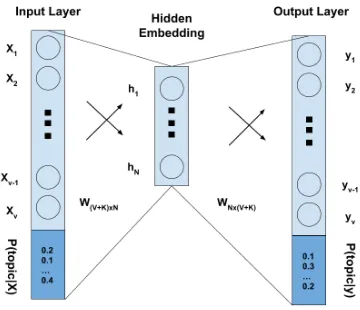
Figure 1: Neural representation of topical word2vec
LDA probabilities with average word2vec repre-sentations – is the fourth baseline model.
3.2 Topic Vectors
We represent a topic vector as theweighted combi-nation of the word2vec vectors of the words in the vocabulary. This represents every inferredtopicas a real-valued vector, with the same dimensions as the word embedding. A topic vector for a given topic is defined as:
topic vectorD = V
P
i=1 piWi
V (1)
whereV is the vocabulary size of our corpus, pi is the probability that a given word appears in the topic, from LDA, andWi is the word2vec embed-ding of that word.
A document vector is given by:
avg topic vectorD = K
P
i=1 piTi
K (2)
whereTi is the topic vector defined in Equation1,
Kis the number of topics of the LDA model, and
piis the inferred probability that a given document contains topici.
3.3 Topical Embedding
To generate topical embeddings, we use the
P(word|topic)from LDA training as the ground truth of how words and topics are related to each other. We normalize that distribution, so that
P
topics
P(topic|word) = 1. This gives a topical
[image:2.595.325.505.67.222.2]Figure 2: Example topic induction in the WLS corpus.
We concatenate this representation to the one-hot encoding of a given word to train a skip-gram word2vec model. Figure1shows a single pass of the word2vec training with this added information. There, XandY are the concatenated representa-tions of the input-output words determined by a context window, andh is anN-dimensional hid-den layer. All the words and the topics are mapped to anN-dimensional embedding during inference. Our algorithm also skips the softmax layer at the output of a standard word2vec model, as our vec-tors are now a combination of one-hot encoding and dense probability matrices.
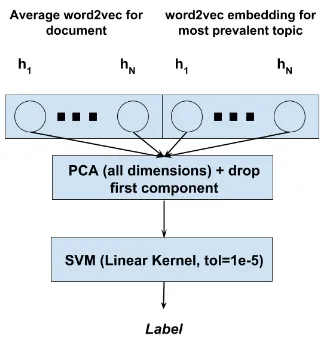
To get document representations, we use the av-erage these modified word2vec embeddings. We also propose a new way of representing documents as seen in Figure3where we concatenate the aver-age word2vec with the word2vec representation of the most prevalent topic in the document following LDA inference.
3.4 Topic-induced word2vec
Our final model involves inducing topics into the corpus itself. We represent every topic with the string topic i where i is its topic number; e.g., topic 1 istopic 1, and topic 25 istopic 25. We also create asunktopic character (analogous toUNKin vocabulary space) and set it totopic (K+1), where
Kis the number of topics in the LDA model. We normalize P(word|topic) to get
P(topic|word)(Section3.3). With a probability of 0.5, set empirically, we replace a given word with the topic string for max(P(topic|word)), provided the max value is≥0.2. If this max value is< 0.2, the word is replaced with the sunk topic for that model.
Figure 2 shows an example of topic induction on a snapshot of an ASR transcript of WLS. This
Figure 3: Setup for classification using hybrid mod-els. The PCA step exists for models applying work de-scribed in Section3.4.1.
process is repeated N = 10 times and this aug-mented corpus is now run through a standard skip-gram word2vec model with dimensions set to 400 to accommodate the bigger corpus. The intuition behind this approach is that it allows words to learn how they occur around topics in a corpus and vice versa. Document representations follow the same format as in Section3.3and in Figure3.
3.4.1 PCA Update
Inspired by the work of Arora et al. (2016), we transform the features of our models with PCA, drop the first component, and input the result to the classifier, as it improves accuracy empirically. Apart from the ablation study, all experiments use an SVM classifier with a linear kernel and tol-erance set to10−5.
4 Results
4.1 DB Classification
We report the average of the F1 micro and F1 macro scores for the 5-folds for all baseline and proposed models. These results are presented in two parts in Tables2and3.
The TF-IDF model sets a very strong baseline with an accuracy of74.95%, which is already bet-ter than the automatic models of Yancheva and Rudzicz(2016) on the same data.
[image:3.595.337.497.63.234.2]LDA Pre-trained word2vec Trained word2vec TF-IDF Concatenation Topic Vectors
5 Topics 25 Topics PCA Update PCA Update
F1 micro 55.70% 62.78% 66.97% 67.34% 71.50% 72.60% 74.95% 74.22% 56.27%
[image:4.595.74.528.63.124.2]F1 macro 54.44% 62.46% 64.78% 65.10% 71.33% 72.25% 74.49% 73.90% 35.90%
Table 2: DB Classification results (Average 5-Fold F-scores): Part 1
Topical word2vec
Topical word2vec
+ topic
Topical word2vec
Topical word2vec
+ topic
Topic-Induced word2vec
Topic-Induced word2vec
+ topic
Topic-Induced word2vec
Topic-Induced word2vec
+ topic Topic-Induced word2vec
Topic-Induced word2vec
+ topic
Topic-Induced word2vec
Topic-Induced word2vec
+ topic 25 topics 25 topics and PCA 5 topics 25 topics 5 topics and PCA 25 topics and PCA
F1 micro 75.32% 75.32% 73.69% 71.14% 75.32% 75.68% 77.50% 76.40% 77.10% 74.59% 76.77% 75.31%
F1 macro 74.97% 75.01% 73.32% 70.70% 74.98% 75.36% 77.19% 76.09% 76.86% 72.27% 76.48% 75%
Table 3: DB Classification results (Average 5-Fold F-scores): Part 2
embedding model, with the 25-topics variant giv-ing an average accuracy of77.5%.
To check if accuracies are statistically signifi-cant, we calculate our test statistic (Z) as follows:
Z= p p1−p2
2¯p(1−p¯)/n (3)
where (p1, p2) are the proportions of samples correctly classified by the two classifiers respec-tively, nis the number of samples (which in our case is551) andp¯= p1+p2
2 .
Augmenting word2vec models with topic in-formation significantly improves accuracy in the topic-induced word2vec model (p = 0.0227) when compared to the vanilla-trained word2vec model. This change is not significant in the top-ical embedding model (p= 0.152).
4.2 Evaluation of Different Classifiers
Using the the 25-topic topic-induced word2vec, we consider other discriminative classifiers. As seen in Table4, the linear SVM model gives the best accuracy of 77.5%, though all other mod-els perform similarly, with accuracies upwards of
70%. There is no statistically significant differ-ence between using an SVM vs. a LR (p= 0.569) or a gradient boosting classifier (p= 0.094).
Discriminative Classifier F1 micro F1 macro
SVM w/ linear kernel 77.50% 77.19%
Logistic Regression (LR) 76.05% 75.51% Random Forest 71.13% 69.97% Gradient Boosting Classifier 73.14% 72.39%
Table 4: DB: Discriminative Classifiers on Topic-induced LDA-25 model
5 Discussions
Although the topic distributions of the LDA mod-els were not distinctive enough in themselves, they capture subtle differences between the AD and CT patientsmissedby the vanilla word2vec mod-els. Simple concatenation of this distribution to the document increases the accuracy by 2.72%
(p= 0.31).
Topic vectors on their own do not provide much generative potential for this clinical data set, as representing a document as a single point in space, after going through two layers of contraction, re-moves information relevant to classification.
Our novel topic-induced model performs the best among our proposed models, with an accu-racy of77.5%on a 5-fold split of the DB dataset. To put this in perspective, Yancheva and Rudz-icz(2016)’s automatic vector-space topic models achieved74%on the same data set, albeit with a slightly different setup. Applying PCA to the fea-tures does not have a significant trend.
6 Limitations and Future Work
7 Conclusions
In this paper, we show the utility of augmenting word2vec with LDA-induced topics. We present three models, two of which outperform vanilla word2vec and LDA models for a clinical binary text classification task. Going forward, we will test this model on other tasks, diagnostic and oth-erwise, to see its generalizability. This can provide a starting point for clinical classification problems where labeled data may be scarce.
Acknowledgements
The Wisconsin Longitudinal Study is spon-sored by the National Institute on Aging (grant numbers R01AG009775, R01AG033285, and R01AG041868), and was conducted by the Uni-versity of Wisconsin. Rudzicz is an Inaugural CI-FAR Chair in artificial intelligence.
References
Alzheimer’s Association et al. 2017. 2017 Alzheimer’s disease facts and figures. Alzheimer’s & Dementia, 13(4):325–373.
Sanjeev Arora, Yingyu Liang, and Tengyu Ma. 2016. A simple but tough-to-beat baseline for sentence em-beddings.
Christopher Cieri, David Miller, and Kevin Walker. 2004. Fisher English training speech parts 1 and 2.
Philadelphia: Linguistic Data Consortium.
Kathleen C Fraser, Jed A Meltzer, and Frank Rudz-icz. 2016. Linguistic features identify Alzheimer’s disease in narrative speech. Journal of Alzheimer’s Disease, 49(2):407–422.
Harold Goodglass and Barbara Barresi. 2000. Boston diagnostic aphasia examination: Short form record booklet. Lippincott Williams & Wilkins.
Matthew Honnibal and Ines Montani. 2017. spaCy 2: Natural language understanding with Bloom embed-dings, convolutional neural networks and incremen-tal parsing. To appear.
Man Lan, Chew-Lim Tan, Hwee-Boon Low, and Sam-Yuan Sung. 2005. A comprehensive comparative study on term weighting schemes for text catego-rization with support vector machines. In Special interest tracks and posters of the 14th international conference on World Wide Web, pages 1032–1033. ACM.
David Lewis et al. 1987. Reuters-21578. Test Collec-tions, 1.
Yang Liu, Zhiyuan Liu, Tat-Seng Chua, and Maosong Sun. 2015. Topical word embeddings. In Associ-ation for the Advancement of Artificial Intelligence, pages 2418–2424.
Le Luo and Li Li. 2014. Defining and evaluating clas-sification algorithm for high-dimensional data based on latent topics. PloS one, 9(1):e82119.
Brian MacWhinney. 1992. The CHILDES project: Tools for analyzing talk. Child Language Teaching and Therapy, 8(2):217–218.
Brian MacWhinney, Davida Fromm, Margaret Forbes, and Audrey Holland. 2011. AphasiaBank: Methods for studying discourse. Aphasiology, 25(11):1286– 1307.
Tomas Mikolov, Kai Chen, Greg Corrado, and Jef-frey Dean. 2013a. Efficient estimation of word representations in vector space. arXiv preprint arXiv:1301.3781.
Tomas Mikolov, Ilya Sutskever, Kai Chen, Greg S Cor-rado, and Jeff Dean. 2013b. Distributed representa-tions of words and phrases and their compositional-ity. InAdvances in neural information processing systems, pages 3111–3119.
Daniel Povey, Arnab Ghoshal, Gilles Boulianne, Lukas Burget, Ondrej Glembek, Nagendra Goel, Mirko Hannemann, Petr Motlicek, Yanmin Qian, Petr Schwarz, Jan Silovsky, Georg Stemmer, and Karel Vesely. 2011. The kaldi speech recognition toolkit. In IEEE 2011 Workshop on Automatic Speech Recognition and Understanding. IEEE Signal Pro-cessing Society. IEEE Catalog No.: CFP11SRW-USB.