Generalized Hebbian Algorithm for Incremental Singular Value
Decomposition in Natural Language Processing
Genevieve Gorrell
Department of Computer and Information Science Link¨oping University
581 83 LINK ¨OPING Sweden
Abstract
An algorithm based on the Generalized Hebbian Algorithm is described that allows the singular value decomposition of a dataset to be learned based on single observation pairs presented seri-ally. The algorithm has minimal mem-ory requirements, and is therefore in-teresting in the natural language do-main, where very large datasets are of-ten used, and datasets quickly become intractable. The technique is demon-strated on the task of learning word and letter bigram pairs from text.
1 Introduction
Dimensionality reduction techniques are of great relevance within the field of natural lan-guage processing. A persistent problem within language processing is the over-specificity of language, and the sparsity of data. Corpus-based techniques depend on a sufficiency of examples in order to model human language use, but the Zipfian nature of frequency be-haviour in language means that this approach has diminishing returns with corpus size. In short, there are a large number of ways to say the same thing, and no matter how large your corpus is, you will never cover all the things that might reasonably be said. Language is often too rich for the task being performed; for example it can be difficult to establish that two documents are discussing the same topic. Likewise no matter how much data your sys-tem has seen during training, it will invari-ably see something new at run-time in a do-main of any complexity. Any approach to
au-tomatic natural language processing will en-counter this problem on several levels, creat-ing a need for techniques which compensate for this.
Imagine we have a set of data stored as a matrix. Techniques based on eigen decomposi-tion allow such a matrix to be transformed into a set of orthogonal vectors, each with an asso-ciated “strength”, or eigenvalue. This trans-formation allows the data contained in the ma-trix to be compressed; by discarding the less significant vectors (dimensions) the matrix can be approximated with fewer numbers. This is what is meant by dimensionality reduction. The technique is guaranteed to return the clos-est (least squared error) approximation possi-ble for a given number of numbers (Golub and Reinsch, 1970). In certain domains, however, the technique has even greater significance. It is effectively forcing the data through a bot-tleneck; requiring it to describe itself using an impoverished construct set. This can al-low the critical underlying features to reveal themselves. In language, for example, these features might be semantic constructs. It can also improve the data, in the case that the de-tail is noise, or richness not relevant to the task.
The technique has been successfully applied to information retrieval, where the overspecificity of language is particularly problematic; text searches often miss relevant documents where different vocabulary has been chosen in the search terms to that used in the document (for example, the user searches on “eigen decom-position” and fails to retrieve documents on factor analysis). LSA has also been applied in language modelling (Bellegarda, 2000), where it has been used to incorporate long-span se-mantic dependencies.
Much research has been done on optimis-ing eigen decomposition algorithms, and the extent to which they can be optimised de-pends on the area of application. Most natu-ral language problems involve sparse matrices, since there are many words in a natural lan-guage and the great majority do not appear in, for example, any one document. Domains in which matrices are less sparse lend themselves to such techniques as Golub-Kahan-Reinsch (Golub and Reinsch, 1970) and Jacobi-like ap-proaches. Techniques such as those described in (Berry, 1992) are more appropriate in the natural language domain.
Optimisation is an important way to in-crease the applicability of eigen and singu-lar value decomposition. Designing algorithms that accommodate different requirements is another. For example, another drawback to Jacobi-like approaches is that they calculate all the singular triplets (singular vector pairs with associated values) simultaneously, which may not be practical in a situation where only the top few are required. Consider also that the methods mentioned so far assume that the entire matrix is available from the start. There are many situations in which data may con-tinue to become available.
(Berry et al., 1995) describe a number of techniques for including new data in an ex-isting decomposition. Their techniques apply to a situation in which SVD has been per-formed on a collection of data, then new data becomes available. However, these techniques are either expensive, or else they are approxi-mations which degrade in quality over time. They are useful in the context of updating an existing batch decomposition with a sec-ond batch of data, but are less applicable in
the case where data are presented serially, for example, in the context of a learning system. Furthermore, there are limits to the size of ma-trix that can feasibly be processed using batch decomposition techniques. This is especially relevant within natural language processing, where very large corpora are common. Ran-dom Indexing (Kanerva et al., 2000) provides a less principled, though very simple and ef-ficient, alternative to SVD for dimensionality reduction over large corpora.
approach is limited to cases where the final matrix is expressible as the linear sum of outer products of the data vectors. Note in particu-lar that Latent Semantic Analysis, as usually implemented, is not an example of this, be-cause LSA takes the log of the final sums in each cell (Dumais, 1990). LSA, however, does not depend on singular value decomposition; Gorrell and Webb (Gorrell and Webb, 2005) discuss using eigen decomposition to perform LSA, and demonstrate LSA using the Gen-eralized Hebbian Algorithm in its unmodified form. Sanger (Sanger, 1993) presents similar work, and future work will involve more de-tailed comparison of this approach to his.
The next section describes the algorithm. Section 3 describes implementation in practi-cal terms. Section 4 illustrates, using word n-gram and letter n-gram tasks as examples and section 5 concludes.
2 The Algorithm
This section introduces the Generalized Heb-bian Algorithm, and shows how the technique can be adapted to the rectangular matrix form of singular value decomposition. Eigen decom-position requires as input a square diagonally-symmetrical matrix, that is to say, one in which the cell value at row x, column y is the same as that at row y, column x. The kind of data described by such a matrix is the correlation between data in a particular space with other data in the same space. For example, we might wish to describe how of-ten a particular word appears with a particu-lar other word. The data therefore are sym-metrical relations between items in the same space; word a appears with word b exactly as often as word b appears with word a. In sin-gular value decomposition, rectansin-gular input matrices are handled. Ordered word bigrams are an example of this; imagine a matrix in which rows correspond to the first word in a bigram, and columns to the second. The num-ber of times that word b appears after word a is by no means the same as the number of times that word a appears after word b. Rows and columns are different spaces; rows are the space of first words in the bigrams, and columns are the space of second words.
The singular value decomposition of a
rect-angular data matrix, A, can be presented as;
A=UΣVT (1)
whereU andV are matrices of orthogonal left and right singular vectors (columns) respec-tively, and Σ is a diagonal matrix of the cor-responding singular values. TheU andV ma-trices can be seen as a matched set of orthogo-nal basis vectors in their corresponding spaces, while the singular values specify the effective magnitude of each vector pair. By convention, these matrices are sorted such that the diag-onal of Σ is monotonically decreasing, and it is a property of SVD that preserving only the first (largest) N of these (and hence also only the first N columns of U and V) provides a least-squared error, rank-N approximation to the original matrix A.
Singular Value Decomposition is intimately related to eigenvalue decomposition in that the singular vectors,U andV, of the data matrix, A, are simply the eigenvectors of A∗AT and
AT ∗A, respectively, and the singular values, Σ, are the square-roots of the corresponding eigenvalues.
2.1 Generalised Hebbian Algorithm
Oja and Karhunen (Oja and Karhunen, 1985) demonstrated an incremental solution to find-ing the first eigenvector from data arrivfind-ing in the form of serial data items presented as vec-tors, and Sanger (Sanger, 1989) later gener-alized this to finding the first N eigenvectors with the Generalized Hebbian Algorithm. The algorithm converges on the exact eigen decom-position of the data with a probability of one. The essence of these algorithms is a simple Hebbian learning rule:
Un(t+ 1) =Un(t) +λ∗(UnT ∗Aj)∗Aj (2)
Unis then’th column ofU (i.e., then’th
eigen-vector, see equation 1), λ is the learning rate and Aj is the j’th column of training matrix
A. tis the timestep. The only modification to this required in order to extend it to multiple eigenvectors is that each Un needs to shadow
any lower-ranked Um(m > n) by removing its
projection from the inputAj in order to assure
the resulting eigenvectors. Sanger’s final for-mulation (Sanger, 1989) is:
cij(t+ 1) =cij(t) +γ(t)(yi(t)xj(t) (3)
−yi(t)
k≤i
ckj(t)yk(t))
In the above, cij is an individual element in
the current eigenvector,xj is the input vector
and yi is the activation (that is to say, ci.xj,
the dot product of the input vector with the
ith eigenvector). γ is the learning rate. To summarise, the formula updates the cur-rent eigenvector by adding to it the input vec-tor multiplied by the activation minus the pro-jection of the input vector on all the eigenvec-tors so far including the current eigenvector, multiplied by the activation. Including the current eigenvector in the projection subtrac-tion step has the effect of keeping the eigen-vectors normalised. Note that Sanger includes an explicit learning rate, γ. The formula can be varied slightly by not including the current eigenvector in the projection subtraction step. In the absence of the autonormalisation influ-ence, the vector is allowed to grow long. This has the effect of introducing an implicit learn-ing rate, since the vector only begins to grow long when it settles in the right direction, and since further learning has less impact once the vector has become long. Weng et al. (Weng et al., 2003) demonstrate the efficacy of this approach. So, in vector form, assuming C to be the eigenvector currently being trained, ex-pandingy out and using the implicit learning rate;
ci =ci.x(x−
j<i
(x.cj)cj) (4)
Delta notation is used to describe the update here, for further readability. The subtracted element is responsible for removing from the training update any projection on previous singular vectors, thereby ensuring orthgonal-ity. Let us assume for the moment that we are calculating only the first eigenvector. The training update, that is, the vector to be added to the eigenvector, can then be more simply described as follows, making the next steps more readable;
c=c.x(x) (5)
2.2 Extension to Paired Data
Let us begin with a simplification of 5:
c= 1
ncX(X) (6)
Here, the upper case X is the entire data ma-trix. n is the number of training items. The simplification is valid in the case that c is sta-bilised; a simplification that in our case will become more valid with time. Extension to paired data initially appears to present a prob-lem. As mentioned earlier, the singular vectors of a rectangular matrix are the eigenvectors of the matrix multiplied by its transpose, and the eigenvectors of the transpose of the matrix multiplied by itself. Running GHA on a non-square non-symmetrical matrix M, ie. paired data, would therefore be achievable using stan-dard GHA as follows:
ca= 1
nc
aM MT(M MT) (7)
cb = 1
nc
bMTM(MTM) (8)
In the above, ca and cb are left and right sin-gular vectors. However, to be able to feed the algorithm with rows of the matrices M MT
and MTM, we would need to have the en-tire training corpus available simultaneously, and square it, which we hoped to avoid. This makes it impossible to use GHA for singu-lar value decomposition of serially-presented paired input in this way without some further transformation. Equation 1, however, gives:
σca =cbMT =
x
(cb.bx)ax (9)
σcb =caM =
x
(ca.ax)bx (10)
Here, σ is the singular value and a and b are left and right data vectors. The above is valid in the case that left and right singular vectors
caandcbhave settled (which will become more
accurate over time) and that data vectors a
Inserting 9 and 10 into 7 and 8 allows them to be reduced as follows:
ca= σ
nc
bMTM MT (11)
cb = σ
nc
aM MTM (12)
ca= σ
2
nc
aM MT (13)
cb = σ
2
nc
bMTM (14)
ca= σ
3
nc
bMT (15)
cb = σ
3
nc
aM (16)
ca=σ3(cb.b)a (17) cb =σ3(ca.a)b (18)
This element can then be reinserted into GHA. To summarise, where GHA dotted the input with the eigenvector and multiplied the result by the input vector to form the training up-date (thereby adding the input vector to the eigenvector with a length proportional to the extent to which it reflects the current direc-tion of the eigenvector) our formuladirec-tion dots the right input vector with the right singular vector and multiplies the left input vector by this quantity before adding it to the left singu-lar vector, and vice versa. In this way, the two sides cross-train each other. Below is the final modification of GHA extended to cover mul-tiple vector pairs. The original GHA is given beneath it for comparison.
cai =cbi.b(a− j<i
(a.caj)caj) (19)
cbi =cai.a(b− j<i
(b.cbj)cbj) (20)
ci =ci.x(x−
j<i
(x.cj)cj) (21)
In equations 6 and 9/10 we introduced approx-imations that become accurate as the direction
of the singular vectors settles. These approx-imations will therefore not interfere with the accuracy of the final result, though they might interfere with the rate of convergence. The constant σ3
has been dropped in 19 and 20. Its relevance is purely with respect to the cal-culation of the singular value. Recall that in (Weng et al., 2003) the eigenvalue is calcula-ble as the average magnitude of the training update c. In our formulation, according to 17 and 18, the singular value would bec di-vided by σ3
. Dropping the σ3
in 19 and 20 achieves that implicitly; the singular value is once more the average length of the training update.
The next section discusses practical aspects of implementation. The following section illus-trates usage, with English language word and letter bigram data as test domains.
3 Implementation
slowly. The problem can be addressed by wait-ing until each swait-ingular vector pair is relatively stable before beginning to train the next. By “stable”, we mean that the vector is changing little in its direction, such as to suggest it is very close to its target. Measures of stability might include the average variation in posi-tion of the endpoint of the (normalised) vector over a number of training iterations, or simply length of the (unnormalised) vector, since a long vector is one that is being reinforced by the training data, such as it would be if it was settled on the dominant feature. Termination criteria might include that a target number of singular vector pairs have been reached, or that the last vector is increasing in length only very slowly.
4 Application
The task of relating linguistic bigrams to each other, as mentioned earlier, is an example of a task appropriate to singular value decom-position, in that the data is paired data, in which each item is in a different space to the other. Consider word bigrams, for example. First word space is in a non-symmetrical re-lationship to second word space; indeed, the spaces are not even necessarily of the same di-mensionality, since there could conceivably be words in the corpus that never appear in the first word slot (they might never appear at the start of a sentence) or in the second word slot (they might never appear at the end.) So a matrix containing word counts, in which each unique first word forms a row and each unique second word forms a column, will not be a square symmetrical matrix; the value at row a, column b, will not be the same as the value at row b column a, except by coincidence.
The significance of performing dimension-ality reduction on word bigrams could be thought of as follows. Language clearly ad-heres to some extent to a rule system less rich than the individual instances that form its surface manifestation. Those rules govern which words might follow which other words; although the rule system is more complex and of a longer range that word bigrams can hope to illustrate, nonetheless the rule system gov-erns the surface form of word bigrams, and we might hope that it would be possible to discern
from word bigrams something of the nature of the rules. In performing dimensionality reduc-tion on word bigram data, we force the rules to describe themselves through a more impover-ished form than via the collection of instances that form the training corpus. The hope is that the resulting simplified description will be a generalisable system that applies even to instances not encountered at training time.
On a practical level, the outcome has ap-plications in automatic language acquisition. For example, the result might be applicable in language modelling. Use of the learning algo-rithm presented in this paper is appropriate given the very large dimensions of any real-istic corpus of language; The corpus chosen for this demonstration is Margaret Mitchell’s “Gone with the Wind”, which contains 19,296 unique words (421,373 in total), which fully re-alized as a correlation matrix with, for exam-ple, 4-byte floats would consume 1.5 gigabytes, and which in any case, within natural language processing, would not be considered a particu-larly large corpus. Results on the word bigram task are presented in the next section.
Letter bigrams provide a useful contrast-ing illustration in this context; an input di-mensionality of 26 allows the result to be more easily visualised. Practical applications might include automatic handwriting recogni-tion, where an estimate of the likelihood of a particular letter following another would be useful information. The fact that there are only twenty-something letters in most western alphabets though makes the usefulness of the incremental approach, and indeed, dimension-ality reduction techniques in general, less ob-vious in this domain. However, extending the space to letter trigrams and even four-grams would change the requirements. Section 4.2 discusses results on a letter bigram task.
4.1 Word Bigram Task
magnitude of 2000 was given as the criterion for beginning to train the next vector pair, the reasoning being that since the singular vectors only start to grow long when they settle in the approximate right direction and the data starts to reinforce them, length forms a reason-able heuristic for deciding if they are settled enough to begin training the next vector pair. 2000 was chosen ad hoc based on observation of the behaviour of the algorithm during train-ing.
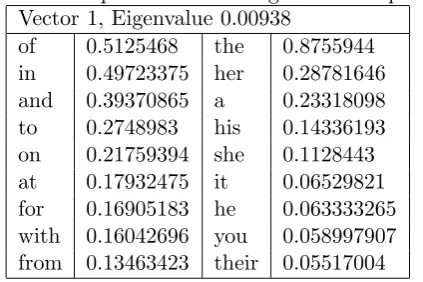
[image:7.595.77.289.612.753.2]The data presented are the words most rep-resentative of the top two singular vectors, that is to say, the directions these singular vectors mostly point in. Table 1 shows the words with highest scores in the top two vec-tor pairs. It says that in this vecvec-tor pair, the normalised left hand vector projected by 0.513 onto the vector for the word “of” (or in other words, these vectors have a dot product of 0.513.) The normalised right hand vector has a projection of 0.876 onto the word “the” etc. This first table shows a left side dominated by prepositions, with a right side in which “the” is by far the most important word, but which also contains many pronouns. The fact that the first singular vector pair is effectively about “the” (the right hand side points far more in the direction of “the” than any other word) reflects its status as the most common word in the English language. What this result is saying is that were we to be allowed only one feature with which to describe word English bigrams, a feature describing words appear-ing before “the” and words behavappear-ing similarly to “the” would be the best we could choose. Other very common words in English are also prominent in this feature.
Table 1: Top words in 1st singular vector pair Vector 1, Eigenvalue 0.00938
of 0.5125468 the 0.8755944
in 0.49723375 her 0.28781646
and 0.39370865 a 0.23318098
to 0.2748983 his 0.14336193
on 0.21759394 she 0.1128443
at 0.17932475 it 0.06529821
for 0.16905183 he 0.063333265
with 0.16042696 you 0.058997907
from 0.13463423 their 0.05517004
Table 2 puts “she”, “he” and “it” at the top on the left, and four common verbs on the right, indicating a pronoun-verb pattern as the second most dominant feature in the corpus.
Table 2: Top words in 2nd singular vector pair Vector 2, Eigenvalue 0.00427
she 0.6633538 was 0.58067155
he 0.38005337 had 0.50169927
it 0.30800354 could 0.2315106
and 0.18958427 would 0.17589279
4.2 Letter Bigram Task
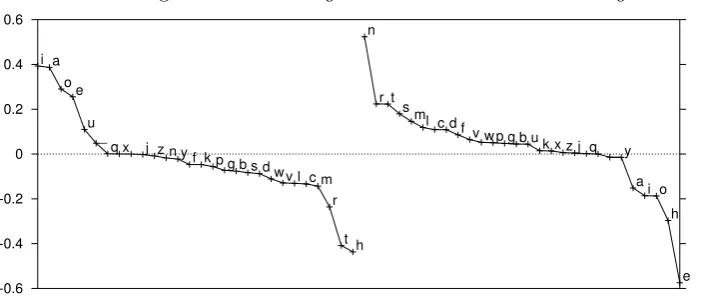
Running the algorithm on letter bigrams illus-trates different properties. Because there are only 26 letters in the English alphabet, it is meaningful to examine the entire singular tor pair. Figure 1 shows the third singular vec-tor pair derived by running the algorithm on letter bigrams. The y axis gives the projection of the vector for the given letter onto the sin-gular vector. The left sinsin-gular vector is given on the left, and the right on the right, that is to say, the first letter in the bigram is on the left and the second on the right. The first two singular vector pairs are dominated by letter frequency effects, but the third is interesting because it clearly shows that the method has identified vowels. It means that the third most useful feature for determining the likelihood of letter b following letter a is whether letter a
is a vowel. If letter b is a vowel, letter a is less likely to be (vowels dominate the nega-tive end of the right singular vector). (Later features could introduce subcases where a par-ticular vowel is likely to follow another partic-ular vowel, but this result suggests that the most dominant case is that this does not hap-pen.) Interestingly, the letter ’h’ also appears at the negative end of the right singular vec-tor, suggesting that ’h’ for the most part does not follow a vowel in English. Items near zero (’k’, ’z’ etc.) are not strongly represented in this singular vector pair; it tells us little about them.
5 Conclusion
Figure 1: Third Singular Vector Pair on Letter Bigram Task
-0.6 -0.4 -0.2 0 0.2 0.4 0.6
i a oe
u _
q x j z n y
f k p g b s d w v l c m
r
t h n
r t s
ml c d
f v wp g b u
k x z j q _ y
a i o
h
e
of the incremental approach means that singular value decomposition is an option in situations where data takes the form of single serially-presented observations from an unknown matrix. The method is particularly appropriate in natural language contexts, where datasets are often too large to be pro-cessed by traditional methods, and situations where the dataset is unbounded, for example
in systems that learn through use. The
approach produces preliminary estimations of the top vectors, meaning that informa-tion becomes available early in the training process. By avoiding matrix multiplication, data of high dimensionality can be processed. Results of preliminary experiments have been discussed here on the task of modelling word and letter bigrams. Future work will include an evaluation on much larger corpora.
Acknowledgements: The author would like to thank Brandyn Webb for his contribution, and the Graduate School of Language Technol-ogy and Vinnova for their financial support.
References
J. Bellegarda. 2000. Exploiting latent semantic in-formation in statistical language modeling. Pro-ceedings of the IEEE, 88:8.
Michael W. Berry, Susan T. Dumais, and Gavin W. O’Brien. 1995. Using linear algebra for in-telligent information retrieval. SIAM Review, 34(4):573–595.
R. W. Berry. 1992. Large-scale sparse singular value computations. The International Journal of Supercomputer Applications, 6(1):13–49.
Scott C. Deerwester, Susan T. Dumais, Thomas K. Landauer, George W. Furnas, and Richard A. Harshman. 1990. Indexing by latent semantic analysis. Journal of the American Society of In-formation Science, 41(6):391–407.
S. Dumais. 1990. Enhancing performance in latent semantic indexing. TM-ARH-017527 Technical Report, Bellcore, 1990.
G. H. Golub and C. Reinsch. 1970. Handbook se-ries linear algebra. singular value decomposition and least squares solutions. Numerical Mathe-matics, 14:403–420.
G. Gorrell and B. Webb. 2005. Generalized heb-bian algorithm for latent semantic analysis. In
Proceedings of Interspeech 2005.
P. Kanerva, J. Kristoferson, and A. Holst. 2000. Random indexing of text samples for latent se-mantic analysis. InProceedings of 22nd Annual Conference of the Cognitive Science Society.
E. Oja and J. Karhunen. 1985. On stochastic ap-proximation of the eigenvectors and eigenvalues of the expectation of a random matrix. J. Math. Analysis and Application, 106:69–84.
Terence D. Sanger. 1989. Optimal unsupervised learning in a single-layer linear feedforward neu-ral network. Neural Networks, 2:459–473.
Terence D. Sanger. 1993. Two iterative algorithms for computing the singular value decomposition from input/output samples. NIPS, 6:144–151.