Joint memory-based learning of syntactic and semantic dependencies
in multiple languages
Roser Morante, Vincent Van Asch
CNTS - Language Technology Group University of Antwerp
Prinsstraat 13
B-2000 Antwerpen, Belgium
{Roser.Morante,Vincent.VanAsch}@ua.ac.be
Antal van den Bosch
Tilburg University
Tilburg centre for Creative Computing P.O. Box 90153
NL-5000 LE Tilburg, The Netherlands [email protected]
Abstract
In this paper we present a system submitted to the CoNLL Shared Task 2009 performing the identifi-cation and labeling of syntactic and semantic depen-dencies in multiple languages. Dependepen-dencies are truly jointly learned, i.e. as if they were a single task. The system works in two phases: a classifica-tion phase in which three classifiers predict different types of information, and a ranking phase in which the output of the classifiers is combined.
1 Introduction
In this paper we present the machine learning system submitted to the CoNLL Shared Task 2009 (Hajiˇc et al., 2009). The task is an extension to multi-ple languages (Burchardt et al., 2006; Hajiˇc et al., 2006; Kawahara et al., 2002; Palmer and Xue, 2009; Surdeanu et al., 2008; Taul´e et al., 2008) of the CoNLL Shared Task 2008, combining the identifica-tion and labeling of syntactic dependencies and se-mantic roles. Our system is a joint-learning system tested in the “closed” challenge, i.e. without making use of external resources.
Our system operates in two phases: a classifica-tion phase in which three memory-based classifiers predict different types of information, and a rank-ing phase in which the output of the classifiers is combined by ranking the predictions. Semantic and syntactic dependencies are jointly learned and pro-cessed. In the task description no precise defini-tion is given of joint learning. We consider that a joint-learning system is one in which semantic and
syntactic dependencies are learned and processed jointly as a single task. In our system this is achieved by fully merging semantic and syntactic dependen-cies at the word level as the first step.
One direct consequence of merging the two tasks, is that the class space becomes more complex; the number of classes increases. Many machine-learning approaches do not scale well to larger class spaces in terms of efficiency and computer resource requirements. Memory-based learning is a noted ex-ception, as it is largely insensitive to the number of classes in terms of efficiency. This is the primary reason for using memory-based learning. Memory-based language processing (Daelemans and van den Bosch, 2005) is based on the idea that NLP prob-lems can be solved by storing solved examples of the problem in their literal form in memory, and apply-ing similarity-based reasonapply-ing on these examples in order to solve new ones. Memory-based algorithms have been previously applied to semantic role la-beling and parsing separately (Morante et al., 2008; Canisius and Tjong Kim Sang, 2007).
We briefly discuss the issue of true joint learning of two tasks in Section 2. The system is described in Section 3, Section 4 presents and discusses the results, and in Section 5 we put forward some con-clusions and future research.
2 Joint learning
When two tasks share the same feature space, there is the natural option to merge them and consider the merge as a single task. The merging of two tasks will typically lead to an increase in the number of classes, and generally a more complex class space. In practice, if two combined tasks are to some
tent related, the increase will tend to be less than the product of the number of classes in the two original tasks, as classes from both tasks will tend to cor-relate. Yet, even a mild increase of the number of classes leads to a further fragmentation of the class space, and thus to less training examples per class label. Joint learning can therefore only lead to posi-tive results if the data sparsity effect of the fragmen-tation of the class space is counter-balanced by an improved learnability.
Here, we treat the syntactic and semantic tasks as one and the same task. At the word level, we merge the class labels of the two tasks into single labels, and present the classifiers with these labels. Further on in our system, as we describe in the next sec-tion, we do make use of the compositionality of the labels, as the semantic and syntactic output spaces represented two different types of structure.
3 System description
The joint system that we submitted works in two phases: a classification phase in which three memory-based classifiers predict different aspects of joint syntactic and semantic labeling, and a ranking phase in which the output of the classifiers is com-bined. Additionally, a memory-based classifier is used for predicate sense disambiguation. As a first step, before generating the instances of the classi-fiers we merge the semantic and syntactic dependen-cies into single labels. The merged version of the dependencies from an example sentence is shown in Table 1, where column MERGED DEPs contains all the dependencies of a token separated by a blank space expressed in labels with the following format: PHEAD::PDEPREL:APRED.
3.1 Phase 1: Classification
In the classification phase, three classifiers predict different local aspects of the global output structure. The classifiers have been optimized for English, by training on the full training set and testing on the development set; these optimized settings were then used for the other six languages. We experimented with manually selected parameters and with eters selected by a genetic algorithm, but the param-eters found by the genetic algorithm did not yield better results than the manually selected parameters.
N Token Merged Dependencies 1 Housing 2::NMOD:A1
2 starts 2:: :A2 3::SBJ: 4:: :A1 6:: :A1 13:: :A0
3 are 0::ROOT:
4 expected 3::VC:
5 to 4::OPRD:C-A1
6 quicken 5::IM:
7 a 8::NMOD:
8 bit 6::OBJ:A2
9 from 6::ADV:A3
10 August 13::NMOD:AM-TMP 11 ’s 10::SUFFIX: 12 annual 13::NMOD:AM-TMP 13 pace 9::PMOD:
14 of 13::NMOD:A2
15 1,350,000 16::NMOD: 16 units 14::PMOD:
17 . 3::P:
Table 1: Example sentence with merged depen-dency labels.
3.1.1 Classifier 1: Pairwise semantic and syntact dependencies
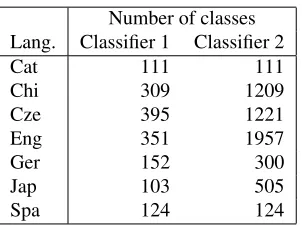
Classifier 1 predicts the merged semantic and syn-tactic dependencies that hold between two tokens. Instances represent combinations of pairs of tokens within a sentence. Each token is combined with all other tokens in the sentence. The class predicted is the PDEPREL:APRED label. The amount of classes per language is shown in Table 2 (“Classifier 1”).
Number of classes Lang. Classifier 1 Classifier 2
Cat 111 111
Chi 309 1209
Cze 395 1221
Eng 351 1957
Ger 152 300
Jap 103 505
[image:2.612.315.541.60.259.2]Spa 124 124
Table 2: Number of classes per language predicted by Classifiers 1 and 2.
We use an IB1 memory–based algorithm as im-plemented in TiMBL (version 6.1.2)1, a memory-based classifier memory-based on the k-nearest neighbor
[image:2.612.353.504.485.598.2]rule. The IB1 algorithm was parameterised by us-ing modified value difference as the similarity met-ric, gain ratio for feature weighting, using 11 k
-nearest neighbors, and weighting the class vote of neighbors as a function of their inverse linear dis-tance. Because of time limitations we used TRIBL for Czech and Chinese to produce the official results, although we also provide postevaluation results pro-duced with IB1. TRIBL is a hybrid combination of IB1 and IGTREE, a fast decision-tree approxi-mation of k-NN (Daelemans and van den Bosch, 2005), trading off fast decision-tree lookup on the most important features (in our experiments, five) with slower k-NN classification on the remaining features.
The features2used by this classifier are:
• The word, lemma, POS and FILLPRED3 of the
to-ken, the combined token and of two tokens before and after token and combined token.
• POS and FILLPRED of the third token before and after token and combined token.
• Distance between token and combined token, loca-tion of token in relaloca-tion to combined token.
Because data are skewed towards the NONE class, we downsampled the training instances so that there would be a negative instance for every positive instance. Instances with the NONE class to be kept were randomly selected.
3.1.2 Classifier 2: Per-token relations
Classifier 2 predicts the labels of the dependency relations of a token with its syntactic and/or seman-tic head(s). Instances represent a token. As an ex-ample, the instance that represents token 2 in Table 1 would have as class: :A2-SBJ: - :A1- :A1- :A0. The amount of classes per language is shown in Ta-ble 2 under “Classifier 2”. The number of classes exceeds 1,000 for Chinese, Czech, and English.
The features used by the classifier are the word, lemma, POS and FILLPRED of the token and two tokens before and after the token. We use the IB1 memory–based algorithm parameterised in the same way as Classifier 1.
2POSrefers to predicted part-of-speech andlemmato pre-dicted lemma in the description of features for all classifiers.
3The FILLPRED column has value Y if a token is a predi-cate.
3.1.3 Classifier 3: Pairwise detection of a relation
Classifier 3 is a binary classifier that predicts whether two tokens have a dependency relation. In-stance representation follows the same scheme as with Classifier 1. We use the IGTREE algorithm as implemented in TiMBL. The data are also skewed towards the NONE class, so we downsampled the training instances so that there would be a negative instance for every four positive instances.
The features used by this classifier are:
• The word, lemma, POS and FILLPRED of the to-ken, of the combined toto-ken, and of two tokens be-fore and after the token.
• Word and lemma of two tokens before and after combined token.
• Distance between token and combined token.
3.1.4 Results
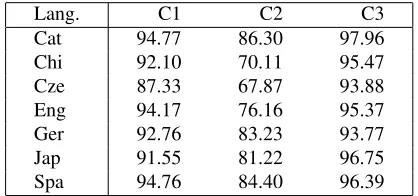
The results of the Classifiers are presented in Ta-ble 3. The performance of Classifiers 1 and 3 is sim-ilar across languages, whereas the scores for Clas-sifier 2 are lower for Chinese, Czech and English. This can be explained by the fact that the number of classes that Classifier 2 predicts for these languages is significantly higher.
Lang. C1 C2 C3
Cat 94.77 86.30 97.96
Chi 92.10 70.11 95.47
Cze 87.33 67.87 93.88
Eng 94.17 76.16 95.37
Ger 92.76 83.23 93.77
Jap 91.55 81.22 96.75
[image:3.612.322.531.424.522.2]Spa 94.76 84.40 96.39
Table 3: Micro F1 scores per classifier (C) and per language.
Training times for the three classifiers were rea-sonably short, as is to be expected with memory-based classification. With English, C2 takes just over two minutes to train, and C3 half a minute. C1 takes 8 hours and 18 minutes, due to the much larger amount of examples and features.
3.2 Phase 2: Ranking
role assignments) is Classifier 1, which predicts the merged semantic and syntactic dependencies that hold between two tokens (PDEPREL:APRED la-bels). If this classifier would be able to predict the dependencies with 100% accuracy, no further pro-cessing would be necessary. Naturally, however, the classifier predicts incorrect dependencies to a certain degree, and does not provide a graph in wich all to-kens have at least a syntactic head. It achieves 51.3% labeled macro F1. The ranking phase improves this performance. This is done in three steps: (i) ranking the predictions of Classifier 1; (ii) constructing an intermediate dependency tree, and (iii) adding extra semantic dependencies to the tree.
3.2.1 Ranking predictions of Classifier 1
In order to disambiguate between all possible de-pendencies predicted by this classifier, the system applies ranking rules. It analyses the dependency relations that have been predicted for a token with its potential parents in the sentence and ranks them. For example, for a sentence with 10 tokens, the sys-tem would make 10 predictions per token. The pre-dictions are first ranked by entropy of the class dis-tribution for that prediction, then using the output of Classifier 2, and next using the output of Classifier 3.
Ranking by entropy In order to compute entropy we use the (inverse-linear) distance-weighted class label distributions among the nearest neighbors that Classifier 1 was able to find. For example, the pre-diction for an instance can be: { NONE (2.74), NMOD: (0.48)}. We can compute the entropy for this instance using the formula in (1):
−
n
X
i=1
P(labeli)log2(P(labeli)) (1)
with
- n: the total number of different labels in the distri-bution, and
- P(labeli): the total sum of the weights in the distributionthe weight of label i
The system ranks the prediction with the lowest entropy in position 1, while the prediction with the highest entropy is ranked in the last position. The rationale behind this is that the lower the entropy, the more certain the classifier is about the predicted dependency. Table 4 lists the first six heads for the
predicate word ‘starts’ ranked by entropy (cf. Ta-ble 1).
Head Predicted label Distribution Entropy Housing NONE {NONE (8.51)} 0.0 expected :A1 {:A1 (5.64)} 0.0 to NONE {NONE (4.74)} 0.0 quicken :A0 {:A0 (4.13), :A1 (0.18), :A2 (0.31)} 0.56 are NONE {NONE (2.56), SBJ: (0.52)} 0.65 starts :A0 {:A0 (7.90), :A1 (0.61), :A2 (1.50)} 0.93
Table 4: Output of Classifier 1 for the first six heads of ‘starts’, ranked by entropy.
On the development data for English, applying this rule causes a marked error reduction of 26.5% on labeled macro F1: from 51.3% to 64.2%.
Ranking by Classifier 2 The next ranking step is performed by using the predictions of Classifier 2, i.e. the estimated labels of the dependency rela-tions of a token with its syntactic and/or semantic head(s). The system ranks the predictions that are not in the set of possible dependencies predicted by Classifier 2 at the bottom of the ranked list.
Head Predicted label Distribution Entropy expected :A1 {:A1 (5.64)} 0.0 Housing NONE {NONE (8.51)} 0.0 to NONE {NONE (4.74)} 0.0 quicken :A0 {:A0 (4.13), :A1 (0.18), :A2 (0.31)} 0.56 are NONE {NONE (2.56), SBJ: (0.52)} 0.65 starts :A0 {:A0 (7.90), :A1 (0.61), :A2 (1.50)} 0.93
Table 5: Output of Classifier 1 for the first six heads of ‘starts’. Ranked by entropy and Classifier 2.
Because this is done after ranking by entropy, the instances with the lowest entropy are still at the top of the list. Table 5 displays the re-ranked six heads of ‘starts’, given that Classifier 2 has predicted that possible relations to heads are SBJ:A1 and :A1, and given that only ‘expected’ is associated with one of these two relations.
On the development data for English, applying this rule induces a 9.0% error reduction on labeled macro F1: from 64.2% to 67.4%.
error reduction on labeled macro F1: from 67.4% to 69.1%.
Head Predicted label Distribution Entropy expected :A1 {:A1 (5.64)} 0.0 quicken :A0 {:A0 (4.13), :A1 (0.18), :A2 (0.31)} 0.56 starts :A0 {:A0 (7.90), :A1 (0.61), :A2 (1.50)} 0.93 Housing NONE {NONE (8.51)} 0.0 to NONE {NONE (4.74)} 0.0 are NONE {NONE (2.56), SBJ: (0.52)} 0.65
Table 6: Output of Classifier 1 for the first six heads of ‘starts’. Ranked by entropy, Classifier 2, and Classifier 3.
3.2.2 Construction of the intermediate dependency tree
After ranking the predictions of Classifier 1, the system selects a syntactic head for every token. This is motivated by the fact that every token has one and only one syntactic head. The system selects the pre-diction with the best ranking that has in the PDE-PREL part a value different than “ ”.
The intermediate tree can have more than one root or no root at all. To make sure that every sentence has one and only one root we apply some extra rules. If the sentence does not have a token with a root la-bel, the system checks the distributions of Classi-fier 1. The token with the rootlabel in its distribution that is the head of the biggest number of tokens is taken as root. If the intermediate tree has more than one root, the last root is taken as root. The other root tokens get the label with a syntax part (PDEPREL) that has the highest score in the distribution of Clas-sifier 1.
The product of this step is a tree in which ev-ery token is uniquely linked to a syntactic head. Because syntactic and semantic dependencies have been linked, the tree contains also semantic depen-dencies. However, the tree is missing the purely se-mantic dependencies. The next step adds these rela-tions to the dependency tree.
3.2.3 Adding extra semantic dependencies
In order to find the tokens that have only a seman-tic relation with a predicate, the system analyses for each predicate (i.e. tokens marked with Y in FILL-PRED) the list of predictions made by Classifier 1 and selects the predictions in which the PDEPREL part of the label is “ ” and the APRED part of the label is different than “ ”. On the development data
for English, applying this rule produces a 6.7% er-ror reduction on labeled macro F1: from 69.1% to 71.1%.
3.3 Predicate sense disambiguation
Predicate sense disambiguation is performed by a classifier per language that predicts the sense of the predicate, except for Japanese, as with that language the lemma is taken as the sense. We use the IGTREE algorithm. Instances represent predicates and the features used are the word, lemma and POS of the predicate, and the lemma and POS of two tokens be-fore and after the predicate. The results per language are presented in Table 7.
Lang. Cat Chi Cze Eng Ger Spa
F1 82.40 94.85 87.84 93.64 73.57 81.13
Table 7: Micro F1 for the predicate sense disam-biguation.
4 Overall results
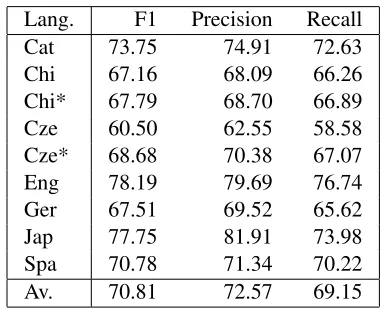
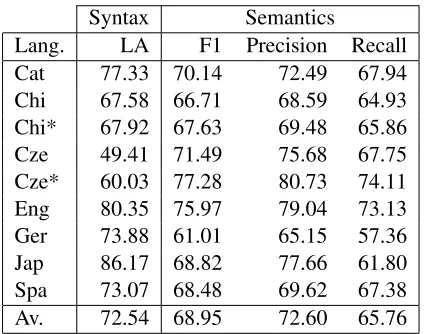
The system was developed by training on the train-ing set provided by the task organisers and testtrain-ing on the development set. The final results were ob-tained by testing on the testing set. Table 8 shows the global results of the system for syntactic and se-mantic dependencies.
Lang. F1 Precision Recall
Cat 73.75 74.91 72.63
Chi 67.16 68.09 66.26
Chi* 67.79 68.70 66.89
Cze 60.50 62.55 58.58
Cze* 68.68 70.38 67.07
Eng 78.19 79.69 76.74
Ger 67.51 69.52 65.62
Jap 77.75 81.91 73.98
Spa 70.78 71.34 70.22
[image:5.612.330.524.462.618.2]Av. 70.81 72.57 69.15
Table 8: Macro F1, precision and recall for all de-pendencies per language. Postevaluation results are marked with *.
Syntax Semantics
Lang. LA F1 Precision Recall
Cat 77.33 70.14 72.49 67.94
Chi 67.58 66.71 68.59 64.93
Chi* 67.92 67.63 69.48 65.86
Cze 49.41 71.49 75.68 67.75
Cze* 60.03 77.28 80.73 74.11
Eng 80.35 75.97 79.04 73.13
Ger 73.88 61.01 65.15 57.36
Jap 86.17 68.82 77.66 61.80
Spa 73.07 68.48 69.62 67.38
[image:6.612.80.293.58.225.2]Av. 72.54 68.95 72.60 65.76
Table 9: Labeled attachment (LA) score for syntac-tic dependencies and Macro F1, precision and recall of semantic dependencies per language. Postevalua-tion results are marked with *.
5 Conclusions
In this paper we presented the system that we sub-mitted to the “closed” challenge of the CoNLL Shared Task 2009. We observe fairly low scores, which can be possibly improved for all languages by making use of the available morpho-syntactic fea-tures, which we did not use in the present system, by optimising the classifiers per language, and by improving the reranking algorithm. We also ob-serve a relatively low recall on the semantic task as compared to overall recall, indicating that syntactic dependencies are identified with a better precision-recall balance. A logical continuation of this study is to compare joint learning to learning syntactic and semantic dependencies in isolation, using the same architecture. Only then will we be able to put for-ward conclusions about the performance of a joint learning system versus the performance of a system that learns syntax and semantics independently.
Acknowledgments
This study was made possible through financial sup-port from the University of Antwerp (GOA project BIOGRAPH), and from the Netherlands Organisa-tion for Scientific Research.
References
Aljoscha Burchardt, Katrin Erk, Anette Frank, Andrea Kowalski, Sebastian Pad´o, and Manfred Pinkal. 2006. The SALSA corpus: a German corpus resource for lexical semantics. InProceedings of the 5th Interna-tional Conference on Language Resources and Evalu-ation (LREC-2006), Genoa, Italy.
S. Canisius and E. Tjong Kim Sang. 2007. A con-straint satisfaction approach to dependency parsing. InProceedings of the CoNLL Shared Task Session of EMNLP-CoNLL 2007, pages 1124–1128.
W. Daelemans and A. van den Bosch. 2005. Memory-based language processing. Cambridge University Press, Cambridge, UK.
Jan Hajiˇc, Jarmila Panevov´a, Eva Hajiˇcov´a, Petr Sgall, Petr Pajas, Jan ˇStˇep´anek, Jiˇr´ı Havelka, Marie Mikulov´a, and Zdenˇek ˇZabokrtsk´y. 2006. Prague De-pendency Treebank 2.0.
Jan Hajiˇc, Massimiliano Ciaramita, Richard Johans-son, Daisuke Kawahara, Maria Ant`onia Mart´ı, Llu´ıs M`arquez, Adam Meyers, Joakim Nivre, Sebastian Pad´o, Jan ˇStˇep´anek, Pavel Straˇn´ak, Mihai Surdeanu, Nianwen Xue, and Yi Zhang. 2009. The CoNLL-2009 shared task: Syntactic and semantic depen-dencies in multiple languages. In Proceedings of the 13th Conference on Computational Natural Lan-guage Learning (CoNLL-2009), June 4-5, Boulder, Colorado, USA.
Daisuke Kawahara, Sadao Kurohashi, and Kˆoiti Hasida. 2002. Construction of a Japanese relevance-tagged corpus. In Proceedings of the 3rd International Conference on Language Resources and Evaluation (LREC-2002), pages 2008–2013, Las Palmas, Canary Islands.
R. Morante, W. Daelemans, and V. Van Asch. 2008. A combined memory-based semantic role labeler of en-glish. In Proc. of the CoNLL 2008, pages 208–212, Manchester, UK.
Martha Palmer and Nianwen Xue. 2009. Adding seman-tic roles to the Chinese Treebank. Natural Language Engineering, 15(1):143–172.
Mihai Surdeanu, Richard Johansson, Adam Meyers, Llu´ıs M`arquez, and Joakim Nivre. 2008. The CoNLL-2008 shared task on joint parsing of syntactic and se-mantic dependencies. InProceedings of the 12th Con-ference on Computational Natural Language Learning (CoNLL-2008).