Original citation:
Thanissaro, P.N. (2012) What makes you not a Sikh?: A preliminary mapping of values, Sikh Formations 8(2)
Permanent WRAP url:
http://wrap.warwick.ac.uk/49948 Copyright and reuse:
The Warwick Research Archive Portal (WRAP) makes the work of researchers of the University of Warwick available open access under the following conditions. Copyright © and all moral rights to the version of the paper presented here belong to the individual author(s) and/or other copyright owners. To the extent reasonable and practicable the material made available in WRAP has been checked for eligibility before being made available.
Copies of full items can be used for personal research or study, educational, or not-for-profit purposes without prior permission or charge. Provided that the authors, title and full bibliographic details are credited, a hyperlink and/or URL is given for the original metadata page and the content is not changed in any way.
Publisher’s statement:
"This is an Author's Original Manuscript of an article submitted for consideration in the Sikh Formations © Taylor & Francis] Sikh Formations is available online at
http://www.tandfonline.com”
The version presented here may differ from the published version or, version of record, if you wish to cite this item you are advised to consult the publisher’s version. Please see the ‘permanent WRAP url’ above for details on accessing the published version and note that access may require a subscription.
Acknowledgements
The author would like to thank Dr. Mandy Robbins (Glyndŵr University) for supervision of the original research, Denise Chaplin (RE advisor to Southwark), Prof. Harbhajan Singh (NASACRE Executive) for pre-proofing the Sikh attitude statements, Greenwich SACRE for facilitation of schools access, Revd. Canon Prof. Leslie J. Francis (University of Warwick), and the anonymous reviewers for critique and encouragement, Phra Kru Sangharak Veera Virandharo, Kannika Parker, Anuchit Treerattanajutawat, Bhuzaneezah Boonthucksa and Apassara Sangrungreang for administrative assistance and the Teachers Development Agency and Dhammakāya International Society of the United Kingdom which co-sponsored the cost of this research.
Notes on contributor
Phra Nicholas Thanissaro is a postgraduate research student at the University of Warwick’s Institute of Education. He has been funded until 2015 by a University of Warwick Chancellor’s Scholarship to conduct research on Buddhist adolescent identity and religiosity in the UK. A Buddhist monk affiliated with the Dhammakāya Foundation, he holds a Masters degree from the University of Warwick and a Postgraduate Certificate of Education from Manchester Metropolitan University.
What makes you not a Sikh?: A preliminary mapping of values
Phra Nicholas Thanissaro
Postgraduate Research Student: University of Warwick, Coventry, UK
Abstract
This study sets out to establish which Sikh values contrasted with or were shared by non-Sikh adolescents. A survey of attitude toward a variety of Sikh values was fielded in a sample of 364 non-Sikh schoolchildren aged between 13 and 15 in London. Values where attitudes were least positive concerned Sikh duties/code of conduct, festivals, rituals, prayer Gurdwara attendance, listening to scripture recitation, the amrit initiation. Sikh values empathized with by non-Sikhs concerned family pride, charity, easy access to ordination and Gurdwaras, maintaining the five Ks, seeing God in all things, abstaining from meat and alcohol and belief in the stories of Guru Nanak. Further significant differences of attitude toward Sikhism were found in comparisons by sex, age and religious affiliation. Findings are applied to teaching Sikhism to pupils of no faith adherence. The study recommends the extension of values mapping to specifically Sikh populations.
Keywords
Introduction
In recent years, the essentialisms often inherent in comparative religion have been
moderated by returning to the subjective testimonies of religious adherents (William
Cantwell Smith 1981) or to conceive of religious boundaries not as rigid but as
overlapping and to some extent porous. Nowhere is the fuzziness of the boundaries of
religious identity more apparent than in the acculturation of minority religions to a
mainstream culture – a scenario found with the Sikh community in the UK. This paper
is a quantitative study that attempts to map these value boundaries through a process of
elimination.
Sikhs are a substantial and well-established minority in the UK numbering
336,000 according to the 2001 census (Nesbitt 2009, 39) – about 0.6% of the total
schoolchildren and reaching 2% of schoolchildren for some British local authorities.
The phases of migration and settlement of the Sikh community in the UK are already
well documented elsewhere (Ballard 1989; 2000; Nesbitt 2005, 90-91; Singh and Tatla
2006). As for Sikhism in UK schools, since 1975, the multicultural principles of
Religious Education apparent in the majority of published Agreed Syllabuses for
schools in England and Wales was rethought – in an effort to increase pupils’
understanding of world faiths included Sikhism (Nesbitt 2000, 257). Sikhism has been
examined in Religious Studies at GCSE (Cole 1987) and ‘A’ level (Buddle 1987) since
1987 and for younger children curriculum books have become available portraying the
lives of children growing up in Sikh families in Britain [e.g. Aggarwal (1984) and Lyle
(1977)]. Nonetheless, ethnographic research has revealed mismatch between the
representation of the religion in the syllabus and experience of the pupils in school
(Nesbitt 2004, 80). Discrepancies apparent in curriculum books include such issues as
2009, 46) and over-generalization of the practice of the five Ks and the wearing of the
turban (Nesbitt 1998, 107) – thus it would be expected that the measurement of attitudes
in tandem with teaching about Sikhism be important in ensuring continual improvement
of education about religions in a plural society. Impartial data is essential for
unravelling stereotypes – especially for communities such as that of the British Sikhs
who have as recently as 1976 had to campaign for aspects of their religious identity
(Jones and Fleming 2007, 406). The scientific study of religious identity has most easily
lent itself to qualitative (idiothetic) research, especially in Europe (Hood et al. 2009, 26)
and a whole phenomenology-empiricism debate has sprung up concerning the limits of
each methodology in understanding religion (Batson et al. 1993, 17). Without going
into the detail of this debate, suffice it to say that it is operationally attractive, where the
opportunity arises, to be able to research religious issues in a quantitative/empirical
(nomothetic) way as the outcomes are generally repeatable, generalizable to other
contexts and independent of the people conducting the research – an approach to
research that has enjoyed more popularity in North America than Europe. Over the last
half century, a tradition has grown up to measure attitudes toward religion — which has
developed to the point it can act as a generalizable diagnostic tool in areas where
religion plays an important role – such as on religious borders, in the question of
denominational schools and for unravelling stereotypes. Such research stands at the
crossroads of several fields of enquiry – empirical theology, psychology of religion,
social psychology and education.
Working definitions of religiosity are no stranger to quantitative religious
research. The effort to model the religious sphere of life has led to the development of
over 125 measurement scales for religiosity (Hill and Hood 1999). Since the majority of
would apply equally to Sikhism. Some of the scales of attitude to religion seem more
readily applicable to non-Christian religions than others. One style of attitude measure
which has proved valid and reliable for religiosity in Christianity (Francis 1978),
Hinduism (Francis et al. 2008), Islam (Sahin and Francis 2002) and Judaism (Francis
and Katz 2007) is that of the Francis Scale of Attitude toward Christianity (FSAC). In
brief, it has employed attitude questions on religious values using a five-point Likert
scale and generally includes reverse-coded questions to control for mechanical ticking
by respondents. Correlations of results from the religiosity scales have generally shown
that more positive religious attitudes are more commonly found in females, younger
respondents and those with more religious behaviour and involvement (Kay and Francis
1996, 191). The practicality of the instrument has been in its assumption of
unidimensionality of religiosity rather focussing on other dimensions of religious life
such as frequency of worship. Thus, although Christianity is an internally diverse
religion, FSAC has managed to overcome any problems of intra-religious diversity
allowing, for example, experimental control for religiosity in comparison of values
between the Catholic and Protestant communities in Northern Ireland (Greer and
Francis 1992).
If Sikh religiosity were to be measured, it is not clear, on issues of validity,
whether the internal diversity problems could be overcome with the same ease as for
other religions, given that there is disagreement, even amongst Sikhs themselves, about
what constitutes true Sikh identity (see Nesbitt 1999). Theoretically, it would be
attractive to model Sikh identity and attitude – since it underlies many unexplored
topics lying at the interface between Sikh young people and the tradition in which they
are nurtured. A conceivable problem, however, might be the huge amount of internal
and is especially evident where Sikh observance overlaps with that of Hindus (Nesbitt
2009, 47). For other religions, the heterogeneous nature of religiosity seems to have
been passed over without great trouble in quantitative surveys – perhaps because
religious adherence has clear creeds to define allegiance – for example, it could be said
that a person was Christian if they adhered to Christian creed. It is possible that these
potential difficulties have prevented systematic attention being paid to development of
quantitative measures of Sikh religiosity. Nonetheless, quantitative measurement of
Sikh religiosity has already been employed in several academic disciplines. Smith and
Kay designed (2000, 189) a sixteen-question, FSAC-equivalent scale for Sikhism in
their research on how classroom factors affected Religious Education (Kay and Smith
2002) but did not establish validity for it against degree of Sikh observance. Similar
work on a FSAC-equivalent scale for Sikh religiosity has established an even more
reliable scale (Thanissaro 2011, 801). A scale of ‘Sikh-ness’ has also been described
qualitatively in ethnographic studies (Nesbitt 1999, 319). Comparisons between the
attitudes of young Sikhs and adolescents of other or no religious affiliation have been
made by Alan Smith (2002; 2006), Francis (2001) and Francis and Robbins (2005,
186-193).
A key term to define when justifying the use of quantitative data in measuring
Sikh religiosity is ‘validity’ which means the extent to which an instrument measures or
correlates with the theorized scientific construct it purports to measure (Pennington
2003, 37) – in this study, the relevant construct is Sikh religiosity, or religiosity unique
to Sikhs. Validity can be divided into several components – four of which are of direct
relevance here. Construct validity is concerned with examining how the operational
form of the construct works in the light of theory. Face validity is what an instrument
should be tested against the views of a panel of experts or a representative sample of the
respondents or target audience. This aspect of validity is often a good starting point for
research, but in social science, on its own, it is not a secure predictor of validity.
Content validity is the extent to which a measure represents all facets of a social
construct. Discriminant validity [or in some places ‘divergent’ validity (Cooper 2002,
60)] is the degree to which an operation that is not similar to other operations it
theoretically should not be similar to. Since the deductive processes of science, even
social science, tend to be most powerful through research to falsify rather than to
confirm theories (Popper 1963) trying to find out what is unique to Sikhs by eliminating
the values shared by non-Sikhs would be considered an essential part of the due
diligence in ascertaining construct validity.
Against this background, the brief of the present study was to explore attitude toward
Sikhism in a sample of UK adolescents, together with comparisons in terms of sex, age
and religious affiliation to explore new understandings of Sikh religiosity, to support
policy that is enactable, especially ascertaining whether mismatch is having an effect on
adolescent attitudes to Sikhism and to suggest possible ways to close any gaps. The
article does not set out to propose a new scale of attitude to Sikhism as this has already
been published elsewhere (Thanissaro 2011).
Method
Sample
Research was undertaken upon a convenience sample of 364 non-Sikhs – 232 boys and
132 girls – aged between 13 and 15 years attending London schools. Ethnically the
race (11%) and 7 Chinese (2%). The religious composition of the sample was 149
Christians (41%), 120 of no religion (33%), 45 Moslems (12%), 17 Hindus (5%), 15
Buddhists (4%), 3 Jews (1%) and 13 of other religions (4%) – both religious and ethnic
categories being self-assigned. Of the pupils in the sample, 43% had studied Sikhism in
their Religious Education lessons of the past year.
Procedure & Analysis
A multi-purpose survey (detail of the survey can be found in Thanissaro 2010a,
184-191) was deployed as part of a wider research project. The survey contained
biographical questions adapted from Francis’s (2001) adolescent values inventory and
32 Likert five-point scale (strongly agree – agree – not certain – disagree – disagree
strongly) attitude statements1 focussing on Sikh values adapted from previous
qualitative (Nesbitt 2000) and quantitative (Diane Linnet Smith and Kay 2000, 189)
adolescent attitudes research in the UK. Two reverse-coded statements were included in
the attitude to Sikhism section, namely, “Sikh scriptures are out of date” and “That Sikh
men wear turbans is strange” as a strategy to guard against inclusion of results from
participants who had mechanically ticked the same column throughout regardless of
their true attitudes. In the design stage, the questionnaire was piloted satisfactorily on a
small group of non-Sikh participants of the target age range to estimate time for
completion and to make sure wording was unambiguous, avoiding Sikh jargon as far as
possible.
Three schools volunteered their participation in response to a circular letter from
their local Standing Advisory Council on Religious Education. Surveys were delivered
to participating schools in the quantities they required and administered to pupils by
Year 9 and 10 teachers under examination conditions in their regular Religious
Education classes in the period January and February 2010. In keeping with constraints
of ethical approval non-consenting pupils had the option of destroying their
questionnaires after completion instead of submitting them and completed surveys were
kept anonymous to protect participants from having their views traced back to them.
The resulting dataset was analyzed by means of the SPSS statistical package (SPSS Inc.
1988) using the frequency and cross-tabulation routines.
Results
Overview of Attitudes to Sikhism
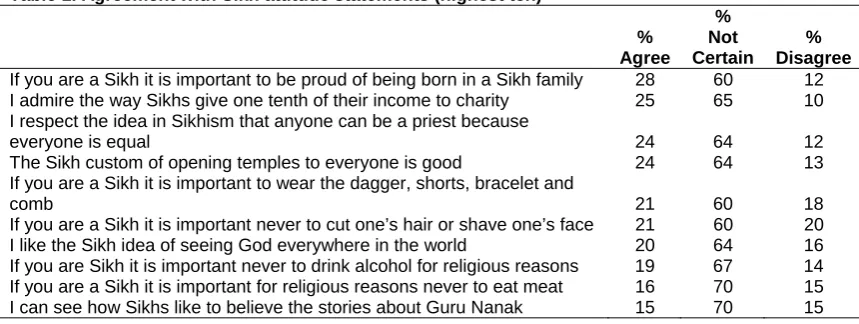
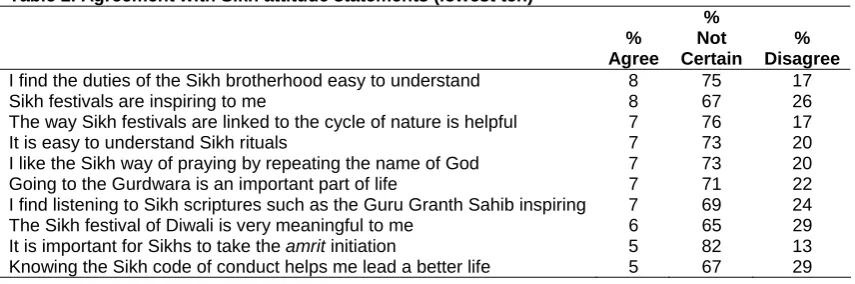
Tables 1 and 2 provide an overview respectively of the highest and lowest levels of
agreement with Sikh statements amongst the non-Sikh sample. Although the survey
used a five-point continuum, for clarity of presentation, the ‘agree strongly’ and ‘agree’
responses were recoded into a single category styled ‘agree’ and the ‘disagree strongly’
and ‘disagree’ responses have been similarly recoded into a single category styled
‘disagree’. In the ranking of Tables 1 and 2, reverse-coded statements were not included
[image:10.595.82.512.548.710.2]to avoid possible confusion involving double negatives.
Table 1. Agreement with Sikh attitude statements (highest ten)
% Agree
% Not Certain
% Disagree
If you are a Sikh it is important to be proud of being born in a Sikh family 28 60 12
I admire the way Sikhs give one tenth of their income to charity 25 65 10
I respect the idea in Sikhism that anyone can be a priest because
everyone is equal 24 64 12
The Sikh custom of opening temples to everyone is good 24 64 13
If you are a Sikh it is important to wear the dagger, shorts, bracelet and
comb 21 60 18
If you are a Sikh it is important never to cut one’s hair or shave one’s face 21 60 20
I like the Sikh idea of seeing God everywhere in the world 20 64 16
If you are Sikh it is important never to drink alcohol for religious reasons 19 67 14
If you are a Sikh it is important for religious reasons never to eat meat 16 70 15
As shown in Table 1, the top ten Sikh value statements agreed with by non-Sikhs
concerned family pride (28%), charity (25%), easy access to ordination (24%) and
Gurdwaras (24%), wearing the dagger, shorts, bracelet and comb (21%) and not cutting
the hair (21%), seeing God everywhere (20%), abstaining from meat (16%) and alcohol
[image:11.595.85.513.244.386.2](19%) and belief in the stories of Guru Nanak (15%).
Table 2. Agreement with Sikh attitude statements (lowest ten)
% Agree
% Not Certain
% Disagree
I find the duties of the Sikh brotherhood easy to understand 8 75 17
Sikh festivals are inspiring to me 8 67 26
The way Sikh festivals are linked to the cycle of nature is helpful 7 76 17
It is easy to understand Sikh rituals 7 73 20
I like the Sikh way of praying by repeating the name of God 7 73 20
Going to the Gurdwara is an important part of life 7 71 22
I find listening to Sikh scriptures such as the Guru Granth Sahib inspiring 7 69 24
The Sikh festival of Diwali is very meaningful to me 6 65 29
It is important for Sikhs to take the amrit initiation 5 82 13
Knowing the Sikh code of conduct helps me lead a better life 5 67 29
Table 2 shows the ten value statements which elicited the least agreement amongst
non-Sikhs and which potentially represent the values that make a person Sikh. These
concerned Sikh duties (8%)/code of conduct (5%), being inspired by Sikh festivals (8%)
– their linkage to the cycle of nature (7%) – the meaningfulness of Diwali (6%), rituals
(7%), prayer by repeating the name of God (7%) Gurdwara attendance (7%), listening
Comparisons
Sex Differences
Table 3. Comparison between male and female pupils
Male % Agree
Female
% Agree χ2 p<
I like the Sikh idea of seeing God everywhere in the world 16 27 6.73 .01
The Sikh custom of opening temples to everyone is good 20 30 5.12 .05
Knowing the Sikh code of conduct helps me lead a better life 7 1 7.12 .01
I admire the way Sikhs give one tenth of their income to
charity 21 32 5.14 .05
I think the Sikh scriptures are out of date* 12 5 4.43 .05
Note: Only significant Chi-squared test scores included. N= 232 males and 132 females. *Reverse-coded statement
Generally speaking, the psychology of religion has found that female respondents have
a more positive attitude toward religion on scales of attitude to religion (Hood et al.
2009, 152). The finding for adolescent attitude to Sikhism by contrast, was that in 27 of
32 items, there was no significant difference between males and females. Items where a
significant difference between males and females was found according to a Pearson
Chi-squared test (two-tailed) are shown in Table 3 above. Female pupils had a more
positive attitude to Sikhism for four attitude questions – liking the way Sikhs see God
everywhere, the custom of opening their temples to all, charity and being less likely to
consider Sikh scriptures out of date. On only one question had the male pupils a more
positive attitude toward Sikhism than female pupils – in the matter of agreeing that to
know the Sikh code of conduct helped them to lead a better life – perhaps concerning an
increased tendency found in the females of a similar sample to apply teachings to their
Age Differences
Table 4. Comparison between Year 9 and Year 10 pupils
Y9% agree
Y10%
agree χ2 p<
I like the Sikh way of praying by repeating the name of God 10 3 5.91 .05
I find the duties of the Sikh brotherhood easy to understand 11 4 4.33 .05
If you are Sikh it is important never to drink alcohol for
religious reasons 23 12 6.13 .05
Note: Only significant Chi-squared test scores included. N= 227 from Year Nine and 137 from Year Ten.
The normal assumptions for validity of the FSAC predicts that attitude toward religion
should become less positive with age. For questions concerning attitude to Sikhism, the
age difference between Year 9 and Year 10 pupils was shown to make no difference in
29 of the 32 items. As shown in Table 4 above, there were three values statements
where there was a significant difference in responses between Year Nine and Year Ten
pupils, namely concerning Sikh prayer, duties of the Sikh brotherhood and abstaining
from alcohol – a trend that would correspond with the normal assumptions for validity
Differences by religious affiliation
Table 5. Comparison by religious affiliation
no religion % agree Dharmic % agree Abrahamic
% agree χ2 p<
I find listening to Sikh scriptures such as the
Guru Granth Sahib inspiring 7 19 6 7.24 .05
Sikh festivals are inspiring to me 9 22 5 10.85 .01
Going to the Gurdwara is an important part of life 7 22 6 9.90 .01
Sikhism is relevant to the modern world 13 19 6 7.70 .05
I like the Sikh idea of seeing God everywhere in
the world 14 38 21 8.75 .05
The Sikh festival of Diwali is very meaningful to
me 4 25 4 24.27 .001
Knowing the Sikh code of conduct helps me lead
a better life 6 12 2 6.90 .05
I can see how Sikhs like to believe the stories
about Guru Nanak 18 28 10 9.16 .05
It is easy to understand Sikh rituals 8 19 5 7.67 .05
I find it easy to understand Sikhism 12 25 10 6.26 .05
It is important for Sikhs to wear the shorts [kachh]
at all times 13 16 5 9.51 .01
It is important for Sikhs to wear the dagger
[kirpan] at all times 13 19 5 9.99 .01
I think the Sikh scriptures are out of date* 15 7 0 9.94 .01
Reincarnation gives me hope 19 34 11 13.26 .01
Note: Only significant Chi-squared test scores included. N= 120 of no religion, 32 from Dharmictraditions and 197 from Abrahamic traditions.
*Reverse-coded statement.
Analysis of attitude results by religious affiliation, where limited numbers allowed only
a three-way division into ‘no religion’, ‘Dharmic’ (Buddhist and Hindu) and
‘Abrahamic’ (Christian, Jewish and Moslem) significant polarizations of opinion were
observed in 14 (i.e. almost half) of the 32 questions asked – indicating a relative
tendency for Sikh values to polarize opinion compared to Buddhism (Thanissaro 2010a,
90). Two trends perceptible for comparision by religious affiliation were value
statements where Dharmic religions empathized more than the non-religious or
Abrahamic religions and value statements where Abrahamic religions tend to agree less
than the non-religious and Dharmic religions.
As shown in Table 5, value statements where the Dharmic religions tended to
inspired by Sikh scriptures recitation, rituals and festivals (especially Diwali), Gurdwara
attendance, the relevance of Sikhism to the modern world, seeing God in all things,
applying the Sikh code of conduct to everyday life, Sikh stories and the ease of
understanding Sikhism. Value statements where the Abrahamic religions tended to
empathize less than the Dharmic religions or the non-religious concerned the wearing of
the shorts [kachh] and the dagger [kirpan] and reincarnation – however, those of
Abrahamic religions were less likely to think Sikh scriptures out of date. There were no
cases of those of ‘no religion’ having value statements they empathized with more than
those who were religious as has previously been found in this sample for Buddhist value
statements (Thanissaro 2012b).
Discussion
The present article has been a study in discriminative validity for Sikh values. The study
admittedly depends on the assumption that it is reasonable to extrapolate between
‘attitude toward Sikhism’ and ‘Sikh attitude’. There remains a possibility however, that
the distinction between having a positive attitude to Sikhism (as a non-Sikh) and having
Sikh attitudes (as a Sikh) may be larger than anticipated – in consequence of which the
article title retains the word ‘preliminary’. Nonetheless, the study has produced
noteworthy outcomes on two fronts – possible new understanding of Sikh religiosity
and support for policy and practice enactable in contexts where non-Sikhs need to be
New understanding of Sikh religiosity
Figure 1. Degree of sharing of Sikh values with non-Sikhs.
Figure 1 is a graphic comparison of ‘Sikh’ values that are potentially exclusive to Sikhs
and those that overlap with non-Sikhs, combining the results from Tables 1 and 2. The
figure maps the values boundaries of self-identified religious affiliation. Aspects of
Sikhism that at face value might seem representative of the religion, upon
experimentation turned out not to be exclusive to Sikhism (in terms of concept validity)
and therefore would be unreliable as identifiers of Sikh religiosity for future research.
Values such as thinking Sikhs should maintain the Five Ks – which face validity might
lead one to assume were features of Sikh religiosity – were actually shared by
concerning the amrit initiation) that we might associate with Sikhs are exclusive to
Sikhism – but if a person were to lack these few items from their ‘values footprint’ it
[image:17.595.94.508.177.490.2]would correspond with ‘what makes one not a Sikh’.
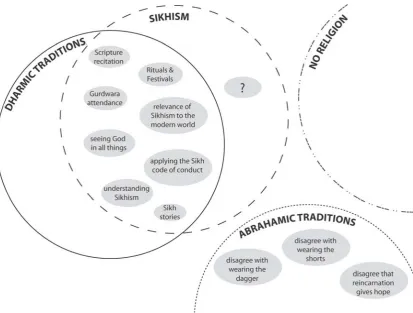
Figure 2. Sikh values overlapping with non-Sikhs of self-assigned groups.
Figure 2 analyses the ‘Sikh’ values overlapping with non-Sikhs in terms of
self-assigned religious group. The figure shows how conceptually difficult it is to identify
exclusively Sikh values. It would seem instead that religious identity including that of
Sikh has fuzzy boundaries which may indicate Sikh identity being many-layered. At the
very minimum, the layers of ‘tradition’, ‘group’ and ‘individual’ identified by Jackson
(1997, 65) would seem relevant here – a perspective that would takes the understanding
of Sikh values beyond the essentialisms of comparative religion. This conceptualization
agrees with the usual historical or comparative justification for putting it in this
category. Removing the values shared by the Dharmic religions of Figure 2 from the
Sikh values of Figure 1 leaves only the amrit initiation, prayer by repeating the name of
God and the duties of the Sikh brotherhood – which might be an indication of a starting
place for the elucidation of exclusively Sikh values in future research. Alternatively, it
may be that the Sikh identity exists as a particular combination of values – a possibility
testable if a large enough sample of Sikh participants could be quantitatively surveyed
by multifactorial analysis.
Although, age seems to have a smaller impact on enthusiasm for Sikh values
than would be expected in relation to values from other religions – it may be that the
apathy for Sikhism amongst adolescents does not increase much with age, because it
has already set in from an earlier age than is the case for other religions like Buddhism
where a direct comparison was possible (Thanissaro 2011, 800).
Support for policy that is enactable
The impression of non-Sikh attitudes to Sikhism revealed by this study is one of schools
failing to ameliorate negative attitudes to Sikh values. A source of information
incidental to the quantitative data collected in the questionnaire was the comments
pupils volunteered in the feedback section – or added as ‘graffiti’ elsewhere in the
survey. One of the added comments expressed indignation about having to comment on
Sikh values – for example, the feedback of a Black African 14-year-old girl who added,
“I don’t admire Sikhs – I have a religion” as if she didn’t consider Sikhism a valid
religion, was reminiscent of the antagonism and anger identified by Everington (2005,
243) as needing attention in Religious Education and Citizenship teaching. From the
and the value of the Sikh code of conduct (29%) which might indicate areas for more
positive attention in Religious Education lessons.
Further comments that indicated an adolescent mindset that minority ethnic
communities had nothing to do with them, reminiscent of attitudes observed by Barnard
(2000) and Everington (2005, 249), ranged from ignorance on the part of a 14-year-old
ethnically-mixed girl who wrote, “I didn’t even know there was such a thing as
Sikhism,” to apathy on the part of a 15-year-old Black African girl who commented,
“Sikhism – to be honest I don’t care…(the researcher) should add a ‘don’t care’ box
(…for us to tick instead).” Similar comments came from a 14-year-old Asian
Bangladeshi boy who wrote, “There’s no-one in the class that are (sic) Sikh – so what’s
the point, man?” and a 14-year-old White boy who commented, “I don’t care about
Sikh’s (sic) religion – it is someone else’s thing.” The present author is inclined to agree
with Kay and Smith’s (2002) underlying assumption that a child should come away
from Religious Education with not only a factual understanding of a religion, but also a
positive impression of it. It would be worrying if an Religious Education pupil studied a
religion and was left with only apathy towards it – an apathy that Thanissaro has
contrasted with its near-equivalent of ‘neutrality’ (2010b, 71) – and is a substantial
reason to advocate measure of attitudes hand-in-hand with the study of religions rather
than merely noting examination results – since although examination results are soon
forgotten, attitudes about religion may stay with a school-leaver for life.
Since Ballard has noted a particular lack of acculturation on behalf of British Sikhs,
maintaining that there is no indication that British Sikhs are losing their distinctiveness
behalf of non-Sikh adolescents in the UK2 – in which case, the religion might warrant
specially positive image-building on the part of Religious Education teachers –
especially when Sikhs are known to be generally less happy at school compared to other
South Asian pupils, worrying more about their studies and generally lacking confidence
in the prevailing authorities more than pupils of other religious groups (Smith 2002,
314, 316).
The difficulty has also been noted for the wording of many of the value statements
used in this study, that it is hard to find any alternative to explicitly Sikh terms
(Thanissaro 2011). For teachers aiming to communicate Sikhism in Religious Education
in a more positive light, it would appear from the attitude questions fielded in this
research that the aspects of Sikhism considered most positive by non-Sikh adolescents
such as pride about being born in a Sikh family (28% agreement); Sikhs giving a tenth
of their income to charity (25% agreement); opening up the Sikh priesthood to
all-comers (24% agreement), and; opening up Sikh temples to all (24% agreement).
Suggestions for further research
Given the opportunity to repeat this research, it would be instructive to perform a
multivariate analysis on a larger sample, to ascertain how many factor dimensions
would be necessary to model Sikh religiosity accurately and to find out whether
‘Sikh-ness’ lies in a certain combination of values. Some limitations should be mentioned
concerning the study described here – namely that on the basis of this study alone, it
cannot be assumed that children of non-adolescent age will show the same attitudes to
Sikhism. Further research would be encouraged to repeat the methodology of the
present study taking a wider age-range as its sample, and increasing the percentage of
2
Sikh respondents so that conclusions can be drawn not only about attitude toward
Appendix 1: 32 Sikh Attitude Statements in decreasing order of popularity
1. If you are a Sikh it is important to be proud of being born in a Sikh family 2. I admire the way Sikhs give one tenth of their income to charity
3. I respect the idea in Sikhism that anyone can be a priest because everyone is equal 4. The Sikh custom of opening temples to everyone is good
5. If you are a Sikh it is important to wear the dagger, shorts, bracelet and comb 6. If you are a Sikh it is important never to cut one’s hair or shave one’s face 7. I like the Sikh idea of seeing God everywhere in the world
8. If you are Sikh it is important never to drink alcohol for religious reasons 9. If you are a Sikh it is important for religious reasons never to eat meat 10. I can see how Sikhs like to believe the stories about Guru Nanak 11. Reincarnation gives me hope
12. I am fascinated to hear Sikh stories
13. It is important for Sikhs not to cut their hair [kesh] or beard
14. It is important for Sikhs to wear the comb [kangha] at all times
15. It is important for Sikhs to wear the steel bracelet [kara] at all times
16. I find it easy to understand Sikhism 17. That Sikh men wear turbans is strange*
18. If you are a Sikh it is important to take the amrit initiation ceremony
19. I think the Sikh scriptures are out of date* 20. Sikhism is relevant to the modern world
21. It is important for Sikhs to wear the dagger [kirpan] at all times
22. It is important for Sikhs to wear the shorts [kachh] at all times
23. I find the duties of the Sikh brotherhood easy to understand 24. Sikh festivals are inspiring to me
25. The way Sikh festivals are linked to the cycle of nature is helpful 26. It is easy to understand Sikh rituals
27. I like the Sikh way of praying by repeating the name of God 28. Going to the Gurdwara is an important part of life
29. I find listening to Sikh scriptures such as the Guru Granth Sahib inspiring 30. The Sikh festival of Diwali is very meaningful to me
31. It is important for Sikhs to take the amrit initiation
References
Aggarwal, Manju. 1984. I am a Sikh. London: Franklin Watts.
Ballard, Roger. 1989. Differentiation and Disjunction among the Sikhs in Britain. In The Sikh Diaspora: Migration and the Experience beyond Punjab. ed. N. G. Barrier and V. A. Dusenbery, 200-234. Columbia, MA: South Asia Books. Ballard, Roger. 2000. The Growth and Changing Character of the Sikh Presence in
Britain. In The South Asian Religious Diaspora in Britain, Canada, and the United States. ed. H. G. Coward, R. B. Williams and J. Hinnells, 127-144. New York: State University of New York Press.
Barnard, S. 2000. An investigation into the reasons behind the poor attitudes to RE of white, secular majority, Year 10 boys. Unpublished MA field study: University of Warwick.
Batson, C.D., P.A. Schoenrade and W.L. Ventis. 1993. Religion and the Individual: a social-psychological perspective. Oxford: Oxford University Press.
Buddle, V. 1987. Sikhism at "A" level, Sikh Bulletin 4:32-33. Cole, W. Owen. 1987. Sikhism at GCSE, Sikh Bulletin 4:29-31.
Cooper, Colin. 2002. Individual Differences. London: Hodder Education.
Everington, Judith. 2005. Adolescent attitudes to 'the other': citizenship and religious education in England. In Religion, Education and Adolescence: International Empirical Perspectives. ed. L. J. Francis, M. Robbins and J. Astley, 235-259. Cardiff: University of Wales Press.
Francis, Leslie J. 1978. Attitude and longitude: a study in measurement, Character Potential: a record of research 8, no.3:119-130.
Francis, Leslie J. 2001. Religion and values: a quantitative perspective. In The Fourth R for the Third Millennium: Education in Religion and Values for the Global Future. ed. L. J. Francis, J. Astley and M. Robbins, 47-78. Dublin: Lindisfarne. Francis, Leslie J. and Y.J. Katz. 2007. Measuring attitude toward Judaism: the internal
consistency reliability of the Katz-Francis Scale of Attitude toward Judaism, Mental Health, Religion and Culture 10, no.4:309-324.
Francis, Leslie J. and Mandy Robbins. 2005. Urban Hope and Spiritual Health: The Adolescent Voice. Peterborough: Epworth.
Francis, Leslie J., Yashoda Romil Santosh, Mandy Robbins and Savita Vij. 2008. Assessing attitude toward Hinduism: The Santosh-Francis Scale, Mental Health, Religion and Culture 11, no. 6:609-621.
Greer, J.E. and Leslie J. Francis. 1992. Measuring rejection of Christianity among 14-16-year-old adolescents in Catholic and Protestant schools in Northern Ireland, Personality and Individual Differences 13, no. 12:1345-1348.
Hill, P.C. and R.W. Hood. 1999. Measures of religiosity. Birmingham, AL: Religious Education Press.
Hood, Ralph W., Peter C. Hill and Bernard Spilka. 2009. The Psychology of Religion: An Empirical Approach. New York: The Guilford Press.
Jackson, Robert. 1997. Religious Education: An Interpretive Approach. London: Hodder and Stoughton.
Jones, Carwyn and Scott Fleming. 2007. 'I'd rather wear a turban than a rose': a case of the ethics of chanting, Race Ethnicity and Education 10, no. 4:401-414.
Kay, William K. and D. Linnet Smith. 2002. Classroom Factors and Attitude towards Six World Religions, British Journal of Religious Education 24, no. 2:111-122. Lall, S. 1999. 'I Know who God is': A Study of Sikh Children's Spirituality within
Various Expressions of Sikhism. Oxford: Farmington Institute for Christian Studies.
Lyle, S. 1977. Pavan is a Sikh. London: Adam & Charles Black.
Nesbitt, Eleanor. 1998. Bridging the Gap between Young People's Experience of Their Religious Traditions at Home and School: The Contribution of Ethnographic Research, British Journal of Religious Education 20, no. 2:102-114.
Nesbitt, Eleanor. 1999. Sikhs and Proper Sikhs: The Representation of Sikhism in Curriculum Books and Young British Sikhs' Perceptions of their Identity. In Sikh Identity: Continuity and Change. ed. P. Singh and N. G. Barrier, 315-334. New Delhi: Oxford University Press.
Nesbitt, Eleanor. 2000. The Religious Lives of Sikh Children: A Coventry Based Study. Leeds: Department of Theology & Religious Studies, University of Leeds. Nesbitt, Eleanor. 2004. Intercultural Education: Ethnographic and Religious
Approaches. Brighton: Sussex Academic Press.
Nesbitt, Eleanor. 2005. Sikhism: A Very Short Introduction. Oxford: Oxford University Press.
Nesbitt, Eleanor. 2009. Research Report: Studying the Religious Socialization of Sikh and 'Mixed-Faith' Youth in Britain: Contexts and Issues, Journal of Religion in Europe 2, no. 1:37-57.
Pennington, Donald. 2003. Essential Personality. London: Arnold.
Popper, Karl Raimund. 1963. Conjectures and Refutations: the growth of scientific knowledge. New York: Harper & Row.
Sahin, A. and L. J. Francis. 2002. Assessing attitude toward Islam among Muslim adolescents: the psychometric properties of the Sahin-Francis scale, Muslim Education Quarterly 19, no. 4:35-47.
Singh, Gurhapal and Darshan Singh Tatla. 2006. Sikhism in Britain: The Making of a Community. London: Zed.
Smith, Alan G.C. 2002. The Nature and Significance of Religion among Adolescents in the Metropolitan Borough of Walsall. University of Wales, Bangor: unpublished PhD dissertation.
Smith, Alan G.C. 2006. Growing up in Multifaith Britain: explorations in youth, ethnicity and religion. Cardiff: University of Wales Press.
Smith, Diane Linnet and William K. Kay. 2000. Religious Terms and Attitudes in the Classroom (Part 2), British Journal of Religious Education 22, no. 3:181-191. Smith, William Cantwell. 1981. Towards a World Theology: Faith and the
Comparative History of Religion. Maryknoll, NY: Orbis.
SPSS Inc. 1988. SPSS User's Guide, 2nd Edition. New York: McGraw-Hill.
Thanissaro, Phra Nicholas. 2010a. Religious Education and Attitudes to Buddhism & Sikhism. Unpublished MA Dissertation: University of Warwick.
Thanissaro, Phra Nicholas. 2010b. Teaching Buddhism in Britain’s schools: redefining the insider role, Contemporary Buddhism 11, no. 1:69-84.
Thanissaro, Phra Nicholas. 2011. Measuring attitude towards Buddhism and Sikhism: Internal consistency reliability for two new instruments, Mental Health, Religion & Culture 14, no. 8:797-803.