Original citation:
Smith, Laura A. and Ng, Irene C. L. (2012) Service systems for value co-creation. Working Paper. Coventry: Warwick Manufacturing Group. WMG Service Systems Research Group Working Paper Series (Number 01/12).
Permanent WRAP url:
http://wrap.warwick.ac.uk/41098
Copyright and reuse:
The Warwick Research Archive Portal (WRAP) makes this work by researchers of the University of Warwick available open access under the following conditions. Copyright © and all moral rights to the version of the paper presented here belong to the individual author(s) and/or other copyright owners. To the extent reasonable and practicable the material made available in WRAP has been checked for eligibility before being made available.
Copies of full items can be used for personal research or study, educational, or not-for-profit purposes without prior permission or charge. Provided that the authors, title and full bibliographic details are credited, a hyperlink and/or URL is given for the original metadata page and the content is not changed in any way.
A note on versions:
The version presented here is a working paper or pre-print that may be later published elsewhere. If a published version is known of, the above WRAP url will contain details on finding it.
WMG Service Systems Research Group
Working Paper Series
Service Systems for Value Co-Creation
_____________________________________________________________________
Laura A Smith
Irene CL Ng
Service Systems for Value Co-Creation
Smith, Laura A
Doctoral Candidate
Centre for Innovation and Service Research, University of Exeter
Business School, Rennes Drive, Exeter EX4 4PU, UK
Tel: +44 (0) 1392 723200
E-mail: [email protected]
Ng, Irene CL
Professor of Marketing and Service Systems
Service Systems Group, Warwick Manufacturing Group,
University of Warwick, Coventry CV4 7AL, UK
Tel: +44 (0) 247652 4871
E-mail: [email protected]
WMG Service Systems Research Group
Working Paper Series
Issue number: 01/12
ISSN: 2049-4297
January 2012
Introduction
Over the last few decades there has been growing interest from both marketing researchers and practitioners in the creation of value (Eggert & Ulaga, 2002). In a series of publications on the Service-Dominant Logic (S-D Logic), Vargo and Lusch (2004: 2008) review the economic foundations that underpin how value creation is understood. In doing so, they put forward a number of propositions, which have had a significant impact on current management theory and practice. The central tenant of value creation under an S-D Logic is that value is always uniquely and phenomenologically determined by the customer. Therefore first, the enterprise cannot deliver value but only offer value propositions, and second, the customer is always a co-creator of value and therefore a customer’s value-creating processes and resources affect the success of a company’s value proposition. Given this orientation, and since the context of value creation is not within the firm’s control, managing the customer as a co-creator of value-in-use would present itself as a major challenge in designing and managing service systems. This chapter investigates the challenges of a service system for co-creation through a review and comparative analysis of three widely published cases considered to be service systems for co-created outcomes. As a result, six challenges of a service system for co-creation are summarised; the determination challenge; the measurement challenge; the revenue challenge; the context challenge; the resource challenge; and the skills challenge.
Literature review
Approaches to Customer Value in Management: Exchange vs. Value-in-Use
For centuries, the nature of value has been discussed and debated; in fact, the discussion can be traced back as far as Aristotle (Vargo et al, 2008). Part of its elusiveness has been pinned down to the foundations of economics and the study of market exchange (e.g. Vargo and Lusch, 2004, 2008; Vargo and Morgan, 2005). From these foundations, two general meanings of value have evolved – ‘‘value-in-exchange’’ and ‘‘value-in-use’’ – with each reflecting a different way of thinking about value and its creation.
such management literature, upon which management practice is based, reflects this. Notably, value creation within management literature has primarily taken a transaction-centric approach, which has manifested in two streams of literature. The first stream, found predominantly in customer lifetime value and customer retention, is centred on the appropriation of value by the producer through exchange with the customer; here value creation is often defined as the economic worth of a customer to the company. As such, it focuses on the value outcome that can be derived from providing and delivering superior customer value to the market (Payne & Holt, 2001). The second stream from the ‘market orientation’ literature is on the creation and distribution of value to the customer through the provider’s offering. Conventional strategy literature argues that a company’s success depends on the extent to which it delivers to the customer what is of value to them, emphasising the linkages between providing superior customer value and achieving organisational profitability, performance and competitive advantage (e.g.Slater and Narver, 1995; Naumann, 1995).
[image:5.595.89.499.457.659.2]In 2004, Vargo and Lusch’ seminal paper on the Service Dominant Logic (S-D Logic) claims that this is a Goods Dominant Logic (G-D Logic), whereby value is considered to be created (manufactured) by the producer and distributed to the consumer. As such, within this prevailing logic, value is generally thought to be created through a series of activities performed by the producer. This view has also been referred to as a ‘manufacturing logic’ or the ‘old enterprise logic’ by researchers such as Normann (2001) and Zuboff and Maxmin (2002) (Chandler and Vargo, 2011).
Figure 1 – Model of value-in-exchange (Vargo, 2009)
for customers through the manufacturing and delivery of an offering. That is, the company embeds value in the offering, be it tangible or intangible, by transforming raw materials and activities into something that customers want. In this sense, value is created by the company in the form of a good or service, and this valuable offering is delivered through an exchange in the marketplace for money. Value is measured by this exchange transaction, and the customer then consumes or destroys this value embedded in the offering they have purchased.
In management literature, this perspective of value creation suggests that superior customer value and therefore competitive advantage, is achieved by the producer
‘adding value’ to the offering to be exchanged in the market place. Levitt (1969), for example pointed out that competitive advantage is not created by what companies produce in their factories but by ‘what they add to their factory output in the form of packaging, services, advertising, customer advice, financing, delivery arrangements, warehousing, and other things that people value’. Exploring value from this perspective alone may be overemphasising the exchange transaction in the creation of value for the customer, as it is shown to only represent one level of value for the customer. It has also been shown that value is created after the exchange transaction, in a customer’s use of the offering (Lapierre, 1997).
As such, much of contemporary marketing literature has moved the discussion of customer value away from the transaction-centric understanding of value-in-exchange, to the concept of value-in-use. Accordingly, most current literature would now describe customer value as that which is experienced by the customer in use situations, rather than what is determined by the producer for exchange. In a comprehensive definition of customer’s evaluation of value, Woodruff (1997) defines customer value as the following:
‘Customer value is a customer's perceived preference for and evaluation of those product attributes, attribute performances, and consequences arising from use that facilitate (or block) achieving the customer's goals and purposes in use situations.’ (Woodruff, 1997: P.142)
This definition captures the dynamic and context-dependent nature of how customers judge value, the criteria they use to do so, and the relative importance they place on such criteria (Parasuraman, 1997; Payne and Holt, 2001). Thus, it reflects the phenomenological nature of value creation, described by Holbrook (1994:2006) as ‘an interactive relativistic preference experience’. In their 2004 and 2008 articles, Vargo and Lusch similarly contend that value is perceived and determined by the consumer on the basis of “value-in-use” and that value is contextual, experiential and idiosyncratic.
of utility implies that the customer’s role in value creation is passive and their activities are limited to evaluating the benefits of the product or service. In contrast, S-D Logic proposes that value-in-use is co-created as a phenomenological experience of the beneficiary and as a result, the customer is an active participant in value creation.
Value Co-Creation
The customer as an active participant in the provision of service has been a central theme in service literature, as the customer is seen to play an active role in the process of service delivery and as a result, determine the quality of the service outcome (see for example Schneider and Bowen, 1995; Fitzsimmons, 1985; Heskett et al., 1997; Dabholkar, 1990; Meuter and Bitner, 1998). This active participation in service delivery is related to early service literature on inseparability, whereby the production of service activities cannot be separated from the customer’s consumption, or use, of that service and therefore the customer is inextricably involved in the process (Ordanini and Pasini, 2008). Of course it is arguable that this may not be the case in every service context; customer involvement may vary dramatically across services. For example, there may be very little customer involvement in the servicing of a car; the garage does the work with minimal instruction from the customer. However, high levels of customer involvement are required when buying and tailoring a suit. Herein lays a potential key distinction between service production and the creation of value. Under S-D Logic, co-production can be viewed as the customer’s involvement in the realisation of the company’s value proposition, rather than the value outcome. Value co-creation in contrast, is viewed as the customer’s realisation of the value proposition to obtain value-in-use (Ng et al., 2008). Under this distinction, customers are always co-creators of value; they may not always be co-producers of service.
The customer as an active participant in value creation has been a growing concern in marketing (e.g. Wilkstrom, 1996; Prahalad and Ramaswamy 2000; Prahalad and Ramaswamy 2004; Gronroos, 2008; Gronroos, 2011) and is converged in the S-D Logic premise of value co-creation (Vargo and Lusch, 2004, 2008). Central to the premise of value co-creation is the notion that companies cannot provide value, but merely offer propositions of value; it is the customer that determines value and co-creates it with the company at a given time and context. Thus, a company’s offering, whether it be goods or services, is merely value unrealised i.e. a ‘store of potential value’, until the customer realises it through co-creation in context and gains the benefit (Ng et al., 2010). This view raises a number of important implications not dealt with under traditional transaction-centric management practices. First, value realised in context would mean that the social, ecological, and environmental surroundings, whilst not possible to control, are endogenous to the process of value co-creation (Vargo et al, 2008). Second, customer’s resources to co-create value become central towards realising a firm’s value proposition.
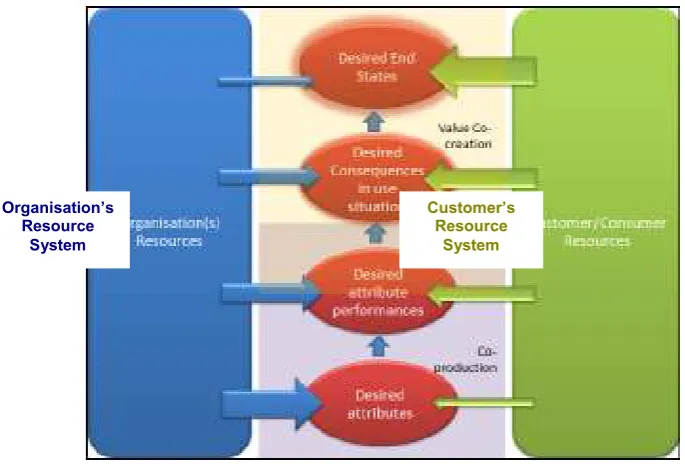
Vargo and Lusch, 2011). These systems take action, apply resources, and work with other systems in mutually beneficial ways to co-create value (Vargo et al, 2008). Principally then, both the customer and the firm can be considered to be systems, each of which is an arrangement of resources connected by a value proposition (Vargo et al, 2008; Spohrer et al, 2007; Spohrer et al, 2008; IfM and IBM, 2008). This is illustrated in Figure 2.
Figure 2 – Model of Value Co-creation (Ng et al, 2011, p441)
From an S-D Logic perspective, a system’s resources can be classified as either operand or operant (Vargo and Lusch, 2004). Operand resources are typically considered tangible resources, including economic resources goods/materials such as natural resources, that require some action on them to create value. Operant resources, on the other hand, are typically intangible resources, such as knowledge and skills, and cultural and social resources that are capable of acting on operand and other operant resources to create value. Each system has the ability to access resources from their own system and from other systems through exchange. These systems include internal (e.g., own, employees), private (e.g., friends, stockholders), and market-facing (suppliers, other economic exchanges) systems and resources (Vargo et al, 2008). This is a developed concept in the case of the organisation system and is covered in the field of operations management through service supply chain literature. However, thought on S-D Logic and service science suggests that customers also deploy operand and operant resources made available to them by the firm, by other internal, private and market facing systems and by themselves and in that way to realise value-in-use (Arnould et al, 2006). This is what is described by the S-D Logic as customer resource integration. Arnould et al (2006) go further to say that the configuration of customers’ operant resources, their family relationships, commercial relationships, brand communities, imaginations, knowledge, skills and physical powers influence how customers will employ their operand resources.
Customer’s Resource
System Organisation’s
These resource systems are thought to be deployed and integrated in the use experience through value-creating processes or resource integration. Payne et al (2008) describe processes in this context as the procedures, tasks, mechanisms, activities and interactions which support the co-creation of value, and further contend that both the customer and the company systems have these value-creating processes and practices. The practices and processes of both systems are thought to come together in joint interaction or encounter interactions (Gronroos and Ravald, 2009; Payne et al, 2008). These interactions may exist at varying levels of co-creation, shown in the centre of Figure 2, and it is argued that such practices and processes are the ones that need to be managed in order to achieve successful co-creation outcomes (Payne et al, 2008).
information and data to ensure effective learning and to inform customers of any risks. Companies have traditionally benefited from information asymmetry between the consumer and the firm. If firms strategically manage and design their service system for co-creation, that asymmetry may be diminished and firms can no longer assume opaqueness of prices, costs, processes and profit margins (Prahalad and Ramaswamy, 2004).
As discussed, literature on value creation has presented models of value co-creation and suggested benefits and possible implications of an organisational system for co-creation. With the exception of Payne et al (2008), limited research has been conducted into how organisations should manage co-creation. This chapter goes on to address the question of ‘what challenges do the design and management of a service system for co-creation present?’
Method
In order to address this question, the chapter reviews and comparatively analyses three case studies, the unit of analysis of which is an individual contract. A case study method is an appropriate approach for improving understanding of operational issues; it allows an investigation of potential challenges for management and design of service systems for co-creation (Eisenhardt and Graebner, 2007). The cases presented have been widely reported in a series of publications1 (see Ng and Nudurupati, 2010; Ng et al, 2010; Ng and Ding 2012; Ng et al., 2011; Smith et al., (forthcoming); Smith et al., 2012; Ng et al., 2012) and it is proposed that they are representative cases of service systems for co-created outcomes. As previously discussed, service systems are considered a dynamic configuration, or arrangement, of resources that create and deliver value between the provider and the customer through service (IfM and IBM, 2008). Each of the cases is explored in terms of the type and configuration of provider and customer resources employed in the delivery of a co-created outcome, which is determined by the contract terms.
All three case studies explore maintenance, repair and overhaul (MRO) service contracts in the defence industry and were conducted between 2007 and 2010; the details of each case is provided in Table 1. Two of the cases specifically contract on performance-based outcomes in which the company is tasked to deliver specific levels of performance in collaboration with the customer, rather than merely provide assets or activities. It can therefore be argued that these contracts in particular serve as an exemplar for value co-created and co-produced, where both parties are focused on achieving outcomes.
1
Table 1 – Three case studies exploring maintenance, repair and overhaul (MRO) service contracts in the defence industry
. Provider
Organisation
Customer Organisation
Equipment Primary Contract
Outcome
Contract Pricing Mechanism
Performance Measure People directly
employed on contract
Case 1* Aerospace Systems (anonymised) (Primary Contractor) Western-European Defence Department
Fastjet To maintain a defined
level of available mission-ready flying hours across a fleet of approx 200 aircraft
10+ year (through-life) contract
Total value of approx. £946m.
Charged based on an annual rate (barring exceptions and pain/gain share mechanisms)
Incentives against key performance indicators
Measurement of availability of a bank of flying hours of the aircraft.
There was also a non-contractual key performance indicator based on Government Furnished Materials (incl supplying physical facilities, material, data, IT and manpower). This was part of the Defence Dept’s
performance measurement in delivering the necessary assets and manpower for the
programme.
+1500 people on a joint project team comprising the Defence Department Equipment and Support organisation and Aerospace Systems Case 2* Missile Systems (anonymised) Western-European Defence Department Missile system
To maintain a defined level of percentage availability of the missile system
13+ year (through-life) contract
Approx. £156m firm price contract, including incentives against key performance indicators
The measurement of availability in barracks and the availability in the “operating theatre” (e.g. in Afghanistan)
+1500 people on a joint project team comprising the Defence Department and Missile Systems
Case 3** ABC (anonymised) Western-European Defence Department Multi-purpose military helicopter engine
To provide engine support on request (including preventative, scheduled and
unscheduled)
Paid on the basis of time and material including the actual cost of direct labour,
materials and equipment usage, and a fixed add-on to cover overheads and profit.
To respond to requests within 24 hours.
Measurement against specified overhaul turn around times.
Provider employees only. Approx. 30 directly incurred on the
programme. Over 1000 directly allocated from various departments.
*
*Cases 1 and 2 relate to a project consortium funded by the Engineering & Physical Science Research Council (UK). Information for these cases has been reproduced, with author permission, from the following publications: Ng and Nudurupati, 2010; Ng et al, 2010; Ng and Ding 2012; Ng et al., 2011
Findings: The Challenges of Service Systems for Co-Creation
The Determination Challenge
Payne et al (2008) stated that in managing the co-creation of value, business strategy starts by understanding the customer’s value-creating practices and processes and selecting which of these they wish to support. This positioning within the customer’s processes thus defines the scope of the firm’s value proposition. Evidence from the cases similarly suggests that there may be multiple value propositions for co-created value, upon which a firm may wish to contract. From the cases, four value propositions for co-created systems are found for defence equipment, each representing a different service system for the co-creation of value-in-use of military equipment.
These value propositions are (1) the potential performance of the asset in use; (2) the minimum disruption to potential use; (3) maximising potential availability of equipment for use; and (4) supporting capability for a given operational goal (Smith et al., (forthcoming); Smith et al., 2012). The first of these value propositions is representative of traditional manufacturing of equipment, in which three firms – Aerospace Systems, Missile Systems and ABC – contracted on the transfer of ownership of the equipment. The equipment proposes a certain value to the customer, the Defence Department, in use through its potential performance, but is realised almost solely by the Defence Department’s customer system in the context of their own operating environment. As such, the only organisation system resource supplied for integration is the asset itself. Second, it was found that organisations can co-create for minimum disruption to the asset’s potential performance in use, through collaborative support of processes and practices for recovery of the asset at the point of failure. This is demonstrated in Case 3, where ABC provides unscheduled support through the integration of organisational resources such as time and materials. Third, Cases 1 and 2 contracted on availability for use of equipment determined as the ‘readiness’ of a fleet of engines or a weapon system for deployment. In these cases, Aerospace Systems and Missile Systems not only contractually provide their system resources for integration, but are also responsible for the management and activity of resource integration. Lastly, whilst not explicit in any of the case contracts, there was evidence of organisational resources being integrated for the capability of equipment in use towards certain operational outcomes. For example, in Case 3 the firm was found to provide advice and materials for specific military operations:
‘You can say “right, the serviceable assets – I could take that assembly, that assembly and that assembly and build an (asset) good for (a certain performance) and send it to (achieve this goal).’ (Smith et al, 2011)
Analysis of the three cases shows that in designing a service system for co-creation, there may be multiple levels of value-creating practice and process upon which the firm can base its value proposition. This is the determination challenge of which value-creating processes to contract upon.
The Measurement Challenge
The Revenue Challenge
Related to the determination and measurement challenges is the challenge of how to manage revenues in service systems for value co-creation. As shown in Table 1, firms in Cases 1 and 2 charge based on a firm price annual rate for availability of equipment, barring exceptions and pain/gain share mechanisms. Alternatively, in Case 3, ABC charges based on the actual resources consumed. Although Cases 1 and 2 operate to a different level of contracted outcome than Case 3, it does raise the issue of mutuality of value outcomes. If a service system for co-creation is to be viable, it must hold potential value for both the customer and the provider. When considering financial benefits of service systems, it has been reported by the National Audit Office that in Case 1, the Defence Department has saved £1.3bn, reducing the cost per flying hour by 51 per cent. Similarly, in Case 2 the Defence Department has estimated cost savings of £175m over the period of the equipments’ lifetime (http://www.defenseindustrydaily.com/). This illustrates potential financial benefit for the customer of a service system for co-creation. However, it has been shown in the case of servitization, that a shift towards delivering value-in-use is not always profitable for the providing organisation; although it is seen to increase revenue, it is not always profitable for the bottom line (Neely, 2008). What is not evidenced in the cases is whether Cases 1 and 2 have both benefited financially from a service system for co-creation. Arguably, a firm price contract holds an element of risk not present in the revenue management mechanism of ABC, which guarantees that a loss is not made, as all direct and indirect costs of achieving the outcome are covered. This presents a revenue challenge of service systems for co-creation.
The Context Challenge
An S-D Logic perspective of value creation suggests that value created in use is contextual. Therefore social, ecological, and environmental surroundings at the point of use, whilst not possible to control, would be endogenous to a service system designed for value co-creation (Vargo et al, 2008). As a result, the management of a service system for co-creation could be affected by context. Findings from the cases suggest that use of defence equipment is dependent on context. Indeed, customer’s usage of equipment, and more specifically their repeat and changing conditions of usage, led to uncertainties in achieving outcomes consistently.
In all three cases it was found that the variety of use-situations directly influenced the firm’s ability to co-create outcomes. In Case 3, for example, the helicopter engine was designed over 30 years ago for use in European climates. Circumstances and use situations have changed over the lifetime of the engine and now the customer is operating it in hot and sandy conditions in Afghanistan, which affect the engine’s performance in use. This is illustrated in the following extract from Case 3:
‘We have deployed equipment out in Afghanistan and then we have other training activities in the UK and in Europe, the conditions are quite different, when they’re out in theatre, it’s quite a harsh environment for a helicopter, when they come back they tend to require more overhaul of the modules’
The Resource Challenge
It has been argued previously in the chapter that in designing and managing a service system for co-creation, customer’s resources to co-create value become central towards realising a firm’s value proposition. Evidence from the case studies suggests that firms integrate customer operand resources including material and information resources in the delivery of co-created outcomes. The following extract from Case 3 illustrates use of customer material resources in the firm’s practices and processes for co-created outcomes:
‘Sometimes we’re using his assets as well. So if he’s got assets in store then we request that we have those
parts to use in his (assets). We’ve also asked our customers whether we can buy some of his stock.’ (Smith
et al, 2012)
The following extract from the same case provides an example of information required in order to co-create outcomes:
‘I have to know what they’re doing with it, how many hours they’re (operating) it and what their plans are
for it longer-term and also some records of the history of each of the (assets).’ (Smith et al, 2011)
As the case evidence suggests, a service system for co-creation requires integration of customer materials and information in the firm’s value-creating processes and practices in order to achieve outcomes. This may present potential challenges in terms of gaining access to information and material, if this requirement is not stipulated under contractual agreements. This thus gives rise to a customer resource challenge in managing a service system for co-creation.
The Skills Challenge
Further to integration of operand resources such as material and information, case evidence also suggests that firms may need to transform and align the customer’s operant resources (i.e. people behaviours) to achieve contracted outcomes. In fact, analysis of Cases 1 and 2 suggests that both behavioural and information alignment between the two systems provide significant explanatory power on contract performance (see Ng and Ding, 2012).
Under availability-based contracts like Cases 1 and 2, the customer’s failure to co-create value results in the firm not being able to achieve the outcomes they have been contracted to deliver. Hence, the customer’s skills and ability to access resources to co-create value becomes the firm’s responsibility. Case evidence suggests that Aerospace Systems and Missile Systems put in place structures and processes to ensure expectations are congruent and competencies are complementary between themselves and their customer, the Defence Department. This was partially achieved through becoming fully engaged in the use practices and processes of the customer, so as to understand the pressures from the use of the equipment, and to recommend how both the firm and the customer resources could be deployed to deliver the outcomes across varying states and varieties of use. Even in Case 3, which was not contracted on availability, there is evidence of customer behaviour transformation. For example:
‘Helicopters have got a lot heavier and the flying has got a lot harder, especially in hot climates. Therefore, we’re seeing corrosion. [To prevent injury or damage] we’ve instructed that they inspect the engines every 1,000 hours and any corrosion witnessed on the blades, they’ve got to throw them away and replace them.’
Ramaswamy (2000). The challenge for transforming operant resources, therefore, may present itself as a skills challenge. However, to achieve behavioural transformation is not merely an issue of skill; the firm must be in a position to transform the behaviour of customers as well as be empowered for such behavioural transformation. In Cases 1 and 2, contractual mechanisms ensure a certain degree of power and influence. In Case 3 however, it is likely that ABC has less control over customer behaviour in use.
Discussion
A service system for value co-creation, particularly for the delivery of outcomes, changes the boundaries of the firm. In the traditional notion of value creation, the customer system was ‘outside the company’ and value creation occurred inside the company through its activities; see Figure 1. The company and the consumer had distinct roles of production and consumption respectively. Aerospace Systems produced an aircraft; the Defence Department used that aircraft as part of a system of resources to achieve military operations. Service systems for value co-creation shifts the boundaries of value creation; it shifts the skills sets and capability of the company to focus on effects of what they make/do and the effects of what customers do in combination for value-in-use. It redraws a system to focus on joint system capability of customer and company.
The transition from practices under the traditional view of value creation to practices with a co-creation view is not a minor change, as the six challenges suggest. Indeed, this chapter proposes that service systems for value co-creation face at least six challenges in design and management; a determination challenge; a measurement challenge; a revenue challenge; a context challenge; a resource challenge; and a skills challenge. These challenges are in part due to the two primary implications of an S-D Logic view of value creation, as discussed early in the chapter. First, value-in-use is realised in context and therefore would mean that the social, ecological, and environmental surroundings, whilst not possible to control, are endogenous to the process of value co-creation and therefore to the provider’s service system (Vargo et al, 2011). This is because value-in-use is state dependent and even when the customer and the company do the exact same thing each time, the state of the world changes and together with it, the way the service is being delivered (Ng et al., 2009). Therefore, a service system for co-creation would compel the company to better understand customer needs and usage requirements across differing environmental conditions, so that customers are able to realise the company’s value proposition through their part in the co-creation process. In doing so, Storbacka and Lehtinen (2001) argue that this may involve: a review of co-creation opportunities; planning, testing and prototyping value co-creation opportunities with customers; implementing customer solutions and managing customer encounters; and developing metrics to assess whether or not the enterprise is making appropriate value propositions.
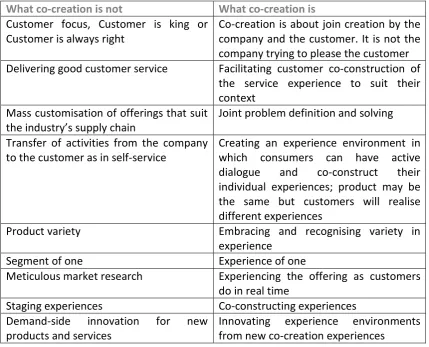
Table 2 – The concept of co-creation (Updated/Adapted from Prahalad and Ramaswamy, 2004)
What co-creation is not What co-creation is
Customer focus, Customer is king or Customer is always right
Co-creation is about join creation by the company and the customer. It is not the company trying to please the customer Delivering good customer service Facilitating customer co-construction of
the service experience to suit their context
Mass customisation of offerings that suit the industry’s supply chain
Joint problem definition and solving
Transfer of activities from the company to the customer as in self-service
Creating an experience environment in which consumers can have active dialogue and co-construct their individual experiences; product may be the same but customers will realise different experiences
Product variety Embracing and recognising variety in experience
Segment of one Experience of one
Meticulous market research Experiencing the offering as customers do in real time
Staging experiences Co-constructing experiences Demand-side innovation for new
products and services
Innovating experience environments from new co-creation experiences
Whether or not an organisation chooses to contract on the co-creation of customer outcomes, and therefore act as a partner in the value creation process, is a matter of strategy. It may not be viable for all organisations or industries to adopt this type of business model. As Oliva and Kallenberg (2003) discuss, service systems for creation incur operating risk due to the fact that a service system or co-creation takes responsibility for part or all of the end-user’s process over which they may have limited control. Moreover, not all customers may prefer the firm to take an active role in the creation of value-in-use. They may indeed prefer to be the sole resource integrator and simply contract with a firm to acquire the necessary resources to achieve value-in-use on their own. However, the latter challenges of co-creation regarding customer context and resources provide opportunities for firms to innovate their offerings to better support a customer’s realisation of value without necessarily contracting to co-provide them. Through exploration of use, firms can support the processes and practices of integration and provide information on other resources that might improve their use experience.
Conclusion
customer and their resources are a partner in the processes and practices of the firm (Prahalad and Ramaswamy, 2000). As we have discussed, it may not be a question of whether customers and their resources are a partner to the provider in the value creation process. Under S-D Logic, customers are always considered co-creators of value, as value is phenomenologically determined by them, in use. In this case, it is a question of to what extent, strategically, that providers choose to be a partner in the customer’s processes and practices of value creation in use. Through a review of three widely published cases, this chapter summarises six challenges in the design and management of a service system for co-creation; the determination challenge; the measurement challenge; the revenue challenge; the context challenge; the resource challenge; and the skills challenge.
The challenges presented in this chapter have been identified through exploration of the co-production and co-creation of functional or operational outcomes in the context of business-to-business organisations. Future research in co-creation should also investigate service systems for co-creation in business-to-consumer outcomes. It is likely that in these context outcomes will not be limited to functional outcomes but may involve layers of functional and social outcomes. Furthermore, the balance of influence, power and trust in business-to-consumer markets are likely to be different.
References
Arnould, E. J., Price, L. L. and Malshe, A. (2006), ‘Toward a cultural resource-based theory of the customer’, in Lusch, R. F. and Vargo, S. L. (Eds.), ‘The service-dominant logic of marketing: Dialog, debate and directions’, Armonk, NY: ME Sharpe, pp. 320−333.
Chandler, J. and Vargo, S. L. (2011), ‘Contextualization and value-in-context: how context frames exchange’, Marketing Theory, Vol. 11, No. 1, pp. 35-49.
Dabholkar, P (1990), "How to Improve Perceived Service Quality by Improving Customer Participation," in Developments in Marketing Science, B.J. Duniap, ed. Cullowhee, NC: Academy of Marketing Science, pp. 483-87.
Drucker, Peter. F. (1974), Management: Tasks, Responsibilities, Practices. New York, Harper & Row, Publishers Inc.
Echeverri, P. and Skålén, P. (2011) Co-creation and co-destruction: A practice-theory based study of interactive value formation, Marketing theory, Vol. 11 No.3 pp. 351-373.
Eggert, A., & Ulaga, W. (2002), ‘Customer-perceived value: A substitute for satisfaction in company markets?’ Journal of Company and Industrial Marketing, 17(2/3), pp. 107– 118.
Eisenhardt, K. M. and Graebner, M. E. (2007), "Theory building from cases: opportunities and challenges", Academy of Management Journal, Vol. 50, No. 1, pp. 25-32.
Fitzsimmons, James A. (1985), "Consumer Participation and Productivity in Service Operations," Interfaces, 15 (3), pp. 60-67.
Gronroos, C & Ravald, A. (2009) Marketing and the Logic of Service: Value Facilitation, Value Creation and Co-creation, and their Marketing Implications, working paper Hanken School of Economics, ISBN 978-952-232-061-2.
Grönroos, C. (2008): Service Logic Revisited: Who Creates Value? And Who Co-Creates? European Management Review, Vol. 20, No.4, pp. 298-314.
Gronroos, C. (2011), Value co-creation in service logic: A critical analysis, Marketing Theory, Vol. 11, No. 3, pp. 279–301.
Holbrook, M. B. (1994). ‘The Nature of Customer Value’, In: R. T. Rust and R. L. Oliver (eds), Service Quality: New Directions in Theory and Practice. Sage, Newbury Park, CA.
Holbrook, M.B. (2006) ‘ROSEPEKICECIVECI versus CCV: The resource-operant, skills-exchanging, performance-experiencing, knowledge-informed, competence-enacting, co-producer-involved, value-emerging, customer-interactive view of marketing versus the concept of customer value: ‘I can get it for you wholesale’. In R. F. Lusch & S. L. Vargo (Eds.), The service dominant logic of marketing: Dialog, debate and directions (pp. 208–223). Armonk, NY: M.E. Sharpe.
IfM and IBM, 2008. Succeeding through service innovation: A service perspective for education, research, business and government. Cambridge, United Kingdom: University of Cambridge Institute for Manufacturing.
Kotler, P. (1972). ‘A Generic Concept of Marketing’, Journal of Marketing, Vol. 36(April), pp. 46–54. Lapierre, J. (1997). What does value mean in business-to-business professional services?. International
Journal of Service Industry Management, Vol. 8 No. 5, pp. 377-397.
Levitt, T. (1969). The Marketing Mode: Pathways to Corporate Growth. McGraw-Hill, New York.
Meuter, Matthew L. and Mary Jo Bitner (1998), "Self-Service Technologies: Extending Service Frameworks and Identifying Issues for Research," in AMA Winter Educators' Conference, Dhruv Grewal and Connie Pechmann, eds. Chicago: American Marketing Association, pp. 12-19.
Naumann, E. (1995), Creating Customer Value. The Path to Sustainable Competitive Advantage, Thompson Executive Press, Cincinnati, Ohio.
Neely, A. (2008), “Exploring the financial consequences of the Servitization of manufacturing”, Operations Management Research. Vol.1 No. 2 (December), pp. 103-118.
Ng, Irene C. L., Lei Guo, James Scott and Nick Yip (2008), “Towards a Benefit-based Framework for Understanding B2B Services and its impact on Contract and Capability”, Proceedings of the 10th International Research Seminar in Services Management, 27-30 May 2008, La Londe, France Ng, Irene C.L. and Sai Nudurupati, (2010) “Outcome-Based Service Contracts In the Defence Industry –
Mitigating the Challenges,” Journal of Service Management, Vol. 21, No. 5, pp. 656-674.
Ng, Irene C.L. and X. Ding. (2012), “Relational Specificity in the Value Co-production of Outcome-based Contracts in Equipment-based Service,” under review in Administrative Science Quarterly
Ng, Irene C.L. Parry, G., Smith, L., Maull, R. M., Briscoe, G. and Marlowe, S. (2012), Transitioning from a Goods-Dominant to a Service-Dominant Logic: Visualising the Value Proposition of ABC, under review in the Journal of Service Management
Ng, Irene C.L., Sai Nudurupati and Jason Williams, (2011) “Redefining Organizational Capability for Value Co-creation in Complex Engineering Service Systems in Complex Engineering Service Systems:
Concepts & Research, Ng, Irene C.L., Glenn Parry, Peter Wild, Duncan MacFarlane and Paul Tasker (Eds.) ISBN: 978-0-85729-188-2, London: Springer
Ng, Irene C.L., Sai Nudurupati and Paul Tasker, (2010) “Value Co-creation in Outcome-based Contracts for Equipment-based Service”, AIM working paper series, WP No 77 - May – 2010
http://www.aimresearch.org/index.php?page=wp-no-77 under second review in Journal of Service Research
Normann, R. (2001), Reframing Company: When the Map Changes the Landscape, John Wiley &, Chichester.
Normann, R. and R. Ramírez (1994). Designing Interactive Strategy: From Value Chain to Value Constellation. John Wiley & Sons, Chichester.
Oliva, R., and Kallenberg, R., 2003. Managing the transition from products to services. International Journal of Service Industry Management. Vol. 14 No. 2, pp. 160-172.
Ordanini, A. and Pasini, P. (2008), Service co-production and value co-creation: The case for a service-oriented architecture (SOA), European Management Journal, Vol. 26, pp. 289– 297.
Payne, A. and Holt, S. (2001) ‘Diagnosing customer value: Integrating the value process and relationship marketing.’ British Journal of Management, Vol. 12, pp. 159−182.
Payne, A., & Frow, P. (2005). A strategic framework for customer relationship management. Journal of Marketing, Vol, 69 (Oct), pp. 167–176.
Payne, A., K. Storbacka and P. Frow (2008) Managing the co-creation of value. Academy of Marketing
Science.Vol. 36, No. 1, pp. 83–96.
Plé, L. and Cáceres, R. C. (2010) "Not always co-creation: introducing interactional co-destruction of value in service-dominant logic", Journal of Services Marketing, Vol. 24, No. 6, pp. 430 - 437.
Prahalad, C.K. and Ramaswamy, V. (2000), Co-opting Customer Competence, Harvard Business Review, Vol. 78 Issue 1, pp. 79-87.
Prahalad, C.K. and Ramaswamy, V. (2004) Co-creation Experiences: The Next Practice in Value Creation. Journal of Interactive Marketing, Vol. 18 No. 3 pp. 5-14.
Sawney, M. (2006), ‘Going Beyond The Product: Defining, Designing and Delivering Customer Solutions’ In R. F. Lusch & S. L. Vargo (Eds.), The service dominant logic of marketing: Dialog, debate and directions, pp. 365-380.
Schneider, Benjamin and David E. Bowen (1995), Winning the Service Game. Boston: Harvard Business School Press.
Slater, S. F. and J. C. Narver (1995). ‘Market Orientation and the Learning Organization’, Journal of Marketing, Vol. 59 No. 3, pp. 63–74.
Smith, Adam. [1776] 1904. An inquiry into the nature and causes of the wealth of nations. London: W.Strahan and T. Cadell.
Smith, L., Maull, R. M. and Irene C.L. Ng, (2012) “Servitization and Operations Management: A Service Dominant Logic Approach”, conditionally accepted for International Journal of Operations and Production Management, working paper at
http://business-school.exeter.ac.uk/research/areas/topics/management/outputs/publication/?id=682
Smith, L., Ng, Irene C.L. and Maull, R. M. (2012) “The Three Value Cycles of Equipment Based Service,” Production, Planning and Control, forthcoming
Spohrer, J., Maglio, P. P., Bailey, J. and Gruhl, D. (2007), Steps toward a science of service systems, Computer, Vol. 40, pp. 71–77.
Spohrer, J., Vargo, S. L., Caswell, N. and Maglio, P. P. (2008) The service system is the basic abstraction of service science. In Proceedings of the 41st Annual Hawaii International Conference on System
Science, January, p. 104.
Storbacka, K., and Lehtinen, J. R. (2001). Customer relationship management: Creating competitive advantage through win–win relationship strategies. Singapore: McGraw-Hill.
Vargo, S. and R. Lusch (2004) ‘Evolving to a new dominant logic in Marketing’ Journal of Marketing, 68, pp. 1-17.
Vargo, S. L. (2009) ‘Doing Research in Service: A research meeting on the Service-Dominant Logic’ Advanced Institute for Management (AIM) Research workshop, March 19th 2009,
London.http://www.aimresearch.org
Vargo, S. L. and Lusch, R. F. (2011), It's all B2B…and beyond: Toward a systems perspective of the market, Industrial Marketing Management, Vol. 40, pp. 181–187.
Vargo, S. L. and R. F. Lusch. (2008). Service-dominant logic: Continuing the evolution. Journal of the Academy of Marketing Science. Vol. 36 No.1, pp. 1-10.
Vargo, S. L., Maglio, P. P. and Akaka, M. A. (2008), On value and value co-creation: A service systems and service logic perspective, European Management Journal, Vol. 26, pp. 145– 152
Vargo, Stephen L. and Fred W. Morgan(2005) "Services in Society and Academic Thought: A Historical Analysis." Journal of Macromarketing, Vol. 25 No. 1, pp. 42-53.
Woodruff R. B. (1997). ‘Customer Value: The Next Source of Competitive Advantage’, Journal of the Academy of Marketing Science, Vol. 25 No. 2, pp. 139–153.
Yip K.T. (2012), “What are the attributes of value co-creation and how may they impact on the
customers’ willingness to pay? Observations from three service industries.” PhD Thesis, University of Exeter.