warwick.ac.uk/lib-publications
Original citation:
Hsueh, Nathanael, Clarkson, Guy J. and Shipman, Michael. (2016) Functionalisation of
alkenes through telescoped continuous flow aziridination processes. Organic Letters.
Permanent WRAP URL:
http://wrap.warwick.ac.uk/81479
Copyright and reuse:
The Warwick Research Archive Portal (WRAP) makes this work by researchers of the
University of Warwick available open access under the following conditions. Copyright ©
and all moral rights to the version of the paper presented here belong to the individual
author(s) and/or other copyright owners. To the extent reasonable and practicable the
material made available in WRAP has been checked for eligibility before being made
available.
Copies of full items can be used for personal research or study, educational, or not-for profit
purposes without prior permission or charge. Provided that the authors, title and full
bibliographic details are credited, a hyperlink and/or URL is given for the original metadata
page and the content is not changed in any way.
Publisher’s statement:
“This document is the Accepted Manuscript version of a Published Work that appeared in
final form in Organic Letters, copyright © American Chemical Society after peer review and
technical editing by the publisher.
To access the final edited and published work
http://pubs.acs.org/page/policy/articlesonrequest/index.html .”
A note on versions:
The version presented here may differ from the published version or, version of record, if
you wish to cite this item you are advised to consult the publisher’s version. Please see the
‘permanent WRAP url’ above for details on accessing the published version and note that
access may require a subscription.
Functionalisation of Alkenes Through Telescoped Continuous
Flow Aziridination Processes
Nathanael Hsueh, Guy J. Clarkson and Michael Shipman*
Department of Chemistry, University of Warwick, Gibbet Hill Road, Coventry, CV4 7AL, U.K.
Supporting Information Placeholder
ABSTRACT: Alkenes can be efficiently aziridinated using highly soluble iminoiodane derivatives under continuous flow conditions. By combining the aziridine generation with nucleophilic ring opening reactions, a variety of products can be made without the need to handle or isolate these potentially hazardous intermediates. Additionally, this chemistry can be used to make and use aziridines that are difficult to isolate and purify because of their high reactivity.
Aziridines are valuable building blocks widely used for the production of nitrogen containing molecules.1,2 In particular, they serve as ‘spring-loaded’ electrophiles that, upon nucleophilic ring opening, facilitate the for-mation of a variety of C−C and C−heteroatom bonds. These processes have such broad scope, efficiency, selectivity, and atom economy that they have been cate-gorized as “click” reactions.3 However, the high reactivity of these nitrogen heterocycles make them potentially hazardous to human health.4 For example, aziridine (ethylenimine) is a powerful alkylating agent with both mutagenic and genotoxic activity,4a Although the toxicity of other aziridines is less well established, considerable caution should be exercised when working with them to limit harmful exposure.
Continuous flow chemistry provides a way to generate and handle hazardous and reactive reagents in a safe manner.5 Thus, we reasoned that this technology might allow us to generate and use aziridines in telescoped processes without recourse to handling or purifying them. The synthesis6-12 and utilization13-15 of these elec-trophilic species in laboratory-scale flow chemistry has recently attracted considerable attention although just two reports have explored their use as transient interme-diates in telescoped processes. In 2016, Gaunt, Lapkin and coworkers described the continuous-flow synthesis and derivatization of a bicyclic aziridine by way of Pd-catalyzed C(sp3)–H activation.11 In the only other report, we described a simple flow synthesis of aziridines by
nately, the applicability of our chemistry was limited by the range of 1,2-amino alcohols that are commercially available or readily prepared. Moreover, aryl sulfonyl chlorides (e.g. TsCl) could not be used as activators for the ring closure as the derived chloride ion competed as a nucleophile leading to unwanted side products in the subsequent ring openings. This problem was solved through application of methanesulfonic anhydride as activator in the telescoped reactions, however this fur-ther limited the range of products that could be made by this approach.
Scheme 1. Concept for the generation and ring-opening of aziridines in continuous flow by metal-catalyzed nitrene transfer from iminoiodanes.
No need to handle or isolate the potentially hazardous intermediates I
OnPr
NSO2R
R2
NuH/H+
R2
Nu
NHSO2R
R2
N S R
O O
R1
R1
R1
–ArI Cu(II)
18 examples 79-48%
R NH2
OH
Ms2O
R NMs
R NHMs
Nu
Previous work:12
Nu/H+
R2
R1
R3
catalyst
R2
R1
R3
NSO2R
R2
Nu R1
NHSO2R
R3
This work:
Nu/H+
ArI NSO2R
limitations: • Limited availability of 1,2-amino alcohols
• Telescoped processes restricted to N-Ms derivatives
–ArI base
Among methods developed for the preparation of aziridines, the metal catalyzed addition of nitrenes to C=C double bonds is especially general offering high levels of chemo-, regio- and stereocontrol.1 Aryl-sulfonylimino phenyliodanes such as PhI=NTs have emerged as a particularly useful and practical nitrene precursors for such chemistry.16 This encouraged us to explore the aziridination/ring opening of alkenes under continuous flow conditions using this methodology (Scheme 1). Potential benefits include the fact that: (i) a very wide range of alkenes are commercially available and are known to participate in such metal catalyzed aziridinations; (ii) many ArI=NSO2R are accessible,
mak-ing it possible to tune the aziridine N-substituent; and (iii) an inert by-product is generated in the form of an aryl iodide which should not interfere in the telescoped ring opening reactions.
At the outset of this work, we faced a significant prac-tical obstacle insofar as most common iminoiodane de-rivatives such as PhI=NTs and PhI=NNs are extremely insoluble in organic solvents. To solve this problem, we turned to a report by Yoshimura and coworkers who de-scribed highly soluble and reactive N-tosyl nitrene pre-cursors derived from o-propoxyiodobenzene.17 We pre-pared iminoiodane 1a from (2-propoxyphenyl)-λ3 -iodanediyl diacetate according to the published method (Scheme 2). Additionally, three new iminoiodanes name-ly 1b-d were synthesized from the corresponding tron deficient sulfonamides in good yields. These elec-tron withdrawing substituents were introduced to en-hance the reactivity of the aziridines, and make it easier to remove the sulfonyl groups from the nitrogen atom in the end products.18 Whilst iminoiodanes 1c and 1d had good solubility in chlorinated solvents, 1b proved to be only sparingly soluble making it unsuitable for further use in the flow aziridinations reported herein.
Scheme 2. Synthesis of iminoiodanes 1a-d.
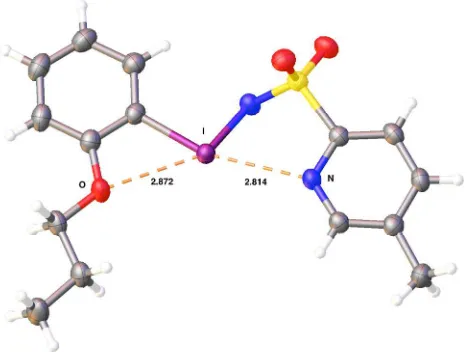
The structure of 1d was unambiguously established by X-ray crystallography which also provides possible in-sights into why it is more soluble (Figure 1 and Support-ing Information). Unlike PhINTs which has a polymeric structure stabilised by short intermolecular IQN bonds (2.482 Å),19 there are no such interactions in 1d. Instead, the iodine benefits from a strong intramolecular interac-tion with the appended pyridine nitrogen atom (2.814 Å) as well as the ether oxygen (2.872 Å). The absence of strong intermolecular interactions presumably aids solu-bility.
Figure 1. ORTEP depiction of the X-ray structure of 1d
highlighting the key interactions with the iodine atom.
Scheme 3.
a
ArI=NSO2R (0.1 mmol) in CH2Cl2 (2 mL) and the alkene (1 mmol, 10 equiv) and (pyr)4Cu(OTf)2 (0.01 mmol) in MeCN (2 mL) were combined in two-channel microreactor, flow rate = 0.45 ml min-1 (see Supporting Information). b Isolated yield after column chromatography. c Using an in-expensive tube reactor made from PTFE tubing, flow rate =
Cu(pyr)4(OTf)2
CH2Cl2, MeCN
21 °Ca
Rt = 10 min
I OnPr
NSO2R
R1
R2
NSO2R
2a-lb
Ph NTs
2a; 82%
NTs
2f; 70% (73%c)
NTs
2e; 68% NTs
2d; 68% (68%c)
NTs
2j; 71%
Ph N
2b; 77% S O
O
O2N
N S O
O
O2N
2g; 70%
N S O
O
O2N
2h; 46%d
Ph N
2c; 79% S O
O
N
N
2k; 73% S O
O
N
N
2i; 76% S O
O
N
Cl
N
2l; 82% S O
O
N
1a, 1c or 1d
R1 R2
ACS Paragon Plus Environment
[image:3.612.324.558.40.216.2]0.50 ml min-1 (see Supporting Information). d Conducted using cycloheptene (20 equiv).
Using soluble iminoiodanes 1a, 1c and 1d, we next explored the synthesis of aziridines in flow. A commer-cial microreactor (total reactor volume = 4.5 cm3) con-nected to computer controlled syringe pumps was used (see Supporting Information for set-up). The reactions were performed by combining tetrakis(pyridine)copper(II) triflate (10 mol%) and the alkene (10 equiv) in MeCN, with the iminoiodane (1 equiv) dissolved in CH2Cl2.20
The addition rates were controlled to achieve a resi-dence time (Rt) of 10 min in the reactor. In this way,
aziridines 2a-l were produced in good yields after col-umn chromatography (Scheme 3). All three imi-noiodanes were effective nitrene transfer reagents under flow conditions. Similar results were achieved using an inexpensive, tube reactor in place of the chip reactor, as illustrated by the synthesis of 2d and 2f in comparable yields.
Scheme 4.
a
H2SO4 in MeOH (Nu = OMe); H2SO4 in EtOH (Nu = OEt); MsOH in BnOH (Nu = OBn); HCl in Et2O/CH2Cl2 (1:3) (Nu = Cl), flow rate = 1.0 ml min-1. For full details, see Sup-porting Information. b Isolated yield after column chromatog-raphy.
Next, we sought to ascertain if telescoped reactions could be undertaken whereby the aziridine is made and directly ring opened without recourse to handling or iso-lation. For these reactions, a three-input tube reactor was constructed with a total residence time of 20 min (see Supporting Information). First, the iminoiodane, alkene and catalyst were combined at room temperature to produce the aziridine, whereupon the nucleophile and acid activator were introduced to effect ring opening. Better results in these telescoped reactions were achieved by reducing the quantities of the alkene (5 equiv). Through the synthesis of amines 3a-r in moder-ate to good overall yields, it is apparent that this three-component process tolerates good variation in the al-kene, nucleophile and iminoiodane (Scheme 4).21 For example, using alcohol nucleophiles this chemistry pro-vides rapid access to 1,2 amino alcohol motifs.22 An un-expected benefit is that it can be used to make and use aziridines that are difficult to isolate and purify because of their high reactivity. For example, this telescoped pro-cess can be used to efficiently make 3e and 3f derived from α-methyl styrene, despite the fact that attempts to isolate the corresponding aziridine were unsuccessful. Regiospecific opening at the more hindered benzylic carbon of the intermediate aziridines was seen in all cases. This was established by HMBC 3-bond cou-plings,23 and in the case of 3h further verified by X-ray crystallography (see Supporting Information).
Additionally, the feasibility of making imidazolines has been demonstrated through the synthesis of 4a-c by reaction of 1d with a selection of styrenes, followed by boron trifluoride induced ring expansion in the presence of acetonitrile (Scheme 5).24 In each case, a single regi-oisomer was observed.
Scheme 5. Flow synthesis of imidazolines by a tele-scoped aziridination/ring expansion sequence.
S O
O NO2
H N OMe
3g; 71%
S O
O NO2
H N OMe
Cl 3o; 48% S O O N H N Cl
3h; 49% S O O N H N Ph OMe
3d; 64%
S O O N H N OEt F
3r; 61% I
OnPr
NSO2R
R2
NuH/H+a
R2
Nu
NHSO2R
R2 N S R O O R1 R1 R1
3a-rb 1c, d
S O
O NO2
H N Ph
Nu
3a: Nu = OMe; 73%
3b: Nu = OCH2Ph; 55% 3c: Nu = Cl; 55%
S O
O NO2
H N Ph
Nu Me
3e: Nu = OMe; 67%
3f: Nu = OEt; 56%
S O
O NO2
H N Nu
3i: Nu = OMe; 76%
3j: Nu = OEt; 78%
S O
O NO2
H N Nu
3k: Nu = OMe; 73%
3l: Nu = Cl; 58%
S O
O NO2
H N Nu
Cl
3m: Nu = OMe; 79%
3n: Nu = OCH2Ph; 61%
S O
O NO2
H N Nu
F
3p: Nu = OMe; 77%
3q: Nu = Cl; 52%
Rt = 10 min
Rt = 10 min
Cu(pyr)4(OTf)2
CH2Cl2, MeCN
21 °C Ph N N S O O N
4c; 71% N
N S O
O N
4a; 77%
N N
S O
O N
4b; 70% Cl
Ar NSO2R N MeCN/BF3 Ar Ar N S R O O
4a-c 1d
Rt = 10 min
Rt = 10 min
Cu(pyr)4(OTf)2
CH2Cl2, MeCN
In conclusion, we have devised a general route to aziridines from a variety of alkenes using new, soluble iminoiodanes under continuous flow conditions. By tele-scoping their generation with further chemistry of the aziridines, it is possible to produce a wide range of valu-able products by way of regiocontrolled openings. As well as limiting exposure to these potentially hazardous heterocycles, this has the added benefit that it can be used to make aziridines that are rather reactive and diffi-cult to isolate. The application of these soluble imi-noiodanes in other processes including the asymmetric aziridination of alkenes under continuous flow is ongoing in our laboratory and will be disclosed in due course.
ASSOCIATED CONTENT
Supporting Information
Details of continuous flow apparatus, experimental proce-dures, characterisation data for all compounds, copies of 1H and 13C NMR spectra and X-ray data for 1d and 3h. This Supporting Information is available free of charge on the ACS Publications website.
AUTHOR INFORMATION
Corresponding Author
* [email protected]; Tel +44 24765 23186; Fax +44 24765 24429
ACKNOWLEDGMENT
We thank the University of Warwick for financial sup-port. The Oxford Diffraction Gemini XRD system was obtained, through the Science City Advanced Materials project: Creating and Characterizing Next Generation Advanced Materials. We thank Dr. Andrew J. Clark (Uni-versity of Warwick) for the generous loan of equipment.
REFERENCES
(1) For a monograph, see Yudin, A. K., Ed. Aziridines and Epoxides in Organic Synthesis; Wiley-VCH: Weinheim, 2006.
(2) For reviews, see (a) Degennaro, L.; Trinchera, P.; Luisi, R. Chem. Rev. 2014, 114, 7881–7929. (b) Callebaut, G.; Meiresonne, T.; De Kimpe, N.; Mangelinckx, S. Chem. Rev.
2014, 114, 7954–8015. (c) Cardoso, A. L.; Pinho e Melo, T. M. V. D. Eur. J. Org. Chem.2012, 6479–6501. (d) Stanković, S.; D'hooghe, M.; Catak, S.; Eum, H.; Waroquier, M. l.; Van Speybroeck, V.; De Kimpe, N.; Ha, H.-J. Chem. Soc. Rev.
2012, 41, 643–665. (e) Florio, S.; Luisi, R. Chem. Rev.2010, 110, 5128–5157.
(3) (a) Moses, J. E.; Moorhouse, A. D. Chem. Soc. Rev.
2007, 36, 1249–1262. (b) Kolb, H. C.; Finn, M. G.; Sharpless, K. B. Angew. Chem. Int. Ed.2001, 40, 2004–2021.
(4) (a) IARC Monographs on the Evaluation of Carcinogenic Risks to Humans, Volume 71 (1999), WHO press, Lyon,
France. (b) Ismail, F. M. D.; Levitsky, D. O.; Dembitsky, V. M. Eur. J. Med. Chem.2009, 44, 3373–3387.
(5) For leading references, see (a) Gutmann, B.; Cantillo, D.; Kappe, C. O. Angew. Chem. Int. Ed.2015, 54, 6688–6728. (b) Ager, D. J. in Managing Hazardous Reactions in Process Chemistry, ACS Symposium Series (2014), vol 1181, pp 285– 351. (c) Degennaro, L.; Carlucci, C.; De Angelis, S.; Luisi. R. J. Flow Chem.2016, http://dx.doi.org/10.1556/1846.2016.00014. (6) Maskill, K. G.; Knowles. J. P.; Elliot, L. D.; Alder, R. W.; Booker-Milburn, K. I. Angew. Chem. Int. Ed.2013, 52, 1499– 1502.
(7) Rossi, S.; Puglisi, A.; Benaglia, M.; Carminati, D. M.; In-trieri, D.; Gallo, E. Catal. Sci. Technol.2016, 6, 4700–4704.
(8) Scholz, S. O.; Farney, E. P.; Kim, S.; Bates, D. M.; Yoon, T. P. Angew. Chem. Int. Ed.2016, 55, 2239–2242.
(9) Baumann, M.; Baxendale, I. Synlett, 2016, 27, 159–163. (10) Chandrasekhar, D.; Borra, S.; Nanubolu, J. B.; Maurya, R. A. Org. Lett.2016, 18, 2974–2977.
(11) Zakrzewski, J.; Smalley, A. P.; Kabeshov, M. A.; Gaunt, M. J.; Lapkin, A. A. Angew. Chem. Int. Ed.,2016, 55, 8878 – 8883.
(12) Hsueh, N.; Clarkson, G. J.; Shipman, M. Org. Lett.2015, 17, 3632–3635.
(13) Nagaki, A.; Takizawa, E.; Yoshida, J.-I. Chem. Lett.
2009, 38, 1060–1061.
(14) Giovine, A.; Musio, B.; Degennaro, L.; Falcicchio, A.; Nagaki, A.; Yoshida, J.-I.; Luisi, R. Chem. Eur. J. 2013, 19, 1872–1876.
(15) Salice, P.; Rossi, E.; Pace, A.; Maity, P.; Carofiglio, T.; Menna, E.; Maggini, M. J. Flow Chem.2014, 4, 79–85.
(16) (a) Karila, D.; Dodd, R. H. Curr. Org. Chem.2011, 15, 1507–1538. (b) Chang, J. W. W.; Ton, T. M. U.; Chan, P. W. H. Chem. Rec.2011, 11, 331–357.
(17) Yoshimura, A.; Nemykin, V. N.; Zhdankin, V. V. Chem. Eur. J. 2011, 17, 10538–10541.
(18) (a) Fukuyama, T.; Jow, C.-K.; Cheung, M. Tetrahedron Lett. 1995, 36, 6373–6374. (b) Pak, C. S.; Lim, D. S. Synth. Commun. 2001, 31, 2209–2214. (c) Han, H.; Bae, I.; Yoo, E. J.; Lee, J.; Do, Y.; Chang, S. Org. Lett.2004, 6, 4109–4112.
(19) Mishra, A. K.; Olmstead, M. M.; Ellison, J. J.; Power, P. P. Inorg. Chem.1995, 34, 3210–3214.
(20) Cu(pyridine)4(OTf)2 proved to be a superior catalyst to
Cu(OTf)2 which was used by Yoshida and co-workersfor batch
aziridinations using 1a (ref 14). No attempts were made to re-cover the excess alkene from these reactions. Further details of the process optimisation are provided in the Supporting In-formation.
(21) N-Tosyl derivatives made from 1a were much less effec-tive in these ring openings. Moreover, extending the residence time for ring opening with MeOH/H2SO4 to 20 min did not lead
to any significant improvement.
(22) Bergmeier, S. C. Tetrahedron2000, 56, 2561–2576. (23) Furuta, Y.; Kumamoto, T.; Ishikawa, T. Synlett 2004, 362–364.
(24) Prasad, B. A. B.; Pandey, G.; Singh, V. K. Tetrahedron Lett.2004, 45, 1137–1141.
ACS Paragon Plus Environment