http://go.warwick.ac.uk/lib-publications
Original citation:Lereya, Suzet Tanya, Samara, Muthanna and Wolke, Dieter. (2013) Parenting behavior and the risk of becoming a victim and a bully/victim : a meta-analysis study. Child Abuse & Neglect . ISSN 0145-2134
Permanent WRAP url:
http://wrap.warwick.ac.uk/54524 Copyright and reuse:
The Warwick Research Archive Portal (WRAP) makes the work of researchers of the University of Warwick available open access under the following conditions. Copyright © and all moral rights to the version of the paper presented here belong to the individual author(s) and/or other copyright owners. To the extent reasonable and practicable the material made available in WRAP has been checked for eligibility before being made available.
Copies of full items can be used for personal research or study, educational, or not-for-profit purposes without prior permission or charge. Provided that the authors, title and full bibliographic details are credited, a hyperlink and/or URL is given for the original metadata page and the content is not changed in any way.
Publisher’s statement:
“NOTICE: this is the author’s version of a work that was accepted for publication in Child Abuse & Neglect. Changes resulting from the publishing process, such as peer review, editing, corrections, structural formatting, and other quality control mechanisms may not be reflected in this document. Changes may have been made to this work since it was submitted for publication. A definitive version was subsequently published in Child Abuse & Neglect.
http://dx.doi.org/10.1016/j.chiabu.2013.03.001 A note on versions:
The version presented here may differ from the published version or, version of record, if you wish to cite this item you are advised to consult the publisher’s version. Please see the ‘permanent WRAP url’ above for details on accessing the published version and note that access may require a subscription.
1
Parenting behavior and the risk of becoming a victim and a bully/victim: A
meta-analysis study
Suzet Tanya Lereya, Ph.D, Department of Psychology, University of Warwick,
Coventry (UK), CV4 7AL; (Postdoctoral Researcher)
Muthanna Samara, Ph.D, Department of Psychology, Kingston University London,
Kingston-Upon-Thames (UK) KT1 2EE; (Senior Lecturer in Psychology)
Dieter Wolke, Ph.D, Department of Psychology and Division of Mental Health and
Wellbeing (Warwick Medical School), University of Warwick, Coventry (UK), CV4 7AL;
(Professor of Developmental Psychology and Individual Differences)
Correspondence: Suzet Tanya Lereya, Department of Psychology, University of
Warwick, Coventry, CV4 7AL, UK, Phone: + 44 24 7652 3151, Fax: + 44 24 7652
4225, e-mail: [email protected]
Funding: Drs. Wolke and Lereya’s work on this study was supported by the Economic and
Social Research Council (ESRC) grant ES/K003593/1. Dr. Samara received support from
Qatar National Research Fund (QNRF) grant NPRP5 – 1134- 3-240.
Acknowledgments: We would like to thank all authors who supplied the required
information to perform the meta-analysis.
2 Abstract
Objective: Being bullied has adverse effects on children’s health. Children’s family
experiences and parenting behavior before entering school help shape their capacity to adapt
and cope at school and have an impact on children’s peer relationship, hence it is important to
identify how parenting styles and parent-child relationship are related to victimization in
order to develop intervention programs to prevent or mitigate victimization in childhood and
adolescence.
Method: We conducted a systematic review of the published literature on parenting behavior
and peer victimization using MEDLINE, PsychINFO, Eric and EMBASE from 1970 through
the end of December 2012. We included prospective cohort studies and cross-sectional
studies that investigated the association between parenting behavior and peer victimization.
Results: Both victims and those who both bully and are victims (bully/victims) were more
likely to be exposed to negative parenting behavior including abuse and neglect and
maladaptive parenting. The effects were generally small to moderate for victims (Hedge’s g
range: 0.10 to 0.31) but moderate for bully/victims (0.13 to 0.68). Positive parenting behavior
including good communication of parents with the child, warm and affectionate relationship,
parental involvement and support, and parental supervision were protective against peer
victimization. The protective effects were generally small to moderate for both victims
(Hedge’s g: range: -0.12 to -0.22) and bully/victims (-0.17 to -0.42).
Conclusions: Negative parenting behavior is related to a moderate increase of risk for
becoming a bully/victim and small to moderate effects on victim status at school. Intervention
programs against bullying should extend their focus beyond schools to include families and
start before children enter school.
3
Parenting behavior and the risk of becoming a victim and a bully/victim: A
meta-analysis study
Victims of bullying are repeatedly exposed to aggressive behavior, perpetrated by an
individual or peer group with more power than the victim (Olweus, 1993, 2002; Wang,
Nansel, & Iannotti, 2011). Bullying is a global problem with an average of 32% of children
being bullied across 38 countries/regions (World Helth Organization, 2012). Victims more
often develop physical health problems (Gini & Pozzoli, 2009; Wolke, Woods, Bloomfield,
& Karstadt, 2001), a range of mental health difficulties including anxiety and depression
(Arseneault, Bowes, & Shakoor, 2010; Woods & White, 2005; Zwierzynska, Wolke, &
Lereya, 2013), psychotic symptoms, (Schreier et al., 2009) and borderline personality
symptoms (Wolke, Schreier, Zanarini, & Winsper, 2012). They are also at highly increased
risk of self-harm, suicidal ideation, and attempting and completing suicides (Fisher et al.,
2012; Klomek et al., 2009; Winsper, Lereya, Zanarini, & Wolke, 2012). The targets of
bullying are victims (Haynie et al., 2001; Wolke, Woods, Bloomfield, & Karstadt, 2000), and
those who both bully others and are victims of bullying are called bully/victims (Wolke &
Samara, 2004; Wolke et al., 2000). Bully/victims usually display the highest level of conduct,
school, and peer relationship problems (Juvonen, Graham, & Schuster, 2003; Wolke &
Samara, 2004) and may come from the most adverse family backgrounds (Smokowski &
Kopasz, 2005).
Children’s family experiences before entering school help shape their capacity to
adapt and cope at school and have an impact on children’s peer relationships (Ladd, 1992).
Thus, it is important to identify which parenting styles and parent-child relationships are
related to victimization in order to develop intervention programs to prevent or mitigate
victimization in childhood and adolescence. From a social learning perspective, it has been
4 (Bandura, 1973, 1986), and parents’ child rearing behavior may serve as a model upon which
children base their behavior and expectations of future relationships (Ladd, 1992). It was
found that maladaptive parenting, marked by high levels of hostility, hitting and shouting,
was related to increased risk of peer victimization at school (e.g. Ahmed & Braithwaite,
2004). On the other hand, children of authoritative parents (high on demanding and high on
responsiveness) was found to do better at school and have less adjustment problems (e.g.
Baumrind, 1991; Hay & Meldrum, 2010).
However, global parenting styles may fail to identify distinct aspects of parenting that
are associated with childhood adjustments (Linver & Silverberg, 1997). The examination of
individual parenting characteristics enable the exploration of relative independent effects of
these characteristics on child outcomes (Grolnick & Ryan, 1989). For example, previous
research identified several factors that are important for the socialization of children. These
include the extent of supervision (Georgiou, 2008), warmth (Booth, 1994; Fine, Voydanoff,
& Donnelly, 1993) and overprotection (Finnegan, Hodges, & Perry, 1998). Knowing which
parenting factors increase or decrease the risk of victimization is necessary in order to
develop prevention or intervention programs that go beyond the school context.
The objective of this meta-analysis is to systematically investigate the type and
strength of the association between parenting behavior (i.e., parent-child communication,
authoritative parenting, parental involvement and support, supervision, warmth and affection
of the parents, abuse and neglect, maladaptive parenting, overprotection) on being bullied.
5
Method
The present meta-analysis was conducted according to the MOOSE guidelines for systematic
reviews of observational studies (see supplementary Table 1; Brugha et al., 2012; Stroup et
al., 2000).
Search Strategy
We conducted a literature search for cross-sectional and longitudinal studies of the
association between parenting behavior and peer victimization published between January
1970, when the influential work of Olweus on bullying appeared, and the end of December
2012. The following electronic databases were searched: MEDLINE, PsychINFO, Eric and
EMBASE. The following keywords were used ‘bully*’, ‘bulli*’ and ‘victim*’ in conjunction
with ‘parent*’, ‘authoritarian’, ‘authoritative’, ‘permissive’, ‘hostility’, ‘warmth’, ‘punitive’,
‘indulgent’, ‘neglectful’, ‘overprotection’, ‘discipline’, ‘control’, ‘dominance’, ‘accept*’,
‘reject*’, ‘sensitive’, ‘insensitive’, ‘communication’, ‘affect*’, ‘encouragement’,
‘interaction’, ‘monitor*’, ‘responsive’, ‘family’, and ‘famili*’. The parenting keywords were
chosen from Holden and Miller’s meta-analysis (1999) on enduring parents’ child rearing
styles.
Study Inclusion and Exclusion Criteria
The online MEDLINE search yielded 6,123 articles, the PsychINFO yielded 4,401 articles,
Eric yielded 2,104 articles and EMBASE yielded 4,039 articles. The overall systematic
literature search included 16,667 articles. There was an overlap of 4,926 articles. Duplicate
articles were excluded from subsequent searches and the final literature search included
6 In order to be included in the analysis, the study had to meet three criteria. Firstly, the
study had to include measures of peer victimization at school and parenting behavior that was
directly related to the child. Guided by previous meta-analyses on peer victimization (Hawker
& Boulton, 2000; Nakamoto & Schwartz, 2010; Reijntjes, Kamphuis, Prinzie, & Telch, 2010)
studies that assessed relational, physical, verbal and/or cyber victimization were included.
The studies could use self-report (Ahmed & Braithwaite, 2004), peer nominations
(Cenkseven Onder & Yurtal, 2008), or teacher (Shin & Kim, 2008) or parent reports (Bowes
et al., 2009). Secondly, the authors should report (or provide after request) sufficient
statistical information (correlations, means and standard deviations, odds ratio, F or t values)
in order to allow the use of meta-analytic techniques. Finally, the studies needed to come
from published sources in English, such as journals, book chapters, or books. Studies were
excluded for the following reasons: (1) the sample was from a clinical population; (2) it was a
qualitative study; (3) it was an experimental study; (4) it included only distal family variables
that are indirectly related to the child (e.g. domestic violence); or (5) there was not sufficient
statistical information for the computation of effects and it was not provided by the authors
despite being contacted.
We reviewed the titles and abstracts of all articles found (N=11,741), resulting in 291
full text articles for additional review. Two of the authors independently screened the full-text
articles according to the selection and inclusion criteria. A total of 72 articles were further
excluded. For studies where data were missing, authors were contacted to obtain information
about the relationship between victimization and parenting factors or moderator variables.
However, some authors were not able to provide missing data (e.g. Baldry, 2003; Rigby,
1993; Shields & Cicchetti, 2001), could not be reached (e.g. Lowenstein, 1977, 1978) or did
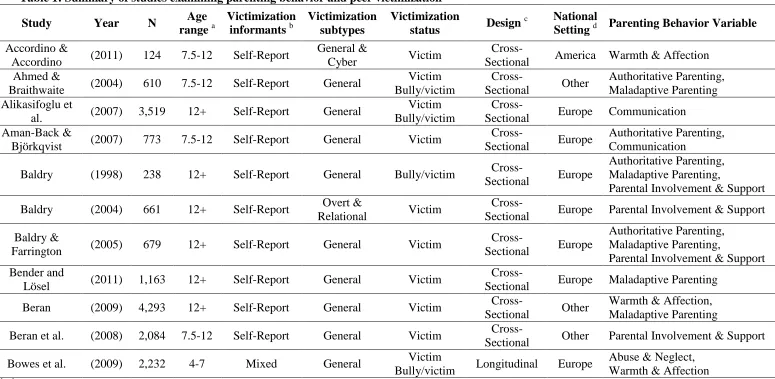
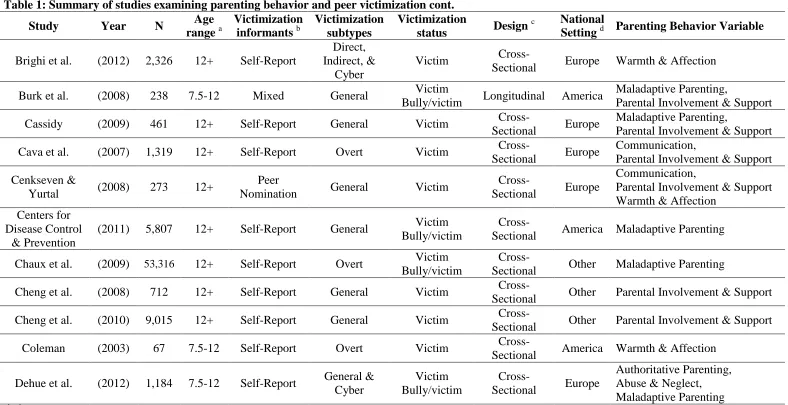
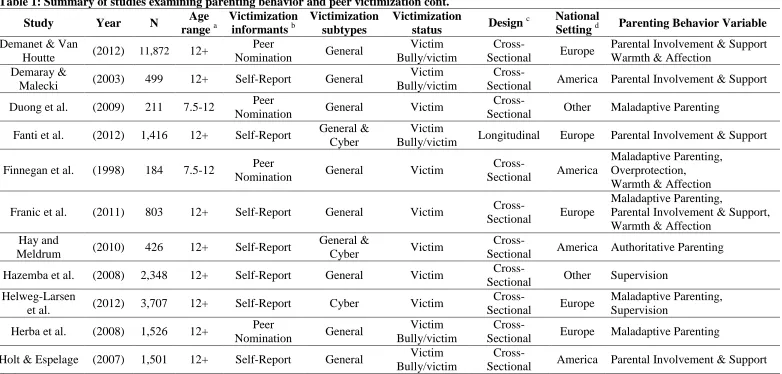
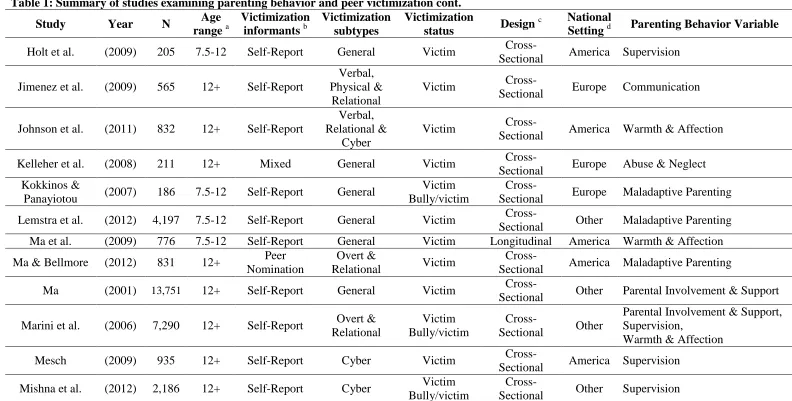
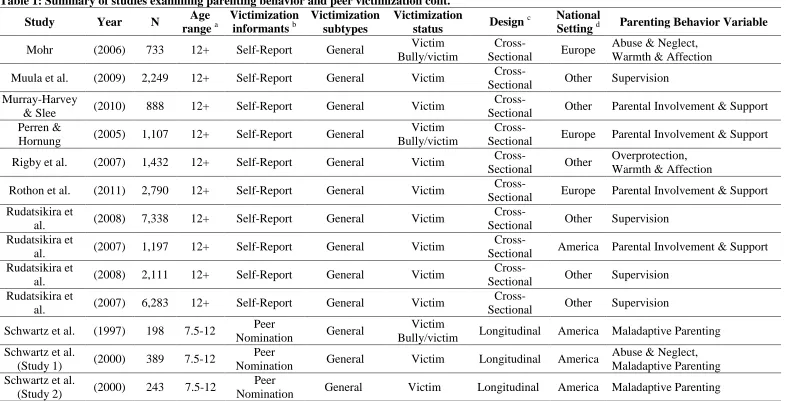
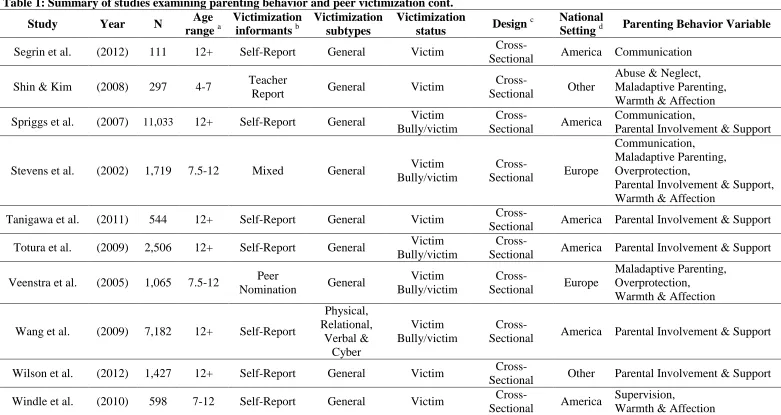
meta-7 analysis. Finally, 70 studies (N=119 samples for victims; N=55 samples for bully/victims)
were included in the meta-analysis and are shown in Table 1. The final meta-analytic sample
8
Selection of Parenting Behavior Variables and Coding
Two coders independently constructed categories for the parenting variables that were then
jointly reviewed and decided with the help of a senior reviewer. Because, merging variables
into very few categories might have obstructed any systematic patterns or too many
categories that might reveal insufficient data for the analysis, considerable attention was
given to determine the appropriate categories (Holden & Miller, 1999). Eight categories of
parenting behavior were created (see supplementary Table 2 for rationale behind the
categories): positive parenting behavior: authoritative parenting, parent-child
communication, parental involvement and support, supervision, warmth and affection;
negative parenting behavior: abuse/neglect, maladaptive parenting, and overprotection.
Then, the two coders independently placed 117 parenting variables into the 8
categories (see supplementary Table 2 for variables in each category). Cohen’s kappa was
computed for the constructs and results revealed very good inter-rater agreements; all kappa’s
exceeded 0.84. All discrepancies were discussed and resolved by the coders. Three of the 117
variables did not match any of the categories. These variables (i.e. family problem solving,
family general control and parental responsibility) were not classified into any of the
suggested constructs and thus were not included in the analyses. In several instances, two or
more variables used in a study were merged and classified into the same categories (e.g.
tracking and knowledge [Marini, Dane, Bosacki, & Ylc, 2006] were placed in the supervision
category). In such cases, the effect sizes from the two (or more) variables were averaged to
form one measure per study as recommended by Rosenthal to maintain independent samples
in the meta-analysis (Rosenthal, 1991). If more than one study was published using the same
data set, the paper with the most information and parenting factors was chosen (e.g. Bowes et
9 into the following categories: early childhood (4-7 years), middle childhood (7.5-12 years)
and adolescence (older than 12 years). Assessment method of peer victimization (e.g.,
self-report, peer nomination, teacher or mixed), continent (Europe, America and other) and
10
Table 1: Summary of studies examining parenting behavior and peer victimization
Study Year N Age
range a
Victimization informants b
Victimization subtypes
Victimization
status Design
c National
Setting d Parenting Behavior Variable
Accordino &
Accordino (2011) 124 7.5-12 Self-Report
General &
Cyber Victim
Cross-Sectional America Warmth & Affection Ahmed &
Braithwaite (2004) 610 7.5-12 Self-Report General
Victim Bully/victim
Cross-Sectional Other
Authoritative Parenting, Maladaptive Parenting Alikasifoglu et
al. (2007) 3,519 12+ Self-Report General
Victim Bully/victim
Cross-Sectional Europe Communication Aman-Back &
Björkqvist (2007) 773 7.5-12 Self-Report General Victim
Cross-Sectional Europe
Authoritative Parenting, Communication
Baldry (1998) 238 12+ Self-Report General Bully/victim
Cross-Sectional Europe
Authoritative Parenting, Maladaptive Parenting, Parental Involvement & Support
Baldry (2004) 661 12+ Self-Report Overt &
Relational Victim
Cross-Sectional Europe Parental Involvement & Support
Baldry &
Farrington (2005) 679 12+ Self-Report General Victim
Cross-Sectional Europe
Authoritative Parenting, Maladaptive Parenting, Parental Involvement & Support Bender and
Lösel (2011) 1,163 12+ Self-Report General Victim
Cross-Sectional Europe Maladaptive Parenting
Beran (2009) 4,293 12+ Self-Report General Victim
Cross-Sectional Other
Warmth & Affection, Maladaptive Parenting
Beran et al. (2008) 2,084 7.5-12 Self-Report General Victim
Cross-Sectional Other Parental Involvement & Support
Bowes et al. (2009) 2,232 4-7 Mixed General Victim
Bully/victim Longitudinal Europe
Abuse & Neglect, Warmth & Affection a,b,c,d Moderators.
11
Table 1: Summary of studies examining parenting behavior and peer victimization cont.
Study Year N Age
range a
Victimization informants b
Victimization subtypes
Victimization
status Design
c National
Setting d Parenting Behavior Variable
Brighi et al. (2012) 2,326 12+ Self-Report
Direct, Indirect, &
Cyber
Victim
Cross-Sectional Europe Warmth & Affection
Burk et al. (2008) 238 7.5-12 Mixed General Victim
Bully/victim Longitudinal America
Maladaptive Parenting, Parental Involvement & Support
Cassidy (2009) 461 12+ Self-Report General Victim
Cross-Sectional Europe
Maladaptive Parenting, Parental Involvement & Support
Cava et al. (2007) 1,319 12+ Self-Report Overt Victim
Cross-Sectional Europe
Communication, Parental Involvement & Support
Cenkseven &
Yurtal (2008) 273 12+
Peer
Nomination General Victim
Cross-Sectional Europe
Communication,
Parental Involvement & Support Warmth & Affection
Centers for Disease Control
& Prevention
(2011) 5,807 12+ Self-Report General Victim Bully/victim
Cross-Sectional America Maladaptive Parenting
Chaux et al. (2009) 53,316 12+ Self-Report Overt Victim Bully/victim
Cross-Sectional Other Maladaptive Parenting
Cheng et al. (2008) 712 12+ Self-Report General Victim
Cross-Sectional Other Parental Involvement & Support
Cheng et al. (2010) 9,015 12+ Self-Report General Victim
Cross-Sectional Other Parental Involvement & Support
Coleman (2003) 67 7.5-12 Self-Report Overt Victim
Cross-Sectional America Warmth & Affection
Dehue et al. (2012) 1,184 7.5-12 Self-Report General & Cyber
Victim Bully/victim
Cross-Sectional Europe
Authoritative Parenting, Abuse & Neglect, Maladaptive Parenting a,b,c,d Moderators.
12
Table 1: Summary of studies examining parenting behavior and peer victimization cont.
Study Year N Age
range a
Victimization informants b
Victimization subtypes
Victimization
status Design
c National
Setting d Parenting Behavior Variable
Demanet & Van
Houtte (2012) 11,872 12+
Peer
Nomination General
Victim Bully/victim
Cross-Sectional Europe
Parental Involvement & Support Warmth & Affection
Demaray &
Malecki (2003) 499 12+ Self-Report General
Victim Bully/victim
Cross-Sectional America Parental Involvement & Support
Duong et al. (2009) 211 7.5-12 Peer
Nomination General Victim
Cross-Sectional Other Maladaptive Parenting
Fanti et al. (2012) 1,416 12+ Self-Report General & Cyber
Victim
Bully/victim Longitudinal Europe Parental Involvement & Support
Finnegan et al. (1998) 184 7.5-12 Peer
Nomination General Victim
Cross-Sectional America
Maladaptive Parenting, Overprotection, Warmth & Affection
Franic et al. (2011) 803 12+ Self-Report General Victim
Cross-Sectional Europe
Maladaptive Parenting,
Parental Involvement & Support, Warmth & Affection
Hay and
Meldrum (2010) 426 12+ Self-Report
General &
Cyber Victim
Cross-Sectional America Authoritative Parenting
Hazemba et al. (2008) 2,348 12+ Self-Report General Victim
Cross-Sectional Other Supervision Helweg-Larsen
et al. (2012) 3,707 12+ Self-Report Cyber Victim
Cross-Sectional Europe
Maladaptive Parenting, Supervision
Herba et al. (2008) 1,526 12+ Peer
Nomination General
Victim Bully/victim
Cross-Sectional Europe Maladaptive Parenting
Holt & Espelage (2007) 1,501 12+ Self-Report General Victim Bully/victim
Cross-Sectional America Parental Involvement & Support a,b,c,d Moderators.
13
Table 1: Summary of studies examining parenting behavior and peer victimization cont.
Study Year N Age
range a
Victimization informants b
Victimization subtypes
Victimization
status Design
c National
Setting d Parenting Behavior Variable
Holt et al. (2009) 205 7.5-12 Self-Report General Victim
Cross-Sectional America Supervision
Jimenez et al. (2009) 565 12+ Self-Report
Verbal, Physical &
Relational
Victim
Cross-Sectional Europe Communication
Johnson et al. (2011) 832 12+ Self-Report
Verbal, Relational &
Cyber
Victim
Cross-Sectional America Warmth & Affection
Kelleher et al. (2008) 211 12+ Mixed General Victim
Cross-Sectional Europe Abuse & Neglect Kokkinos &
Panayiotou (2007) 186 7.5-12 Self-Report General
Victim Bully/victim
Cross-Sectional Europe Maladaptive Parenting
Lemstra et al. (2012) 4,197 7.5-12 Self-Report General Victim
Cross-Sectional Other Maladaptive Parenting Ma et al. (2009) 776 7.5-12 Self-Report General Victim Longitudinal America Warmth & Affection
Ma & Bellmore (2012) 831 12+ Peer Nomination
Overt &
Relational Victim
Cross-Sectional America Maladaptive Parenting
Ma (2001) 13,751 12+ Self-Report General Victim
Cross-Sectional Other Parental Involvement & Support
Marini et al. (2006) 7,290 12+ Self-Report Overt & Relational
Victim Bully/victim
Cross-Sectional Other
Parental Involvement & Support, Supervision, Warmth & Affection
Mesch (2009) 935 12+ Self-Report Cyber Victim
Cross-Sectional America Supervision
Mishna et al. (2012) 2,186 12+ Self-Report Cyber Victim Bully/victim
Cross-Sectional Other Supervision a,b,c,d Moderators.
14
Table 1: Summary of studies examining parenting behavior and peer victimization cont.
Study Year N Age
range a
Victimization informants b
Victimization subtypes
Victimization
status Design
c National
Setting d Parenting Behavior Variable
Mohr (2006) 733 12+ Self-Report General Victim
Bully/victim
Cross-Sectional Europe
Abuse & Neglect, Warmth & Affection
Muula et al. (2009) 2,249 12+ Self-Report General Victim
Cross-Sectional Other Supervision Murray-Harvey
& Slee (2010) 888 12+ Self-Report General Victim
Cross-Sectional Other Parental Involvement & Support Perren &
Hornung (2005) 1,107 12+ Self-Report General
Victim Bully/victim
Cross-Sectional Europe Parental Involvement & Support
Rigby et al. (2007) 1,432 12+ Self-Report General Victim
Cross-Sectional Other
Overprotection, Warmth & Affection
Rothon et al. (2011) 2,790 12+ Self-Report General Victim
Cross-Sectional Europe Parental Involvement & Support Rudatsikira et
al. (2008) 7,338 12+ Self-Report General Victim
Cross-Sectional Other Supervision Rudatsikira et
al. (2007) 1,197 12+ Self-Report General Victim
Cross-Sectional America Parental Involvement & Support Rudatsikira et
al. (2008) 2,111 12+ Self-Report General Victim
Cross-Sectional Other Supervision Rudatsikira et
al. (2007) 6,283 12+ Self-Report General Victim
Cross-Sectional Other Supervision
Schwartz et al. (1997) 198 7.5-12 Peer
Nomination General
Victim
Bully/victim Longitudinal America Maladaptive Parenting Schwartz et al.
(Study 1) (2000) 389 7.5-12
Peer
Nomination General Victim Longitudinal America
Abuse & Neglect, Maladaptive Parenting Schwartz et al.
(Study 2) (2000) 243 7.5-12
Peer
Nomination General Victim Longitudinal America Maladaptive Parenting a,b,c,d Moderators.
15
Table 1: Summary of studies examining parenting behavior and peer victimization cont.
Study Year N Age
range a
Victimization informants b
Victimization subtypes
Victimization
status Design
c National
Setting d Parenting Behavior Variable
Segrin et al. (2012) 111 12+ Self-Report General Victim
Cross-Sectional America Communication
Shin & Kim (2008) 297 4-7 Teacher
Report General Victim
Cross-Sectional Other
Abuse & Neglect, Maladaptive Parenting, Warmth & Affection
Spriggs et al. (2007) 11,033 12+ Self-Report General Victim Bully/victim
Cross-Sectional America
Communication, Parental Involvement & Support
Stevens et al. (2002) 1,719 7.5-12 Mixed General Victim Bully/victim
Cross-Sectional Europe
Communication, Maladaptive Parenting, Overprotection,
Parental Involvement & Support, Warmth & Affection
Tanigawa et al. (2011) 544 12+ Self-Report General Victim
Cross-Sectional America Parental Involvement & Support
Totura et al. (2009) 2,506 12+ Self-Report General Victim Bully/victim
Cross-Sectional America Parental Involvement & Support
Veenstra et al. (2005) 1,065 7.5-12 Peer
Nomination General
Victim Bully/victim
Cross-Sectional Europe
Maladaptive Parenting, Overprotection, Warmth & Affection
Wang et al. (2009) 7,182 12+ Self-Report
Physical, Relational, Verbal & Cyber Victim Bully/victim
Cross-Sectional America Parental Involvement & Support
Wilson et al. (2012) 1,427 12+ Self-Report General Victim
Cross-Sectional Other Parental Involvement & Support
Windle et al. (2010) 598 7-12 Self-Report General Victim
Cross-Sectional America
Supervision, Warmth & Affection a,b,c,d Moderators.
16
Table 1: Summary of studies examining parenting behavior and peer victimization cont.
Study Year N Age
range a
Victimization informants b
Victimization subtypes
Victimization
status Design
c National
Setting d Parenting Behavior Variable
Winsper et al. (2012) 6,043 7-12 Mixed General Victim
Bully/victim Longitudinal Europe Maladaptive Parenting
Yabko et al. (2008) 242 12+ Self-Report General Victim
Cross-Sectional America Maladaptive Parenting
Ybarra &
Mitchell (2004) 1,501 12+ Self-Report Cyber Victim
Cross-Sectional America
Supervision, Warmth & Affection, Maladaptive Parenting a,b,c,d Moderators.
17
Data Analysis
Studies provided different data and Hedge’s g, a dimensionless effect size, defined as the
difference between the means of the two compared groups (e.g., victims versus neutrals)
divided by the pooled standard deviation, was used (Cooper & Hedges, 1994). The outcomes
of studies reporting correlations were transformed to Hedges g using the Comprehensive
Meta-Analysis (CMA) program (Borenstein, Hedges, Higgins, & Rothstein, 2011). Hedge’s g
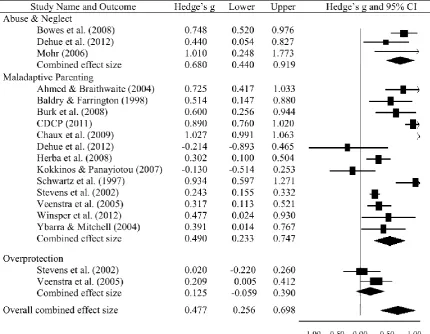
with 95% confidence intervals for each study comparing the individual study’s effect size to
the overall weighted effect size across studies for each parenting category are reported (see
Figures 2, 3, 4 and 5). Effect size may be interpreted using Cohen’s convention of small
(0.20), medium (0.50) and large (0.80) effects (Cohen, 1988).
Mean effect sizes for the total sample were calculated for those studies reporting
separate effect sizes for two or more independent groups of participants. If different effect
sizes were derived from self-, mother-, teacher-, and peer- reports of victimization, these
were combined into one effect size. Similarly, very few studies provided separate effect sizes
for males and females; hence, if an effect size was given separately for males and females,
they were combined.
Effect sizes were analyzed using the random effects model. Error term is composed of
variation originating from both within-study variability and between study differences
(Cooper & Hedges, 1994). Hence, the generalization extends beyond the specific studies to
other studies considered to be part of the same population (Rosenthal, 1995). The distribution
of effect sizes was examined using tests of heterogeneity. Significant heterogeneity indicates
that differences across effect sizes are likely due to factors other than sampling error, such as
different study characteristics (Borenstein et al., 2011). Moderator analyses were then
18 analogous to analysis of variance (ANOVA) and yield homogeneity estimates, a within
groups Q (Qw) and a between groups Q (Qb). A significant value for Qw indicates that the
effect sizes within a category of the moderator variable are heterogeneous, whereas a
significant value for Qb indicates that the effect sizes are significantly different across
different categories of the moderator variable (Borenstein et al., 2011).
We examined the potential for publication bias by using four methods. First, we
computed Rosenthal’s failsafe number (FSN; i.e., the number of studies that would be
required to nullify the observed effect) for each combined effect size, separately to address
the “file drawer problem” (Rosenthal, 1991). A tolerance level around a failsafe N equal to 5
times the number of effect size (k) plus 10 (“5k+10” benchmark; Rosenthal, 1979) was
calculated. Satisfactoriness is established if the fail-safe ratio exceeds Rosenthal’s threshold
at 1.00, i.e., when the fail-safe number consistently exceeds the 5k+10 benchmark then there
is no need for additional research to establish the phenomenon. Secondly, biases according to
study size were assessed with use of the Begg and Mazumdar rank correlation test (Kendall's
tau b; Begg & Mazumdar, 1994). Hence, if small studies with controversial results were less
likely to be published, the correlation between variance and effect size would be high.
Conversely, lack of significant correlation can be seen as absence of publication bias.
Thirdly, Egger’s test was used to assess whether there is a tendency for selective publication
of studies based on the nature and direction of results. In the linear regression analysis, the
intercept value provides a measure of asymmetry; the larger its deviation from zero, the more
pronounced the asymmetry (Egger, Smith, Schneider, & Minder, 1997). Lastly, Duval and
Tweedie’s Trim and Fill method was used. This method initially trims the asymmetric studies
from one side to identify the unbiased effect, and then fills the plot by re-inserting the
19
Results
The Hedge’s g for each parenting behavior category is shown in Figures 2 to 5. The studies
included in the analysis with their descriptions are shown in supplementary Tables 3 and 4.
Positive ParentingBehavior(Figures 2 and 4):The combined effect size showed that victims
and bully/victims were significantly less likely to have authoritative parents (victims:
Hedge’s g = 0.19, 95% CI: 0.28, 0.11; z = 4.42; p < 0.001; bully/victims: Hedge’s g =
-0.39, 95% CI: -0.61, -0.18; z = -3.55; p < 0.001), good parent-child communication (victims:
Hedge’s g = 0.12; 95% CI, 0.20, 0.05; z = 3.13; p < 0.01; bully/victims: Hedge’s g =
-0.17, 95% CI: -0.30, -0.04; z = -2.62; p < 0.01), parents that were involved and supportive
(victims: Hedge’s g = -0.22; 95% CI, -0.29, -0.15; z = -5.97; p < 0.001; bully/victims:
Hedge’s g = - 0.30, 95% CI: -0.40, -0.20; z = -5.82; p < 0.001), receive supervision (victims:
Hedge’s g = 0.16, 95% CI: 0.21, 0.12; z = 6.81; p < 0.001; bully/victims: Hedge’s g =
-0.34, 95% CI: -0.54, -0.14; z = -3.31; p < 0.01) and warm and affective parents (victims:
Hedge’s g = 0.22; 95% CI, 0.30, 0.14; z = 5.17; p < 0.001; bully/victims: Hedge’s g =
-0.42, 95% CI: -0.54, -0.31; z = -7.21; p < 0.001). Overall, both victims and bully/victims
were less likely to live in a family with positive parenting (victims: Hedge’s g = -0.19; 95%
CI, -0.23, -0.15; z = -9.65 p < 0.001; bully/victims: Hedge’s g = -0.33; 95% CI: -0.41, -0.26;
z = -9.07; p < 0.001).
Negative ParentingBehavior(Figures 3 and 5): The combined effect size showed that
victims and bully/victims were significantly more likely to have been abused or neglected
(victims: Hedge’s g = 0.31; 95% CI, 0.18-0.44; z = 4.53; p < 0.001; bully/victims: Hedge’s g
= 0.68, 95% CI: 0.44-0.92; z =5.57; p < 0.001), or to have experienced maladaptive parenting
(victims: Hedge’s g = 0.27; 95% CI, 0.15-0.40; z = 4.31; p<0.001; bully/victims: Hedge’s g =
20 overprotective parents (Hedge’s g = 0.10; 95% CI, 0.03-0.17; z = 2.63; p < 0.01). Overall,
both victims and bully/victims were found to experience negative parenting more often
(victims: Hedge’s g= 0.26; 95% CI, 0.16-0.36; z = 4.90; p < 0.001; bully/victims: Hedge’s g
25
Potential Moderator Variables
[image:26.595.83.514.75.409.2]The heterogeneity analyses for some of the categories were significant (see supplementary
Table 3 and 4) indicating potential moderating. Meta-ANOVAs of continent (Europe,
America or other), age (4-7, 7.5-12 or over 12 years), assessment method (self, peer, teacher
or mixed) and design (cross-sectional versus longitudinal) were employed for each parenting
behavior category where moderation effects were detected. Supplementary Tables 5 and 6
shows all moderation effects.
Victims:Communication showed a significant moderating effect according to the
assessment method as indicated by the Qb heterogeneity coefficient (Qb = 6.741; p < 0.05)
26 between the parent and the child (Mean ES = -0.494; p < 0.01; N = 1). Warmth and affection
category showed significant moderating effects according to the age group (Qb = 7.193; p <
0.05). Children aged 12 years or more were less likely to have warm and affectionate families
(Mean ES = -0.305; p < 0.001; N = 11) compared to the other age groups. Lastly, supervision
category showed moderating effects according to continent (Qb = 16.862; p < 0.001) with
European studies finding less supervision for victims (Mean ES = -0.311; p < 0.001; N = 1).
Bully-victims:Parental involvement and support showed significant moderator effects
according to the assessment method (Qb = 7.03; p < 0.05) suggesting that children who
self-reported victimization (Mean ES = -0.35; p < 0.001; N = 8) were less likely to have parents
who are involved and supportive.Warmth and affection showed significant moderator effects
according to continent (Qb = 6.678; p < 0.05), assessment method (Qb = 13.651; p < 0.01) and
age group (Qb = 10.704; p < 0.01). Children from other continents (Mean ES = -0.59; p <
0.001; N = 1), who self-reported victimization (Mean ES = -0.58; p < 0.001; N = 3) or were
over 12 years old (Mean ES = -0.52; p < 0.001; N = 4) had parents with less warmth and
affection. Moreover, maladaptive parenting and overall negative parenting behavior showed
significant moderating effects according to continent (maladaptive parenting: Qb = 32.326; p
< 0.001; overall negative parenting: Qb = 20.124; p < 0.001), other continents showed
strongest maladaptive parenting and overall negative parenting behavior (maladaptive
parenting: mean ES = 0.94, p< 0.001: N = 2; overall negative parenting behavior: mean ES =
0.92, p < 0.001: N = 2).
Publication bias
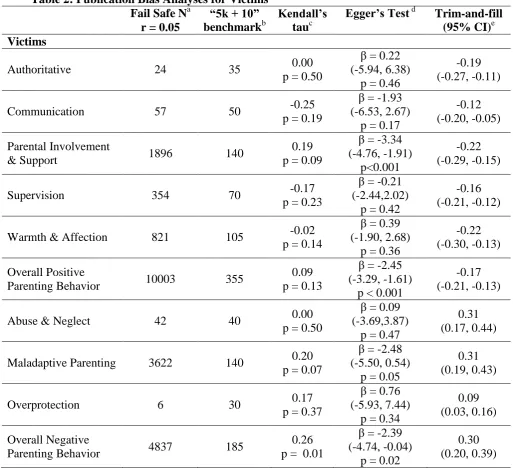
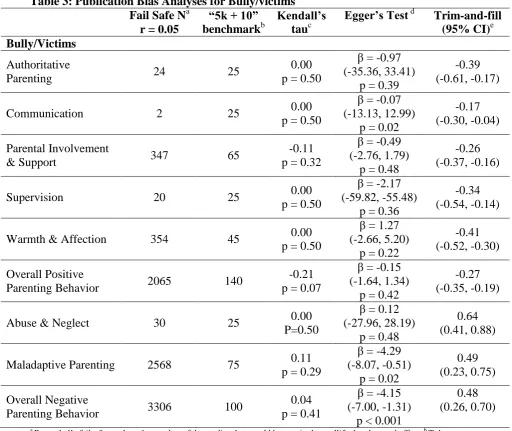
A failsafe N and the “5k+10” benchmark were calculated for all categories (see Tables 2 and
3). For victims, the meta-analysis of authoritative parenting and overprotection did not
27 Mazumdar rank correlation results for overall negative parenting behavior showed that
controversial results from small studies were less likely to be published. Egger’s test showed
significant results for parental involvement and support and overall positive and negative
parenting behavior suggesting that publication bias might have influenced the estimates.
Duval & Tweedie’s trim and fill procedure resulted in slightly different effect sizes for
supervision, warmth and affection, overall positive parenting behavior, maladaptive
parenting, overprotection and overall negative parenting behavior. For bully/victims,
authoritative parenting, communication and supervision categories did not exceed the
“5k+10” benchmark suggesting that the effect may change with future studies. The Begg and
Mazumdar rank correlation results for all categories were not significant. Egger’s test showed
significant results for communication, maladaptive parenting and overall negative parenting
behavior suggesting that publication bias might have influenced the estimates. Duval &
Tweedie’s trim and fill procedure resulted in slightly different effect sizes for parental
28
Table 2: Publication Bias Analyses for Victims Fail Safe Na
r = 0.05
“5k + 10”
benchmarkb
Kendall’s tauc
Egger’s Test d
Trim-and-fill (95% CI)e Victims
Authoritative 24 35 0.00
p = 0.50
β = 0.22 (-5.94, 6.38)
p = 0.46
-0.19 (-0.27, -0.11)
Communication 57 50 -0.25
p = 0.19
β = -1.93 (-6.53, 2.67)
p = 0.17
-0.12 (-0.20, -0.05)
Parental Involvement
& Support 1896 140
0.19 p = 0.09
β = -3.34 (-4.76, -1.91)
p<0.001
-0.22 (-0.29, -0.15)
Supervision 354 70 -0.17
p = 0.23
β = -0.21 (-2.44,2.02)
p = 0.42
-0.16 (-0.21, -0.12)
Warmth & Affection 821 105 -0.02
p = 0.14
β = 0.39 (-1.90, 2.68)
p = 0.36
-0.22 (-0.30, -0.13)
Overall Positive
Parenting Behavior 10003 355
0.09 p = 0.13
β = -2.45 (-3.29, -1.61)
p < 0.001
-0.17 (-0.21, -0.13)
Abuse & Neglect 42 40 0.00
p = 0.50
β = 0.09 (-3.69,3.87)
p = 0.47
0.31 (0.17, 0.44)
Maladaptive Parenting 3622 140 0.20
p = 0.07
β = -2.48 (-5.50, 0.54)
p = 0.05
0.31 (0.19, 0.43)
Overprotection 6 30 0.17
p = 0.37
β = 0.76 (-5.93, 7.44)
p = 0.34
0.09 (0.03, 0.16)
Overall Negative
Parenting Behavior 4837 185
0.26 p = 0.01
β = -2.39 (-4.74, -0.04)
p = 0.02
0.30 (0.20, 0.39)
a Rosenthal’s failsafe number: the number of the studies that would be required to nullify the observed effect; b
29
Table 3: Publication Bias Analyses for Bully/victims Fail Safe Na
r = 0.05
“5k + 10”
benchmarkb
Kendall’s tauc
Egger’s Test d
Trim-and-fill (95% CI)e Bully/Victims
Authoritative
Parenting 24 25
0.00 p = 0.50
β = -0.97 (-35.36, 33.41)
p = 0.39
-0.39 (-0.61, -0.17)
Communication 2 25 0.00
p = 0.50
β = -0.07 (-13.13, 12.99)
p = 0.02
-0.17 (-0.30, -0.04)
Parental Involvement
& Support 347 65
-0.11 p = 0.32
β = -0.49 (-2.76, 1.79)
p = 0.48
-0.26 (-0.37, -0.16)
Supervision 20 25 0.00
p = 0.50
β = -2.17 (-59.82, -55.48)
p = 0.36
-0.34 (-0.54, -0.14)
Warmth & Affection 354 45 0.00
p = 0.50
β = 1.27 (-2.66, 5.20)
p = 0.22
-0.41 (-0.52, -0.30)
Overall Positive
Parenting Behavior 2065 140
-0.21 p = 0.07
β = -0.15 (-1.64, 1.34)
p = 0.42
-0.27 (-0.35, -0.19)
Abuse & Neglect 30 25 0.00
P=0.50
β = 0.12 (-27.96, 28.19)
p = 0.48
0.64 (0.41, 0.88)
Maladaptive Parenting 2568 75 0.11
p = 0.29
β = -4.29 (-8.07, -0.51)
p = 0.02
0.49 (0.23, 0.75)
Overall Negative
Parenting Behavior 3306 100
0.04 p = 0.41
β = -4.15 (-7.00, -1.31)
p < 0.001
0.48 (0.26, 0.70)
a Rosenthal’s failsafe number: the number of the studies that would be required to nullify the observed effect; b
30
Discussion
This review finds that both victims and bully/victims are more likely to be exposed to
negative parenting. Although the effect sizes were usually small for increasing the risk of
being a victim, the effects of negative parenting were moderate for bully/victims. Abuse and
neglect and maladaptive parenting were the best predictors of victim or bully/victim status at
school. Furthermore, high parental involvement and support, and warm and affectionate
relationships were most likely to protect children and adolescents against peer victimization
followed by good family communication and supervision. However, protection by positive
parenting for becoming a victim of peer bullying was small and at best moderate for
bully/victims. These effects were found independent of whether reported by children
themselves, parents, teachers or mixed method. The effects of parenting were found to be
generally stronger for bully/victims than victims. Bully/victims have been shown to display
the highest level of conduct, school, and peer relationship problems (Juvonen et al., 2003;
Kumpulainen & Rasanen, 2000) and have the greatest risk of developing multiple
psychopathologic behaviors compared to pure bullies, pure victims or children who are not
involved in bullying behavior (Kim, Leventhal, Koh, Hubbard, & Boyce, 2006). The reason
behind developing such problems may be partly due to exposure to harsher parenting rather
than being a bully and victim simultaneous.
Through their experiences with primary caregivers, children may learn rules and
constructs of relationships. According to social learning theories (Bandura, 1978),
family-relational schema (Perry, Hodges, & Egan, 2001), and attachment theory (Bowlby, 1973),
children who grow up in a socially adverse environment where they are exposed to violence
may be at particular risk for learning negative relationship patterns. Moreover, research
31 1999). Certain characteristics of the victimized children may make them more likely to be
targets of other forms of assault. For example, some maltreated and abused children may
adopt a submissive and ingratiating posture with their parents in an effort to maintain their
safety in violent and/or chaotic homes (Finkelhor & Browne, 1985; Koenig, Cicchetti, &
Rogosch, 2000). Moreover, children who are exposed to negative parenting may learn that
they are powerless, have less-confidence and become less able to assert their needs (Duncan,
2004); they may generalize such behavior to extra familial interactions; and peers may regard
them as easy targets for bullying (Schwartz, Dodge, & Coie, 1993; Wolke & Samara, 2004).
On the other hand, some maltreated children display heightened levels of aggression (Shields
& Cicchetti, 1998) and antisocial acts (Kaufman & Cicchetti, 1989), which suggests that they
may be more inclined towards bullying behavior. Adverse parenting has also been shown to
alter brain and stress reactions that in turn may make children more likely to be targets of
bullying (Belsky & de Haan, 2011). On the other hand, protective factors, such as positive
parenting, may strengthen the child’s self-concept and help to acquire adaptive coping
strategies that reduce the chance of peer victimization (Kochenderfer-Ladd & Skinner, 2003)
and make the child more resilient (Rutter, 1987). Although parental involvement and support
and high supervision decrease the chances of children involving in bullying behavior, for
victims, overprotection increased this risk. It is possible that children with overprotective
parents may not develop qualities such as autonomy and assertion (Finnegan et al., 1998),
and hence, they may become easy targets for bullies. It could also be that parents of victims
may become overprotective of their children.
Several limitations should be considered when interpreting these findings. First, the
cross-sectional nature (N=62) of most studies does not allow to differentiate cause and effect.
32 1999; Lengua, 2006; i.e., a bullied child may be difficult and thus lead to maladaptive
parenting, or maladaptive parenting could lead to being bullied by peers). However, the few
available prospective studies (N=8) provide tentative evidence for temporal priority, i.e.,
parenting behaviors are precursors of being bullied. Secondly, only studies published in
English were used in the analysis. However, the analysis revealed no publication bias in most
of the categories. Thirdly, some of the studies used the same informant (e.g., both being
bullied and parenting characteristics are self-reported by children); hence the results might be
inflated by common method variance. However, studies that used different informants
revealed similar results and there were no significant differences between assessment
methods with regards to parenting behavior variables. Fourthly, most of the studies included
did not measure different forms of victimization separately (i.e., physical and relational
bullying). Although these two forms of bullying are often both experienced (Wolke et al.,
2000), they may be differentially related to personal adjustment (Crick & Bigbee, 1998).
Fifthly, although previous studies showed that the parents treat their daughters and sons
differently (Starrels, 1994) and the effects of parenting is different for boys and girls (Chang,
Schwartz, Dodge, & McBride-Chang, 2003), we were not able to analyze the effect sizes
separately as most studies did not measure the relationships between parenting and bullying
involvement separately for boys and girls. Finally, substantial heterogeneity was detected
within the parenting categories. This may be due to our classification of the various parenting
concepts into the eight categories.
In conclusion, our review of 70 studies finds evidence that parenting has small to
moderate associations with being bullied, in particular if the child is both a victim and bullies
others (bully/victim). Bullying is a substantial problem (World Helth Organization, 2012) and
33 consequences (Arseneault et al., 2010; Wolke, Copeland, Angold, & Costello, in press).
Moreover, previous research has shown that children involved in bullying behavior as
bully/victims are at a greater risk for developing behavioral and psychological problems
(Juvonen et al., 2003; Kumpulainen & Rasanen, 2000; Wolke et al., in press). Partly, the
reason behind developing such problems may be due to exposure to harsher parenting rather
than being a bully and victim simultaneously. Recent evidence indicates that although
bully/victims come from harsher family environments, this difference may by itself only
partly explain adverse long-term consequences (Copeland, Wolke, Angold, & Costello,
2013). However, future studies on bullying need to take into account parenting and family
adversity when investigating the associations between victimization role and outcomes.
General practitioners should routinely enquire about parent-child and peer relationships.
Intervention programs that target children who are exposed to harsh or abusive parenting,
may prevent peer victimization. Specific parental training programs may be necessary to
strengthen supportive involvement and warm and affectionate parenting to improve family
34
References
Accordino, D. B., & Accordino, M. P. (2011). An exploratory study of face-to-face and cyberbullying in sixth grade students. American Secondary Education, 40(1), 14-30.
Ahmed, E., & Braithwaite, V. (2004). Bullying and victimization: Cause for concern for both families and schools. Social Psychology of Education, 7, 35-54.
Alikasifoglu, M., Erginoz, E., Ercan, O., Uysal, O., & Albayrak-Kaymak, D. (2007). Bullying behaviours and psychosocial health: results from a cross-sectional survey among high school students in Istanbul, Turkey. European Journal of Pediatrics, 166, 1253-1260.
Aman-Back, S., & Bjorkqvist, K. (2007). Relationship between home and school adjustment: children's experiences at ages 10 and 14. Perceptual & Motor Skills, 104(3 Pt 1), 965-974. Arseneault, L., Bowes, L., & Shakoor, S. (2010). Bullying victimization in youths and mental health
problems: "Much ado about nothing"? Psychological Medicine, 40, 717-729
Baldry, A. C. (2003). Bullying in schools and exposure to domestic violence. Child Abuse & Neglect, 27, 713-732.
Baldry, A. C. (2004). The impact of direct and indirect bullying on the mental and physical health of Italian youngsters. Aggressive Behavior, 30, 343-355.
Baldry, A. C., & Farrington, D. P. (1998). Parenting influences on bullying and victimisation. Legal and Criminological Psychology, 3, 237-254.
Baldry, A. C., & Farrington, D. P. (2005). Protective factors as moderators of risk factors in adolescence bullying. Social Psychology of Education, 8, 263-284.
Bandura, A. (1973). Aggression: A social learning theory analysis. Englewood Cliffs, NJ: Prentice Hall. Bandura, A. (1978). Social learning theory of aggression. Journal of Communication, 28, 12-29. Bandura, A. (1986). Social foundations of thought and action: A social cognitive theory. Englewood
Cliffs, NJ: Prentice-Hall.
Baumrind, D. (1991). The influence of parenting style on adolescent competence and substance use. The Journal of Early Adolescence, 11(1), 56-95.
Begg, C. B., & Mazumdar, M. (1994). Operating characteristics of a rank correlation test for publication bias. Biometrics, 50, 1088-1101.
Belsky, J., & de Haan, M. (2011). Annual Research Review: Parenting and children’s brain
development: the end of the beginning. Journal of Child Psychology and Psychiatry, 52, 409-428.
Bender, D., & Lösel, F. (2011). Bullying at school as a predictor of delinquency, violence and other anti-social behaviour in adulthood. Criminal Behaviour and Mental Health, 21, 99-106. Beran, T. (2009). Correlates of Peer Victimization and Achievement: An Exploratory Model.
Psychology in the Schools, 46, 348-361.
Beran, T., Hughes, G., & Lupart, J. (2008). A model of achievement and bullying: Analyses of the Canadian national longitudinal survey of children and youth data. Educational Research, 50, 25-39.
Booth, C. L. (1994). Predicting social adjustment in middle childhood: the role of preschool attachment security and maternal style. Social Development, 3, 189-204.
Borenstein, M., Hedges, L., Higgins, J., & Rothstein, H. (2011). Comprehensive meta analysis version 2. Englewood, NJ: Biostat.
Bowes, L., Arseneault, L., Maughan, B., Taylor, A., Caspi, A., & Moffitt, T. E. (2009). School, neighborhood, and family factors are associated with children's bullying involvement: A nationally representative longitudinal study. Journal of the American Academy of Child & Adolescent Psychiatry, 48, 545-553.
35 Brighi, A., Guarini, A., Melotti, G., Galli, S., & Genta, M. L. (2012). Predictors of victimisation across
direct bullying, indirect bullying and cyberbullying. Emotional & Behavioural Difficulties, 17, 375-388.
Brugha, T. S., Matthews, R., Morgan, Z., Hill, T., Alonso, J., & Jones, D. R. (2012). Methodology and reporting of systematic reviews and meta-analyses of observational studies in psychiatric epidemiology: systematic review. The British Journal of Psychiatry, 200, 446-453.
Burk, L. R., Park, J., Armstrong, J. M., Klein, M. H., Goldsmith, H. H., Zahn-Waxler, C., & Essex, M. J. (2008). Identification of early child and family risk factors for aggressive victim status in first grade. Journal of Abnormal Child Psychology, 36(4), 513-526.
Cassidy, T. (2009). Bullying and Victimisation in School Children: The Role of Social Identity, Problem-Solving Style, and Family and School Context. Social Psychology of Education, 12(1), 63-76. Cava, M. J., Musitu, G., & Murgui, S. (2007). Individual and social risk factors related to overt
victimization in a sample of Spanish adolescents. Psychological Reports, 101, 275-290. Cenkseven Onder, F., & Yurtal, F. (2008). An Investigation of the Family Characteristics of Bullies,
Victims, and Positively Behaving Adolescents. Educational Sciences: Theory and Practice, 8(3), 821-832.
Centers for Disease Control and Prevention. (2011). Bullying among middle school and high school students--Massachusetts, 2009. MMWR - Morbidity & Mortality Weekly Report, 60(15), 465-471.
Chang, L., Schwartz, D., Dodge, K. A., & McBride-Chang, C. (2003). Harsh parenting in relation to child emotion regulation and aggression. Journal of Family Psychology, 17, 598-606.
Chaux, E., Molano, A., & Podlesky, P. (2009). Socio-economic, socio-political and socio-emotional variables explaining school bullying: a country-wide multilevel analysis. Aggressive Behavior, 35, 520-529.
Cheng, S. T., Cheung, K. C. C., & Cheung, C. K. (2008). Peer victimization and depression among Hong Kong adolescents. Journal of Clinical Psychology, 64, 766-776.
Cheng, Y., Newman, I. M., Qu, M., Mbulo, L., Chai, Y., Chen, Y., & Shell, D. F. (2010). Being bullied and psychosocial adjustment among middle school students in China. Journal of School Health, 80, 193-199.
Cohen, J. (1988). Statistical power analysis for the behavioral sciences (2nd ed.). Hillsdale, N.J.: Erlbaum.
Coleman, P. K. (2003). Perceptions of parent-child attachment, social self-efficacy, and peer relationships in middle childhood. Infant and Child Development, 12, 351-368. Cooper, H., & Hedges, L. (1994). The handbook of research synthesis. New York: Russell Sage
Foundation.
Copeland, W. E., Wolke, D., Angold, A., & Costello, E. J. (2013). Adult psychiatric and suicide outcomes of bullying and being bullied by peers in childhood and adolescence. JAMA Psychiatry, 1-8. doi: 10.1001/jamapsychiatry.2013.504
Crick, N. R., & Bigbee, M. A. (1998). Relational and overt forms of peer victimization: A multiinformant approach. Journal of Consulting and Clinical Psychology, 66, 337-347. Curtner-Smith, M. E. (2000). Mechanisms by which family processes contribute to boys' bullying.
Child Study Journal, 30(3), 169-186.
Dehue, F., Bolman, C., Vollink, T., & Pouwelse, M. (2012). Cyberbullying and traditional bullying in relation to adolescents' perception of parenting. Journal of CyberTherapy and Rehabilitation, 5, 25-34.
Demanet, J., & Van Houtte, M. (2012). The impact of bullying and victimization on students' relationships. American Journal of Health Education, 43(2), 104-113.
36 Duncan, R. D. (1999). Maltreatment by parents and peers: The relationship between child abuse,
bully victimization, and psychological distress. Child Maltreatment, 4(1), 45-55.
Duncan, R. D. (2004). The impact of family relationships on school bullies and their victims. In D. L. Espelage & S. M. Swearer (Eds.), Bullying in American schools: a social-ecological perspective on prevention and intervention (pp. 227–244). Mahwah, NJ: Lawrence Erlbaum Associates. Duong, M. T., Schwartz, D., Chang, L., Kelly, B. M., & Tom, S. R. (2009). Associations between
maternal physical discipline and peer victimization among Hong Kong Chinese children: The moderating role of child aggression. Journal of Abnormal Child Psychology, 37(7), 957-966. Egger, M., Smith, G. D., Schneider, M., & Minder, C. (1997). Bias in meta-analysis detected by a
simple, graphical test. BMJ, 315(7109), 629-634.
Eisenberg, N., Fabes, R. A., Shepard, S. A., Guthrie, I. K., Murphy, B. C., & Reiser, M. (1999). Parental reactions to children's negative emotions: Longitudinal relations to quality of children's social functioning. Child Development, 70, 513-534.
Fanti, K. A., Demetriou, A. G., & Hawa, V. V. (2012). A longitudinal study of cyberbullying: Examining risk and protective factors. European Journal of Developmental Psychology, 9, 168-181. Fine, M. A., Voydanoff, P., & Donnelly, B. W. (1993). Relations between parental control and warmth
and child well-being in stepfamilies. Journal of Family Psychology, 7, 222-232.
Finkelhor, D., & Browne, A. (1985). The traumatic impact of child sexual abuse: A conceptualization. The American Journal of Orthopsychiatry, 55, 530-541.
Finnegan, R. A., Hodges, E. V. E., & Perry, D. G. (1998). Victimization by peers: Associations with children's reports of mother–child interaction. Journal of Personality and Social Psychology, 75, 1076-1086.
Fisher, H. L., Moffitt, T. E., Houts, R. M., Belsky, D. W., Arseneault, L., & Caspi, A. (2012). Bullying victimisation and risk of self harm in early adolescence: Longitudinal cohort study. BMJ, 344. doi: 10.1136/bmj.e2683
Franic, T., Dodig, G., Kardum, G., Marcinko, D., Ujevic, A., & Bilusic, M. (2011). Early adolescence and suicidal ideations in Croatia: sociodemographic, behavioral, and psychometric correlates. Crisis, 32, 334-345.
Georgiou, S. (2008). Bullying and victimization at school: The role of mothers. British Journal of Educational Psychology, 78, 109-125.
Gini, G., & Pozzoli, T. (2009). Association between bullying and psychosomatic problems: A meta-analysis. Pediatrics, 123, 1059-1065.
Grolnick, W. S., & Ryan, R. M. (1989). Parent styles associated with children's self-regulation and competence in school. Journal of Educational Psychology, 81, 143-154.
Hawker, D. S. J., & Boulton, M. J. (2000). Twenty years' research on peer victimization and
psychosocial maladjustment: A meta-analytic review of cross-sectional studies. The Journal of Child Psychology and Psychiatry, 41, 441-455.
Hay, C., & Meldrum, R. (2010). Bullying victimization and adolescent self-harm: Testing hypotheses from general strain theory. Journal of Youth and Adolescence, 39, 446-459.
Haynie, D. L., Nansel, T. R., Eitel, P., Crump, A. D., Saylor, K., Yu, K., & Simons-Morton, B. (2001). Bullies, victims, and bully/victims: Distinct groups of at-risk youth. Journal of Early Adolescence, 21(1), 29–49.
Hazemba, A., Siziya, S., Muula, A. S., & Rudatsikira, E. (2008). Prevalence and correlates of being bullied among in-school adolescents in Beijing: results from the 2003 Beijing Global School-Based Health Survey. Annals of General Psychiatry, 7, 6.
37 Herba, C. M., Ferdinand, R. F., Stijnen, T., Veenstra, R., Oldehinkel, A. J., Ormel, J., & Verhulst, F. C.
(2008). Victimization and suicide ideation in the TRAILS study: specific vulnerabilities of victims. Journal of Child Psychology and Psychiatry, 49, 867-876.
Holden, G. W., & Miller, P. C. (1999). Enduring and different: A meta-analysis of the similarity in parents' child rearing. Psychological Bulletin, 125, 223-254.
Holt, M. K., & Espelage, D. L. (2007). Perceived social support among bullies, victims, and bully-victims. Journal of Youth and Adolescence, 36, 984-994.
Holt, M. K., Kaufman Kantor, G., & Finkelhor, D. (2009). Parent/child concordance about bullying involvement and family characteristics related to bullying and peer victimization. Journal of School Violence, 8, 42 - 63.
Jimenez, T. I., Musitu, G., Ramos, M. J., & Murgui, S. (2009). Community involvement and
victimization at school: An analysis through family, personal and social adjustment. Journal of Community Psychology, 37, 959-974.
Johnson, R. M., Kidd, J. D., Dunn, E. C., Green, J. G., Corliss, H. L., & Bowen, D. (2011). Associations between caregiver support, bullying, and depressive symptomatology among sexual minority and heterosexual girls: Results from the 2008 Boston youth survey. Journal of School Violence, 10, 185-200.
Juvonen, J., Graham, S., & Schuster, M. A. (2003). Bullying among young adolescents: The strong, the weak, and the troubled. Pediatrics, 112, 1231-1237.
Kaufman, J., & Cicchetti, D. (1989). Effects of maltreatment on school-age children's socioemotional development: Assessments in a day-camp setting. Developmental Psychology, 25, 516-524. Kelleher, I., Harley, M., Lynch, F., Arseneault, L., Fitzpatrick, C., & Cannon, M. (2008). Association
between childhood trauma, bullying and psychotic symptoms among a school-based adolescent sample. The British Journal of Psychiatry, 193, 378-382.
Kim, Y. S., Leventhal, B. L., Koh, Y.-J., Hubbard, A., & Boyce, W. T. (2006). School bullying and youth violence: Causes or consequences of psychopathologic behavior? Archives of General Psychiatry, 63, 1035-1041.
Klomek, A. B., Sourander, A., Niemelä, S., Kumpulainen, K., Piha, J., Tamminen, T., . . . Gould, M. S. (2009). Childhood bullying behaviors as a risk for suicide attempts and completed suicides: A population-based birth cohort study. Journal of the American Academy of Child & Adolescent Psychiatry, 48, 254-261.
Kochenderfer-Ladd, B., & Skinner, K. (2003). Children’s coping strategies: Moderators of the effects of peer victimization? Developmental Psychology, 38, 267-278.
Koenig, A. L., Cicchetti, D., & Rogosch, F. A. (2000). Child compliance/noncompliance and maternal contributors to internalization in maltreating and nonmaltreating dyads. Child Development, 71, 1018-1032.
Kokkinos, C. M., & Panayiotou, G. (2007). Parental discipline practices and locus of control:
Relationship to bullying and victimization experiences of elementary school students. Social Psychology of Education, 10, 281-301.
Kumpulainen, K., & Rasanen, E. (2000). Children involved in bullying at elementary school age: their psychiatric symptoms and deviance in adolescence: an epidemiological sample. Child Abuse and Neglect, 24, 1567-1577.
Ladd, G. W. (1992). Themes and theories: Perspectives on processes in family peer relationships. In R. D. Park & G. W. Ladd (Eds.), Family-peer relationships: Moedls of linkage (pp. 3-34 ). Hillsdale, NJ: Lawrence Erlbaum Associates.
Lemstra, M. E., Nielsen, G., Rogers, M. R., Thompson, A. T., & Moraros, J. S. (2012). Risk indicators and outcomes associated with bullying in youth aged 9-15 years. Canadian Journal of Public Health, 103, 9-13.
38 Linver, M. R., & Silverberg, S. B. (1997). Maternal predictors of early adolescent achievement-related
outcomes. The Journal of Early Adolescence, 17(3), 294-318. Lowenstein, L. F. (1977). Who is the bully? Home and School, 11, 3-4.
Lowenstein, L. F. (1978). The bullied and non-bullied child: A contrast between the popular and unpopular child. Report: ED175200. 15pp.
Ma, L., Phelps, E., Lerner, J. V., & Lerner, R. M. (2009). The development of academic competence among adolescents who bully and who are bullied. Journal of Applied Developmental Psychology, 30, 628-644.
Ma, T. L., & Bellmore, A. (2012). Peer victimization and parental psychological control in adolescence. Journal of Abnormal Child Psychology, 40(3), 413-424.
Ma, X. (2001). Bullying and being bullied: To what extent are bullies also victims? American Educational Research Journal, 38(2), 351-370.
Marini, Z. A., Dane, A. V., Bosacki, S. L., & Ylc, C. (2006). Direct and indirect bully-victims: Differential psychosocial risk factors associated with adolescents involved in bullying and victimization. Aggressive Behavior, 32, 551-569.
Mesch, G. S. (2009). Parental mediation, online activities, and cyberbullying. Cyberpsychology and Behavior, 12(4), 387-393.
Mishna, F., Khoury-Kassabri, M., Gadalla, T., & Daciuk, J. (2012). Risk factors for involvement in cyber bullying: Victims, bullies and bully–victims. Children and Youth Services Review, 34, 63-70. Mohr, A. (2006). Family variables associated with peer victimization: Does family violence enhance the probability of being victimized by peers? Swiss Journal of Psychology, 65(2), 107-116. Murray-Harvey, R., & Slee, P. T. (2010). School and home relationships and their impact on school
bullying. School Psychology International, 31(3), 271-295.
Muula, A. S., Herring, P., Siziya, S., & Rudatsikira, E. (2009). Bullying victimization and physical fighting among Venezuelan adolescents in Barinas: Results from the Global School-Based Health Survey 2003. Italian Journal of Pediatrics, 35(38).
Nakamoto, J., & Schwartz, D. (2010). Is peer victimization associated with academic achievement? A meta-analytic review. Social Development, 19, 221-242.
Olweus, D. (1993). Bullying at school: What we know and what we can do. Oxford: Blackwell Publishers.
Olweus, D. (2002). Bullying at school. Oxford: Blackwell.
Perren, S., & Hournung, R. (2005). Bulling and delinquency in adolescence: Victim’s and perpetrators’ family and peer relations. Swiss Journal of Psychology, 64(1), 51-64.
Perry, D. G., Hodges, E. V., & Egan, S. K. (2001). Determinants of chronic victimization by peers: A review and a new model of family influence. In J. Juvonen & S. Graham (Eds.), Peer harassment in school: The plight of the vulnerable and victimized (pp. 73-104). New York: The Guildford Press.
Reijntjes, A., Kamphuis, J. H., Prinzie, P., & Telch, M. J. (2010). Peer victimization and internalizing problems in children: A meta-analysis of longitudinal studies. Child Abuse & Neglect, 34, 244-252.
Rigby, K. (1993). School children's perceptions of their families and parents as a function of peer relations. The Journal of Genetic Psychology, 154, 501-513.
Rigby, K., Slee, P. T., & Martin, G. (2007). Implications of inadequate parental bonding and peer victimization for adolescent mental health. Journal of Adolescence, 30, 801-812.
Rosenthal, R. (1979). The file drawer problem and tolerance for null results. Psychological Bulletin, 86, 638-641.
Rosenthal, R. (1991). Meta-analysis: A review. Psychosomatic Medicine, 53, 247-271. Rosenthal, R. (1995). Writing meta-analytic reviews. Psychological Bulletin, 118, 183-192. Rothon, C., Head, J., Klineberg, E., & Stansfeld, S. (2011). Can social support protect bullied