VC Technology in Internet Voting System
Sumit Jagtap1, Smitesh Vichare2, Alpa Vaidya3, Mangesh Jogdand4, Prof. Shivani Sthapak5
UG Students, Dept. of Information Technology, Dhole Patil College of Engineering, Pune, Maharashtra, India1,2,3,4 Assistant Professor, Dept. of Information Technology, Dhole Patil College of Engineering, Pune, Maharashtra, India5
ABSTRACT:For the effective Taxi business we developed the fleet management system based on GPS which is important tool, as well as its useful to provide information to taxi driver for earning profit by mining the historical GPS path of the projectiles. In the literature, distance between current place and recommended place, time for next passengers and exact fare of trip these three factors provide the similar objective have been considered in different work. In this paper, in addition to this factor we added one more factor that is based on driver’s experience which is most likely locations to pick up the passenger given the current passenger drop off location .the one location and another location graph model referred to as OFF-ON model is worked for define the relation between the get off location and next passengers get on location. To estimate the expected fare for a trip started at a recommended location we adopted an ON-OFF model. A real world dataset from CRAWDAD is used to evaluate the proposed system. A simulator has been developed for the simulate journey behavior of taxies in database. Our proposed system still effective on recommending better profitable cruising location.
KEYWORDS: About four key words separated by commas.
I. INTRODUCTION
THIS corporate companies, elections are conducted to elect President, Secretary and other board members. Candidates may be working across the world and it is therefore difficult for them to vote from there. A web based polling system assists the process, with security measures by which they can vote confidentially from any part of the world. In the 2001 general election in Washington State, 69% of votes cast were cast by mail. This Internet voting system provides them good solutions with security using Visual Cryptography [1, 2].
A. Internet Voting system refer as online voting system in that user’s client server can connect to server system. Hence there is three way implement voting system over the internet: Kiosk, Remote, and poll-site voting. Each of these three ways has its own particular security requirements. In remote voting a third party, or the voter himself (rather than election officials) has control over the voting client and operating environment. In Kiosk voting, the voting client may be installed by election officials, but the voting environment is out of election officials control. In Poll- site voting, election officials have control over the voting client and the operating environment. The visual cryptography system develop for the mainly remote internet voting its nothing prevent being poll-site or kiosk voting, depending on the security requirements. Visual cryptography system having ability to carry out small and large-scale election procedures, or even surveys where strong security may be less of a concern. It is not unreasonable to ask that remote Internet voting be as secure as voting by mail. The authors note that although remote internet system has make large amount of attacks that may not be applicable to poll-site or kiosk Internet voting, it at least reduces the threat of insider attacks and allows less trust to be placed in the election officials.
II. LITERATURE SURVEY
User There are number of visual cryptography schemes in Existence. A selection are described below.
A. 2 out of 2 Visual Cryptography Scheme
In that scheme visual cryptography system can secret image will be divided in two blocks. This easiest way of kind of visual Cryptography. In these scheme we focus on security of voting as we using two share one of the get to user at the election time and second share will be send on users email id. To reveal the original image, these two shares are required to be stacked together. Table 1 represents the division of black and white pixel in this scheme [8].
Table I. THE PIXEL PATTERN FOR 2-OUT-OF-2 VC [9]
B. n out of k Visual Cryptography
In that scheme allow for divide secret image into k numbers of shares. For example, In 3 out of 6 VC scheme, any 3 shares out of 6 shares are sufficient to reveal the secret data. The major problem associated with this scheme is that the user needs to maintain many shares which may result into loss of shares. Also more number of shares means more memory consumption.
C. k out of k Visual Cryptography
Here original secret is divided into k number of shares and
For reconstruction of the secret, all k shares are necessary. For example, in 6 out of 6 VC scheme, Secret is revealed only after stacking all the 6 shares, where k= 6. This scheme is not so popular because managing k number of shares is difficult task and it also increases time complexity.
D. Traditional voting systems
With traditional poll site voting, voters authenticate themselves by providing identification or an affirmation to a trusted poll worker; Internet-based voting offers great convenience, but does not offer such obvious authentication methods. Today, remote voting in governmental elections is done through absentee ballots that offer little security, and are slow and expensive to tabulate, and remote voting is becoming increasingly accepted and Popular [10].
III.PROPOSED SYSTEM
In With traditional voting, most voters are willing to accept this because they believe the poll workers are trustworthy. With remote voting, stronger measures are required, and it is important that the existence of those measures is clearly conveyed to voters in a way that establishes an appropriate level of trust [11].
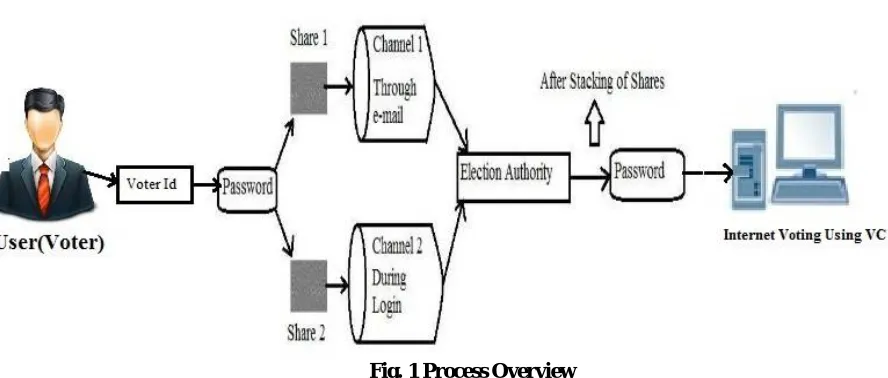
Fig. 1 Process Overview
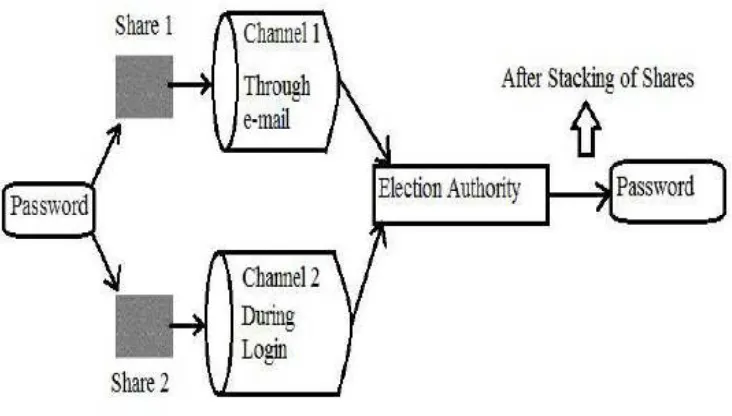
identify authentic based, it is unlikely that vote selling can be prevented. In our system we provide transparency in voting so no any voter can sell his own vote to another voter. This property could be guaranteed by requiring an open process. For instance, the placing of transparencies in envelops could be conducted in public where voters could observe that the transparencies are selected randomly. A voter visits the election web site and enters the type able username. The election web site maintains a list of the username used to create transparency and check entered key is match with two shares or not (extensions that would allow a voter to change a previously cast vote are possible but not considered here). If the entered username is valid, the election server can calculate the corresponding transparency image. The election server then generates a random string to use as a password, and generates an image containing that string rendered as a bitmap image. The complementary image to the password image for the voter’s transparency is generated and displayed on a webpage returned to the voter. After the web server displays the corresponding image generated from username, the voter combines both the transparency to reveal the password as shown in Fig 2.The user can login with the combined two shares in that one share will be generate at the time voting and second share will be already send on users Email id
Fig 2. System Architecture
are used. Admin has the option to set the password for the users and also change the password; Admin can view the election details
.
IV.EXPERIMENTAL RESULTS
Fig 3. Candidate Registration
Admin can registered the Candidate details and add the image.
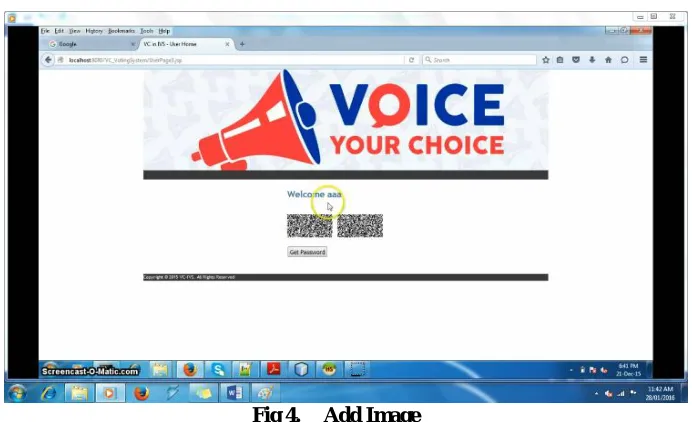
Fig 4. Add Image
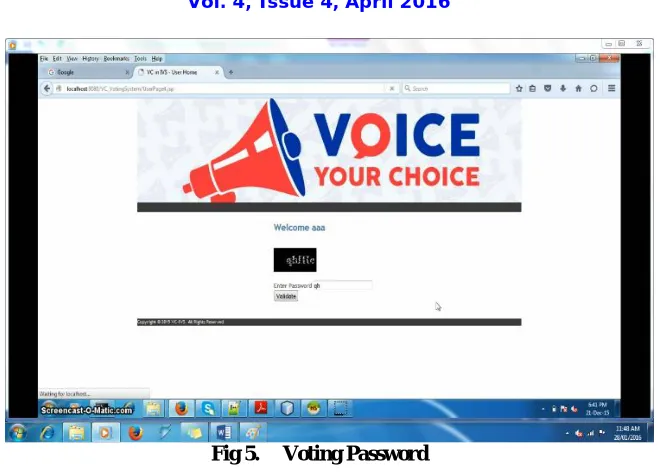
Fig 5. Voting Password
In above image User get password for secure voting
Fig 6. Display candidate details
Display all available candidate details.
V. CONCLUSION
the voting process. The system we propose uses visual cryptography to provide mutual authentication for voters and election servers.
REFERENCES
1. Adi Shamir (1979), “How to share a Secret”, Communications of the ACM, pp .612-613.
2. M. Naor and A. Shamir (1995), “Visual Cryptography”, Advances in Cryptology-Eurocrypt ’94 Proceeding, LNCSvol. 950, Springer-Verlag, pp. 1-12.
3. Scott Wolchok, Eric Wustrow, Dawn Isabel, and J. Alex Halderman, (2012) “Attacking the Washington, D.C.Internet Voting System”, In Proc. 16th Conference on Financial Cryptography & Data Security,pp .1-18
4. Hussein Khalid Abd-alrazzq1, Mohammad S. Ibrahim2 and Omar Abdurrahman Dawood (2012), “Secure Internet Voting System based on Public Key Kerberos”, IJCSI International Journal of Computer Science Issues, Vol. 9, Issue 2, No 3, pp. 428-434. 5. Adhikari Avishek and Bimol Roy (2007) “Applications of Partially Balanced Incomplete Block Designs in Developing (2,n) Visual
Cryptographic Schemes”. IEICE Trans. Fundamentals, Vol.E90–A, No.5 ,pp. 949-951
6. Marek R. Ogiela, Urszula Ogiela(2009) “Linguistic Cryptographic Threshold Schemes”, International Journal of Future Generation Communication and Networking.Vol.2, No.1,pp. 33-40
7. Carlo Blundo, University of Salerno, Alfredo De Santis and Douglas R Stinson (1998), “On the contrast in visual cryptography scheme”.pp. 1-28
8. Thomas Monoth, Babu Anto P (2009), “Achieving optimal Contrast in Visual Cryptography schemes without pixel expansion”. International Journal of Recent Trends in Engineering, Vol 1, No 1, pp. 468-471.
9. A B Rajendra and H S Sheshadri (2012), Study on Visual Secret Sharing Schemes Using Biometric Authentication Techniques, AJCST, Vol 1, pp.157-160.
10. Anusha MN and Srinivas B K (2012), “Remote Voting System for Corporate Companies using Visual Cryptography,” vol. 2, pp. 250–251.
11. Pallavi V Chavan, Mohammad Atique, and Anjali R Mahajan, (2011) “An Intelligent System for Secured Authentication using Hierarchical Visual Cryptography-Review”, ACCE Int J. on Network Security, vol. 02, No. 04.pp. 7-9
12. 2014 “Electronic Medical Report Security Using Visual Secret Sharing Scheme”, IEEE UKSim 15th International Conference on Computer Modeling and Simulation Proceedings, pp, 78-83
BIOGRAPHY
Mr. Sumit Jagtappursuing his Degree Course in Bachelor of Engineering from Dhole Patil College of Engineering,
Pune, Maharashtra, India
Mr. Smitesh Vicharepursuing his Degree Course in Bachelor of Engineering from Dhole Patil College of
Engineering, Pune, Maharashtra, India
Miss. Alpa Vaidyapursuing his Degree Course in Bachelor of Engineering from Dhole Patil College of Engineering,
Pune, Maharashtra, India
Mr. Mangesh Jogdandpursuing his Degree Course in Bachelor of Engineering from Dhole Patil College of
Engineering, Pune, Maharashtra, India
Prof. Shiwani Sthapakis an AssistantProfessor in Department of Information Technologyin Dhole Patil College of
![Table I. THE PIXEL PATTERN FOR 2-OUT-OF-2 VC [9]](https://thumb-us.123doks.com/thumbv2/123dok_us/1453945.1178133/2.595.182.414.271.449/table-i-pixel-pattern-vc.webp)