ISSN Online: 2327-4344 ISSN Print: 2327-4336
DOI: 10.4236/gep.2019.712010 Dec. 23, 2019 139 Journal of Geoscience and Environment Protection
Enhancing the Social and Natural Capital of
Canadian Agro-Ecosystems through
Incentive-Based “Alternative Land Use
Services” (ALUS) Programs: Recurring Themes
and Emerging Lessons
Robert France
1*, Jeffrey Campbell
1, Kate Sherren
21Rural Research Centre, Faculty of Agriculture, Dalhousie University, Halifax, Canada 2School for Resource and Environmental Studies, Dalhousie University, Halifax, Canada
Abstract
Alternative Land Use Services (ALUS) is an incentive-based program estab-lished in Canada to pay farmers for their voluntary delivery of ecosystem ser-vices (ES). All seven ALUS programs across the country were examined using a standardized case-study approach based on site visits, reading internal documents, attending program meetings, and engaging in semi-structured interviews with program administrators, participating farmers, and advisory board members. Direct content analysis was used to highlight recurrent themes and emerging lessons in relation to the salient particulars of program physical location, administration framework, delivery of ES, and development and receipt by communities. Our three major findings are: 1) Overall, ALUS has been judged by participants to be a very successful program, whose strength is that it is completely voluntary, non-permanent, and readily adaptable to each location’s environmental conditions, economic funding base, and cultural milieu. 2) One serious shortcoming of all ALUS programs is a general lack of quantifiable data on their ability to increase ES. Instead, environmental benefits are either assumed or based on the idea that the areal extent of enrolled land is the sole measure of its environmental worth. 3) It may be that the social impact of ALUS is its greatest success. In this regard, for farmers, it is the process of engaging in land-use decision making and the recognition of their role as environmental stewards that is a bigger motiva-tion for participating in an ALUS program than the modest financial incen-tives which they receive.
How to cite this paper: France, R., Campbell, J., & Sherren, K. (2019). En-hancing the Social and Natural Capital of Canadian Agro-Ecosystems through Incen-tive-Based “Alternative Land Use Services” (ALUS) Programs: Recurring Themes and Emerging Lessons. Journal of Geoscience and Environment Protection, 7, 139-162. https://doi.org/10.4236/gep.2019.712010
Received: August 20, 2019 Accepted: December 20, 2019 Published: December 23, 2019
Copyright © 2019 by author(s) and Scientific Research Publishing Inc. This work is licensed under the Creative Commons Attribution International License (CC BY 4.0).
http://creativecommons.org/licenses/by/4.0/
DOI: 10.4236/gep.2019.712010 140 Journal of Geoscience and Environment Protection
Keywords
Agro-Ecosystem Services, Incentive Payments, Grassroots Participation, Natural and Social Capital
1. Introduction
Innovative land-use planning is increasingly being employed in variable forms around the world as a means of enhanced habitat management in order to en-sure sustainable agricultural policy. Since 2008, across Canada, one such mecha-nism, “Alternative Land Use Services” (ALUS), has been developed in different ecological and sociopolitical environments and governance-management frame-works in five Canadian provinces (Figure 1) to deliver ecosystem services (ES) from privately held agricultural landscapes (France & Campbell, 2015). ALUS operates on six core principles (Table 1), and is a grassroots initiative based on payments for both land-sharing and land-sparing approaches (sensu Fischer et al., 2008; Grau et al., 2013) matching local agriculture and conservation needs. Best management practices (BMPs) include: tree planting in legislated riparian buffer zones, setting aside wetlands and grassed headland reserves, expanding existing buffer zones, installing soil conservation structures, implementing prac-tices to reduce soil erosion such as retiring high slope land, and constructing livestock exclusion fencing along waterways (see photographs in France & Campbell, 2015). The purpose of the present study was to undertake the first, cross-system examination of all the Canadian ALUS programs, and to highlight, in this special publication forum on “land use planning, management and sus-tainability” for an international readership, the recurring themes and lessons that have emerged.
Table 1. Core principles of ALUS programs (Bailey & Reid, 2004; KAP, 2004; ALUS,
2011).
• Participation in the ALUS program is completely voluntary.
• The amount of land enrolled in ALUS is capped at a maximum (usually about 20 percent) in order to maintain an agriculturally based landscape.
• ALUS is designed to be integrated into existing land-use policies, conservation initiatives, and incentive programs so as to compliment them rather than compete against them.
• Lands that are deemed of marginal productivity or of noted environmental fragility are the primary target of the ALUS program, with the intention being to retire or alter cultivation practices for ecological benefits.
• In addition to being voluntary, ALUS is meant to be flexible with short-term contracts. Farmers are also permitted to withdraw from the program earlier than the contract-specified duration, but will have to reimburse any payments received.
DOI: 10.4236/gep.2019.712010 141 Journal of Geoscience and Environment Protection Although the ALUS concept has expanded across Canada, published scholar-ship on the programs, especially of a comparative basis, is lacking. An early scoping survey we conducted in 2012 through bibliographic and on-line research showed that whereas ALUS was well documented in the popular media (116 press releases), there had not been any publications in the international litera-ture. In comparison, more than a hundred publications exist on the older Con-servation Reserve Program (CRP) in the United States (Riley, 2010), and other similarly themed programs around the world, including Canada’s Environ-mental Farm Plans (EFPs) (Robinson, 2006). The preliminary research under-taken on ALUS is largely available only in internal and grey literature documents that have not been widely circulated. More recent scholarship about ALUS is re-stricted to particulars about individual programs underway in Norfolk County (Mackenzie, 2008; Rosenberg, 2010; MacLean, 2014; Irvine, 2013) and elsewhere in Ontario (Ouelett, 2018), the Rural Municipality of Blanshard, Manitoba (RMB) (Mann et al., 2014; Holland, 2015), and the province of Prince Edward Island (PEI) (Johnston, 2012; Lantz et al., 2012; Kolinjivadi et al., 2019). Only two of these ten site-specific studies have been published in the peer-reviewed literature. And no cross-system examination has been published beyond back-ground descriptions of the developmental case-histories of each of the inde-pendent ALUS programs across Canada (France & Campbell, 2015).
Our intent herein is to trade the detailed specifics of individual case-study analyses, such as those noted above, with a broad overview garnered through a cross-system, largely qualitative, examination, and the first undertaken, of the entire corpus of Canadian ALUS programs. The purpose of the present study, therefore, is based on the belief that by taking such a synoptic approach, we can highlight the recurring themes and emerging lessons with respect to how ALUS operates and is perceived. This approach was motivated by the study goal of identifying the need for future improvements in design and implementation as well as more-detailed research that should be undertaken if this particular strat-egy is to continue or to be expanded, as is being considered. Furthermore, de-spite the present paper pertaining solely to this particular Canadian program of payment for agro-ecosystem services, we believe that this example of sustainable land-use policy and planning will be of interest to an international readership involved in developing similar programs within their own respective countries.
2. Methods
DOI: 10.4236/gep.2019.712010 142 Journal of Geoscience and Environment Protection
Figure 1. ALUS programs discussed in the text. From left (west) to right (east), Alberta: the two counties of Vermillion River and
Parkland; Saskatchewan: four rural municipalities (RMs) near Regina; Manitoba: the Little Saskatchewan River District in the Rural Municipality of Blanshard; Ontario: the two counties of Norfolk and Grey/Bruce (plus additional proposed programs not elaborated on in the text); and the province-wide program in Prince Edward Island (PEI). Detailed, site-specific maps are shown
in Campbell (2014).
operating ALUS program though there is interest from both farmers and con-servation groups in restarting the program there in the future.
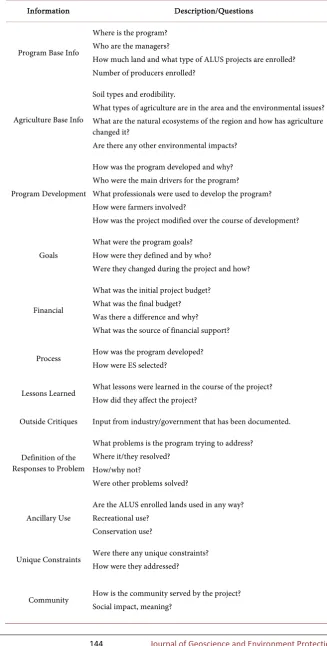
To meet the objective of investigating the ALUS programs, each location was examined using a standardized case-study approach to provide a comprehensive cross-system comparison. Descriptive case-histories were constructed based on site visits, existing grey literature documents, internal documents from ALUS program meetings, and in-depth, semi-structured interviews with program ad-ministrators and participating farmers. Details about the visits, physical and so-cio-demographic particulars, agro-environmental backgrounds, and diachronic developmental descriptions for all the study sites are presented in France and Campbell (2015).
DOI: 10.4236/gep.2019.712010 143 Journal of Geoscience and Environment Protection Anecdotal conversations, which were not formally recorded, took place with farmers who are currently or once were involved with the ALUS programs. Ac-tivities engaged in during site visits included one-on-one meetings with program coordinators; attending group Partnership Advisory Committee (PAC) meet-ings; tours of retired marginal farmland, created wetlands and pollinator strips, and planted shelterbelts and native prairies with farmers and program adminis-trators; and direct participation in riparian tree planting, wetland construction, and alternative water access projects, as well as surveying potential sites for fu-ture BMP implementation with participants. During formal interviews with ad-ministrators and PAC members, and anecdotal conversations with farmers, questions about the perceived strengths, benefits, weaknesses, and suggested areas for improvement of ALUS were answered honestly and without bias. The qualitative nature of such interviews and conversations enables collection of in-formation about values and attitudes that are frequently missed by quantitative surveys. As detailed by Greenland-Smith (2014), unstructured interviews in the form of conversations with open-ended and flexible question prompts (Zhang & Wildemuth, 2009) are deemed most valuable to the study of agricultural ES. Such conversational acquisition of data enables researchers to obtain a wider range of attitudinal responses than through answers to set questions in surveys (Kvale & Brinkmann, 2009). In unstructured interviews, questions are generated spontaneously, though not without meticulous prior preparation of targeted avenues of investigation, as was done in this case. The opinions of 8 program administrators (including top-level coordinators), 19 participating farmers, and 12 other PAC members were obtained in this way. The bulk of interviewees (63% for administrators, 75% for PAC members, and 79% for farmers) were all middle-aged (40 to 65), with most being male (75% for administrators, 83% for PAC members, and 100% for farmers). The organizations of the various PAC members, such as eNGOs, are listed in France & Campbell (2015).
The main focus of the research was on investigating farmer uptake, and the administration and development of ALUS. Program funding, although the ad-vantages and disadad-vantages of their sources are briefly touched upon, was not the focus of the research. Nor do we do not attempt to rationalize why ALUS should be funded or how funding should be allocated within individual pro-grams.
DOI: 10.4236/gep.2019.712010 144 Journal of Geoscience and Environment Protection
Table 2. Landscape architecture case-study methodology from Francis (1999), as
modi-fied for agricultural comparisons.
Information Description/Questions
Program Base Info
Where is the program? Who are the managers?
How much land and what type of ALUS projects are enrolled? Number of producers enrolled?
Agriculture Base Info
Soil types and erodibility.
What types of agriculture are in the area and the environmental issues? What are the natural ecosystems of the region and how has agriculture changed it?
Are there any other environmental impacts?
Program Development
How was the program developed and why? Who were the main drivers for the program? What professionals were used to develop the program? How were farmers involved?
How was the project modified over the course of development?
Goals
What were the program goals? How were they defined and by who?
Were they changed during the project and how?
Financial
What was the initial project budget? What was the final budget? Was there a difference and why? What was the source of financial support?
Process How was the program developed?
How were ES selected?
Lessons Learned What lessons were learned in the course of the project? How did they affect the project?
Outside Critiques Input from industry/government that has been documented.
Definition of the Responses to Problem
What problems is the program trying to address? Where it/they resolved?
How/why not?
Were other problems solved?
Ancillary Use
Are the ALUS enrolled lands used in any way? Recreational use?
Conservation use?
Unique Constraints Were there any unique constraints? How were they addressed?
Community How is the community served by the project?
DOI: 10.4236/gep.2019.712010 145 Journal of Geoscience and Environment Protection literature (Prokopy, 2011). Proponents for ALUS argue that these qualitative as-pects, such as community empowerment, are the key reasons underlying the success of the ALUS approach (Delta Waterfowl, 2013). However, these have of-ten been overlooked in third-party program assessments which ofof-ten examine only the economics and conservation merits of the ALUS concept. Furthermore, due to inaccuracies in the passive recollection of natural conditions by respon-dents in traditional surveys (Owen et al., 2009), we employed in situ “go-along” conversations with practitioners (Carpiano, 2009; Evans & Jones, 2011), aided by using landscape features as prompts (Riley, 2010). Such an approach provides an accurate assessment of farmer attitudes regarding ES (Greenland-Smith, 2014). The data collected were examined using a directed content analysis (Hsieh & Shannon, 2005), building on the intuitive methodology of grounded theory (Charmaz, 2006), with coding as per the standard procedure in social science ag-ricultural research (Roesch-McNally et al., 2018), which in the present case, was based the categories of the case-study methodology adapted from Francis (1999).
The present paper highlights a qualitative appraisal of the recurring themes and emerging lessons from a cross-system examination of the ALUS programs. These themes are based upon the comparisons and contrasts of the findings from the programs, with the lessons organized under the following four over-arching categories: location, administration and funding, delivery, and develop-ment. The Results section (based on information obtained from site visits, inter-views, and background documents) goes through the most salient features of the various ALUS programs, after which the Discussion section provides evaluation of the overall strategies.
3. Results (Program Elements Findings)
3.1. Program Location
DOI: 10.4236/gep.2019.712010 146 Journal of Geoscience and Environment Protection in PEI and eutrophication of prairie lakes due to inadequate riparian buffer strips in the West. However, many program administrators felt that it is doubtful whether an ALUS program, which is intended to preserve and promote natural capital in working agricultural landscapes, could be used as a solution where ei-ther (a) large-scale and long-term land retirement and restoration would be needed, as for example the creation of wildlife sanctuaries, or (b) in cases where restoration is legally required of ecosystem functions that have been very se-verely degraded.
Interviewed participants uniformly endorsed the capping principle of ALUS, which maintains agricultural landscapes by setting a limit on the amount of land individual farmers can enroll. This was particularly well displayed in the very successful program in Norfolk County, Ontario, as well as the expired program in the RMB, Manitoba. Elsewhere, developing and pilot phase programs have placed less emphasis on capping, as ALUS demonstration projects in these loca-tions are unlikely to produce regional economic impacts given that only a small area of encompassed land is removed from production. Notably, PEI has not implemented capping as its province-wide ALUS program is addressing wide-spread and serious water quality and erosion issues caused by widewide-spread inten-sive potato agriculture.
In most of the regions with ALUS programs, agriculture was not the sole eco-nomic driver. In Western Canada, the County of Vermillion River (CVR), and Parkland County, Alberta, are heavily involved in the oil and gas industry, and in PEI and Ontario, the ALUS program locations are also important for tourism. Interestingly, participants, both administrators and farmers, thought that ALUS is able to benefit both these sectors, for example, as a potential offset for oil and gas production, or in terms of protecting and promoting cultural ES (i.e. envi-ronmental resources such as recreation areas and aesthetics) as a potential to draw tourists to multifunctional rural areas.
3.2. Program Administration and Funding
All of the ALUS programs are characterized by a diverse portfolio of stake-holders and supporters comprised of farmers, eNGOs, and various branches of government (France & Campbell, 2015). This diversity offers the strength of enabling multiple goals that target the environment, agriculture, and the sur-rounding community. There was common agreement that in addition to helping to create a more multifunctional program, diversity in the administration also brings additional expertise and in-kind support, as well as networking to the fi-nancial partners.
DOI: 10.4236/gep.2019.712010 147 Journal of Geoscience and Environment Protection funding bodies which included foreign natural resource agencies, at the same time as addressing the wishes of resident farmers.
PEI utilized a different approach for their provincially funded program. Al-though administered exclusively by the provincial government, during the de-velopment of the program external stakeholders from industry, communities, and eNGOs were relied upon for guidance in generating a sustainable program that would have broad acceptance. Currently, the government administration meets annually with these stakeholders to review the program and to suggest modifications if needed.
The Partnership Advisory Committee model, since being formalized in Nor-folk County, Ontario in 2007, has become the central structure in all current ALUS programs across the country, with the exception of PEI’s unique top-down program. With representation on the PAC from municipal and provincial gov-ernments, eNGOs, and predominantly farmers, this model keeps program de-velopment and administration at the grassroots level, and was endorsed by all as setting the new standard. Norfolk County’s PAC further engages producers by appointing five of its ten farmer members as liaisons. These liaisons were be-lieved by participants to assist the ALUS coordinator by providing initial and continuing communication with interested farmers, thereby helping to establish trust. Many proponents have pointed to the strength of this model as part of the success of ALUS for engaging farmers in the program, not only in Norfolk County, but also elsewhere across the country.
Significantly, our examination found that the deemed effectiveness of an ALUS program was not influenced by the particular administration structure. However, because many farmers are often distrustful of government and eN-GOs, the involvement of farmers in the ALUS administration process is opined across the board as being de rigueur to the acceptance of the program by the ag-ricultural community.
With the exception of province-wide program operating in PEI, present-day ALUS programs were not primarily supported by governmental funding. As a result, many of those interviewed expressed concerns about the longevity of these programs due to their reliance upon grants from various funding agencies in order to administer ALUS payments. Despite this implicit uncertainty, ALUS in Norfolk County, Ontario has been extended beyond its initial pilot phase to become a full-fledged program in the absence of significant government fund-ing. Furthermore, it is worth noting that as a result of the continued support and interest from funding partners, no ALUS program has been terminated since that of the original pilot project in the RMB, Manitoba, and even there, we were told that discussions are presently underway to resurrect that widely regarded program.
DOI: 10.4236/gep.2019.712010 148 Journal of Geoscience and Environment Protection though most programs are not primarily reliant upon that form of financial sup-port. However, despite not being funded directly by government, our examina-tion found that many programs have been successful in obtaining support. In Alberta, for example, the designation of the CVR as a wetland restoration agency has enabled that county’s ALUS program to be able to access provincial money specifically targeted for wetland restoration. Although this funding cannot be used for annuities, it did help with the initial costs of designing and implement-ing the BMPs.
PEI’s ALUS program is fortunate with its budget of one million dollars allot-ted annually by the provincial government. Although we were informed that this generous budget has allowed PEI to have some of the highest levels of ALUS participation and annuity payments across Canada, concerns were nevertheless shared that the program’s long-term survival is still ultimately dependent upon the political will of the current governing party. In comparison, some partici-pants from across the country noted, in a glass half-full manner, that other ALUS programs which are only partially funded by or supported with in-kind support from provincial or municipal governments, would not be subjected to unmanageable and abrupt changes set in place by a new political landscape.
3.3. Program Delivery
Providing a positive market value for the production of ES is the fundamental function of all the ALUS programs. Our examination found that the payment levels vary greatly, depending on the agricultural practices and location. For example, annuities paid on a per-hectare basis for the initial project in the RMB were $38, $19 and $13 for no agricultural use, no haying, and no grazing, respec-tively. Annuity rates for enrolling retired marginal land in the CVR, Alberta are as low as $13/ha, whereas payments in Norfolk County, Ontario are as high as $375/ha. We found that the highly variable payment rates seen across the coun-try reflect differences in opportunity costs and local land values. Despite the low payment amounts offered in some cases, such as in Manitoba’s RMB, where the average per annum compensation totaled just $1800, most farmers across Can-ada we interviewed considered the payment they received as fair compensation for their efforts (though, of course, not surprisingly, some would like to be paid more for ALUS-enrolled land). It is worth noting in general, and in the case of PEI in particular, that program administrators told us that lower ALUS pay-ments, while less appealing to individual farmers, are of overall benefit to agri-culture as they prevent market distortion by artificially increasing land values. Interviewed administrators went out of their way to note that such distortion occurred in the American CRP during the 1980s when the payments, which were larger than land rental fees, caused the value of farmland to increase because of a capitalization of this potential revenue.
DOI: 10.4236/gep.2019.712010 149 Journal of Geoscience and Environment Protection However, our examination found that the monitoring procedure is certainly not universal and varies in its implementation among the various programs. For example, the CVR’s ALUS program conducts annual compliance monitoring prior to making annuity payments. Within this program there have been cases where farmers have been unable to complete the intended project due to vaga-ries of inclement weather. In these cases, administrators informed us that the CVR ALUS honoured their payments. PEI’s ALUS program randomly audits ten percent of its ALUS enrollments each year. The province’s program has adopted a non-compliance protocol which stops subsequent payment to delinquent par-ticipants, something which, however, administrators told us they had not yet had to enforce. This is because the few issues of non-compliance have been caused by miscommunication, often between farmers and their employees, and not due to a deliberate abuse of the program by the managing farmer her/himself. And in the RMB, Manitoba, former program administrators informed us that compli-ance monitoring had been inconsistent due to agents of the Manitoba Crop In-surance Corporation, the agency responsible for the monitoring, having varying interpretations about the specifics entailed in ALUS enrollment. For example, some monitoring agents had expected to see total non-use and completely un-disturbed land being set aside, and therefore subsequently disqualified farmers based on the presence of all-terrain vehicle tracks and even footprints in pothole wetlands. This disgruntled many farmers, those whom we interviewed telling us that they had in consequence subsequently voiced their discontent at public gatherings and meetings.
As seen in the previous examples, compliance monitoring does not need to be consistent among the various programs. Differences are bound to exist due to the idiosyncrasies of location and the resources of the program dedicated to un-dertaking the monitoring. However, there was a common opinion of all inter-viewed participants that it is essential to have uniform compliance monitoring within any individual ALUS program in order to ensure that farmers, technicians, and monitoring officials all have the same understanding of the expectations.
Our examination found that the ALUS concept has been received with a mix-ture of supportive recognition for its novel namix-ture, as well as some criticism for the manner of its implementation. Indeed, based on the collective opinions shared by participants, each individual program has had its own set of successes and shortcomings. In general, participation in ALUS has been embraced by dif-ferent types of farmers, ranging from those owning or operating large busi-ness-oriented farms to those whom are small-scale hobby farmers. By eliminat-ing monetary penalties (“sticks”) and instead offereliminat-ing modest incentives (“car-rots”) for environmental work, financially motivated farmers are willing to par-ticipate in ALUS. For the environmentally-minded farmers we interviewed, ALUS is viewed as a tool to help implement environmental projects faster than would otherwise be possible.
DOI: 10.4236/gep.2019.712010 150 Journal of Geoscience and Environment Protection country is the belief that farmers will only maintain ALUS projects on marginal land provided that payments are continued. Although this concern should not be overlooked, promising indicators have come from Norfolk County, Ontario, with the majority of surveyed farmers telling us they would keep ALUS projects intact should payments cease. In fact, it is critical to note that many of the farm-ers participating in ALUS programs across the country we spoke with describe feeling more reward from the societal recognition of their role as environmental stewards than from the financial compensation which, while important, is often considered to be of secondary consideration.
Reactions from governments about ALUS have been mixed, according to the opinions of program administrators. Whereas the provincial government of PEI has fully endorsed ALUS, other provincial governments have been less suppor-tive. Some program administrators shared a common regret that their provincial governments, although interested in ALUS, often do not fully understand its po-tential or use. The first ALUS in the RMB, Manitoba, for example, was heavily criticized by government and eNGOs for focusing on maintaining existing natural capital, with only slight consequent increases devoted to building new capital in terms of creating wetlands and other wildlife habitat.
Another interesting result from our examination was that numerous ALUS proponents commenting on the Canadian federal government’s stance, opined that development of the program on a national scale would not be financially feasible. Program managers concurred that ALUS at a national scale would be untenable due to centralized control (though there are some whom disagree and are actively investigating the possibility of just such a nation-wide program). In-stead, by maintaining control at smaller regional scales, these interviewees be-lieved that the ensuing programs can be more focused and efficient at delivering targeted and meaningful environmental solutions. Across the board, again and again, we were told that the perception of the program as a grassroots initiative is widely acknowledged by all participants as being one of its strengths in build-ing farmer engagement.
3.4. Program Development
All of the ALUS programs were developed similarly: in general, ES that were needed were identified, and the program was based on the capability of farmers to provide those ES. Although the goals of each program were often similar, our examination found that the motivation and the process to select these goals of-ten differed among the programs. Slight differences existed in program devel-opment with respect to how each integrated with existing environmental pro-grams and how ALUS was launched in each respective location.
DOI: 10.4236/gep.2019.712010 151 Journal of Geoscience and Environment Protection allows the farmer to access cost-share funding, through the EFP, for installation of on-farm BMPs, thereby leaving the ALUS funding to be used solely for annu-ity payments. One notable exception is PEI’s ALUS program which does not mandate farmers to participate in its EFP. However, PEI does integrate ALUS into existing cost-share funding specifically targeted for the construction of ero-sion control structures and riparian zone enhancement. Our examination found that ALUS programs elsewhere have partnered with local organizations and programs to facilitate targeted on-farm projects, such as that in Grey/Bruce County in Ontario, for example, with the Sydenham Sportsman Association, a local group interested in preserving cold-water fisheries (France & Campbell, 2015). There was a general agreement among stakeholders that ALUS programs are therefore very effective at complementing and enhancing existing conserva-tion programs and directives. By offering prolonged payments for the produc-tion of ES, administrators told us that ALUS makes many cost-share programs more attractive and feasible for farmers.
Use of preliminary demonstration projects of the ALUS concept has been a critical component of the unveiling of each program to the agricultural commu-nity for seven of the nine case-studies examined. Following an initial develop-ment phase, where the PAC identifies the goals and deliverables of the program, ALUS is first implemented though a pilot phase. Usually lasting about three years, administrators believed that the pilot phase generates support for the pro-gram by demonstrating to farmers how ALUS can work on their farms and to financial supporters that it is a worthy investment. Following this pilot phase and any necessary fine-tuning in ALUS’s delivery, the program becomes fully established and expands to involve more farmers and increased land enrollment.
Only two case-studies did not have an ALUS pilot demonstration: the RMB in Manitoba, and PEI’s province-wide program. The Manitoban program was itself a pilot to test the effectiveness and suitability of the overall concept for conserva-tion in agriculture. Originally intended to be the base for a program to be launched nationally, there was never a serious attempt to ensure its long-term viability. We were told that presently work is underway to re-launch ALUS in the RMB, Manitoba, using the now-established procedure of piloting before evolving into an established program. And although PEI’s ALUS was not for-mally trialed before being implemented into a provincial policy, government administrators informed us that ES projects were undertaken in several water-sheds to set the groundwork for the program in order to assess farmer involve-ment in delivering ES, as well as the degree of support from the community. The findings at the conclusion of the two-year period were positive, interviewed farmers telling us that they participated and altered their practices accordingly, and that watershed residents were found to be willing to pay for the expense of producing ES.
DOI: 10.4236/gep.2019.712010 152 Journal of Geoscience and Environment Protection and other residents in the target areas. By building support and reworking the program to suit the environmental and agricultural goals of the program, the long-term viability was believed by administrators to be more secure. However, as shown in the PEI case-study, it is possible to bypass the pilot phase of an ALUS if another program of similar scope has been previously undertaken and well received.
Across all of the examined ALUS programs, we found that the dual goals of environmental protection/restoration and farmer empowerment were recurring themes. In more established programs, such as those in the CVR, Alberta, Nor-folk County, Ontario, and PEI, goals are targeted to address specific environ-mental and social problems, such as riparian zone enhancement for erosion protection or the establishment of native prairie. For programs in their infancy, such as Grey/Bruce and other counties in Ontario, and Parkland County, Al-berta, goals were less specific, focusing on environmental benefits such as gen-eral water quality issues, and encouraging farmers to be proactive to prevent the regulation of agricultural activities by outside influences. This difference based on the developmental stage of the programs is likely a consequence of a combi-nation of increased farmer awareness of specific environmental issues, and in-creased stakeholder interest in using ALUS as a tool for their own conservation goals. Uniquely, PEI’s ALUS program is specifically used as a means to comple-ment existing environcomple-mental regulations, increase their effectiveness, and to re-ward compliance.
Whereas ALUS projects are often similar among different programs, our ex-amination found that patterns in their justification appear to be dependent upon population density and the intensity of agriculture in each region. Water quality protection through preserving wetlands, establishing riparian buffer zones, con-structing livestock exclusion fencing, and providing off-stream livestock water-ing were regarded by participants as higher priorities in areas with higher popu-lation densities and more intensive agriculture. These areas included Grey/Bruce County, Ontario, the province of PEI, Parkland County, Alberta, and the Rural Municipalities of Francis, Lajord, Indian Head and South Qu’Appelle in Sas-katchewan. In more rural and less densely populated areas, such as the RMB, Manitoba, and the CVR, Alberta, participants placed more emphasis on retiring marginal land and on increasing the area of wildlife habitat. Interestingly, Nor-folk County, Ontario, did not prioritize water quality despite the relatively high population density. This may be due to the region’s history in tobacco agricul-ture which required a small working land base. Therefore, despite the presence of over 1,300 farms in this southern Ontario county, most are small, so the im-pact on waterways has not been as great as in areas of high intensity agriculture such as that occurring in PEI and the Western Prairie provinces.
3.5. Importance of Themes on ALUS Program Development
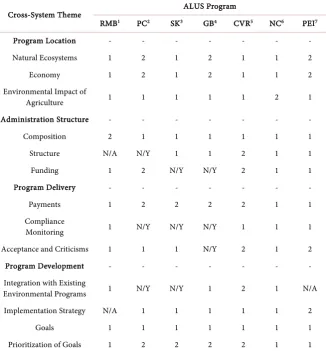
DOI: 10.4236/gep.2019.712010 153 Journal of Geoscience and Environment Protection emphasis of mention from the interviewed individuals. The relative importance of each of the themes deduced from the cross-system examination played dif-ferent roles in shaping the goals, project design, and implementation of each in-dividual ALUS program (Table 3). Concepts that were considered of major im-portance to individual programs were often a principle reason for the initiation of ALUS or heavily considered during program development. Considerations of minor importance were built upon, but were not critical in the administration, goals, or implementation of the particular ALUS program. While some of the deduced themes are not yet applicable in the developing or recently established programs, only three were deemed not applicable in two programs. The first ALUS program in RMB, Manitoba did not place an emphasis on the administra-tion structure or the implementaadministra-tion method to build support and guarantee
Table 3. Comparison of the importance of the deducted cross-system themes in the
de-velopment and delivery of studied ALUS programs in Canada. 1—Major importance, 2—Minor importance, N/A—Not applicable (for defunct program of RMB and prov-ince-wide program in PEI) and N/Y—Not yet applicable (for other ongoing programs). Importance discrimination designations explained in the text.
Cross-System Theme ALUS Program
RMB1 PC2 SK3 GB4 CVR5 NC6 PEI7
Program Location - - - -
Natural Ecosystems 1 2 1 2 1 1 2
Economy 1 2 1 2 1 1 2
Environmental Impact of
Agriculture 1 1 1 1 1 2 1
Administration Structure - - - -
Composition 2 1 1 1 1 1 1
Structure N/A N/Y 1 1 2 1 1
Funding 1 2 N/Y N/Y 2 1 1
Program Delivery - - - -
Payments 1 2 2 2 2 1 1
Compliance
Monitoring 1 N/Y N/Y N/Y 1 1 1
Acceptance and Criticisms 1 1 1 N/Y 2 1 2
Program Development - - - -
Integration with Existing
Environmental Programs 1 N/Y N/Y 1 2 1 N/A
Implementation Strategy N/A 1 1 1 1 1 2
Goals 1 1 1 1 1 1 1
Prioritization of Goals 1 2 2 2 2 1 1
1Rural Municipality of Blanshard, Manitoba. 2Parkland County, Alberta. 3Rural Municipalities of Francis,
Lajord, Indian Head and South Qu’Appelle, Saskatchewan. 4Grey and Bruce Counties, Ontario. 5County of
DOI: 10.4236/gep.2019.712010 154 Journal of Geoscience and Environment Protection longevity. PEI’s provincial ALUS program made very little attempt to integrate with existing environmental programs as it was meant to complement specific regulations.
4. Discussion
4.1. Environmental Impact
As a conservation minded, land management strategy, ALUS appears to be very adaptable. Its grassroots approach has meant that the various programs entail both land-sparing and land-sharing conservation strategies. Being attuned to lo-cal conservation goals, each program is molded by regional agriculture, natural ecosystems, and cultural values, with no common one-size fits all, cookie-cutter model. In Western Canada, ALUS is more comparable to a land-sparing tool (i.e. separating agriculture and conservation), being based on retiring extensive areas of high slope and other marginal land. In Ontario, ALUS is exhibited more as a land-sharing program (i.e. integrating conservation into agriculture), based on retiring small parcels of marginal land, enhancing streams and wetlands, and incorporating ES such as bird and pollinator habitat admix agriculture. The program of PEI has hints of both, in terms of retiring high-slope land while also improving the function and biodiversity of riparian zones.
DOI: 10.4236/gep.2019.712010 155 Journal of Geoscience and Environment Protection still-sceptical governmental officials. Given ALUS’s stated objectives to integrate with existing environmental initiatives, we strongly believe that the programs should engage with the various government agencies that have the resources in place to collect better environmental data, and to conduct monitoring, thereby allowing ALUS administrators to focus on issues of farmer engagement and project administration.
During our research, the term ES was loosely used to include wildlife habitat, erosion control, and water quality. Although there can be little doubt that marginal land taken out of agriculture has positive environmental benefits for water quality and wildlife habitat, there was an immediate inference of multi-functionalism in providing numerous ES. This problem is not unique to ALUS and is sympto-matic of a recurring attempt to simplify ecosystem functions by many different programs that use market-based instruments of applying economic value to ES (Burgin, 2008; Walker et al., 2009; Robert & Stenger, 2013). Whereas ES such as native pollinators or enhancement of game species may be quick and easy to as-sess, other ES could take far longer to establish and gauge.
The voluntary nature of the ALUS programs, although promoting the produc-tion of site-specific ES such as erosion control and wildlife habitat, may limit the desired environmental goals that can be attainable on a regional scale. Farmers who have no desire to participate in ALUS, or who consciously farm in a manner that is environmentally damaging, can hinder the programs. In such cases, ALUS would have little regional impact, necessitating reliance on traditional le-gal regulations that would become the primary means in which to stop envi-ronmental degradation. In such cases, we consider that PEI, which uses its ALUS program as a complement to regulation, could serve as a model for situations where voluntary stewardship is deemed or determined to be insufficient to en-sure that regional environmental conditions are maintained at, or are restored to, an acceptable level. That said, such governmental oversight may run counter to the noted independent-mindedness that characterizes many farmers. In such cases, a form of an “alter-PES”, operated by environmentally-conscious farmers, might develop in the shadow of the formal ALUS program (Kolinjivadi et al., 2019).
4.2. Social Impact
DOI: 10.4236/gep.2019.712010 156 Journal of Geoscience and Environment Protection which at first had attracted only a handful of skeptical farmers. Within a year, however, a similar meeting promoting ALUS in the county attracted more than a hundred farmers and ranchers, all acutely interested in ALUS. We feel that this social empowerment is the true strength of the ALUS program which, once es-tablished, can set the foundation for more sound environmental work to be un-dertaken. Other, subsequently conducted and site-specific investigations have reached similar conclusions (MacLean, 2014; Holland, 2015).
From our conversations with participants and administrators, it became ap-parent that farmers felt that the main benefit for ALUS programs was the socie-tal recognition for their role as environmensocie-tal stewards. It is this social capisocie-tal that is the main driving force behind ALUS participation, with the financial in-centives, which can be very modest, being viewed as a secondary benefit.
The level of incentives must be carefully calibrated for reasons other than avoiding market distortion. There is, for instance, a real risk of financial incen-tives “crowding out” more intrinsic motivations to farm sustainably (Greiner & Gregg, 2011; Vollan, 2008), causing worse conditions when the incentives expire. It can also degrade conditions in places where incentive funding is not yet avail-able, as farmers see the potential for future payments to do something they might have otherwise done anyway. Also, another potentially deleterious reper-cussion is that some farmers might be tempted to intensify production in order to compensate for land taken out of production through being given over to ALUS (Kolinjivadi et al., 2019). On the other hand, with respect to producing positive financial benefits, given the increasing difficulty of farming some mar-ginal land in the face of climate-related extreme weather, ALUS may make common sense in simply providing a better land-use strategy to apply in toto for net collective gain; i.e. a classic example of hedging one’s bets (France & Camp-bell, 2015).
4.3. Financial Sustainability
DOI: 10.4236/gep.2019.712010 157 Journal of Geoscience and Environment Protection PEI’s ALUS program, which has had continued financial support from its provincial government, does not have the short-term financial concerns of other ALUS programs. Although it is a provincial policy and relatively stable, it could be subject to a change in political will, whereby the program could quickly lose its funding. However, it is believed that in PEI’s case this is very unlikely as the program has been very successful when used in conjunction with existing envi-ronmental regulations in the province.
Some ALUS programs are looking at developmental offset-and-trading mecha-nisms to bring in revenue. The lack of data about the value of the natural capital together with the controversial nature of offset trading may limit this approach. The literature is reasonably clear that credit and banking style restoration may not provide the same ES as those lost in the area being developed (Robert & Stenger, 2013). However, the strategy does provide opportunity to mitigate and allow economic development while encouraging the production of ES in agri-cultural landscapes which may already be highly disturbed, such as those in the peri-urban intreface.
The financial efficiency of the ALUS program is something that was only briefly mentioned by administrators, but is something that we believe should be more strongly championed. By engaging farmers, who already own both land-working equipment and hold operation experience, in the physical implementation of the recommended BMPs, the programs do not have to invest significant capital or labour to undertake ALUS projects. There are some exceptions where specialized equipment has had to be purchased, such as a grass-seed harvester in Norfolk County, Ontario, or where wetland restoration has been subcontracted to spe-cialized professionals. But, overall, ALUS seems to be a very cost-effective mechanism through which to get environmental mitigation and restoration in the ground.
5. Implications for Land-Use Planning and Sustainable
Agro-Ecosystem Management
5.1. Natural Capital Shortcomings and Recommendations
DOI: 10.4236/gep.2019.712010 158 Journal of Geoscience and Environment Protection program (Mann et al., 2014), or the Environmental Benefits Index, used to assess the CRP in the United States (Smith, 2003), is to be encouraged.
5.2. Social Capital Concerns and Strengths
Financially, ALUS does face uncertainty, but this is typical of most present-day environmental programs. The continued financial support of ALUS, as well as its ability to use the participant’s on-farm equipment and experience, serves to increase its viability, thereby reducing the resources needed to operate the pro-gram compared to other environmental propro-grams. This suggests an optimistic future for ALUS’s continuation as an economically efficient strategy for agricul-tural stewardship and environmental improvement. Ongoing investigation into more stable programs, such as EFP, seems necessary. Presently, Nova Scotia, for example, is investigating whether to implement an ALUS program as part of its EFP. In France and Campbell (2015) we list ten key elements to consider and ten mistakes to avoid to increase the likelihood of success with planning, adminis-tering, and implementing an ALUS program.
There are two distinct models that have been used for the administration of ALUS, each having its own particular advantages and disadvantages. PEI’s top-down model has many strengths including financial security, resources for compliance monitoring, and access to government resources. However, despite using a grassroots approach to develop the program, there are still members of the province’s farming community that feel more consultation with them is needed, in addition to greater outreach in order to encourage other, presently reticent and possibly recalcitrant individualswho are not currently implement-ing ALUS on their farms (Lantz et al., 2012). Feelimplement-ings of a lack of real autonomy are obvious shortcomings of such a top-down administrative structure, estab-lished with only minimal input from farmers (Kolinjivadi et al., 2019). Elsewhere across Canada, however, the bottom-up approach that has been adopted by all other past and present ALUS programs, most notably through the PAC frame-work, has been extremely successful in engaging farmers (Mackenzie, 2008; Rosenberg, 2010; MacLean, 2014; Holland, 2015), and as we found in our cross-system examination, has garnered their widespread endorsement. The idea of an administrative format closely reliant upon a PAC comprised of knowl-edgeable stakeholders has been suggested as a valuable, grassroots-based, gov-ernance structure that could be adopted to improve restoration efforts in the marine coastal zone, a region whose knowledge base and experience level in this regard are lacking compared to those in the terrestrial landscape (France, 2016). ALUS therefore can offer lessons of use for environmental restorationists and land-use managers beyond the bailiwick of agricultural production.
DOI: 10.4236/gep.2019.712010 159 Journal of Geoscience and Environment Protection and government oversight (Lawrence et al., 2004). This supports research by Knowler and Bradshaw (2007) indicating increased social capital as being one of the most important influences on why farmers undertake environmental work. In short, farmers want to do the right thing in terms of finding a balance be-tween production and conservation (McGuire et al., 2013). In this regard, ALUS can pave the way for farmers, who appear to be driven more by social capital benefits in terms of increased societal reputation as good stewards, than they are by accruing increased financial incentives, to work with eNGOs and govern-ments to attain mutually agreeable environmental outcomes. Finally, ALUS ap-pears to be representative of a growing body of research suggesting that it is the process of participating in environmental restoration that is ultimately just as or even more significant than any environmental products ensuing therefrom (France, 2008; Egan et al., 2011).
Acknowledgements
This research was supported by grants from Agriculture and Agri-Food Canada, Delta Waterfowl, the Nova Scotia Federation of Agriculture, and the NSAC Class of 56. Discussions with Jim Fisher, Jonathan Scarf, Shawn Hill, Lindsey Bennet, Keith Reid, Niall Kuyek, Gabriel Clark, and Joan Gabrielson were in-strumental to the various case studies investigated. Nancy MacLean, Peter Ha-vard and Al Hansen are thanked for reviewing an earlier draft of this research. All procedures performed in studies involving human participants were in ac-cordance with the ethical standards of the institutional and/or national research committee and with the 1964 Helsinki declaration and its later amendments or comparable ethical standards.
Conflicts of Interest
The authors declare no conflicts of interest regarding the publication of this pa-per.
References
ALUS (2011). ALUS: Beginning; and How ALUS Works. http://alus.ca
Bailey, R. O., & Reid, D. J. (2004). ALUS: The Farmer’s Conservation Plan.Norfolk Fed-eration of Agriculture. ALUS Canada, Toronto, Ontario.
Burgin, S. (2008). BioBanking: An Environmental Scientist’s View of the Role of Biodi-versity Banking Offsets in Conservation. Biodiversity and Conservation, 17, 807-816. https://doi.org/10.1007/s10531-008-9319-2
Campbell, J. B. (2014). A Case-Study Analysis of the Alternative Land Use Services Pro-gram (ALUS). M.Sc. Thesis, Nova Scotia: Dalhousie University.
Carpiano, R. M. (2009). Come Take a Walk with Me: The “Go-Along” Interview as a Novel Method for Studying the Implications of Place for Health and Well-Being.
Health and Place, 15, 263-272.https://doi.org/10.1016/j.healthplace.2008.05.003
DOI: 10.4236/gep.2019.712010 160 Journal of Geoscience and Environment Protection
Delta Waterfowl (2013). Adopt a Pothole; and Wetlands Get a Boost in Alberta.
http://www.deltawaterfowl.org
Egan, D., Hjerpe, E. E., & Abrams, J. (2011). Human Dimensions of Ecological Restora-tion: Integrating Science, Nature, and Culture. Washington DC: Island Press. https://doi.org/10.5822/978-1-61091-039-2
Evans, J., & Jones, P. (2011). The Walking Interview: Methodology, Mobility and Place.
Applied Geography, 31, 849-858.https://doi.org/10.1016/j.apgeog.2010.09.005
Fischer, J., Brosi, B., Daily, G. C., Ehrlich, P. R., Goldman, R., Goldstein, J., Lindenmayer, D. B., Manning, A. D., Mooney, H. A., Pejchar, L., Ranganathan, J., & Tallis, H. (2008). Should Agricultural Policies Encourage Land Sparing or Wildlife-Friendly Farming?
Frontiers in Ecology and Environment, 6, 380-385.https://doi.org/10.1890/070019
France, R. L. (2003). Wetland Design: Principles and Practices for Landscape Architects and Land-Use Planners. New York: W.W. Norton.
France, R. L. (2008). Healing Natures, Repairing Relationships: New Perspectives on Res-toring Ecological Spaces and Consciousness. Winnipeg: Green Frigate Books.
France, R. L. (2016). From Land to Sea: Governance-Management Insights from Terre-strial Restoration Research Useful for Developing and Expanding Social-Ecological Marine Restoration. Ocean and Coastal Management, 133, 64-71.
https://doi.org/10.1016/j.ocecoaman.2016.08.022
France, R. L., & Campbell, J. S. (2015). Payment for Agro-Ecosystem Services: Develop-mental Case-History Descriptions of Canada’s Grassroots “ALUS” Programs. Research Journal of Agriculture and Environmental Management, 4, 405-431.
Francis, M. (1999). A Case Study Method for Landscape Architecture. Brussels: Land-scape Architecture Federation.
https://www.lafoundation.org/sites/default/files/2019-01/casestudymethod.pdf
Grau, R., Kuemmerle, T., & Macchi, L. (2013). Beyond “Land Sparing versus Land Shar-ing”: Environmental Heterogeneity, Globalization and the Balance Between Agricul-tural Production and Nature Conservation. Current Opinions Environmental Sustain-ability, 5, 477-483.https://doi.org/10.1016/j.cosust.2013.06.001
Greenland-Smith, S. (2014). Farmer Perceptions of Wetland Ecosystem Goods and Ser-vices. M.Sc. Thesis, Halifax: Dalhousie University.
Greiner, R., & Gregg, D. (2011). Farmers’ Intrinsic Motivations, Barriers to the Adoption of Conservation Practices and Effectiveness of Policy Instruments: Empirical Evidence from Northern Australia. Land Use Policy, 28, 257-265.
https://doi.org/10.1016/j.landusepol.2010.06.006
Holland, K. L. (2015). Transitioning to a New Approach for Sustainability: The Case of Manitoba’s ALUS Project. Ph.D. Thesis, Edmonton: Univ. Alberta.
Hsieh, H. F., & Shannon, S. E. (2005). Three Approaches to Qualitative Content Analysis.
Quality Health Research, 15, 1277-1288.https://doi.org/10.1177/1049732305276687
Irvine, C. (2013). Community Composition Change of Pollinating Insects on Farms En-rolled in Alternative Land Use Services Pilot Project in Norfolk County, Ontario.
https://alus.ca/wp-content/uploads/2016/08/PollinatorStudy-Irvine.pdf
Johnston, L. (2012). An Assessment of Prince Edward Island’s Alternative Land Use Ser-vices (ALUS) Program, 2008-2011. M.Sc. Thesis, Fredericton: University of New Bruns-wick.
Keystone Agricultural Producers (KAP) (2004). A Proposal for the Development of an Alternate Land Use Services Pilot Project in the Rural Municipality of Blanshard.
DOI: 10.4236/gep.2019.712010 161 Journal of Geoscience and Environment Protection
Knowler, P., & Bradshaw, B. (2007). Farmers’ Adoption of Conservation Agriculture: A Review and Synthesis of Recent Research. Food Policy, 32, 25-48.
https://doi.org/10.1016/j.foodpol.2006.01.003
Kolinjivadi, V., Mendez, A. Z., & Dupras, J. (2019). Putting Nature “to Work” through Payments for Ecosystem Services (PES): Tensions between Autonomy, Voluntary Ac-tion and the Political Economy of Agri-Environmental Practice. Land Use Policy, 81,
324-336.https://doi.org/10.1016/j.landusepol.2018.11.012
Kvale, S., & Brinkmann, S. (2009). Interviews: Learning the Craft of Qualitative Research Interviewing. Thousand Oaks, CA: SAGE Publications Inc.
Lantz, V., Johnston, L., & Anderson, T. (2012). A Survey of Farmer Perspectives on the PEI ALUS Program. Fredericton: Faculty of Forestry and Environmental Management, University of New Brunswick.
Lawrence, G., Richards, C. A., & Cheshire, L. (2004). The Environmental Enigma: Why Do Producers Professing Stewardship Continue to Practice Poor Natural Resource Management? Journal of Environmental Policy, 6, 251-270.
https://doi.org/10.1080/1523908042000344069
Mackenzie, B. F. (2008). Supporting Environmental Stewardship and Livelihood Benefits in Ontario’s Greenbelt: Assessing the Potential Contribution of the Alternative Land Use Services Program. M.Sc. Thesis, Waterloo: Univ. Waterloo.
MacLean, M. K. (2014). We Have a Responsibility: Alternative Land Use Services, Farm-ers and Environmental Stewardship. M.Sc. Thesis. Guelph: Univ. Guelph.
Mann, J., Grant, C., & Kulshreshtha, S. (2014). Economics of a Pricing Mechanism to Compensate Rural Land Owners for Preserving Wetlands. Canadian Water Resources Journal, 39, 462-471.https://doi.org/10.1080/07011784.2014.965037
Mauchline, A. L., Park, J. R., Finn, J. A., & Mortimer, S. R. (2007). The Agri-Environmental Footprint Index. Aspects of Applied Biology, 81, 263-266.
McGuire, J., Wright Morton, L., & Cast, A. D. (2013). Reconstructing the Good Farmer Identity: Shifts in Farmer Identities and Farm Management Practices to Improve Water Quality. Agriculture and Human Values, 30, 57-69.
https://doi.org/10.1007/s10460-012-9381-y
Ouelett, F. (2018). La Participation des Agriculteurs aux Démarches Volontaires en Agro-environnement: Le Cas du Programme Alternative Land Use Service (ALUS) en Ontario. M.A. Thesis, Laval: Université Laval.
Owen, R. J., Duinker, P. N., & Beckley, T. M. (2009). Capturing Old Growth Values for Use in Forest Decision-Making. Environmental Management, 43, 237-248.
https://doi.org/10.1007/s00267-008-9133-3
Prokopy, L. S. (2011). Agricultural Human Dimensions Research: The Role of Qualitative Research Methods. Journal of Soil and Water Conservation, 66, 9-12.
https://doi.org/10.2489/jswc.66.1.9A
Riley, M. (2010). Emplacing the Research Encounter: Exploring Farm Life Histories.
Qualitative Inquiry, 2, 34-45.https://doi.org/10.1177/1077800410374029
Robert, N., & Stenger, A. (2013). Can Payments Solve the Problem of Undersupply of Ecosystem Services? Forestry Policy Economics, 35, 83-91.
https://doi.org/10.1016/j.forpol.2013.06.012
Robinson, G. M. (2006). Canada’s Environmental Farm Plans: Transatlantic Perspectives on Agri-Environmental Schemes. Geographical Journal, 172, 206-218.
https://doi.org/10.1111/j.1475-4959.2006.00207.x
Feed-DOI: 10.4236/gep.2019.712010 162 Journal of Geoscience and Environment Protection
back: Examining the “Ethic” of Soil Stewardship among Corn Belt Farmers. Rural Soci-ology, 83, 145-173.https://doi.org/10.1111/ruso.12167
Rosenberg, J. (2010). An Analysis of the Critical Success Factors for Participation in Ag-ricultural-Environmental Programs: A Case Study. M.Sc. Thesis, Guelph: Univ. Guelph. Smith, M. (2003). Agricultural Resources and Environmental Indicators: Land
Retire-ment. In Agricultural Resource and Environmental Indicators 2003 (pp. 15, 23-35). United States Department of Agriculture and Economic Resource Service.
https://www.ers.usda.gov/webdocs/publications/41964/30300_landretirement.pdf?v=0
Vollan, B. (2008). Socio-Ecological Explanations for Crowding-Out Effects from Field Experiments in Southern Africa. Ecological Economics, 67, 560-573.
https://doi.org/10.1016/j.ecolecon.2008.01.015
Walker, S., Brower, A. L., Theo, R. T., & Lee, W. G. (2009). Why Bartering Biodiversity Fails. Conservation Letters, 2, 149-157.
https://doi.org/10.1111/j.1755-263X.2009.00061.x