J. Biomedical Science and Engineering, 2009, 2, 51-56
Using position specific scoring matrix and auto
covariance to predict protein subnuclear localization
Rong-Quan Xiao
1, Yan-Zhi Guo
2, Yu-Hong Zeng
2, Hai-Feng Tan
1, Xue-Mei Pu
2, Meng-Long Li
1,2*1College of Life Sciences, Sichuan University, Chengdu 610064. 2College of Chemistry, Sichuan University, Chengdu 610064, P.R. China. Correspondence should be addressed to Meng-Long Li([email protected]). Tel: +86 28 89005151; Fax: +86 28 85412356.
Received September 8th, 2008; revised November 13th, 2008; accepted November 20th, 2008
ABSTRACT
The knowledge of subnuclear localization in
eukaryotic cells is indispensable for
under-standing the biological function of nucleus,
genome regulation and drug discovery. In this
study, a new feature representation was
pro-posed by combining position specific scoring
matrix (PSSM) and auto covariance (AC). The
AC variables describe the neighboring effect
between two amino acids, so that they
incorpo-rate the sequence-order information; PSSM
de-scribes the information of biological evolution
of proteins. Based on this new descriptor, a
support vector machine (SVM) classifier was
built to predict subnuclear localization. To
evaluate the power of our predictor, the
benchmark dataset that contains 714 proteins
localized in nine subnuclear compartments was
utilized. The total jackknife cross validation
ac-curacy of our method is 76.5%, that is higher
than those of the Nuc-PLoc (67.4%), the OET-
KNN (55.6%), AAC based SVM (48.9%) and ProtLoc
(36.6%). The prediction software used in this
article and the details of the SVM parameters are
freely available at http://chemlab.scu.edu.cn/
predict_SubNL/index.htm and the dataset used
in our study is from Shen and Chou’s work by
downloading at http://chou.med.harvard.edu/
bioinf/Nuc-PLoc/Data.htm.
Keywords:
Position Specific Scoring Matrix;
Auto Covariance; Support Vector Machine;
Pro-tein Subnuclear Localization Prediction
1. INTRODUCTION
The cell nucleus is complex, important subcellular
or-ganelle in eukaryotes cell. It organizes the
comprehen-sive assembly of our genes and their corresponding
regulatory factors [1]. Meanwhile, it also reflects various
intricate biological activities, and controls various kinds
of biologic processes [2]. Many proteins, from outside a
nuclear, trend to be localized into specific subnuclear
locations of the nucleus [3]. If proteins can not be
cor-rectly localized into its specific subnuclear locations in
human, it will lead to genetic disease [4], cancer [5] or
virally infected cells [6].
Thus, it’s desirable to get the
knowledge of protein subnuclear localization for in-
depth understanding cell biological processes and
ge-nomic regulation. However, it is costly and
time-con-suming to assay the subnuclear localization of proteins
by biology experiments [7]. The number of protein
se-quences is increasing more rapidly than that of identified
proteins [7]. So it is of great practical significance to
develop computational approaches for identifying the
protein subnuclear localizations in cell nucleus. At the
same time, many lines of evidences have indicated that
computational approaches, such as structural
bioinfor-matics [8], molecular docking [9], pharmacophore
mod-elling [10], QSAR [11,12,13], protein subcellular
loca-tion predicloca-tion [7,14], identificaloca-tion of membrane
pro-teins and their types [15], identification of enzymes and
their functional classes [16], identification of proteases
and their types [17], protein cleavage site prediction
[18,19], and signal peptide prediction [20,21] can
pro-vide very useful information for both basic research and
drug discovery in a timely manner. The present study is
devoted to develop a new method for predicting protein
subnuclear localization in hope to stimulate the
devel-opment of the relevant areas.
Recently, many algorithms have already been
devel-oped for predicting protein subcellular localizations [22,
23,24,25,26,27,28,29,30,31,32,33], as reviewed by Chou
[7]. Even several web severs have been constructed for
predicting subcellular localization of various organisms
[14,34,35,36,37]. However, there are only a few
compu-tational methods for predicting protein subnuclear
local-ization [38,39,40,41], such as OET-KNN [42], ProLoc
[43], Nuc-PLoc [44], and AdaBoost classifiers [45].
Compared to the conventional amino acid composition
(AAC), pseudo amino acid (PseAA) composition [46],
originally introduced by Chou [47,48], can include the
sequence-order information of sequences. Similarly, the
PsePSSM was also proposed by Shen and Chou in order
to incorporate the evolution information of proteins [44].
They built a new web server called Nuc-PLoc for
pre-dicting protein subnuclear localization by fusing PseAA
composition and PsePSSM with a promising prediction
result. In this study, we developed a new method by
fus-SciRes
ing position specific scoring matrix (PSSM) and auto
covariance (AC), so that this method can incorporate
sequence-order information by AC and the evolutionary
information by PSSM. A classifier based on SVM was
constructed to predict protein subnuclear localization
using jackknife test. The result indicates that our method
has successfully enhanced accuracies of the existing
methods for predicting protein subnuclear localization.
2. MATERIALS AND METHODS
2.1. Data Sets
In this paper, our dataset is obtained from article by Shen
and Chou [44]. And anyone can freely download it at this
page (http://chou.med.harvard.edu/bioinf/Nuc-PLoc/
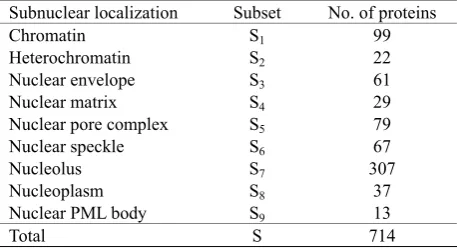
Data.htm). This dataset consists of nine classes and 714
proteins in total. Details of this benchmark dataset are
shown in
Table 1
.
S
i(
i
=1, 2… 9) is used to represent
each of nine subsets and S represents the total dataset.
2.2. Feature Representations
2.2.1. Auto Covariance (AC)
We selected three common physicochemical properties,
hydrophobicity [49], volumes of side chains of amino
acids [50], and polarity [51], to represent the structure
and function [52], the stereospecific blockade [53] and
the electronic property [54] of residues in a protein
re-spectively. These original values were taken from Guo
et
al
. [55] and were first normalized to zero mean value and
unit standard deviation (SD) by Equation (1):
, '
,
i j j
i j j
P
P
P
=
S
−
(1)
(
i
=1, 2, 3;
j
=1, 2, 3…, 20.)
Where
P
i,jis the
i-th
descriptor value for
j-th
amino
acid,
P jis the mean of the
j-th
descriptor of the 20
amino acids and
S
jis the value of SD. So each protein
sequence was translated into three vectors with each
amino acid represented by the normalized values.
[image:2.595.58.287.629.754.2]There are many approaches to convert the protein
se-quences into numerical order sese-quences, including
auto-correlations and auto covariance (AC). Autoauto-correlations,
quite similar to AC, has been used in the prediction of
secondary structure content [56,57,58] and structural
class [59,60,61,62]; however, AC as a statistical tool for
Table 1. The benchmark dataset consists of 714 nuclear proteins classified into nine subnuclear localizationsSubnuclear localization
Subset
No. of proteins
Chromatin S
199
Heterochromatin S2 22
Nuclear envelope
S3 61
Nuclear matrix
S
429
Nuclear pore complex
S5 79
Nuclear speckle
S6 67
Nucleolus S7 307
Nucleoplasm S8 37
Nuclear PML body
S9 13
Total S
714
analyzing sequences of vectors has also been
success-fully adopted by our research group for protein
classifi-cations [55,63] from primary sequence. So in our study,
AC was selected to transform these numerical vectors
into uniform matrices in order to take the neighboring
effect of the sequences into account. Here,
lag
is the
dis-tance between one residue and its neighbour, a certain
number of residues away. The AC variables are
calcu-lated by the Equation (2) [55].
, , ,
, ( ),
1 1 1
1
−(
1
) (
1
)
+
= = =
−
=
L lag∑
i j−
∑
L i j×
−
∑
L i jlag j i lag j
i i i
L lag
AC
P
L
P
P
L
P
(2)
Where
i
is the position in the sequence
P
,
j
is one
de-scriptor,
L
is the length of the sequence
P
and
lag
is the
value of the lag.
In this way, the number of AC variables,
D
, can be
calculated according to Equation (3) [55].
D lg p
= ×
(3)
Where
lg
is the maximum
lag
(
lag
=1, 2, 3…,
lg
) and
p
represents the number of descriptors.
2.2.2. Position Specific Scoring Matrix (PSSM)
A PSSM is a Position Specific Scoring Matrix and is a
commonly used representation of motifs (patterns) in
biological sequences [64]. So far, this method has been
used for predicting protein subcellular localization [65]
and subnuclear localization [40,44].
For a protein sequence
P
with
L
amino acid residues,
PSSM is obtained according to the following Equation [44].
1 1 1 2 1 1 20
2 1 2 2 2 2 20
1 2 20
1 2 20
j
j
PSSM
i i i j i
L L L j L
P
P
P
P
P
P
P
P
P
P
P
P
P
P
P
P
P
→ → → →
→ → → →
→ → → →
→ → → →
⎡ ⎤
⎢ ⎥
⎢ ⎥
⎢ ⎥
⎢ ⎥
⎢ ⎥
= ⎢ ⎥
⎢ ⎥
⎢ ⎥
⎢ ⎥
⎢ ⎥
⎢ ⎥
⎣ ⎦
L
L
L
L
M
M
M
M
M
M
L
L
M
M
M
M
M
M
L
L
(4)
In Equation (4), where
i
→
j
describes
i-th
amino acid
residue of the protein sequence
P
being mutated to
amino acid type
j
in the biology evolution process,
P
i→jis the score of this mutation and
L
is the length of the
sequence
P
. Here we used the numerical codes 1, 2, 3…
20 to represent the single character of ordered 20 native
amino acid types in Equation (4). To get the
L
×
20
scores of the
P
PSSMin the Equation (4), we used three
iterations of PSI-BLAST [66] with default threshold (the
default E-value is 0.001) to search the Swiss-Prot database
(version 54.4, released on 25 Oct. 2007) for multiple
sequence alignment against the protein
P
. Then, the
value of
P
i→jis standardized by Equation (5), as given
below.
20
1
1 20
) )
max(
min(
o i j j i jo
i j
o o
i j i j
P
P
P
P
P
→ = →
→
→ →
− ∑
=
(
i
= 1, 2, 3…
L
;
j
= 1, 2, 3…20)
Where
oi→j
P
is the original scores generated by
PSI-BLAST,
P
i→jis a zero mean value over the 20
native amino acids and the value is between -1 and 1.
However, because of proteins with different lengths
L
,
the matrices of the PSSM descriptor in Equation (4) have
different numbers of rows. To gain the uniform matrix
for protein sequences of different lengths, we converted
the PSSM of protein
P
to a uniform vector through the
Equation (6) [44].
1 2 20
( 1,2, ,20)
PSSM j
j
P
=
⎡⎢⎣P
P
L
P
L
P
⎥⎦⎤Τ=
L
(6)
Where T is the transpose operator,
Pjis the average
score over
j-th
column in Equation (4).
Finally, the
P
PSSMdescribes the evolutionary
infor-mation of a protein sample, and AC variables contain the
interaction information between two amino acid residues
of a sequence
.
So each protein sequence was converted
into a numerical vector by concatenating PSSM and AC. Here,
each AC variable was appended a weight factor of 0.05.
2.2.3. Accuracy and Matthew's Correlation
Coef-ficient (MCC)
To evaluate the performance of this method, two
pa-rameters, accuracy and Matthew's correlation coefficient
(MCC), were selected in this article. They are calculated
by Equation (7) and Equation (8), respectively.
TP
Accuracy TP FN
=
+
(7)
)
(
)
(
)
(
)
(
TP
FP
TP
FN
TN
FP
TN
FN
FN
FP
TN
TP
MCC
+
×
+
×
+
×
+
×
−
×
=
(8)
Where TP represents the true positive; TN, the true
nega-tive; FP, the false positive and FN, the false negative.
3. RESULTS AND DISCUSSION
In statistical prediction, the following three
cross-vali-dation methods are often used to examine a predictor
for its effectiveness in practical application:
independ-ent dataset test, subsampling test, and jackknife test
[67]. However, as elucidated in [14] and demonstrated
by Eq.50 of [7], among the three cross-validation
methods, the jackknife test is deemed the most objective
that can always yield a unique result for a given
bench-mark dataset, and hence has been increasingly used by
tigators to examine the accuracy of various predictors
(see, e.g., [7,33,68,69,70,71,72,73,74,75,76,77,78,79,80,
81,82]). So in this paper, the jackknife test was chosen to
validate the current algorithm. Because the benchmark
dataset used has nine subsets, the one-to-one multiclass
classification system led to 9*(9-1)/2=36 SVM models
for one single encoding methods. Meanwhile, for AC
variables, the value of
lg
was optimized as 13 through a
series of control experiments, and the value of
p
is 3. So,
the number of AC variables,
D
, is 39 (
D lg p
= ×
13 3 39
= × =
) according to Equation (3).
Amino acid composition (AAC) has been widely used
for predicting subcellular localizations [7,14,22,23,24,
25,26,27,28,30,31,32,34,35,36,37,83,84,85], so it was
also used as a substitution model in our study. And thus,
three SVM models based on AAC, AC and PSSM, were
respectively constructed.
[image:3.595.88.507.673.753.2]The results according to jackknife test are listed in
Table 2
. As can be seen from
Table 2
, the prediction
accuracy of PSSM based model is nearly equal to that of
AAC based model. However, AC based model gives the
lower accuracy of 64.13%. Then we constructed models
by fusing the three substitution models, so four fused
classifier were built.
Table 2
shows that the accuracies of
the four fused models are higher than those of the three
anterior models. Among those four fused models, the
accuracy of the model combining PSSM, AAC and AC is
lower than that of PSSM and AC based model that
ob-tains the best performance with an accuracy of 76.45%.
So the final SVM model was built based on PSSM and
AC. The kernel function of SVM is radio basis function
(rbf), and the parameters of C and γ are listed in the table
by downloading at http://chemlab.scu.edu.cn/predict_
SubNL/index.htm.
In order to further examine the prediction power of the
current classifier, the performance of this method was
also compared with those of the existing methods on the
same training dataset. The results obtained by several
algorithms with different substitution models were
sum-marized in
Table 3
. From
Table 3
, we can see that the
accuracy obtained by Nuc-PLoc [44] is much higher than
those of ProtLoc [43], AAC based SVM and OET-KNN [42].
When compared to Nuc-PLoc, our method obtains a better
performance with the accuracy of 76.5%. It means our
method is successful in predicting protein subnuclear
localization only using primary sequences of proteins
Table 2. Overall accuracies by jackknife tests with different substitution models on the benchmark dataset of Table 1
Substitution Model AAC
aAC
bPSSM
cAAC+AC
dPSSM+AAC PSSM+AC
dPSSM+AAC+AC
dAccuracy 73.82%
64.13%
73.85%
74.05% 75.97% 76.45% 75.99%
a: Amino acid composition
b: Auto covariance
c: Position specific scoring matrix
Table 3. Overall accuracy by jackknife tests with different algorithms on the benchmark dataset of Table 1
Algorithm
Protein sample descriptor Overall
accuracy
ProtLoc
a,dAmino acid composition
261/714=36.6%
SVM
dAmino acid composition
349/714=48.9%
OET-KNN
b,dPseAA Composition
397/714=55.6%
Nuc-PLoc
c,dFusion of PsePSSM and PseAA Composition
481/714=67.4%
Our method
Combination of PSSM and AC
546/714=76.5%
a: See Cedano
et al
. (1997)[86]
b: See Shen and Chou (2005)[42]
c: See Shen and Chou (2007)[44]
d: The results were from Shen and Chou (2007)[44], and the original data could been seen in that article.
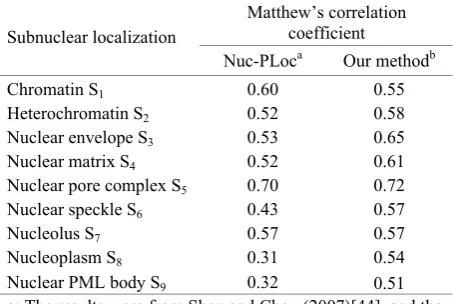
Table 4. The MCC values obtained by the jackknife tests with Nuc-PLoc and our method on the benchmark dataset of Table 1
Matthew’s correlation
coefficient
Subnuclear localization
Nuc-PLoc
aOur method
bChromatin S
10.60
0.55
Heterochromatin S
20.52 0.58
Nuclear envelope S
30.53 0.65
Nuclear matrix S
40.52
0.61
Nuclear pore complex S
50.70
0.72
Nuclear speckle S
60.43 0.57
Nucleolus S
70.57
0.57
Nucleoplasm S
80.31
0.54
Nuclear PML body S9 0.32 0.51
a: The results were from Shen and Chou (2007)[44], and the
original data could be seen in that article.
b: The classifier fused PSSM and AC.
In addition, to evaluate the stability of our method, the
values of the MCC for the nine subsets were compared
based on Nuc-PLoc and our current predictor,
respec-tively, as seen in
Table 4
. For nine subsets, our method
yields a higher MCC than Nuc-PLoc, except the subset
S1. So, compared to the existing methods, our classifier
combined with PSSM and AC has further improved the
prediction accuracy of protein subnuclear localization.
4. CONCLUSION
In this paper, a new classifier was developed by fusing
PSSM and AC for predicting protein subnuclear
local-ization only using the primary sequences of nuclear
pro-teins. The SVM predictor was constructed based on
PSSM and AC. AC variables represent the interactions
between amino acids in protein sequences; PSSM
de-scribes the evolutionary information. So the method
in-corporated not only the evolution information, but also
the sequence-order information. Compared with the
cur-rent methods, this method successfully raises the
predic-tion accuracy. Hence, it may be a good supplementary
tool for protein function studies.
ACKNOWLEDGEMENT
The authors gratefully thank Shen and Chou for sharing the benchmark dataset. The work was funded by the National Natural Science Founda-tion of China (No. 20775052).
REFERENCES
[1] G. S. Stein, J. B. Lian, W. A. van, J. L. Stein, A. Javed, G. Bar-nes, L. Gerstenfeld, D. Vradii, S. K. Zaidi, and J. Pratap, et al. (2006) Organization of transcriptional regulatory machinery in nuclear microenvironments: Implications for biological control and cancer. Cancer Treatment Reviews, 32, 13-13.
[2] A. I. Lamond, and W. C. Earnshaw, (1998) Structure and func-tion in the nucleus. Science, 280, 547-553.
[3] J. M. Bridger, and W. A. Bickmore, (1998) Putting the genome on the map. Trends in Genetics, 14, 403-409.
[4] H. G. Sutherland, G. K. Mumford, K. Newton, L. V. Ford, R. Farrall, G. Dellaire, J. F. Caceres, and W. A. Bickmore, (2001) Large-scale identification of mammalian proteins localized to nuclear sub-compartments. Human Molecular Genetics, 10, 1995-2011.
[5] S. K. Zaidi, D. W. Young, A. Javed, J. Pratap, M. Montecino, W. A. van, J. B. Lian, J. L. Stein, and G. S. Stein, (2007) Nuclear microenvironments in biological control and cancer. Nature Re-views Cancer, 7, 454-463.
[6] R. D. Phair, and T. Misteli, (2000) High mobility of proteins in the mammalian cell nucleus. Nature, 404, 604-609.
[7] K. C. Chou, and H. B. Shen, (2007) Recent progress in protein subcellular location prediction. Analytical Biochemistry, 370, 1-16.
[8] K. C. Chou, (2004) Structural bioinformatics and its impact to biomedical science. Current Medicinal Chemistry, 11, 2105- 2134.
[9] K. C. Chou, D. Q. Wei, and W. Z. Zhong, (2003) Binding mechanism of coronavirus main proteinase with ligands and its implication to drug design against SARS. Biochemical and Bio-physical Research Communications, 308, 148-151.
[10] Sirois, S., Wei, D. Q., Du, Q. S. and Chou, K. C. (2004) Virtual screening for SARS-CoV protease based on KZ7088 pharma-cophore pointst. Journal of Chemical Information and Computer Sciences, 44, 1111-1122.
[11] Du, Q. S., Mezey, P. G. and Chou, K. C. (2005) Heuristic mo-lecular lipophilicity potential (HMLP): A 2D-QSAR study to LADH of molecular family pyrazole and derivatives. Journal of Computational Chemistry, 26, 461-470.
[12] Du, Q. S., Huang, R. B., Wei, Y. T., Du, L. Q. and Chou, K. C. (2008) Multiple field three dimensional quantitative struc-ture-activity relationship (MF-3D-QSAR). Journal of Computa-tional Chemistry, 29, 211-219.
[13] Prado-Prado, F. J., Gonzalez-Diaz, H., de, V. O., Ubeira, F. M. and Chou, K. C. (2008) Unified QSAR approach to antimicrobi-als. Part 3: First multi-tasking QSAR model for Input-Coded prediction, structural back-projection, and complex networks clustering of antiprotozoal compounds. Bioorganic and Medici-nal Chemistry, 16, 5871-5880.
[14] Chou, K. C. and Shen, H. B. (2008) Cell-PLoc: a package of Web servers for predicting subcellular localization of proteins in various organisms. Nature Protocols, 3, 153-162.
[image:4.595.59.286.250.402.2]for predicting membrane proteins and their types by incorporat-ing evolution information through Pse-PSSM. Biochemical and Biophysical Research Communications, 360, 339-345. [16] Shen, H. B. and Chou, K. C. (2007) EzyPred: a top-down
ap-proach for predicting enzyme functional classes and subclasses. Biochemical and Biophysical Research Communications, 364, 53-59.
[17] Chou, K. C. and Shen, H. B. (2008) ProtIdent: A web server for identifying proteases and their types by fusing functional domain and sequential evolution information. Biochemical and Bio-physical Research Communications, 376, 321-325.
[18] Chou, K. C. (1996) Prediction of human immunodeficiency virus protease cleavage sites in proteins. Analytical Biochemis-try, 233, 1-14.
[19] Shen, H. B. and Chou, K. C. (2008) HIVcleave: a web-server for predicting human immunodeficiency virus protease cleavage sites in proteins. Analytical Biochemistry, 375, 388-390. [20] Chou, K. C. and Shen, H. B. (2007) Signal-CF: A
sub-site-coupled and window-fusing approach for predicting signal peptides. Biochemical and Biophysical Research Communications, 357, 633-640.
[21] Shen, H. B. and Chou, K. C. (2007) Signal-3L: A 3-layer ap-proach for predicting signal peptides. Biochemical and Bio-physical Research Communications, 363, 297-303.
[22] Chou, K. C. (2000) Prediction of protein subcellular locations by incorporating quasi-sequence-order effect. Biochemical and Bio-physical Research Communications, 278, 477-483.
[23] Chou, K. C. and Cai, Y. D. (2002) Using functional domain composition and support vector machines for prediction of pro-tein subcellular location. Journal of Biological Chemistry, 277, 45765-45769.
[24] Cai, Y. D., Liu, X. J., Xu, X. B. and Chou, K. C. (2002) Support vector machines for prediction of protein subcellular location by incorporating quasi-sequence-order effect. Journal of Cellular Biochemistry, 84, 343-348.
[25] Cai, Y. D., Liu, X. J. and Chou, K. C. (2002) Artificial neural network model for predicting protein subcellular location. Computers and Chemistry, 26, 179-182.
[26] Chou, K. C. and Cai, Y. D. (2004) Prediction and classification of protein subcellular location-sequence-order effect and pseudo amino acid composition. Journal of Cellular Biochemistry, 90, 1250-1260.
[27] Chou, K. C. and Cai, Y. D. (2004) Prediction of protein subcel-lular locations by GO-FunD-PseAA predictor. Biochemical and Biophysical Research Communications, 320, 1236-1239. [28] Gao, Q. B., Wang, Z. Z., Yan, C. and Du, Y. H. (2005)
Predic-tion of protein subcellular locaPredic-tion using a combined feature of sequence. Febs Letters, 579, 3444-3448.
[29] Zhang, T. L., Ding, Y. S. and Chou, K. C. (2006) Prediction of protein subcellular location using hydrophobic patterns of amino acid sequence. Computational Biology and Chemistry, 30, 367-371.
[30] Chou, K. C. and Shen, H. B. (2006) Predicting protein subcellu-lar location by fusing multiple classifiers. Journal of Cellusubcellu-lar Biochemistry, 99, 517-527.
[31] Chou, K. C. and Shen, H. B. (2006) Predicting eukaryotic pro-tein subcellular location by fusing optimized evidence-theoretic K-Nearest Neighbor classifiers. Journal of Proteome Research, 5, 1888-1897.
[32] Zhou, X. B., Chen, C., Li, Z. C. and Zou, X. Y. (2008) Improved prediction of subcellular location for apoptosis proteins by the dual-layer support vector machine. Amino Acids, 35, 383-388. [33] Shi, F., Chen, Q. J. and Li, N. N. (2008) Hilbert Huang
trans-form for predicting proteins subcellular location. Journal of Biomedical Science and Engineering, 1, 59-63.
[34] Chou, K. C. and Shen, H. B. (2006) Hum-PLoc: A novel ensem-ble classifier for predicting human protein subcellular localiza-tion. Biochemical and Biophysical Research Communications, 347, 150-157.
[35] Shen, H. B., Yang, J. and Chou, K. C. (2007) Euk-PLoc: an ensemble classifier for large-scale eukaryotic protein subcellular
location prediction. Amino Acids, 33, 57-67.
[36] Shen, H. B. and Chou, K. C. (2007) Hum-mPLoc: An ensemble classifier for large-scale human protein subcellular location pre-diction by incorporating samples with multiple sites. Biochemi-cal and BiophysiBiochemi-cal Research Communications, 355, 1006- 1011.
[37] Chou, K. C. and Shen, H. B. (2007) Euk-mPLoc: A fusion clas-sifier for large-scale eukaryotic protein subcellular location pre-diction by incorporating multiple sites. Journal of Proteome Re-search, 6, 1728-1734.
[38] Lei, Z. D. and Dai, Y. (2005) An SVM-based system for pre-dicting protein subnuclear localizations. BMC Bioinformatics, 6, 291-298.
[39] Lei, Z. D. and Dai, Y. (2006) Assessing protein similarity with Gene Ontology and its use in subnuclear localization prediction. BMC Bioinformatics, 7, 491-500.
[40] Mundra, P., Kumar, M., Kumar, K. K., Jayaraman, V. K. and Kulkarni, B. D. (2007) Using pseudo amino acid composition to predict protein subnuclear localization: Approached with PSSM. Pattern Recognition Letters, 28, 1610-1615.
[41] Li, F. M. and Li, Q. Z. (2008) Using pseudo amino acid compo-sition to predict protein subnuclear location with improved hy-brid approach. Amino Acids, 34, 119-125.
[42] Shen, H. B. and Chou, K. C. (2005) Predicting protein subnu-clear location with optimized evidence-theoretic K-nearest clas-sifier and pseudo amino acid composition. Biochemical and Bio-physical Research Communications, 337, 752-756.
[43] Huang, W. L., Tung, C. W., Huang, H. L., Hwang, S. F. and Ho, S. Y. (2007) ProLoc: Prediction of protein subnuclear localiza-tion using SVM with automatic seleclocaliza-tion from physicochemical composition features. Biosystems, 90, 573-581.
[44] Shen, H. B. and Chou, K. C. (2007) Nuc-PLoc: a new web-server for predicting protein subnuclear localization by fusing PseAA composition and PsePSSM. Protein Engineering Design and Selection, 20, 561-567.
[45] Jiang, X. Y., Wei, R., Zhao, Y. J. and Zhang, T. L. (2008) Using Chou's pseudo amino acid composition based on approximate entropy and an ensemble of AdaBoost classifiers to predict pro-tein subnuclear location. Amino Acids, 34, 669-675.
[46] Shen, H. B. and Chou, K. C. (2008) PseAAC: A flexible web server for generating various kinds of protein pseudo amino acid composition. Analytical Biochemistry, 373, 386-388.
[47] Chou, K. C. (2001) Prediction of protein cellular attributes using pseudo-amino acid composition. Proteins-Structure Function and Genetics, 43, 246-255.
[48] Chou, K. C. (2005) Using amphiphilic pseudo amino acid com-position to predict enzyme subfamily classes. Bioinformatics, 21, 10-19.
[49] Tanford, C. (1962) Contribution of Hydrophobic Interactions to the Stability of the Globular Conformation of Proteins. Journal of the American Chemical Society, 84, 4240-4247.
[50] Krigbaum, W. R. and Komoriya, A. (1979) Local interactions as a structure determinant for protein molecules: II. Biochimica et Biophysica Acta, 576, 204-248.
[51] Grantham, R. (1974) Amino acid difference formula to help explain protein evolution. Science, 185, 862-864.
[52] Guo, Y. Z., Li, M., Lu, M., Wen, Z., Wang, K., Li, G. and Wu, J. (2006) Classifying G protein-coupled receptors and nuclear re-ceptors on the basis of protein power spectrum from fast Fourier transform. AMINO ACIDS, 30, 397-402.
[53] Hackel, M., Hinz, H. J. and Hedwig, G. R. (1999) Partial molar volumes of proteins: amino acid side-chain contributions derived from the partial molar volumes of some tripeptides over the temperature range 10-90 degrees C. BIOPHYSICAL CHEMISTRY, 82, 35-50.
[54] Guo, Y. Z., Li, M. L., Wang, K. L., Wen, Z. N., Lu, M. C., Liu, L. X. and Jiang, L. (2006) Fast fourier transform-based support vector machine for prediction of G-protein coupled receptor subfamilies. (Vol 37, pg 759, 2005). ACTA BIOCHIMICA ET BIOPHYSICA SINICA, 38, 456-456.
sup-port vector machine combined with auto covariance to predict protein-protein interactions from protein sequences. Nucleic Acids Research, 36, 3025-3030.
[56] Lin, Z. and Pan, X. M. (2001) Accurate prediction of protein secondary structural content. Journal Of Protein Chemistry, 20, 217-220.
[57] Zhang, C. T., Lin, Z. S., Zhang, Z. D. and Yan, M. (1998) Pre-diction of the helix/strand content of globular proteins based on their primary sequences. Protein Engineering, 11, 971-979. [58] Zhang, Z. D., Sun, Z. R. and Zhang, C. T. (2001) A new
ap-proach to predict the helix/strand content of globular proteins. Journal Of Theoretical Biology, 208, 65-78.
[59] Kedarisetti, K. D., Kurgan, L. and Dick, S. (2006) Classifier ensembles for protein structural class prediction with varying homology. Biochemical And Biophysical Research Communica-tions, 348, 981-988.
[60] Kurgan, L. A. and Homaeian, L. (2006) Prediction of structural classes for protein sequences and domains-Impact of prediction algorithms, sequence representation and homology, and test procedures on accuracy. Pattern Recognition, 39, 2323-2343. [61] Li, X. and Pan, X. M. (2001) New method for accurate
predic-tion of solvent accessibility from protein sequence. Pro-teins-Structure Function And Genetics, 42, 1-5.
[62] Kurgan, L. and Chen, K. (2007) Prediction of protein structural class for the twilight zone sequences. Biochemical And Bio-physical Research Communications, 357, 453-460.
[63] Guo, Y. Z., Li, M. L., Lu, M. C., Wen, Z.N. and Huang, Z. T. (2006) Predicting G-protein coupled receptors-G-protein cou-pling specificity based on autocross-covariance transform. Pro-teins, 65, 55-60.
[64] Ben-Gal, I., Shani, A., Gohr, A., Grau, J., S, A., Shmilovici, A., Posch, S. and Grosse, I. (2005) Identification of transcription factor binding sites with variable-order Bayesian networks. Bio-informatics, 21, 2657-2666.
[65] Xie, D., Li, A., Wang, M. H., Fan, Z. W. and Feng, H. Q. (2005) LOCSVMPSI: a web server for subcellular localization of eu-karyotic proteins using SVM and profile of PSI-BLAST. Nucleic Acids Research, 33, 105-110.
[66] Schaffer, A. A., Aravind, L., Madden, T. L., Shavirin, S., Spouge, J. L., Wolf, Y. I., Koonin, E. V. and Altschul, S. F. (2001) Improving the accuracy of PSI-BLAST protein database searches with composition-based statistics and other refinements. Nucleic Acids Research, 29, 2994-3005.
[67] Chou, K. C. and Zhang, C. T. (1995) PREDICTION OF PRO-TEIN STRUCTURAL CLASSES. Critical Reviews in Bio-chemistry and Molecular Biology, 30, 275-349.
[68] Chen, Y. L. and Li, Q. Z. (2007) Prediction of the subcellular location of apoptosis proteins. Journal of Theoretical Biology, 245, 775-783.
[69] Chen, Y. L. and Li, Q. Z. (2007) Prediction of apoptosis protein subcellular location using improved hybrid approach and pseudo-amino acid composition. Journal of Theoretical Biology, 248, 377-381.
[70] Zhou, X. B., Chen, C., Li, Z. C. and Zou, X. Y. (2007) Using Chou's amphiphilic pseudo-amino acid composition and support vector machine for prediction of enzyme subfamily classes. Journal of Theoretical Biology, 248, 546-551.
[71] Chen, C., Chen, L. X., Zou, X. Y. and Cai, P. X. (2008) Predict-ing protein structural class based on multi-features fusion. Jour-nal of Theoretical Biology, 253, 388-392.
[72] Chen, K., Kurgan, L. A. and Ruan, J. S. (2008) Prediction of protein structural class using novel evolutionary collocation- based sequence representation. Journal of Computational Chem-istry, 29, 1596-1604.
[73] Du, P. F. and Li, Y. D. (2008) Prediction of C-to-U RNA editing sites in plant mitochondria using both biochemical and evolu-tionary information. Journal of Theoretical Biology, 253, 579-586.
[74] Jiang, X. Y., Wei, R., Zhang, T. L. and Gu, Q. (2008) Using the concept of Chou's Pseudo Amino Acid composition to predict apoptosis proteins subcellular location: An approach by ap-proximate entropy. Protein and Peptide Letters, 15, 392-396. [75] Jin, Y. H., Niu, B., Feng, K. Y., Lu, W. C., Cai, Y. D. and Li, G.
Z. (2008) Predicting subcellular localization with AdaBoost Learner. Protein and Peptide Letters, 15, 286-289.
[76] Li, F. M. and Li, Q. Z. (2008) Protein Subcellular Location Using Chou’s Pseudo Amino Acid Composition and Improved Hybrid Approach. Protein and Peptide Letters, 15, 612-616. [77] Lin, H. (2008) The modified Mahalanobis Discriminant for
predicting outer membrane proteins by using Chou's pseudo amino acid composition. Journal of Theoretical Biology, 252, 350-356. [78] Lin, H., Ding, H., Guo, F. B., Zhang, A. Y. and Huang, J. (2008)
Predicting Subcellular Localization of Mycobacterial Proteins by Using Chou’s Pseudo Amino Acid Composition. Protein and Peptide Letters, 15, 739-744.
[79] Niu, B., Jin, Y. H., Feng, K. Y., Liu, L., Lu, W. C., Cai, Y. D. and Li, G. Z. (2008) Predicting membrane protein types with bragging learner. Protein and Peptide Letters, 15, 590-594. [80] Wang, T., Yang, J., Shen, H. B. and Chou, K. C. (2008)
Predict-ing membrane protein types by the LLDA algorithm. Protein and Peptide Letters, 15, 915-921.
[81] Wu, G. and Yan, S. M. (2008) Prediction of mutations in H3N2 hemagglutinins of influenza A virus from North America based on different datasets. Protein and Peptide Letters, 15, 144-152. [82] Zhang, G. Y. and Fang, B. S. (2008) Predicting the cofactors of
oxidoreductases based on amino acid composition distribution and Chou’s amphiphilic pseudo-amino acid composition. Journal of Theoretical Biology, 253, 310-315.
[83] Cai, Y. D. and Chou, K. C. (2003) Nearest neighbour algorithm for predicting protein subcellular location by combining func-tional domain composition and pseudo-amino acid composition. Biochemical and Biophysical Research Communications, 305, 407-411.
[84] Park, K. J. and Kanehisa, M. (2003) Prediction of protein sub-cellular locations by support vector machines using composi-tions of amino acids and amino acid pairs. Bioinformatics, 19, 1656-1663.
[85] Chou, K. C. and Cai, Y. D. (2004) Predicting subcellular local-ization of proteins by hybridizing functional domain composi-tion and pseudo-amino acid composicomposi-tion. Journal of Cellular Biochemistry, 91, 1197-1203.