Distance Sampling with a Random Scale Detection Function
1Cornelia S. Oedekoven
Jeffrey L. Laake
Hans J. Skaug
2
Received: date / Accepted: date
3
Abstract
4
Distance sampling was developed to estimate wildlife abundance from observational surveys with 5
uncertain detection in the search area. We present novel analysis methods for estimating detection 6
probabilities that make use of random effects models to allow for unmodeled heterogeneity in detection. 7
The scale parameter of the half-normal detection function is modeled by means of an intercept plus 8
an error term varying with detections, normally distributed with zero mean and unknown variance. In 9
contrast to conventional distance sampling methods, our approach can deal with long-tailed detection 10
functions without truncation. Compared to a fixed effect covariate approach, we think of the random 11
effect as a covariate with unknown values and integrate over the random effect. We expand the random 12
scale to a mixed scale model by adding fixed effect covariates. 13
We analyzed simulated data with large sample sizes to demonstrate that the code performs correctly 14
for random and mixed effect models. We also generated replicate simulations with more practical sample 15
sizes (˜100) and compared the random scale half-normal with the hazard rate detection function. As 16
expected each estimation model was best for different simulation models. We illustrate the mixed effect 17
modeling approach using harbor porpoise vessel survey data where the mixed effect model provided 18
an improved model fit in comparison to a fixed effect model with the same covariates. We propose 19
that a random or mixed effect model of the detection function scale be adopted as one of the standard 20
approaches for fitting detection functions in distance sampling. 21
Keywords: Abundance estimation AD Model Builder Half-normal Harbor porpoise detections
Het-22
erogeneity in detection probabilities Mixed effects 23
1
Introduction
24
Distance sampling was developed to estimate wildlife abundance from observational surveys with visibility
25
bias (Buckland et al., 2001). This visibility bias may occur in the case that the observer misses objects
26
within the search area owing to imperfect detection. In this paper we present novel analysis methods for
estimating detection probabilities that make use of random effects models.
28
The two most common distance sampling methods are line and point transect sampling. For line transects,
29
the observer travels down the line and records all perpendicular distances from the line to the detections of
30
the species of interest. For point transects, the observer remains at the point for a fixed amount of time and
31
records all radial distances from the point to the detections of the species of interest. For brevity, we will
32
speak of objects below where each object may consist of single animals (or plants) or clusters of these. Here,
33
we assume that all objects on the line or point are detected with certainty.
34
Using conventional distance sampling (CDS) methods, the first step of analyzing distance sampling data
35
generally consists of fitting a probability density function (pdf)f(x) to the sample of observed distances to
36
infer the detection probability (Buckland et al., 2001). This function is determined byg(x) andh(x), where
37
g(x) is the probability of seeing an object at distancex given the object is at that distance andh(x) is the
38
probability that the object is at distancex. The pdff(x) is given by:
39
f(x) = ´ g(x)h(x)
g(u)h(u)du,
which is the probability density for seeing an object atx conditional on the fact that it was seen somewhere.
40
Random placement of a sufficiently large number of lines or points within the study area allows us to assume
41
a uniform distribution of objects locally at the line or points. For lines, this means thath(x) = 1/wwherew
42
is the strip half-width and for pointsh(x) = 2πx/(πw2) wherew is the radius of the circle. Misspecification
43
of h(x) can be caused e.g., by presuming randomly placed transects while surveying along linear features
44
such as roadsides where animals are not evenly distributed with increasing distance from the line. This can
45
lead to bias in estimating detection probability and, hence, to bias in estimating abundance (Marques et al.,
46
2010). However, from here on, we will refer to line transect sampling although the methods we describe are
47
the same for points with the adjustment for a differenth(x). Withh(x) = 1/w,f(x) simplifies to
48
f(x) =´wg(x)
0 g(u)du
. (1)
With the additional assumption that detection atx=0 is perfect (i.e.g(0)=1),f(x) evaluated at distance
49
zero is given by:
50
f(0) = ´w 1
0 g(u)du
. (2)
For n observations from strips of total length L and width 2w, the estimator of object density within the
51
total search area is:
D= n 2wLp=
n
2wL´0wg(u)w1du = nf(0)
2L , (3)
where p=´0wg(u)1
wdu is the average detection probability. Note that n refers to the number of detected 53
objects. In the case that objects consist of clusters of size larger than one, eq (3) needs to be multiplied with
54
the expected cluster size to estimate density of individuals. Using the design-based approach from Buckland
55
et al. (2001), object abundance in the study area may be obtained by multiplying D from eq (3) with the
56
size of the study area. The quantityµ=´0wg(u)du=wpis called the effective strip width (ESW), but is
57
actually a half-strip width for each side of the line.
58
However, when not considering cluster size, p is the only quantity from eq (3) that requires estimation,
59
whilen, w andL are known. Hence, it is important to fit a flexible detection function that allows reliable
60
estimation of p. Using CDS methods, this was generally accomplished by comparing the fits of multiple
61
key-adjustment term combinations (see section 2 for details). However, two main methods have been
devel-62
oped that allow modeling heterogeneity in detection probabilities by including observable covariates in the
63
detection function model (Marques and Buckland, 2003) or by using mixture models (Miller and Thomas,
64
submitted).
65
In the following we begin by summarizing and comparing these existing methods for fitting detection
66
functions (section 2). This sets the stage for section 3.1 where we propose a new method, i.e. the random scale
67
detection function. We discuss the likelihood for this function (section 3.2) and expand the random scale
68
to a mixed scale model (section 3.3). Furthermore, we demonstrate our proposed methods in a simulation
69
study (section 4) and apply the mixed effect approach to harbor porpoise (Phocoena phocoena) detections
70
in comparison to the equivalent fixed effect approach (section 5).
71
2
Existing methods for fitting flexible detection functions
72Currently there are three primary ways to fit detection functions for distance sampling data. The most
73
common is the key function and adjustment series described in Buckland et al. (2001). The general formula
74
is:
75
g(x) =k(x)(1 + Pm
j=1ajpj(x))
k(0)(1 +Pm
j=1ajpj(0))
where k(x) is a key function, pj(x) is a series of adjustment functions with coefficientsaj andm the total 76
number of adjustment terms fitted. The denominator scales the function such that g(0)=1 although this
77
denominator is not necessary for fitting because it cancels in eq (1). An example is a half-normal key function
and a cosine adjustment series
79
g(x) = exp(−(x/γ)
2/2)(1 +Pm
j=1ajcos(jπx/w)) (1 +Pm
j=1aj)
where γ is the scale parameter of the half-normal key function. This key-adjustment approach allows for
80
flexible fitting to the observed distances. It does, however, require defining a truncation width (w), imposing
81
non-linear constraints to maintain monotonicity (i.e.g(x1)≥g(x2) for allw≥x2> x1) and ensuring that
82
1≥g(x)>0. In addition, it has been shown that fitting of detection functions with long tails is problematic
83
with this approach.
84
A second approach is to include a vector of explanatory covariates z in the scale parameter of the
half-85
normal or hazard-rate detection function (Marques and Buckland, 2003). An example using a half-normal
86
detection function is:
87
g(x|z) = exp(−[x/exp(z0β)]2/2) (4)
wherez0 denotes the vector transpose andβis a parameter vector of the same length asz. In comparison to
88
the previous approach, no adjustment series need be used and the single parameter scale of the half-normal
89
function (or the hazard-rate) is replaced with exp(z0β). Hence, the scale of the detection function is adjusted
90
for each detected object depending on the observed covariate values during the detection.
91
The model in eq (4) is conditional onz; hence, it is essential thatzis independent ofx(i.e.,h(x|z) =h(x))
92
(Borchers and Burnham, 2004). An obvious example where this fails is animal behavior that might differ with
93
x(e.g. responsive movement of the animals to the observer). This approach provides monotone detection
94
functions without constraints, does not require truncation and is suitable for fitting long tails. It has the
95
added advantage of providing better small-area estimates of density when the covariates vary spatially
96
(Hedley and Buckland, 2004). On the other hand, the covariate approach does depend on being able to
97
identify and measure covariates that affect detection probability (Marques and Buckland, 2003; Marques
98
et al., 2007).
99
If there is any remaining lack of fit, the first and second approaches can be combined using covariates in
100
the key function and a series adjustment (Marques et al., 2007, e.g.). However, it is then subject to the same
101
problems as the key-adjustment approach where the constraints may become even more problematic as they
102
depend on the explanatory covariate values. Even if the function is constrained correctly for all observed
103
values of z, predictions for unobserved values of z may yield invalid probabilities due to the addition of
104
adjustment functions.
The third approach is rather recent and involves fitting a mixture ofm detection functions (Miller and
106
Thomas, submitted) along the lines of Pledger (2000) for capture-recapture models. Here, the detection
107
function can be represented as:
108
g(x) = m X
j=1
πjg0j(x)
wherePm
j=1πj = 1 andgj0(x) is a properly specified detection function. As long as each component detection 109
function is monotone,g(x) will be monotone.
110
3
Random and mixed scale models
111
3.1
Random scale detection function
112An additional approach we present here is to use random effects in the detection function scale to allow for
113
unmodeled heterogeneity in detection. Consider a half-normal detection function where the scale parameter
114
is modeled by means of an interceptβ plus an error term, varying with detections, normally distributed
115
with zero mean and unknown variance (∼N(0, σ)): 116
g(x|) = exp(−x2/(2γ()2)). (5)
The scale is now modeled as:
117
γ() = exp(β+).
We assume a normal distribution for and use N(,0, σ) as shorthand for the normal density function 118
evaluated atwith mean zero and standard deviationσ. Considering that long-tails may result from some 119
objects with high detection probabilities out to great distances or some conditions under which objects are
120
detectable at great distances, we argue that this random scale will be able to cope with long-tailed detection
121
functions (i.e. with large values for).
122
3.2
Likelihood formulation for the random scale model
123Using the random scale detection function, the marginalized likelihood for the sample ofnobserved distances
124
can be derived directly from equations 2.39 and 2.40 in Borchers and Burnham (2004). In comparison with
125
the covariate approach using fixed effects from above, we think of the random effect as a covariate with
unknown values and integrate over the random effect. This is accomplished by including an integral over
127
the unknown random effect in both the numerator and denominator:
128
Lg(β, σ) = n Y
i=1
´∞
−∞g(xi|)N(,0, σ)d
´∞ −∞
´w
0 g(u|)du N(,0, σ)d
, (6)
where thexi refer to the distances to the detected objects withi= 1,2, ..., n. We denoteLg with subscript 129
g indicating that here we use a properly defined detection function g(x|) with g(0) = 1 (for comparison
130
see eq (13) Appendix 1, Supporting Information where we present an alternative formulation,Lf where the 131
scale mixture is applied to the probability density from eq (1) rather than to the detection function). In
132
this formulation (eq (6)) we denote the scale intercept with βg. The numerator of eq (6) is the marginal 133
detection function evaluated atxi: 134
∞
ˆ
−∞
g(xi|)N(,0, σ)d, (7)
while the denominator of eq (6), divided byw, is the marginal probability that the object was seen within
135
truncation widthw:
136
∞
ˆ
−∞
ˆ w
0
g(u|)du N(,0, σ) 1
wd. (8)
We note that in contrast to point transects, the availability function for line transectsh(x) = 1/wfrom eqs
137
(7) and (8) cancel in eq (6).
138
3.3
Mixed scale detection function
139A mixed effects model in which observed covariates (z) are included in the detection function can be
ac-140
complished by combining the covariate model from above (eq (4)) with the random scale model (eq (5))
141
using:
142
γ(,z) = exp(z0β+). (9)
where z, β and are as before. Note that here the intercept β from eq (5) is replaced with z0β. The
143
half-normal detection function with a mixed scale can now be written as:
144
In this case, the likelihood is conditional on the observed covariate values. Building upon the likelihood
145
formulation from eq (6), the likelihood for the sample ofn observations is now given by:
146
Lg(β, σ|z) = n Y
i=1
´∞
−∞g(xi|z, )N(,0, σ)d
´∞ −∞
´w
0 g(u|z, )du N(,0, σ)d
(11)
3.4
Density estimators using a random or mixed scale
147Using a random scale detection function, an estimate of object density D can be obtained using eq (8) in
148
place ofp in eq (3) giving:
149
D= n
2wL´−∞∞ ´0wg(u|)du N(,0, σ)w1d
.
When explanatory covariates are included for the mixed scale approach, the Horvitz-Thompson-like
150
estimator (eq 2.44 in Borchers and Burnham, 2004) can be used to estimate object density:
151 D= n X i=1 1 2wLpi
= n X
i=1
1
2wL´−∞∞ ´0wg(u|, zi)du N(,0, σ)w1d
, (12)
where for each ofi= 1,2, ..., nobjects, 1 is divided by the probability that it is detectedpi, which are then 152
summed up over all n. For the mixed scale approach, the numerator of eq (12) needs to be replaced with
153
si, the size of the ith object, in the case that cluster sizes are larger than 1 and density of individuals is 154
estimated.
155
4
Simulation study
156
The R packageRandomScale(https://github.com/jlaake/RandomScale) contains code for fitting models
157
using maximum likelihood, for plotting the fitted model and for estimating abundance in the covered area
158
using eq (12) multiplied by 2wL. Some of the functions of this package are based on theLg formulation from 159
eq (6), while other functions useLf, where the scale mixture is applied to the probability density from eq (1). 160
In Appendix S1 (Supporting Information) we defineLf in eq (13) and provide a proof and simulations that 161
show thatLf yields the same MLE asLg in the case of the half-normal detection function in combination 162
with normal random effects; however,Lf was more stable numerically thanLg in our simulations. There is 163
no guarantee thatLf will approximateLg for non-Gaussian detection functions, and the method should be 164
regarded as approximate and used with caution in this case.
165
(Fournier et al., 2012). Lg can also be fitted solely with R code in the package. ADMB allows flexible 167
specification with random effects (Fournier et al., 2012). By default ADMB integrates the likelihood using
168
the Laplace approximation, but for Lg and Lf it was necessary to use the more accurate Gauss-Hermite 169
adaptive quadrature which is also part of ADMB. Some additional C++ code to enable the use of multinomial
170
weights with Gauss-Hermite integration for the random effects is contained in the package. With simulation
171
we compare the results from the R and ADMB code obtained with the two different formulations (Appendix
172
1, Supporting Information). We used examples with simulated data for random and mixed effects with large
173
sample sizes so the results and comparisons were only slightly affected by sampling variability (Section 4.1).
174
We also provide replicate simulations from various detection functions and compare the results from the
175
half-normal random scale detection function with the hazard rate detection function (Section 4.2). All of
176
the code used in this manuscript is provided in the package (use help(RandomScale)).
177
4.1
Fitting random and mixed scale detection functions
178The following is an example of a mixed effects model that can only be fitted with the ADMB code andLf 179
(see eq (13) Appendix 1, Supporting Information) in theRandomScale package. We simulated distances for
180
536 detected objects from a half-normal detection function with random scale (log(σ) = −0.5) truncated 181
atw = 50 where the distances of the first 438 detected objects were from a population withN = 2000 with
182
a larger scale intercept βg = 2 compared to the last 98 objects from a population of N = 1000 withβg = 183
1. The subsets of the data are distinguished by including a two-level factor covariate with values 0 and 1
184
for the first and second subset, respectively. All objects have the same random effect distribution. We fit
185
models to the data with the covariate (mixed model) and without the covariate (random model), both using
186
Lf. 187
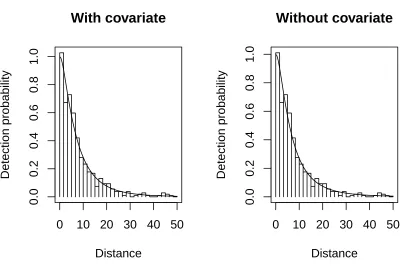
The fit of the detection functions averaged over all data look similar for both models (Fig. 1) but the
188
model with the covariate is clearly better with a4AIC of 33.34. The estimate of abundance from the model
189
with the covariate is 3212 (se=261.6) and without the covariate is 3267 (se=276). For the mixed effect model
190
the estimated standard deviation (0.57) is smaller than the same quantity for the random effect model (0.67)
191
which absorbs the heterogeneity due to the missing covariate into the random effect.
192
The total abundance estimates are similar, but when abundance is estimated for each type of object
193
(with covariate: 2176 (se = 182.9) and 1036.1 (se = 155.1); without covariate: 2669 (se = 231) and 597.2
194
(se = 70.9) the importance of including the covariate becomes obvious. When using the model with the
195
covariate, the model fits tighter to the observed data (Fig. 2) in particular for the subset of the data with the
196
smaller sample size, i.e. the subset of the data with covariate value = 1. On the other hand, for the model
without the covariate predicted detection probabilities are too low for distances near zero and too high for
198
larger distances which results in an underestimate of abundance of those with covariate value 1. Likewise,
199
the estimated abundance for objects with covariate value 0 is too high.
200
4.2
Simulation comparison with hazard rate
201The random scale normal detection function has two parameters and is thus more flexible than a
half-202
normal with a single parameter. The hazard rate which is often used to represent detection functions also
203
has two parameters, so a simulation comparison of the alternative two-parameter models is worthwhile.
204
We simulated data from a t-distribution with 3, 5, and 10 degrees of freedom, also from a random scale
205
half-normal (βg = -0.5; σ = 0.5) and from a hazard rate (g(x) = 1−exp(−(x/σ)−p);σ = 0.7;p = 2.5). 206
We simulated 500 replicates for each detection function with expected sample sizes of 60-90 and 130-180 by
207
varying the true abundance (N) for the scenario. The distances were generated using rejection sampling
208
with w=40 and the parameters were chosen so the largest observed distance would not exceed 20. The
209
number detected (n) and the largest observed distance (w) would vary so they are summarized as means
210
in the results (Table 1). For each data set we fit the random scale half-normal with the ADMB code from
211
theRandomScale package using Lg eq (6) andLf (see eq (13) from Appendix 1, Supporting Information) 212
and the hazard rate detection function using themrds package (Laake et al., 2013) using a transect width
213
(w) equal to the largest observed distance and twice the largest observed distance to approximate an infinite
214
width. We measured the proportion of replicates in which Akaike’s Information Criterion (AIC) was smaller
215
forLg versusLf and vice versa. Even though they should produce the same likelihood value we have found 216
that our ADMB implementation ofLf has better convergence thanLg. We also compared the proportion of 217
replicates in which AIC was smaller forLf versus the hazard rate model. For the random-scale half-normal 218
model we computed the percent relative bias (PRB=100(N−Nˆ)/N) and its simulation standard error and
219
root mean squared error (√(var( ˆN)−(N¯ˆ−N)2) expressed as a percentage of N. We also computed the
220
same quantities using the estimate from the model with the smallest AIC for each replicate. In comparing
221
abundance estimates to the true value we usedN/w which scales with the width of the transect that was
222
used.
223
As expected, the random scale half-normal and hazard rate did best when the data were generated from
224
the fitted model. In general, when generating data under a different distribution, the hazard rate tended
225
to underestimate and the random scale half-normal model tended to over-estimate abundance. However,
226
when AIC was used to select the best model, the average bias was typically less than 5% and often within
227
simulation error. The bias of the average was largest when data were generated from the hazard rate, because
the random scale half-normal tended to over-estimate the intercept and abundance because the hazard rate
229
detection function has a long tail and then flattens near x=0. For these same scenarios, the ADMB code
230
for Lg had substantial problems with convergence in comparison to Lf. In fewer than 0.2% of the 10000 231
simulations did theLgcode produce a smaller negative log-likelihood thanLf. Whenw was set to twice the 232
largest observed distance, the random scale half-normal performed better with less bias and the hazard rate
233
performed worse with more negative bias except when the hazard rate was used to generate the simulated
234
distances. In real data applications we never know the true detection function, so it is useful to have a set
235
of models to examine and use a model selection criterion like AIC.
236
5
Application to harbor porpoise data
237In 2002, a small boat survey for harbor porpoise (Phocoena phocoena) was conducted in waters of the Strait
238
of Juan de Fuca and around the San Juan Islands in Washington state, USA. Three observers surveyed along
239
a set of systematically placed lines with an observer standing on the bow and at the starboard and port
240
sides. When harbor porpoise were detected, the angle from the line to the harbor porpoise was measured
241
with an angle board and the radial distance to the detection was estimated visually. Observers were trained
242
and tested in visual distance estimation but for this example, we ignore the error in distance estimation.
243
The angle and radial distance was converted to perpendicular distance. In addition to distance, the number
244
of harbor porpoise (size) was recorded for each detection.
245
A total of 477 harbor porpoise groups were detected with group size varying from 1 to 6. We fitted a
246
model with a half-normal detection function and used group size as a covariate. We fitted a fixed effect
247
detection function with themrdspackage (Laake et al. 2013) and a mixed effects detection function with the
248
RandomScale package. Themrds package requires a finite width, so to make the AIC values equivalent we
249
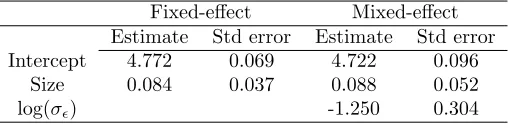
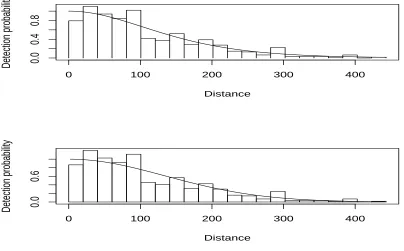
setw=443.2 the largest distance for each analysis. The fit of the detection functions (Table 2) look similar
250
(Fig. 3) but the model that includes the random effect is slightly better with a4AIC of 2.6. The estimate
251
of harbor porpoise group abundance within the 886.4 meter strip is 1243 (se = 59) for the fixed effect model
252
and 1360 (se = 93) for the mixed effect model. The higher abundance estimate resulted from the slightly
253
steeper estimated detection function (Fig. 3).
254
6
Discussion
255
Incorporating a random effect in the scale of the detection function extends the covariate approach of
256
Marques and Buckland (2003) to enable modeling of additional unspecified and typically unknown sources
of heterogeneity in detection probability. This removes the need to select an arbitrary truncation width
258
which is typically needed for the CDS key-adjustment function fitting (Buckland et al., 2001). The random
259
and mixed effects modeling can be used with other detection functions such as the hazard function (Buckland
260
et al., 2001) as long as the parametrization includes a scale parameter (x/σ); although it could also be applied
261
to the shape parameter in the hazard function. The models can be easily extended to allow covariates to be
262
included for the random effects standard deviation σ. For example, heterogeneity in detection probability 263
may be enhanced or reduced as a function of weather, habitat or other covariates. We propose that a random
264
or mixed effect model of the detection function scale be adopted as one of the standard approaches for fitting
265
detection functions in distance sampling.
266
7
Ackwlowledgements
267
We thank Steve Buckland for reviewing a nearly final draft of the paper. Cornelia Oedekoven was supported
268
by a studentship jointly funded by the University of St Andrews and EP-SRC, through the National Centre
269
for Statistical Ecology (EPSRC grant EP/C522702/1). Hans Skaug thanks the Center for Stock Assessment
270
Research for facilitating his visit to University of California, Santa Cruz.
271
References
272Borchers, D. and Burnham, K. (2004). Advanced Distance Sampling., chapter General formulation for
273
distance sampling. Oxford University Press, Oxford.
274
Buckland, S. T., Anderson, D. R., Burnham, K. P., Laake, J. L., Borchers, D. L., and Thomas, L. (2001).
275
Introduction to Distance Sampling. Oxford University Press.
276
Fournier, D. A., S. H. J., Ancheta, J., Ianelli, J., Magnusson, A., Maunder, M. N., Nielsen, A., and Sibert, J.
277
(2012). Ad model builder: using automatic differentiation for statistical inference of highly parameterized
278
complex nonlinear models. Optimization Methods and Software27,233–249.
279
Hedley, S. L. and Buckland, S. T. (2004). Spatial models for line transect sampling. Journal of Agricultural,
280
Biological and Environmental Statistics9,181–199.
281
Laake, J., Borchers, D., Thomas, L., Miller, D., and Bishop, J. (2013). mrds: Mark-Recapture Distance
282
Sampling. R package version 2.1.4.
283
Marques, F. F. C. and Buckland, S. T. (2003). Incorporating covariates into standard line transect analyses.
284
Marques, T. A., Buckland, S. T., Borchers, D. L., Tosh, D., and McDonald, R. A. (2010). Point transect
286
sampling along linear features. Biometricspage no.
287
Marques, T. A., Thomas, L., Fancy, S. G., and Buckland, S. T. (2007). Improving estimates of bird densities
288
using multiple covariate distance sampling. The Auk124,1229–1243.
289
Miller, D. L. and Thomas, L. Mixture models for distance sampling detection functions. Unpublished
290
manuscript.
291
Pledger (2000). Unified maximum likelihood estimates for closed capture-recapture models using mixtures.
292
Biometrics56,434–442.
Table 1: Percent relative bias (PRB) and root mean square error (RMSE) as proportion of true abundance for random scale half-normal and hazard rate detection function models for distances generated from t-distribution, random scale half-normal and hazard rate detection functions. Each value is the summary for 500 replicate simulations; ¯wand ¯nare the mean truncation distance and mean sample size. The subscripts F, G and HR refer to
Lf, Lg and the hazard rate. AVG subscript represents the values in which the estimate was generated from the model that had the lowest AIC for each replicate. Data were generated from a t-distribution with listed degrees of freedom (t(df)), a random scale half-normal (hn) withβg = -0.5 and
σ= 0.5 , and a hazard rate (hr;g(x) = 1−exp(−(x/σ)−p withσ= 0.7 andp= 2.5).
Function w¯ n¯ P RBF P RBHR P RBAV G se(P RBAV G) AICF < AICHR AICF < AICG AICG< AICF RM SEF RM SEHR RM SEAV G
t(df=3) 8.80 136.46 8.67 -9.80 -2.25 0.84 0.39 0.14 0.00 16.67 18.61 18.87
17.23 136.46 6.23 -13.01 -0.97 0.80 0.63 0.16 0.00 17.97 17.02 17.81
t(df=5) 5.23 132.30 7.46 -7.92 -0.86 0.77 0.46 0.06 0.00 15.73 16.89 17.13
10.47 132.30 4.04 -12.50 -0.21 0.68 0.76 0.09 0.00 17.34 14.62 15.29
t(df=10) 3.70 128.09 4.88 -7.98 -2.11 0.68 0.46 0.08 0.00 14.97 14.47 15.26
7.41 128.09 1.54 -13.58 -1.19 0.60 0.84 0.07 0.00 17.82 12.74 13.57
t(df=3) 6.86 68.18 15.08 -3.78 2.11 1.34 0.29 0.10 0.00 23.95 33.18 30.01
13.63 68.18 8.84 -10.11 0.43 1.13 0.57 0.10 0.00 21.95 26.57 25.24
t(df=5) 4.32 66.16 11.24 -3.64 1.74 1.14 0.34 0.06 0.01 22.19 27.56 25.66
8.64 66.16 4.51 -11.48 -0.59 1.01 0.70 0.11 0.01 21.69 22.20 22.59
t(df=10) 3.24 63.65 10.92 -1.82 2.37 2.55 0.34 0.03 0.00 23.77 27.04 25.58
6.48 63.65 3.62 -12.01 0.00 2.12 0.77 0.08 0.03 21.33 20.14 21.23
hn 4.52 172.60 3.33 -12.28 -2.51 0.69 0.62 0.06 0.00 17.21 14.27 15.68
9.03 172.60 0.02 -16.62 -2.03 0.63 0.89 0.12 0.00 20.11 13.43 14.32
hn 3.79 86.50 8.28 -7.32 -0.80 1.02 0.39 0.04 0.00 20.00 23.58 22.85
7.59 86.50 2.09 -13.69 -1.41 0.91 0.79 0.07 0.00 21.57 19.87 20.47
hz 15.67 183.22 20.22 2.87 3.11 1.09 0.01 0.80 0.00 10.96 28.48 11.34
28.48 183.22 19.44 1.94 4.28 1.30 0.09 0.82 0.00 10.68 27.64 13.72
hz 12.57 91.44 24.97 4.01 5.32 0.87 0.05 0.56 0.00 17.98 35.94 20.17
22.68 91.44 23.32 2.40 5.76 0.90 0.14 0.55 0.00 17.12 34.27 20.93
Table 2: Parameter estimates, standard errors for fixed (AIC=5375.7) and mixed effect (AIC=5373.1) models fitted to harbor porpoise vessel survey data.
Fixed-effect Mixed-effect Estimate Std error Estimate Std error Intercept 4.772 0.069 4.722 0.096
Size 0.084 0.037 0.088 0.052
0
10 20 30 40 50
0.0
0.2
0.4
0.6
0.8
1.0
With covariate
Distance
Detection probability
0
10 20 30 40 50
0.0
0.2
0.4
0.6
0.8
1.0
Without covariate
Distance
[image:15.612.76.481.84.352.2]Detection probability
0 10 20 30 40 50
0.0
1.0
Model with covariate
covariate value=0
Distance
Detection probability 0 10 20 30 40 50
0.0
0.8
Model with covariate
covariate value=1
Distance
Detection probability
0 10 20 30 40 50
0.0
0.8
Model without covariate
covariate value=0
Distance
Detection probability 0 10 20 30 40 50
0.0
1.0
Model without covariate
covariate value=1
Distance
[image:16.612.75.486.81.358.2]Detection probability
0 100 200 300 400
0.0
0.4
0.8
Distance
Detection probability
Distance
Detection probability
0 100 200 300 400
0.0
[image:17.612.75.479.107.358.2]0.6
Supporting Information
294Additional Supporting Information may be found in the online version of this article:
295
296
Appendix S1: Comparison between two likelihood formulations for the random scale detection function
297