OPEN VIRTUAL WORLDS: A SERIOUS PLATFORM FOR
EXPLORATORY AND GAME BASED LEARNING
Miller, Alan, University of St Andrews, St Andrews, UK [email protected]
Getchell, Kristoffer, University of Bedfordshire, Luton, UK [email protected]
Allison, Colin, University of St Andrews, St Andrews, UK [email protected]
This paper presents our experiences of, and reflections, on five years’ work in using virtual worlds to support exploratory learning across a range of disciplines and educational contexts. Both educational and systems aspects are considered. Experiential learning enriches education by allowing exploration of a subject. However, often barriers of time, place, cost or scale make it difficult to conduct real world experiential learning. This paper presents experiences in utilizing virtual worlds to support experiential learning in the arts, humanities and sciences. The work presented here draws upon several years of experience in designing, developing and deploying virtual world applications, which address the concrete needs of specific subject areas in a range of educational contexts.
The work was motivated by the observation that 3D educational environments could leverage digital literacy developed whilst playing console games and the desire to provide an engaging learning experience where users navigate a virtual environment much as they would the real world. Furthermore, developments in computer hardware and networking mean that 3D applications are more readily able to run on standard computers found in offices and educational institutions.
The initial application developed was a simulation of an archeological excavation. Prototypes were developed in a first person shooter game, a virtual reality environment and a virtual world. We found that virtual world technology offered users presence through the proxy of avatars and powerful support for shaping and programming the environment.
Our experience in virtual worlds has developed over time, with a simulation of an archeological dig, a virtual teaching space for a management course, a virtual lab for wireless networking and a lab for exploring Human Computer Interaction being the first projects hosted on our Second Life island. The experience was positive and students engaged in valuable learning activities that would not otherwise have been possible. However, we came up against several constraints that were not inherent in Virtual Worlds per se, but rather flowed from the service model adopted in Second Life. This led us to explore alternatives and saw us transition towards an OpenSim based open virtual world.
The ability for institutions to manage their own virtual world service offers benefits in the areas of content creation, application development, cost and scalability. However, in providing such a service, a number of challenges arise that must be met if the educational potential of virtual worlds is to be realised. These challenges lie in the realms of application design, support for resource creation, and system support.
The power of open virtual worlds is illustrated in three exemplar applications developed in OpenSim. These are a virtual laboratory for experimenting with Internet routing protocols, a reconstruction of what was once Scotland’s largest and most important religious building; St Andrews Cathedral, and a tool for learning about intervention in humanitarian disasters.
Within our work, a number of subjects and educational contexts are considered: including PhD and masters research projects, laboratory sessions as part of accredited degree programs, open days for aspiring entrants and an exhibition held in a science center attended by the “interested public”. Subject areas include computer science, history, management, archeology, and art history.
Taken together this work demonstrates the power of virtual worlds as a platform for developing 3D applications that support heterogeneous exploratory learning. There are still challenges to be met for the potential to be realised but the potential is considerable.
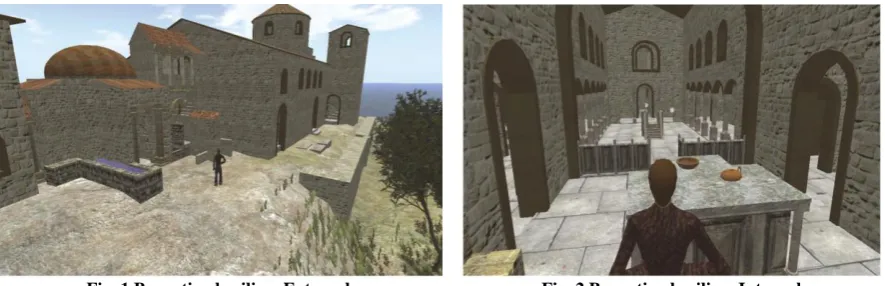
Fig. 1 Byzantine basilica: External Fig. 2 Byzantine basilica: Internal
INTRODUCTION
Virtual Worlds (VW) offer the promise of widening and enriching the educational scenarios within which exploratory learning may be practiced. They empower students to explore contexts that would be inaccessible to them in the real world. Learners achieve presence through the proxies of avatars, and consequently are aware of and may interact with fellow learners within the virtual environment. The geography and architecture of VWs may be defined and programmed by users, thereby allowing learners to participate in a creative process online.
As the baseline of computing equipment available in academic institutions and the home environment continues to advance, commodity PCs have the 3D graphics capabilities that was previously reserved for graphics workstations. Consequently, 3D environments are becoming more accessible.
We have found that VWs are engaging, popular and motivating [1]. Students enjoy using them and find them educationally valuable [2]. Furthermore VWs provide a rich environment through which content presented through media such as; text, images, video and animations, may be collaboratively explored. This enables the creation of spaces that include both interactive simulations and supporting materials. As learners navigate virtual 3D spaces they may select learning pathways, thereby enabling self-paced, collaborative and student centred exploratory learning.
The main contributions of this work are in the identification; of opportunities that arise from the use of Open Virtual Worlds (OVW), of challenges that need to be met for these opportunities to be realised and in meeting these challenges, as well as in developing, deploying and evaluating OVW based applications that support experiential learning.
This paper is organized into the following sections. First, experiential learning is defined; its advantages and limitations are considered along with how it may be blended with other modes of learning. Next experiences of using the popular VW Second Life to support experiential learning are reflected on and the opportunities and challenges that arise from running OVW services are identified. Progress in the development of a framework for developing and delivering an OVW, which provides support for content creation, application development, managing network resources and utilising private clouds to provide services is reported. Three exemplar applications developed with the framework: a Reconstruction of St Andrews Cathedral, a Network Routing Laboratory and a Virtual Humanitarian Disaster, are then introduced. The applications’ educational contribution is then described and their value assessed.
EXPERIENTIAL LEARNING
where the learner is both active and is able to draw upon didactic learning to establish the knowledge base required to maximise their benefit from active learning.
One of the main restrictions on the use of experiential learning is the scope of the learner’s direct experience. Barriers of cost, time, place and scale may limit the ability to engage directly with phenomenon under study. Atoms are too small to experience directly, it is not possible for most of us to walk on the moon, computer networking protocols cannot be directly observed and ancient buildings cannot be seen as they were in the past.
The scope of a learner's experiences can be extended by creating virtual experiences utilising computer simulations. As computer systems continue to advance, so does the availability, sophistication and realism of simulations. Today, commodity computer systems being bought by schools, businesses and universities support 3D virtual environments. As old stocks of computers are replaced, 3D capabilities will become routinely available.
EXPERIENCES IN SECOND LIFE AND OPENSIM
Virtual Worlds like Second Life offer a 3D framework which can be used to develop heterogeneous applications. The ability of “residents” to program and shape their environment lies at the heart of the power of VWs. This is illustrated by the wide range of educational applications developed within Second Life. Three examples are given below:
The LAVA project: The development of a mixed 2D/3D simulation of the excavation of a Spartan Basilica. A reconstruction of the Basilica was developed in Second Life [3].
WiFi Virtual Laboratory: In world interfaces and visualisations were linked to a realistic network simulator to allow students to collaboratively explore WiFi protocols [4].
HCI Lab: The programmability of the environment allowed a space to be created within which students conducted assignments designing user interfaces [5].
The experience of using Second Life as an educational platform was positive. Students found the environment engaging; the platform offered greater flexibility than traditional computer games and, unlike virtual reality, allowed users to achieve presence through the proxy of avatars [6 - 9].
However, we found there were several limitations on the power of the environment. The programmability is appropriate for simple interactions and animations only. There are restrictions on the mode and the frequency of external communication.In order to develop an in world presence land needs to be rented, which limits the scale of presence that can be achieved for a given budget. There are restrictions on uploading and downloading content.
These limitations are not inherent in VWs; rather they flow from the service model operated in Second Life. Alternative service models are supported by OVWs, with institutions able to subscribe to a service, run their own service or choose a hybrid approach.
The flexibility offered by OVWs means they can be deployed in a number of scenarios, with different user interfaces being appropriate for different circumstances. In a standard PC configuration, users interact with the VW using a mouse and keyboard. This configuration provides access to all features but requires some familiarisation before proficiency is achieved. Touch screens and games controllers can be used to reduce the time to proficiency amongst users at the cost of providing access to only a subset of VW functionality.
CHALLENGES FOR OPEN VIRTUAL WORLDS
There are a number of similarities between OpenSim and SL. They share the same clients; consequently they share a common user interface. Interactivity can also be added to both environments through the development of scripts. The configuration and operation of a local VW service provides opportunities to improve support for content creation, application development, service provision and system development. These, in turn, allow the range of in world activities that are supported by the virtual world to be enriched.
Content Creation: Having administrative control over the VW allows object import and export policies to be defined locally. By using Object Archive Repository (OAR) and Inventory Archive Repositories (IAR) files it is possible to save and load the entire contents of an island or an avatar’s inventory. This opens up the possibility of libraries of VW content being created and shared between different VWs.
Application Development: Administrative control of a VW opens the opportunity of enabling powerful programming paradigms. Importantly, the lifting of the arbitrary limitations SL imposes on the frequency with which scripts may create objects or participate in communication is facilitated. OpenSim contains support for three additional programming modes - Mini Region Modules, Region Modules and Plug Ins [10].
Service Provision: Running a local service offers the possibility of significantly reducing the marginal costs associated with the service as virtualisation allows the reuse of existing resources. Consequently, more in world space is available to support application needs.
System development: The existence of an open source server for VWs allows experimentation with system aspects of VWs to be addressed. For example work on network protocols and traffic management.
MEETING THESE CHALLENGES
In order to use an OVW in an educational context it is necessary to address challenges relating to content creation, application development, service provision and network resource utilisation. In our work these challenges have been addressed through the development and use of several tools.
5.1 Supporting Content Creation: The Demiurge Toolkit
Demiurge allows content for educational virtual worlds to be easily and quickly created [11]. The toolkit enables users to run a sandboxed virtual world locally, to create their content and then save and upload it to a server for use. The sandbox environment consists of a configured OpenSim server, client and supporting software. It can be run from a USB stick with the minimum of configuration.
To supplement the development environment a comprehensive set of resources are provided. These allow themed 3D spaces to be loaded as a starting point for content creation. These spaces may then be tailored in world to meet specific requirements. Once a virtual world space has been created in Demiurge it may be uploaded to a server or run locally, allowing resources to be used in laboratory sessions or run from a presenter’s laptop in a lecture.
5.2 Supporting Application Development: X Multi Region Modules
Virtual worlds are programmable through in world scripting. Users write simple scripts in world and attach them to specific objects to assign behaviour to those objects. As any user can create scripts, there are security risks with the power of scripting limited to minimise any risks. The in world development of scripts is a time consuming process. This acts as a limiting factor impacting on the level of complexity that can be delivered through in world scripts.
and loaded into the OVW environments in real-time, without the need to reconfigure or restart the service. XMRMs were used to develop network layer routing simulations on Routing Island [10] that allow students to interact and ‘play’ with the algorithms they are learning.
5.3 Service Provision: Cloud Aware Virtual World System
Virtual world usage is not smooth, with demand peaking during in world events [12]. From an educational perspective, these events may be a laboratory session or lecture. When utilisation is low it is sensible to host a region in a cloud, with the region moving to dedicated servers when demand increases. The CLoud Aware virtual World System (CLAWS) allows virtual worlds to be dynamically resourced and migrated in response to measured system load. It is made up of two parts. The first is a monitoring system responsible for collecting and analysing data from OpenSim regions and from the cloud virtual machines. The second is an application plugin for OpenSim which facilitates the migration of regions between simulations located on different hosts or virtual machines.
The load balancing system is designed as an OpenSim plugin. This causes OpenSim to expose an additional XML-RPC API which facilitates the redistribution of load. The central component bridging together the two subsystems redistributes load dependent upon the obtained monitoring data. The result is a system which automatically compensates for changes in load by leveraging a cloud system (Figure X1). This is achieved through the serialisation and transfer of OpenSim regions over XML-RPC, with connections to clients maintained throughout the transfer.
5.4 Network Systems: Mongoose
As with any multimedia application there are issues concerning how VWs regulate their demands on networks to avoid congestion. TCP’s Fair equation is used as the yardstick for assessing the success of non-TCP congestion control schemes, and has been a crucial mechanism for avoiding congestion collapse on the Internet. There have been several studies of VW traffic [13-15]. We have conducted a systematic comparison of SL with TCP which showed that the standard SL client uses more bandwidth than TCP under conditions of scarce resource and less bandwidth than TCP when resources are plentiful. A new SL client has been developed, Mongoose, which uses a window tracking rate congestion control system. A set of experiments were carried out, which showed that Mongoose achieves a much closer fit to the TCP Fair equation than the standard SL client [16].
If virtual worlds are to become as ubiquitous as the web two further issues need to be addressed. The development of open standards which enable communication between different virtual world implementation [18.19] opens up the possibility of networks of virtual worlds being interconnected. Integration with the existing web and addressing the issue of persistence of presence across VWs will improve accessibility and enable 3D interfaces to existing web resources to be developed.
1
Each server runs Userbot, an OpenSim bot written in C#, and the OpenSim load balancing system. collectd polls each server and commits test data to the database; analysed examines host performance over time; and controld manages virtual machines and the invocation of the load balancing system.
VIRTUAL WORLD APPLICATIONS
Within education, VWs may be used to support distance learning, to replicate tutorials and lectures in a virtual environment and for outreach work [2]. We focus upon our experiences in developing support for experiential learning. Three examples are outlined, the reconstruction of St Andrews Cathedral for classics students, the creation of a tool for management students to explore issues that arise with interventions within humanitarian disaster [17] and a virtual laboratory for experimenting with network routing algorithms [10]. Similar work described elsewhere includes a simulation of an archaeological excavation [17,18], human computer interaction laboratories [5] and a virtual laboratory for exploring wireless networking [4].
6.1 Phoenix: Reconstructing Scotland’s Cathedral
St Andrews Cathedral is a striking landmark and a fascinating building for scholars and visitors alike. Work on the Cathedral began around 1160 and it was finally consecrated in 1318 in the presence of Robert the Bruce. At one time the Cathedral was Scotland’s largest and most magnificent church. Today the Cathedral site spans approximately 1 km2. Much of the building was destroyed during the reformation and many Cathedral stones can be found in the walls of the town’s houses. Whilst sections of wall and St Rules tower remain, it remains difficult to construct a mental image of the scale and complexity of the Cathedral architecture.
The reconstruction of the Cathedral was the subject of several student projects, with each having a specific set of goals: developing a web site which supports account creation and links to a welcome area in the 3D world, developing a visitor’s centre, developing specific areas of the site and developing a location aware heads up display that provides a multimedia guided tour. From a systems perspective it was necessary to have VW resources on scale sufficient to host the Cathedral site. With multiple people working on the project simultaneously, the Demiurge toolkit was used to provide an independent sandboxed development environment for each student.
6.2 Virtual Humanitarian Disaster
The Virtual Humanitarian Disaster (VHD) learning and teaching resource is centred on simulating the events occurring in the aftermath of an earthquake, enabling students to make decisions concerning critical situations within the controlled environment of a virtual world, where the consequences of any decisions do not impact on the lives and property of those in the real world.
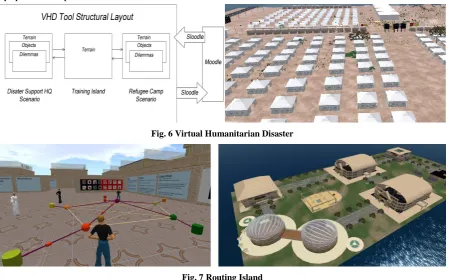
There are three islands within the VHD; the command centre, an area for constructing a refugee camp and a reference refugee camp. The command centre is equipped with video streams providing
[image:6.595.90.539.101.232.2]information related to the disaster, links to web sites which provide the availability and cost of equipment and personnel, and a series of dilemmas for students to consider.
In the construction area students are provided with the tools with which to construct their own camp. These include templates for tents, food, medical supplies, latrines, lights and fences. In designing the camp factors such as hygiene, security, density of population and cultural sensitivity need to be considered. The reference refugee camp, build with input from practicing professionals, spans several islands and is built to scale. It provides an exemplar against which student designs can be compared.
6.3 Routing Island
[image:7.595.89.540.108.388.2]Routing algorithms are critical to the Internet, with the core algorithms forming an integral part of computer networking courses. Learning about routing algorithms can be difficult because they are dynamic, abstract and invisible. The way they react to changes in the network can be hard to visualise in static, paper based diagrams and the fact they are distributed means that making the connection between lines of pseudo code in a textbook and their behaviour on multiple nodes can be difficult. Routing Island is based around a tool that allows students to explore the behaviour of routing algorithms. The tool is designed to supplement diagrams in textbooks or printed lecture notes by allowing students to visualise network behaviour at any node. Unlike the real world, in the virtual world it is possible to define a network topology, construct links and then watch packets flow. By altering the topology as traffic is flowing students can see, in real-time, how dataflow is impacted. The user is then able to investigate how the algorithms work from any node on the network. This allows them to observe the steps the algorithm takes as it calculates routing paths across the network from multiple vantage points. The user is also able to send packets across the network and observe how changes made by the routing algorithm affect the route that packets take. The goal is that users are free to watch how the algorithms work, develop hypothesis about how changing the topology will change the algorithms, and then make those changes to test if their hypothesis is correct.
Fig. 6 Virtual Humanitarian Disaster
EVALUATION SCENARIOS
The evaluation of our use of VWs in educational contexts is on-going with the Cathedral, Routing Island and Virtual Humanitarian Disaster all being used as part of accredited degree courses in 2011/12. We have evaluated the deployment of VWs in two separate public engagement events; a science fair/exhibition hosted by the Dundee Science Centre and an Undergraduate Recruitment Event/Open Day hosted by the School of Classics at the University of St Andrews.
7.1 Virtual Worlds in Exhibition Spaces: Experiences at Dundee Science Centre
In this scenario the VW reconstruction of St Andrews Cathedral was exhibited over the weekend of 16 – 18th
March 2012. There were over 1000 visitors, comprising groups from local primary schools and Scout and Guide groups as well as the general public.
At the exhibition, four visitor terminals were connected to a mobile server via an isolated network switch, with a performance monitoring and administration terminal connected to the server. WiFi connectivity was also provided to allow laptops to be used to control a number of in-world characters that were designed to interact with visitor’s avatars.
The visitor terminals included two 24” TFT screens and a 150” projection screen to allow the view from the terminals to be broadcast to the entire exhibition space. Visitors interacted with the VW using XBox controllers with the left joystick controlling movement and the right joystick controlling the direction in which the avatar was looking. Visitors could walk, run and fly through the VW whilst talking to other in-world characters using the headphones and microphones attached to the Xbox controllers.
Several programmed characters were created to escort visitors through the VW, these included: A Bishop, King Robert the Bruce who consecrated the Cathedral in 1318, an Augustinian Friar, the “Old Grey Lady” (a ghost reported to haunt the cathedral), a Dundee United football player and young “modern” male and female characters. In addition, visitors were also free to explore at their own pace.
Throughout the three-day event, network traffic traces were captured along with application load and server resource metrics including; frame rendering times, the number of frames per second delivered by the server and server memory utilisation.
The experience was evaluated in three ways; users of the system were observed, a visitor book was provided where freeform feedback could be provided and questionnaires were handed out. The feedback received was strongly positive with over forty comments left in the visitor book alone.
“the best place I have ever been love everything inside and will be looking forward to coming back”
male primary school student
“very detailed and interesting. good game. we like robert the bruce :)” 3 female primary school students
“kids were very interested and enjoyed being able to interact with the cathedral, the controllers were a medium that made it easy for them to do this” parent
“Fantastic work. Can't wait to visit St Andrews again to look at the cathedral ruins” family group
“Very interesting would be great to be shown in schools” STEM ambassador
Through observing visitors and interacting with them in-world it was clear that people were attracted to the exhibit and found it easy to use, engaging and educational. All ages were able to quickly master the user interface and navigate the environment with minimal levels of instruction. School children between the age of 7 and 17 were particularly adept at using the controllers.
to follow up the experience through visiting the cathedral ruins or by connecting to the Cathedral model from home and exploring it in more detail.
7.2 Virtual Worlds Laboratory Session as Part of a Blended Approach to Learning
The Virtual Sparta and the Reconstruction of the Byzantine Spartan Basilica were used in the School of Classics open day to provide an engaging taster of studying Classics at the university. Several school groups attended the open day, with each 45-minute session taking place in the computer laboratories in the Schools of Classics. Equipped with 14 computers capable of running the SL client at medium to law graphics settings, the laboratory was not an ideal location for the event, but its proximity to the other open day events meant that participant numbers were high. Visitors interacted with the VW using the traditional keyboard and mouse interface.
At the start of each session, participants were asked to name five things that typified ancient Sparta and share these with the rest of the group. Typical responses focussed on military aspects; soldiers, red, gladiators, war, etc. This was followed by a 15-minute used to introduce some of the history, politics and prose of Spartan culture, after which participants entered the VW to explore the areas surrounding the Basilica. In the first part of the VW session participants were free to familiarise themselves with the avatar controls and explore the Basilica. In the second part a lecturer used a live projection of the Basilica to illustrate an explanation of the relationship between the status worshippers and the viewpoints of ceremonies they could access.
Participants were engaged throughout the session and were able to navigate the VW environment successfully. They were also able to communicate with each other in world as they explored the 3D space using textual chat. At the end of the session participants were asked an open question: “In what ways has this session made you rethink ancient Sparta?” Two representative answers are given below:
I now see Sparta as not merely a city of war and violence for it actually had great political minds along with poetic influences. It also shows that it was not as barbarous as it’s made out to be for it had well-built and established churches showing.
I didn’t know that Spartans wrote poetry! First one sounded like Horace to begin with. Intriguing to wander around an ancient site and experience it three dimensionally. I would be interested to be able to use other ancient buildings in this sort of way.
CONCLUSION
Virtual Worlds offer the opportunity for students to gain experience in environments that are inaccessible in the real world. It is due to this that we contend that VWs have the potential to widen the use of experiential learning in the curriculum.
Open virtual worlds present a number of opportunities for reducing the cost and increasing the power of VW applications. For this potential to be fully realised, however, technical and engineering challenges need to be overcome.
The Demiurge toolkit enables the offline creation and sharing of resources, and XMRMs enable programmers to extend the underlying capabilities of the OpenSim environment with customised modules. Mongoose, a TCP Fair client ensures VWs efficiently make use of network resources without adversely affecting other traffic on the network, and CLAWS, for minimises the cost of VW infrastructure by utilising virtualisation/cloud technology.
References
Wankel, C., & Kingsley, J. Higher Education in Virtual Worlds Teaching and Learning in Second Life
2009, Emerald Group Publishing Limited, Howard House, Wagon Lane Bingley.
Jiang, S., Duncan, I. M. M., & Miller, A. H. D.. A taxonomy of virtual worlds usage in education. British Journal of Educational Technology (2011).
Getchell, K., Miller, A., Allison, C. & Sweetman, R. J. Exploring the Second Life of a Byzantine Basilica, (2009) Serious Games on the Move. Petrovic, O. & Brand, A. (eds.). Springer p. 165-180.
Sturgeon, T., Allison, C., Miller, A., & Miller, A. H. D. (2009). 802.11 wireless experiments in a virtual world. In Proceedings of the 14th annual ACM SIGCSE Conference on Innovation and Technology in Computer Science Education (pp. 85—89).
Perera, I., Allison, C., Nicoll, J., Sturgeon, T., & Miller, A. H. D. (2010). Managed Learning in 3D Multi User Virtual Environments. International Journal of Digital Society (IJDS), 1(4), 323-332. Lang, S. L., & Kobilnyk, D., Visualizing Atomic Orbitals Using Second Life, Journal of Virtual
Worlds Research, Vol 2, No 1 (2009)
Schwartz, D., Second Life and Classical Music Education: Developing Iconography That Encourages Human Interaction, Journal of Virtual World Research, Vol 2, No 1 (2009)
Gerstein, J Beyond the Game: Quest Atlantis as an Online Learning Experience for Gifted Elementary Students, Journal of Virtual World Research, Vol 2, No 1 (2009)
Jarmon, L., Lim, K. Y. T., & Carpenter, B. S., Pedagogy, Education & Innovation, Journal of Virtual Worlds Research, Vol 2, No 1 (2009)
McCaffery, J. P., Miller, A. H. D., & Allison, C. (2011). Extending the Use of Virtual Worlds as an Educational Platform - Network Island: An Advanced Learning Environment for Teaching Internet Routing Algorithms. In International Conference on Computer Supported Education (CSEDU) 2011
Miller, A. H. D. (2011). Demiurge: a toolkit for creating educational content in virtual worlds. In 12th Annual Conference, of the Educational Academy Subject Centre for Information and Computer Science Belfast.
Sanatinia, A., Oliver, I. A., Miller, A. H. D. & Allison, C., Virtual Machines for Virtual Worlds, CLOSER 2012 International Conference on Cloud Computing and Services Science.
J. Kinicki and M. Claypool, Traffic Analysis of Avatars in Second Life, in Proceedings of the 18th ACM International Workshop on Network and Operating Systems Support for Digital Audio and Video (NOSSDAV), Braunschweig, Germany, May 2008.
S. Fernandes, F. Antonello, J. Moreira, D. Sadok, and C. Kamienski, Traffic Analysis Beyond This World: The Case of Second Life. in 7th International workshop on Network and Operating Systems Support for Digital Audio & Video (NOSSDAV) 2007, 2007.
Getchell, K., Miller, A., Nicoll, J. R., Sweetman, R. ., Allison, C., & Miller, A. H. D. (2010). Games Methodologies and Immersive Environments for Virtual Fieldwork. IEEE Transactions on Learning Technologies, 3, 281-293.
Getchell, K., Oliver, I., Miller, A., Allison, C., & Miller, A. H. D. (2010). Metaverses as a Platform for Game Based Learning. In Proceedings of 24th IEEE International Conference on Advanced Information Networking and Applications (AINA), 2010 (pp. 1195—1202).
Oliver, I. A., Miller, A. H., & Allison, C. (2010). Virtual worlds, real traffic: interaction and adaptation. In Proceedings of the first annual ACM SIGMM conference on Multimedia Systems (MMSYS 2010) (pp. 305--316). ACM Press - Association for Computing Machinery.
Oliver, I. A., Miller, A. H. D. & Allison, C. Mongoose: throughput redistributing virtual world,
Proceedings of the 21st IEEE International Conference on Computer Communications and Networks. IEEE
Dow, L., Miller, A. H. D. & Burt, E. Managing Humanitarian Emergencies: Teaching and Learning with a Virtual Humanitarian Disaster Tool 2012 CSEDU 2012.
Gelissen, J. H. A., et al MPEG-V and Other Standards, Journal of Virtual Worlds Research, Vol 4 No 3 (2011)