Elisabeth Schlottmann,1,∗ Steffen Holzinger,1,∗ Benjamin Lingnau,2 Kathy L¨udge,2 Christian Schneider,3 Martin Kamp,3 Sven H¨ofling,3 Janik Wolters,1,† and Stephan Reitzenstein1
1Institut f¨ur Festk¨orperphysik, Quantum Devices Group, Technische Universit¨at Berlin,
Hardenbergstraße 36, EW 5-3, 10623 Berlin, Germany 2
Institut f¨ur Theoretische Physik, AG Nichtlineare Laserdynamik,
Technische Universit¨at Berlin, Hardenbergstraße 36, EW 7-1, 10623 Berlin, Germany 3
Technische Physik, Universit¨at W¨urzburg, Am Hubland, 97074 W¨urzburg, Germany
(Dated: September 13, 2016)
We experimentally and theoretically investigate injection locking of quantum dot (QD) microlasers
in the regime of cavity quantum electrodynamics (cQEDCQED:::::). We observe frequency locking and
phase-locking where cavity enhanced spontaneous emission enables simultaneous stable oscillation at the master frequency and at the solitary frequency of the slave microlaser. Measurements of the second-order autocorrelation function prove this simultaneous presence of both master and slave-like
emission, where the former has coherent character withg(2)(0) = 1 while the latter one has thermal
character with g(2)(0) = 2. Semi-classical rate-equations explain this peculiar behavior by cavity
enhanced spontaneous emission and a low number of photons in the laser mode.
Controlling an oscillator’s frequency by injecting exter-nal sigexter-nals is a universal concept in nonlinear science and applies to aplethora:::::::::multitudeof physical and biological systems [2–5]. It is an integral part of mobile commu-nication or digital video broadcasting. Beyond various applications of injection locking there has been enormous interest in the physical understanding of this important phenomenon, and for conventional macroscopic oscilla-tors it is well understood by Adler’s theory [6, 7]. In con-trast, injection locking in microsystems operating close to the quantum level of light and matter is an almost un-explored field of research in which only few experiments have been realized [8, 9]. Indeed, the question appears how miniaturized devices, such as micro- or nanolasers operating in the few photon regime, respond to the ex-ternal stimulus by the master laser.
Micro- and nanolaser have been studied extensively in recent years and are usually based on dielectric or plas-monic laser resonators [10–14] with an effective mode volume on the order of the cubic wavelength. As a re-sult light-matter coupling is strongly enhanced [15] and spontaneous emission coupling factors (β-factors) close to unity are observed [16]. This allows for lasing with a greatly reduced threshold and only a few tens of photons in the laser mode [17–19]. In recent experiments such lasers operating in the regime of cavity quantum electro-dynamics (cQED::::::CQED) have been used to investigate nonlinear effects such as spontaneous chaos induced by delayed feedback [20] or symmetry breaking [21]. In this letter, we study the external control of a
cQED::::::CQED:enhanced microlaser exhibiting an ultra-low threshold and less than 100 photons in the cavity. Where synchronization of the slave laser to the master frequency is expected for its conventional counterparts,
∗These authors contributed equally to this work.
stationary oscillation synchronized to the external signal and oscillation at the solitary frequency is observed to oc-cur simultaneously for our microlaser. As evidenced by a theoretical analysis, the observed partial injection locking is a phenomenon unique to nonlinear single mode high-β microlasers excited with a few tens of quanta. Interest-ingly, the remaining emission at the solitary frequency of the slave microlaser shows thermal character associated with an autocorrelation functiong(2)(0) = 2.
The cQED CQED:::::::enhanced lasers used in our exper-iments are micropillar lasers, with a single layer of In0.3Ga0.7As quantum dots with an area density of
5·109/cm2 acting as a gain medium, sandwiched
be-tween AlAs/GaAs distributed Bragg reflectors forming a λ-cavity. Using electron beam lithography and plasma etching pillar structures with a diameter of 5.3 µm are fabricated, planarized with benzocyclobutene, and contacted with ring shaped gold contacts. From the linewidth at inversion the quality factor is estimated to Q= 21 000. Cf. Ref. [22] for details on the sample fab-rication. Due to unavoidable structural asymmetries the degeneracy of the two orthogonal polarized fundamental cavity modes is lifted [23]. In the present device this leads to a complete suppression of the higher energy mode and lasing was observed on the lower energy mode only. The device operates as a single mode laser.
The sample is mounted in a continuous flow He-cryostat at a temperature ofT ∼15 K, and electrically pumped by a precision current source. Emission is collected with an aspherical lens (NA=0.5), spatially filtered and analyzed with a power-meter, a spectrometer (spectral resolution 6.5 GHz) or alternatively with a scanning Fabry-P´erot cavity (7.5 GHz free spectral range, 100 MHz resolu-tion). The cavity photon numbershnˆ0iare deduced from
the numerical simulations of thecQED
::::::
CQEDmicrolaser and are in agreement with the measured emission power ofPS =hν0ηκhnˆ0i= 470 nW atI = 1.4Ithr with
equa-(a) ~10K microlaser variable attenuator CCD monochromator polarization
optics λ/2-plate
Fabry-Perot PZT SPCM 1 Master Slave SPCM 2 (c) (d) (b) 100 101 102 106 〈 n 〉 Experiment Theory for: β ≈2 10-6
β ≈2 10-2
.
.
100 101 δν (G Hz )1 1.2 1.4 1.6 1.8
-1 0 1 op er ati ng re gio n 〈 G 〉〈 G0 〉
Current (I/Itr)
0.04 0.07-2
-1 0 1 2 Theory Det un in g ∆ (G Hz ) Keff Experiment
0.01 0.04 0.07
[image:2.612.53.563.53.179.2]Keff 0 2 4 6 8 In te rfe re nc e A m pl itu de ( ar b. un it) (f) (e)
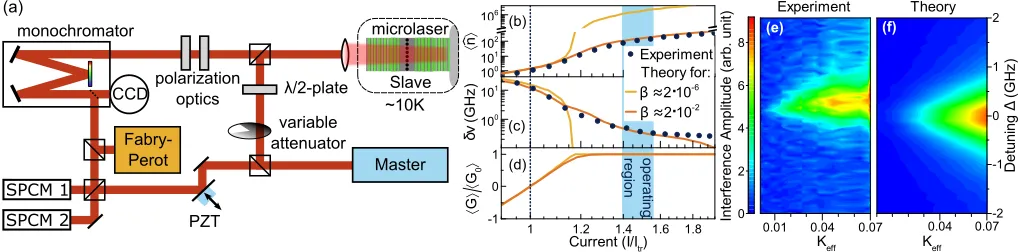
FIG. 1. The microlaser and its optical characteristics(a) Sketch of the optical setup used in the experiments. (b)-(c)
Average photon number hˆni and linewidth δν0 (FWHM) obtained from the measured output characteristics and numerical
simulations respectively as function of normalized currentI/Ithr. The investigatedcQED::::::CQEDmicrolaser exhibitsβ∼10−2,
while for comparison the calculation forβ∼10−6 corresponds to a conventional low-β laser. (d) Calculated normalized gain
hGi= 2Z g2
0(2hˆρi −1). (e) Amplitude of the phase-locked slave oscillation as a function of detuning ∆ between master and
slave and injection strengthKef f, measured at high electrical current. (f) Simulation result corresponding to (e).
tions based on a quantum Langevin approach to the
cQED CQED:::::::system in the weak coupling regime. This allows for a simple, but accurate incorporation of the phase-sensitive injection of the master field EM =
|EM|ei2π∆t. The resulting differential equations for the
complex electric field in the cavityE, where the photon number is given byhnˆi=|E|2/E2
0, the average quantum
dot occupationρ=hρ(t)ˆ iand the wetting layer occupa-tionw=hw(t)ˆ iread:
˙
E=h2Zg20(2ρ−1)−κ
2
i
(1 +iα)E+κ
2EM+FS,(1)
˙ ρ=−g
2 0
E2
0
|E|2 2ρ−1
+Sw 1−ρ− ρ
τQD
, (2)
˙ w= I
e0A
−2Z
A Sw 1−ρ
−2Z inact A ρinact τQD − w τw , (3)
where from the total number of QDs in the cavity a por-tionZ = 250 is considered as active andZinact = 750 is
considered as inactive [24], but pumped by the injected current. E0=
q
hν0
2εrε0V is the electric field per cavity
pho-ton, with ε0 and r = 11 denoting the vacuum
permit-tivity and background dielectric constant, respectively. A = 22µm2 and V = 4µm3 are the area of the pillars
cross-section and the mode volume, respectively. The photon loss rate is given by κ = 2πν0
Q = 100ns
−1. The
amplitude-phase coupling coefficientα= 2 was extracted from the experimental above-threshold linewidth shown in Fig. 1 [25], andEM is the external master laser field
incident at the micropillar. The Langevin source term FS =E0
q2βZhρˆi
τQD ξ(t) models spontaneous emission, with
a Gaussian white noiseξ(t). The Purcell-reduced spon-taneous lifetime in the QDsτQD = 110 ps and in the
wet-ting layer τw= 1 ns, respectively, which are determined
from fits to the input-output curve, Fig. 1 (b-c). All values are in agreement with measured values in similar devices [26]. The occupation of the inactive dots is
cal-culated from the static solution of Eq. (2) without stim-ulated recombination, which yieldsρinact= τQDSw
1+τQDSw.
For our experimental studies a quantum dot microlaser with emission frequency ν0 = 352 THz was used. The
measured input/output characteristics presented in Fig. 1 (b, c) were reproduced quantitatively by our numerical model. According to the simulations, the onset of stim-ulated emission occurs at a current of Ithr = 24 µA.
The β-factor is extracted from the fits to the input-output curves of the micropillar laser along with its sub-threshold linewidth, which both depend sensitively on the choice of beta. We extract β ∼ 2%. The investi-gated laser shows a rather smooth transition from spon-taneous to stimulated emission. This behavior is typical forcQEDCQED::::::enhanced microlasers [27], and stands in contrast with conventional lasers withβ&10−5
exhibit-ing a drastic increase of emission intensity above thresh-old. Similar, linewidth reduction and gain clamping are less pronounced compared to their conventional counter-parts (Fig. 1 b-d).
For a first injection experiment, a rather high cur-rent of I = 2.3Ithr was chosen. As master
oscilla-tor, emission from a tunable external cavity diode laser with frequency νM was injected into the cQED::::::CQED
oscillator. An upper limit for the injection strength Kmeas =
p
PM/PS was obtained by measuring the
free-running slave emission powerPSand the reflected master
powerPM in absence of current I after spatial filtering
by a nearly diffraction limited pinhole. Due to imperfect mode matching, the injection efficiency is below unity. We extract the effective injection ratio Kef f from
nu-merical fits to the injection locking dynamics (Fig. 1(f) and Fig. 4(b), respectively). Best agreement between ex-periment and theory is obtained forKef f =Kmeas/10.
To prove phase-synchronization between master laser and
0 . 0 0 . 5 1 . 0 1 . 5
0 . 0 0 . 5 1 . 0 1 . 5 2 . 0
- 2 - 1 0 1 2
- 2
- 1
0
1
2
( a ) n o n - l o c k e d ( b ) ( c )
" s l a v e - l i k e "
D
e
t un i n
g
∆ ( G
H
z )
f r e q u e n c y ν - ν0( G H z )
l o c k e d " m a s t e r - l i k e "
〈
nlo
c
k
〉
〈
ntot
〉
〈
nlo
c
k
〉
〈
ntot
〉
.
〈
n
〉
〈
n0
〉
n o n - l o c k e d l o c k e d
- 2 - 1 0 1 2 0 . 0
0 . 5 1 . 0
D e t u n i n g ∆ ( G H z )
.
β ≈2 1 0- 6
.
T h e o r y
〈
n
〉
〈
n0
〉 β ≈2 1 0- 2
E x p e r i m e n t
- 2 - 1 0 1 2 0 . 0
0 . 5
1 . 0 β ≈2 1 0. - 6
β ≈ 2 1 0- 2
[image:3.612.69.543.52.227.2]D e t u n i n g ∆ ( G H z )
FIG. 2. Partial injection locking of the QD-microlaser(a) High resolution spectra of the emission atI= 1.6Ithr under
optical injection withKef f ∼0.17 for various detunings. The frequency axis is relative to the free running slave frequency of
ν0 = 352 THz. The microlaser shows a large region of partial injection locking, where phase-locked oscillation at the master
frequencyν0+ ∆ and non-locked oscillation at the slave frequencyν0 occur simultaneously. (b) Upper panel: Intensity of the
phase-locked (master-like) and the non-locked (slave-like) oscillation as obtained from the measurements shown in (a). All error bars correspond to one standard deviation as obtained from fitting the data with Lorentzian curves. Lower panel: Ratio between locked and total oscillation intensity, indicating that despite the comparable large injection strength, perfect locking is
not achieved. (c) Numerical simulations corresponding to (b). For the used microlaser withβ∼2% (solid lines) partial locking
is reproduced, while for a conventional laser withβ= 0 (dashed lines) complete locking is predicted.
master’s phase with a dithering mirror corresponds to the phase-locked oscillation amplitude of the slave. Fig. 1 (e) shows a map of this amplitude, depending on in-jection rate K and detuning between master and slave ∆ =νM−ν0. A slightly asymmetric locking cone
indi-cates phase-locking up to ∆∼1.5 GHz. The asymmetry of the locking cone originates in amplitude-phase cou-pling being common for semiconductor lasers [28, 29] and interference with directly reflected master radiation for larger values ofK. Towards the border of the locking re-gion, the slave oscillation amplitude decreases, as the os-cillator is forced to oscillate at an unpreferable frequency. In this regard, the microlaser behaves under external in-jection similar to conventional lasers, where the locking range is given approximately by Kef fν0
Q
√
1 +α2∼1 GHz
forKef f = 0.03 [7, 25].
For experiments in the ultra-low light level regime, the region of stable single mode laser oscillation with I ∼
1.5 Ithr was chosen, where the measured linewidth is
δν0∼350 MHz. In this regime the average photon
num-ber in the cavity is hˆn0i ∼ 100, at least three orders
of magnitude lower compared to conventional lasers. In addition to phase-sensitive measurements, high resolu-tion spectra were recorded for varying ∆ atKef f = 0.17
(Fig. 2). For positive ∆, strong phase-locked emission at the master frequency is visible, while weaker phase-locked emission is measured for negative detunings ∆ as ex-pected from the interference measurements. Surprisingly, this is accompanied by strong non-phase-locked emission with the slave’s solitary frequency and linewidth, indi-cating a regime of partial locking where the laser
os-cillates at the master frequency and at its solitary fre-quency simultaneously. Only for detunings smaller than the emission linewidth of the solitary laser,|∆|< δν0, the
spectrally broad non-locked emission is suppressed and narrow-band phase-locked emission becomes dominant. This phenomenon of partial injection locking is well re-produced by numerical simulations taking into account the impact of Purcell-enhanced spontaneous emission in the high-βlaser operating with few photons in the cavity. Interestingly, partial injection locking is not theoretically predicted for conventional low-β single mode lasers. We would also like to note that in lasers with a more complex mode structure, an intensity reduction (but not complete suppression) under optical injection has been observed. When addressing injection in higher-order modes of VC-SELs [30] or in a different polarization mode [31, 32], a suppression of one laser mode emission was achieved by gain competition with other modes of the laser. In con-trast, our experiments are performed with a single mode laser. Here, in the locking regime the emission at the solitary slave laser frequency is mainly driven bycQED
::::::
CQED:enhanced spontaneous emission.
To gain insight into the dynamical processes, measure-ments of the second-order photon autocorrelation func-tion were performed with a Hanbury-Brown and Twiss (HBT) setup [33]. As expected for the master oscillator and equally for the slave without injection the second or-der autocorrelation function is constantg(2)(τ) = 1. In
0 . 0 0 0 . 0 5 0 . 1 0 1 . 0
1 . 5 2 . 0
0 . 8 1 . 0 1 . 2 1 . 4
- 1 . 0 - 0 . 5 0 . 0 0 . 5 1 . 0 1 . 0
1 . 2
l o c k e d n o n - l o c k e d
g
(2
)(0
)
K
∆= - 0 . 8 8 G H z
E x p e r i m e n t S i m u l a t i o n
g
(2
)(τ
)
∆= - 1 . 4 5 G H z
( b )
g
(2
)(τ
)
τ ( n s )
( a )
FIG. 3. Signatures of partial injection locking in
the time domain (a) Time-dependent second-order
auto-correlation measurements for ∆ = −1.45 GHz (top) and
∆ =−0.88 GHz (bottom). Both show an exponentially
de-caying oscillatory behavior, caused by the beat note between the simultaneously present spectrally narrow locked and the spectrally broad non-locked oscillation modes. (b) Frequency-selectively measured photon statistics of the locked and non-locked emission, with absolute value of ∆ comparable to the lower panel in (a). The latter one undergoes a transition from
coherent to thermal emissiong(2)(0) = 2 with increasing
in-jection strengthKef f. Solid lines are numerical simulations.
the time domain. The frequency of the measured oscilla-tion corresponds exactly to the frequency difference be-tween phase-locked and non-locked oscillation, while the exponential decay of its amplitude is related to the spec-tral linewidth of the two oscillation modes. In agreement with the simulations, these measurements prove that the presence of a phase-locked and non-locked components in the spectra of Fig. 2a is not caused by (fast) chaotic switching [24] as it can occur in deterministic nonlinear oscillators under external injection [34, 35], but thecQED
::::::
CQED:microlaser indeed oscillates in a superposition of both oscillation modes.
The photon statistics can be determined by performing HBT measurements spectrally filtered by a Fabry-P´erot cavity for both frequencies separately. The locked emis-sion shows as expected coherent emisemis-sion (g(2)(0) = 1)
independent of the injection strength Kef f (Fig. 3(b)).
However, the non-locked emission exhibits an increasing g(2)(0) with increasingKef f and finally reaching the
ther-mal limit g(2)(0) = 2. Thus, optical injection in a mi-crolaser provides the unique and appealing opportunity of controlling the photon statistics at the slaves solitary frequency by gradually shifting the contribution of stim-ulated emission to the master lasers frequency.
For further insight into the physical origin of partial in-jection locking, we adjust the inin-jection current to I = 1.4Ithr, where the laser operates with only 70 photons
in the cavity. While keeping the detuning constant at ∆ = δν0, the injection strength Kef f was varied. For
conventional nonlinear oscillators without quantum noise an abrupt onset of synchronization above a critical in-jection strength Kcrit is expected. In addition, close to
Kcrit the external injection may lead to chaotic
dynam-ics via gain competition effects [36]. For the given pa-rameters of our microlaser Kcrit ∼0.1 is expected [34].
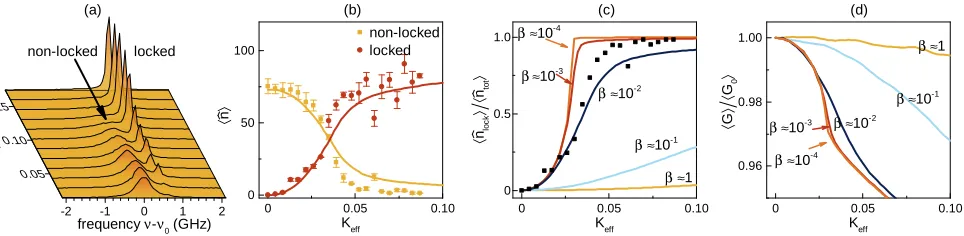
In contrast to the expectations for conventional lasers, we find a rather smooth transition from free running to synchronized oscillation when experimentally increasing Kef f (Fig. 4). In the transition region phase-locked
os-cillation at the master frequencyν0+ ∆ and non-locked
oscillation near ν0 occur simultaneously, comparable to
the case of varying detuning. Again, this effect is not at-tributed to chaotic switching between different oscillation modes observed in conventional systems: second-order autocorrelation measurements indicate constant station-ary oscillation. Chaotic dynamics are suppressed in our experiments by quantum fluctuations [36–38], as recently predicted for optomechanical systems [39].
The used quantum mechanical rate equation model per-fectly describes the phenomenon of partial injection lock-ing and the resultlock-ing dynamics. Figure 4(c) shows the ratio between the average photon number in the phase-locked mode and both oscillation modes for var-ious values of β between unity and zero. For conven-tional macroscopic laser oscillators exhibiting small β-factors and large average photon numbers, injection with Kef f > Kcrit leads to an efficient suppression of
non-locked oscillations and thus a ratio of 1. For the inves-tigatedcQEDCQED:::::::oscillator with β ∼10−2 the
non-locked oscillation intensity is comparable to the non-locked intensity for a wide range of parameters. With increas-ingβ, the presence of partial injection locking gradually increases, while in the limit of β ∼ 1, i.e. threshold-less lasers, the non-locked emission is dominant even for large injection strength. In such devices injection locking is impeded by spontaneous emission noise. This partial injection locking incQEDCQED::::::microlasers is a genuine phenomenon attributed to Purcell enhanced spontaneous emission noise playing a dominant role in a system with only a few tens of photons in the cavity.
The rate equation model gives insight into the underlying physical mechanism: Injection of the master oscillator ef-fectively reduces the cavity loss rateκ for phase-locked oscillation. Thereby, the threshold for oscillations at the master frequencyIthr ∼κis reduced and consequentely
the gainhGiis clamped to a lower value compared to the free running oscillator (Fig. 4d). In conventional lasers with low β-factor and a number of cavity photons well above 103 this mechanism suppresses non-locked
oscilla-tion, even for very small Kef f. In contrast, in cQED
::::::
[image:4.612.58.290.59.170.2]simultane-0 0 . 0 5 0 . 1 0
0
5 0 1 0 0
0 0 . 0 5 0 . 1 0
0
0 . 5 1 . 0
0 0 . 0 5 0 . 1 0 0 . 9 6
0 . 9 8 1 . 0 0
- 2 - 1 0 1 2 0 . 1 5
0 . 1 0
0 . 0 5
( d ) ( c )
( b )
K
f r e q u e n c y ν-ν0 ( G H z )
( a )
n o n - l o c k e d l o c k e d
〈
nloc
k
〉
〈
ntot
〉
n o n - l o c k e d l o c k e d
〈
n
〉
K e f f K e f f
β≈1 β≈1 0 - 2
β≈1 0 - 3
β≈1 0 - 4
β≈1 0 - 1
〈
G
〉
〈
G0
〉
K e f f
β≈1 0 - 4
β ≈1 0 - 3 β ≈1 0 - 2
β ≈1 0 - 1
[image:5.612.69.551.60.178.2]β ≈1
FIG. 4. Mode intensities and gain under variation of the injection strength with∆ = 500MHz(a) High-resolution
emission spectra of thecQEDCQED::::::microlaser atI= 1.4Ithrunder optical injection. Locked oscillation at frequencyν0+ ∆
and non-locked oscillation near frequencyν0 is visible within a large range ofKef f values. (b) Intensity of locked (red) and
non-locked (yellow) oscillation for varyingKef f. Dots are measured values extracted from (a), while solid lines correspond to
numerical simulations of the device. (c) Contribution of the locked emission to the overall emissionhˆnlocki/hˆntoti for various
β∼1−10−4corresponding tohˆn0i ∼5−7000. Dark blue squares correspond to the measurement shown in (b). (d) Calculated
gainhGias function ofKef f, corresponding to theβ-values in (c).
ously. This effect is not predicted by classical determin-istic theories of single-mode nonlinear oscillators, but is understood by the quantum theory of lasers including
cQEDCQED::::::enhanced spontaneous emission. Measure-ments of the photon statistics reveal thermal emission associated with g(2)(0) = 2 of the non-locked oscilla-tions at high injection strength. Our results pave the way for further studies on the dynamics ofcQED::::::CQED enhanced microlasers and explores the limits of exter-nal quantum control of nanophotonic systems. As such, it connects to possible applications in the field of
:::e.g. ::
in::::::optical:::::data:::::::::::::::communication,::::::where:::::::::::::::injection-locking
:::
can::::::::increase:::the:::::::::::modulation::::::::::bandwidth:::of:::::::::::conventional
:::::
lasers:[40].:::::::::::::Furthermore,:::::::chaotic::::::::::dynamics:::::::induced:::by ::::::::
feedback::::::::injection::is:::::::applied::in::::::securechaos communica-tion and random number generacommunica-tion [41]. Interestingly, it also very relevant to optical reservoir computing , in particular, for an appealing implementation :::::When
:::::
using:::::::::::miniaturized:::::and:::::::::integrated::::::::devices,::::our:::::work::is
:::::
highly::::::::relevant:::for:::::both:::::::::::applications.::::::Most:::::::::::importantly,
:::
our:::::work::::will::::::enable::::::::reservoir:::::::::reservoir::::::::::computing::::with
:::::::: optically
:::::::coupled:::::laser:::::::arrays:[42, 43].:::::::This::::type:::of
::::::::::::
neuromorphic::::::::::computing::isbased on diffractive coupling
and injection of small-footprint lasersin dense arrays of:
:::::
lasers::::and::::::::crucially:::::relies::on:::::::optical::::::::injection::as::::::::coupling
::::::::::
mechanism.:::::::::Strong:::::::benefit:::is:::::::::expected:::::from::::::dense
:::::
arrays:::of::::::::::microlasers:::in:::::order:::to::::::realize::::::large::::::::networks
::
of:::::::coupled::::::lasers.:::::::Hence,::::::::::exploration::::and:::::::::::::understanding
::
of::::::optical:::::::::injection:::in::::::::::microlasers::::::::directly::::::::connects:::to
:::::::::
important:::::::::::applications::in::::the:::::fields:::of:::::::::advanced::::::optical
::::
data::::::::::::::communication::::and::::::optical::::::::::processing.
ACKNOWLEDGMENTS
The research leading to these results has received fund-ing from the European Research Council under the Euro-pean Union’s Seventh Framework ERC Grant Agreement No. 615613 and from the German Research Foundation via CRC 787.
REFERENCES
[1] Pikovsky, A. Synchronization: A aniversal concept in
nonlinear Sciences, (Cambridge University Press, Cam-bridge, 2008).
[2]Pikovsky,:::::::::::A.,: ::::::::::::::Synchronization::::A::::::::aniversal:::::::concept
:
in:::::::::nonlinear:::::::::Sciences, ::::::::::(Cambridge:::::::::University::::::Press,
::::::::: Cambridge,::::::2008).
[3] Anishchenko, V. S., Balanov, A. G., Janson, N. B.,
Igo-sheva, N. B. & Bordyugov, G.V.,:::::::::::Entrainment:::::::between
::::
heart::::rate:::and:::::weak::::::::::noninvasive::::::forcing,:Int. J. Bifurca-tion Chaos 10, 2339 (2000).
[4] Rippard, W. H., Pufall, M. R., Kaka, S., Silva, T. J., Russek, S. E. & Katine, J. A
:,::::::::Injection::::::locking:::and:::::phase :::::
control::of::::spin:::::::transfer:::::::::::::nano-oscillators,:Phys. Rev. Lett.,
95, 067203 (2005).
[5] Wilke, B. et al.:,::::The::::::GEO::::600:::::::::::gravitational:::::wave
:::::::
detector, Class. Quantum Grav. 19, 1377 (2002).
[6] Adler, R.:,::A:::::study::of::::::locking::::::::::phenomena::in::::::::::oscillators,
Proceedings of the IRE 34, 351 (1946).
[7] Erneux, T. & Glorieux, P.:, Laser dynamics(Cambridge
University press, Cambridge, 2010).
[8] Astafiev, O., Inomata, K., Niskanen, A. O., Yamamoto,
T., Pashkin, Y. A., Nakamura, Y., & Tsai, J. S.:,:::::Single
:::::::::::
artificial-atom::::::lasing, Nature 449, 588 (2007).:
[9] Andr´e, S., Brosco, V., Shnirman, A., & SchnSch¨::::on, G.,
:::: Phase
::::::::diffusion::::and::::::locking::in::::::::::single-qubit::::::lasers, Phys.
[10] Oulton, R.F., Sorger, V. J., Zentgraf, T., Ma, R. M.,
Gladden, C., Dai, L., Bartal, G. & Zhang, X.:,:::::::Plasmon
::::
lasers:::at::::deep:::::::::::::subwavelength:::::scale,: Nature, 461, 629 (2009).
[11] Lu, Y.et al.
:: J.,
::::Kim,:::J.,:::::Chen,:::H.:::Y.,::::Wu,:::C.,::::::::Dabidian, ::
N.,::::::::Sanders,::C.:::E.,::::::Wang,:::C.:::Y.,::::Lu,:::M.:::Y.,::Li:::B.:::H.,
:::
Qiu,:::X.,:::::::Chang,:::W.:::H.::::::Chen,::L.:::J.,:::::::Shvets,:::G.,:::::Shih,
::
C.::K.:&::::Gwo,:::S.,:::::::::Plasmonic::::::::nanolaser:::::using:::::::::epitaxially
:::::
grown::::silver:::::film, Science,337, 6093 (2012).
[12] Painter, O., , Lee, R. K., Scherer, A., Yariv, A.,
O’brienBrien::::, J. D., Dapkus, P. D., & Kim, I.,
:::::::::::::
Two-dimensional::::::::photonic::::::::band-gap::::::defect:::::mode:::::laser, Science,2485421 (1999).
[13] Khajavikhan, M., M., Simic, A., Katz, M., Lee, J. H.,
Slutsky, B., Mizrahi, A., Lomakin, V. & Fainman, Y.,
:::::::::::
Thresholdless::::::::nanoscale::::::coaxial::::::lasers,:Nature,482204 (2012).
[14] Hill, M. T.,et al.
::: Oei,
:::Y.:::S.,::::::::::Smalbrugge,::::B.,::::Zhu,:::Y., ::
de:::::Vries,:::T.,::::van::::::::::Veldhoven,::P.:::J.,::::van::::::Otten,:::F.:::W.
::
M.,::::::::::Eijkemans,:::T.::J.,::::::::::Turkiewicz,::J.:::P.,:::de:::::::Waardt,:::H.,
:::::
Geluk,::E.:::J.,::::::Kwon,::S.:::H.,:::Lee,:::Y.:::H.,::::::N¨otzel,::R.:&Smit,::::
::
M.:::K.,::::::Lasing:::in:::::::::::::metallic-coated:::::::::::nanocavities,: Nature Photon.,1589 (2007).
[15] Vahala, K.J.:,:::::::Optical::::::::::::microcavities, Nature 424, 839
(2003).
[16] Lermer, M.et al.:,:::::::::Gregersen,::::N.,:::::::Lorke,::::M.,::::::Schild,
::
E.,::::::Gold,:::P.,::::::Mork,::::J.,:::::::::Schneider,::::C.,:::::::Forchel,::::A.,
::::::::::
Reitzenstein,:::S.,::::::::H¨ofling,::S.:& Kamp,:::::::::M.,:::::High::::beta
::::
lasing::in::::::::::micropillar::::::cavities:::::with::::::::adiabatic::::layer::::::design, Appl. Phys. Lett.,102, 052114 (2013):.:
[17] Strauf, S., Hennessy, K., Rakher, M., Choi, Y.-S., Badolato, A., Andreani, L., Hu, E., Petroff, P. &
Bouwmeester, D.:,::::::::::Self-Tuned::::::::Quantum::::Dot::::::Gain::in
:::::::
Photonic:::::::Crystal::::::Lasers,:Phys. Rev. Lett., 96, 127404
(2006).:
[18] S. Reitzenstein, et al.::S.,:::::::L¨offler,::::A.,:::::::::Hofmann,::::C.,
:::::::
Kubanek,::::A.,:::::::Kamp,::::M.,:::::::::::Reithmaier,:::::J.P.,:::::::Forchel,
::
A.,:::::::::::Kulakovskii,:::V.::::D.,::::::::Keldysh,:::L.:::V.,:::::::::::Ponomarev,
:
I.:::V.,:& Reinecke,::::::::::T.:::L.,:::::::::Coherent:::::::photonic::::::::coupling
:
of:::::::::::::semiconductor::::::::quantum:::::dots,:Opt. Lett., 31, 1738 (2006).
[19] Nomura, M., Kumagai, N., Iwamoto, S., Ota, Y. &
Arakawa, Y.:,:::::Laser::::::::::oscillation::in::a::::::::strongly:::::::coupled
:::::::::::::::::::::::::
single-quantum-dot-nanocavity::::::system,:Nature Phys.,6, 279 (2010).
[20] Albert, F.et al.,:::::::::::Hopfmann,::::C.,::::::::::::Reitzenstein,::::S.,
::::::::
Schneider,:::C.,::::::::H¨ofling,:::S.,::::::::::Worschech,:::L.,::::::Kamp,::::M.,
:::::
Kinzel,::::W.,:::::::Forchel,::A.,:&Kanter,::::::::I.,:::::::::Observing:::::chaos::for
::::::::::
quantum-dot::::::::::microlasers::::with:::::::external::::::::feedback,:Nature Comm.2, 366 (2011).
[21] Hamel, P., Haddadi, S., Raineri, F., Monnier, P., Beau-doin, G., Sagnes, I., Levenson, A. & Yacomotti, A. M.,:::::::::::Spontaneous:::::::::::::::mirror-symmetry::::::::breaking::in:::::::coupled
:::::::::::::
photonic-crystal::::::::::nanolasers,: Nature Photon. 9, 311 (2015).
[22] B¨ockler, C.et al.:,::::::::::::Reitzenstein,::::S.,:::::::::Kistner,::::C.,
::::::::::
Debusmann,::::R.,:::::::L¨offler,:::A.,::::::Kida,::::T.,::::::::H¨ofling,:::S.,
::::::
Forchel,:::A.,:::::::::::Grenouillet,:::L.,::::::::Claudon,:::J. & G:´e::::rard,::J.
::
M.,::::::::::Electrically::::::driven::::::high-Q::::::::quantum:::::::::::::dot-micropillar
::::::
cavities,:Appl. Phys. Lett.,92091107 (2008).
[23] Reitzenstein, S.et al., ,:::::::::Hofmann,::::C.,::::::::::Gorbunov,:::A.,
:::::
Strau,::::M.,::::::Kwon,:::S.:::H.,::::::::::Schneider,::::C.,:::::::L¨offler,:::A.,
::::::
H¨ofling,::::S.,::::::Kamp,::::M.:& ::::::Forchel,::::A.,:::::::::::AlAs/GaAs
::::::::
micropillar::::::::cavities:::::with::::::::quality:::::::factors:::::::::exceeding
::::::
150.000,:Appl. Phys Lett.90, 251109 (2007).
[24]C. Redlich, et al.,:::::::Redlich,:::C.,::::::::Lingnau,:::B.,:::::::::Holzinger,
::
S.,:::::::::::Schlottmann,:::E.,:::::::::Kreinberg,:::S.,::::::::Schneider,:::C.,::::::Kamp,
::
M.,::::::::H¨ofling,:::S.,:::::::Wolters,:::J.,:::::::::::Reitzenstein,:::S.& L¨:::::udge,
:: K.,
::::::::::::::Mode-switching:::::::induced::::::::::::super-thermal::::::::bunching::in ::::::::::
quantum-dot:::::::::::microlasers,: New J. Phys. 18, 063011 (2016).
[25] Wieczorek, S., Krauskopf, B., Simpson, T. B., & Lenstra, D.,:::::The:::::::::dynamical::::::::::complexity:::of:::::::::optically:::::::injected
:::::::::::
semiconductor::::::lasers, Phys. Rep.,416, 1 (2005).:
[26] Reitzenstein, S.,::::::::::::::Semiconductor::::::::::Quantum:::::Dot::
-::::::::::
Microcavities:::for:::::::::Quantum:::::Optics:::in::::Solid::::::State, IEEE J. Sel. Top. Quantum Electron.,18, 1733 (2012).
[27] Gies, C., Wiersig, J., Lorke, M. & Jahnke,
F.:,::::::::::::::Semiconductor:::::::model:::::for:::::::::::::::::quantum-dot-based
:::::::::
microcavity::::::lasers, Phys. Rev. A75, 013803 (2007).
[28] Lingnau, B., Chow, W. W. & L¨udge, K.,
::::::::::::: Amplitude-phase
::::::::coupling:::::and:::::chirp:::in:::::::::::quantum-dot :::::
lasers:::::::::influence::of::::::charge::::::carrier:::::::::scattering::::::::dynamics,: Opt. Express 22, 4867 (2014).
[29] Henry, C. H.,Theory::::::::of:::the:::::::::Linewidth::of::::::::::::Semiconductor
:::::
Lasers,:IEEE J. Quantum Electron.18, 259 (1982).
[30] Hong, Y., Spencer, P. S., Reed, P., & Shore, A.,
::::::
Optical:::::::Injection:::::::::Dynamics::of:::::::::Two-Mode::::::Vertical::::::Cavity
:::::::::::::
Surface-Emitting:::::::::::::Semiconductor::::::Lasers,:IEEE J. Quan-tum Electron.38, 274 (2002).
[31] Valle, A., Gatare, I., Panajotov, K., &
Scia-manna, M.:,:::::::::Transverse::::::Mode:::::::::Switching::::and:::::::Locking
:
in:::::::::::::Vertical-Cavity:::::::::::::::Surface-Emitting::::::Lasers::::::::Subject::to
:::::::::
Orthogonal:::::::Optical::::::::Injection,:IEEE J. Quantum Elec-tron.43, 322 (2007).
[32] Gatare, I., Sciamanna, M., Buesa, J., Thienpont, H.,
& Panajotov, K.:,:::::::::Nonlinear:::::::::dynamics::::::::::::accompanying
:::::::::
polarization:::::::::switching::in::::::::::::vertical-cavity:::::::::::::surfaceemitting
::::
lasers::::with:::::::::orthogonal::::::optical::::::::injection,:Appl. Phys. Lett.
88, 101106 (2006).
[33] Hanbury Brown, R. & Twiss, R. Q.,::::::::::Correlation:::::::between
::::::
photons::in::::two::::::::coherent:::::beams:::of:::::light, Nature, 4927 (1956).
[34] Lingnau, B., L¨udge, K., Chow, W. W. & Sch¨oll,
E.:,:::::::Failure:::of:::the:::α::::::factor::in::::::::::describing:::::::::dynamical
:::::::::
instabilities:::and:::::chaos::in:::::::::::quantum-dot::::::lasers,:Phys. Rev.
E 86, 065201(R) (2012).
[35] Goulding, D.et al. ,::::::::Hegarty,:::S.:::P.,::::::::::Rasskazov,::::O.,
::::::
Melnik,::S.,:::::::::Hartnett,:::M.,:::::::Greene,:::G.,::::::::::McInerney,::J.:::G.,
:::::::::
Rachinskii,::D.:&::::::Huyet,:::G.,::::::::::Excitability:::in:a::::::::quantum
::
dot::::::::::::semiconductor:::::laser::::with:::::optical::::::::injection,:Phys. Rev. Lett.98, 153903 (2007).
[36] Weiss, C. O. & Vilaseca, R.,:Dynamics of lasers
(Wiley-VCH, Weinheim, 1991).
[37] Wimberger, S.:,:Nonlinear dynamics and quantum chaos
(Springer Int. Pub., Switzerland, 2014).
[38] Sattar, Z. A. , Kamel, N. A., and Shore, K. A.,::::::Optical
:::::::
Injection::::::Effects::in::::::::::Nanolasers IEEE J. Quantum Elec-tron.52, 2, (2016).
[39] Bakemeier, L. Alvermann, A & Fehske, H.:,::::::Route::to
:::::
Chaos::in:::::::::::::Optomechanics,:Phys. Rev. Lett. 114, 013601
(2015).:
[40]Simpson,::::::::::::T.B.::::and::::Liu,::::::J.M.,:::::::::Enhanced::::::::::Modulation
:::::::::
Bandwidth::in::::::::::::::Injection-Locked:::::::::::::Semiconductor::::::Lasers,:
::::
IEEE:::::::Photon.:::::Tech.::::Lett.:9::::1322:::::::(1997).
[41] Sciamanna, M. & Shore, K. A.:,::::::Physics::::and::::::::::applications
:
of::::laser:::::diode::::::chaos,:Nature Photon.9, 152 (2015).
::
L.,:::::::::Gutierrez,:::J.::::M.,:::::::::Pesquera,:::L.,:::::::::Mirasso,:::C.:::R.,
& ::::::Fischer,:::I.,::::::::Photonic::::::::::information::::::::::processing::::::beyond
::::::
Turing::::an::::::::::::optoelectronic::::::::::::::implementation::of::::::::reservoir
:::::::::
computing, Opt. Expr. 20, 3241 (2012):.
[43] Brunner, D.et al. ,::::::::Soriano,:::M.:::C.,::::::::Mirasso,:::C.:::R.,:&
::::::
Fischer,:::I.,:::::::Parallel:::::::photonic:::::::::::information:::::::::processing::at
::::::