Elaborator Reflection: Extending Idris in Idris
David Christiansen
Indiana University Bloomington, USAEdwin Brady
School of Computer Science, University of St Andrews, Scotland
Abstract
Many programming languages and proof assistants are defined by elaboration from a high-level language with a great deal of implicit information to a highly explicit core language. In many advanced languages, these elaboration facilities contain powerful tools for program construction, but these tools are rarely designed to be repurposed by users. We describeelaborator reflection, a paradigm for metaprogramming in which the elaboration machinery is made directly available to metaprograms, as well as a concrete realization of elaborator reflection in Idris, a functional language with full dependent types. We demonstrate the applicability of Idris’s reflected elaboration framework to a number of realistic problems, we discuss the motivation for the specific features of its design, and we explore the broader meaning of elaborator reflection as it can relate to other languages.
Categories and Subject Descriptors D.3.3 [Programming Lan-guages]: Language Constructs and Features
Keywords Metaprogramming, dependent types, elaboration
1.
Introduction
Writing programs that write programs, ormetaprogramming, allows ordinary programmers to seize privileges that were once reserved for language implementers. This is especially true when metapro-grammers are able to extend the languages that they use to express themselves. Language extensions can eliminate the need for tedious boilerplate code, they can enable domain-specific idioms, notation and design patterns to be expressed directly, and they can enable optimizations that were not foreseen by the compiler’s authors. In languages based on dependent type theory, metaprograms are widely used for automating the construction of proofs as well as programs. Idris is a pure functional language with full dependent types. Idris is type checked in two stages: first, a metaprogram known as anelaboratortranslates the user-accessible language into a much smaller core language, known asTT, after which theTTprogram is type checked independently with a much simpler type checker.
Elaboration allows Idris to have high-level conveniences whose safety is guaranteed by the core language’s type checker. These conveniences include implicit arguments that are found by the
compiler, type classes,1type-driven disambiguation of names, and local definitions. The core language has none of these. Elaborating each of these features affects the elaboration of the others. For example, resolving a type class might cause the value of an implicit argument to be discovered, which itself provides type information that enables a name to be disambiguated, which then might cause still more implicit arguments to be solved. This means that the elaboration procedures for each of these features must be able to share information and that they cannot be written in isolation.
A difficult metaprogramming problem calls for a powerful solution. Taking a cue from successful metaprogramming systems for proof automation, Brady (2013) based the Idris elaborator on the design of tactic-based interactive proof assistants, embedding proof tactics in a Haskell monad. The elaborator is then a function from high-level Idris abstract syntax trees to programs in this tactic language, which construct the desiredTTprogram when run. The abstractions and effects in the tactic language, including holes to be filled in and unification problems yet to be resolved, enable the elaborators for each language feature to communicate without needing to know about each others’ implementation details. Additionally, the tactic-based elaborator has proven to be robust in the face of extensions that were not conceived of at the time of its initial implementation, such as quasiquotation (Christiansen 2014). Unfortunately, the elaborator monad is part of the underlying language implementation, and modifications and extensions require changing the compiler, erecting a solid barrier between language users and language implementers.
In this paper, we introduceelaborator reflection, where Idris’s elaboration framework is realized as a primitive monad in Idris itself. This empowers ordinary Idris users to write elaboration scripts in Idris, and running these elaboration scripts is as easy as type checking an Idris file, rather than rebuilding the compiler. With this new power at our fingertips, we discovered that Idris’s elaborator monad turns out to be useful for more than just elaborating high level Idris programs. We extended Idris with the ability to write separate termination proofs for general recursive functions by automating the Bove-Capretta transformation (Bove and Capretta 2005), we automated the proofs of a number of the lemmas in Idris’s standard library, and we demonstrated how to generate data types that match the schemas of external data sources based on Idris’s type providers (Christiansen 2013), all without leaving the cozy confines of our favorite language.
Contributions
This paper makes the following contributions:
• We presentelaborator reflection, a new paradigm for metapro-gramming in which metaprograms output a simpler core
lan-1Type classes are called “interfaces” in recent versions of Idris, but in the
guage and have access to the elaboration facilities of the high-level language’s implementation.
•We demonstrate a concrete realization of elaborator reflection in the dependently typed functional language Idris.
•We demonstrate that Idris’s elaborator reflection is general enough to support diverse metaprogramming tasks, including type class derivation, proof automation, interactive code genera-tion, and even reimplementation of compiler features as libraries. Additionally, elaborator reflection may provide an alternative route to self-hosting. We comment on this possibility in Section 7.
2.
Motivating Examples
Elaborator reflection allows us to write metaprograms, describing mechanical procedures for automatically generating programs in Idris’s core language. In this section we briefly describe two exam-ples which will benefit from elaborator reflection: automatic gen-eration of termination predicates to help reason about totality; and automation of a family of proofs. Here, we describe the problems; later, in Section 5, we will describe how to solve these problems and others using elaborator reflection.
Before discussing more realistic examples, it can be instructive to see a small example of elaborator reflection in action. Firstly, we construct a metaprogram that will implement a monomorphic identity function at a type determined by the context in which it is invoked:
mkId : Elab ()
mkId = do x <- gensym "x" attack
intro x fill (Var x) solve solve
The type annotationElab ()declares thatmkIdis a metaprogram that uses elaborator reflection. The use ofdo-notation desugars to the monadic bind operator, just as in Haskell. The first step in generating the function is to construct a unique name for its argument using gensym, which returns a fresh name. The next tactic,attack, is used to delimit fresh scopes. It is described in detail in Section 4.1. The lambda term is constructed usingintro, which automatically populates the type annotation of the lambda from the expected function type. The body of the lambda is filled with a reference to its bound variablex. Becausefillonly places a provisional term in the focused hole, thesolvetactic is used to mark that provisional term as a complete solution. Finally,solveis used again, this time to mark the scope introduced byattackas completed.
The metaprogram is invoked using the syntax%runElab mkId, which tells Idris to build a term by applying the elaboratormkId. It can be used in many different contexts that expect identity functions:
idNat : Nat -> Nat idNat = %runElab mkId
idUnit : () -> () idUnit = %runElab mkId
idString : String -> String idString = %runElab mkId
theAnswer : Int
theAnswer = (%runElab mkId) 42
We will return to a detailed description of elaborator reflection soon. First, we present two interesting metaprogramming problems.
2.1 Termination Predicates
Idris is primarily a programming language rather than a proof assistant. As such, it admits programs that it cannot determine to be total functions and programmers do not, in general, need to write termination proofs. To maintain its consistency as a logic, non-total programs are not reduced during type checking, but are otherwise compiled normally.
However, a user who has written a total function that does not pass the termination checker may later decide to use it in a type, either to prove some property about it or to be able to exploit its reduction behavior. To use this function in a type, the user must rewrite it to contain an explicit termination argument. Unfortunately, such a modification typically has a drastic negative impact on the readability of the function, commingling the administrivia of the termination argument with the interesting flow of the algorithm being implemented. Ideally, a user would specify an algorithm, and then receive a separate proof obligation for its termination condition, separating the mundane bookkeeping of the transformation from the interesting termination argument.
For example, a programmer might write a functional analogue ofquicksort:
quicksort : List Nat -> List Nat quicksort [] = []
quicksort (x::xs) =
quicksort (filter (< x) xs) ++ x :: quicksort (filter (>= x) xs)
Then, the programmer might decide that they want a total version of quicksort. Ideally, it should be sufficient to write:
make quicksort total by qsTotalityProof
whereqsTotalityProofbecomes the name of a proof obligation for a termination argument.
Rather than hard-coding such an interactive feature by directly modifying our language implementation, we can use the reflected elaborator to implement it as a library. Bove and Capretta (2005) demonstrated a means of rewriting a large class of functional programs that use general recursion into a form acceptable to proof assistants. The Bove-Capretta transformation of a program consists of an inductive family that represents the call graph of the program, indexed by the program’s arguments, and a function that is structurally recursive over these call graphs. The inductive family is typically referred to as anaccessibility predicate. Forquicksort, the accessibility predicate is:
data QSAcc : List Nat -> Type where QSAccCase0 : QSAcc []
QSAccCase1 : QSAcc (filter (< x) xs) -> QSAcc (filter (>= x) xs) -> QSAcc (x :: xs)
The well-foundedness of the accessibility predicate can serve as evidence that the program will return a value in finite time for a particular set of arguments that have been proven to be accessible, and it becomes possible to prove that the function is total by showing that all possible arguments are accessible. Forquicksort, we write a helper functionqs’by recursion over aQSAccpredicate:
qs' : (xs : List Nat) -> QSAcc xs -> List Nat qs' [] QSAccCase0 = []
qs' (x :: xs) (QSAccCase1 l r) = qs' (filter (< x) xs) l ++ x :: qs' (filter (>= x) xs) r
Constants,c::= Typei (type universes)
| i (integer literal)
| str (string literal)
Binders,b::= λx:t (abstraction)
| letx 7→t : t (let binding)
| ∀x:t (function space)
| varx:t (pattern variable)
Terms,t::= c (constant)
| x (variable)
| b. t (binding)
| t t (application)
| T (type constructor)
[image:3.612.58.286.74.250.2]| D (data constructor)
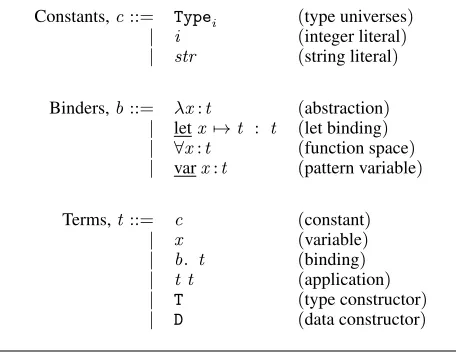
Figure 1. TTexpression syntax
predicate is always uniquely determined by the other arguments to the function. We will revisit this example in Section 5.1, and see how we can automatically generate accessibility predicates using elaborator reflection.
When the program to be translated makes use of nested recursion, the accessibility predicate will refer to the rewritten program, as the result of the nested call must be accessible. Thus, to support nested recursion, the method requires that the type theory support inductive-recursive definitions as set forth by Dybjer (2000). Both Idris and its reflected elaborator support inductive-recursive definitions.
2.2 Proof Automation
Proof obligations sometimes arise naturally in the course of de-pendently typed programming. Like Agda (Norell 2007), Idris is primarily designed to support the interactive, direct construction of proof terms in the same fashion as program terms.
When one cares about the structure of a proof object, rather than its mere existence, this approach is convenient. However, some proof objects are wholly uninteresting, and contribute only tedious details to a program text. In these cases, an automation system more like those of tactic-based proof assistants can be desirable, allowing these proofs to be produced with much less code.
As befits its roots in tactic-based interactive proof assistants, Idris’s reflected elaborator can be used as a tactic language for proof automation. Here, we present a simple yet powerful proof automation procedure, namedmushas an homage to the much more capable tacticcrushin Chlipala (2011). We can applymushas follows, for example, to prove the associativity of addition:
plusAssoc : (j, k, l : Nat) ->
plus (plus j k) l = plus j (plus k l) plusAssoc = %runElab mush
We can use mush to prove a variety of the properties that are proved by hand in Idris’s Prelude, including that zero is a right identity of addition, that addition and subtraction cancel, that mapping a function over a list preserves the length of the list, that the length of two appended lists is the sum of the length of the input lists, and that the empty list is a right identity of appending lists. We will present the definition ofmushin Section 5.2.
3.
The Core Language and Elaboration
Idris’s elaborator is written in Haskell in an elaboration monad that provides state and error handling effects. Full details of the
elaborator, including the typing and evaluation rules for the core language, are given by Brady (2013). The typing rules are standard for a dependently typed core calculus. In this section we reprise the essential features for elaborator reflection. In particular, we show the syntax of the core language,TT, and its representation as high level Idris data types.
3.1 The Core Language,TT
Figure 1 shows the syntax of Idris’s core expression language,TT.2 The purpose of elaboration is to translate a high level Idris program into a collection of data type definitions and pattern matching function definitions, built fromTT expressions. Data types are defined in the following form, whereTis thetype constructorand theDiare thedata constructors:
data T : t where D1 : t | . . . | Dn : t
TTsupports mutual inductive-recursive definitions (Dybjer 2000). In this paper, we do not show the distinction between parameters and indices, but the distinction is indeed maintained inTT. All functions are defined by top-level pattern match clauses, in the following form:
f : t
var~x1:~t1.f~t1 = t1 . . .
var~xn:~tn.f~tn = tn
Note that names which are used in the definition are explicitly bound as pattern variables using a varx:Tbinding. So, for example, the high level Idris program. . .
data Vect : Nat -> Type -> Type where Nil : Vect Z a
(::) : a -> Vect k a -> Vect (S k) a
vAdd : Num a => Vect n a -> Vect n a -> Vect n a
vAdd Nil Nil = Nil
vAdd (x :: xs) (y :: ys) = x + y :: vAdd xs ys
. . . elaborates to the following definitions inTT: data Vect : ∀n:Nat. ∀a:Type. Type where
Nil : ∀a:Type. Vect Za
| (::) : ∀a:Type. ∀k:Nat. ∀x:a. ∀xs:Vect k a. Vect(Sk)a
vAdd : ∀a:Type. ∀n:Nat. ∀c:Numa.
∀xs:Vectn a. ∀ys:Vectn a. Vectn a vara : Type, c : Numa.
vAddaZc(Nila) (Nila) = Nila vara : Type, k : Nat, c : Numa,
x : a, xs : Vectk a, y : a, ys : Vectk a.
vAdda(Sk)c((::)a k x xs) ((::)a k y ys) = ((::)a k((+)c x y) (vAdda k c xs ys))
Note that all of the function and pattern variables have been made explicit in the types.
3.2 Elaboration
Elaboration of a high level Idris program intoTTinvolves traversing the syntax of the high level program, incrementally constructing aTTterm. During elaboration, theTTterm may containholes, which stand for parts of the program which have not yet been elaborated. Elaboration istype-directed, meaning that the elaborator always knows the type of the term it is constructing. The elaborator may also generateunification constraintsbetween the type of the
b::= . . .
| ?x:t (hole binding)
[image:4.612.59.250.76.138.2]| ?x≈t:t (guess)
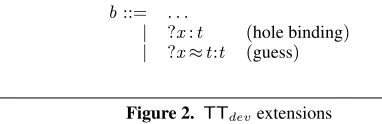
Figure 2. TTdevextensions
term it is constructing, and the required type. Such constraints may often need elaboration to make further progress before they can be resolved. There are, therefore, several pieces of state which need to be maintained during elaboration:
•agoal type, which is aTTterm representing the type to be inhabited by the current elaboration procedure;
•an incrementally constructedproof term, which is aTTterm that must inhabit the goal type;
•ahole queuecontaining the holes and guesses that remain in the proof term;
•a collection of open unification problems;
•a supply of fresh names; and miscellaneous pieces of state to implement other internal operations.
We refer to these collectively as theproof state.
Instead of maintaining a separate metavariable context that tracks the unique names, scopes, expected types, and equality constraints related to the holes in the term, the Idris elaborator equipsTTwith two additional binding forms, using the already-existing scoping and equality mechanisms for terms and contexts to represent metavariables in-place. This style was pioneered by McBride’s (1999) Oleg proof assistant. We refer to this extended core language as thedevelopment calculusTTdev. Figure 2 shows
the extensions to the syntax of hole and guess binders inTTdev.
InTTdev, the term?x :t.eis the termewith an additional
bound variablex. The typing rules for hole binders assign the typet
toxin its scope, demanding no further justification because further elaboration will be required to determine the actual term of typet
to be inserted. Because we are working modulo Idris’s definitional equality which includesβ-conversion, directly substituting a term for the holexmight trigger a sequence of reductions that interferes with further processing that we intend to perform. Thus, instead of directly substituting a term for a hole variable, we first construct a temporary binder that resembles a let but is computationally inert. This placeholder binder is called aguess. If the terme0is inserted into the holexabove, the resulting guess is written?x≈e0:t. e. Then, when concerns about the precise structure of the body of the guess binder are no longer relevant, the guess can be substituted for the variable that it binds.
During elaboration, the names of holes and guesses are unique, so that the hole queue can contain just the names. When the hole queue is non-empty, elaboration is said to befocusedat the hole or guess whose name is at the head of the queue. Many tactics implicitly modify the focused hole. When a guess is substituted for the variable that it binds, focus proceeds to the next hole or guess in the queue.
The Idris elaborator interprets each high-level Idris construct as a computation in an elaborator monad:
data Elab a -- abstract
Elaboration scripts are written using a collection of basictactics, which are small, reusable building blocks for proof term construc-tion. Some of the most commonly used tactics are:
•claim, which wraps the focused subterm with a new hole binding for a given name and type;
• fill, which converts a hole into a guess given an appropriately-typed term; and
• solve, which substitutes the focused guess in its scope and focuses on the next term.
We will describe these and other tactics in detail in Section 4.1. The Idris elaborator (and hence theElabdata type) is written in Haskell, so any features of the language are written as programs in theElab monad in Haskell. The purpose of elaborator reflection is to expose theElabmonad in Idris programs, thus allowing Idris extensions to be written directly in Idris itself. To use this, we need an Idris representation ofTTprograms, and an Idris API for the elaborator monad.
3.3 Reflection Data Types
Idris’s reflection API uses a number of data types for representing terms and definitions, as shown in Figure 3.
-- Variable names data TTName = ...
-- Constants
data Const = I Int | Str String | ...
-- Binders
data Binder : Type -> Type where Lam : (ty : a) -> Binder a Pi : (ty, kind : a) -> Binder a Let : (ty, val : a) -> Binder a PVar : (ty : a) -> Binder a Hole : (ty : a) -> Binder a Guess : (ty, val : a) -> Binder a
[image:4.612.315.557.231.554.2]-- Terms which have not yet been typechecked data Raw = Var TTName
| RBind TTName (Binder Raw) Raw | RApp Raw Raw
| RConstant Const | RType
-- Well typed, de Bruijn indexed terms data TT = P NameType TTName TT
| V Int
| Bind TTName (Binder TT) TT | App TT TT
| TConst Const | TType TTUExp
Figure 3. Outline of the reflectedTTdata type
The core language is represented by two separate data types: RawandTT.Rawis used to represent terms that are to be submit-ted to the type checker, whileTTrepresents terms produced by the type checker. The differences between them are thatRawdoes not mention universe levels and it does not distinguish between locally and globally bound names, with a single constructor for variable references.TT, on the other hand, decorates the type of types with information about universe levels and it uses a locally nameless rep-resentation, with de Bruijn indices for bound variables. Additionally, TTcontains local caches of the types of global variables, allowingTT terms to be understood in isolation. Both representations of the core language have a uniform representation of binders, implemented by the data typeBinder.
qualifiers, TTName includes constructors for machine-generated unique names as well as names that result from inner scopes, such as whereblocks. Additionally, it includes a constructor that is reserved for names generated by user elaboration scripts so that they can define globally-unique top-level names for helper definitions.
While the majority of the data types involved in elaborator reflection are used to represent details about the core Idris language, a few of them mention features of high-level Idris. In particular, top-level type signatures are represented by a list ofFunArgfollowed by a return type, rather than by a dependent function type in the core theory:
data Plicity =
Explicit | Implicit | Constraint
record FunArg where constructor MkFunArg name : TTName type : Raw plicity : Plicity erasure : Erasure
This allows reflection scripts to specify whether each argument is to be passed implicitly, explicitly, or using type class resolution, as well as whether the arguments are intended to be runtime-relevant. By looking up this specification in the global context, elaboration scripts can determine the intended calling conventions of Idris functions and attempt to infer implicit arguments as users would expect. Additionally, record types such asTyDecl,DataDefn, and FunDefndescribe new type declarations, data declarations, and pattern-matching functions to be added to the global context.
Finally, reflected error messages are represented as lists of the typeErrorReportPart, which contains constructors for embed-ding strings, Idris terms, names, and even other error messages in an error. This allows error messages that result from metaprograms to be rendered using Idris’s pretty printer and to take advantage of some of Idris’s interactive features.
3.4 Quasiquotation
Working directly with the RawandTT data types when writing metaprograms in Idris has many of the same disadvantages as programming directly inTT. Christiansen (2014) described how to use Idris’s elaborator to translate quotations of high-level Idris terms into the corresponding reifiedTTterms. While it is certainly possible to use the reflected elaborator without quotations, they are a convenient interface and are used extensively in this paper. The expression syntax:
`( e )
refers to a quotation of the expressionefor which a type must be inferrable, while the syntax:
`( e : t )
represents a quotation of a term at some particular type (Idris does not have a native type annotation syntax for expressions, as it is not necessary elsewhere). Idris quotations are in fact quasiquotations, which means that sub-regions of a quotation can be evaluated rather than quoted. These sub-regions, calledantiquotations, are prefixed with a tilde (~). Quotations can be used both as ordinary expressions and as patterns, with antiquotations in patterns containing patterns. Additionally, both theTTandRawdata types can be quoted, and Idris uses the expected type to determine which representation to produce.
Idris also has a quotation syntax forTTName. Because Idris sup-ports pervasive type-disambiguated overloading, there is a distinc-tion between names as they are written in a source file and the full,
qualified version that is eventually discovered during elaboration. The syntax`{{n}}is an unresolved quotation of the namen— that is, it is a quotation of the namenprecisely as written. The similar syntax`{n}is a resolved quotation, where the namenis treated as a reference to a unique name in scope, and expanded with namespace qualifiers prior to reification as aTTName. Ifncannot be uniquely resolved, then`{n}will result in an error. Typically, unresolved names should be used for new things being defined by a metapro-gram, while resolved names should be used for existing definitions that the metaprogram will consult.
4.
Elaborator Reflection
An Idris program consists of a series of declarations, which can be data types, records, functions, type classes, and instances, among others. Elaborator reflection adds a new declaration form:
%runElab e
Here,e is an Idris expression. This will first elaborate e with the goal typeElab (). If successful, the result is then run as an elaboration scriptby a built-in interpreter that assigns elaboration effects to a collection of primitive elaboration scripts. This can be understood by analogy to run-time side effects. Like Haskell, Idris has a familyIOof computations that are assigned effectful semantics by the language runtime: a program with typeIO a produces a value of typea, potentially having used side effects to do so. Analogously, a program inElab aproduces a value of typea, potentially having used side effects in the elaborator. While IOactions are run implicitly by being assigned the namemain, actions inElabare run explicitly using the%runElabsyntax.
Similarly, elaborator reflection adds a new expression form:
%runElab e
This works in exactly the same way as the declaration form, except that the elaboration script is run in the context of expression elaboration.
4.1 Elaborator Operations
Elabis an instance of theFunctor,Applicative, andMonadtype classes. Additionally, a backtracking failure-handling operator is used to implementAlternative, allowing the standard Idris choice operator<|>to be used to express error recovery. Errors can occur when tactics are misused, or they can be explicitly signaled by the failtactic, which takes a reflected error message as an argument. The additional effects available in Elab largely correspond to the low-level tactics mentioned in Section 3.2, described in detail by Brady (2013). While Brady’s article distinguishes between expression and definition elaborators, with the latter invoking the former, the reflected elaborator allows the mixing of both forms of operation and thus expands these tactics with operators for both querying and extending the global context. This is to allow the same elaboration code to be used in both expression and definition contexts, as well as to allow elaboration scripts to produce expressions that depend on auxiliary definitions or data types. In this section, we describe the most important primitives in detail. A comprehensive description is available in the first author’s Ph.D. thesis (Christiansen 2016).
As described in Section 3, the elaboration monad has a state that includes a proof term with holes in it, a queue containing these holes, and a collection of open unification constraints. The following primitive operators inElabmanipulate or query the proof state:
gensym : (hint : String) -> Elab TTName
focus : (h : TTName) -> Elab ()
Move the focus to the holeh, bringing it to the front of the hole queue, or fail if the holehdoes not exist.
unfocus : (h : TTName) -> Elab ()
Move the holehto the end of the hole queue, or fail if thehdoes not exist.
fill : (e : Raw) -> Elab ()
Place a terme with typete in the focused hole?h : th. e0,
converting it to a guess?h≈e:t. e0, and fail if the current focus is not a hole. The typetof the guess is constructed by unifyingte
andth, which may instantiate holes that they refer to. Fail if the
current focus is not a hole or if unification fails. This unification can result in the solution of further holes or the establishment of additional unsolved unification constraints.
solve : Elab ()
Substitute the focused guess throughout its scope, eliminating it and moving focus to the next element of the hole queue. Fail if the focus is not on a guess.
claim : (n : TTName) -> (t : Raw) -> Elab () Establish a new hole binding namednwith typet, surrounding the current focus.
apply : (op : Raw) -> (argSpec : List Bool) -> Elab (List TTName)
Apply the operatorop, establishing holes for its arguments based onargSpec, a list of Booleans whose length is equal to the number of arguments that the operator will be applied to. A hole is established for each argument, with the type determined by the type of the operator, with the appropriate references to earlier holes in cases where the operator has a dependent type. If the corresponding Boolean isFalse, the hole is not eligible to be solved by unification, while if the corresponding Boolean is True, the hole is marked as suitable to be solved automatically. For example, elaborating an application of a function fthat takes one implicit argument and two explicit arguments might invoke apply `(f) [False, True, True]. The names of the established holes are returned.
This tactic is not part of Brady’s 2013 idealized tactic language. It is a built-in tactic inElabto allow its complicated implemen-tation to be directly shared with the underlying Idris elaborator. Figure 4 exhibits anElabscript that usesapplyto insert the termplus Z (S Z)into a goal of typeNat.
compute : Elab ()
Normalize the current goal type.
rewriteWith : (rule : Raw) -> Elab ()
Attempts to rewrite the current goal using the equality proof rule. This tactic invokes the underlying elaborator for Idris’s rewrite ... in ...syntax.
Each form of binderbin Figures 1 and 2 has an introduction associated tactic. A precondition of these tactics is that the focused hole is of the form?h:t . h— that is, that the body of its scope consists directly of a reference to the hole-bound variable. If a
do [x, y] <- apply `(plus) [False, False] solve
focus x; fill `(Z); solve focus y; fill `(S Z); solve
Figure 4. AnElabscript to insertplus Z (S Z)
hole binder were of the form?h : t1 → t2. f hand a tactic such asintro `{{x}}were applied, the result would be the term ?h:t2. λx:t1. f h. However, this would cause the application of
fto be ill-typed, as it expects an argument of typet1→t2, not an argument of typet2. Additionally, some binding tactics require that
t, the type of the holeh, have a specific form, because the binder that is to be established may have a typing rule associated with it. The binding tactics are:
intro : (n : TTName) -> Elab ()
Wrap the focused hole?h : ∀x :t1. t2.h in a lambda, or
fail if the focus is not on a hole suitable for binding. The provided name is used for function’s argument, so the result isλn:t1.?h: [n/x]t2.h.
forall : (n : TTName) -> (t : Raw) -> Elab ()
Wrap the focused hole?h:Type. ein a dependent function type, yielding(n : t)→?h:Type. e.
patbind : (v : TTName) -> Elab ()
Introduce a new pattern binding varvaround the hole, similarly tointroandforall.
letbind : (n : TTName) ->
(v : Raw) -> (t : Raw) -> Elab ()
Introduce a newletbinding around the focused hole, given a namento bind, a termv, and a type annotationt. It is an error if vdoes not have typetin the focused context.
attack : Elab ()
Restructure the focused hole to make it suitable for binding by establishing a new hole inside a guess. If the focus is at ?h:t1→t2. f h, then invokingattackwill result in the term ?h≈(?h0 :t1 → t2. h0):t1 → t2. f hwith the focus onh0. Invocations of binding tactics should be bracketed byattackand solve, representing the new scopes. Following a binding tactic, the focus is on a hole in the immediate scope of the introduced binding, so repeated invocations ofattackare not necessary for repeated binders.
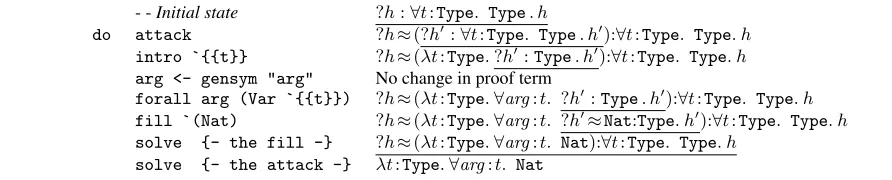
For an example of the interplay betweenattackand binding tactics, refer to Figure 5 in which theTT equivalent of the Idris term \t : Type => t -> Natis constructed using tactics.
The following queries against the global environment are pro-vided as primitives inElab:
getEnv : Elab (List (TTName, Binder TT))
Look up the lexical scope at the focused hole, or fail if there are no holes.
lookupTy : (n : TTName) ->
Elab (List (TTName, NameType, TT))
Look up the core-language types of every overloading of a name nin the global context. TheNameTypeindicates whether the name is a user-defined constant, a data constructor, or a type constructor.
lookupDatatype : (n : TTName) -> Elab (List Datatype)
Look up the reified definitions of all data types whose names are overloadings ofn.
lookupFunDefn : (n : TTName) ->
Elab (List (FunDefn TT))
- -Initial state ?h:∀t:Type. Type. h
do attack ?h≈(?h0:∀t:Type. Type. h0):∀t:Type. Type. h
intro `{{t}} ?h≈(λt:Type.?h0:Type. h0):∀t:Type. Type. h
arg <- gensym "arg" No change in proof term
forall arg (Var `{{t}}) ?h≈(λt:Type.∀arg:t. ?h0:Type. h0):∀t:Type. Type. h
fill `(Nat) ?h≈(λt:Type.∀arg:t. ?h0≈Nat:Type. h0):∀t:Type. Type. h
solve {- the fill -} ?h≈(λt:Type.∀arg:t. Nat):∀t:Type. Type. h
[image:7.612.70.516.70.160.2]solve {- the attack -} λt:Type.∀arg:t. Nat
Figure 5. An elaboration script with binding, where the terms in focus are underlined
lookupArgs : (n : TTName) ->
Elab (List (TTName, List FunArg, Raw)) Look up the high-level Idris calling conventions (that is, which arguments are to be found implicitly) for all overloadings ofn.
The following operators provide an interface to the type checker and evaluator:
check : (env : List (TTName, Binder TT)) -> (tm : Raw) -> Elab (TT, TT)
Invoke the type checker to produce a fully-annotated term and its type, considered with respect to a particular lexical environment env.
normalise : (env : List (TTName, Binder TT)) -> (tm : TT) -> Elab TT
Invoke the evaluator to normalizetmrelative to the global context and the lexical contextenv.
Elaboration scripts can extend the global context with new declarations and definitions. Rather than a single-step process to define a function or data type, a two-step process is employed where the type of a function or type constructor is first declared, followed by another operation to define either its pattern-matching equations or constructors. Under this scheme, the newly defined elements can be required to pass the type checker, but it is still possible to define functions and data types that refer to one another. Additionally, this allows elaboration scripts to leave behind abstract definitions to be later filled in by users, such as the totality proof obligations from Section 2.1. The operators for extending the global context are:
declareType : TyDecl -> Elab () Add a type declaration to the global context. defineFunction : FunDefn Raw -> Elab ()
Use a sequence of pattern-matching clauses to define a function. As a special case, zero-argument definitions produce top-level bindings of constants.
declareDatatype : TyDecl -> Elab ()
Add the declaration of the type constructor for an inductive family to the global context.
defineDatatype : DataDefn -> Elab () Define an inductive family by its list of constructors. metavar : TTName -> Elab ()
Solve the current hole as if it were a top-level Idris named hole. Not to be confused with the holes inTTdev, which are an
implementation technique for elaborators, Idris’s holes represent unfinished user programs. These holes can later be solved using all of Idris’s standard interactive features. This tactic allows metaprograms to delegate to human intelligence when necessary.
As an example of tactic-driven definitions, the Idris data type definition:
data B = T | F
can be equivalently constructed with the following metaprogram: %runElab
(do declareDatatype $
Declare `{{B}} [] `(Type) defineDatatype $
DefineDatatype `{{B}}
[ Constructor `{{T}} [] (Var `{{B}}) , Constructor `{{F}} [] (Var `{{B}}) ])
and the Idris type declaration:
append : Vect n a -> Vect m a -> Vect (n + m) a
can be equivalently created using the metaprogram: imp : TTName -> Raw -> FunArg
imp n t = MkFunArg n t Implicit Erased
exp : TTName -> Raw -> FunArg
exp n t = MkFunArg n t Explicit NotErased
appendDecl : TyDecl appendDecl =
Declare `{{append}}
[ imp `{{a}} `(Type) , imp `{{n}} `(Nat) , imp `{{m}} `(Nat) , exp `{{xs}}
`(Vect ~(Var `{{n}}) ~(Var `{{a}})) , exp `{{ys}}
`(Vect ~(Var `{{m}}) ~(Var `{{a}})) ]
`(Vect (plus ~(Var `{{n}}) ~(Var `{{m}})) ~(Var `{{a}}))
%runElab (declareType appendDecl)
In addition to the specialized searching performed to resolve type class instance dictionaries, Idris also contains a general-purpose proof search that attempts to use the constructors of inductive types to solve a goal. Proof search is invoked during elaboration when solving for implicit arguments decorated with theautomodifier as well as interactively by users during program development. In the reflected elaborator, proof search can be applied to the focused goal:
search' : Int -> List TTName -> Elab ()
Attempt to solve the focused hole using proof search, taking a search depth and a list of additional names to use as hints.
represent the defining clauses of pattern-matching definitions as pairs of terms, and patterns can have complicated relationships that are imposed by dependent pattern matching. To aid in the production of terms, elaboration scripts can recursively invoke the reflected elaborator:
runElab : Raw -> Elab () -> Elab (TT, TT)
Use the provided elaboration script to solve a reflected goal. The action is run in a fresh proof state with the provided type as the goal, and the resulting term and its type are returned on success. Finally, to assist in the development of non-trivial elaboration scripts, some debugging tools are provided:
debug : Elab a
Halts the elaborator as if a fatal error had occurred and provide a detailed dump of the elaborator state, including the current proof term and the contents of the hole queue. This can be used to diagnose errors in elaboration scripts.
debugMessage : List ErrorReportPart -> Elab a Halt and show all of the information displayed bydebug, along with a user-specified message. The message, like the one provided tofail, is rendered using Idris’s pretty printer.
Idris’s type classes are elaborated to record types, and instances are elaborated to either records of functions or to functions from other instances dictionaries to new instance dictionaries. The database of registered instances for a given type class is a map-ping from type class names to collections of instance names, and instance resolution attempts to combine these instances to create an inhabitant of a particular goal type.Elabcontains effects for querying the instance database as well as registering new definitions as instances.
Additional operations include tactics to replace a hole with a pattern variable, look up the name and type of the focused goal, get the hole queue as a list of names, and check terms for conversion. There are also a collection of operators that reveal information about where%runElab was invoked, such as the lexically declared namespace, the precise source location, and the precedence and associativity declared for some operator.
4.2 Interactive Proving
Tactic scripts are notorious for being difficult to read without tool support, and tactic scripts built with Idris’s elaborator reflection are no exception. Thus, Idris provides an interactive shell in which Elabactions can be executed one at a time, replacing a previous special-purpose tactic language. This interactive shell provides programmers with immediate feedback as to the effect of their actions. Additionally, it allows them to inspect values that result fromElabcomputations, such as the internal representations of reified definitions. At the end of an interactive elaboration session, Idris will optionally append the elaboration script to the current source file, so that loading it will execute the tactic script.
Additional tools can be built on top of the elaboration shell. For example, the Emacs mode for Idris provides a proof script development environment, reminiscent of Proof General (Aspinall 2000), in which programmers can interactively step forwards and backwards a tactic script, inspecting the proof state at each step.
4.3 Staging Issues
From the perspective of an Idris user who is not using elaborator reflection, the elaboration of an Idris program proceeds from top to bottom. Names must be declared before use. Idris additionally supportsmutualblocks, within which all type declarations are elab-orated prior to elaborating all definitions, allowing for mutually recursive definitions. Some expressions, such ascaseexpressions,
require additional top-level definitions to be produced after elabora-tion, but these helper definitions are not accessible to other parts of the program, which means that users can be blissfully unaware of this elaboration order.
This account of name and definition visibility becomes more challenging in the presence of elaborator reflection. Like Template Haskell, Idris’s elaborator reflection introduces tricky staging issues. Metaprograms in the elaborator can have side effects such as defining new names, filling holes, or even aborting elaboration.
For example, lists are elaborated from left to right. This can be observed using the following declaration:
xs : List Nat xs = let x = S Z
valDecl = Declare `{{val}} [] `(Nat) in [%runElab (do declareType valDecl
fill `(Z) solve), x + val]
The namevalin the second position in the list is not bound until the elaborator script in the first position has executed. If list elaboration were to proceed from right to left, thenvalwould be unbound.
It is also possible to observe that the value ofvalDeclhas been elaborated prior to the execution of the elaborator script, because it is available. Furthermore, simply liftingElabexpressions to the top level and elaborating them prior to the elaboration of the context in which they are executed is not sufficient: if it were computed via a caseexpression, the script would fail, because the computational behavior of thecaseexpression is not elaborated until afterxshas been elaborated. In the future, we hope to make the dependencies between elaboration stages more explicit.
5.
Using the Reflected Elaborator
A metaprogramming system is of no use if it cannot be used to write interesting metaprograms. In this section, we deliver on our promises from Section 2 and describe additional experiences with the reflected elaborator.
5.1 Termination Predicates
In Section 2.1 we showed the following general recursive definition ofquicksort:
quicksort : List Nat -> List Nat quicksort [] = []
quicksort (x::xs) =
quicksort (filter (< x) xs) ++ x :: quicksort (filter (>= x) xs)
Idris cannot automatically determine that this function terminates. We can, however, show that it terminates using an accessibility predicate. Using elaborator reflection, we can automatically generate accessibility predicates by directly adapting Bove and Capretta’s method (2005) to rewrite Idris programs that make use of general recursion into a pair of an accessibility predicate and a function defined by recursion over the predicate. We begin by declaring the type of the elaboration procedure:
bc : (inFun, outFun, accPred : TTName) -> Elab () bc inFun outFun accPred = do
(inFun', Ref, inTy) <- lookupTyExact inFun | _ => fail [TextPart "Not a function"]
The-Exactvariants of the lookup operations require that a single name match and do not disambiguate. In Idris’s extended do notation, the vertical bar specifies alternative actions to be taken instead of the remainder of thedoblock, in case a pattern-matching dobinding fails to match its main pattern. In this case, the program terminates with an error message.
Next, the code generator declares the new data type and the new function. ThelookupArgsExactquery discovers the calling convention of a function — that is, which of its arguments are to be discovered automatically through unification or through type class resolution. After that, a new inductive family is declared usingdeclareDatatype, which establishes a formation rule or type constructor in the global typing context.
(_, args, res) <- lookupArgsExact inFun' declareDatatype $ Declare accPred args `(Type)
Now that the accessibility predicate has been declared, the new function, which uses it, must be declared. The new functions argu-ments are those of the previous function along with the accessibility predicate applied to the other arguments.
let accArg = MkFunArg `{{acc}}
(mkApp (Var accPred)
(map (Var . name) args)) Explicit
NotErased
In this code,Varis a term constructor for variable references, taking a name as an argument, andnameprojects the name field from FunArg. In Idris’s surface syntax, this argument would be written (acc : accPred ~a), whereaccPredis the name provided for the accessibility predicate and~ais the names of the previous arguments to the function. In the case ofqs, this will be(acc : QSAcc xs). The new argumentaccArgis added to the signature for the rewritten function:
declareType $
Declare outFun (args ++ [accArg]) res
We declare the rewritten function’s type and the type constructor of the accessibility predicate first, because the constructors of the data type may need to refer to the function, and those will not be typeable if it does not yet exist.
Now that the typing rules for the rewritten function and the accessibility predicate have been added, it is time to compute the constructors of the data type and the pattern-matching equations for the rewritten definition. The input to the transformation is the list of original clauses:
DefineFun _ oldClauses <- lookupFunDefnExact inFun'
Because each equation is simultaneously translated into a new equa-tion and a corresponding constructor of the accessibility predicate, the result of processing the clauses is unzipped into constructors and new pattern-matching equations. TheprocessClausesfunction is a direct implementation of Bove and Capretta’s algorithm. (newClauses, ctors)
<-unzip <$> processClauses Z oldClauses
Finally, the data type is defined by its constructors and the rewritten function is defined using the new pattern-matching equations. defineDatatype $ DefineDatatype accPred ctors defineFunction $ DefineFun outFun newClauses
We can invokebcusing the%runElab directive: %runElab (bc `{quicksort} `{{qs'}} `{{QSAcc}})
The resulting definitions are theTTequivalents of:
data QSAcc : List Nat -> Type where QSAccCase0 : QSAcc []
QSAccCase1 : QSAcc (filter (< x) xs) -> QSAcc (filter (>= x) xs) -> QSAcc (x :: xs)
and
qs' : (xs : List Nat) -> QSAcc xs -> List Nat qs' [] QSAccCase0 = []
qs' (x :: xs) (QSAccCase1 l r) = qs' (filter (< x) xs) l ++ x :: qs' (filter (>= x) xs) r
It is now up to a user to show thatQSAcc xsis inhabited for all lists xsby defining a helper such as the following:
qsAcc : (xs : List Nat) -> QSAcc xs
This particular formulation is convenient when there may be some additional preconditions for totality. In cases where the function is actually total, it may be convenient to instead generate an unfulfilled proof obligation that the entire domain is accessible as well as a wrapper with the same signature as the original function. This proof obligation can then be discharged using all of Idris’s standard tools for interactive development. The wrapper then uses the result of this proof to call the rewritten function. Because this mechanism did not require modifications to the Idris compiler, users are free to customize it however they want, while still being able to rely on the unmodified underlying type checker for correctness, and features such as custom syntax rules3can be used to provide a syntax akin to that in Section 2.1
5.2 Proof Automation with Tactics
Previous versions of Idris supported a special-purpose tactic lan-guage for writing proofs at an interactive shell, and user inter-faces reminiscent of dedicated proof assistants such as Coq were constructed to facilitate interactive proving. However, the special-purpose tactic language had a number of drawbacks: its extreme simplicity meant that it was not possible to build abstractions or non-trivial derived tactics, it was impossible to reuse Idris code in tactics, and it introduced a large number of new keywords into the language grammar. Elaborator reflection has subsumed this previous tactic language, allowing Idris’s ordinary abstractions and definition forms to be used to build a richer language of tactics. Idris addition-ally includes a library of derived tactics that is namedPruviloj. In addition to extended versions of the primitive tactics that do things like introducing multiple lambda bindings at once, Pruviloj includes features such as an induction tactic that generates its own eliminators for inductive families and tactics for automatically discharging proof goals with absurd hypotheses. The eliminator-generation feature of Pruviloj replaces a built-in feature of the Idris compiler, and we aim to implement more of Idris in itself in the future.
To demonstrate the utility of the derived tactics in Pruviloj for proof automation, we now present the definition of themushtactic from Section 2.2. The tactic will perform the following steps when given a goal of the form(x : t) -> P x:
1. Bindxunder a lambda, introducing it as a local assumption 2. Perform induction onx, generating elimination principles as
necessary
3. In each proof goal introduced by the induction, apply a non-inductive solver calledauto.
mush : Elab () mush =
do attack
x <- gensym "x" intro x
try intros
induction (Var x) `andThen` auto solve
Thismushtactic uses derived tactics and tacticals such asintros, which introduces as many times as possible with automatically-generated names;try, which applies its argument but does nothing in case of failure;induction, which generates and applies an elimination principle to the appropriate value and motive, returning a list of holes corresponding to the cases for each constructor; and andThen, which runs its first argument, expecting a list of hole names, then applies its second argument in each of the holes.
The helper tacticautoperforms the following steps: 1. Normalize the goal
2. If the goal is a universal quantification, introduce all quantified variables as local assumptions
3. Attempt to rewrite the goal with all equality proofs that are assumptions from induction
4. Attempt to dispatch the potentially-rewritten goal using a local hypothesis, or Idris’s built-in proof search if that fails
auto : Elab () auto =
do compute attack try intros
hs <- map fst <$> getEnv for_ hs $
\ih => try (rewriteWith (Var ih)) hypothesis <|> search
solve
The only new Pruviloj tatic employed in the definition ofautois hypothesis, which attempts to solve the goal with each variable in the local scope, failing if none apply. The tacticsearch is defined in the Prelude assearch' 100 []. All of the control structures, including thedo-notation, the recovery operator<|>, the iteration operatorfor, and the mapping operator<$>, are standard Idris operators that can be used with any instances of Monad, Alternative, Foldable, andFunctortype classes, which are analogous to their Haskell definitions.
5.3 Deriving Type Class Instances
Haskell supports deriving of instances for a collection of built-in type classes, freeing users from the burden of writing boilerplate Boolean equality comparisons and conversions toString. Idris has no similar feature. However, using elaborator reflection, we have been able to implement deriving of type classes such asEqand Show. While deriving ofEqandShoware implemented as traditional code generators, we have also implemented a tactic that will derive decision procedures for Idris’s propositional equality for a large class of data types, given a type signature. As decidable equality typically requires a number of pattern-matching cases that is quadratic with respect to the number of constructors in the data type, this can save a great deal of code.
5.4 Interaction with Idris Type Providers
Idris’s type providers (Christiansen 2013), inspired by F# (Syme et al. 2013), allow arbitrary side effects to be performed during type
checking. This lets Idris programs refer to the world in which they are found. Type providers in Idris differ from F#’s type providers, along with analogous uses of IO in Template Haskell, in a very important way: instead of using IO to do code generation, with the generated code spliced into the program prior to further type checking, Idris type providers compute a value using IO which is then included directly in the elaborated program. In particular, an Idris type provider is a term with typeIO (Provider a), where Provideris an error monad isomorphic toEither String. The elaborator for the declaration syntax:
%provide (x : a) with p
executespas an IO action. Ifpreturns a success, then the contents of the success are unpacked and used as the definition ofx, while ifpreturns an error message, elaboration halts and displays the message to the user. Because they are ordinary IO actions returning an ordinary Idris data type, Idris type providers manage to stay within the abstractions of the language. Idris’s full dependent types enable these provided values to be used as codes in the technique of generic programming with universes (Altenkirch and McBride 2003; Benke et al. 2003). A single computed value can be used to instantiate an entire library of code at one particular type from a predetermined part of Idris’s type system.
However, generic programming with universes does not come for free. Types described with a universe encoding do not enjoy the conveniences of native data types, such as convenient notations for pattern matching, and techniques like pattern synonyms cannot easily be specialized to a particular returned code. The syntactic overhead is substantial and difficult to avoid. Additionally, while Idris’s optimizer and partial evaluator (Brady and Hammond 2010) may be able to reduce or remove the cost of carrying around codes at run time, this cannot be relied upon in general, which may lead to unpredictable changes in performance. For these reasons, generic programming with universes is not applicable to all type providers, and code generation may sometimes be a better option.
By first using a type provider to discover information about the surrounding world and then anElabscript to generate code, the full expressiveness of an approach based on code generation becomes available, while still maintaining the possibility of using ordinary IdrisIOactions for the effectful portions.
Here, we demonstrate the definition of a type provider combined with anElabscript that, together, generate a record type based on a list of field/type pairs in a text file. Similar metaprograms are used for purposes such as generating data types based on database schemas.
An Idris record type consists of a single-constructor data type along with a collection of getters and setters that are named accord-ing to a particular convention. Getters project a saccord-ingle field from an instance of the record type, while setters construct a new instance that is the same as an old one, except with one field replaced by a new value. In Idris, the syntaxrecord {f} rprojects a field from rusing the getter namedf, whilerecord {f=y} rinvokes a setter namedset fto construct a modified version ofr. In other words, to generate a record type namedRwith fieldsf1:t1, . . . ,fn:tn,
we generate the following type declaration:
data R : Type where
MkR :(f1: t1)->· · · ->(fn: tn)-> R
We also generate getters and setters for each fieldfk:
fk: R -> t1
fk(MkR a1 . . . an)= ak
set fk: tk-> R -> R
In our example type provider, record fields can be either strings, floating-point numbers, or arbitrary-precision integers. We represent these types using the following data type:
data Ty = STRING | INTEGER | DOUBLE
We use the typeList (String, Ty)to represent the field names and types of a particular record type. A type provider to read a description from a text file looks like an ordinary Idris program: getRec : String -> IO (Provider (List (String, Ty))) getRec file =
[image:11.612.54.295.578.708.2]do (Right contents) <- readFile file
| Left err => return (Error (show err)) case parseStr rec contents of
Left err => return (Error err) Right info => return (Provide info)
It attempts to read the contents of the given file, passing any errors on to the type provider error constructor. Then, it invokes a combinator parser on the contents of the specified file. Parse errors are returned as type provider errors, while successful results are returned in the Provideconstructor to be spliced in.
The type provider can be invoked on a text file using the following syntax:
%provide (info : List (String, Ty)) with getRec "ProviderTest.txt"
which results in the top-level nameinfobeing bound to the field specification in the text file, assuming that the file exists and is syntactically correct. The next step is to invoke an elaboration script to convert the field specification into a real Idris record type using the following syntax:
%runElab (genRecord `{{MyRecord}} info)
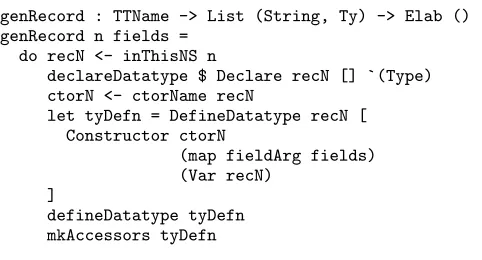
The elaboration scriptgenRecord, defined in Figure 6, is respon-sible for generating the data type and its getters and setters. It is invoked with a name and a record specification as arguments.
The first step ingenRecordis to place the users’s provided name into the current namespace using an helper operation called inThisNS, which queries Elabfor the namespace and wraps it around the name provided as an argument. Then, it declares a zero-argument data type with the namespaced name. After that, it generates a name for the constructor usingctorName, which prependsMkto the user-provided record type name. Next, it adds the constructor, using the helper functionfieldArg to convert (String, Ty)pairs into theFunArgtype described in Section 3.3. Finally, it adds the constructor to the data type and calls a helper operation to define the accessors according to the scheme described earlier in this section. Having done this, the type is now an ordinary Idris record type and can be used with Idris’s record syntax.
genRecord : TTName -> List (String, Ty) -> Elab () genRecord n fields =
do recN <- inThisNS n
declareDatatype $ Declare recN [] `(Type) ctorN <- ctorName recN
let tyDefn = DefineDatatype recN [ Constructor ctorN
(map fieldArg fields) (Var recN)
]
defineDatatype tyDefn mkAccessors tyDefn
Figure 6. Generating a record type
Additionally, it will be compiled just like any other Idris record type. Elaborator reflection does not presently support reusing Idris’s own record type elaborator, but this would be a useful extension in the future.
6.
Related Work
Reflection in Agda (pre-2016) Agda’s elaborator is different in a number of ways from Idris’s: the core language is not strictly delin-eated from the high-level language and a global metavariable context is used instead of an Oleg-style development calculus (Norell 2007). Agda’s type checker can be seen as an elaborator from terms that may contain metavariables to terms that do not. In previous versions of Agda, a number of quoting and unquoting splicing operators were available, along with a data type representing reified high-level Agda terms and definitions. Because the splicing operator acted on high-level Agda terms, it could perform elaboration to do things like solving implicit arguments. Previous work by van der Walt and Swierstra (2012) and Kokke and Swierstra (2015) demonstrated how to use this to encode non-trivial proof automation in Agda itself, and both cite the fact that this proof automation is performed within Agda itself as major advantages. Unfortunately, both systems needed to reimplement much of the infrastructure that is part of the Agda implementation, such as unification, and each was forced to duplicate information about the types of values that Agda already has in its global context.
Reflection in Agda (post-2016) Inspired by Idris’s elaborator reflection, the Agda language has recently adopted a form of elaborator reflection in place of the previous API.4 Since version 2.5.1, Agda exposes its elaboration monad, including the unification and metavariable machinery, to user elaboration scripts. Because the details of its elaboration mechanism differ substantially from those of Idris, so do the operations exposed in its reflected elaborator.
Direct vs. Indirect Reflection In his Ph.D. thesis on reflection in Nuprl, Barzilay (2006) contrasts two approaches to the design of a reflection system:indirect reflection, in which the aspects of the language that are to be reflected are re-implemented internally, and direct reflection, in which the underlying implementation is invoked directly. Barzilay points out a number of advantages of the direct approach to reflection: indirect representations of terms have an exponential increase in memory usage as levels of quotation increase, it becomes more difficult to ensure the correspondence between both implementations of the system, and having two implementations of each feature vastly increases the work that is necessary to develop and maintain new language features. The previous work on reflection in Agda by van der Walt and Swierstra (2012) and Kokke and Swierstra (2015) is an excellent example of the burden that indirect reflection places on language and tool authors.
While Idris’s reflection system uses an indirect representation of reified terms, the exponential blowup is not a major problem because typical applications require no more than one level of quotation. Additionally, because the quoted terms are in Idris’s small, stable core language, concerns about ongoing development are less pressing than they would be if the high-level language were quoted. The large, complex parts of Idris, such as the type checker and the elaboration machinery, are reflected directly. For example, the elaboration strategy for Idris’srewrite ... in ... syntax, which rewrites the current goal type using an equality proof, is exposed directly as therewriteWithprimitive, rather than requiring that it be re-implemented in Idris code. Likewise, theapply tactic, which has proven to be highly useful in both
the elaborator that is written in Haskell and in reflected elaboration scripts, is exposed directly rather than being implemented in a library. This tactic requires somewhat complex reimplementations of the typing rules for dependent functions in order to compute the correct dependent types for the holes that the operator will be applied to, and it makes little sense not to share the implementation.
Template Haskell Template Haskell (Sheard and Jones 2002) is a metaprogramming system for Haskell in which metaprograms are monadic actions that transform Haskell programs. It has been enabled a great deal of interesting work, including prototype imple-mentations of generic programming extensions (Norell and Jansson 2004). Template Haskell’sQmonad, however, does not supply ef-fects related to the elaboration infrastructure of implementations such as GHC. Instead, it provides only the ability to produce fresh names and the ability to look up definitions from the global context.
Tactic-Based Interactive Proof Assistants There is a rich tradition of interactive proof assistants based on automation through tactic languages. Indeed, the ML family of programming languages began as a tactic language for the Edinburgh LCF system, and Nuprl also uses a dialect of ML for proof automation. Coq has a dedicated DSL for writing tactics, known as LTac (Delahaye 2000), with features such as backtracking and matching against terms and contexts. Idris’s elaboration infrastructure intentionally resembles the control structures and features found in these systems. However, the reflected elaborator uses Idris as its own metalanguage, allowing code re-use across programs, specifications, and proofs automation or metaprogramming.
MTac MTac (Ziliani et al. 2013) is an alternative tactic language for Coq that, likeElab, provides a monadic interface to proof au-tomation, using Coq’s own term language. In MTac, a computation with typeM tis a tactic that will either solve a goal of typetor fail. In other words, the type of a tactic provides information about the goals to which it can be applied. While they are superficially similar, MTac and elaborator reflection serve different purposes. MTac is a dedicated proof automation language, specifically tai-lored to that purpose, while elaborator reflection is intended to be a general-purpose means of language extension. Implementing MTac’s primitives would be an interesting use of the reflected elabo-rator.
Internal Metaprogramming in Type Theory Altenkirch and McBride (2003) and Benke et al. (2003) pointed out that many applications of generic programming can be internalized directly into type theory, using a universe encoding. Later work by Chapman et al. (2010) showed that primitive facilities for defining data types can be replaced by a single self-describing type of descriptions, uni-fying generic programming with ordinary programming. Chapman et al. refer to this technique aslevitation. Inspiring as this work is, many practical problems remain to be solved before we can build our languages on top of levitation. In particular, we do not yet have predictable optimization strategies to eliminate all extraneous data type descriptions at run time, and implementations of techniques like levitation are notoriously slow when compared to native data types in existing type checkers. While we wait for the missing technology, other techniques are relevant and interesting.
Other, special-purpose universes have been used to write non-trivial and interesting metaprograms, including some of the ones that we have implemented with elaborator reflection, internally to type theory. In particular, McBride (2015) showed how to generically describe general recursion in Agda, including a generic version of the Bove-Capretta predicates that are implemented using an encoding based on Dybjer and Setzer’s 1999 encoding of inductive-recursive definitions. Devriese and Piessens (2013) provided a large collection of metaprogramming tools implemented directly within
Agda. Because these metaprograms are written in the type theory, they are also verified, and they have all the other advantages of programs written in type theory.
While this line of work is exciting, there are many important problems to be solved before we can rely on internalized reason-ing for all of our metaprogrammreason-ing needs. First, described data types still have a significant performance overhead, both during type checking and execution, relative to native data types and defi-nitions. Second, the need to account for every detail internally can lead to epic amounts of code and work to automate even simple procedures — Devriese and Piessens’s metaprogramming system required approximately 1200 lines of code to implement a generic printer, much of which is a mandatory correctness proof for the metaprogram. By contrast, programs in the reflected elaborator are similar in length and complexity to traditional tactic scripts and code generators. An implementation of type class instance derivation for Showusing Idris’s elaborator reflection that handles more data types than Devriese and Piessens’s implementation and must take care of additional details like generating instance objects is less than 300 lines of code. Finally, a number of separate universes for metapro-gramming exist, with different strengths and weaknesses, and code written for one is not immediately applicable to the others. There is hope on the horizon — Magalh˜aes and L¨oh (2014) demonstrate a universe for Haskell datatypes from which many other commonly-derived universe encodings can themselves be commonly-derived. A similar solution might work for universes of dependent data types.
While one of these universes or tools could be given special syn-tactic and run-time support, privileging a single metaprogramming system for fast execution and tool support might prevent progress with others. Additionally, metaprograms written inElabcan use verified internal metaprograms’ tactics by generating the appropriate code. We need not make an all-or-nothing choice between external and internal metaprogramming, and elaborator reflection could even be used to ease some of the overhead of using internal metaprogram-ming features, just as Idris’s elaborator eases the burden of working in a very small language likeTT.
7.
Discussion
We have described an approach to metaprogramming called elabora-tor reflectionthat is applicable to languages that have a type checker that synthesizes terms in either a separate core language or a much more explicit version of the source language. In Idris, elaborator reflection has enabled features to be moved from the compiler to libraries, making the implementation simpler and providing users with more flexibility. It has also replaced a previous special-purpose tactic language. The features provided by the elaboration frame-work, such as incremental construction of terms and higher-order unification, have proven to be useful for a variety of metaprogram-ming tasks. Additionally, elaborator reflection provides a framework within which other metaprogramming systems can be implemented. Idris’s reflected elaborator falls short of a complete tool for language extension. It is not yet possible to replace or extend the built-in elaboration procedures for already-existing language features, and the need to invoke elaboration scripts explicitly using %runElab means that they are not as convenient as built-in features of Idris. We hope to lift these limitations in the future.