Ev
er
y Child’
s Future Matters
2007
3r
d edition
Wales
Room 1, University of Wales
University Registry
King Edward VII Avenue
Cardiff CF10 3NS
029 2037 6956
[email protected]
www.sd-commission.org.uk/wales
Northern Ireland
Room E5.11, Castle Buildings
Stormont Estate
Belfast BT4 3SR
028 9052 0196
[email protected]
www.sd-commission.org.uk/northern_ireland
www.sd-commission.org.uk
Sus
tainable De
velopmen
t C
ommis
sion
England
(Main office)55 Whitehall
London SW1A 2HH
0300 068 6305
[email protected]
Scotland
Osborne House
1 Osborne Terrace
Edinburgh EH12 5HG
0131 625 1880
[email protected]
www.sd-commission.org.uk/scotland
Contents
Foreword 5
Executive summary 6
A Introduction 8
B Children’s wellbeing and the environment: what does the research say? 11
1 Be healthy 12
2 Stay safe 14
3 Enjoy and achieve 16
4 Make a positive contribution 18
5 Achieve economic wellbeing 20
C Enhancing the delivery of Every Child Matters 23
1 Be healthy 26
2 Stay safe 28
3 Enjoy and achieve 30
4 Make a positive contribution 32
5 Achieve economic wellbeing 34
D Priorities for action 37
E Moving forward 45
1 Central and regional government 46
2 Local authorities 48
3 Delivery partners 51
families. We recognise that, since 2007, some of the research has aged but as demand remains high we feel it right to republish while the need exists. While some research data has been updated, we have focused our revisions largely on the changing nature of the policy landscape, reporting progress that has been made across government on areas
influencing children’s wellbeing.
The Department of Children Schools and Families (DCSF) has published its third Sustainable Development Action Plan (2008-2010) Brighter Futures – Greener Lives in 2008, and its fourth
(2010-12) in 2010. DCSF’s first national Play Strategy (2008)
together with £235 million of dedicated investment
brings to life the Government’s aim to create places
to play in every residential community including a
focus on traffic.
The Department of Health’s (DH) physical
Recent research from the Cabinet Office, An Analysis of Urban Transport (2009), and the
accompanying document, The Wider Costs of
Transport in English Urban Areas (2009), recognises
that poorly planned transport can lead to poor air quality, noise pollution, physical inactivity and unnecessary greenhouse gas emissions. Estimated costs to society from these issues are 2½ to 3½ times more than the costs of congestion alone. To address these issues, the Department for
Transport’s (DfT) The Future of Urban Transport
(2009) sets out a vision which promotes walking and cycling and reclaims streets and public space as
places for social interaction. DfT’s guidelines on the
Children are at the heart of many of our society’s aspirations and it’s clear that when we try we can get a lot right. The Government’s decision to focus on children’s wellbeing in Every Child Matters is a good one. Yet when we take our focus away from the things we do directly for children and look at the wider
picture it’s clear that many children are expected
to live in polluted, noisy, concrete environments. We chip away at our green spaces and consume natural resources to the point where we threaten our own existence. What would our neighbourhoods, transport choices and environmental policies look
like if they took children’s wellbeing – both now and
in the future – as their starting point?
These concerns are not some kind of sideshow
to children’s wellbeing; they are critical features of
a good childhood. And yet the majority of Children
and Young People’s Plans contain scant reference
to the environment. When it comes to listening and
responding to young people’s views about their
needs, we have to start by asking them the right questions. Not just what facilities they would like to see provided for their recreation, but what they think is wrong and right about their communities at a fundamental level, and what they would like to see change.
At the heart of this debate is a major social justice issue among and between generations. The poorest and most vulnerable people are the
ones who suffer most and first from the destruction
of the environment. For example, destruction of green and open spaces in inner cities removes what are often the only places for children and
young people from disadvantaged communities to play outdoors. Similarly, we recognise the right of children to a safe, healthy, enjoyable and rewarding present – but are we acting to protect that quality of life in future? Climate change stands in the way of this at present. It has the capacity to destabilise the economy here and overseas, producing upheaval, insecurity and poverty as well as incalculable environmental damage.
Our challenge is to extend the horizons of
children’s policy beyond the present social and
economic focus to embrace the environment as a key factor in wellbeing. Local authorities in their role as place-shapers and strategic champions for children and young people have a singular opportunity to lead this change, but they need concerted support and coordination from central government. We must do this today for all children, and we must ensure that children are being empowered to do this themselves through schools, youth services and community projects.
Bringing social, economic and environmental factors together in this way is the basis of sustainable development, a core UK Government aim. It is a necessary part of building a society that cares for its children. It should be one of our core values.
We owe it to children and young people to allow them a healthy and sustainable future. They will not easily forgive us if we continue to squander their environmental inheritance.
Waheed Saleem
birth to nineteen – focusing on their wellbeing, personal development and future prosperity.
This paper explores the influence of the environment on children’s wellbeing and is written for everyone
designing and delivering services that impact on
children’s lives. The evidence set out demonstrates that children’s environmental wellbeing – their daily
experience of living and learning in the environment around them, and their options and opportunities for experiencing a healthy environment in the future – is a critical factor in their overall wellbeing.
How does this relate to the delivery of ECM
and the design of children’s services? ECM strongly targets children’s social and economic needs –
that is its inspiration. However, using a mix of commissioned research and the experiences of nine local authorities, we demonstrate that attention to the other pillar of sustainable development – the environment – provides a powerful mode of delivery of ECM outcomes. Local authorities are in a unique position to develop these connections in ways that need not add to current service obligations; in fact working in this way can provide a smarter way to achieve their existing goals. The
role of Children’s Trusts and housing, transport,
planning and environmental partners in improving local environments is highlighted in DCSF statutory
guidance for Children’s Trusts (2010) following the
Apprenticeships, Skills, Children and Learning Act (2009) (ASCL Act 2009)i. Moreover, the Children’s Planii states that “sustainable development is a
non-negotiable for children’s wellbeing.”
Many of our recommendations are for people
working in children’s services – broadly defined to include those developing children’s policy as well as those managing and delivering specific services
such as Children and Young People Partnership
The paper is structured into five sections plus a list of resources for further reading and reference.
The sections are as follows.
4. Priorities for action. Notes three high priorities for action on behalf of children:
road traffic, green space and climate change. Road traffic because of the local and global
pollution this causes, road safety concerns and the need to increase safe outside play opportunities; green space because children need this for their learning and emotional development; and climate change because nobody can prosper – least of all children – in a world devastated by global warming. A child-centred perspective is urgently required in these areas; they are also
consistently highlighted by children and young people as being important to their lives.
5. Moving forward. Proposals for central and regional government, local authorities, and
the wealth of partners delivering children’s
services. A key recommendation is that
children’s services people should champion children’s needs for a healthy environment
now and in the future.
1. Introduction. Background to the two key policy areas discussed in this paper – Every Child Matters and sustainable development. Also describes the sources of information on which this paper is based.
2. Children’s wellbeing and the environment: what does the research say? The evidence – national and international – on the environmental dimension of children and
young people’s wellbeing. Draws largely on
two commissioned research reviews carried out by The University of York and the new economics foundation.1 Snapshots of the
findings are structured under the five ECM
outcomes.
3. Enhancing the delivery of Every Child Matters. Discussion of how sustainable development can enhance the delivery of ECM, with reference to the priorities established by the framework for the
inspection of children’s services. Practical
connections are drawn between the ‘key
judgements’ for ECM and the evidence
presented in the preceding section.
The DCSF’s Children’s Plan (2007)iii aims to make England “the best place in the world for children
and young people to grow up” and states that
“sustainable development is a non-negotiable
for children’s wellbeing.” The DCSF’s Sustainable Development Action Plan (2008-10) Brighter Futures – Greener Livesiv stated that “children cannot grow up into a stable and secure world unless we, as a
country and as an international partner, find ways
to improve our wellbeing while conserving our most
precious resource, the planet.” The five Every Child Matters (ECM) outcomes remain central to a range
of initiatives that have been developed to cover the needs of all children and young people – from birth to nineteen – focusing on their wellbeing, personal development and future prosperity. The quality of the places in which children live and learn and play is increasingly recognised as key to achieving these outcomes. DCSF advocates this in its Sustainable
Development Action Plan (2010-2012).v
Every Child Matters aims to improve the daily experiences of all children and young people in England. It recognises that growing up is a process of understanding yourself and your place in the world, and that this is best done in a healthy, safe and supportive context. That having the chance to enjoy life and feel a sense of achievement is good
for children’s self-esteem. That being involved
from a young age in activities that make a positive contribution to society develops important skills for life and work. And that all of these factors can help
to secure children’s economic wellbeing.
We live in a truly dynamic era packed full of uncertainties and opportunities. Changes in technology, demographics and culture are occurring at an unprecedented rate as we seek new ways to increase our income and wellbeing. The fact that life satisfaction in the UK has levelled off since the 1970s (despite continued economic growth) suggests it is problematic to assume that ongoing national economic growth will lead to increased
up of waste. Our generation is the first to knowingly
degrade the environment at the expense of children now and in the future – a fact that challenges much of our rhetoric about the importance of children in society.
How does this relate to the delivery of ECM
and the design of children’s services? In this paper we explore the influence the environment has on children’s wellbeing. How are children affected by
their environments as they grow up, and how do
they benefit or lose out from different environmental factors? ECM is strong on children’s social and
economic wellbeing. Using commissioned research and the experience of nine local authorities, we will demonstrate how attention to the local and global environment is a powerful means of achieving ECM outcomes.
“… there are environmental services, including the provision of green spaces and clean air, and strategies which seek to reduce carbon emissions, all of which have the potential to have a radical effect on children’s wellbeing now and in the future. Children’s Trust partners which provide services that relate to these issues should consider what the effect on children may be and how the provision can best to improve children’s wellbeing.”
DCSF’s Statutory Guidance on Co-operation Arrangements, including the Children’s Trust Board and the Children and Young Peoples Plan. (1.14)
DCSF’s Children’s Trusts: Statutory Guidance on Co-operation Arrangements (2010)vi recognises the role of sustainable development in creating good places for children and young people to grow up. That is, local environments which encourage healthy, green
and fulfilling and sustainable lifestyles. For example,
the recent focus on improving the nutritional content of school meals has created a double win for many schools and local authorities. The use of locally sourced, fresh and organic ingredients has reduced
‘food miles’, as well as increasing the amount of
Introduction
Every Child’s Future Matters 9
Our approach
The starting point of this project – which we
have called Every Child’s Future Matters – is the
perspective of children and their environmental needs. Academic evidence7 and work with local authorities form the foundation of our conclusions
and taken together with Securing the Future8 and the Stern Review9 they make a strong case for viewing Every Child Matters through a sustainable development lens.
What is sustainable development?
Sustainable development enables “all people throughout the world to satisfy their basic needs and enjoy a better quality of life, without compromising
the quality of life of future generations”.10 As is
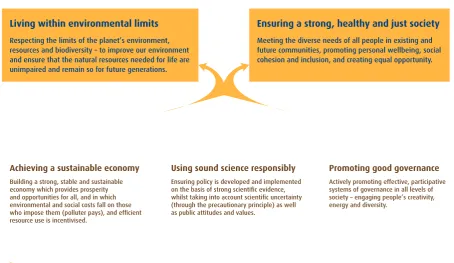
shown in Figure 1 five ‘guiding principles’ have been adopted by government to define the essential
elements of sustainable development.
In some areas, the links between children’s
wellbeing and sustainable development are
abundantly clear, for example in children’s health,
participation in decision-making, and economic aspirations. But it is not immediately obvious how one of the two primary principles of sustainable development – living within environmental limits – connects with the ECM agenda. In order to better
understand this link we commissioned two separate studies from The University of York and the new economics foundation (nef).
We also invited practitioners from nine local authorities (one in each English region – see Annex 1 for a list) to help us evaluate current practice and identify where the key opportunities for progress might lie. Two workshops were held over the course of the project; the period in between providing space for the practitioners to explore issues with
colleagues and bring back their findings to the group. The issues raised by the practitioners’ group
[image:11.595.69.524.525.788.2]contributed to the nef study and have also informed this paper.
Figure 1 Five guiding principles of sustainable development
Using sound science responsibly
Ensuring policy is developed and implemented on the basis of strong scientific evidence, whilst taking into account scientific uncertainty (through the precautionary principle) as well as public attitudes and values.
Promoting good governance
Actively promoting effective, participative systems of governance in all levels of society – engaging people’s creativity, energy and diversity.
Achieving a sustainable economy
Building a strong, stable and sustainable economy which provides prosperity and opportunities for all, and in which environmental and social costs fall on those who impose them (polluter pays), and efficient resource use is incentivised.
Ensuring a strong, healthy and just society
Meeting the diverse needs of all people in existing and future communities, promoting personal wellbeing, social cohesion and inclusion, and creating equal opportunity.
Living within environmental limits
Children’s wellbeing and
the environment
What does
the research
say?
B
• Features like physical immaturity and life-style make children more vulnerable to environmental hazards. Preventing exposure is
the most effective way of protecting children’s health and there is sufficient evidence of
potential harm to recommend a precautionary approach to environmental hazards.12
• Children living within 500 metres of a major road for a sustained period of time (eight years), were found to have substantial
deficits in lung function compared with
children living at least 1,500 metres away.13
UK traffic levels increased by 10 per cent
between 1994 and 2004 and the trend is set to continue.14 Poor air quality is more likely to have its worst effects on people who are already susceptible to respiratory problems or cardiovascular disease and on those whose age makes them vulnerable.15
We are all susceptible to environmental hazards, but children are more so.
They breathe more air, drink more water, and eat more food for their size than adults do.11
Air pollution from vehicles and industrial sources makes places physically unpleasant. It is bad for health, especially respiratory health, and contributes to water and soil contamination. In recent decades, children have become less active. They walk less to school – less in general – and pursue more sedentary leisure pursuits than ever before, often sitting indoors rather than being outside. In tandem with poor diet, this is contributing to rising levels of obesity.
1
Be healthy
• A systematic review examining children,
young people and parents’ views of walking and cycling identified the need to reduce the
convenience of car travel. The authors found in favour of promoting walking and cycling as
‘cool’, and recommend encouraging walking and cycling as part of ‘good parenting’.16
• An international study has shown that the UK has the highest asthma rates in the world with 21 per cent and 25 per cent of 6-7 and 13-14 year-olds respectively reporting asthma symptoms within the last year.18
• Several studies have shown that occupants of vehicles can be exposed to internal air that is more polluted than that outside. In an Amsterdam study, the exposure of cyclists travelling the same routes was always lower than vehicle occupants.19
• Walking or cycling to school are still popular choices for school journeys but are becoming less so. Figures show a drop from 58 per cent in 1989-91 to 47 per cent in 2003-4.21
For children aged five to ten school car runs
rose from 38 per cent in 1995-97 to 43 per cent in 2005.22 It is estimated that fewer than six out of ten girls and three out of
ten boys obtain the Chief Medical Officer’s
recommended daily level of physical activity for their age groups.23 In adults, car use and its impact on reducing weekly walking has been estimated to lead to two stones of weight gain over a decade.24
• Evaluation of the Links to Schools programme
finds that extending the National Cycle
Network to schools has also improved young
people’s accessibility to work, shops, friends
and recreation places.25
• Even small amounts of green space (this term is used throughout as a shorthand for the parks, play areas and natural habitats accessible to a community – urban or rural) are shown to have qualities that facilitate relaxation and recovery from mental fatigue and stress.26 Merely viewing nature through
a window has health benefits. Time spent
in green space has particular value for
children with symptoms of attention deficit hyperactivity disorder, benefiting their
concentration and self-discipline.27
• Researchers have calculated disability-adjusted life years (DALYs) lost and deaths attributable to a range of environmental factors. They conclude that large proportions of deaths and DALYs in European children are attributable to outdoor and indoor air pollution, inadequate water and sanitation,
lead exposure and injuries. Road traffic
accidents account for 13.5 per cent of accidental deaths in 0-4 year olds, 28.1 per cent in 5-14 year olds and 26 per cent in 15-19 year olds.28
• Research conducted by Sustrans in 40 schools showed that 45 per cent of pupils wanted to cycle, but just three per cent were doing so. Similarly, of the 35 per
cent of children travelling to school by car, almost half of them would prefer not to.29
• Dummer, in a multi-site study using birth data from Cumbria, found excess perinatal and infant mortality due to
spina bifida and heart
defects in areas close to incinerators and crematoria, but the exact compounds responsible could not be determined.30
• Absorption rates of toxins
Road traffic presents a very real threat to children’s wellbeing – not simply to their immediate safety, but to their health through pollution and noise and to their emotional wellbeing through the constraining effect of road traffic on outdoor mobility, discovery and play. The loss of green space to roads and other forms of development puts children at risk from higher levels of violence and aggression within their communities. Taken together, safety concerns arising from traffic and crime mean that many parents inhibit their children’s freedom. While understandable, this is sometimes disproportionate to the level of risk and creates other, not insignificant, problems.
2
Stay safe
• Children don’t always feel ‘safe’ in their
local area and view roads as dangerous.32 Their parents are also anxious about the
people and traffic that their children might
encounter33 and restrict their mobility accordingly.34
• Being killed as a pedestrian is the largest cause of death between the ages of 5 and 14. One hundred and forty-one children aged 0-15 were killed in road accidents in 2005, while 3,331 were seriously injured.35 Dying in
a road traffic accident is much more likely for
children from low-income families.36
• Dutch children spend half of their pedestrian
time in traffic-calmed/controlled areas,
but only 10 per cent of English children are protected in this way. Pedestrian mortality rates among English children are twice those of Dutch children. UK evaluation of 20mph zones showed them to be effective
in reducing traffic speed and accidents.
Child pedestrian injuries fell by 70 per cent and child cyclist injuries by 48 per cent. The research found that ‘no migration of accidents was found to other areas as a result
of the introduction of the zones’.37
• Hillman argues that ‘parental paranoia’, fuelled by lurid media stories, is unjustified
• A Chicago study found that when urban public housing residents, with homogenous levels of income, education and life circumstances, were randomly assigned to buildings with varying levels of nature nearby, residents in the less green environments reported more aggression and violence and higher levels of mental fatigue.40
• Davis and Jones found that many 9 and 10 year-olds would prefer to cycle to school rather than travel by car, but they are not allowed to by their parents. The authors concluded that adults appeared to “want to teach children to be careful and to be scared of cars rather than attempting to limit the
Low-quality environments impact negatively on children’s ability to enjoy and achieve, and this is most pronounced among vulnerable and disadvantaged children. Conversely, access to green spaces – and in particular natural habitats – contributes to emotional recovery and motor fitness. But these areas must be well maintained and unspoilt by noise, pollution and anti-social behaviour. Poor access to natural areas limits children’s ability to connect positively with the environment and distances them from important sources of discovery, learning and play, with impacts on their emotional wellbeing.
3
Enjoy and achieve
• Defra’s recent survey of young people’s
attitudes to climate change found that 72 per cent of 11 to 17 year olds said they enjoyed studying climate change at school, and 90 per cent said they wanted to maintain or increase
this focus in future. The figures are even
higher for the sub-sample of young people claiming to be worried about climate change (83 per cent and 94 per cent respectively).42
• The ongoing experience of road and air
traffic noise is shown in a number of studies
to be stressful for children,43 affecting their cognitive development,44 classroom behaviour and reading comprehension.45 These effects are more prevalent in children
with hearing difficulties and those who are
not familiar with spoken English. Problems with ambient noise tend to arise above 60
decibels (the level of traffic noise through
slightly open windows). Primary school children in a selection of London boroughs were found to be exposed to typical daily noise of 72 decibels. The SATs results of older (Key Stage 2) children were more affected by noise than those of younger children.46
• Fjortoft notes that
children’s play is more
vigorous outdoors than indoors and, in contrast to traditional playgrounds, the rough surfaces of natural environments provide movement challenges. The study found that children who play regularly in what are described as
‘natural areas’ showed a statistically significant
improvement in motor
fitness with better
coordination, balance and agility.47
• A study of 6,000 school children in Los Angeles showed that lung function growth was 10 per cent slower among children living in communities with high NO2 (nitrogen
dioxide) levels and other traffic-related
pollutants. There was an increase in school
absence rates with daily fluctuations of O3 (ozone) linked to traffic emissions. Children
• Short-term and even superficial exposure to
natural areas through brief walks and even looking at images of nature have been found to have positive effects on mood, reducing feelings of anger and anxiety.49
• Children spending time playing in natural areas experience adventure and risk-taking
as well as developing self-confidence, social
skills and respect for the value of nature.51 This opportunity is systematised in schemes such as the Danish-founded Forest Schools programme, with positive impacts on
children’s self-esteem, team working and
motivation.52
• Mendell and Heath found that a substantial
proportion of children’s exposure to indoor
pollutants occurs within schools. Although
there was insufficient evidence to establish specific causal relationships, there was
strong suggestive evidence to link higher levels of nitrogen dioxide with poorer school attendance and poor ventilation with reduced academic performance.17
Every Child’s Future Matters 17
• In 9-14 year-old children, shopping and spending have been negatively associated with school performance.50 This casts doubt over whether retail developments, for
example, contribute to children’s wellbeing or simply serve their more superficial wants for
Experiencing nature first-hand as a child supports understanding and care for the environment, with important positive effects on their behaviour as adults. Access to natural places and other safe outside spaces is already limited for many children in urban areas, and continues to diminish as a result of infrastructure and building projects. Local regeneration and environmental improvement projects – which can involve children and young people as participants – provide opportunities for communities to reverse these trends at the same time as improving their social capital.
4
Make a positive
contribution
• McInroy & McDonald found that people involved with neighbourhood-based projects to improve public spaces developed a range of new skills and knowledge (e.g. enhanced teamwork and understanding of local planning systems). The experience increased social interaction and left people feeling more actively involved in their communities.53
• On the basis of 2,000 interviews with urban adults aged 18 to 90 years, Wells and Lekies found that playing in natural areas as a child
makes a significant contribution to knowledge
about the environment and leads to positive environmental attitudes and behaviours in adulthood.54
• Barratt Hacking et al. found children to be concerned about local environmental quality and habitats for wildlife, but highlighted
a gap between the children’s desires to
improve their environments and opportunities for them to act.55
• Defra’s survey of young people’s attitudes
• DCSF received a strong message about the environment from children and young people as part of its 2006 consultation on sustainable schools. In essence, the message was “adults please stop destroying the planet and using up its resources – I need these for
my future.”57
At a local scale, lack of green space, road traffic and poor environmental quality limit safe movement across communities and reduce the scope for socialisation and play. They also limit opportunities for discovering and learning about the natural world – and hence forming connections with it. All of this reduces children’s ability to stay fit, healthy and emotionally well-balanced – vital features of their future economic wellbeing. Looking at the bigger picture, climate change will impact severely on our economy, and produce limitless social and environmental consequences. Similarly, depletion of the earth’s natural resources and the accumulation of waste in land, air and water act against the interests of children now – including their economic interests – and constrain their future options. More positively, each environmental challenge is an opportunity for business innovation and sustainable economic development (‘green growth’) leading to new goods, services and markets – and jobs for those who are suitably equipped with the right mix of knowledge, skills and experiences.
5
Achieve economic
wellbeing
• The Stern Review made clear that climate change, if not arrested, could lead to a 20 per cent contraction of the global economy,
reducing everyone’s prosperity and creating
mass migrations and catastrophes in the most-affected countries.58 The future economic prosperity of children is directly challenged by this eventuality; failure to act now on reducing carbon emissions works
directly against children’s interests.
• Children’s physical inactivity, characterised
by car travel and sedentary leisure pursuits, combined with an unhealthy diet, contributes to health problems like obesity which limits economic potential. Obesity is estimated to cost the NHS directly around £1 billion a year, and the UK economy a further £2.3 to £2.6 billion.59
• Kaplan’s assessment of the positive effects
• Taylor et al. show that children with
symptoms of attention deficit hyperactivity
disorder are better able to concentrate following contact with nature. The more contact children have with the natural environment, the higher they score in tests of concentration and self-discipline61 – with obvious repercussions for their future employability.
• UNICEF’s report on children’s wellbeing in industrialised countries finds no obvious
relationship between levels of child wellbeing and national GDP per capita. The Czech Republic achieves a higher overall rank for child wellbeing than several wealthier countries including the UK and the United States.62 Caution is needed to ensure that national economic growth – by itself – is not
assumed to improve children’s lives.
environments for good and ill – their homes, their streets, the air they breathe, their landscapes. It suggests that changes to the quality of those environments impact on the quality of life of children and their communities. Sometimes those changes – for example, new roads, houses, industrial facilities, retail outlets, leisure centres – are pursued in the name of progress without taking long-term social and environmental considerations into account, and can needlessly destroy the natural environment. This mode of development – based on short-term solutions and the assumption that economic development and wellbeing go hand in hand – looks surprisingly outdated when set against the broader range of factors we now know contribute to wellbeing. As nef point out, although GDP has increased 80 per cent since the early 1970s, a measure that includes both social and economic costs (referred to as MDP – Measure of Domestic Progress) fell sharply in the 1980s and has never regained its 1976 peak decoupling the link between economic and social progress.63 Layard has also highlighted the inadequacy of economic growth as a surrogate for human happiness.64
some major milestones have been reached in areas like health and social care, education and access to learning and information. But we have not proved to be good custodians of the environment. Short-term decisions intended to serve immediate needs continue to strain our natural resource base – and our quality of life – despite widespread awareness of the consequences now and in the future.
These impacts are not borne evenly by all people. As the World Health Organization recently
confirmed, poorer people bear the brunt of the world’s environmental problems.65 Living within environmental limits is not simply a means of protecting the planet. It is a means of securing human livelihoods and therefore integral to meeting the other goals of sustainable development: a strong, healthy and just society, and a sustainable
economy. Children don’t just lose out today if we fail
Enhancing
the delivery
C
per day indoors watching television in addition to time spent playing computer games.69 Certainly this sedentary lifestyle is concerning from a physical health perspective. But it also breeds detachment from the natural world – an area that children need to understand and care about (and that they derive emotional wellbeing from experiencing) if they are to become responsible consumers and citizens later in life.
In their analysis of children’s health and the
environment in Europe, the WHO stated that protecting children against environmental hazards lies at the heart of sustainable development.70 Despite gaps, the current evidence is considered
sufficient to warrant what is described as a ‘precautionary approach’. But what would this
entail exactly with an issue like school travel, where higher numbers of children are now driven to school than ever before?
We know that time spent walking or cycling is a
good investment in children’s fitness and mental
health and concentration. The car culture that many families experience – and in some cases enthusiastically join – works in opposition to
children’s health, fitness and safety. Journeys to
school by car account for over 20 per cent of
term-time peak hour traffic71 and this may rise as more schools begin providing a core offer of extended services.72 Some European countries have prioritised
public transportation and use ‘home zones’ (street design that does not automatically prioritize traffic
over other street users) more widely than in the UK, reducing the appeal and convenience of car use.
states, “A street design which accommodates the needs of children and disabled people is likely to
suit most, if not all, user types.”75
The Department for Education and Skills (now DCSF) consulted young people in 2006 on their feelings about their local areas and what they would do to improve them.76 They relayed their frustrations
with traffic, noise, litter and loss of green space,
and queried why adults were continuing to deplete natural resources and create global warming despite knowing the consequences. In its reply, the DCSF suggested that sustainable development – that is development which helps people enjoy a better quality of life now without compromising the ability of future generations to meet their needs – is not
an optional extra for children’s policy and services;
rather, “it is a necessary part of building a society
that cares for its children”.
Recent research found that of 75 Children and
Young People’s Plans with a variety of 90 different
targets, very few referred to the environmental
context of children’s experiences. Some 26 of
these plans included a priority for “sustainable
Every Child’s Future Matters 25
(CYPPs) in local authorities, is concerning for at least two reasons. Firstly, as we have already highlighted, there is strong evidence that the environment makes an important contribution to the wellbeing of children. Poor environmental quality simply inhibits the delivery of ECM. Secondly, in the wake of the Stern Review,79 the economic and social implications of climate change are well established.
It is increasingly hard to envisage children’s policy
without taking this into account.
The opportunity, then, is to recognise sustainable development and ECM as mutually supportive initiatives, the former providing a powerful vehicle for delivering the latter. However, it should not be assumed that action is required only by those delivering specialist sustainable development or environmental services. Nor should it be the sole
responsibility of children’s services teams as many
of the environmental factors affecting children lie
beyond their immediate influence. The government’s
recent guidance for local authorities on ‘sustainable
communities’ points to the need for cooperation
across a broad-based alliance of players from citizens to community groups, local to central government, and public, private and voluntary sectors.80
Insufficient collaboration at a strategic level was one of the key barriers identified by our local
authority participants.81 While some elements of ECM
service delivery are benefiting from a sustainable
development approach, progress is often held back by the lack of systematic involvement across
children service departments, the local authority as a whole and its relationships with local partners. It is vital that political leadership and the initiatives of individual local authority departments dovetail so that the actions of one do not cancel out the others.
Statutory guidance for Children’s Trusts
(2010) advocates that there should be ‘no sharp boundaries around services for children and young
people’ (See section 1.1) and that local partners
should work together to address the needs of local children, young people and families. For instance, partners responsible for housing, transport, the environment and green space should work together
within Children’s Trusts’ cooperation arrangements,
to consider how they can improve the wellbeing of local children, young people and families (See section 1.11 – 1.15).
Enhancing ECM delivery within the
inspection framework
Children’s services teams have many responsibilities
and duties and it is important to ask, if we are encouraging their use of sustainable development principles, how this contributes to existing agendas.
Taking each of the five outcomes in turn, this
section suggests ways of embedding sustainable development as a mode of delivery of ECM. Examples of practice are linked to a selection of the relevant
Walking or cycling to school are still popular choices with children, but rates have fallen in favour of car
use. Parents need information about the benefits of walking and cycling and confidence in the safety of
their children. Efforts to understand the barriers to more sustainable modes of travel will improve the effectiveness of interventions.83 The length of school
journeys are increasing and this may influence modal
choice. Between 1989-91 and 1994 the average journey to school for 5 to 10 year olds increased from 2.0 to 2.5 kilometres.84 Consideration may
need to be given to the intersection of sustainable travel and the school choice agenda. The evaluation of the Links to Schools programme – a provider of safe walking and cycling routes to schools – showed an increase in children
using these modes; and a third replacing a car journey.85 Likewise, personalised travel
planning in Kingston’s Local Area Agreement led to ‘modal shift’
and CO2 emissions savings.86
1
Be healthy
Example
Clanfield Primary School in Oxford provides workshops for parents to support them in providing healthy lunchbox dinners.
“Parents and carers receive support to keep their children healthy”
K
ey judg
ement
Continued action on school meals will benefit children’s health and concentration, and reduce
the environmental consequences of heavy food processing. Fresh, locally sourced food is healthier,
“ Healthy lifestyles are promoted
for children and young people”
K
ey judg
“ I think under NO circumstances should London’s green spaces
be built on.”
Young person’s view of the London Plan in respect of climate change.94
In urban areas, the maximum recommended levels of some pollutants are often exceeded88
and proximity to landfill sites, industrial zones,
busy roads and aircraft noise is a reality for many families, particularly those on low incomes. Planning, environment, health, transport and housing departments cooperate to ensure that children and young people live in neighbourhoods
that are conducive to healthy, sustainable living.
While children’s services cannot achieve this alone, a broader ‘place shaping’ approach can contribute
effectively to this goal.90
Research shows that time spent in green space can have restorative qualities91 and can help to reduce anxieties.92 Where schools have developed their grounds as a resource for environmental learning and action, many have been surprised by the sustained popularity of their efforts, for example gardening clubs which grow healthy food for the school canteen while providing wildlife habitats and compost heaps
which divert waste from landfill.93 Where school grounds are of a high quality, providing access to them out of school hours and during holidays can increase exposure to green space for children and young people.
K
ey judg
ement
“Action is taken to promote children
and young people’s mental health”
K
ey judg
ement
Every Child’s Future Matters 27
Evidence-based information on the risks of different
forms of travel danger can allay parents’ fears
about letting their children cycle and walk to school.
Parents’ concerns about the risk of strangers, for example, can pose a barrier to children’s freedom
that is not statistically borne out.
2
Stay safe
Road accidents are a serious concern, but care must be taken to ensure that protecting children does not end up incarcerating them in cars, bedrooms and
classrooms. Limiting young people’s movements rather than focusing on issues like traffic speed
produces a range of problems associated with inactivity, including obesity and an inability to
assess risks due to insufficient exposure to civic
space. Increased use of no-stopping zones around schools can discourage school runs by car, and the introduction of 20 mph speed limits cuts child pedestrian accidents by 70 per cent and child cyclist accidents by 48 per cent.95 Constructing designated cycle routes to include schools and locating new schools on existing routes, as well as providing all schools with quality cycling facilities, will allow children to make healthier, safer choices. Where cycle lanes are part of the road, low barriers, as used in Copenhagen, make children safer and feel safer.96 Play areas should also be safe and easily accessible by walking and cycling.
“ Children and young people are provided
with a safe environment”
“ Children and young people and their carers are informed
about key risks to their safety and how to deal with them”
K
ey judg
ement
K
ey judg
ement
Example
Collaboration between children’s services,
regeneration programmes and those charged with community safety, can ensure that schemes such as those providing community wardens have the maximum amount of impact in ensuring children can walk and cycle safely around their
neighbourhoods. Children and parents’ confidence is key to children and young people’s ability to ‘enjoy and achieve’ and ‘make a positive contribution’ locally. A national evaluation of nine
community warden schemes in Scotland found them to have an impact out of all proportion to their numbers. The schemes were found to exert a
positive influence on crime and anti-social behaviour
despite the fact that many of them operated in areas where “informal types of social control that
many take for granted had broken down”.97
DCSF’s statutory guidance for Children’s Trusts (2010) recognises that Children’s Trust Board
partners, through their Local Strategic Partnership,
are well placed to influence infrastructure planning
at local and regional levels to ensure the needs of children, young people and their families are
“Charge for parking at the school gates.”
Young person’s view of the London Plan in respect of climate change.99
“ Many of the children and young people we spoke to described the chaos caused when parents, carers pick up and drop off pupils… Groups spoke about how school pick ups cause unnecessary pollution as many cars only have one or two pupils in them.”
National Children’s Bureau98
“ Agencies collaborate to safeguard children according
to the requirements of current government guidance”
K
ey judg
ement
Every Child’s Future Matters 29
embedded in local housing, regeneration and transport plans, and in action to reduce carbon emissions (see Sections 1.11-1.15). The guidance also
explains that Children’s Trusts should take a broader
role in safeguarding, including accident prevention
(Section 5.23) through traffic-calming measures and
Children as young as three can benefit from learning
about the environment – within the environment. Local authorities such as Norfolk, Gloucestershire and Worcestershire use the Danish environmental education programme, Forest Schools, in their early years services. In one evaluation, teachers reported that “the children
had significantly developed their vocabulary and communication skills” as a consequence of the
programme.100 Programmes like Forest Schools can
be run in a range of settings, not just field centres,
and local authorities might consider locating new
children’s facilities in proximity to green spaces
and safe play areas to increase their range of learning options, or developing existing sites for this purpose.
Environmental projects can offer young people an experience of succeeding outside a school setting and provide opportunities for having a positive rather than negative impact in their local community. A good example is the Cardboard to Caviar ABLE
project in Wakefield, organised by Yorkshire Green
Business Network, that has partnerships with a range of organisations including the West Yorkshire
waste minimisation and enterprise activities, with excellent outcomes for the young people involved and the project partners.
The small group of young offenders involved in the project have a lower than average re-offending rate. Work is now underway to replicate
3
Enjoy and achieve
“ Early years provision promotes children’s development and wellbeing
and helps them meet early learning goals”
“Education provision is made for children who do not attend school”
K
ey judg
ement
K
ey judg
ement
“Their concern for the environment provides the potential for them to make very real contributions to local and global communities… However, if children and young people are to develop informed environmental concerns in the first place, they also rely on education about the environment and on their own experience of the natural world.”
Schools participating in the National Healthy Schools Programme have been shown to enjoy higher rates of success at Key Stage 2 than schools outside the scheme.101 The programme focuses on transport modes, healthy eating and emotional and physical
fitness. Similarly, schools that have made sustainable
development and the environment a core feature
of their practice have reported benefits to pupils in
terms of their self-esteem, behaviour, motivation, achievement and level of interest and responsibility for global challenges.102
By exploring real issues in real places – inside and outside the classroom – sustainable development
helps to make learning relevant to young peoples’
lives. An NFER study of learning outside the classroom in 728 schools showed that off-site visits beyond Key Stage 2 are rare.103 The Learning Outside the Classroom Manifesto launched in 2006 acknowledges that these can be the most
memorable and motivating experiences of a child’s
school career. A US study examined schools in a number of states that have adopted ‘environmental
education’ as the main focus across the curriculum
– using the environment as an “integrating context
for learning.”104 Schools enjoyed maths, science and social studies improvements. Reading scores also
improved, “sometimes spectacularly”.105
Accessible, safe green spaces
are vital to children’s ability
to spend active and healthy time with their peers outside, and good quality urban green
spaces can counter a significant
number of the negative aspects of urban living.106 Regeneration, housing projects
and new children’s facilities
should take account of the need for this in their design. Such spaces will only be used if they are planned, protected and managed as carefully as built environments.107 Lack of maintained toilets and play equipment, and the presence of nearby major roads limit visits for younger children. Revenue funding to allow at least some supervision of parks and other green spaces is an important factor in protecting them from damage and ensuring visitors feel safe.
“ Action is taken to ensure that education
provision for 5-16 year olds is of good quality”
“ Children and young people are enabled and encouraged
to attend and enjoy school and to achieve highly”
“All children and young people can access a range of recreational
activities, including play and voluntary learning provision”
Example
Acknowledging the barrier transport was placing in accessing services and seeking to promote sustainability, Durham County Council has introduced a reduced bus rate for 14-16 year olds.
K
ey judg
ement
K
ey judg
ement
K
ey judg
ement
Care for oneself, for each other and for the environment are some of the values at the heart of sustainable development, and provide a meaningful
context for young peoples’ social and emotional
development. Many young people are enthusiastic and imaginative in their responses to global and local
environmental challenges, and can contribute to the solutions
through volunteering opportunities and community based activities like food growing, environmental regeneration, provision of green space and tackling climate change.
4
Make a positive
contribution
The London Borough of Camden attempts to involve and educate young people about the planning
system. Children’s own drawings have been used on street planning notifications to increase their
response rates, and young people periodically make presentations to the planning committee. Given the
impact that road traffic has on children’s movement,
safety and health, it is right to involve young people in providing evidence to full council and planning committee meetings where key decisions are made.
Youth activities are an important way of challenging the boredom that is a key element in anti-social
“Children and young people are supported in developing
socially and emotionally”
K
ey judg
ement
“Children and young people are encouraged to participate
in decision making and in supporting the community”
“Action is taken to reduce anti-social behaviour
by children and young people”
K
ey judg
ement
Case study
Worcestershire County Council are piloting a programme with Peace Child International. Students from
Eco Action Teams, school councils, the Youth Parliament and Youth Forum will be trained to become sustainability ambassadors in their local communities.
K
ey judg
Youth activities are an acknowledged element of government crime prevention programmes,111 yet provision is often intermittent due to short-term funding and geographically patchy such that young people from low-income families are not always able to participate. Organisations such as Trees for Cities and Groundwork attempt to involve children and young people in environmental projects of their own choosing, fostering interest and ownership. As many schools have noticed, when young people are actively involved in the design and development of their landscapes, they are less likely to be damaged through vandalism.112
A review of outdoor education, including school
grounds projects, found benefits in areas such as children’s confidence, autonomy and ‘coping’.113 Time spent in green space has particular value for children
with symptoms of attention deficit hyperactivity disorder, benefiting their concentration.114 Similarly, looked-after children have much to gain from participation in environmental projects organised in their home or local areas. These provide opportunities
to learn organisational and problem-solving skills, build self-esteem, and make a positive contribution to those around them. Above all, they can engender a sense of
place (‘rootedness’) which
is important for emotional stability.
“Action is taken to prevent offending and to reduce
re-offending by children and young people”
“Children and young people who are looked after
are helped to make a positive contribution”
K
ey judg
ement
K
ey judg
ement
“Let more powerful people understand, hold campaigns, let the older and the more powerful people understand me and understand that there needs to be change now.”
Energy use in the house accounts for more than a quarter of all energy used in the UK, but a typical household wastes a third of the energy it pays for.116 Many low-income households spend at least 10 per cent of their income on fuel and this is expected to rise substantially as fuel prices increase.117
Energy saving advice and financial assistance from
programmes such as Warm Front aim to reduce energy waste and costs. Workshops and free energy audits for households such as the Save Energy in Stockwell project have environmental and economic
benefits now and back up learning about energy
and the environment in school, supporting the development of positive habits and life skills.
5
Achieve economic
wellbeing
The environment, and sustainable development more broadly, has emerged as a key factor in business strategy, not only in terms of resource
efficiency and cost-saving, but in developing new
products and markets based on changing customer demand. In a recent survey of university applicants,
46 per cent of respondents identified environmental
considerations as important or very important when deciding which organisation to work for.118 A pilot project involving young people in Worcestershire high schools engages pupils in the design of ‘low
“Stop people building unnecessary buildings, e.g. shopping malls.”
Young person’s view of the London Plan
in respect of climate change.122
“Young people aged 11-19 are
helped to prepare for working life”
“Action is taken by partners to
support families in maximising
their economic wellbeing”
K
ey judg
ement
K
ey judg
One study suggests that while children living in rural areas generally want their environments to remain the same, children in urban areas express a strong desire for change.119 Inner-city regeneration and environmental improvement projects are frequently keen to harness this drive, but often involve only a limited range of young people due to poor engagement strategies and competing school commitments. An example of how this has been overcome is the DCSF Children and Youth Board,
where the involvement of young participants (8 to18 years) counts towards an ASDAN youth achievement
award. Similarly, Defra’s Climate Change Champions
programme involves nine young people in a busy schedule of events and publicity without disrupting (in fact enhancing) their school work. As well as
gaining significant media coverage, the Champions have influenced positive change within their own
schools and regions.
We know that even moderate traffic noise has
an impact on classroom behaviour and reading comprehension, and that these effects are more likely for children with a hearing impairment or those using English as an additional language.120 This is not just an urban problem. Despite comprising 80 per cent rural land, Hertfordshire is one of the least tranquil counties in the UK. This is in part due to high levels of aircraft noise.121 Noisy environments – whether these are homes, schools, recreation areas
or other places where children and young people spend time – erode their ability to concentrate, learn and achieve. This is an important consideration when deciding where to locate
new facilities for children and families, or how to improve the ambience and effectiveness of existing sites. Where tranquillity is under threat it should be protected vigilantly.
“Community regeneration initiatives address the needs of children and
young people”
“Children and young people with learning difficulties and/or disabilities
are helped to achieve economic wellbeing”
K
ey judg
ement
K
ey judg
Priorities
for action
sustainable development – and in particular the environment – becomes one of its leading considerations. As one local authority participant in this project put it, “We should not so much be considering what sustainable development could contribute to ECM as what it must contribute in order that the outcomes of ECM are themselves achievable.” 124
As they grow up children and young people are confronted by a range of environmental challenges, not just big global problems like climate change, but smaller, creeping problems like pollution, noise, loss of green space – challenges which leave an indelible mark on their attitudes, behaviours and
wellbeing later in life. Children’s environmental
wellbeing – their daily experience of living and learning in the environment around them, and their options and opportunities for experiencing
a healthy environment in the future – is a critical factor in their overall wellbeing. It affects their physical wellbeing through the air they breathe, the food they eat and the streets and buildings they inhabit; their emotional wellbeing through their access to nature, and the sense of attachment and
‘place’ they associate with their local area; and their
Every Child’s Future Matters 39
The studies commissioned for this paper point to a range of actions that might be taken by government –
central, regional and local – to develop the environmental dimension of children’s policy. Three areas are
highlighted as priorities, not only because the evidence demands urgent attention, but because time and again children refer to them as particular causes of concern:
The benefits to society arising through greater
personal mobility have been obtained at substantial (and often overlooked) costs to communities, particularly children who are no longer free to explore their local areas safely, and are most susceptible to
traffic noise and pollution. This is a serious problem
as it shrinks and degrades the space in which
children grow up. This has implications for physical and mental health. The wider costs to society of poorly planned transport are estimated to be 2½ to
3½ times more than the costs of traffic congestion
alone.vii DfT guidance (2009) encourages the use of 20mph zones in residential streets, around schools, shops, markets, playgrounds and other areas.viii
Response 1a
New developments and regeneration schemes should aim to reduce pollution, noise and safety
problems arising from road traffic, not simply
minimise further negative impacts – a very important distinction. Safe and healthy freedom of movement of children and young people (and everyone else) across communities should be a goal of existing and new local developments. This cannot be achieved, for example, by locating new houses next to busy roads (whether or not such areas happen to be available for development) or placing new roads and infrastructure close to residential areas. New developments need to be designed around pedestrians and cycle users with safer walking areas, enforcements to stop vehicles
parking on pavements and ‘traffic-taming’ 20 mph
zones.
It should be possible for young people and parents to make sustainable journeys safely from their homes to schools and local services. Cycle lanes that are off-road or have low protection barriers
between cyclists and traffic should be extensive
as they are in some other European countries, and public transport should be intelligently designed and affordable. A density of 50 homes per hectare is vital to enable communities to attract and sustain good public transport and support a local school. High levels of density need not mean a drop in desirability or quality. Housing in some of the most expensive parts of London such as Kensington has grown to a density of 400 homes per hectare and remains extremely popular. 125