Sc:>
i
l - S t ::i:--...:1.c:::
t -...:1.::i:-~I ri. t ~ ::i:-a.
c:::
ti
c:> ri.by
ZHAO X i ri.gqu._a..ri.
A thesis submitted in partial fulfilment
of the requirements for the Degree of Doctor
of Philosophy at the University of Canterbury
Abst.:ra..ct.:
A time domain analysis procedure and computational models for seismic
soil-structure interaction are presented in this work. The time domain
analysis technique makes it possible to take the nonlinearity of the soil and
the_upper structure into account in the soil-structure interaction analysis.
The boundary element method has been used to model the far-field soil
which has been shown to be very effective for a surface foundation or an
embedded foundation in a linearly elastic half space, A simplified vertical
energy transmitting boundary has been developed for a large near-field in
which nonlinear finite elements are used. This simplified vertical boundary
requires much less computational effort than that required by the boundary
element method because no numerical transformation is required,
The bounding surface plasticity model has been implemented for the solid
finite elements of the near-field soil and the beam elements of the upper
structure. This model can also be used in the free field analysis.
An approximate model for the far-field dynamic stiffness matrix has been
proposed for the time domain analysis. By specifying the dynamic stiffness
matrix of the far-field at the fundamental frequency of the soil-structure
system, a nonlinear analysis of the near-field and the upper structure can be
performed. Techniques to avoid the unstable solution of the approximate model
are also given.
Various partitioned analysis procedures are discussed and a numerical
evaluation of the stabilities and their accuracies are presented.
An primary investigation of the soil-structure interaction effects is
performed for two sites. Period shift due to the presence of the flexible
soil has a very strong influence on the structural responses and the large
structural displacements relative to the free field caused by the
soil-structure interaction were found to be responsible for the pounding of
adjacent structures. The soil nonlinearity has been found to be an important
A c kr.t.<.>"\i\7"1 e <lgemeri. t:
This research was carried out at the Department of Civil Engineering,
University of Canterbury under the overall guidance of Professor R. Park, the
Head of the Department.
I wish to thank Dr. A. J. Carr, the main supervisor of the research
project, and Dr. P.J. Moss, the co-supervisor of the project, for their
invaluable advice and encouragement which have been of fundamental importance
in completing this work.
Thanks are due to Dr. A. Bhimaraddi and Dr. R.O. Davis for their
invaluable discussions.
Thanks are also due to Professor Gao Boyang
~
{(,)}j] )
and ProfessorShen Shizhao (
y,br,t~)
of the Harbin Architectural and Civil EngineeringInstitute, Harbin, for their support and encouragement.
Grateful thanks are extended to the academic staff and fellow
post-graduate students for their assistance. Special thanks are given to Mr. B.
Hutchison for his assistance on the computer work and Mrs. V. Grey for her
drawing.
I am yery grateful to the Sisters in Villa Maria for their generous
support, especially to Sisters Anne McLaughlin, Murry George, Marian Maxwell,
Joan Kinney, Juliana Gallagher, Liguori Fox and Benedict Mcquillan.
I express my sincerest gratitude to Mr. J.B. Dunne for his most generous
support and the arrangement of the accommodation.
Special thanks are due to Dr. Yan Hui Wang for her invaluable support
and a great deal of encouragement.
The deepest gratitude is given to my parents for their precious support
T ~ b l e o f C o ~ t e ~ t s
Abstract . . . ; . i
Acknowledgement ii
Table of Contents iii
Table of Principal Symbols . . . vi
Chapter 1
1.1 1.2 1.3 1.4 1.5 Introduction
Soil-Structure Interaction Effects in a Seismic
Environment
General Analysis Procedure
The Basic Governing Equation of Equilibrium
of the Soil-Structure System . . . .
Modelling of the Near-Field Soil and the Upper structure
Modelling of the Far-field Soil
Boundary
Energy Transmitting
1.6 Prospects for a Feasible Analysis 'Procedure
on Available Computers
Chapter 2
2.1
2.2
2.3
The Theoretical Development of an Energy Transmitting
Boundary - - Boundary Element Method . . . .
The Basic Wave Equation in an Infinite Domain
Dynamic Stiffness Matrix for Soil Element Discrete
Form of Wave Equations
Boundary Element Method Based on Green's Function
2.4 Derivation of the Green's Function for a Two
Dimensional Surface Foundation Resting on a
Horizontally Layered Half Space
2.5 Derivation of the Green's Function for
a Tow Dimensional Foundation Embedded
in a Horizontally Layered Half Space
2.6 An Alternative Approach to Evaluate the Global Nodal
Forces and the Local Response
2.7 A Simplified Vertical Boundary for the Finite Element
Model in the Near-Field
2.8 Summary
Chapter 3
3.1
3.2
3.3
3.4
Modelling Of the Near-Field_Soil and Upper Structure
Basic Formulation for the Finite Element Analysis
Basic Formulation of the Theory of Plasticity
Constitutive Law for the Near-field Soil
Finite Element Implementation of the Soil Model
3.5 Determination of the Model Parameters
and the Model Prediction .
3.6 The Bounding Surface Plasticity Model
for the Beam Element
3.7
3.8
Chapter 4
4.1
Solution Techniques for the Dynamic Problems
Material Assumptions and Other Available Models
Computer Implementation of the Energy Transmitting
Boundaries and Numerical Considerations
The Boundary Element Formulation . . .
4.2 Transformation in the Wave Number Domain
and the Spatial Domain . . . .
4.3 The Implementation of the Simplified Vertical
Energy Transmitting Boundary . . .
4.4
Chapter 5
5.1 5.2 5.3 5.4 5.5 5.6
Symmetric and Antisymmetric Foundation Systems
Time Domain Analysis and the Approximate
Modelling of the Far-Field . . .
Transformation of the Dynamic Stiffness Matrix
Computational Procedure for a Time Domain
Analysis Using the Convolution Integral
Previously Proposed_Frequency Independent Model
The Proposed Approximate Model and
Its Numerical Verification . . . . . . .
Numerical Results of the Simplified Vertical Boundary
Chapter 6
6.1
6.2
6.3
6.4
Chapter 7
7.1
7.2
7.3
Chapter 8
8.1
8.2
8.3
8.4
8.5
Chapter 9
Free Field Analysis and the Input Motion
for Soil-Structure System .
Free Field Analysis of a Linear Horizontally
Layered Half Space . . . .
Nonlinear Analysis of a Horizontally Layered Half Space
Evaluation of the Scattered Motion . . . .
The Seismic Loads for the Soil-Structure System
with Energy Transmitting Boundaries
Partitioned Analysis Procedure
for the Soil-Structure System .
The General Partitioned Analysis Procedure
Stability and Accuracy Evaluation
Summary
A Primary Investigation of Soil Conditions and
Soil-Structure Interaction During a Strong Earthquake
Soil Condition and Building Damage
The Response of the Structures on Stiff Soil
The Response of the Structures on Soft Soil
Soil Nonlinearity and Foundation Failure
Summary Conclusion 123 123 126 127 128 133 133 144 151 153 153-157 165 180 187 189
References . . . 192
Column vector.
Matrix or submatrix.
< >
Step function operator.a Constant for the Newmark numerical integration.
S Constant for the Newmark numerical integration,
1 Shear strain.
S1J Kronecker delta symbol.
E" Elastic strain EP Plastic strain
€~ Strain tensor.
a1J s·tress tensor.
r Shear stress or time in a convolution integral.
A Lame constant or the slope of the normal
consolidation line of soils.
~ The slope of the swelling line of soils
u Poisson's ratio.
p Mass density.
r
Damping ratio.~ Curvature.
{~} Modal shapes.
{~} Modal shapes for a fixed base structure.
0 Beam end rotation.
w Circular frequency.
~t Time increment.
8 Partial differential operator.
V2 Laplacian differential operator.
0 Rotation strain.
ry Stress invariant ratio.
AP The amplitude of incident dilatational wave.
BP The amplitude of reflected dilatational wave.
A.v The amplitude of incident shear wave.
B" The amplitude of reflected shear wave.
[CJ Damping matrix
c Phase velocity.
d
[ D
l
e
EI
f [Fl
{F}
F( ) Fr( )
[ Ffb
l
[ gu
l
[ gt
l
G H h i k K [K] L { L} [L] m M [ M] { M) N
Dilatational wave velocity.
The depth of a layer or the prefix for incremental quantities.
Forth order tensor for the elastic material's property.
Constitutive matrix.
Void ratio.
Flexural stiffness of a beam section.
Material parameter of a beam section.
Plastic modulus of a beam section.
Slope of the bounding line for a beam section.
Plastic void ratio.
Mode of the normal vector of a yielding function.
Flexibility matrix.
Nodal forces in the frequency domain.
Yielding function.
Fourier transform operator.
Flexibility matrix of the ground.
Green;s function for displacement.
Green's function for surface traction.
Shear modulus.
Plastic modulus.
Plastic modulus of the bounding surface.
Material parameter of soils.
Imaginary unit, ie., J-1.
Hardening parameter of soils.
The first stress invariant.
The deviatoric stress invariant.
The determinant of the deviatoric stress matrix.
Wave number.
Bulk modulus for soils, or plastic modulus for beam elements.
Static stiffness matrix.
Loading function.
Dilatational wave propagating direction vector.
Load shape function.
Material parameter for soils.
Material parameter for soils.
Mass matrix.
Shear wave propagating direction vector.
Unit normal vector.
(N] Displacement shape functions.
p Mean normal effective stresses of soils.
{p} Loads in the x-direction.
P Surface traction in the x-direction
q Deviatoric effective stress.
{q} Beam end displacement vector.
{Q} Beam end force vector.
r Tangent of the incident angle for dilatational waves.
{r} Load vector in the z-direction or nodal displacement vector
in the time domain.
R Surface traction in the z-direction.
{R} Nodal force vector in the time domain.
s
[ s]
[ Sfb]
[ Sfb]
[ Sbb]
t
u
Tangent of the incident angle for shear waves.
Dynamic stiffness matrix.
Dynamic stiffness matrix of the ground with excavation.
Dynamic stiffness matrix of the free field.
Dynamic stiffness matrix of the bounded near-field soils.
Surface traction or time.
0isplacement function for the x-direction in the frequency
domain.
{U} Nodal displacement vector in the frequency domain.
v Displacement function for they-direction in the frequency
domain.
w Displacement function for the z-direction in the frequency
domain.
{W} Nodal displacement vector in the z-direction in the frequency
domain.
l . l
C h a . . p t e r l
:::r:: rl. t :r c:, d. "I.I c:: t .i c:, rl.
S o i l - S t r ~ c t ~ r e I ~ t e r a c t i o ~
E f f e c t s i ~ a S e i s m i c E ~ ~ i r o ~ m e ~ t
In recent years, much research has been carried out in the field of
dynamic soil-structure interaction, especially where this has been concerned
with the design of massive civil engineering structures such as nuclear power·
plants and cooling towers (14, L5, W8, Wl2). The soil-structure interaction
effect is also recognized as being important for everyday building structures
(14, L5, W8). The presence of the deformable soil modifies the response of
the structure in two aspects. Firstly, the free-field ground motion at the
site without the structure is strongly affected (01, S7, S8). Secondly, the
presence of the structure creates another source due to the structure
interaction with the surrounding soil, ie. , the incident seismic waves
impinging on the base of the structure will be reflected and the actual base
motion of the structure is different from the free-field motion at the site.
Since the late 1950's, it has been noticed that the soil conditions at
the site have a strong influence on the ground motion during an earthquake
(S7, S8). The maximum ground accelerations developed at two sites at about
equal distances from the zone of energy release could be considerably
different from each other due to the different soil deposits~ Furthermore,
the response spectrum from the two sites could have different characteristics.
The reason for this phenomenon is that the seismic waves travel in a different
manner in different media. For example, at two sites with the same bed-rock
but different soil deposits on them, the seismic waves travel towards the
sites from a source and impinge the surface of the bed rock. Because the two
soil systems have different natural frequencies, it is very likely. that low
frequency components of the seismic wave will be amplified by the softer soil
Thus a structure with a low fundamental frequency may be severely affected
where it rests on the soft soil deposits but adjacent stiffer structures on
the same deposits may be hardly affected at all. Conversely, the structures
with low fundamental frequency on stiffer soil deposits may be only slightly
affected while . adjacent stiff structures are subjected to large inertial
loading (S7, S8).
The multiple reflections of seismic waves in a soil medium make it very
difficult to describe the seismic wave mathematically, In most seismic
engineering analyses, the soil ?eposits of the site are usually assumed to be
much stiffer than the structure resting on the soil. The reflected waves
from the structure's base are ignored. The motion that the structure's base
is subjected to is assumed to be the same as the free-field ground motion and
all of the input energy from the seismic excitation has to be dissipated by
the inelastic deformation within the structure. This is called a single
source problem. For most kinds of soil medium, the above assumption is far
from realistic.· The reflected waves from the structure carry a considerable
amount of energy away and this is referred to as the radiation damping effect.
In a layered or irregular soil medium, some secondary waves may be produced
from the reflected wave and they may strike the structure again. Thus the
response of the structure may be very different from the expected one.
Due to the presence of a deformable soil, the dynamic characteristics of
a structure change. For example, the resonant frequency is no longer the
natural frequency of the fixed base structure but the natural frequency of
the soil-structure system. Usually, the natural frequency of the
soil-structure system is much lower than the natural frequency of the fixed
base structure. In general, the presence of deformable soil will result in
a reduction of the maximum structural distortion in a seismic environment if
the fundamental period of the soil-structure system is larger than the
fundamental period of the site.
Because the rocking is permitted by a deformable soil, the vibration
modes of the structure are different from those of the fixed base structure.
For a nonlinear frame, the change of vibration modes may result in a different
plastic hinge distribution. Some of the plastic hinges originally designed
to dissipate the input energy may never be formed. The ductility demand may
example, for the bounded near-field soil and upper structure, finite element
models can be used. For the unbounded far-field soil, some other model, such
as the boundary element model may be used to incorporate the energy radiation.
The different parts of the soil-structure system can be discretized
differently according to their accuracy requirements. For example, the upper
structure is usually required to be analyzed with much more detail than the
soil and thus a finer model can be used for the upper structure (W8). When
the upper structure is modified during the design process or the system is
analyzed under a different seismic excitation, the dynamic stiffness matrix
of the far-field soil does not have to be recalculated.
If the non-linearity is restricted to the near-field and the upper
structure, the substructure procedure can still give a good approximation when
the total displacements are used as the basic unknowns (LS, W8). For most
engineering applications, the non-linearity of the far-field soil may not
affect the response of the structure very much and can be taken into account
by the free-field analysis. Since seismic wave equations derived under the
assumption of an elastic soil medium do not hold, the wave incidence and
reflection mechanism in a nonlinear soil medium is different from that in
elastic soil medium. In order to perform a nonlinear analysis by using the
substructure procedure, the same incidence and reflection mechanism has to be
assumed, ie., the seismic waves impinge and are reflected on the boundary
between the elastic soil medium and nonlinear medium in the same manner as
between tw~ elastic regions. If the boundary used in the analysis can absorb
all kinds of impinging wave completely, this assumption is realistic, because
the distorted wave impinging on the boundary from the nonlinear soil region
can be decomposed into the components in the form of the elastic waves with
different £requencies.
nonlinear soil region.
The maximum displacement relative to the free-field may increase if
soil-structure interaction is taken into account. The seismic energy may be
transferred among adjacent structures, especially where the dynamic
characteristics are different, and the structure-structure interaction effects
may be quite large (Wl3).
l . 2 G e ~ e r ~ l A ~ ~ l y s i s P r o c e < l ~ r e
Theoretically, the easiest and most logical way to perform an analysis
of soil-structure interaction in a seismic environment is to model a
significant part of the soil around the structure and to apply the free-field
motion at the artificial boundary (L5, W7). This direct procedure allows for
nonlinear soil behaviour and can result in a true nonlinear analysis if the
modelled part of soil is large enough. This problem is referred to as a
source problem with the source being the external boundary. The direct
procedure is not practical because the number of dynamic degrees of freedom
is too great for most available programs and the computational cost can be
very large. Because only a limited part of the soil can be modelled in this
direct procedure, the superposition law is often assumed to be valid. In
this case, a substructure procedure, which is computationally more efficient,
can be employed (15, W7).
If the motion of the soil-structure system is assumed to consist of two
parts, a free-field motion and the interaction motion, the analysis can be
performed by the following procedure (W8). In the first step, the free-field
motion on the interface between the structure or near-field soil, which is
the boundary of the soil being modelled, has to be computed and the analysis
of the unbounded far-field soil is carried out without the presence of the
structure. In the second step, the unbounded soil is modelled as a subsystem.
The dynamic stiffness matrix of the degrees of freedom on the interface is
determined. Then the interaction motion can be calculated by exerting the
interaction forces resulting from the free-field motion on the interface
nodes.· This is a source problem and can be solved relatively easily.
The advantage of the substructure procedure is that the upper structure,
l . 3 The B a s i c G o ~ e r ~ i ~ g E q ~ a t i o ~ o f E q ~ i l i b r i ~ m o f t h e S o i l -S t r ~ c t ~ r e -System
In order to facilitate the nonlinear dynamic soil-structure interaction
analysis, the total displacement is used in the basic governing equations.
At first, the formulae are given in the frequency domain and then transformed
into the time domain.
In the following context, the near-field soil is regarded as an expanded
part of the structure.
The equilibrium equations of the structure can be expressed in the
frequency domain as (B4, LS, W8)
· (1.1)
~here S represents the dynamic stiffness matrix, U represents the displacement
and F represents the forces applied on the structure. The superscript t
stands for the total motion, the subscripts stands for the structure and the
subscript b stands for the nodes on the boundary between the near-field and
far-field.
The dynamic stiffness matrix
(SJ
of the structure can be calculated from(SJ= -
w2[M)
+ iw[C]+
(K]
( 1. 2a)if viscous damping is introduced, or
(SJ= -
w2 [Ml + (1 +2ri)
[Kl (1.2b)if hysteretic damping is introduced. Here [M], [CJ and [K] represent the
f is the hysteretic damping ratio. [S •• ], [S.b], (Sb.] and [Sbb] are subrnatrices of [
s l.
In Eq. 1.1, [Fb] is the interaction forces applied at the boundary and
depends on the structure boundary motion relative to (U~}, the motion of the
boundary nodes of the ground in which the near-field soil and the structure
are absent.' Thus it can be shown that
(1. 3)
where (Sfb] is the dynamic stiffness matrix of the ground without the
near-field soil and cannot usually be written in the form of Eq. 1.2.
Substituting Eq. 1. 3 into Eq. 1.1, the equilibrium equation of the
soil-structure system is
{(U!}}
(U~}(1. 4)
In the analysis of soil-structure interaction under earthquake excitation,
the only loaded nodes are often those on the interface of the far-field and
near-field. Often [F.] is equal to zero and the typical form of the equation
of motion is
{(if.}}
(UO
(1. 5)
The dynamic stiffness matrix of the far-field [Scb] is complex and
frequency dependent. Its real part can be interpreted as generalized spring
coefficients and imaginary part as generalized damping coefficients. It can
be written as
(1. 6)
Subs ti tu ting Eq. 1. 2a and Eq. 1. 6, Eq. 1. 5 may be written in the
( - w2
+
l
[K •• )
[Kb. l
{{U;}}
{U~}
(1. 7)
Because the dynamic stiffness matrix is frequency dependent, the
classical modes of the soil-structure system do not exist even in a 'entirely
linear system. It is still possible however to transform the structure
displacements into the modal displacements of the structure fixed at its
boundary by the following transformation (W7):
{UU (1.8a)
(U;} (1. 8b)
(U~} [<I>] ( z} (1.8c)
(1. 8d)
where {Uh} is the nodal displacement on the near-field boundary relative to
the ground motion, {U!} is the structural displacement relative to the motion
of the structure when the boundary nodal displacements are applied statically.
[T.b] is the quasi-static transformation matrix, [<I>] is the modal shape of the soil-structure system fixed at its boundary nodes and {z} is the modal
( - w2
[2[r][OJ"' (OJ
j
[(OJ
[O]j ) r)}
+ iw
[ Cfb ( w) ] + [ 0 ]
[O] [ Kgb(w)] {Ub}
{ ['>J'[M.,J[T,,J }
- w1 {Uf} ( 1. 9)
[ Mbb] + [ T •bl T [ M •• ] [ T ,bl
where [I] is an identity matrix, [O)=[<I>]T[K •• ) [<I>], and
[n
is a diagonal matrixwhose elements are modal damping ratios if viscous damping is introduced.
I
Eq. 1.7 can be transformed into the time domain by the inverse Fourier
transformation involving a convolution integral (W7):
{{
r~}}
{rU
(1.10)
where
t
{ Rb ) =
J{ [
Kgb ( t -r ) ] ( { r~ ( r ) ) - { rg( r ) ) )0
+[qb(t-r)]((r~(r)} - {rHr)})}dr (1.11)
where r is the displacement in the time domain and [Kfb(t)] and [qb(t)] are
the dynamic stiffness matrices of a linear far-field soil with the excavation
In most analyses, it is more convenient to use the ground motion of the
free-field to evaluate the interaction forces. Eq. 1.11 can be rewritten as
(W7)
t
{Rb}=
J< [
Kgb ( t -r) ]{ r~ ( r) ) + [ qb ( t- r) ) { r~ ( r) }0
- [ K{b < t - ,,. ) J (
r: (
r ) } - [cib
< t - ,,- ) J (r~
< r ) } ) d r < 1 . 12 )where the superscript f stands for the free-field. By using Eq. 1.12, the
scattering motion does not have to be calculated, but the relationship can be
found from the following equation in the frequency domain (W7),
[S~]
+[S~)
[S~]
( 1. 13)(1.14)
where [S~b] is the dynamic stiffness matrix of the near-field soil with only
the degrees of freedom on the interface that contacts the far-field. These
equations can be derived by using a sub-structure analysis on the soil system
without the upper structure. Because the near-field soil is a bounded domain,
its dynamic stiffness matrix can be calculated using the finite element
method.
1 . 4 - M o < l e l l i ~ g o f t h e N e ~ r - F i e l < l
S o i l ~~<l t h e U p p e r s t r ~ c t ~ r e
In the dynamic analyses of civil engineering structures, several
discretized models, such as the finite difference, the finite element and
the boundary element methods, have been successfully employed (B3, BlO, C2,
Z2). It appears that the finite element method is the most powerful one.
During the design process, the structures are usually analyzed under static
loading by the finite element method. During a dynamic analysis, an
additional matrix, which takes the inertial effect into account, is needed.
derived. The dynamic characteristics of a structure can be fully determined
by the mass, damping and static stiffness matrices and a dynamic analysis can
be performed under any kind of dynamic loading. Due to its simplicity and
accuracy, this procedure is superior to the "true dynamic" finite element
analysis in whi.ch a dynamic element stiffness matrix is derived from the
dynamic differential equilibrium equations in the frequency domain and the
mass and stiffness matrices are coupled (G2).
For the mass matrix, a different set of displacement shape functions
from those used in the derivation of the static stiffness matrix can be used
as long as all significant inertial loading can be represented and this
usually results in the lumped mass matrix. The damping matrix may be
constructed on an element level in order to introduce different damping ratios
for the different elements or on the structure level using Rayleigh or
proportioned damping for simplicity (Il).
Often a coarser dynamic model than the static model may be preferred
beca1,1se the computational cost for a dynamic analysis is too high or the
static model can not capture all essential dynamic responses and the dynamic
model has to be established by a direct discretization (W7). In all
circumstances, the discretization procedure for the near-field and the upper
structure in a dynamic analysis is very similar to that used for a static
analysis.
For the upper structure, many different models can be used. For a
structure with a simple geometry, a shear beam model may be used when all the
vertical and twisting displacements are restrained and rigid floors are
assumed. For a three dimensional frame, the rigid floor assumption can still
apply and result in a small dynamic system. For more complex structures, the
plate element, shell element and curved beam element, or combination with
some other simple element types can be used.
When a more complicated model is used, it is still possible to restrict
some less important degrees of freedom or to distribute the structural mass
to some master degrees of freedom to reduce the number of dynamic degrees of
freedom. The simplest way may be to assume zero mass on certain degrees of
freedom and use static condensation to eliminate these degrees of freedom (B3,
C2). This reduction procedure does not apply to nonlinear systems where a
For the near-field soil, many kinds of elements can be used to discretize
the domain. For example, in two dimensional analyses, even the combination
of a simple shear beam or truss element can be used which is very simple to
implement even for nonlinear analyses but may give coarse results. Usually,
two or three dimensional isoparametric finite elements are recommended in
which some sophisticated nonlinear constitutive law may be introduced.
It is worth noting that in certain linear soil-structure interaction
analyses, the use of global generalized displacements to define the structural
displacement may result in a smaller dynamic system than the finite element
model. For example, in the analysis of a tall .chimney, only the first 5 or
6 modes are needed to represent the structure reasonably well (14).
1 . 5 M o d e l l i ~ g o f t h e F a r - f i e l d S o i l - - E ~ e r g y T r a ~ s m i t t i ~ g B o ~ ~ t l a r y
In soil-structure interaction analyses, the most important and difficult
task is the modelling of the far-field soil because of its unbounded nature.
If a significant part of the soil is included in the model, the nature of the
boundary is not important because the amplitudes of the interaction waves
will be quite small when impinging on the boundary due to the material and
geometry damping. From the aspect of computational cost, only a very small
part of soil can be modelled. As described in Section 1.1, all of the
outgoing waves from the interaction between the soil medium and the structure
must travel through the artificial boundary without any significant
reflection. In previous research, many different kinds of boundaries have
been employed to incorporate the energy radiation and they can be catalogued
into three types: elementary boundary, local boundary and consistent boundary.
In the early research on soil-structure interaction, the boundary of the
model was assumed to be either fixed or totally free. All impinging waves
were reflected back into the model and the reflection resulted in a distorted
structural response. To improve the results, the boundary is usually located
far away from the structure and high artificial material damping is introduced
structure their amplitudes are small enough to give a reasonably accurate
structural response. The model leads to high computational cost and the
abnormal material damping results in erroneous responses.
In order to take the energy radiation into account, another type of
boundary has been used. Usually, the boundary consists of a series of dash
pots and springs which are coupled only between the adjacent nodes (L6, Wl).
This kind boundary is called a local boundary and usually absorbs only part
of the impinging waves. For example, a frequency independent viscous boundary
has been extensively used in soil-structure analysis (B4, LS, S5). Infinite
elements have been developed as an energy absorbing device (Ml). Many other
types of local boundary have been employed in the literature (L2, S11). The
advantage of local boundaries is that they are easy to implement with the
finite element method because they couple only the adjacent nodes on the
boundary. It can be shown that the local boundaries can completely absorb
only certain types of impinging waves from some angles.
In recent years, the boundary element method, a powerful numerical method
to deal with an unbounded domain, has been applied to structural dynamics
(BlO, S12, W3, W4, W6), The boundary element model in the time domain for an
uniform half space has been used in soil-structure interaction analyses (S12).
The boundary element model developed by Wolf is suitable for a horizontally
layered half space and can be attached to surface foundations, embedded
foundations and finite element meshes (W7). It can completely absorb all
kinds of impinging waves with varying angles of incidence. In the boundary
element model, the dynamic stiffness matrix can be evaluated in the frequency
domain or directly in the time domain and nonlinear analysis can be performed.
For comparison, the fundamental concept in both the finite element and
the boundary element method will be given, In the finite element analysis,
a given domain is discretized into finite number of elements and then the
displacement field is constructed by using certain interpolation functions
with nodal displacements as the unknown parameters. Next the boundary
conditions are imposed on the constructed displacement function. Finally,
the original differential equilibrium equations are satisfied by applying the
principle of virtual work (B3). In the boundary element analysis, the
displacement fields constructed are required to satisfy the differential
equilibrium equations of a given domain and some boundary conditions under
The original differential equilibrium equations are transformed into a set of
boundary integral equations by using Green Is functions. Now the only
requirement is that all boundary conditions have to be satisfied. The same
discretization procedure can be used for the boundary of the given domain.
Shape functions are used to construct the displacement on the boundary and
then the boundary condition is imposed in some average sense. The interior
displacement can be evaluated after all boundary unknowns are solved (BlO, W7,
W8).
For an unbounded domain, the boundary element method is superior to the
finite element method. For wave propagation problems, it is impossible to
exclude the incoming waves by the artificial boundary of a truncated finite
element mesh. Conversely, it is quite easy to derive analytical solutions
which satisfy all differential equations exactly in addition to the radiation
condition when the soil system is under certain types of dynamic loadings.
These analytical solutions can be used as the weighting functions in the
indirect boundary element procedure (W7, W8). In a horizontally layered half
space, the discrete form of the wave equations can be used to derive the
analytical solutions under some fictitious loads with unknown amplitudes
acting on the exterior of the interface between the near-field soil and
far-field soil. These analytical solutions will satisfy all of the boundary
conditions between the adjacent layers and free surface except those on the
interface. The interface boundary conditions can be imposed in some average
sense by adjusting the unknown amplitudes of the fictitious loads. Thus the
displacement and force relationship on the interface' can be determined. It
is worth noting that for a horizontally layered half space, the analytical
solution for the boundary element has to be constructed numerically.
If the near-field is modelled by finite elements and the number of the
elements on the vertical boundary is large, the efficiency of the boundary
element may be impaired because the Green's functions for all .nodes have to
be stored and a numerical transform has to be performed. The computer storage
requirement increases dramatically with the increase of the number of the
boundary elements on the vertical boundary. The required accuracy is hard to
achieve because of error accumulation in the numerical transformation. In
this case, some other kind of energy transmitting boundaries may be preferred.
For example, for a horizontally layered half space, surface wave modes may be
used to construct the transmitting boundary since most energy is carried away
be used and the error due to discretization can be minimized. The
computational cost for this boundary is much less than that for the boundary
element because no numerical transformation from the wave number domain to the
spatial domain is required. The boundary is considered as a special case of
the boundary element for the vertical boundary in the sense of the weighting
technique and numerical procedure and will be referred to as a simplified
vertical boundary in what follows.
In conclusion the boundary element method may be the best way of
modelling the unbounded domain when a linear elastic far-field is assumed.
When the discrete form of the wave equations are used, the boundary element
method can also be used for a horizontally layered half space. If linear
soil is assumed, boundary elements can be directly attached to the foundation
of the upper structure and thus no finite element model is needed for soils.
When a large part of the soil is modeled by a finite element model to take
into account the nonlinear behaviour of the soils, the partial reflection of
the outgoing waves may not induce significant error in the response of the
upper structure because of the material damping of the soil. In this case,
a frequency independent viscous boundary may be preferred for a homogenous
half space because of its simplicity and the simplified vertical boundary for
a horizontally layered half space.
l . 6 P r o s p e c t s f o r a F e a s i b l e A ~ a l y s i s
P r o c e t l ~ r e o ~ A ~ a i l a b l e C o m p ~ t e r s
In a dynamic soil-structure interaction analysis, the main computational
effort is the evaluation of the dynamic properties of the upper structure and
near-field soil, the calculation of the dynamic stiffness matrix of the
far-field soil and the solution of the system equations. Because of the
presence of the soil, the resultant dynamic system will be much larger than
that for a fixed base structure. The memory required in a computer program
will be greatly increased. In the evaluation of the dynamic stiffness matrix
of far-field soil a substantial part of the computational effort has to be
devoted to the complex transformation between the different domains, the
calculation of discrete forms of the wave equations and the evaluation of
methqd can be used either in. the frequency domain or directly in the time
domain, but some of the quantities have to be computed in the frequency domain
first and then transformed into the time domain. For example, if a time
domain boundary element is applied, the Green's function has to be computed
in the frequency domain first, as all of the discrete forms of wave equation
are valid only for harmonic motions, then transformed into the time domain
(WlO, Wll). The convolution integrals require a considerable amount of
computational effort and memory. For a realistic engineering problem, it may
not be practical to use the time domain boundary element for a horizontally
layered half space on current computers, or at least not a practical way
during the design process. It may be preferable to use the boundary element
method in the frequency domain.
For a linear system, the transient analysis may be achieved by the
frequency domain analysis for some initial conditions. For a nonlinear
system, the analysis can only be performed by employing convolution integrals
because the dynamic stiffness m~trix is frequency dependent. The· dynamic
stiffness matrix has to be computed in the frequency domain first and then
transformed into the time domain. This computation procedure reported earlier
proved to be very time consuming and the transformation was numerically very
difficult (Z2). It is attractive to develop an approximate model ,based on
the frequency domain boundary element for far-field soil applicable to
nonlinear structural analysis but with less computation effort than that
associated with the frequency domain solution.
When the boundary elements are used to model a far-field soil, the
resultant dynamic stiffness matrix has a different form from that of the
near-field and upper structure. The finite element discretization results in
strongly banded and sparse mass, damping and stiffness matrices. The dynamic
stiffness matrix from the boundary element is a fully populated matrix but
with a smaller number of degrees of freedom than for the finite element
procedure. In the solution procedure, it may be not very efficient to solve
the combined system equations because the resultant system have mixed
characteristics. It may be more effective to use a partitioned analysis
procedure which has been used successfully in fluid-structure interaction
analysis (F2, PS). When an approximate model is used for the far-field soil,
Cha..pte:r 2
T h e T h e ~ ~ e t i ~ ~ l D e ~ e l ~ p ~ e ~ t ~ f
~~ E ~ e ~ g y T ~ ~ ~ s ~ i t t i ~ g B~~~d~~y
B~~~d~~y E l e ~ e ~ t M e t h ~ d
2 . l T h e B a s i c Wa~e E q ~ a . . t i o ~
i ~ a ~ I ~ f i ~ i t e Doma..i~
Wave propagation in an elastic medium is the fundamental problem of
dynamic soil-structure interaction. For the sake of completeness and
readability, the three dimensional wave equations in cartesian coordinates are
given below (W7).
In the following expressions Cartesian tensor notation is used because
of its simplicity in writing. The subscript indices (1,2,3,) represent
(x,y,z) respectively.
The Kronecker delta symbol will be used,
if i=j
otherwise
The summation convention will apply, ie.,
au au+ au+ au
and
When a body is under a harmonic excitation with frequency w, the
equilibrium equation of an infinitesimal rectangular parallelepiped
(2.1)
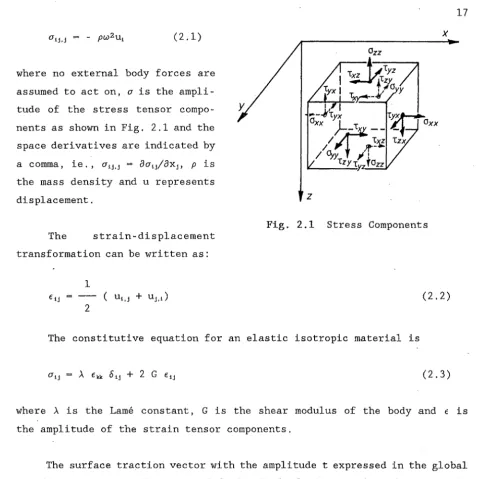
where no external body forces are
assumed to act on, a is the
ampli-tude of the stress tensor compo- Y
nents as shown in Fig. 2.1 and the
space derivatives are indicated by
a comma, ie., a1J,J = 8a1J/8xJ, p is
the mass density and u represents
displacement.
The strain-displacement
transformation can be written as:
1
2
X
z
Fig. 2.1 Stress Components
(2.2)
The constitutive equation for an elastic isotropic material is
(2.3)
where A is the Lame constant, G is the shear modulus of the body and e is
the amplitude of the strain tensor components.
The surface traction vector with the amplitude t expressed in the global
coordinate system acting on an infinitesimal element can be related to the
element stress by the unit normal vector of the surface, ie.,
(2.4)
Substituting Eq. 2.2 and Eq. 2.3 into Eq. 2.1, the following equation can
be obtained,
(2.5)
Now three displacement components can be solved by taking the boundary
conditions into account. The prescribed surface traction can be enforced by
[image:26.602.51.545.49.527.2]To solve Eq. 2.5, two displacement components have to be eliminated and
the resulting differential equation is, however, of fourth order. An
alternative way of solving for the displacement is to introduce new variables:
the volumetric strain with amplitude e and the rotation strain vector (O} with
the amplitude components 01 , 02 and 03 • They are defined as
e = Eu (2.6)
\1
( U3,2
-
U2,3 ) (2.7a)2
1
( U1,3
-
U3,1) (2.7b)2
1
( U2,1
-
U1,2 ) (2.7c)2
The four unknowns can be uncoupled by a simple elimination procedure.
It can be shown that the following two equations are achieved,
w
'v2 e e (2.8)
cP
W.
v2
(0) =-
(O} (2.9)c.
where 'v2 is the Laplacian operator, cP is called the dilatational wave
velocity and is specified as
Cp = [ A + 2G ] ;~ p
c. is called the shear wave velocity and is specified as
(2.10)
(2.11)
The wave equations Eq. 2.8 and Eq. 2.9 are linear partial differential
equations of the second order.
iw iw
exp (- sP ) exp (iwt) (2.12)
.(2.13)
where {L)T =[Lx, Ly, L,], {XF =[x, y, z], sP is the coordinate measured along
a straight line in the propagating direction and Ap is a constant.
It can be verified that the trial solution satisfies Eq. 2.8 if the
following condition holds,
1 .(2.14)
The thtee scalars can be considered as the direction cosines of the straight
line along which sP is measured.
The corresponding amplitudes of the displacement components are
SP
LJ AP exp [iw (t - - - ) ]
Cp
where the subscript j x, y, z indicates the direction.
From Eq. 2.15 and Eq. 2.14 it can be shown that
SP
AP2 exp [ 2iw (t - - - ) ]
Cp
(2.15)
(2.16)
Eq. 2.16 represents a scalar wave propagating in the positive SP-direction
with the velocity cP and amplitude Ap. Its displacement vector coincides with
the direction of propagation. At a given time t = t0 , the displacement vector
is constant if sP is constant, ie. , on a plane perpendicular to the
propagating direction, the displacement vector is constant. The wave
represented by Eq. 2.15 is called a dilatational wave or P-wave and subscript
p has been introduced to indicate the wave type.
The following analogous trial solution can be used for Eq. 2.9,
iw iw
(0) - {C} exp (- s. ) exp (iwt) (2.17)
(2.18)
where (M}r = [Mx, My, M,], (C)r = (Cx, Cy, C,] and s. is the coordinate measured
along a straight line in the propagating direction.
The condition for Eq. 2.17 to satisfy Eq. 2.9 is
(M)T (M) 1 (2.19)
(M)T (C) 0 (2.20)
The three components of {M} are the direction cosines of propagation and (C}
contains the amplitudes of the rotation strains.
The corresponding displacement components are
s.
A,J exp [iw (t - - - ) ] (j x, y, z) (2.21)
c.
in which
(2.22a) ( M~ + M~ )1;2
A.y = - - - (2.22b)
( M~ + M~ )1;2
(2.22c)
c.
(2.22d) ( M~ + M~ )1;2
A,v (2.22e)
( M,_2 + My2 )1/2
where A.h is the amplitude of the horizontal component and A.v is the amplitude
of the component lying in a plane determined by the vertical axis z and the
direction of propagation. It can be shown that Eq. 2.21 represents a wave
propagation with the constant velocity c •. This type of wave is referred to
as a shear wave or S-wave.
In most engineering applications, it is reasonable to assume that the
P-wave and S-wave propagate in the x-z plane. Substituting Ly= My =·0 in Eq.
2.15 and Eq. 2.21 and adding the displacement caused by the P-wave and the
S-wave, the total displacement components are
u = u(x,z) exp (iwt) (2.23a)
v = v(x,z) exp (iwt) (2.23b)
w = w(x,z) exp (iwt) (2.23c)
SP S8
u(x, z) = Lx AP exp (-iw - - ) + M, A,v exp (-iw - - ) (2.23d)
s.
v(x,z) A,h exp (-iw - - ) (2.23e)
c.
Sp S1
w(x,z) L, AP exp (-iw - - ) + Mx A,v exp (-iw - - ) (2.23f)
c.
L~ + L~ 1 (2.23g)
1 (2.23h)
Lxx + L,z (2.23i)
s. = Mxx + M,z · (2.23j)
where u, v and ware the displacement components in x, y and z direction
2 . 2 D y ~ a r n i c S t i f f ~ e s s M a t r i ~ f o r
S o i l E l e r n e ~ t - - - D i s c r e t e
F o r m o f Wa~e E q ~ a t i o ~ s
In a horizontally layered half space, the displacement solution has t'o
satisfy all of the boundary conditions between the adjacent layers and at the
free surface. This requirement makes it impractical to derive an analytical
solution for the layered half space. Instead, each layer can be treated as
a single element and the solution can be constructed for each element and the
boundary conditions can be imposed in the same way as in the finite element
method.
In the following sections, only the in-plane motion is considered because
the out-of-plane motion is much simpler and the further details may be found
in the reference (W7, Kl).
The general definition of the stiffness matrix is the transformation
matrix relating the force components and their corresponding displacement
components. The dynamic stiffness matrix of a soil element will relate the
stress amplitudes on the boundary to the corresponding displacement
components. To enforce the boundary conditions at the top and bottom of the
layer, the following condition has to be satisfied (Kl, W7)
Lx Mx
(2.24)
ie., the P-wave and the S-wave have the same variation in the x-direction.
To solve for L, and M, from Eq: 2. 23g and Eq. 2. 23h when L,., which equals the
cosine of the P-wave incidence angle, M,, which equals the cosine of the
S-wave incidence angle, are known, two roots with opposite signs for L, and
M. can be found. They represent the waves travelling in the opposite
direction. All of these waves have to be included in the solution of the wave
equations.
CP c.
C = (2.25a)
L.: M,,
w
k (2.25b)
C
1
r = - i ( 1
-
) 1/2 (2.25c)L.:
1
s = - i ( 1
-
)1/2 (2.25d)M,,
where c and k are the phase velocity and wave number, respeqtively.
Substituting Eq. 2.25 into Eq. 2.23d and Eq. 2.23f and including the reflected
waves travelling in the positive z-direction, it can be shown that
u(z,x) u(z) exp (-ikx) (2.26a)
w(z,x) w(z) exp (-ikx) (2.26b)
AP
r"]-
Leikrz Le •ikrz -Mseiksz Mse•iksz BP(2.26c)
A.v
w(z) -Lreikrz Lre·ikrz -Meiksz -Me •ik••
B,v
where L and M are Lx and M,, , respectively. AP' BP' A.v and B.v are the
amplitudes of the corresponding waves. Eq. 2. 26c can be written symbolically
as
(U(z)) [GU(z)] (A) (2.26d)
Substituting Eq. 2.26 into Eq. 2.2 and Eq. 2.3, the stress functions a.,
and r"' can be derived as
a .. (z,x) a,.(z) exp (-ikx) (2.27a)
r(z}
L(l-s2 )eikrz L(l-s2 )e-ikrz -2Mseiksz 2Mse•iksz= ikG
r ,..(z) 2Lreikrx -2Lre•ikrz M(l-s2 )eiksz M(l-s2 )e•ikn
(2.27c)
ie.,
(2.27d)
Setting u(z) = U1 and w(z) = W1 when z = 0 and u(z) = U2 and w(z) = W2
when z = d where dis the depth of the layer, and substituting these into Eq. 2.26c then
U1 L L -Ms Ms AP
iW1 -iLr iLr -iM -iM Bp
(2.28a) U2 Leikrd Le•ikrd -Mseiksd Mse•iksd A.v
iW2 -iLreikrd iLre•1krd -iMeiksd -iMe•iksd B.v
ie.
[GA] {A} (2.28b)
and
(U(z)) (2.28c)
The stresses are then determined from
Applying the same procedure to Eq. 2.27c but setting P1
at z = 0 and P2 = r.,2 , R2 = a,.2 at z = d leads to
P1 -2Lr 2Lr -M(l-s2) -M(l-s2)
iR1 -iL(l-s2) -iL(l-s2) i2Ms -i2Ms
ikG
P2 2Lreikrd -2Lre-ikrd M ( 1- s 2 ) e iksd M( 1- s 2) e-iksd
iR2 iL(l-r2 )eikrd iL(l-r2 )e-ikrd -i2Mseikad i2Mse-iksd
i.e.,
{P} [PA] {A}
AP
BP
(2.30a) A.v
B.v
(2.30b)
After solving Eq. 2.28b for (A} and then substituting {A} into Eq. 2.30b,
the dynamic stiffness matrix of the soil element can be obtained where
( p) (2.31)
(2.32)
The matrix inverse in Eq. 2.32 may be performed analytically and the explicit
form of the dynamic stiffness matrix of a soil layer for in-plane motion is
given in the appendix with some special cases.
The above procedure is very similar to the finite element procedure and
the function
+co
[Nu(z,x)] =
J
[GU(z)] (GAJ-1 e-1"" dk -co(2.33)
may be interpreted as a displacement shape function which satisfies the
differential equilibrium equations exactly.
For a half space, applying loads at the free surface will only develop
the waves travelling in the positive z-direction. The radiation condition
requires that no waves come toward the free surface from infinity. Setting
AP and A.v equal zero in Eq. 2. 26c and using the similar procedure eliminating
BP and B.v lead to the dynamic stiffness matrix of the half space' [ sp-sv"] . The complete form is given in the appendix.
For a loaded horizontal layer, the equilibrium equation of an
infinitesimal element can be expressed as (W7)
(2.34)
where p1 is the loading function. For in-plane motion, all of the variables
concerned with they-direction can be omitted.
expressions are assumed
If the following loading
{p(z,x)} = r(z,x)
{p'(Z)}
e•ikxr(z)
(2.35a)
and the load is linearly distributed in the vertical direction
z z P1
rz]
1 - 0 0d d ir1
(2.35b)
z z P2
r(z) 0 -i(l - - ) 0 -i
d d ir2
the particular displacement solution of Eq. 2.34 is (W7)
c2
.
z 1 c2.
rz]
- - - ( 1 - -) - - ( 1 - - )1 r2c~ d kdr 2s 2 c2 p
k 2G i c2 s i z
WP( Z ), - - ( 1
-
- ) -(1 --)
kdr2s2 c2 p s2 d
zd
1 c2.
P1(1- - )
dr2c~ kdr 2s 2 c2 p ir1
(2.36a)
i c2
.
iz P2-
- - ( 1-
- )where p1 and p2 are the load amplitudes at z = 0 and z = d acting in the
x-direction, respectively, and r1 and r2 are the load amplitudes at z = 0 and
z =din the z-direction respectively, ie.,
[ PU( z)] { p} (2.36b)
Substituting Eq. 2.36 into Eq. 2.3, letting P1 = - 'Tx.i, R1 = - a •• 1 , P2 = 'Tu2 and
R2 = a •• 2 , the dynamic stiffness matrix for the linearly distributed loading is
1 kd -1 0
G kd(2-d/ct)
diet
0 -c~/c?[SP] (2.37a)
d -1 0 1 -kd
0 -eve% -kd(2-cVc%) cVc%
and
[ SP
l
(UP) (2.37b)Material damping can be taken into account by introducing complex
material properties, ie., hysteretic or viscous damping is assumed. As a
result G , cP and c, may be replaced in all of equations by (LS, S 2; W7)
G* = G ( 1 + 2
r.)
c*
.
c* p
Cs ( 1 + 2 rs) 112
for hysteretic damping and
G*
c*
.
c* p
G (1 + 2wL)
c. (1 + 2wr .)1/2
(2.38a)
(2.38b)
(2.38c)
(2.38d)
(2.38e)
(2.38f)
for viscous damping, where
rp
andr.
are damping ratio for the P-wave and the2 . 3 B o ~ ~ t l a r y E l e m e ~ t M e t h o d B a s e d
o ~ G r e e ~ ' s F ~ ~ c t i o ~
In an elastic domain where no body forces are assumed to act, which
satisfies the differential equilibrium equation Eq. 2.5, the displacement
solution under a set of loads which satisfies all boundary conditions is a
Green's function for this set of loads.
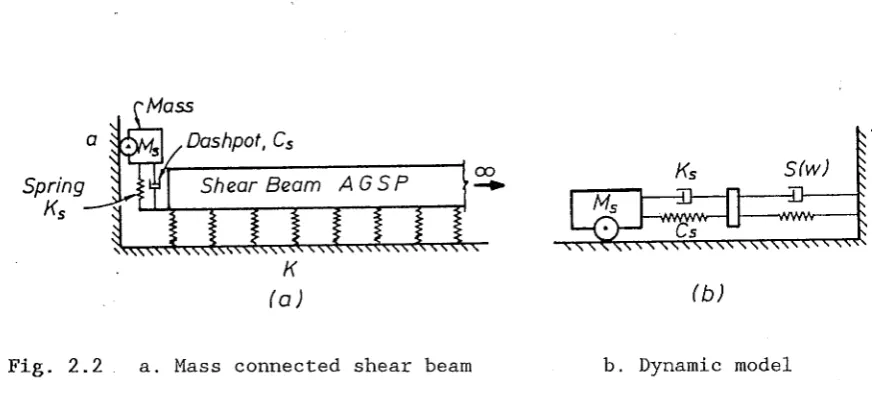
To present the principle of the indirect boundary element method used in
the following section, a one-dimensional problem shown in Fig. 2.2 is taken
as an illustration.
Spring
Ks
Fig. 2.2
K
(a)
a. Mass connected shear beam
(b)
b. Dynamic model
A mass is connected through a spring K. and a dashpot
c.
with asemi-infinite shear beam with shear area A, shear modulus G, cross section
area Sand mass density p resting horizontally on an elastic foundation with
spring constant·k. If the shear beam is under a harmonic excitation at its end
(x = 0) with amplitude P, the equilibrium equation in the vertical direction
is represented by
k
w -
,uw
+w
0 (2.39a)GA c2 8
[image:37.595.64.504.313.519.2]C. -- [ ~ ] 1/2 (2.39c) pS
where
Q
is the shear force in the beam. The solution of Eq. 2.39a whichsatisfies the boundary condition W(x) = 0 at x = oo is
W(x) a exp (-iwx/c) (2.39d)
where c is the wave velocity, i.e.
[
GAr~
C = w
k(a.
-
1)(2.39e)
w GA
(2.39f)
c. k
aw
-ia= - - exp(-iwx/c) (2.39g)
ax
CQ(x) -iGAw a/c exp (-iwx/c) (2.39h)
If W(x) W0 at X 0 then
Q(x) -iGAw/c W0 exp ( -iwx/c) (2.39i)
The dynamic stiffness coefficient of the shear beam under a point load is
s
( GAk ( 1-a0 2 ) ) 112 (2.39j)For an infinite beam with the same properties under a point load with an
unknown amplitude q at x = - e, the equilibrium equation is
k
W,xx - - - W + - - W q &(x+e) (2.40a)
GA c2
.
W(x) i
Q(x)
qc
exp (-iwe/c) exp (-iwx/c)
2GAw
q
2
exp (-iwe/c) exp (-iwx/c)
which can be referred to as the Green's functions.
(2.40b)
(2.40c)
By enforcing the
displacement W(x) = W0 at x = 0 , the unknown load amplitude can be solved
from Eq. 2.40b.
q - 2 ( GAk( l-a.2) )112exp ( iwe/c) W0 (2.40d)
Substituting Eq. 2.40d into Eq. 2.40c and setting x = 0, the relationship
of the force and the displacement at the end can be specified as
p (GAk(l-a02) )112
w.
(2.40e)s
(GAk(l-a02) )112 (2.40f)The stiffness coefficient of the beam is identical with the analytical
solution because in enforcing displacement boundary conditions, no
approximation is introduced.
For a three dimensional half space, the stiffness matrix of the far-field
soil can be derived using the indirect boundary element method in a similar
procedure to that for the semi-infinite shear beam. Firstly, distributed
loads with initially unknown intensities are assumed to act on a source
boundary S' which is offset toward the far-field soil in the semi-infinite
domain without excavation because the analytical solutions are available for
this domain (W3, W4, W7). In the limit, the source boundary can be moved
toward the interface S between near-field and far-field up to an infinitesimal
distance. Because only a finite number of loads can be chosen, an
interpolation function [L(s')] has to be selected and an approximation is
introduced. The distributed load can be expressed as a function of unknown
nodal values {p),
where s' is the coordinate measured along the source boundary S' . The
displacement and surface traction on the interface S for the semi-infinite
domain under the load p(s') can be calculated, .
(Up(s)} (2.41b)
(Tp(s)} [gt< s)
l
(Pl (2.41c)where s is the coordinate measured along the interface S and gu(s), gt(s)
contain the elements of Green's function.
Secondly, the prescribed displacements on the interface can be
constructed as
(U(s)} (2.41d)
where [N(s)] is the interpolation function and {Ubl is the nodal displacement
vector.
Finally, the displacement boundary condition on the interface S has to
be enforced by the weighted-residual technique
J[W(s)r((U(s)) - {Up(s))) ds
s
(2.4le)
where [W(s)F contains the weighting functions. From Eq. 2.4le the unknown
loads at all nodes can be determined. The weighting functions can be chosen
in different possible form according to the different error distribution
mechanisms. Here the matrix of the Green's functions [gt(s)] is chosen as
the weighting function. From Eq. 2.4le, following equations result in
[G]{p) [Tl {Ub} (2.41£)
[G] J[gt(s) ]T[gu(s) ]ds (2.41g)
s
[T] J[gt(s) JT[N(s) ]ds (2.41h)
The concentrated nodal forces on the interface can be obtained as
(Ph}=
J
[N(s)JT(TP(s)}dss
(2 .4li)
Substituting Eq. 2,41c and Eq. 2.4lf into Eq. 2.4li the force-displacement
relationship can be found as
<2.4lj)
The stiffness matrix of the far-field is
(2.41k)
It can be verified that matrix [G] is symmetric and that the stiffness matrix
is always