A thesis
submitted for the degree
of
Doctor of Philosophy in Mathematics
in th
University of Canterbury
by
A.K. Laing /
/
University of Canterbury Christchurch, New Zealand
LIBRt,RX'
Chapter
ABSTRACT
I INTRODUCTION .•
II CRITICAL POINTS IN THE FLOW OF A LAYERED
III
FLUID FROM A RESERVOIR
§2.1. Theory
§2. 2. Solu ons
§2.3. Results and Discussion
§2.4. Generalisation
SOME FURTHER FEATURES OF CRITICAL POINTS
§3.1. Association of erjtieal points
with erfaees ..
§3.2. Relation of critical Unsteady flouJs
ints to
IV PERMANENT WAVES IN A CLOSED THREE LAYERED
v
FLUID
§4.1. Background
§4.2. The general equations
§4.3. Single mode equations
§4.4. Permanent waves in onemo
PERMANENT WAVE STRUCTURES
§5.1. The equations
§5.2. The method of solution
§5.3. Results
§ 5. 4. Cone Zusion
ACKNOWLEDGEMENTS 123
REFERENCES 124
ABSTRACT
Various problems associated with a stably layered fluid are studied.
Firstly, the flow of a layered fluid from a reservoir is considered. Steady solutions are sought and found to depend on the flow at the critical points, that is, points at which the long wave speeds for the different modes of gravity wave propagation vanish. For certain distributions of the layers' depths i t is found that there are too many critical points, and hence the flow is overdetermined and no steady solutions are possible. Thus, when reservoir conditions are slowly altered so as to pass from one depth ratio to another, the flow will not necessarily change slowly too.
A closed three layered fluid with small density differences between the layers is also studied. The
non-linear interactions between the two, closely related,
internal wave modes are investigated, and general evolution equations are obtained for small disturbances at the inter-faces. Permanent solutions involving one mode alone are calculated, but i t is found that at certain wavelengths
the slower mode permanent waves resonantly generate harmonics of the faster mode.
When the group velocity of a train of faster mode waves is the same as the phasevelocity of a slower mode wave there is significant interaction leading to a permanent wave
CHAPTER 1
INTRODUCTION
This thesis deals with various problems associated with a stably layered fluid. In general the systems
considered comprise a rigid lower boundary with homogeneous layers of fluid arranged in order of decreasing density and bounded above by either a free surface or a rigid lid.
The most important areas within these fluids are the regions of density discontinuity, or the interfaces, and i t is here that a disturbance within the fluid will manifest itself. If a free surface is considered an interface whose upper layer is of zero density, then a system with n inter-faces will allow n different modes by which a given
disturbance may propagate. Each of these n modes has an associated long wave speed. Hence, a long wave could propagate at any of n speeds.
Froude number is unity then the flow is critical, and i t is in the regions of critical or near-critical flow that most of the interesting problems lie.
For a fluid with variations of the flow speed in the direction of flow, there arises the possibility the fluid passing through critical conditions at some points. These discrete points are called critical points and play an important role in solving the flow. If the flow is backed up by an infinite reservoir and there is a smooth geometry of contraction of the flow channel, then there will be
steady downstream increase in flow velocity and a number of critical points may exist. For a steady system WOOD (1968 and 1970), WOOD and LAI (1972a and l972b), and LAI and WOOD
(1973) provide examples of the use of critical points in solving flows. BRYANT (1974), and BRYANT and WOOD (1976) further developed this idea and applied i t to a situation in which steady flow solutions are bounded by unsteady regions in which the theory predicts and excessive number of critical points. Chapter two is an application of the same techniques to a slightly more complicated structure, and there are several different features revealed.
The question of critical points is continued into Chapter three to clar both the role of critical points in unsteady flows, and the association of critical points with the interfaces.
ined identities of the modes in internal/surface systems. The latter part of this thesis concentrates on the
non-linear theory of the system with two internal modes. The close relation of the modes causes effects not evident in studies where the interacting parts are W€11 identified such as in the interactions between waves with vastly different modes of propagation.
The aim of this nonlinear analysis is ultimately to seek waves of permanent form which may exist within this system. Permanent waves and permanent wave structures are indeed found with features definitely attributable to the closely related, internal nature of the two modes.
As with the earlier part of the thesis, the problem is historically derived from flows of a critical nature. The concept of permanent waves began with the discovery of solitary waves, that is, isolated pulses with constant shape. The wavelengths of these "solitons" is effectively infinite and they travel at speeds near the longwave speed [in actual fact the speed is {g (h
+a)}~
where h is the fluid depth and a the amplitude of the wave] which characterises the critical conditions for a fluid. In other words, if a fluid contains a critical point, then a solitary wave would be stationary and permanent in form near that critical point.The theory of permanent waves originated in the reconc iation of two distinct classical treatments of gravity waves on homogeneous, incompressible, irrotational
fluids~ Defining a, ~ and h as scales of amplitude,
are based on the two parameters E
=
a/h and ~=
h/~. The first is an initially infinitessimal theory involvingexpansions based on the small parameter E(~ ~2). This can be Fourier analysed and to a first approximation describes linear dispersive wave motion. The other method is the long wave (or shallow water) theory for which v2 (~ E) is
the small parameter. Distortion and breaking of waves are features of this approach. However, when E/V2
=
0(1) these effects attain a balance, and waves whose shape is conserved can exist. Initial investigations were pursued in this field by SCOTT-RUSSELL(l844), BOUSSINESQ (1871), RAYLEIGH (1876) 1and KORTEWEG and DE VRIES (1895) .
The Korteweg -de Vries equation which describes the evolution of waves under these conditions has been found relevant for many physical problems besides small1 finite
amplitude water waves. These include: Magneto-hydromagnetic waves in cold plasma; Rotating flow in a tube; Pressure waves in liquid gas bubble mixtures; Ion accoustic waves in an
anharmonic crystal; Longtitudonal vibrations of a harmonic discrete mass string; and Longtitudonal dispersive waves in elastic rods [see KRUSKAL (1974) for references].
One of the features of the Korteweg -de Vries equation is that i t accommodates solutions of permanent form.
Internal waves of permanent form were not considered until much later [KEULEGAN (1953) 1 LONG (1956)] when
(1966), using a flow force perturbation expansion, provides a generalised theory for internal permanent waves allowing arbitrary vertical density and velocity distributions, and either a free upper surface or a rigid upper boundary.
The interaction of different wavetrains has long been a topic of interest, particularly in oceanography. The concept of radiation stress was used by LONGUET-HIGGINS and STEWART (1960) to study the effect of a wavetrain of
long waves on another of short waves. The variation in energy of the short waves is found to correspond to the work done by the longer waves against the radiation stress
the short waves. This study has later been extended to a two layer system with a surface to see the effect of long interfacial waves on a wavetrain of short free-surface waves [GARGETT and HUGHES (1972)]. The drawback of this method in relation to the present study is the prescribing of the long waves.
However, the present approach is based on a general method proposed by BENNEY (1966) for studying long
non-linear waves and their interactions without prior knowledge of the wave profiles. Generalised expansions in both
parameters E and ~2 are found and solutions sought in the
neighbourhood of E
=
~2=
0. Korteweg -de Vries typeIn the present study several features make BENNEY'S approach preferable to BENJAMIN'S.
Benjamin's analysis is primarily a steady flow analysis based on an expansion of the wave resistance in a small
displacement parameter s. The problem then yields solutions which are shown to be derived from the O(s2) terms. Such solutions are of necessity permanent in form.
However, Benney's method is initially an unsteady
expansion of the general problem. Thus, evolution equations can be found for which solutions of permanent form are
special cases. This method provides a better basis for studying non-linear wave interactions since the notion of wave propagation is present until the final step.
The former approach retains very close contact with its physical interpretation. However, mathematically the flow force is regarded as an integral equation to be solved by successive approximation. On the other hand Benney
writes partial differential equations for the non-linear perturbation equations. These can be solved using fairly standard techniques, and generally seem more manageable than integral equations.
One development incorporated in the present study is that used by BRYANT (1973) [and in subsequent papers] where the wavelength parameter ~ is unrestricted, and so
the expansion is in terms of s but allows a wide range of ~. This ~-exact approach means that Stokes' waves,
give the evolution of the interfacial amplitudes.
The significance of the non-linear effects incorporated into the analysis is in the quadratic interactions they
represent between the various wave harmonics present. These interactions are particularly significant if resonance or near-resonance occurs. If k is a wavenumber, and w(k) the associated linear frequency of a wave, then the resonance conditions for quadratic interactions require that
kt
'+
k2+
k3=
0w ( k 1 ) + w ( k2 ) + w ( k3 )
=
0 •(1.1)
( 1. 2)
In the presence of more than one mode of propagation the frequencies may be of any mode, hence a wide range of
possibilities is present. For near-resonance the relation in (1.2) is a near equality in which case there is still an appreciable transfer of energy possible between elements of the near-resonant triad - For a conservative system, at resonance the energy within a triad is conserved but can be readily transferred between the component harmonics.
For a closed three layered system there are two inter-faces and two internal modes for wave propagation. The non-linear interactions between harmonics of both modes and their contribution to the formation of permanent waves and groups of waves with permanent envelopes are studied in chapters four and five. Chapter four concentrates on developing the relevant evolution equations and using these to solve for permanent waves consisting of one mode only or predominantly one mode. Chapter five extends this to
CHAPTER II
CRITICAL POINTS IN THE FLOW OF A LAYERED FLUID FROM A RESERVOIR
The properties of critical points are instrumental in solving certain types of flow. If a layered fluid flows with uniformly increasing velocity in the downstream
direction, and the correct number of critical points exists, solutions for the flow can be found at these points and
consequently anywhere in the fluid. At the critical points the geometry of the channel containing fluid determines the flow. Hence the naming of the critical points as
controls.
WOOD (1968) analysed the flow from a stably-layered reservoir through an open channel with a horizontal
contraction. The method he established was used later for various reservoir outlet problems including: lock exchange flows (WOOD 1970), layered fluid flow over a weir (WOOD & LAI 1972a) , layered fluid flow from a
reservoir into a closed conduit {WOOD & LAI 1972b), and two-layered flow through a contraction (LAI & WOOD 1973). The critical point corresponding to the fastest wave mode, which occurs at the point of minimum width, is called the control, whilst the upstream critical points are called virtual controls.
conduit that if the withdrawal is steady there may be
discontinuous changes to the flow ratios between the layers. In fact, for some configurations i t is shown that no steady solutions exist, whilst for others there is the possibility of more than one solution. The involvement of critical
points is all important and this chapter further investigates this role using a slightly more complicated model. The work was begun as part of a Masters Thesis by the author (1975).
Consider a large Reynold's number (inviscid), non-diffusive, stably layered fluid, flowing in the positive-x direction through a smooth horizontal contraction with a point of minimum width at x
=
0. A weir is placed in the contraction so that its maximum height is at x=
0.Assume the flow is backed up by a reservoir so that the time for a fluid particle to travel through the contraction is small compared to the time for the streamline patterns to change. This is effectively a system of steady flow with reservoir conditions that can be prescribed. Also assume the hydrostatic approximation, which is reasonable provided the reservoir outlet's dimensions change only gradually so that vertical accelerations are negligible compared to horizontal accelerations.
§2.1. The aim of this chapter is to explore the involvement of critical points in the limiting conditions for steady solutions of a reservoir outlet flow regime. Mathematically, for a stable system there is a fixed number of critical
However,there are situations in which an excessive number of critical points tends to form and so cause
over-determination of the system, and hence instability.
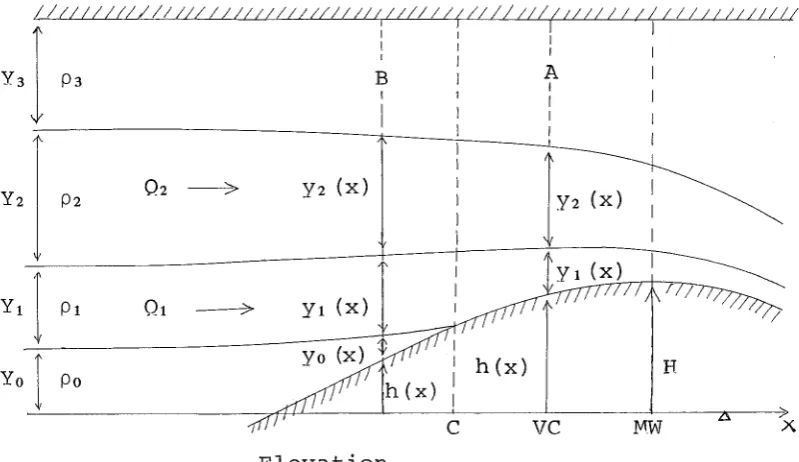
Consider the system depicted in figure (2.1) with two flowing layers above a third stagnant layer. Both the height and width of the channel are functions of x and the geometry of the channel is determined by the relation
h(x) + b(x)
=
a constant, where b(x) is the channel width and h(x) the height of the weir above some datum. The flowing layers are represented by the subscripts 1 and 2 for lower and upper layers respectively, whilst the non-flowing layers by 0 and 3. The thicknesses of layers are yi, the fluxes Qi, the velocities ui,and the densitiespi where Po
>
P1>
P2>
~.
Also, the undisturbed layer thicknesses are Y., and the maximum height of the weirl
(at x
=
0) is H.This system has three main points of interest: a control at the point of minimum width (MW) which is also the weir crest, a virtual control (VC) somewhere upstream at x
=
xVC' and a point of contact between the lowerinterface and the weir (C) which is also upstream of
I
I I 11!/11/111 ///l!/111/111/llll!:///l I /(l/lll!/(;1111 I I t !1/1!11111 I I
I I I I
I I
Y3 P3 B I ~ I
I 1 I I
I I I I
I I I
I I
I
Y2 (x)
(x)
Y 1
l
P1 Ql ----7> Y1 (x)Yo
I
PoYo h(x)
vc
MWElevation
MW ---~~---~
Re s e r v o i r ----,---?>
Plan
b(x)
2
-Figure 2.1
Geometry is b + H
=
b + h mI
I
[image:18.595.102.502.101.332.2]The flow regime may be subdivided into two types: flows with the virtual control upstream or downstream of the point of contact respectively (xvc 5xc). The regions with lxvc - xc
I
small are of particular interest since the proximity may well influence the solutions. In this section the model is analysed theoretically. A discussion ofpossible experimental situations is included in the presentation of the results in §2.3.
§2.1:1. Firstly consider xc
<
xVC<
xMW'The energy equations at the interfaces yield ~ Y2 G:f =Yo +Y1 +Y2 -y1 -y2 -h
· 2 · 1 P2 3 2
~ Y1 G1 = "'2 Y2
p-;:-;
G2 +Yo +Y1 -y1 -h( 2 ._1)
( 2. 2)
where p .. = p. - p. and G. 2 is the dimensionless quantity
l J l J l
2
p. Q.
l l
(j 3 if i 2' j 2 if i 1) . gb 2y ~ ( p . - p . ) =
=
==
l l J
Clearly further equations are required, so the condition that the layers must vary smoothly is used. Differentiating equations (2.1) and (2.2) and solving;
1 db
=
b
dxrn-;T'
I
D1I
=
b
1 db dxm
I
D2I
where [Do
I
and
!
dbI
D1 [=
(1 - G2)[!
db (G2y 12..12_-G2y ) - 12..12_ dh] b dx 2 b dx 1 1 P2 3 2 2 P2 3 dx!
db!DI
b dx 22 2 1 db dh - G2 ( G2 y 2
b
dx - dx ) '=
1 db ( G 2 _ G 2 y E..!_2_) + 12..12_ dhb
dx 2 y2 1 1 P23 P23 dx dh) dx ·The points at which Do is singular are the critical points one of which is at x
=
0 and the other at x=
xvc·invoke the finiteness condition on dy1 and dy2
dx dx
To
requires that either
~~
= 0 or ID1 [ = ID2 I = 0 at the critical points.db
Obviously at the control dx
=
0 and so we must have thatD1 and D2 are also singular at the virtual control.
[Notes: (1) An unsteady analysis of the same configuration would give long wave speeds vanishing under the same
condition of singularity of Do. Briefly, the characteristic directions for unsteady propagations (xk) are defined by
singularity of a coefficient matrix D(x); so [D(x)
I
=
0. Now xk corresponds to the long wave speed of one of the interfacial modes, and thus, for steady flow, the points.
at which x
=
0 correspond to the critical points. This is born out by the observation that [D(i = 0) I = 0 =} [Do I = 0.This relation between the characteristics and critical points is clarified in Chapter III.
(2) Do, D1, and D2 differ only in one column.
Given that [oil
=
0 for any two i E {0,1,2} then, means that [D.I
will vanish for all i E {0,1,2}. Hence,smooth-l
ness of y. gives only two independent conditions at the
l
virtual control,
I Do I = I D1 [ = 0.] .
Thus far: at VC,equations (2.1) and (2.2) along with
I Do I
=
I D1 [=
0 ;at MW,equations (2.1) and (2.2) along with
I
DoI
=
0;. 2 .
QQ__!_ (Yo -h) 0
-y1G1 -
=
p 1 2
or Po 1 (Yo -h) + P1 2 (Yo + Y1 - Y1 -h)
+ P2 3 (Yo + Y1 + y2 - h- Y1 - Y2)
=
0 ( 2. 5)are the equations.
The first seven of these at VC and MW are sufficient to solve for 01, Q2, ylVC' y 2VC' ylMW' Y2MW and hvc (or xvc), and once these have been obtained the final three equations at c will give Ylc' y 2c and he.
Consider now the limiting conditions for this type of flow. If the model is solved for various levels of the upper interface while the other external parameters are held constant, a dependence of this type of solution on the interface level is deduced. The higher the interface, the further downstream the contact point and the further upstream the virtual control. (This is true for most
cases although exceptions are found later.) In the region of small three alternatives are suggested:
( 1)
I
xc - xvcI
vanishes with no discontinuity to thesolutions and so there is continuity between the solutions with xc
>
xvc and those with xc<
xVC' at lxc - xvcl=
0.(2) Critical conditions are reached at C or some point upstream of C while VC and C are still distinct.
(3) As lxc - xvcl vanishes, c ceases to exist and this regime is "continuous" with a regime of three layers flowing.
continuity at C is unlikely. This was indeed verified by the results. The other possibilities may be tested as follows:
(2) By calculating the "critical matrix", analogous to Do , for the three layer region upstream of C and evaluating its determinant as x +x .
c
If a point upstream of C becomes critical while x<
xc, then C will become super-critical with respect to this speed (or mode) and testing this determinant for a change of sign at C will suffice.( 3) By calculating dyo at C over a range of interface
dx
levels. If, as the interface rises,
dJ~
passes smoothly through zero at C, while conditions are still subcritical with respect to this mode, then the lower interface must become tangential to the weir, and the third layer begins to flow. By the same token, given a three-flowing-layer regime and a falling interface, at this point the third layer will cease to flow.Note that as the third layer flows a third wave mode forms with an associated critical point which appears at C. So C is critical with respect to this new mode, but still subcritical with respect to the second mode
considered above.
The above tests necessitate setting up equations for the region x
<
xc:~ Y2
Gi
=
Yo+
Yt+
y2 -Yo - Yt - Y2 -h ( 2. 6)p 1 2 2 2
+ .e..u_ (Yo + Yt -h) ( 2. 7)
Yt-- Gt p23
=
Y2 G2 -Yo - Yt P23-yl.e..u..
Gt
=
£.Q_!_ (Y 3 -Yo -h) . ( 2. 8)Differentiating, 2 l-G2 Gg. 0
=
1Pt 2 (1-Gl)
P23
Ptz 2
Pz3 Gz
2 1 db
GzY2 - - -b dh 1
1 cly2
dx
£.u.
dylPz3 dx
E.!LL
dyoP23 dx
1 db E.ll. 2 . £!!..!_
- b
dh Pz3 Gt Yt - P23dh
dx · ( 2. 9)
Thence, dJ; is readily found, and since Ylc' y
2C, and he
are known, dd·Yo
I
can be calculated. Furthermore, the x x=xc
matrix on the left hand side of equation (2.9) is the
"critical matrix" to be tested fo~ singularity at C. Call this D. Note that the flow will be subcritical upstream of C, so lnl
>
0 in the reservoir, and so at c,In!
will decrease towards zero as lxvc - xcl becomes small.These calculations therefore suffice to give the nature of limiting conditions to this type of flow.
What might happen physically in case (2) above requires a little speculation. Since xc and xvc are distinct, three critical points are implied for a two-moving-layer fluid. This flow is overdetermined and no
steady solutions exist. Some breakdown must occur.
Thus, if these solutions, for which
<
xvc·
<
x are MW' referred to as "type A" solutions, the range of interface levels over which they exist will be bounded by low upper interface levels where cessation of flow in layer 1 occurs, and also by high interface levels where (2) or {3) above occurs.§2.1:2. Now consider xVC
<
xc<
xMW'At the point of minimum width equations (2.1), (2.2) and lno
I ;
0 hold, while at the virtual control the equationsare {2.6), (2. 7) and (2.8),-w·hich after imination of
Yo -yo give
2 2 Pt 2
!:2 Y2 G2 + !:2 Yt
Gt--Po 1
=
Yt +Y2 -y1 -y2k P t 2 Po 2 G 2 k G 2 ;
2 Y t ~
POI
1 - 2 Y2 "'2 2..!..2_ (Y1 -yt).P23 ferentiating,
2 l-G2
=
l _ Pt 2 ·G 2 1 1
P12 02 P12
-Pz3 ot P23
1 db
b
Call the matrix on left hand side of equation {2.12) then the critical condition at
vc
isIB I
=
0 and the finiteness conditions on dyl dyz givedx ' dx
2 2
1 - Gz Gt Y1
=
=
Gi
2 . Po 2 . . 2Gt
Po 1 - G2Y2
(2.10) (2.11)
(2.12}
B,
Solutions can be found from equations (2.10), (2.11) and (2.13). [Note that the matrix D from (2.9) can be written using elementary row operations as
0 B
constant x 0
and this is singular iff
IBJ
= 0. So the elimination of Yo -yo is a matter of choice. Also note that !Do Jt
0for xc
<
x<
xMW andIBI
t
0 for x<
xc, xt
xvc·]Again the limiting conditions for this type of flow are sought. For various levels of the upper interface dyo
I
and !Do j are calculated.dx x=xc x=xc
becomes small, provided !Do
I
<
0, there will be well-determined solutions.Call this type of solution, for xvc
<
xc<
xMW' a "type B" solution.§2.2:1. Solutions to the type-A problem in §2.1.1
cannot be found analytically if the problem is to be kept general. For a similar situation WOOD & LAI (1972a) manage to decouple the crest equations (at MW) from the virtual control equations by setting hvc as zero, making the datum unknown, and proceed to solve analytically at VC. Thence a numerical method obtains solutions at MW and finally
the equations at C (viz (2.1), (2.2) and (2.5)) and MW (viz (2.1), (2.2) and
Jno
I
=
0) have to be solvedsimultaneously. For this purpose a Newton-Raphson numerical method is used once the equations have been analytically reduced as far as possible. Once solved, the conditions at C can be found from equations (2.9), (2.10) and (2.11) with
Yo
=
0.§2.2:2. For the type-B problem in §1.1:2
notice that there is no explicit h(x) dependence at VC
(unlike the type-A problem for which this is quite evident). The number of unknowns is reduced by virtue of the fact
that Qi and x in the form of b(x) always appear together as The equations can be decoupled and analytical solutions found at VC from equations (2 .10) ,. (2 .11) and (2 .13).
G2 _ R
From ( 2. 13) "2 - 1 + R + y ,
yR'
(l+y) (R+R') - R where y
=
l lYt R
=
.f2..L.L P23 and R '=
£Q.1_ • P23(2.14)
Substitution into (2.10) and (2.11), and elimination of y1 ,
leads to a single equation
(~~
-yJ[2y(R+R') (l+R+y) +2R' (l+R+y) +Ry (l+R+R')]=
0whence
y
=
=
(The other possibility gives y
<
0 and is non-physical.) FurthermoreY2
=
y1 [ (l+a) (R+R') - R] (l+R+a)Y2 ~- (l+R)[2a(R+R') +R'] +a2 (R+R') '
where a= y , and also
Consider now any x
[ (l+a) (R+R1
) - R]
(l+R+ a)
xc.
Sinceg~
is a constant, then2R
a Rl [ (l+a) (R+R') - R] (l+R+a)
Also from equations (2.6), (2.7) and (2.8)
(
uJ~
Yz R' R(Yt-yd + (R+R') (Yz-yz)(l+R) (Yt-Yt) + {Yz-yz)
(2.16)
(2.17)
Using (2.16) and (2.17) and writing ~
=
,
we eventuallyY1
get
( a - S) • { ( a+ S) ( 1 + R+ a) [ R 1 +a ( R+ R 1
) ] + ~ ~ [ ( a 2 +aS+ S 2) •
(R+R') (l+R) + aS(a+S) (R+R1
) + (a+S)R' (l+R)
+ aSR'
J }
= 0. (2.18}The only physical solution to this is a =
S,
so
=
== a. (2.19)This result in fact is true for all x
<
xc
since equations (2.16) and (2.17) are quite general for the type-B situation.At MW any attempts to solve analytically become too
involved algebraically and numerical computation is necessary. The ratio in (2.19) does not hold at MW or for any
x
>
xc.
These results are not surprising as the type-B situation is very similar to the two layer selective withdrawal problem for which WOOD (1968) found self-similar solutions withYt constant throughout. However for points downstream of C the flowing layers come into contact with the weir and this
§2.3. Results and Discussion.
It is useful to present the results in the light of
experimental possibilities and so a hypothetical experiment
is considered. Assume all the external parameters are held
constant except Yt and Y2. The upper interface is allowed
to drop. This is achieved by allowing free draining over
the weir but replenishing the upper layer in the reservoir
to maintain a constant depth. BRYANT (1974~ allowed control
over all three layers whilst BRYANT & WOOD (1976) preferred
complete draining with no replenishing. However, the models
all represent reservoir outlet schemes and thus some inflow
is likely. Hence, replenishing the upper layer to keep
constant depth is considered acceptable although, from the
laboratory point of view, less readily reproduced than
complete draining.
The varying parameter as the interface falls is taken
as Y2, which increases. Firstly the ranges of Y2 for
solutions of both type-A and type-B have been found. This
was done for a variety of values of R and R' to show the
effect of density difference ratios on the limiting conditions.
Figures (2.2), (2.3) and (2.4) show the ranges of Y2 for
which these solutions exist for the geometries with crest
heights H
=
0.5, 0.6 and 0.7 respectively. Note that allheights and depths are measured as proportions of
Yo
+
Y1+
Y2. In all cases the width of the channel has aminimum of 0.1, h
+
b=
H+
0.1 determines the geometry, andYo
=
0.2. The limits of the regimes are denoted by solidlines or regularly broken lines (that is or ----) if
-p:;
II
-p:;
[image:29.597.73.807.114.550.2]
I /
/
I
I
I
,l
00 0 0.
0""'
N 0 0 0 0.
.
0 0 Figure 2 of .4 Y2 for Type-A o -0 and Ty e -.2 and H~
P -B solut· 0.7. lons toe. X1St
critical point, by (-·-·-·) if three-flowing-layer solutions are continuous with the two-flowing-layer solutions, and by
(-··-··-··) when the lower layer ceases to flow because Y1
has become too small.
Several features are notable:
(1) Lowering the crest height means the values of the density difference ratios for which the problem is of interst are higher. Since Boussinesq fluids are of most interest and p3 is taken as being very small (even p3
=
0for a free surface), then the smaller R and R' are, the better. Subsequently the configuration with H
=
0.7 will be used in preference to the others.Several solutions were also obtained for reduced Yo
(down to 0.1), but the effect of this was the same as lowering the crest and nothing ext~a was revealed.
(2) In every case for small lxc - xvcl the limiting factor was the tendency to form an extra critical point. It thus follows that in each case there will be an unsteady break-down of the flow pattern at the boundary (to the
two-flowing-layer regimes) for which the virtual control and contact point are close.
(3) For the type-B solutions there are two regions. If
Y2
<
0.445, 0.440 and 0.430 (in Figures (2.2), (2.3) and(2.4) respectively), xvc increases as the interface drops, whilst for Y2 larger than these values, xvc decreases.
ranges of Yz for which type-B solutions exist.
If Yz E (0, 0.06),xvc increases with Y2 , but for
Yz E (0.77, 0.80), xvc decreases as Y2 increases.
Figure (2.5), which has been included to show the dependence
of xvc and xc on Yz, makes these distinctions clear. This
figure is drawn for the three density difference ratios
R
=
R'=
0.006, 0.0036 and 0.0026. For the first two valuesthe two regions of type-B solution are distinct, whilst for
the latter value they are continuous, meeting at a point
where hvc (and hence xvc) reaches a maximum.
This phenomenon is accountable if the experimental
situation is considered. Firstly, i t is reasonable to
assume when one of the flowing layers is shallow that
proportional changes in velocity for a small drop in the
upper interface are small compared to the proportional
changes in the layer thicknesses. That is, for velocity
u and thickness y, you~ uoy, so for purposes of small
change in layer thickness assume the velocities in the thin
layers are constant. Secondly, given the long wave
approx-imation, the narrower any layer becomes, the slower the
critical speed becomes (assuming the layer velocities
constant) . This of course refers to the slow mode since
the fast mode's critical point is at MW. [This is a
general comment. For example, the two layer system with
layer depths y 1 ·and y2 confined between rigid planes, has
a single mode with wave velocity proportional to
1/ (
P1 coth ky1 ·+
Pz coth kyz) . In the long wave limit andh(x)
0.4
0.2
0.2 0.4 0.6
R
=
0.00600.4
0.2
R
=
0.00360.4
0.2
R
=
0.0026Figure 2.5
Positions of Virtual Control (VC) and Contact point (C) for various
levels of the upper interface. Both types of solution are included
[image:34.595.59.549.56.764.2]decreases. For two layers with a free surface and a rigid base the smaller of the two modes' speeds (in the long wave
limit and with y 1 + Y2 a constant, say 1) is
{
Pt P2 _
Yt Y2
[p1pi _
4(p
22 + P1P2) (
- y y· Pz Pt
Yt Y2 1. 2
which also decreases for either y1 or y2 small. This case is akin to the present situation.]
Thus, at the beginning of the "experiment" the interface is still high and Y2 small, so the critical speed is slow and the critical point well upstream. As the reservoir drains the interface drops, and Y2 increases with an increase in the critical speed and a downstream movement of xvc towards the contact point at xc. At the other end of the scale, as Y2 becomes large, Y1 is small and decreasing. For small enough
Y1 the critical speed will be slow again and the critical
point well upstream, getting further upstream as Yt
diminishes.
This means two regions of type-B solutions exist, as (xc -xvc) will be large enough depending on Yt or Y2 being small enough. For some parameters the critical speed never becomes sufficiently large (as the interface drops) for xVC to be close enough to xc for a breakdown. In this situation the type-B solutions are continuous but with a reversal in the direction of xvc· This is the case for R
=
R'=
0.0026 in figure (2.5).equations (2.12), using (2.16) and (2.19}, as
lsi
=positive constant •IG{-
a(R+~~;+R'
I
·IR~
(l+R+R'}G~
- {l+R+a}
I·
(2.20)Upstream and immediately downstream of xVC the second factor on the right hand side of equation (2.20) is negative and so for a given x = x0 , as a varies the sign of the first factor in (2.20) will determine the sign of IBI and hence whether x0
2 aR'
is upstream or downstream of xvc· If G1 (a;x) and a(R+R')+R' are both sketched versus a and x in a three dimensional
figure, is not too difficult to establish that for x small enough, IBI 0 when a some a0 or when a ~ some a1 , and where IBI
=
0, xVC is respectively increasing anddecreasing.
One further point worth noting is the overlapping
type-A and type-B solutions in figures (2.2), (2.3} and (2.4}. This implies that for some interface levels in certain
distributions of the external parameters, both regimes may exist. Under experimental conditions the actual form of the solutions would probably be determined by the flow history. That is, as the interface lowers, the type-B solutions will most likely persist until breakdown occurs at the upper limits depicted in the diagrams. Similarly if the overlap were approached in the opposite manner, the type-A solutions would be expected to continue until their lower boundary is reached.
Thus, beginning with small Y2 and allowing the system
to drain, maintaining constant total depth, if only two
of the point of contact and steady type-B solutions will exist. As Y2 increases a point is reached where steady solutions no longer exist. The flow becomes overdetermined due to the presence of an extra critical point. In the diagrams this is represented by the gaps between regions of type-B and type-A solutions. Where the external parameters lie in one of these gaps, no steady solutions exist and as Yz traverses these values unsteadiness prevails. For larger
Y2, type-A solutions, with the critical point now upstream of the point of contact, appear. This brings a return to
steady flow and these solutions continue until the interface drops so far as to cut off all flow in the lower layer.
If, for small Y2, three layer flow exists, then as the upper layer drops, the third critical point will move
downstream to the point at which the lowest layer stops flowing. Here, the third critical point vanishes, and a point contact between the lower interface and the weir appears with the lower interface tangential to the
surface of the weir. Two layer flow of type-B ensues, and as Y2 gets larger there is either an unsteady transition
to type-A solutions as before, or the possibility of overlap in which case type-B solutions are most likely to persist. The transformation of the third critical point to a contact point, or vice versa, is evident in the results by
simultaneous vanishing of dJ; and the determinant of the critical matrix for three layer flow, whilst the two layer
flow matrix remains non-singular.
the upper interface by replacing the second layer only, then at low levels of the interface solutions of type-B could exist. However, i t should be noticed from figures (2.2),
(2.3) and (2.4) that this upper branch always overlaps with either one layer flow or type-A solutions. Raising the
interface would bring about either an unsteady breakdown and reversion to one layer flow or type-A flow, or a steady transition to three layer flow, depending on the parameters Rand R'. Assuming that the flow history governs the form of solution where overlapping occurs, upper branch type-B solutions are unlikely to be encountered if the upper inter-face is falling since type-A solutions will persist with a possible transition to single layer flow.
As this is a model for a reservoir outlet, there is considerable importance in the discharges for each layer. For solutions within the steady type-A or type-B regions small changes in the external parameters are reflected in small changes in the discharges. However, as the unsteady boundaries to these regions are crossed the flow ratios cannot necessarily be expected to change smoothly and slowly. In the regions of unsteady solutions the flow ratios also oscillate unsteadily.
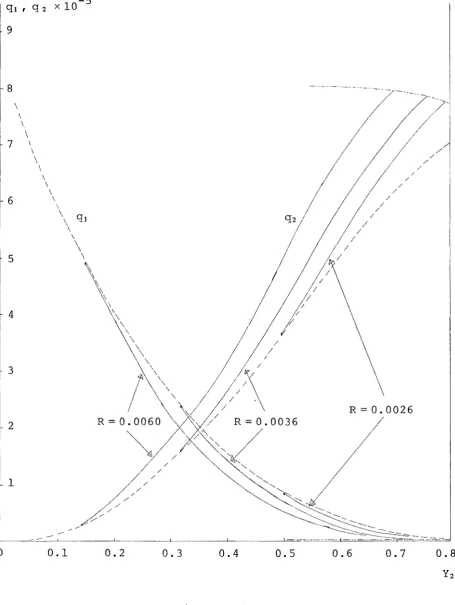
The dependence of flux on the upper interface level is plotted in figure (2.6). The nondimensional quantities
and g)
=
P2 3 g (Yo + Y 1 + Y2 ) 5
9 8 \ \ \ \
7 I
\ \ \ \ 6 5 4 3 2 1 0 \ \
\ ql \ \ \
\
\\,
\\
I
\ \ \ \ \ \ \R = 0.0060 R=0.0036
/ / 0.1
~
/ / / 0.2 / / / / / / / [image:39.595.68.524.35.641.2]0.3 0.4
Figure 2.6
0.5
-
.. _/
/
R=0.0026
0.6 0.7 0.8
Fluxes in both flowing layers as functions of the upper inter-face level. The fluxes are plotted only for the ranges in which type-A solutions exist. The lower limit of Y2 for a given
R(= R') is denoted by---, and the upper limit by- .. - .. - .. as
spread in the flux. The density difference ratios appear to have limited influence. However, the closeness of the curves is a little misleading. There is a substantial vertical
spread but over a large variation in the density difference ratios. For example for Y2
=
0.6, q 2=
5.15 x1o-5 atR
=
0.0026 and 6.60 x1o-5 at R=
0.0060, which is a 30% variation in flux over an alteration in R of 0.0034(a 230% change). Although the density difference ratios are a good indication of the "Boussinesq nature" of the fluid, their function as a measure of density variation is not so good. In order to rectify this and appreciate the discontinuities in the solutions, weighting factors of R
1
for q 2 , and
R
for q 1 are used. Figures (2.7) and (2.8) plot1
R q2 and
R
q1 respectively for H=
0.7.The regions of overlap and discontinuity in these
diagrams can be easily identified with those in figure (2.4). For a given ratio R (and R') the solid lines are traversed from left to right. For small values of Y2 the best picture is obtained from figure (2.8), whilst for large Y2 figure
(2.7) is best. The description of the experiment is the same as made previously. Note
~ flux requires evaluation of q 2
that an expression for total
P ~ k
+ (R - 2 )
ql .
For most cases Ptlikely to be considered experimentally p 3 "" 0, Pt "" 1 and
. ~ k ~·
Pt "" P2 , so that q 2 + R 2 q 1 would suffice.
§ 2. 4. Generalisation.
As a conclusion to this study a general n-layered situation is discussed. Number the layers from 0 to n
+
1from 0 to n. Layers 0 and n + 1 are non-flowing. The method
for dealing with such multilayered systems is derived from
that of WOOD (1968). The energy equations evaluated
upstream of the contact point of the lowest interface and
the weir (Co) give the ferences
.I
yi-hJ k
=
1,2,.o. n-1,1=0 .
(2.21)
the upper most interface
(2o22)
r
and for the lowest interface
-~ P1 uf
=
g(Po- Pt) {Yo -yo -h). {2o23)There are no geometrical restrictions except for the shape
of the channel and weir, for which h =h(x) and b =b(x) with
dh
=
~~
=
0 at x=
0, and the invariance of the quantitiesn+l
I
Y.0 1
n+l
and
I
y. +h.i=O 1
dy. Also used is the condition that the derivatives d :
i
=
0,1 o o . n + 1 must be finite, that is, that yi mustvary smoothly.
Differentiating equations (2.21) -·(2.23),after using
2
h b . . 2 - Qk h
t e su st1tut1on uk- b2 yz , we ave
Coo Co 1 0 0
Cto Ctt Ct2 0
where Coo
=
g (Po - P 1 ) . 2 .Cot
=
Pt Qt~
1 y lckk
=
g ( pk - pk+1)-2
ck,k+1
=
pk+1 Qk+1
b2 y~+1
ck ,.R-
=
( pk - pk+1) gdh
do
=
(Po - Pt )g dx +dk
=
g(pk-pk-1)dx + dh0
0 • • • 0
c n,n _
=
d n
pkQ~
k 11 2 1 • • •
~ yk
k
=
11 2 1 • • •9,
=
11 2 1 • • •k
=
1 1 2 1 o • •2
Pt Qt db
b3y; ·dx
2 2
[pk+1 °k+1
p~Q~J
b3 yk+l
-
b Ykk
=
1 ' 2 ' • • •and d
n
From equation (2.24) we have dy.
l
dx
=
jDij db
lDf
dx i=
0,1, . . . nwhere D is the n+l x n+l matrix on the left hand side of
(2.25)
(2.24) and the D. are obtained by replacing the ith column of
l
D with the vector on the right hand side of (2.24).
Upstream of Co , D is singular at no more than n - 1 points. These are critical points or virtual controls at which the
long wave velocities of the slower modes vanish.
Downstream of Co the equations (2.21) - (2.25) all hold with the adjustment made that all terms subscripted with 0
are omitted. From D and D. form the n x n matrices E and E.
]_ l
respectively by omitting the first row and column. E is
singular at no more than n- 1 points between Co and the crest
of the weir. These are the remaining virtual controls corresponding to the points where the faster mode long wave velocities vanish. E also is singular at x
=
0 whichis the control and corresponds to the fastest mode. At x
=
0 the finiteness condition is clearly satisfied as~~
=
~~
= 0, but at the virtual controls downstream of C we require that the E. matrices are also singular. By an argument similar]_
to that preceding equation (2.4) this results in two independent conditions at each virtual control, viz
jEj
=
jE.I
=
0 for any one i E {1,2, . . . n}. Similarly atl
flow is exactly n - 1 since only then is the system well determined. In principle there can be upton -1 critical points in each part of the flow and so i t is easy to conceive how the total number in both parts of the flow upstream of x
=
0 could exceed n - 1. The flow would then becomeover-determined, solutions would fail and the flow become unsteady. Gradual alteration of the interface levels causes the virtual controls to move, and as any one of them approaches C0 this type of overdetermination is likely. The resulting
unsteadiness would ist until steady solutions are again possible. The new solutions would be characterised by the appearance of one of the virtual controls on the side of C0
opposite to that i t occupied prior to the breakdown.
Thus, steady alteration of inter levels results in a progression of steady phases, in which the flow ratios change smoothly, punctuated by unsteady periods as the virtual controls pass through C0 •
The above discussion assumes layers 1 to n are all flowing, but i t is possible for the lowest layer to stop. In this case C1 will form at the position where the virtual
control corresponding to the appropriate mode vanishes. The situation is now exactly the same as before except that n -1 layers flow with n- 2 virtual controls (in steady flows) and the relevant contact point is now C1 •
(2) The analysis was for steady flow so that when an interface level is altered and the virtual controls move etc, the change in the layer depths is slow enough so that the time for the streamline patterns to change is very large compared to the time for flow through the outlet.
(3) As the flow enters the contraction, the speed in each layer increases and the points of critical speed will be progressively passed until at the control the flow becomes completely supercritical. It would seem plausible that critical conditions pertain to particular interfaces and an association can be made between each critical point and an interface. However, is shown in chapter III that this assignment is very weak and throughout the preceding chapter any such associations have been avoided.
CHAPTER III
SOME FURTHER FEATURES OF CRITICAL POINTS
The preceding chapter raises some interesting questions.
The importance of critical points in solving steady flows
has been displayed and i t would be useful to investigate any
dependence unsteady flows may have on similar phenomena in
order to generalise the concept. Furthermore, for a
multi-layered system as encountered in chapter two there are
several critical points possible, and the question arises
as to whether any correspondence can be assumed between
particular interfaces and particular critical points.
§3.1. Association of Critical points with Interfaces.
It has already been noted in chapter one that a critical
point in a steady flow is a point at which the speed of a
long wave relative to the flow becomes equal to the speed of
the flow itself, so that disturbances emanating from
some-where downstream of a critical point cannot propagate
upstream. For an n-layered system contracting downstream
as in the example of chapter two, there are n wave modes
possible and n critical points. There is a one-to-one
correspondence between the possible long wave speeds and
the critical points, since if the wave speeds are ordered,
<
C , as are the critical points,n
<
xn (flow is in direction of increasingx), the fastest mode, C , will be associated with x and so
n n
inter-face is the same as association of a long wave speed, and hence a wave mode, with an interface. Consequently a relatively simple multilayered system with no contraction can be used to seek a definite pairing of modes and inter-faces.
YIH (1965 Chapter 2 §12.4) considers that this
association is not ambiguous and is possible if the wave speeds
c.
are known as functions of the densitydiscon-1
tinuities 6pi. If Ck vanishes with 6pk then the mode whose speed is Ck belongs to the interface whose density difference is 6pk. In principle this is all very well but the associa-tion is dependent on limiting condiassocia-tions as the 6p. vanish.
1 From a practical point of view a simple comparison of amplitudes of the modes at each interface should give results valid everywhere.
Consider three uniform layers of fluid bounded above and below by rigid barriers with decreasing densities
P1
>
P2>
P3 and undisturbed depths h1, h2 and h3,asdepicted in figure (3.1). Let the interfacial disturbances be n and ~ at the lower and upper interfaces respectively, and introduce a potential function for each layer
¢. i = 1,2,3. Then the equations are 1
'i7 2¢1 = 'i7 2 ¢z = 'i72 ¢3 = 0, ( 3. 1)
with the boundary conditions
3<h - 0 on y = ht + h2 + h3 ( 3. 2)
ay-3</lt
= 0 on y
=
0-a-y
3¢2
= Dnj ·- Dnl = 3¢2 on y = h1 + n
ay
Dt 1 Dt 2--a-y
3¢2n(x,t)
Pt
[image:50.595.75.532.72.752.2]I /Ill/ /Ill 11!1117TT711/IIl/17 7 TT!7TTI/Ill t/ Ill/ 11/777 TTTl/117111/11/Ti y
=
QFigure 3.1
and from pressure continuity at the interfaces
Pt = Pz on y = ht
+
nTaking a first approximation, neglecting terms in squares and products of
n,
C
and <Pi i=
1,2,3, and their derivativesd <I> 1
= an
=
a
<l>z on y=
ht {3.4)8-y
at8-y
Cl <l>z
=
at;=
d <!>3 on y=
ht+
hz ( 3. 5)8-y
at8-y
Pt Cl<l>t
+
Pt gn=
P2a
<1>2+
P2 gn on y=
ht (3. 6)at Clt
P2 Cl <1>2
+
P2 gl; P3 <1<!>3+
P3 gn
on y=
ht+
h2 ( 3 • 7)at
a t
Thus,
cp.(x,t)
=
R{F j (y) exp i (kx-wt)} for j=
1,2,3J
n (x, t)
=
R{b exp i (kx-wt)},~(x,t)
=
R{a exp i (kx-wt)}.Substituting into equations (3.2) - (3.4) eventually yields
S
= -[
(P1 - P2 )gk - W2 (P2 coth kh2+
P1 coth kh1)] . sinh kh2I
P2 w2 ( 3. 8)where there are two values of the frequency w given bv the
positive solutions of the dispersion relation
[ ( p 1 - P2) gk - W2
( P1 coth kh1 + P2 coth kh3 ) ]
X ( P2 - P3 ) gk - W2 ( P2 coth kh2 + P3 coth kh3 ) ]
=
pf w4sinh 2kh2 ( 3. 9)
viz: W1 (k) and wz (k) where w1
>
Wz. These are the frequenciesof the two natural modes.
The ratio in equation (3.8) is convenient and represents
the ratio of amplitudes at upper and lower interfaces for a
given mode. Let r 1 (k)
=
S
when w=
w1 (k) and r2 (k)=
S
when w
=
w2 ( k) .A little manipulation of equations (3.8) and (3.9) gives
the relation
=
( P (P2 - P3) . 1 - P2 ) (3.10)It is instructive to realise that equation (3.9) describes
a composite system comprising
(i) the upper boundary and interface with p1 +p2,
(ii) the lower boundary and interface with p3 +p2 ,
These systems individually have the respective frequencies
gk ( P2 - P3)
P2 coth kh2 + P3 coth kh3 '
(3.11) 2 gk ( Pt - P2)
w (ii) = P2 coth kh2 + Pt coth kht
,
which are precisely the zeros of the left hand side of
Pi
w4equation (3.9). Thus, regard as a "link" term. sinh2kh2
As h 2 +oo, . h\kh + 0, and equation (3.9) gives the unlinked s1n 2
systems described in (3.11). This is relevant since i t gives another criterion for associating a mode with an interface. As the link term increases, the modes in (3.11) are distorted. The present question is whether these distorted modes retain their identity with the interfaces they were associated with in the unlinked systems. Note that this criterion gives the same mode/interface correspondence as Yih's density limits do.
The presence of two modes necessitates rewriting
n (x,t)
=
R{bt exp i (kX-Wt t) + b2 exp i (kx-w2 t)} 1E,(x,t)
=
R{at expi(kx-wtt) +a2 expi(kx-w2t)}, whence, equation (3.8) describes the ratios r1 (k) when w=
w1 (k) , and r2 (k)=
~ when w=
w2 (k) .b2
To convincingly associate a mode with an interface requires that one interface is consistently affected most by one mode. In other words, for the fast mode to be associated with the upper interface requires that
slow mode to belong to the lower interface requires that
lr 2 (k)
I
<
1 always.Reference to equation (3.10) shows i t is convenient to
consider the relationships of lr 1 (k)
I
and lr2 (k)I
to(~~
-:::_~~
J , since there is no great loss of generality 1nchoosing ( P1 :... P2)
= (
P2 - P3) and thus relating these ratiosto unity.
Firstly note that
(1) For k -+ oo, that is, very short waves, the solutions to
w~
equation (3.9) give _2: -+ P1 - P2 or P2 - P3 where if i
=
1gk P1 + P2 P2 + P3
the limit is the larger ratio and if i
=
2 i t is the smaller.Also from equation (3.8)
(. ) I (
P1 :... P2) ( P2+
P3) - ( P2 - P3) ( P1 + P2)I
exp (k h2)r 1 k -+
2 ( P2 + P3) p2 wi
which becomes large as k -+oo. Similarly r 2 (k) becomes very
small, so for large k, lr1
I
;p 1 and lr2I
~ 1.(2) For the fast mode the interfacial disturbances are
always in phase, whilst for the slow mode they are TI out of
phase,so that r 1 (k)
>
0 and r 2 (k)<
0.Using equation (3.10)
that is
( PP2 - P3 1 - P2
J
if and only if r2> -
(P1- P2J P2 - P3Upon using equation (3.8) and the solutions for w1 and w2
from (3.9) eventually we get the condition:
Pz coth khz
+
Pt coth kht Pt - Pz> ~---~--~---. Pz coth khz + P3 coth kh3 (3.12) Pz - P3
Also from (3.10) i t is clearly possible in the general case that both r1 and -rz are larger than unity if Pt - pz > pz - P3.
Condition (3.12) is very weak and implies that i t is
erroneous to assume that a particular mode will be ''strongest" at one interface.
When the density discontinuities are made equal, (3.12) becomes
rt >1>-rz if and only if Pt cothkht >p3 cothkh3 (3.13) which is relatively easy to reverse by careful selection of
To relate this result back to the critical points i t is necessary to consider the long wave velocities. Take k~O, then (3.12) becomes
(Pz -Pt -pz) P3
Pz + Pt Pz + P3
if and only if
11.;
~
>11.;
~
(3.14) Pt - P2 Pz - P3By the same means as above this shows that examples can be found for which rt > 1 > -r 2 is not valid and so the
assignment of critical points to particular interfaces is not a sure process.
The above arguments show the danger of assuming these associations. However, in many cases the parameters
Pt , P2 , P3 , ht , h2 and h3 are in fact such that
r1 > 1 > -r2. For example, suppose p3 ~o,as for a free surface system, then (3.12) becomes
and for Boussinesq type fluids this condition is satisfied. An example of such a fluid would be a two layer free surface system with a density discontinuity due to a salinity
d ference.
If h1 becomes very large (.& pg
=
0), an infinite two layered free surface system results. For the fast mode~~
ekh2>
1 \vhence the free surface is strongly favoured,and for the slow mode whence the inter-face is favoured.
In conclusion, critical point associated with a
particular mode cannot be assumed to belong to one interface. In a physical situation the critical nature of a fluid will relate to a whole vertical cross section. For example, in a system contracting so that the velocity increases from zero as the channel becomes narrow, select a point where just sub-critical conditions prevail and increase the velocity so as to s through critical conditions
The fluid then becomes critical throughout the whole fluid at this point and not just at one interface. If an unsteady breakdown occurs as in chapter two, then i t occurs over all the interfaces, although i t may be more evident at one
particular interface. This inter may vary according to the external parameters.
At a critical point, x, the long wave speed of one of the modes has become stationary through all the layers. Since the layers travel at different speeds then the
At a point upstream of the critical point corresponding
to the slowest mode, the whole fluid, and not just one
inter-face or layer, will be subcritical with respect to all the
modes, but as the velocity progresses through the speeds of
the modes then the fluid becomes supercritical with respect
to progressively more of the modes.
Clearly i t is possible to establish criteria for critical
point/interface associations as YIH (1965) has done, but
these tend to be restricted to special cases involving
limiting conditions on external parameters.
The above discussion naturally relates also to Froude
numbers. At each of the critical points one of the Froude
numbers will pass through unity. However, the Froude
number is a measure of the state of a whole vertical section
of the fluid in relation to a wave speed, and hence has no
associations with particular layers or interfaces.
[Often a non-dimensional quantity related to the ratio
of a layer's velocity to the square root of the layer's
depth is quoted as a Froude number for that layer, but
there is more physical meaning in a "wave speed" definition.]
§3.2. Relation of Critical Points to Unsteady Flows.
As an attempt to understand critical points in a more
general context, i t is appropriate to clarify their relation
to non-steady analysis. The two-layer dam-break problem
provides a useful basis for the discussion.
For linearised unsteady problems the question is one of
first order partial differential equations, and the method