http://www.scirp.org/journal/jqis ISSN Online: 2162-576X ISSN Print: 2162-5751
DOI: 10.4236/jqis.2018.81002 Mar. 23, 2018 12 Journal of Quantum Information Science
One Parameter Family of
N
-Qudit
Werner-Popescu States: Bipartite
Separability Using Conditional
Quantum Relative Tsallis Entropy
Anantha S. Nayak
1, Sudha
1,2, A. R. Usha Devi
2,3, A. K. Rajagopal
2,4,51Department of Physics, Kuvempu University, Shankaraghatta, Shimoga, India 2Inspire Institute Inc., Alexandria, USA
3Department of Physics, Bangalore University, Bangalore, India 4Harish-Chandra Research Institute, Allahabad, India
5Institute of Mathematical Sciences, C.I.T. Campus, Chennai, India
Abstract
The conditional version of sandwiched Tsallis relative entropy (CSTRE) is employed to study the bipartite separability of one parameter family of
N-qudit Werner-Popescu states in their 1:N−1 partition. For all N, the
strongest limitation on bipartite separability is realized in the limit q→ ∞
and is found to match exactly with the separability range obtained using an algebraic method which is both necessary and sufficient. The theoretical supe-riority of using CSTRE criterion to find the bipartite separability range over the one using Abe-Rajagopal (AR) q-conditional entropy is illustrated by comparing the convergence of the parameter x with respect to q, in the impli-cit plots of AR q-conditional entropy and CSTRE.
Keywords
Entropic Separability Criterion, q-Conditional Entropies, Non-Commuting Version of Relative Entropy
1. Introduction
Entropic characterization of separability [1]-[21] in mixed composite states has witnessed a considerable interest in recent years [17]-[21]. The identification of a non-commuting generalization of Abe-Rajagopal (AR) q-conditional Tsallis entropy [10] in the form of conditional version of sandwiched Tsallis relative How to cite this paper: Nayak, A.S.,
Sud-ha, Usha Devi, A.R. and Rajagopal, A.K. (2018) One Parameter Family of N-Qudit Werner-Popescu States: Bipartite Separa-bility Using Conditional Quantum Relative Tsallis Entropy. Journal of Quantum In-formation Science, 8, 12-23.
https://doi.org/10.4236/jqis.2018.81002
Received: February 6, 2018 Accepted: March 20, 2018 Published: March 23, 2018
Copyright © 2018 by authors and Scientific Research Publishing Inc. This work is licensed under the Creative Commons Attribution International License (CC BY 4.0).
http://creativecommons.org/licenses/by/4.0/
DOI: 10.4236/jqis.2018.81002 13 Journal of Quantum Information Science entropy (CSTRE) [19] and its usefulness in identifying a separability range stricter than the separability criterion using AR q-conditional entropy (the so-called AR-criterion) [10], has given more impetus to this study [19][20][21]. It has been established that negative values of CSTRE imply entanglement in chosen bipartitions of any composite state [20]. In noisy one-parameter families of symmetric [20] and non-symmetric [21] multiqubit states the separability range obtained through CSTRE, in addition to being stricter than that through AR-criterion, is shown to match with the separability range obtained through Peres’ Partial Transpose (PPT) criterion [22][23]. While AR-criterion [10][11] [12] [17] [18] relies upon the local versus global disorder thus exhibiting its spectral nature, the CSTRE criterion is illustrated to have non-spectral features [19].
Quite similar to the definition of sandwiched Rényi relative entropy [24][25] [26], the sandwiched form of the Tsallis relative entropy is identified to be [19]
(
)
1 1
2 2
Tr 1
||
1
q
q q
q q
T q
D
q
σ ρσ
ρ σ
− −
−
=
−
(1)
Equation (1) reduces to traditional relative Tsallis entropy T
(
||)
qD ρ σ
(
||)
Tr 1 11
q q
T q
D
q
ρ σ
ρ σ
−
−
=
− (2)
when ρ and σ commute with each other.
The conditional forms of T
(
||)
qD ρ σ are defined as [19]
(
||)
(
||)
11
q AB B
T
q AB B
Q D
q
ρ ρ
ρ ρ = −
−
(3)
and
(
||)
(
||)
11
q AB A
T
q AB A
Q D
q
ρ ρ
ρ ρ = −
−
(4)
with Qq
(
ρ
AB||ρ
B)
, Qq(
ρ
AB||ρ
A)
being respectively given by(
)
(
)
1(
)
12 2
|| Tr
q
q q
q q
q AB B A B AB A B
Q ρ ρ I ρ ρ I ρ
− −
= ⊗ ⊗
(5)
(
)
(
)
1(
)
12 2
|| Tr
q
q q
q q
q AB A A B AB A B
Q ρ ρ ρ I ρ ρ I
− −
= ⊗ ⊗
(6)
In Ref. [20], it has been proved that negative values of DqT
(
ρAB||ρB)
,(
||)
T
q AB A
D ρ ρ indicate entanglement in the bipartite state
ρ
AB. When thesubsystems
ρ
B orρ
A are maximally mixed, Equations (3), (4) reduce toAbe-Rajagopal (AR) q-conditional Tsallis entropies [10] SqT
(
A B|)
,(
|)
T qS B A
DOI: 10.4236/jqis.2018.81002 14 Journal of Quantum Information Science
(
)
1 Tr| 1 ,
1 Tr
q
T AB
q q
B
S A B
q
ρ ρ
= −
− (7)
(
)
1 Tr| 1 .
1 Tr
q
T AB
q q
A
S B A
q
ρ ρ
= −
− (8)
Quite like the AR q-conditional entropies T
(
|)
qS A B , T
(
|)
qS B A , both the
conditional versions of sandwiched Tsallis relative entropy T
(
||)
q AB B
D ρ ρ ,
(
||)
T
q AB A
D ρ ρ reduce to the respective von-Neumann entropies S A B
(
|)
,(
|)
S B A in the limit q→1.
Both AR- and CSTRE-criteria have been employed in Refs. [19] [20] to find the 1:N−1 separability range of the noisy one parameter families of symmetric
N-qubit states involving either W or GHZ states. In Ref. [21], the 1:N−1
separability ranges in two different non-symmetric one-parameter families of
N-qubit states are obtained using AR-, CSTRE-criteria and a comparative analysis of these separability ranges is carried out.
The investigation of separability range in one parameter families of mixed states through AR- and CSTRE-criteria has revealed that whenever the marginal is not maximally mixed and hence does not commute with the global density matrix, the CSTRE criterion yields stricter separability range than its commuting version, the AR-criterion [6] [7] [19] [20] [21]. If the marginal is maximally mixed thus commuting with its density matrix, both AR-, CSTRE-criteria are found to yield identical separability ranges [19] [20] [21]. The supremacy of CSTRE criterion over AR-criterion, in the cases where non-maximal marginals occur, is illustrated for symmetric [19][20] and non-symmetric one-parameter families of multiqubit states [21]. In this work, we wish to examine whether CSTRE criterion remains superior to AR-criterion even for composite states containing qudits. For this purpose, we have considered N-qudit Werner-Popescu states [12], a special one parameter family of states and examine its 1:N−1
separability range using CSTRE criterion. Both AR-, CSTRE-criteria are seen to result in the necessary and sufficient condition for separability in the 1:N−1
partition of these states. Further we compare the convergence of the parameter x, obtained through CSTRE criterion with that obtained through AR criterion, with respect to q. It has been observed that the parameter x converges rapidly in the case of AR criterion, in comparison with that in the case of CSTRE criterion, even for finite values of q thus implying the better stochasticity of CSTRE criterion over the AR-criterion.
This article is organized in four sections including the introductory section (Section 1) in which we recall the non-additive entropic separability criteria such as AR-, CSTRE-criteria and discuss the motivation behind this work. Section 2 introduces the N-qudit Werner-Popescu state as a generalization of noisy one-parmeter family of N-qubit GHZ states to its qudit counterpart. Section 3 examines the 1:N−1 separability range of one parameter family of N-qudit
DOI: 10.4236/jqis.2018.81002 15 Journal of Quantum Information Science results obtained through AR-, CSTRE criteria is carried out and the superiority of CSTRE criterion is illustrated through the implicit plots of x versus q in both AR-, CSTRE methods (Section 3). Finally Section 4 provides a summary of the results.
2. N-Qudit Werner-Popescu States
The Werner-Popescu state with N-qudits [12] is defined as
( )
(
)
( )
( )
( )
1 2
1 2
, , ,
1 d
N N
N N
d d d N d d
N
x A A A
x
I A I A I A x
d
ρ =ρ
−
= ⊗ ⊗ ⊗ + Φ Φ
Here 0≤ ≤x 1 and Id
( )
A ii , =1,2,,N are d×d unit matrices belongingto the subsystem space of each qudit A ii, =1,2,,N. The pure state ΦNd is
given by
1 2
1
0
1
.
N
d N
d A A A
k
k k k
d −
=
Φ =
∑
⊗ ⊗ ⊗ (9)and it is an analogue of GHZ state to d-level systems. Notice that when d=2,
i.e., for qubits, k=0,1 and Equation (9) reduces to the N-qubit GHZ state
(
1 2 1 2)
1
GHZ 0 0 0 1 1 1
2
N = N + N
The eigenvalues of d
( )
N x
ρ are given by
(
)
(
)
1
2
1
1 fold degenerate , 1 1
non-degenerate
N N
N
N
x
d d
d x
d
λ
λ
−
= −
+ −
=
(10)
The focus here is to find the 1:N−1 separability range of ρNd
( )
x usingCSTRE criterion.
3. Bipartite Separability of
d( )
N
x
ρ
in Its
1 :
N
−
1
Partition
Denoting the first qubit as subsystem A and the remaining N−1 qubits as
subsystem B, the density matrix of the N−1 qubit marginal is given by
(
1 2)
1 , , , 1 ( )
d
B TrA A A AN TrA N x
ρ == ρ … = ρ
It can be seen that the eigenvalues ηi of the N−1 qubit marginal
ρ
B of( )
d
N x
ρ , obtained by reducing over the first qubit, are given by
(
)
(
)
[
]
1
1 1
2
2 1
1
-fold degenerate , 1 1
-fold degenerate
N N
N
N
x
d d
d
d x
d d
η
η
− −
− −
−
= −
+ −
=
(11)
Also, the subsystem
ρ
A, the single qudit marginal of( )
dN x
ρ , corresponds to
the maximally mixed state Id d, Id being d×d unit matrix. In order to find the separability range of the state d
N
DOI: 10.4236/jqis.2018.81002 16 Journal of Quantum Information Science partition using CSTRE criterion, one needs to evaluate the eigenvalues γi of the sandwiched matrix
(
)
12( )(
)
12q q
d
q q
A B N A B
I ρ ρ x I ρ
− −
Γ = ⊗ ⊗ (12)
so that
( )
(
)
1||
1
q i
T d i
q N B
D x
q
γ
ρ ρ = −
−
∑
(13)
can be evaluated. Thus, in the evaluation of DqT
(
ρNd( )
x ||ρB)
, the non-negativeeigenvalues γi play a crucial role. In order to obtain the form of the eigenvalues γi for arbitrary N, an analysis of their form for different
(
2, 3, 4, 5)
N N= and d d
(
=3, 4, 5, 6)
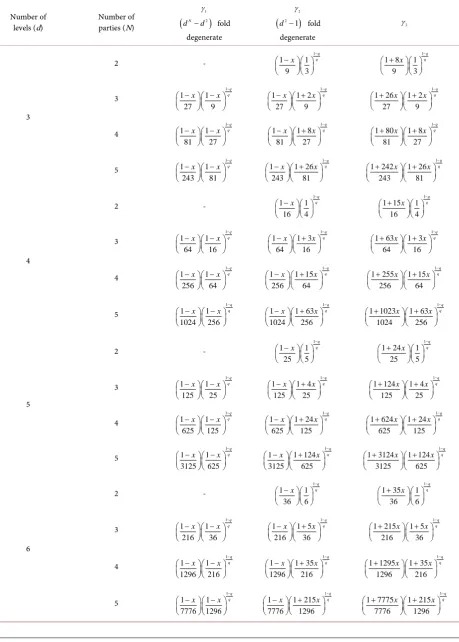
is carried out to arrive at ageneralization for any N, d. Table 1 provides the explicitly evaluated non-zero eigenvalues of the sandwiched matrix Γ for different values of N and d.
It can be readily seen from Table 1 that, there are only three distinct non-zero eigenvalues for the sandwiched matrix Γ. A careful observation of the eigenvalues γi,i=1, 2, 3 in Table 1 leads towards the generalization of the
eigenvalues of sandwiched matrix Γ for N≥2. The generalized eigenvalues γi
of the sandwiched matrix Γ for any N≥2 are given in the following:
(
)
(
)
(
)
(
)
(
)
1
2
1 1
1 2
2
2 1
1 2
3 1
1 1
, -fold degenerate
1 1
1
, 1 -fold degenerate
1 1 1 1
, non-degenerate. q
q
N
N N
q
N q
N N
q
N N q
N N
x x
d d
d d
d x
x
d
d d
d x d x
d d
γ
γ
γ
−
−
− −
−
− −
−
− −
= −
+ −
−
= −
+ − + −
=
(14)
The 1:N−1 separability range of ρdN
( )
x , for each combination of2, 3, 4, 5
N= and d=3, 4, 5, 6 obtained using CSTRE approach allows us to
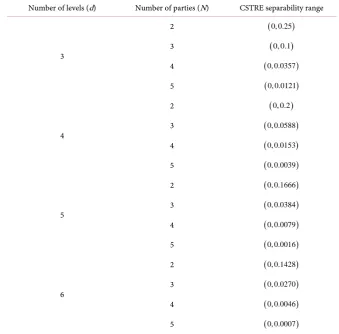
generalize this range to any N and d. Table 2 gives the values of x below which the state d
( )
N x
ρ , (N=2, 3, 4, 5 and d=3, 4, 5, 6) is separable.
Using Table 2, the following 1:N−1 separability range is conjectured for
the one parameter family of N-qudit Werner-Popescu-states.
1
1 0
1 N
x
d −
≤ ≤
+ (15)
One can note that the 1:N−1 separability range given in Eq.(15) is the same
DOI: 10.4236/jqis.2018.81002 17 Journal of Quantum Information Science
Table 1. The non-zero eigenvalues λi of the sandwiched matrix
(
)
( )(
)
1 1
2 2
q q
d
q q
A B N A B
I ρ ρ x I ρ
− −
⊗ ⊗ .
Number of
levels (d) Number of parties (N)
1
γ
(
N 2)
d −d fold
degenerate
2
γ
(
2)
1
d − fold
degenerate
3
γ
3
2 -
1 1 1 9 3 q q x − − 1
1 8 1 9 3 q q x − + 3 1 1 1 27 9 q q x x − − − 1
1 1 2 27 9 q q x x − − + 1
1 26 1 2 27 9 q q x x − + + 4 1 1 1 81 27 q q x x − − − 1
1 1 8 81 27 q q x x − − + 1
1 80 1 8 81 27 q q x x − + + 5 1 1 1 243 81 q q x x − − − 1
1 1 26 243 81 q q x x − − + 1
1 242 1 26 243 81 q q x x − + + 4
2 -
1 1 1 16 4 q q x − − 1
1 15 1 16 4 q q x − + 3 1 1 1 64 16 q q x x − − − 1
1 1 3 64 16 q q x x − − + 1
1 63 1 3 64 16 q q x x − + + 4 1 1 1 256 64 q q x x − − − 1
1 1 15 256 64 q q x x − − + 1
1 255 1 15 256 64 q q x x − + + 5 1 1 1 1024 256 q q x x − − − 1
1 1 63 1024 256 q q x x − − + 1
1 1023 1 63 1024 256 q q x x − + + 5
2 -
1 1 1 25 5 q q x − − 1
1 24 1 25 5 q q x − + 3 1 1 1 125 25 q q x x − − − 1
1 1 4 125 25 q q x x − − + 1
1 124 1 4 125 25 q q x x − + + 4 1 1 1 625 125 q q x x − − − 1
1 1 24 625 125 q q x x − − + 1
1 624 1 24 625 125 q q x x − + + 5 1 1 1 3125 625 q q x x − − − 1
1 1 124 3125 625 q q x x − − + 1
1 3124 1 124 3125 625 q q x x − + + 6
2 -
1 1 1 36 6 q q x − − 1
1 35 1 36 6 q q x − + 3 1 1 1 216 36 q q x x − − − 1
1 1 5 216 36 q q x x − − + 1
1 215 1 5 216 36 q q x x − + + 4 1 1 1 1296 216 q q x x − − − 1
1 1 35 1296 216 q q x x − − + 1
1 1295 1 35 1296 216 q q x x − + + 5 1 1 1 7776 1296 q q x x − − − 1
1 1 215 7776 1296 q q x x − − + 1
DOI: 10.4236/jqis.2018.81002 18 Journal of Quantum Information Science
Table 2. The comparison of the 1:N−1 separability range of the state ρNd
( )
x , forvarious compositions of d and N obtained through CSTRE criterion.
Number of levels (d) Number of parties (N) CSTRE separability range
3
2 (0, 0.25)
3 (0, 0.1)
4 (0, 0.0357)
5 (0, 0.0121)
4
2 (0, 0.2)
3 (0, 0.0588)
4 (0, 0.0153)
5 (0, 0.0039)
5
2 (0, 0.1666)
3 (0, 0.0384)
4 (0, 0.0079)
5 (0, 0.0016)
6
2 (0, 0.1428)
3 (0, 0.0270)
4 (0, 0.0046)
5 (0, 0.0007)
In all these states, the single qudit density matrix turns out to be Id d thus commuting with the corresponding density matrix implying that the in general non-commutative CSTRE approach yields the results equivalent to commutative AR-approach [20]. It is important to notice here that, using algebraic methods [27] [28] it has been shown that Equation (15) is actually the necessary and sufficient condition for separability.
Figure 1 gives an illustration of the monotonic decrease of
(
( )3( )
)
4 ||
T
q B
D ρ x ρ
with increasing x in the limit q→ ∞.
It can be seen that
(
( )3( )
)
4 ||
T
q B
D ρ x ρ is negative for x>0.5633 when q=1
implying that
(
0,0.5633)
is the separability range through Von-Neumannconditional entropy, whereas it is negative for x>0.0357 in the limit q→ ∞
leading to
(
0,0.0357)
as the separability range through CSTRE-criterion.Even though the separability range of d
( )
N x
ρ , obtained using both CSTRE
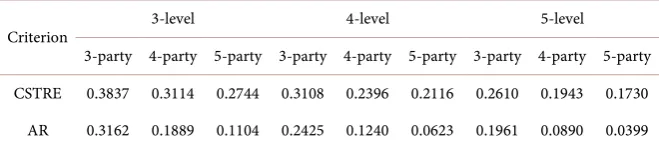
and AR-conditional entropy are same, there is a difference in the way the parameter x converges to the value
x
∞, the value of x for which(
)
limq→∞Sq A B| =0, limq→∞DqT
(
ρN( )d( )
x ||ρB)
=0. Table 3 provides the valuesDOI: 10.4236/jqis.2018.81002 19 Journal of Quantum Information Science
Figure 1. Gives an illustration of the monotonic decrease of
(
( )3( )
)
4 ||
T
q B
[image:8.595.273.476.72.230.2]D ρ x ρ with increasing x in the limit q→ ∞.
Table 3. The comparison of the value of x for q=2, obtained through AR-, CSTRE
criteria.
Criterion 3-level 4-level 5-level
3-party 4-party 5-party 3-party 4-party 5-party 3-party 4-party 5-party CSTRE 0.3837 0.3114 0.2744 0.3108 0.2396 0.2116 0.2610 0.1943 0.1730 AR 0.3162 0.1889 0.1104 0.2425 0.1240 0.0623 0.1961 0.0890 0.0399
parameter x is rapidly decreasing in AR method even for q=2 thus confirming
its relatively rapid convergence in comparison with that of CSTRE in the limit
q→ ∞.
The rapid convergence of the parameter x with increasing values of q in the case of AR q-conditional entropy is illustrated in Figure 2, Figure 3.
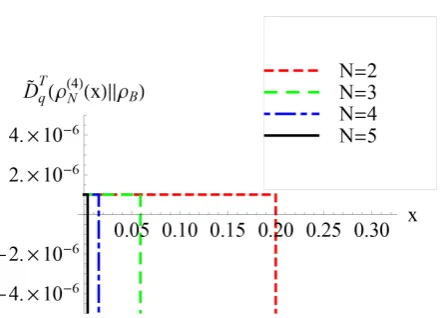
It is also evident from Table 3 that the separability range decreases with the number of subsystems i.e., with the increase of N for any given d. This feature is illustrated in Figure 4, Figure 5.
Similarly a comparison of Figure 4, Figure 5 illustrates that for any given N, the separability range decreases with increasing d. Thus a state of the Werner-Popescu family is entangled throughout the parameter range x if its constituents are qudits with larger d. More qudits in the state implies a single qudit remains entangled with the remaining N−1 qudits in the whole
parameter range.
4. Summary
In this article, the CSTRE criterion is employed to find out the 1:N−1
separability range of N-qudit Werner-Popescu states. It is observed that the
1:N−1 separability range obtained through both CSTRE and AR q-conditional
[image:8.595.207.537.318.392.2]DOI: 10.4236/jqis.2018.81002 20 Journal of Quantum Information Science
Figure 2. The comparison between implicit plots of
(
( )3( )
)
5 || 0
T
q B
D ρ x ρ = and
(
|)
0T q
S A B = , as a function of q in the 1: 4 partition of the 5-qutrit (N=5, d=3)
state ( )3
( )
5 x
ρ . A rapid decrease in the value of x, in comparison with
(
( )3( )
)
5 ||
T
q B
D ρ x ρ ,
can be observed in the case of T
(
|)
q
S A B .
Figure 3. The comparison between implicit plots of
(
( )5( )
)
4 || 0
T
q B
D ρ x ρ = and
(
|)
0T q
S A B = , as a function of q for 4-partite (N=4), 5-level (d=5) Werner-Popescu
states ( )5
( )
4 x
[image:9.595.277.468.77.209.2]ρ .
Figure 4. The graph of CSTRE
(
( )3( )
)
|| 0
T
q N B
D ρ x ρ = versus x for different values of N when d=3. The decrease of the separability range with N, for any given d is clearly
[image:9.595.277.464.315.442.2] [image:9.595.260.490.516.676.2]DOI: 10.4236/jqis.2018.81002 21 Journal of Quantum Information Science
Figure 5. The graph of CSTRE
(
( )4( )
)
|| 0
T
q N B
D ρ x ρ = versus x for different values of N when d=4.
Werner-Popescu state is found to be the reason behind the matching of the
1:N−1 separability ranges due to commutative AR-criterion and
non-commutative CSTRE criterion. The relatively smoother convergence of the parameter x with respect to increasing q is observed in the case of implicit plots of CSTRE in comparison with the convergence in the case of AR q-conditional entropy thus establishing the supremacy of CSTRE criterion over the AR-criterion. The 1:N−1 separability range obtained for N-qudit Werner Popescu states
using entropic criteria is seen to match with that obtained using an algebraic necessary and sufficient condition for separability.
Acknowledgements
Anantha S. Nayak acknowledges the support of Department of Science and Technology (DST), Govt. of India through the award of INSPIRE fellowship; A. R. Usha Devi is supported under the University Grants Commission (UGC), India (Grant No. MRP-MAJOR-PHYS-2013-29318).
References
[1] Horodecki, R. and Horodecki, P. (1994) Quantum Redundancies and Local Realism.
Physics Letters A, 194, 147-152. https://doi.org/10.1016/0375-9601(94)91275-0
[2] Cerf, N.J. and Adami, C. (1997) Negative Entropy and Information in Quantum Mechanics. Physical Review Letters, 79, 5194-5197.
https://doi.org/10.1103/PhysRevLett.79.5194
[3] Abe, S. and Rajagopal, A.K. (1999) Quantum Entanglement Inferred by the Prin-ciple of Maximum Nonadditive Entropy. Physical Review A, 60, 3461-3466.
https://doi.org/10.1103/PhysRevA.60.3461
[4] Giovannetti, V. (2004) Separability Conditions from Entropic Uncertainty Rela-tions. Physical Review A, 70, Article ID: 012102.
https://doi.org/10.1103/PhysRevA.70.012102
[5] Gühne, O. and Lewenstein, M. (2004) Entropic Uncertainty Relations and Entan-glement. Physical Review A, 70, Article ID: 022316.
DOI: 10.4236/jqis.2018.81002 22 Journal of Quantum Information Science
[6] Horodecki, R., Horodecki, P., and Horodecki, M., (1996) Quantum α-Entropy In-equalities: Independent Condition for Local Realism? Physics Letters A, 210, 377-381. https://doi.org/10.1016/0375-9601(95)00930-2
[7] Horodecki, R., Horodecki, M. and Horodecki, M. (1996) Information-Theoretic Aspects of Inseparability of Mixed States, Physical Review A, 54, 1838-1843.
https://doi.org/10.1103/PhysRevA.54.1838
[8] Tsallis, C. (1988) Possible Generalization of Boltzmann-Gibbs Statistics. Journal of Statistical Physics, 52, 479-487. https://doi.org/10.1007/BF01016429
[9] Tsallis, C., Mendes, R.S. and Plastino, A.R. (1998) The Role of Constraints within Generalized Nonextensive Statistics. Physica A, 261, 534-554.
https://doi.org/10.1016/S0378-4371(98)00437-3
[10] Abe, S. and Rajagopal, A.K. (2001) Nonadditive Conditional Entropy and Its Signi-ficance for Local Realism. Physica A, 289, 157-164.
https://doi.org/10.1016/S0378-4371(00)00476-3
[11] Tsallis, C., Lloyd, S. and Baranger, M. (2001) Peres Criterion for Separability through Nonextensive Entropy. Physical Review A, 63, Article ID: 042104.
https://doi.org/10.1103/PhysRevA.63.042104
[12] Abe, S. (2002) Nonadditive Information Measure and Quantum Entanglement in a Class of Mixed States of an Nn System. Physical Review A, 65, Article ID: 052323.
https://doi.org/10.1103/PhysRevA.65.052323
[13] Rossignoli, R. and Canosa, N. (2002) Generalized Entropic Criterion for Separabili-ty. Physical Review A, 66, Article ID: 042306.
https://doi.org/10.1103/PhysRevA.66.042306
[14] Rossignoli, R. and Canosa, N. (2003) Violation of Majorization Relations in Entan-gled States and Its Detection by Means of Generalized Entropic Forms. Physical Re-view A, 67, Article ID: 042302.https://doi.org/10.1103/PhysRevA.67.042302
[15] Batle, J., Casas, M., Plastino, A.R. and Plastino, A. (2002) Conditional q-Entropies and Quantum Separability: A Numerical Exploration. Journal of Physics A, 35, 10311-10324.https://doi.org/10.1088/0305-4470/35/48/307
[16] Batle, J., Casas, M., Plastino, A.R. and Plastino, A. (2003) Some Features of the Conditional q-Entropies of Composite Quantum Systems. European Physical Jour-nal B, 35, 391-398.https://doi.org/10.1140/epjb/e2003-00291-3
[17] Prabhu, R., Usha Devi, A.R. and Padmanabha, G. (2007) Separability of a Family of One-Parameter W and Greenberger-Horne-Zeilinger Multiqubit States Using the Abe-Rajagopal q-Conditional-Entropy Approach. Physical Review A, 76, Article ID: 042337.https://doi.org/10.1103/PhysRevA.76.042337
[18] Sudha, Usha Devi, A.R. and Rajagopal, A.K. (2010) Entropic Characterization of Separability in Gaussian States. Physical Review A, 81, Article ID: 024303.
[19] Rajagopal A.K., Sudha, Nayak, A.S. and Usha Devi, A.R. (2014) From the Quantum Relative Tsallis Entropy to Its Conditional Form: Separability Criterion beyond Lo-cal and Global Spectra. Physical Review A, 89, Article ID: 012331.
https://doi.org/10.1103/PhysRevA.89.012331
[20] Nayak A.S., Sudha, Rajagopal, A.K. and Usha Devi, A.R. (2016) Bipartite Separabil-ity of Symmetric N-Qubit Noisy States using Conditional Quantum Relative Tsallis Entropy. Physica A, 89, 286-295.https://doi.org/10.1016/j.physa.2015.09.086
DOI: 10.4236/jqis.2018.81002 23 Journal of Quantum Information Science
https://doi.org/10.1007/s11128-016-1491-9
[22] Peres, A. (1996) Separability Criterion for Density Matrices. Physical Review Let-ters, 77, 1413-1415.https://doi.org/10.1103/PhysRevLett.77.1413
[23] Horodecki, M., Horodecki, P. and Horodecki, R. (1996) Separability of Mixed States: Necessary and Sufficient Conditions. Physics Letters A, 223, 1-8.
https://doi.org/10.1016/S0375-9601(96)00706-2
[24] Wilde, M.M., Winter, A. and Yang, D. (2014) Strong Converse for the Classical Ca-pacity of Entanglement-Breaking and Hadamard Channels via a Sandwiched Rényi Relative Entropy. Communications in Mathematical Physics, 331, 593-622.
https://doi.org/10.1007/s00220-014-2122-x
[25] Müller-Lennert, M., Dupuis, F., Szehr, O. and Tomamichel, M. (2013) On Quantum Rényi Entropies: A New Generalization and Some Properties. Journal of Mathe-matical Physics, 54, Article ID: 122203.https://doi.org/10.1063/1.4838856
[26] Tomamichel, M., Berta, M. and Hayashi, M. (2014) Relating Different Quantum Generalizations of the Conditional Rényi Entropy. Journal of Mathematical Physics, 55, Article ID: 082206.https://doi.org/10.1063/1.4892761
[27] Pittenger, A.O. and Rubin, M.H. (2000) Separability and Fourier Representations of Density Matrices. Physical Review A, 62, Article ID: 032313.
https://doi.org/10.1103/PhysRevA.62.032313
[28] Pittenger, A.O. and Rubin, M.H. (2000) Note on Separability of the Werner States in Arbitrary Dimensions. Optics Communications, 179, 447-449.