Analysis of MIMO Relay Chains
David Manning
A thesis submitted in fulfillment
of the requirements for the degree of
Masters
in
Electrical and Electronic Engineering
University of Canterbury
Christchurch, New Zealand
Abstract
This thesis is split into two parts: first a statistical analysis of multi-hop MIMO
relay networks, followed by a simulation of the perfomance of a P25 SISO multi-hop
relay network. The basis of the MIMO section is the developement of an end to end
statistical model of the multiple relay channel. This end to end model simplifies the
statistics involved, making the analysis of systems with large numbers of relays and
antennas more practical. A partial system model is obtained. This is exact for a
multiple input single output network and can be used to describe the received signal
at a single antenna in a multiple output system. We go on to look at the relationship
between end to end system parameters and the paramters of individual inter-relay
channels. The SISO section contains a characterisation of BER for P25 relay chains.
The effect of the SNR at each relay node, the nature of the channel and the number
of relay hops on the BER is determined. Furthermore, the performance trends are
compared for a range of common relaying protocols, including amplify and forward
and two types of decode and forward.
Acknowledgements
The author of this work would like to thank Peter Smith, Clive Horn and Jim Cavers
for their continued support in the pursuit of this research. Appreciation is also owed
to Jeremy Reece for his efforts in obtaining funding to support this work.
Contents
Abstract i
Acknowledgements iii
List of Figures viii
List of Tables xii
Abbreviations xiv
1 Introduction 1
1.1 Goals . . . 7
1.2 Contributions . . . 7
1.3 Thesis Organization . . . 8
2 System Model 11 2.1 Notation . . . 13
2.2 Metrics and System Parameters . . . 14
2.3 Multi-hop MIMO Relayed Communications . . . 15
2.3.1 Channel Model . . . 15
2.3.2 Source Signals . . . 18
2.3.3 Relay Protocols . . . 18
2.3.4 Noise . . . 20
2.3.5 Signal Power . . . 20
2.4 Multi-hop SISO Relayed Communications . . . 21
vi
2.4.1 Channel Model . . . 21
2.4.2 Radio Environments . . . 23
2.4.3 P25 Communications . . . 26
2.4.4 Noise . . . 27
2.4.5 Relaying Protocol . . . 27
3 Statistical Properties of Multi-hop Relay Chains 31 3.1 Equivalent Channel Matrices . . . 32
3.2 Dependence Structure of the End to End System . . . 38
3.3 Moments of equivalent noise and channel matrices . . . 40
3.4 Equivalent Channel Matrix Distributions . . . 43
3.5 SNR Distributions . . . 46
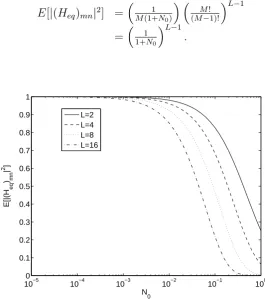
3.6 Relay Amplification . . . 49
3.6.1 Fixed Relay Amplification . . . 49
3.7 Eigenvalues . . . 53
3.7.1 Eigenvalue Decomposition . . . 53
3.8 Channel Approximations . . . 56
4 P25 SISO Simulations 61 4.1 Simulation Methodology . . . 61
4.2 Implementation Details . . . 62
4.3 Slow Fading Relay Channels . . . 65
4.3.1 SNR Effect on BER . . . 69
4.4 Fast Fading Relay Channels . . . 71
4.4.1 The Effect of Doppler Spread on BER . . . 73
4.5 BER Limit . . . 74
4.6 Block Error Rates . . . 76
vii
List of Figures
1.1 Coverage for area B with low user density is provided by relaying
signals between B and the high density area A . . . 4
1.2 A connection between areas A and B is provided by a relay chain through the shadowing object between them . . . 5
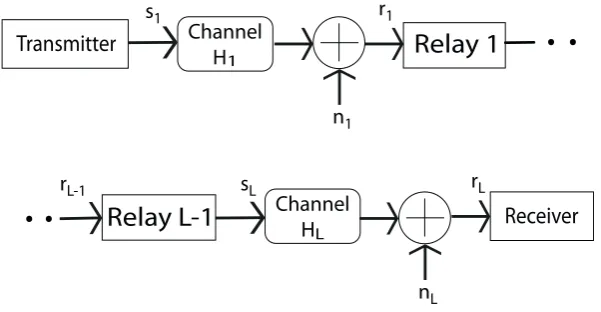
2.1 System diagram for a relay chain with L hops . . . 11
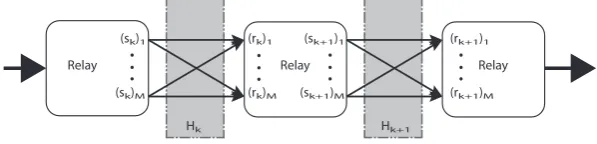
2.2 System diagram for a partial section of a MIMO multi-hop relay link 15 2.3 Fast fading autocorrelation function . . . 18
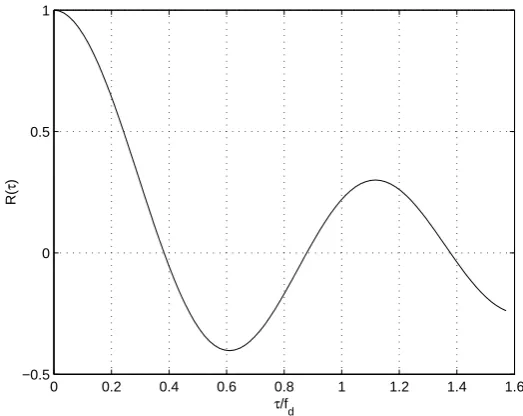
2.4 Multi-path channel model . . . 22
2.5 Power delay profile for urban environment . . . 25
2.6 Power delay profile for urban multi-hop channels . . . 30
3.1 Example of a simple MISO system . . . 32
3.2 E[N SReq] for different values of α, N=4, L=4 . . . 48
3.3 Variance of an element of Heq for a M ×M MIMO system . . . 51
3.4 Variance of an element of neq for aM ×M MIMO system . . . 52
3.5 Probability density function of |(Heq)mn| with N0 = 0 . . . 53
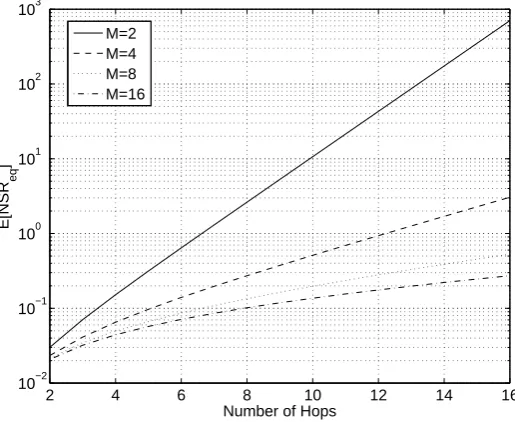
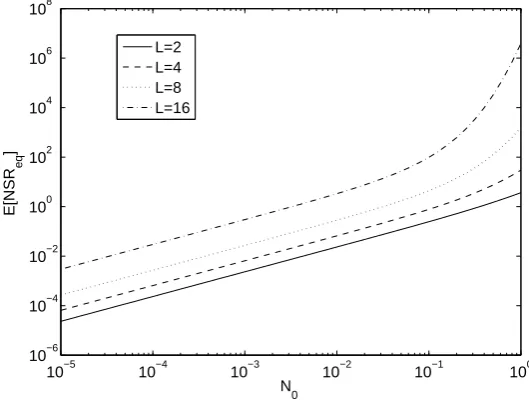
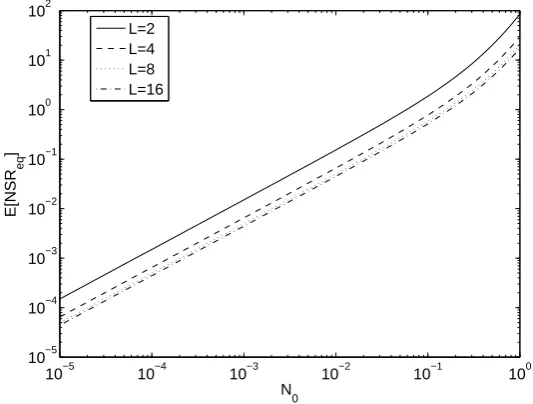
3.6 Plot of expected end to end noise to signal ratios with a SNR of 102 . 54 3.7 Plot of expected end to end noise to signal ratios for a 4×4 MIMO system . . . 55
3.8 Plot of expected end to end noise to signal ratios for a four hop system 56 3.9 Cumulative density of N SReq for a four hop system with a SNR of 10−2 . . . 57
x
3.10 Cumulative density ofN SReq for a 4×4 MIMO system with a SNR
of 10−2 . . . 58
3.11 Magnitude of the average eigenvalue . . . 58
3.12 Magnitude of the individual eigenvalues for an 8 hop system. . . 59
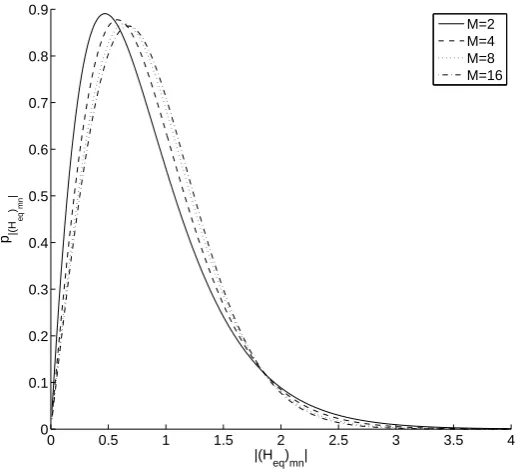
3.13 PDF of |(Heq)mn|, for a system where H=L= 4 andN0 = 10−2 . . . 59 3.14 PDF of |neq,mn|, for a system where H =L= 4 and N0 = 10−2 . . . . 60
3.15 PDF of |N SReq|, for a system where H =L= 4 and N0 = 10−2 . . . 60
4.1 BER vs the number of hops for stationary AF relay chains at 30dB
SNR. Transmission distance increases with the number of hops. . . . 66
4.2 CDF of SN Req for AF relays in flat Rayleigh fading environments . . 67
4.3 BER vs the number of hops for stationary PF relay chains at 30dB
SNR. Transmission distance increases with the number of hops. . . . 68
4.4 CDF of SN Req for PF relays in flat Rayleigh fading environments . . 69
4.5 BER vs the number of hops for stationary DetR relay chains at 30dB
SNR. Transmission distance increases with the number of hops. . . . 70
4.6 BER vs SNR for AF relays . . . 71
4.7 BER vs SNR for PF relays . . . 72
4.8 BER vs SNR for DetR relays . . . 73
4.9 BER for PF relays with a fading speed of 100km/h in each link and
no additive noise. . . 74
4.10 BER for DetR relays with a fading speed of 100km/h in each link
and no additive noise. . . 75
4.11 BER vs Doppler Spread for a 4 hop link with PF relays . . . 76
4.12 BER vs Doppler spread for a 4 hop link with DetR relays . . . 77
4.13 2% BER contours for AF relays with 100km/h faded first and last
links. . . 78
4.14 2% BER contours for PF relays with 100km/h faded first and last links. 78
4.15 2% BER contours for DetR relays with 100km/h faded first and last
links. . . 79
xi
4.17 1% block error rate contours for DetR relays with half rate coding. . 80
4.18 1% block error rate contours for PF relays with half rate coding. . . . 80
4.19 5% block error rate contours for DecR relays with half rate coding. . 81
4.20 5% block error rate contours for DetR relays with half rate coding. . 82
4.21 BER vs SNR for DecR relays with half rate coding. . . 83
List of Tables
2.1 Delay spread parameters for radio models, delay in µs and power in
dB . . . 24
2.2 P25 signalling constellation . . . 26
xiv
Abbreviations
AF - Amplify and forward
BER - Bit error rate
BPSK - Binary phase shift keying
CSI - Channel state information
CB - Citizen Band
DecR - Decode and regenerate
DetR - Detect and regenerate
FIR - Finite impulse response
GEV - Generalised extreme value distribution
ISI - Inter-symbol interference
LOS - Line of sight
MAC - Media access control
MIMO - Multiple input multiple output
SISO - Single input single output
N SReq - Equivalent end to end noise to signal ratio
QAM - Quadrature amplitude modulation
PF - Phase forward
SNR - Signal to noise ratio
SN Req - Equivalent end to end signal to noise ratio
xv
TCM - Trellis coded modulation
Chapter 1
Introduction
When building a communications network, an important consideration is that of
topology [1]. That is, which parts of the network will interact. Two obvious
ar-rangements are centrally routed networks and networks using direct connections.
In a centrally routed network terminal nodes communicate via a single interchange
node. In a network using direct connections terminal nodes communicate directly
with each other. In practice most networks will fall somewhere between these two
extremes. For example, in a cell phone network [2] users communicate via a single
base station within a given area or cell. Users in different cells communicate with
their respective base stations which will transfer the information between them. The
internet works in a similar manner, albeit with a larger hierarchy. Here a user will
connect to an internet service provider, which in turn may connect to a nationwide
exchange and then an intercontinental router. On the other end of the spectrum,
citizen band (CB) radio [3] is an example of a network utilizing direct connections
between users. As may be apparent from the above examples, different topologies
are more appropriate for different types of network.
A centrally routed network is more suited to dealing with a high user density and
can help centralize the cost of establishing a network, that is the capital investment
is primarily in the base stations as opposed to being split evenly between all radio
nodes. In this context, high user density refers to a situation where it can be
expected that a large proportion of the available bandwidth of the network will be
Chapter 1. Introduction 2
required simultaneously, by a large number of users. This would typically require
bandwidth to be allocated to users dynamically and reassigned with a low latency
[2]. A centrally routed network simplifies this task as, if all communications are
transferred via one node, then the allocation of bandwidth can be managed by this
node alone. This task is referred to as media access control (MAC) [1]. The fact
that MAC can be dealt with solely in the central node allows the majority of the
complexity and therefore the cost of network hardware to reside in this node. The
result of this is the opportunity to produce low cost terminal nodes which, combined
with the centrally routed system’s suitability to high user densities, means that a
network of this style has an easily scalable number of users. In a network with direct
routing all the terminals need to be capable of any MAC the network implements.
This limits the practical user density of a network of this type to the complexity
that can be included in the terminal nodes. As such the investment per user in the
network is higher than a centrally routed scheme but as no additional infrastructure
is required the network can be ad hoc in nature. Systems providing scope for direct
communications between users typically provide more geographical scalability than
centrally routed networks while providing less scope for high user densities. This
is not fundamentally the case but rather arises from the typical implementation of
these network types.
Current radio products are predominantly of two types, privately owned radio
terminals utilizing direct communications on public frequencies and commercial
ra-dio networks [4]. The commercial networks are typically centrally routed, with fixed
high power central nodes. This is the context for the work in this thesis. The key
question is whether some of the flexibility advantages of direct point to point
com-munications can be utilized in radio networks built around expensive fixed base
stations. In particular this work looks at using the concept of relays [5] to provide
this flexibility. A relay in this context is considered to be a network node which
immediately retransmits what it receives, possibly with some intermediary
process-ing. The purpose of the relay node is to extend the range over which other nodes
Chapter 1. Introduction 3
nodes to communicate within a given area. It should also remain as transparent as
possible [6]. By transparent we mean that communication between users should be
equivalent to the case where they are in a range where the relay is not needed. That
is the performance and operation of the system should be virtualy the same as in
the case where the relay is not used.
The concept of using relays for communication is not new, in fact it could be
considered as the basis of some of the earliest communication networks. From
semaphore chains to smoke signals to wolf howls, relaying signals provided a simple
means of long distance communication. Modern examples of relays augmenting a
larger network include; relays for cell phone signals located inside large buildings,
which have poor reception from the nearest base station. This relay may be
con-nected to an aerial external to the building, where the signal to the rest of the
network is stronger. A very crude relay is the leaky feeder [7], a length of coaxial
cable which runs along the length of a tunnel and is connected to an aerial
out-side the tunnel. This allows radio signals to propagate inout-side the tunnel. Here we
consider the possibility of a more extensive augmentation of existing networks with
the relay concept, or even stand alone relay based networks. These could be of use
in areas of low user density, where the full sophistication of a base station is not
required. The key requirement of a relay for this purpose is to be of low cost, so as
to provide a useful alternative to installing a base station. Another desirable
prop-erty is to possess a low power requirement. This will allow the possibility of being
battery powered and portable. A product of this nature would provide a low cost,
easily scalable and portable network infrastructure. Situations where this could be
of commercial value include:
• Areas with very low user density, such as rural areas, where little MAC is re-quired. Here the sophistication of a typical base station is unnecessary so a relay
system could provide the same coverage at a much lower cost.
• Temporary networks to provide coverage in remote areas, such as that required
by emergency services. Here the potential portability of relays could be utilized
Chapter 1. Introduction 4
be relocated as required.
• Extension of existing networks into areas of low user density. These areas may not prove economic to cover with a base station, but could be serviced by relaying
signals to an existing base station adjacent to the area [8]. This is outlined in
Fig. 1.1.
A
B
Figure 1.1: Coverage for area B with low user density is provided by relaying signals between B and the high density area A
• Extending or establishing new networks in heavily shadowed areas, such as
val-leys, tunnels, buildings etc. Shadowing [9] refers to the situation where large
objects block the path of radio propagation, hills and buildings would be typical
examples. These objects drastically weaken the signal in their path. In areas
with heavy shadowing the use of single high power transmitters is inefficient,
as most of the transmit power is not received. A solution is to use a sequence
of lower power transmitters to relay the signal around the shadowing objects.
Figure 1.2 is an example of this scenario.
Of course an obvious question relating to a relay system of this nature is: how
big can a network based on this concept become? There are two ways to increase
the network coverage, increasing transmit power and adding more relying nodes [5].
Increasing transmit power removes some of the advantages of the relay concept so is
not necessarily desirable. Hence, network expansion would ideally be performed via
Chapter 1. Introduction 5
A
B
Figure 1.2: A connection between areas A and B is provided by a relay chain through the shadowing object between them
a signal pass through while retaining an acceptable number of errors. Anyone who
has played the game Chinese whispers will identify the problem that if each relay has
the potential to introduce errors into communication, the combination of multiple
relays increases the probability of errors. To allow the use of chains of relays it is
important to investigate what can be done within the relay node to mitigate this
problem and to establish what kinds of conditions these relay networks can operate
in. This work focuses on the effect of increasing the number of relay nodes in the
communication path, with a variety of relay types and radio environments.
Also under consideration is the use of MIMO transmission with relay networks
[10]. MIMO stands for multiple input multiple output and refers to the use of
antenna arrays for both transmission and reception of information. For example a
single transmitter could use multiple antennas to transmit to a receiver with multiple
antennas. Alternatively a set of transmitters with single antennas could transmit
cooperatively to a set of receivers with single antennas. The advantage of multiple
antennas is that it provides spatial diversity. This effect can provide more reliable
transmission or can be used to increase the potential capacity of a wireless channel.
Due to local scattering effects the strength of a radio signal at separate antennas even
if they are located close to each other can vary drastically. Hence the use of multiple
antennas gives a higher probability of receiving a strong signal at one of the antennas.
Chapter 1. Introduction 6
of the channel drops. Furthermore, if the channel properties between each antenna
pair can be tracked by the receiver it is possible to transmit independent information
on each antenna. Antenna arrays at a single node provide this spatial diversity on
a scale of the order of the wavelength of the signal, providing robustness to local
scattering effects. In contrast an array of separate nodes provide a similar effect on a
larger spatial scale. This arrangement can provide redundancy against shadowing as
well as local scattering. The downside to this arrangement is that the geographically
separated nodes need a reliable connection with low delays in order to communicate
cooperatively. This would normally involve a wired connection.
The current knowledge of relay chains can be split into two broad areas:
re-lays using MIMO techniques and those using traditional single antenna systems,
referred to as single input single output (SISO) systems. For MIMO systems, the
results available relating to relay performance are limited but, as with other areas of
MIMO communications, it is an active area of research [11]. Furthermore, multi-hop
relaying using MIMO techniques is in its infancy in terms of performance analysis.
Some results for capacities in relation to numbers of relay nodes and antennas are
available [12, 13]. Optimal relaying techniques and coding structures are developed
in [14] assuming full channel state information (CSI) at each relay. An asymptotic
performance analysis is presented for this system in [14].
Research into SISO communications is more developed, as would be expected
due to its much longer history. It is important to note that these single antenna
systems can still benefit from spatial diversity when multiple relay nodes are used
for signal transmission. As multiple nodes are transmitting the same information in
a multi-hop relay system, a receiver capable of combining signals from all
transmis-sion sources can benefit from this diversity. General results for multi-hop relaying
have still proved difficult to obtain though, an overview of available results is given
in [15]. The system performance is dependent on the type of relay processing
per-formed which complicates a summary of the available knowledge. Introducing the
concepts of analogue and digital relaying make this summary easier. Here, an
Chapter 1. Introduction 7
processing, while a digital relay performs some degree of demodulation and
decod-ing before regeneratdecod-ing and retransmittdecod-ing the signal. With an arbitrary hop length
[16] and [17] give upper bounds on errors for digital relays and analogue relays
us-ing a specific amplification factor. [16] contains an analysis for systems usus-ing the
diversity offered by multiple relays and [17] performs a similar analysis for systems
without this diversity. An approximate expression for error rates is developed in
[18] which applies to analogue relays of arbitrary hop length and includes diversity.
The instantaneous end to end SNR is found in [19] for multi-hop analogue relaying
with diversity. The system error rate is found in [20] for digital relays.
1.1
Goals
The available results for multi-hop MIMO relay systems are limited as a result
of the highly complex statistics of the resulting propagation channel. Currently,
the systems are modeled via a combination of the existing models for the channel
between two radio nodes. The result is a model where the degrees of freedom are
proportional to the number of relay nodes and the square of the antenna numbers.
The motivation of the work presented in Chap. 3 is to develop a model which
describes the statistics of the end to end channel directly, ideally massively reducing
the degrees of freedom of the model. This may lead to an easier analysis of the
performance of the system. For example, error rates and end to end signal to
noise ratios for multi-hop MIMO relay channels are not currently available. An
understanding of the statistics of the complete channel may lead to these expressions.
Parallel to this investigation, Chapter 4 looks at performance metrics of a SISO
system using the P25 protocol.
1.2
Contributions
The thesis makes contributions in both areas of interest, namely in the analysis of
MIMO relay channels and in the evaluation of various SISO relay implementations.
Chapter 1. Introduction 8
relays. Using this model we go on to develop expressions for moments of the elements
of the end to end transfer function, probability densities for the single relay case
and expressions for the end to end signal to noise ratios in the system. We go on
to look at the effects the relay amplification and a capacity analysis based on the
eigenvalues of the transfer matrix.
The analysis of the SISO system, while providing results for the specific
modula-tion scheme outlined in the P25 specificamodula-tion, also addresses some general quesmodula-tions
arising in the literature. The majority of work done in relation to multi-hop
re-lays focuses on flat fading channels. The SISO simulations presented in Chapter
4 include the error rate trends for multipath channels with a variety of common
relaying protocols. This introduces the problem of inter-symbol interference (ISI),
which proves to be significant and in some cases the dominant cause of errors.
1.3
Thesis Organization
Chapter 2 outlines the existing system models based on single hop transmission and
shows how these can be cascaded to describe a multi-hop system. The description
of the model is split into that relevant to MIMO communications, followed by that
applicable to SISO communications. The description of the system model is further
split into four components, the source signals, the propagation channel, the relaying
protocol and the noise components. These are all described separately for MIMO
and SISO communications.
Chapter 3 develops the statistics of the end to end signal model and presents
the results relevant to performance that can be obtained from this model. A look at
the dependence structure in the end to end transfer function of the channel is given
is presented first, the raw moments of elements of the system model follow. End to
end signal to noise ratio distributions are presented next including their moments.
The effects of the linear amplifiers are considered. The penultimate section contains
an empirical analysis of the eigenvalues with an explanation of how these can be
related to capacity. Finally we look at channel model approximations.
Chapter 1. Introduction 9
channel. The simulated results are presented in such a way as to isolate the effects
of individual degrading channel properties. First we demonstrate the effect of slow
fading on the communication scheme across a range of relaying protocols and identify
the cause for the discrepancies in the relay protocols. The results of fast fading are
covered next. Both these sections look at relay protocols ability to mitigate the
effects of frequency selective channels. The complete system model is considered
next. This section looks at conditions in which a desired error rate can be maintained
and is intended to aid system design. The final section looks at requirements for
maintaining block error rates using error correcting codes.
Chapter 2
System Model
Transmitter
s1 r1
n1 Channel
H1
Relay 1
Receiver
sL rL
Channel HL
nL
Relay L-1
[image:29.595.142.443.330.486.2]rL-1
Figure 2.1: System diagram for a relay chain with L hops
The work in Chaps. 3 and 4 is split into an analytical component involving
MIMO techniques and simulation work based on SISO transmission. As the nature
of many system components is different for these two scenarios, the system model
for each part will be described separately. Given that a SISO communication
sys-tem is a special case of the more general MIMO model, the MIMO section will be
described first in, Sec. 2.3, with the SISO specific model following in Sec. 2.4. As
a preliminary, some notation, performance metrics and system parameters will be
defined. Despite the differences between the two scenarios the common structure of
a typical L-hop relay chain can be identified in Fig. 2.1.
To describe the general system in Fig. 2.1 we need to define the signal vectors
s1,s2, . . . ,sL, r1,r2, . . . ,rL and noise vectors n1,n2, . . . ,nL. The originally
Chapter 2. System Model 12
mitted signal, s1, passes through the first channel, which has transfer function H1. This is received, along with additive Gaussian noise, n1, at the first relay. The received signal, r1, is given as r1 = H1
⊗
s1 +n1, with
⊗
being the convolution
operator. The dimension of the vector s1 is given by the number of transmit an-tennas which in this work will be referred to as N1. The dimension of r1 and n1 is the number of receive antennas, denoted by M1. The received signal, r1, is pro-cessed by the relay, producing the signal transmitted by the first relay, referred to
as s2. The relationship between r1 and s2 depends on the type of relay protocol being employed. r2 is then H2
⊗
s2 +n2 and rL = HL
⊗
sL+nL. The number
of receive antennas at the lth relay and the dimension of the vectors nl and rl is denoted Ml. The number of transmit antennas at thelth relay and the dimension of sl+1 is denotedNl. Given these definitions, the transfer function between thelthand
(l−1)threlays hasN
l−1 inputs andMLoutputs. In general these equations require a
convolution of the signal with the channel transfer function. If this transfer function
is an impulse, then this reduces to a multiplication. In practice, this represents a
channel which does not spread a signal in time. As an approximation to a physical
system this is valid provided the difference in propagation delay across all possible
paths is less than the symbol period. Channels of this type are referred to as flat
fading channels, as the attenuation of the channel is independent of frequency. For
the MIMO system in Chap. 3 a channel model of this form is used. This chapter
looks to provide an expression for the end to end transfer function of the relay link,
that is to specify the signal at the final receiver directly in terms of the originally
transmitted signal. This will be an equation of the form r =Heq
⊗
s1+neq, with Heq being the equivalent transfer function between the transmitted signal and the information carrying component of the received signal. The noise terms, neq,
repre-sents the cumulative noise received through the relay link. It is now left to define
Chapter 2. System Model 13
2.1
Notation
Matrices
• Matrices are represented by bold capital letters such asH.
• Hmn refers to the element from themth row of the nth column of H.
• Hm refers to the mth row of H.
• Hn refers to the nth column ofH.
• Some equations will use specific indices, such as H1, to denote either the
first column or row ofH. Whether this refers to the row or column will be apparent from the context.
• Equations will also use notation such asHl to denote a single matrix from a set of matricesHl, l∈ {1,2, . . . , L}. Once again, the fact that this is a full
matrix rather than a row or column vector will be apparent by context. To
refer to an element of such a matrix the notation (Hl)mnis used to represent
the element from the mth row of the nth column of Hl. Similarly the mth
row ofHl is denoted (Hl)m and nth column, (Hl)n.
Vectors
• Vectors are represented by bold lower case letters such as s.
• sm refers to the mth element of s.
• sk refers to the kth vector in the set sk, k ∈ {1,2, . . . , L}, skm refers to the mth element of this vector.
Products
Empty product expressions are considered to be equal to one. For example,
∏L
l=L+1Hl = 1.
Random Variables
Chapter 2. System Model 14
complex Gaussian variables (ZMCSCG), which are of the form z1 +jz2 where
z1, z2 are i.i.d real zero mean Gaussian variables. We also define CN(0,1) to be
the distribution of a ZMCSCG variable with unit variance.
Complex Variables
Complex conjugates and Hermitian transposes will be denoted by the symbol
†. That is, a scalar x has complex conjugate x†, a vector, s, has Hermitian transposes† and a matrix,H, has Hermitian transpose H†.
2.2
Metrics and System Parameters
When quantifying the performance of communication systems, a variety of metrics
can be used. The metrics used in this work are:
Capacity This is a measure based on information theory giving an upper bound on the rate of the communication system that can be maintained while retaining
no transmission errors.
Bit Error Rate (BER) This metric gives the number of bit discrepancies between the transmitted and received message as a fraction of the total number of bits
contained in the message. The ratio given is normally an average with the
message size tending to infinity as the number of bit errors for any given message
will vary.
Block Error Rate (BLER) Similar to BER the BLER is often applied to trans-mission schemes that send data in discrete, finite blocks. Here the ratio of blocks
containing one or more errors to the total number of blocks transmitted is given.
Fundamentally, all performance measures of a communication system are
depen-dent on the ratio of the received signal power to the received noise power. Let r be
the scalar received signal at a single antenna and n be the scalar noise at the same
single receive antenna. The signal to noise ratio (SNR) is defined as EE[[||nr||22]] giving
Chapter 2. System Model 15
2.3
Multi-hop MIMO Relayed Communications
Relay Relay Relay
Hk Hk+1
(sk+1)1
(sk+1)M
(rk+1)1
(rk+1)M
(sk)1
(sk)M
(rk)1
[image:33.595.141.440.147.219.2](rk)M
Figure 2.2: System diagram for a partial section of a MIMO multi-hop relay link
For the MIMO system we will focus on flat fading channels. As the transfer
function of this channel is an impulse, the effect of the channel in the system model
reduces to a multiplication. A partial multi-hop MIMO link is shown in Fig. 2.2.
We can define the received signal at the first relay asr1 =H1s1+n1. This received signal is then processed by the relay to give s2, the signal transmitted by the first relay. In general the received signal at the lth relay is given byr
l=Hlsl+nl.
2.3.1
Channel Model
For the MIMO relays the standard Rayleigh scattering model of wireless propagation
is used. Here the gain between any transmit/receive antenna pair is given by a
variable distributed as a ZMCSCG variable. The model represents propagation
scenarios in which there is no line of sight (LOS) path present and it assumes a
large degree of scattering of the signal at the receiver. It can be shown in this
situation that the attenuation between an antenna pair is Rayleigh distributed [9].
Hence the PDF of the channel attenuation is given in [21] Chap. 18 Sec. 10.2 as
p(x) = x
σ2 exp
(
−x2
2σ2
)
, x≥0
whereσ is the distribution scale parameter, which in this case specifies the average
channel attenuation. The phase shift of the channel is uniformly distributed between
−π and π.
In a MIMO system [22] the gains between each antenna pair can be represented
Chapter 2. System Model 16
H=
H1,1 · · · H1,N
..
. . .. ...
HM,1 · · · HM,N
,
for a MIMO system with N transmit antennas and M receive antennas. Such a
system will be referred to as M×N MIMO. Each element, Hm,n, inHis distributed as an i.i.d ZMCSCG variable. His referred to as the channel matrix. Ifsis anN×1 vector representing the signals at the N transmitters then the signals received at the
M receivers are given as r=Hs. In the presence of noise this becomes r=Hs+n
where n is an M ×1 vector of i.i.d complex Gaussian variables.
The Rayleigh model represents local scattering of the signal at the receiver. To
account for shadowing between transmit and receive antennas an additional
log-normal scaling parameter is log-normally used, while free space path loss is represented
by another parameter. The work in Chaps. 3 and 4 does not focus on a specific
physical system so a distance or antenna coefficient for the free space path loss
cannot be specified. Shadowing is also a constant scaling parameter for a given
inter node channel. Hence we remove both of these components from our channel
model and instead we simply specify the SNR at the receiver. This is justified based
on the fact that for a physical radio link the degree of shadowing experienced will
remain relatively constant over the period of transmission. Hence from the point
of view of system design it is just as useful to evaluate the links performance at a
given average SNR.
Time Varying Channels
The channel model described here is based on the idea of a large number of scattered
signal paths combining randomly at the receiver to produce the received signal. This
suggests that the received signal will vary in space. Hence a moving receiver will
experience a time dependent channel. Similarly, if an object around the receiver
that is affecting the scattered signal is moving, then even a stationary receiver
will experience a channel that varies over time [9]. The effect is the same if the
Chapter 2. System Model 17
and objects in the propagation environment dictates the extent of this effect. For
the purpose of analysis in wireless communications, the rate of change of the channel
is broken into two categories, these being fast and slow fading channels. In a slow
fading channel the rate of change of the channel is considered to be of an order such
that over a symbol period of the modulation scheme the channel can be considered
to be static. In this situation the performance of the communication scheme is not
affected directly by the changing channel, but the average performance of the system
will be dependent on how the channel properties change over time. In a fast fading
environment the channel properties are assumed to change significantly within a
symbol period and will potentially affect the demodulated signal.
We use a model of fast fading based on the Jakes Doppler spectrum [9]. With
this model the change over time can be defined by an autocorrelation function
R(τ) =J0(2πfdτ) whereJ0 is the zeroth-order Bessel function of the first kind,fd is
the maximum doppler shift andτ is the time between two channel instances. R(τ) is
the autocorrelation function of an element of the channel matrix,H. For the complex element,Hmn, the autocorrelation function is defined asR(τ) =E[(Hmn)†t(Hmn)t+τ],
where the subscript refers to the time at which Hmn is observed. The maximum
doppler shift is defined as fd = vfcc where fc is the carrier frequency and v is the
relative velocity of the transmitter and receiver or the scattering objects. Figure
2.3 is a plot of the normalized auto correlation and gives a measure of the expected
commonality between two instances of the channel with a separation in time given
by fτ d.
The effect of a time varying channel on the received signal depends on the type
of modulation employed by the communication system. When using a constant
envelope, non-coherent modulation such as DPSK the change in channel properties
across adjacent symbols introduces errors in the received signal. When designing a
system to operate in these conditions the autocorrelation function of the channel can
be used to give an indication of acceptable symbol rates for a given error margin.
It can be seen from Fig. 2.3 that the higher the symbol frequency the greater
Chapter 2. System Model 18
0 0.2 0.4 0.6 0.8 1 1.2 1.4 1.6
−0.5 0 0.5 1
τ/fd
R(
τ
[image:36.595.151.413.110.318.2])
Figure 2.3: Fast fading autocorrelation function
modulation a change in the channel phase shift between sample times will introduce
an error in the demodulated signal. Hence, a higher correlation between channel
properties at adjacent sample times results in a lower error probability. Figure 2.3
also suggests that there is a lower limit to symbol frequency for a practical DPSK
system giving by the first zero crossing of the channel autocorrelation function.
At this point the channel properties are not reliably correlated between adjacent
samples.
2.3.2
Source Signals
The source signals, s1, are N1×1 vectors drawn from a random sequence at a rate given by the sample frequency of the communication protocol. The samples drawn
from the sequence are assumed to be uncorrelated. Furthermore E[s†1s1] is assumed to be equal to one.
2.3.3
Relay Protocols
The types of relaying considered are split into two general categories. In the
Chapter 2. System Model 19
correspond to the use of analogue or digital relays respectively. In decoded relaying
the message is estimated at each relay and regenerated. As a result, the end to end
channel properties are not important and each hop in the relay link can be
con-sidered independently. The problem in evaluating the performance with decoded
relaying becomes one of describing error propagation as decision errors from one
relay will be transmitted to the next. Chapter 3 does not look at this issue and
the analytical work focuses on linear relaying. Relays of this type retransmit the
received signal with some form of linear transformation, α, hence the transmitted
signal for relay one is given bys2 =α1r1 where
s2 =α1(H1s1+n1).
This pattern can be continued to give the signals throughout the relay chain.
Let the received signal at thelth relay berl, the signal transmitted from thelthrelay besl+1, the channel transfer function between the (l−1)th and lth relays be Hl and
the received noise at the lth relay be nl. With these definitions
rl =Hlsl+nl,
sl+1 =αlrl,
sl+1 =αl(Hlsl+nl). (2.1)
Expanding (2.1) recursively we can define the signal at the final receiver, rL,
in terms of the signal at the original transmitter, s1, giving an end to end system equation. This is shown in Sec. 3.1.
The general form forαl is anMl×Nl complex matrix. This allows the possibility
of the output at each antenna on the transmit side of the relay being a linear
combination of the inputs at each antenna on the receive side. An important special
case of this general form is a diagonal αl matrix. Here, the signal received at each
antenna is scaled to give the output at a transmit antenna. Hence there is no
combining of signals, simply a scaling. A further simplification is the reduction of
αl to a scalar, where there is once again no combining of signals and only a simple
Chapter 2. System Model 20
2.3.4
Noise
The system model includes additive Gaussian noise at each receive antenna.
Com-plex Gaussian noise is assumed. Hence the noise, n, is given by
√
N0
2 (nr+jni) where
nr and ni are i.i.d real Gaussian variables andN0/2 is the power spectral density of the noise.
2.3.5
Signal Power
To provide a general model for the relay system it is desirable to normalize the
signal powers in the system model. To achieve this the various parts of the system
can be redefined as follows. Let the physical signal at the first relay be defined by
˜s2 = ˜α( ˜H1˜s1+ ˜n1). (2.2)
We will write (2.2) in terms of a set of signals with unit power scaled by the
power of the signals in the actual physical system.
√
Ps2s2 = ˜α(
√
PHH1
√
Ps1s1+
√
Pnnˆ1) (2.3)
Here, H1 is the normalized channel matrix where E[|(H1)mn|2] = 1, s1, s2 and ˆn1 are normalized transmit signals and noise vectors in the same fashion.
Ps2 = E[˜s
†
2˜s2], Ps1 = E[˜s
†
1˜s1], PH = E[|( ˜H1)mn|2], Pn = E[|n˜1,m|2]. Dividing (2.3)
by √PHPs1 we have
√
Ps2
√
PHPs1
s2 = ˜α(H1s1+
√
Pn
√
PHPs1
ˆ
n1),
s2 =
√
PHPs1
√
Ps2
˜
α(H1s1+
√
Pn
√
PHPs1
ˆ
n1).
If we then define a normalized amplification factor, α, as
α=
√
PHPs1
√
Ps2
˜
α,
Chapter 2. System Model 21
E[n1n†1] =
Pn PHPs1
I,
then we have the normalized system model
s2 =α(H1s1+n1).
Since α is still an arbitrary scaling variable we can represent the various signal
powers in the system by the variance of n1 alone. Furthermore, PPn
HPs1 is equal to the inverse of the signal to noise ratio, SN R1 , and the model can be defined directly by this parameter. Hence in system modeling it is sufficient to define the SNR and
use unit power channels and signals.
2.4
Multi-hop SISO Relayed Communications
When using SISO communications the system model becomes scalar, but here we
allow the possibility of the radio channel spreading the signal in time. This requires
a convolution in the system equations. The received signal at the first relay, r1, is
given byh1
⊗
s1+n1. In SISO systems the possibility of non linear relay processing
is considered, so an end to end system equation is not necessarily obtainable. The
signals at thelthrelay can still be defined asr
l,sl+1andnlwith the transfer function
between the lth and (l−1)th relay being h
l. The received signals are defined by
rl=hl
⊗
sl+nl.
The relationship between rl and sl+1 depends on the relay protocol employed and is covered in Sec. 2.4.5.
2.4.1
Channel Model
Here we use the flat Rayleigh channel as a reference to which the more complex
propagation models can be compared. In the results presented, the flat Rayleigh
Chapter 2. System Model 22
the other channel distortions to be assessed by comparison. The other channel
mod-els used here are extensions of the Rayleigh propagation concept, which allow the
inclusion of phenomena such as ISI and the time varying channel causing distortion
of the demodulated signal. These extended models will be described here.
While the Rayleigh model accounts for the local scattering of the received signal
it does not allow for a LOS signal from the transmitter. The model can be extended
to allow a non zero mean amplitude representing the presence of a LOS path. This
is referred to as a Rician channel [9], where the channel attenuation distribution is
defined by the PDF [21] Chap. 18 Sec. 10.7
p(x) = x
σ2 exp
(
−(x2+µ2) 2σ2
)
I0
(xµ
σ2
)
, x≥0 (2.4)
and I0(x) is the first order Bessel function of the second kind. In (2.4), µ is a
location parameter and represents the attenuation of the LOS path, while σ2 is a
scale parameter. The average channel attenuation is given by 2σ2+µ2. The phase
shift is once again uniformly distributed between −π and π.
Relay zN1
st+N1
z-1
st-1
n s
Relay r
H
z-N2
st-N2
Figure 2.4: Multi-path channel model
The Rician/Rayleigh model accounts for local scattering of the signal at the
receiver but, as the possible phase shift is limited to the range [−π, π), it does not
include the effects of ISI. More complex propagation models can account for received
signals with varying amounts of delay by including additional paths with delayed
versions of the transmitted signal. This model can now reproduce the effects of
Chapter 2. System Model 23
symbols. The properties of a variety of radio environments can be represented
using combinations of path delays and expected attenuations. If the individual
path gains are considered to be uncorrelated, the baseband signal can be described
mathematically using a finite impulse response (FIR) structure
rt= N2
∑
n=−N1
hnexp(θn)st−n,
where hn and exp(θn) make up the complex weights of the FIR filter. Details of
how the weights are obtained are given in Sec. (4.2).
2.4.2
Radio Environments
The environment models used are taken from [23]. These specify power delay
pro-files based on measured data in a set of European locations designed to replicate
the nature of propagation in general locations of a similar nature. The
environ-ments modeled are rural, urban, hilly rural and hilly urban scenarios. As a point of
reference, a flat Rayleigh environment has also been simulated. The environment
models are defined in Table 2.1. In the simulations the expected channel gains are
normalized to unity. The models define a delay and a gain for each path with the
shortest path assigned a delay of 0s and the strongest path a gain of 0dB. The
sam-ple period of the modulated signal is 21µs. The rural environment is the simplest
radio environment with a small delay spread and half the signal power existing in
a line of sight (LOS) path. This is representative of a high site situation where
the relay nodes could be located on adjacent hilltops for example. The hilly rural
environment has no LOS path and a much larger delay spread, 17µs at -12dB as
opposed to 0.5µs at -20dB. This is representative of a situation such as a series
of relays placed along the length of a valley. The urban environment includes a
longest delay of 5µs at -10dB and the strongest path delayed by 0.2µs. The hilly
urban environment has a sightly longer maximum delay of 6.6µs with the signal
power more evenly distributed across the delay spread. It is important to consider
a range of radio environments as different systems may be better suited to different
Chapter 2. System Model 24
Table 2.1: Delay spread parameters for radio models, delay in µsand power in dB
Tap Rural Urban Hilly Urban Hilly Rural
Delay Power Delay Power Delay Power Delay Power
1 0 0 0 -3 0 -3 0 0
2 0.1 -4 0.2 0 0.4 0 0.2 -2
3 0.2 -8 0.6 -2 1.0 -3 0.4 -4
4 0.3 -12 1.6 -6 1.6 -5 0.6 -7
5 0.4 -16 2.4 -8 5.0 -2 15 -6
6 0.5 -20 5.0 -10 6.6 -4 17.2 -12
Considering the effect of multiple relay nodes on the end to end radio channel
makes the propagation channel much more complex. To get a feel for the resulting
channel, consider a SISO system with linear relays in the absence of noise. Starting
with the flat Rayleigh case, when a set of these channels are combined in series the
output becomes
rt=
∏
n hnst.
If we define the channel gain, hn, in polar form, that is hn = Anexp(jθn), the
total phase change of the channel becomes ∑nθn. The combined amplitude is
∏
nAn. Since
∑
nθn is the sum of N circularly symmetric, independent, uniformly
distributed random variables it is also distributed uniformly in the interval [−π, π).
The combined amplitude is distributed as a product of Rayleigh variables.
Next we consider the multi-path channel model where
rt= N2
∑
n=−N1
hnexp(θn)st−n.
The combination of these channels becomes more cumbersome to describe
math-ematically. To circumvent this, first we define ϕd as a shift operator such that ϕd(st) =st−dandϕd1(s)ϕd2(s) = ϕd1+d2(s). With this notation, the output can then
be given as
rt= L
∏
k=1
[ N
2
∑
n=−N1
hnexp(θn)ϕdkn(st)
]
.
Chapter 2. System Model 25
the original paths. Considering one of these path combinations, the amplitude is
again distributed as a product of Rayleigh variables and the phase is uniform on
the interval [−π, π). Finally, the delay is the sum of the delays of the individual
paths that make up the end to end paths. To assess the nature of the end to end
channel it is useful to consider the power delay profile. That is the expected signal
power at the receiver over time corresponding to an instance of a transmitted signal.
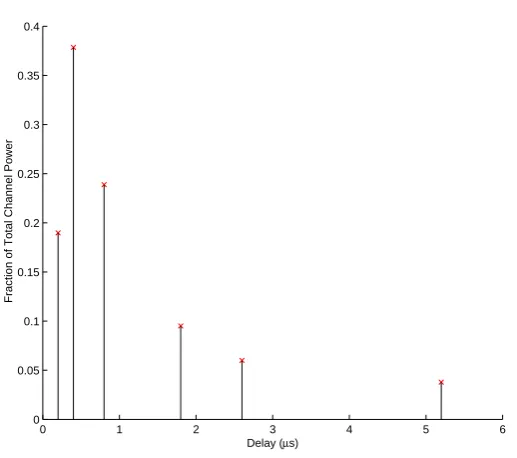
For example, the power delay profile of the urban channel as defined in Table 2.1 is
given in Fig. 2.5.
0 1 2 3 4 5 6
0 0.05 0.1 0.15 0.2 0.25 0.3 0.35 0.4
Delay (µs)
[image:43.595.160.419.286.515.2]Fraction of Total Channel Power
Figure 2.5: Power delay profile for urban environment
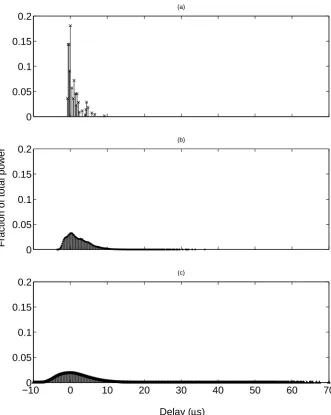
As these profiles define the transfer function of the channel the profile for
multi-hop channels can be obtained by the convolution of the transfer functions. Figure
2.6 shows how the distribution of signal power in time is affected by multiple relay
nodes.
As the number of hops increases, the dispersion of the signal in time increases.
Without a receiver with the ability to equalize the channel, not only will the received
power decrease as the transmitted power is spread outside the sample period, but
this proportion of the transmitted power will also interfere with adjacent symbols.
Chapter 2. System Model 26
sample time at the receiver will not necessarily be aligned with the peak received
power.
2.4.3
P25 Communications
We give special attention in this work to the P25 communication protocol. This
uses a non-coherent frequency/differential phase modulation. The protocol maps 2
bits per symbol. While the P25 specification [24] allows some variation in the details
of implementation, our system uses differential phase shift modulation. Here, the
signal is represented by the change in phase between successive sample periods. The
message bits are grey coded to symbols as given by the signal constellation in Table
2.2. The signal to be transmitted, s, is given by
Table 2.2: P25 signalling constellation Bits Phase Change
10 -135
00 -45
01 45
11 135
st=st−1exp(iθt),
where the subscript t gives the sample time and θ is the message symbol.
P25 communications have several advantages for wireless propagation. The
con-stant envelope frequency/differential phase modulation is not susceptible to
distor-tion due to a constant complex gain in the propagadistor-tion path. Though the
demodu-lated signal is affected by a time varying phase change in the propagation path, the
extent of this effect is proportional to the rate of change of the channel phase and
the symbol rate chosen for modulation. The protocol, being non-coherent and not
taking advantage of any channel state information, will not provide a high
band-width efficiency in challenging propagation environments. The payoff for this is low
complexity radio hardware.
The symbol frequency is 4.8kHz, the modulation frequency 48kHz. The
Chapter 2. System Model 27
offers a higher level of robustness in fast fading channels. Conversely, the symbol
frequency is lower than the modulation frequency, as this reduces susceptibility to
ISI. The carrier frequency is 800MHz. To demodulate the received signal, the phase
difference between successive samples is calculated and the result mapped back to
the appropriate bits.
The receiver works as follows. The phase change between samples, ˆθ, is obtained
as,
ˆ
θ =arg(rtr†t−1). (2.5)
This phase change is then mapped to the closest valid symbol, that is the value of
m′ ∈ {−3,−1,1,3} that minimizes
arg
(
ritri∗(t−1)exp
(
−jπm′
4
)) .
The protocol also specifies a forward error correcting (FEC) scheme based on a
convolution code. The code is based on a 96 symbol block and has a 12 data rate. The
symbols to be transmitted are interleaved before passing through the convolutional
encoder and modulated as above. At the decoder, demodulation is performed as
normal then a Viterbi decoder is used to estimate the interleaved symbols. These
are then deinterleaved to recover the original symbol sequence.
2.4.4
Noise
The system is modeled using complex Gaussian noise. This is of the same form as
used in the MIMO model. Hence the noise, n, is given by
√
N0
2 (nr +jni), where
nr and ni are i.i.d real zero mean Gaussian variables and N0 is the average noise power.
2.4.5
Relaying Protocol
The primary requirements of the relays are for them to be of low cost and power.
This is the advantage it offers over a centrally routed (ie. base station) network.
Chapter 2. System Model 28
maintaining a reasonable capacity over the link is also a requirement and this can
become challenging as the number of relay nodes increase. To produce a practical
communication system, the relay nodes must control the cumulative negative effects
of the multi-hop propagation environment.
The simplest form of relay is a fixed gain amplifying relay in which sl+1 =αlrl,
where αl is a constant scalar. In this type of system, the amplification factor, αl,
can be designed to control the expected transmit power, E[|sl+1|2]. To maintain a constant value for E[|sl|2], l ∈ 1,2, . . . , L, the amplification factor can be set as
αl =
√
1
E[|hl|2]+N0. This scheme will require expensive linear amplifiers. It also
will prove unstable for channels with a large variance as there is no control over
the instantaneous transmit powers, s2
l+1. The scheme requires knowledge of the expected channel attenuations, E[|hl|2], and expected noise power at the receiver, N0.
If the relay is capable of tracking channel state information, a better system
would use an adaptive gain, where αl =
√
1
|hl|2+N0. A special case of this scheme
can be applied to constant envelope modulation schemes. If no information is carried
in the amplitude, the relay node can simply take the phase of the received signal
and retransmit this at the desired power. Mathematically, this is equivalent to an
amplification factor, αl =
√
1
|rl|2, and requires no knowledge of the channel state or received noise power. The fact the transmission power can be controlled precisely
means the maximum power of information carrying signal can be transmitted at any
given instance. Constant transmit power also allows the use of simple and cheap
non-linear amplifiers.
Looking at decoding relays, the simplest relaying protocol detects message
sym-bols then regenerates the estimated signal for transmission. This protocol requires a
digital relay. In these relays the signal is shifted from pass band to base band and a
differential detector is used to estimate the transmitted message symbols as per the
P25 protocol. Differential modulation is then used to produce the signal imposed
on the carrier signal for transmission. This also allows the transmit power to be
Chapter 2. System Model 29
the information carrying signal power and allowing the use of simple, non-linear
amplifiers. There are other significant advantages to the decoding and
regenera-tion of the message at each relay. It removes the effects of the multi-hop channel,
only suffering from the results of channel distortion between each relay pair. The
downside of this scheme is that any decoding errors at the relays will be propagated
through to the final receiver.
The simulation work undertaken investigates four options for relaying protocols.
These are referred to as Amplify and Forward (AF) [25], Phase Forwarding (PF),
Detect and Regenerate (DetR) [26] and Decode and Regenerate (DecR). The AF
protocol use the fixed amplification scheme giving a constant expected transmit
power across all the relay nodes. PF relays use the phase only transmission scheme,
providing constant power transmission. The DetR protocol is the basic digital relay,
demodulating the input signal to perform symbol estimation before regenerating the
signal for transmission. This protocol also allows constant power transmission. The
DecR protocol is based on the trellis coded modulation (TCM) scheme of the P25
specification. In this case the relay nodes perform symbol detection in the same way
as for DetR. Then, the most likely transmitted data sequence is estimated from the
received symbols using a Viterbi algorithm. This estimate of the transmitted signal
Chapter 2. System Model 30
0 0.05 0.1 0.15 0.2
(a)
0 0.05 0.1 0.15 0.2
(b)
Fraction of total power
−100 0 10 20 30 40 50 60 70
0.05 0.1 0.15 0.2
(c)
[image:48.595.113.445.200.616.2]Delay (µs)
Chapter 3
Statistical Properties of Multi-hop
Relay Chains
This analysis of relay chains focuses on the use of linear relays in flat Rayleigh
radio environments. The flat Rayleigh model is used as this is the most important
baseline case and leads to a multiplicative channel model, as opposed to requiring
a convolution operation which results from the use of a multi-path model. As the
statistics of the flat Rayleigh case are already highly complex, the multi-path case
has been left to be considered in future work. Detect and regenerate relays are
also not considered in this section. The reason for this is that in decoding relays
the message is regenerated at each relay and so the problem becomes one of error
propagation and the propagation channel between each relay pair can be handled
independently. To recap the system model presented in Sec. 2.3, the communication
system is represented at the lth relay by
sl+1 =αlrl
=αl(Hlsl+nl).
In Secs. 3.3-3.5 the linear amplification term,α, is left arbitrary. To give explicit
results in these sections we assume that it is a constant.
The focus of this section is the development of an end to end system model, of
the formrL=Heqs1+neq. Ideally this will prove useful in analysis of properties such as end to end capacity and BER. An end to end model is found for a multiple input
Chapter 3. Statistical Properties of Multi-hop Relay Chains 32
single output (MISO) system. We use this to characterise end to end properties
including noise to signal ratios and the moments of elements of the channel matrix
and noise vector. Additionally, the dependence structure in the end to end model
is established for MIMO systems. Finally, a characterisation of the eigenvalues of a
MIMO system is presented.
3.1
Equivalent Channel Matrices
Transmitter Relay
Receiver
H1 h2
s2,1
s2,2
r2
s1,1
s1,2
r1,1
r1,2
Figure 3.1: Example of a simple MISO system
Here we construct an end to end model for a MISO system. This can also be
applied to a MIMO system to give properties relating to a single receive antenna.
Consider a MISO system in the context of a relay chain. Here, arrays of antennas at
the source and relays transmit to arrays of receive antennas, with the constraint that
the final receiver has only one antenna. This reduces the channel matrix between
the final relay and receiver to a vector. We will look at a specific case of this type
of system to illustrate the method of obtaining the equivalent model. Consider a
system using a 2×2 MIMO link followed by a single antenna receiver, as in Fig.
3.1, with a flat Rayleigh channel and linear relaying. For this example we have the
channel model,
r2 =
[
h2,1 h2,2
]
α1
(H1)1,1 (H1)1,2 (H1)2,1 (H1)2,2
s1,1
s1,2
+
n1,1
n1,2
+n2. (3.1)