DIAGRAM METHODS FOR REDUCTI ON FACTOR
CALCULATIONS IN JAHN-TELLER SYSTEMS
A thesis
submitted in partial fulfilment
of the requirements for the Degree
of
Doctor of Philosophy
in the
University of Canterbury
Christchurch, New Zealand.
by
S. H. r:ayne
,-;:,-,"University of Canterbury
SCIENCES LIBRARY
ABSTRACT
A novel method is developed for the description and calculation of
Ham reduction factors in 'Jahn-Teller active' systems which are weakly
coupled to many lattice modes. Diagrammatic many-body perturbation theory
for finite temperatures is combined with diagrammatic group theory into a
coherent formalism, whose essential features are readily visualized. The
method lends itself to economical calculation of reduction factors (given
the recent availability of 6j symbols for crystal point group) and also to
generalization of the traditional single multiplet 'Jahn-Teller problem' •
Multirnode effects may be distinguished experimentally by searching for
particular combinations of reduction factors, associated with particular
Feynman diagrams, that vanish to all orders in systems with a continuous
symmetry group and to fourth order in all , within a single-mode
coupling model.
octahedral
General expressions for reduction factors are derived for
up to at least fourth order, and including lattice
anhar-monicity and non-linear electron-phonon coupling. The effects of symmetric
vibrations and intermultiplet coupling on reduction factors, and
CONTENTS
INTRODUCTION
CHAPTER
I
I I
III
VIBRONIC REDUCTION FACTORS
1. CONSTRUCTION OF EIGENSTATES
2. REDUCTION FACTORS
3. JAHN-TELLER SYSTEMS IN OCTAHEDRAL SYMMETRY
3.1 Doublet states -
r
3 3.2 Triplet states- r
5 3.3 Quartet states - f8
4. EXTENDED MULTIPLETS
5. SUMMARY
REDUCTION FACTORS VIA GREEN FUNCTIONS
1. A PERTURBATIVE SOLUTION FOR THE ION-PHONON SYSTEM
1.1 The Green function formalism
1.2 Comparison with standard procedure
2. AN EFFECTIVE EXTERNAL PERTURBATION
3. FEYNMAN TO GROUP-THEORETIC DIAGRAMS
4. 'ELECTRONIC' REDUCTION FACTORS
5. SUMMARY
JAHN-TELLER SYSTEMS IN OCTAHEDRAL SYMMETRY - I
1. METHOD OF CALCULATION
2. LINEAR ION-PHONON INTERACTION - f3 x E 2.1 Reduction factors to fourth order
2.2 Generalizations to higher orders
PAGE
1
4
4
7
12
13
13
15
20
21
22
22
22
30
32
36
39
44
46
46
51
51
54
3. GROUP-THEORETIC STRUCTURES OF ALL FEYNMAN DIAGRAMS 58
3.1 Arbitrary symmetry
3.2 Application to f 3 X. E
58
IV
4. LINEAR, NON-LINEAR, ANHARMONIC INTERACTIONS
4.1
4.2
5. SYMMARY AND DISCUSSION
JAHN-TELLER SYSTEMS IN OCTAHEDRAL SYMMETRY - II
1. TRIPLET STATES - f5 x €
67
67
75
SO
83
S3
1.1 Linear interaction - an exact solution
S4
1.2 Inclusion of non-linear, anharmonic couplings 87
2. TRIPLET STATES - OFF DIAGONAL INTERACTIONS
2.1 Linear interaction
2.1(a) x 1:2
2.1(b) x (
2.1(c) Equal coupling - f5 x (£=1: 2)
90
90
91
92
94
2.2 Linear, non-linear, anharmonic interactions - 95
f 5 x 2)
3. QUARTET STATES
3.1 Linear interaction
3.1(a) fS x €
3.1(b) fS x 1:2
3.1(c) fS x (£+1: 2)
3.1(d) Equal coupling - fS x (£=1: 2)
97
97
97
98
100
105
3.2 Linear, non-linear, anharmonic interactions - 105
f S x (a
l +£+1:2)
4. DISCUSSION
4.1
4.2
4.3
Features of the f
5, fS systems Other lattice models
Predictions for any symmetry
5. OTHER ASPECTS OF THE FORMALISM
5.1 Intermultiplet coupling
5.2 Higher-order reduction factors
lOS
lOS
110
113
119
119
124
APPENDIX
I
II
III
IV
V
VI
VII
REFERENCES
PUBLICATIONS
TABLES OF j SYMBOLS FOR THE OCTAHEDRAL GROUP, 0
LABELLING OF THE VIBRATIONAL STATES FOR THE
JAHN-TELLER SYSTEMS,
-/r
8 x
(E=L
2)MULTIPLICITY CONSIDERATIONS FOR THE
r8
STATESj SYMBOLS FOR THE GROUP S05
REDUCTION OF GROUP-THEORETIC STRUCTURES TO j SYMBOLS
METHODS FOR EVALUATING FEYNMAN DIAGRAMS AND LATTICE SUMS
ELIMINATION OF THE LINEAR INTERACTION TRANSFORMING AS
r
1
ACKNOWLEDGEMENTS
PAGE
130
137
139
142
144
149
155
158
162
FIGURE PAGE
1 10
2 25
3 27
4 34
5 37
6 41
7 48
8 56
9 59
10 61,62
11 66
12 69,70
13 77
14 89
15 101
1.
INTRODUCTION
When the coupling of an impurity ion to a host crystal lattice is
not so strong, that the Jahn-Teller instability of degenerate electronic
states lowers the site symmetry of the ion, the system is said to exhibit
the dynamic Jahn-Teller effect (DJTE), (Ham (1972), Englman (1972».
The coupling between the lattice vibrations and the electronic states now
modifies the energy levels of the combined (vibronic) system in a non-trivial
manner, even for weak coupling. Ham first recognized the import of the
DJTE for the interpretation of EPR and optical spectra of impurities: when
a symmetry lowering perturbation is applied to the ionic levels, i t is the
vibronic, and not the electronic states, which determine the response.
He introduced the concept of reduction factors (RFs) to describe the (observed)
reduction of electronic matrix elements of the perturbation, as a result of
the vibronic coupling. Since the magnitudes of the RFs contain details of
the ion-lattice interaction, their measurement, and the theoretical models
advanced for their ion, have played important roles in the
under-standing of impurity-host It is these models that are our concern.
Ham's (1965, 1968) initial model for RFs, was based on the coupling
of the ion to the linear ( ) displacements of the nearest neighbours,
assuming a single frequency for this vibration. For example, for the case
of an electronic doublet in cubic ,
r
3, coupled to a
r
3-typ e vibration,r3
x E, the vibronic ground states related the two RFs, p,q for this system, as q = ~ (l+p) . This simple model was used with reasonable success, and held sway until 1973, when Englman and Halperin and, simultaneously, Gauthierand Walker, showed the above relation to be incorrect when the coupling was
to more than one mode fre~uency. imental confirmation of their
pre-diction followed (Abou-Ghantous et al. (1974». Bates and co-workers
(Bates (1978) - this article reviews theoretical treatments) have also
developed a multimode coupling model for some Jahn-Teller (JT) systems.
The methods of calculating RFs, used by the above authors and others, can be
divided into three categories:
(i) Construction of the eigenstates of the vibronic Hamiltonian (e.g.
Ham, Halperin and Englman) - the standard method. It lends itself
to a determination of the relations between RFs that can follow from
(ii) Transformation of the vibronic Hamiltonian and external perturbation
(Bates) - applicable for linear ion-lattice coupling of JT ions in
certain symmetries (it is only exact for one system).
(iii) Green function methods (Gauthier and Walker) - valid for weak coupling.
Though each of the three methods has its limitations, the first is inferior
to the other two, because the dependence of the RFs on temperature, and on
the coupling of the ion to the continuum of lattice modes, cannot be easily
calculated. However, despite the work of the above authors and others,
several important problems remain outstanding: a unified approach to RF
cal-culations for JT systems of any symmetry, has yet to be given; the coupling
of the ion to the lattice has usually been considered in some restricted form;
temperature effects, in combination with the continuum coupling, have not
been examined carefully; nor has there been a general formulation to allow
the treatment of other considerations, such as coupling between separated
electronic states and higher order RFs. With the restriction to a weak
coupling solution, we redress this situation. We follow Gauthier and Walker's
initiative, and use the thermal Green function method. This borrows the
techniques of quantum field theory: perturbative expansions in any interaction
are conveniently represented as Feynman graphs. Relevant physical quantities
can then be calculated to desired orders, by summing the appropriate graphs.
In our case though, these graphs are not merely useful visual aids. Unlike
Gauthier and Walker, we represent
all
algebraic aspects of the formalism bydiagrams, as the details of the symmetry constraints on the ion-lattice and
the perturbing interactions are latent in these diagrams, and can be extracted
with the aid of Stedman's (1975, 1976) diagram technique for groups. We
use this technique to maximum advantage to reduce computations. The result
is a systematic, and novel, method for the calculation of RFs for any JT
system.
In Chapter I, we give the most general formulation of RFs that follows
from a knowledge of the symmetry of the system eigenstates alone. Previous
treatments are insufficient for our purposes. Relations between RFs for
multiplets in octahedral symmetry, the systems of later interest, are
calcul-ated. The Green function formalism is presented in Chapter II, our diagram
method developed, and RFs defined in an analogous manner to that in Chapter I.
In Chapter III, we derive analytic expressions for the RFs for the electronic
doublet,
r
as functions of coupling type, lattice frequencies, and temper-3,3.
This analysis is extended to the more complicated octahedral systems in
Chapter IV. For all systems, we examine the implications of our formulae
for the interpretation of RFs. Comparisons with previous theoretical
treatments are made throughout. Appendices of tables and diagrams are
included so that our calculations may be followed.
As additional examinable material, we present at the end of the above
work, a paper which considers some consequences of ion-lattice coupling for 2+
CHAPTER I
FACTORS
We give a general group-theoretic construction for the
of the vibronic Hamiltonian. Following a generalization of Ham's definition
of reduction factors i t is shown how to extract the symmetry information in
them with a knowledge of the j symbols of the invariance group of the Hamil-tonian. We introduce the diagram method for groups for this. We then
determine the relations between reduction factors for isolated multiples in
cubic symmetry and review the work which has been done in this area. Lastly
we remark on systems that have a more complicated energy level structure.
1. CONSTRUCTION OF EIGENSTATES
We shall describe the electronic energy level scheme of an impurity ion
in the perfect host crystal by the eigenvalue equation,
He ~ (q) ~ E ~ (q)
a a a
where q represents the electronic coordinates.
electronic Hamiltonian, H , is not of interest e
terms (free iOn, static crystal field,
(I-I)
The form of the
, but i t will contain all
etc.) which are larger in
magnitude than the dynamic interaction between the ion and the lattice .
The complete set of eigenfunctions {~ } will then form a good basis for a a
linear vector space V (a subspace of Hilbert space).
q The energy levels of
the host lattice vibrations (phonons) can be described similarly - a
Hamil-tonian Hp with eigenfunctions
Xa(Q) (Q
the vibrational coordinates) spanninga vector space V
Q
.
The vibronic Hamiltonian for the interacting electron-phonon system is
written as
H H
+
H+
V(qQ)e p
H
+
V (qQ) •5.
We need not specify the interaction V at this stage either. To construct
the eigenfunctions of (1-2) we form the set of all possible products {~a X
S
}'
This set is complete for a function of the coordinates (q,Q) and a linearcombination of these products will form a basis for a vector space Vq x V
Q
the tensor product of Vq and VQ
(Messiah (1965).eigenfunctions of (1-2) have the form
Thus the most general
'l'y (qQ) ( 1-3)
Now if the ion is situated at a lattice site of symmetry corresponding to
some point group G, H is invariant with respect to the symmetry operations
e
of G, the eigenvalues E take on degeneracies, and the eigenfunctions ~ (q)
a
amay be relabelled by the components of the irreducible representations (irreps)
of G. Similarly for the XS' The same relabelling occurs for the vibronic eigenfunctions (1-3) since, as Ham (1972) pointed out, although the electronic
degeneracy is lifted by the inclusion of V, (1-2) remains invariant with
respect to G under simultaneous transformations of the coordinates q,Q.
Changing to bra-ket notation we introduce symmetrized orthonormal bases for
the irrep spaces VA' Vv of G and choose them to be eigenvectors of the
Hamil-tonians H , H by the relabelling (kept throughout our work)
e p
~ ~ Ixu>
a (1-4)
Here ~, n are the components of the irreps A, V of G and x, y represent all other labels necessary to specify the eigenstates completely (all definitions
and properties of group-theoretic quantities that we use can be found in
Butler (1975, 1981». So,
H Ixu> e
and EXA has degeneracy IAI (dimension of A). The tensor product space
VAX Vv will in general decompose into a sum of irreducible spaces ~ Va of G and the product of the kets (1-4) can be written
IxU>lyvn> E ros
I
(xA,yv)ras><rosIA2;vn> ( 1-5)Here I (XA,yV) ros> is a basis ket in the product space, <rasIA~;vn> is a
coupling coefficient for G and the multiplicity label r distinguishes the
space V transforming in the same manner under G.
a
It takes the valuesr 0, 1, .•.• R where R is the number of times
a
appears in the KroneckerSEE ERRATA
Since the {~ } also transform irreducibly under G we may choose eigenvectors y
IZKk> of Hand (1-3) becomes
IZKk> = l: XA£ yvn
(1-6)
The generalized coupling coefficient <XA£j yvnlzKk> (in general complex)
contains the relevant physical information concerning the formation of vibronic
eigenstates, given a specific H, as well as a part depending on symmetry
con-siderations alone. To factorize these parts we first invert
(1-5)
to obtainbasis vectors for the space V CJ
I (xA,yv)rCJs>
=
l: £n(1-7)
An arbitrary linear combination of these must give the eigenvector IZKk>, so
with CJ
=
KIZKk> l: I (XAYV) rKS>< ( x
)rKslzKk>
(I-B)
By considering the action of a group operation 0 , gEG, on the kets (1-7),
(I-B)
gseparately, i.e.:
o
IZKk>g
~
Izki> A(g)ikand using the unitarity of the matrix representation { .A (g) .. }, the coefficient
1.J
in
(I-B)
becomes « )rKslzKk>.6 and is independent of k. Together(1-6,
sk7, B) factorize the generalized coupling coefficient into a coupling coefficient
for G and a term independent of the components k, £, n:
XAYV <xA£;yvnlzKk> = l: <A£;vnlrKk><xA;yvlzrK> '= l: <A£;vnlrKk> A
zrK
r r
(1-9)
(1-6)
with(1-9)
gives the most general group-theoretic construction of theeigenstates of the Hamiltonian (1-2) which transform as the k-th component of
the irrep K of G, the invariance group of (1-2). The summations over (XA£)
(yvn) ensure that all possible electronic and vibrational states are included
in the formation of a single vibronic state characterized by (z K k) .
Leung and Kleiner
(1974)
have achieved a similar result by a morecircuitous route - their Equn. (1) can always be chosen to transform
irreduc-ibly. However, contrary to their statements, the construction of the vibronic
7.
concering the relative strengths of V and H have been made in arriving at
p (I -6) •
2 • REDUCTION FACTORS
Consider a single electronic multiplet { ~AQ,>}. In the absence of
electron-phonon coupling, the effect of external perturbations and other
interactions involving dynamical operators on this multiplet, can be
repres-ented by the Hamiltonian
H '= L h of.!
s f.!m f.!m m (I-la)
f.! . 1 . t
o 1S an e ectron1C opera or
m transforming irreducibly under G and the h f.!m
are functions of the external perturbations and other operators (Ham, 1972).
(H is assumed to have a magnitude much less than H ).
s e However, since in
any real experiment i t is the vibronic system on which (I-Ia) acts, then any
measured quantities will be related to the matrix elements <~ I IH I~ > and
y s y
Ham (1965, 1968) restated the problem: for the (multiplic
free) systems he was considering, the ground vibronic multiplet had the same
symmetry labels as its electronic parent, for moderate strengths of V.
Hence the ground state vibronic matrix elements of (I-la) were identical to
those of
where the bar denotes operators in the vibronic manifold, defined by
and K(f.!) is a reduction factor (RF),
(I-II)
a ratio of the matrix elements in the two manifolds, independent of the
component labels. Arguing that the overlap of the vibrational wavefunctions
would make K(f.!) < 1 Ham deduced that a measurement of the response of the ground state of the system to an electronic perturbation would yield values
An assumption made in writing (I-ll) is that other vibronic/electronic
levels are sufficiently separated in energy from the mUltiplets under
consider-ation that the perturbconsider-ation does not mix them. Nevertheless, general matrix
elements <z'K'k'
lo~lzKk>
(and hence their corresponding reduction factors) mwill be required to describe the system as the interaction V increases in
strength, in particular the transition from the dynamic to the static JTE.
This then will be our first generalization of Ham's notation. Our second
is the relaxation of the mUltiplicity restriction in his definitions. We
take
O~
to be an irreducible tensor operator whose matrix elements between meither electronic or vibronic states may be factorized by the Wigner-Eckart
theorem into a sum of independent constants (with respect to
G),
the reducedmatrix elements. Thus a vibronic matrix element becomes
<z 'K 'k '
I
O~
I ZKk>m ( I-12)
(We discard the idea of an operator 0 acting entirely within the vibronic manifold). A different set of constants, <x'A' I
lo~PI
IXA>, is produced bythe electronic matrix elements. Consider now the matrix elements of (I-6).
A general element is;
x <z'K'k' IX'A't'; y'v'n'><xAt; yvnlz K k>
where the sum is over all repeated labels.
{Iyvn>} and (I-9) the right hand side is;
~. < xIA't' loplxAt>
\ ' 11
(AX'
A IYVJ
*
m z'r'K'
Using the orthonormality of
x <r'K'k' IA't'; vn><Ati vnlrK k>
We cannot take the ratio of the matrix elements on both sides of (I-13)
( I-D)
(I-14)
directly. But as the (multiplicity free) definition of (I-ll) is just the
ratio of two reduced matrix elements, the obvious generalization of Ham's
method is to define a RF,
a
(XA) y ~ (ZK), byI
(I-15)9.
This will serve to relate the two arbitrary matrix elements in (1-13),
independently of the component of the irreps. Note however, that in general,
an operator as simple as H can never be written.
s
To help obtain a simple form for the RF we digress to the diagrammatic
techniques of Stedman (1975), (1976) - where the details of the following can
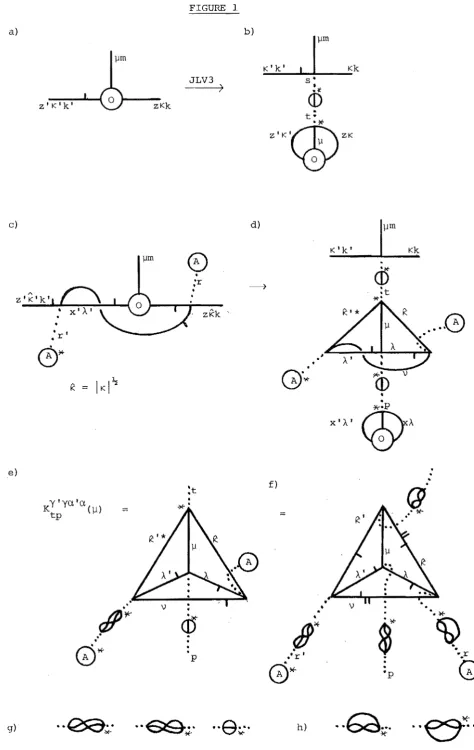
be found . The left hand side of (1-13) is depicted by Fig. lea). The stub
on the line labelled K'k' is a 2 jm symbol and z,z', though not group labels,
are left on the lines. The circle labelled 0 is an invariant subdiagram with three external legs and therefore application of the JLVn theorems for
n=3 will reproduce the result of (1-12), Fig. l(b). The top and bottom
parts of this diagram are respectively, a coupling coefficient and a reduced
matrix element, summed over multiplicity indices s,t (dotted lines). The
central part is a permutation matrix or 3 j symbol, m«13), K'~K)st' inserted to produce an 'untwisted' version of the Wigner-Eckart theorem. The diagram
definitions of the two coupling coefficients in (1-14) allow the latter to be
represented by Fig. l(c) with the circles labelled A, depicting those factors
in (1-14). All summations in (1-14) are implied by the diagram. Since
there is a stub on each internal line of Fig. l(c) the whole diagram is an
invariant and the JLV3 theorem may be applied twice, first to the external
legs labelled K'~K, and then to the legs A'~A to produce Fig. led).
Compari-son with Fig. l(b) and (1-15) yields the diagram definition of the RF,
l(e), where we have untwisted the line labelled by irrep
v.
This figure involves a summation over four 3jm vertices and is thus expressible as a 6jsymbol. To obtain the latter in its standard form we introduce further 3j
symbols, the result of the Derome-Sharp lemma, the reality of the 2 jm symbols
and the 2j symbol, ~ , (double stubs). The result is Fig. l(f) with the
(J
corresponding algebraic expression:
KY' ya 'a ( )
tp ~ (AX' z'r'K' A' Y
J
*
{
~*A'A*}
\! K K' t" ,s sp
I
.~
KK'
I
~ ~K \!
x m«132)~*K*K')tt' m«12}\!A'K'*) m«132)v*KA*)
r's' rs
x m(12) ~A' *A) , pp
This result is valid for an arbitrary compact group G. However for our
(1-16)
problems a simplification follows immediately. All the crystallographic
FIGURE 1
b)
K'k'
I
rm
Kka)
JLV3 s·
)
•
.-tz'K'k' zKk
<D
c)
d)I~m
K'k' Kk
\.1m
0
cD
•
;r ~
A
•
:tz'K'k'
*.
ZKk
... ·0
,
,
• r0~
.
.
#.
Gj~
*'
K
IKI~
(l)
•
,!,<,.px':>'"
@A
e)
..
.
.
f)
.
:t
(9
KY'YCt'Ct( ) *'
.
tp )l =
.. - *
. .
•
•
II'¥<
.
'. *
<D
•
~
~
IJ~
.
,.
.
0*
p.-r
I ·.rG~
.
.
'pG
g)
··esa~·
..
~;:
··e~·
h).. Q ...
[image:16.595.56.531.70.821.2]11.
the 3j symbols to have a simple form: for an interchange, i, of the columns
of the 3jm symbol (AIA2A3)r~1~2~3 '
± 1. Thus the diagrams . leg) are equivalent. For a
cyclic interchange,
8 rs
and we can neglect the diagrams Fig. l(h) altogether. (Thus the exact
position of a multiplicity line at a 3jm vertex is irrelevant). Even for
groups which are not simple phase i t may be that for the irreps of interest
one can still make the above choices for the 3j symbols. This is the case
for the groups S02' S03' S05 which have been found to be invariance groups
of the vibronic Hamiltonian in special JT systems.
Now, (1-16) becomes
KY'ya 'a ( )
tp J1
I
yv rr,
(AX' A 'YV) Z t r ' K '
*
AXAYV {J1*A' zrK V K KA.*}
t 'I
KK'I
~
. r rp
(1-17)
Thus the most general RF can always be written as the sum of two parts: the
first, the A's, contains all the physical information about the
electron-phonon interaction necessary to find eigensolutions of (1-2); the second,
depends upon the irreps of the group G of (1-2) alone. In particular a
knowledge of the 6j, 3j and 2j symbols of G yields all the information about
RFs which can follow from a symmetry analysis, independently of both the
nature and the strength of the interaction V.
As i t is not our intention to attempt a solution of the vibronic problem,
for the remainder of the chapter we treat the A's as free parameters to be
determined for a particular model. But they are not all independent:
orthonormalityof the kets (1-6) a normalization
8
zz'
=L
XA yvr
by the unitarity of the coupling coefficient. If we set ~
r
l i n (1-17),the 6j reduces to 11..1<1 (XK*vr').o, the 3j becomes <p, and (1-18) is
rr , 1\
KY'yaa(r )
t=p=o 1 8 zz' (1-19)
1 for any triple (KAv». This result simplifies some of the
3. JAHN-TELLER SYSTEMS OCTAHEDRAL SYMMETRY
In our later chapers strongly coupled JT systems will not be of interest
so we confine our attention to a single degenerate electronic level and its
derived ground vibronic level. Asmost of the studies of the dynamic JTE have
been of systems such as this in cubic symmetry we take the group G to be the
octahedral (double) group O. We investigate the
RFs
which follow for the2-, 3-, and 4-fold degeneracies that occur, the last of these being sufficiently
complex to highlight the need for a formula as simple as (1-17). We reproduce
the 3j and 6j symbols evaluated by Butler for this group in Appendix IA. We
also.list there the notation used below and throughout our work to designate
irreps and various JT systems. Since for any single electronic and vibronic
mu1tiplets x
=
x', zz'
and KI = K=
A'=
A (certainly for the magnitudes of V we are interested in), we can dispense with most of the labels in (1-17),rewriting i t as;
I
vrrl
I
y (1-20)
x (>..Avrl) (AA~p)
(the only complex for any point group are those corresponding to Kramer's
doublets but (1-2) is necessarily invariant under time reversal and so has no
matrix elements within these levels, (Abragam and Bleaney (1970».
define a positive parameter,
I
y
We also
13.
(1-18) is then
I
1. (1-22)vr
We now list the RFs for G 0, A
, r
4,
r
5,r8
and review previous work connected with them.3.1 Doublet States -
r3
A
=
f3
,
~, v=
r
l
, r2, r3.
There are no multiplicities. We find1
(We can always remove the
A
label from bA
without confusion).v
These equationsgive,
(I-23)
With the relabelling q
=
K(r
3), p
=
K(r
2), (1-24) is the most general relation for the RFs of the vibronic doublet, first derived by Abragam and Bleaney andlater by Leurg and Kleiner (1974). Ham's (1968) initial treatment of the
orbital doublet linearly coupled to a single
r3
phonon (pair) of a cluster of nearest neighbours of the ion,r
3 x £ , showed that b7
=
0 in the weak and strong coupling limits, a result subsequently generalized by Leung and Kleiner.They and Halperin and Englman (1973), and Gauthier and Walker (1973) have also
shown that weak linear coupling to lattice phonons of different frequencies
makes b
7 > O. Thus one expects to find for measurements on the vibronic ground state, q < ~ (l+p).
3.2 Triplet States -
r5
A
=
f5,
r
4 · ~,v
= f l ' f 3,r
4' f 5 · Again there are no mUltiplicities. The RF's listed below have the same form for A = f5 and f4 so we refer to f5throughout only. ( 1-20) gives,
K(r ) b + b
4 - ~ b - ~ bS
3 0 2
K( f
4) b 0
-
~ b4 + ~ b2-
~ bs
1 (1-24)
(1-24) is identical to Equn. (37) of Leung and Kleiner. Bersuker and Polinger
(1973) have obtained an equivalent result
in this chapter.
For the linear coupling of the
Ham (1965) obtained the results,
1 ,
the same approach as presented
to a f
3-phonon pair, fS x £,
(1-25)
Leung and Kleiner have since shown that for arbitrary coupling to (many) f3
phonons, that b
2 ~ bS 0, generalizing Ham's result. They also show for weak linear coupling to a fS phonon triplet, fS x T
2, that b2 becomes non-zero only when its perturbative expansion in V is taken to tenth order. Ham
calcul-ated RFs to second order based on the cluster model, for this system, and
Bates et al. (1974) extended his results to full lattice coupling.
These authors and Judd (1974) have obtained analytic expressions in the
strong coupling limit while the intermediate region has been treated numerically,
Caner and Englman (1966), Sakamoto and Muramatsu (1978).
The fS x (£ + T
2' system, coupling to both phonon symmetries, is
more complicated. Originally Bersuker and Polinger obtained RFs on the
cluster model for weak T2 - and arbitrary £-type linear coupling. This work
has since been generalized by Bates et al. One special system exists however,
the equal linear coupling of f3 and fS phonons of equal frequency to the
elect-ronic triplet, fS x (£ ~ T
2). The five-fold degeneracy of the vibrational mode results in (1-2) having symmetry higher than cubic, namely S03 (O'Brien
(1971), Romestain and Merle d'Aubigne (1971». Indeed, as shown most clearly
by Judd (1974), the invariance of the vibrational Hamiltonian under the
oper-ations of the group Us allows the eigenstates Iyvn> to be uniquely labelled by
the irreps of the groups in the chain,
Thus the irreps A, ~, V are those of S03 and are labelled by the J values. For the triplet, A
~
I, and~,
V = 0, 1, 2. Using $A=
(_1)2A, (AlA2A3 0)
15.
K(O) b
+
bl
+
b=
10 2
K(l) b
+
l:ib - l:ib0 1 2
K( 2) b - l:ibl
+
10 b 2 10
or
SK(2) - 3K (1)
=
2 - 6b1
(1-26)We could have obtained this directly from (1-24) since the 0 irreps are
com-parent labels for the S03 irreps so,
K(l)
=
K(f4), K(2) (1-27)
(1-26) reduces to O'Brien's result only when b
l
=
O. But she restricted the vibrational quintets to a common frequency. The labelling of theUs
irreps then insured that J=l of S03 never occurred in the group - subgroup reduction(Judd) . As no-one has presented the argument clearly we show in Appendix II
that this restriction is removed for quintets of different frequency.
3.3 Quartet States - f8
A
= f8' respectively,The symmetric and anti symmetric parts of the product
A
xA
aref ) 8 s
=
r
2+
2f4+
fSThus a mUltiplicity of two exists whenever ~,
v
equal f4 or fS and complexparameters in addition to (1-21) must be defined,
L
y
(
X3YV]*
A z03
2,5 only (1-28)
They do not appear in the normalization (1-22). Consider now the consequences
of a multiplicity for the matrix element of an operator.
symbolically as,
r
R
r
We write this element
(1-29)
where the bracket denotes a 3jm symbol and ~ is a reduced matrix element. There is a freedom in the way one performs the factorization in (1-29). One
) == U r ' r ' r
(1-30)
R 1 U R
s s's s
where U is a unitary matrix. Then r ~ r ' in (1-29), the matrix element is
unaltered, but the 6j symbols which are formed from the 3jms will be different
for the two sets of labels {r}, {r I} . Now the 6j tables of Appendix IA
corres-pond to one choice for the fS 3jms. However, Butler first produced a
differ-ent set of 6js (unpublished) with which we in turn first calculated the general
form of the RFs for the quartet. This set is reproduced in Appendix IB (the
differences between the two sets only occurs for the triple (332r)). We shall
give our results for both sets of 6js, because, in the first place, we wish to
compare them with the only other major attempt at the fS RFs, that of Ham,
Leung and Kleiner (1976) (HLK) , and in the second place, besides making clear
the arbitrariness of the mUltiplicity choice we want to show that one set of
6j s is preferable for calculations.
For our first set of RFs we use the 6js of Appendix lB. Taking account
of (1-22) and defining B
v
bV + b~ from (1-2S), we can tabulate the results as:1
K tp (11)
1 -2 -2/5 -S/5 4/5 -2
f3 1 -2 -1 -1/5 -4/5 2/5 -2 -1
r
00
4
1 -2/5-liS
-13/15 -8/5 -2/5 -6/5 -7/5U
r
4 1 -S/5 -4/5 -8/5 -4/15 -4/5 -8/510f4 4/5 2/5 -2/5 2/5 -4/15 2/15 2/3
01f4 4/5 2/5 -2/5 2/5 -4/15 2/15 -2/3
oarS
1 -2 -6/5 -4/5 -4/15 -4/3 -2/31/5 1 -2 -1 -7/5
-8/
5 2/15 -2/3 -1/3The two remaining RFs not given in (1-31) but produced by our formula are,
K
IO (f 5)
(01)
17.
SEE ERRATA
However, we show in Appendix IlIA that the S03=> 0 3jms require K (r
S) ~ 0 .
tp tp
Thus the eight RFs for the rS multiplet are completely described by eight
real parameters (two of unknown sign) and although one can invert (I-31) to
obtain all parameters there are no
we faced previously.
relations between the RFs such as
HLK restricted the coupling of the ion to the lattice to be linear (of
arbitrary strength) via (many) r3 and rS phonons, rS x (£+T
2), and expressed
their RFs in terms of five parameters. Their (hidden) multipl choice
corresponds to the conventions of Abragam and Bleaney (1970 - section lS.3)
and Koster et al.'s (196.3) coupling coefficients. For future reference we
show in Appendix IIIB that the following one-to-one correspondence between
HLKs labelling of RFs and ours holds as a result:
HLK (1-31)
K .. (r 4)
1.J Ktp (r 4)
where
i,j 2 0
1 t,p 1
K(r~)
K (r 5)00
K(r~)
Kll(rS)
K(r
2), K(r3) are the same in both. (Hereafter we use our labelling only). We can also relate two of our parameters to theirs directly (by comparing
(1-6,-9) to their Equns. (1,5) and using Koster et al's tables),
(1-32)
(The numerical coefficients of b
4 and b7 obtained from their RF expressions agree with those of (1-31) with one exception - see below). However, three
relations must exist for the b , B
vr
v
2,5 to obtain their remainingpara-meters. One follows immediately from their results and implies a correction
to one of their formulae without much work on our part: if K
IO(r4) is to depend on the same parameters as the other RFs, as their results suggest, then
we can set BS
=
0 in (1-31) in which case we find K10(r4) KOI (r4), contrary to HLK. However, as they have this equality to within a factor of 25/9, and
2
their coefficients of pi, b are out by a factor of 3/5 we believe they should
1 2 1
5 (l-p') - 15 (l-q') - 5 a 2
+
!
5 b2 (1-33)We now turn to the presentation of our second set of RFs using the
6js. of Appendix IA. We first explain why these 6js are a better set to
work with and what effects the transformation between the two sets have.
Amongst the 6js responsible for the formulae (1-31) are those of the
type ,
{1133} 233 . trsp
Here the 'off-diagonal' mUltiplicity pairs (rs) = (10), (01) complicate the
summations in (1-30). If one could remove such pairs then unnecessary work
would be eliminated and, as one simplification, B2 would not appear in K
t t(l1). Butler noticed that for some pairs (t,P) such a transformation of the 6js of
Appendix IB was indeed possible.
tities, i t takes the form,
Denoting the transformed set by primed
quan-{
u
Ur ' r s's (1-34)
where the left hand side is chosen to be diagonal in (r's'). (~ is derived in
Appendix IIle). Notice that this transformation only affects the original set
of 6js whenever the triple (233) is involved. It follows from (I-30) that
any quantity depending upon this triple will also be altered in the multiplicity
separation. Thus in our new set of RFs there will appear new parameters b' 2r, B; , which can be related to the originals by,
[A X3Y2
]
zr'3 U r ' r A
x3y2
zr3 (I-35)
and new RFs, K~'pl
(f
4), obtained from their originals by the transformation (I-34) . All other quantities are unaltered. With these changes our second
19,
1 b
7 b4 b20 b21 bSO bSl
K (fi ) tp
r
2 1 -2 -2 -2
r3 1 -2 -1 -1 2 -1
, r
00 4 1 -4/3
-4/
3 -4/3 -4/3'II r 4 1 -2 -1 -4/3 -1/3 -2/3 -S/3 (I-36)
r
00 S 1 -2 -4/3 -2/3 -4/3 -2/3
11 r S 1 -2 -1 -4/3 -S/3 -2/3 -1/3
and Kio(r4) 2/3 (B'
2
+
BS) 01The simplicity of the expressions (I-36) in comparison to those of (I-31) is
obvious. Six of the RFs are now expressed in terms of six positive parameters
and are independent of the remaining two factors. And although (I-36) and
(I-31) are physically equivalent and the experimental problem of determining
all RFs is not altered by our transformation, the form of (I-36) suggests that
any attempt to find relations between them on a specific model will be made
much easier by using the new set of 6js rather than the old set.
The last problem in this section which may be easily handled by our
formalism is the equal linearly coupled system rS x
(E=T
2) (Pooler and O'Brien (1977), Judd ( 1976) ) • The vibronic Hamiltonian is now invariant under the
operations of the group SOS and the vibrational part under Us ~ 50 S' notation of Appendix IV where the necessary j symbols are listed,
A
fi, V
=
0,1,2. We find the RFs to beK(l) 1 S/S b
l - 4/S b2
K(2) 1 - 4/S b
l - 6/S b2
or K(2) lo:! {l+K(l)} - 4/S b
2
In the
lo:!,
(I-37)
a result of the same form as (1-23).
determine that,
The compatability relations for SO ~o
5
K(l)
K (2) =
K (r S) 00
SH ERRATA]
and K(2 ) K (f
4)
00
The last two equalities must hold for either multiplicity separation in 0) • (1-37) reduces to the results of HLK and Pooler and O'Brien only when b
2
=
0, which is a special case, by the argument in Appendix II.4. EXTENDED MULTIPLETS
Section (1.3) dealt with the case of single electronic and vibronic
multiplets, applicable to the study of the DJTE. For a better description of
the JT systems excited vibronic levels must be included, certainly in the
strong coupling limit (assuming that the interaction V is not only linear in
the displacements of the lattice). In theory (1-17) allows
arr
electronic and their derived vibronic states to be included in setting up an effectiveHamiltonian (whose eigenstates will generally involve mixtures of the IZKk»
to describe the effect of (1-10) on the system. (Though in the systems of
usual interest (orbital electronic states) the effects of excited electronic
levels can be neglected in the formation of vibronic as the latter are
typically separated by the order of phonon energies, much smaller than the
electronic separations).
these problems as well.
We can extract all the symmetry information in
As an example, consider an electronic doublet x=x',
>,,=>"'=f •
3 The
possible vibronic irreps are
K,K' = (f
l
,f
2,f
3) and there will be five RFs with fixedz,z'
for ~=
f f3. Ham (1972) uses the RFs corresponding to the first 2,
excited singlet
(K'=f
l
/f
2) connected to the ground doublet(K=f
3), r in hisnotation, to describe the transition to the static JTE. However, the only
RFs that can be related have the
K,K'
labels in common, for all·systems.Thus for
K=K'=f
we find, 3K2 '2(f 3)
x4y7 Az4
- a generalization of (1-23) to include all vibronic levels of f3 symmetry
21.
of the previous section will generalize like this. Also there may exist
additional relations for vibronic levels of other than ground state symmetry.
The triplet
A
=A'
and
where y'
KY'Y(f ) 5
(z
).
y'
yo
yA knowledge of the vibronic levels structure and the non-zero parameters for
specific JT interactions would allow the above relations to be exploited in
determining the effective Hamiltonian for any system, in the manner of Setser
and Estle for the orbital doublet. We shall not pursue these problems, as
our answer to an effective Hamiltonian description for the external
perturb-ation will turn out to be quite different.
s.
SUMMARYThe most general group-theoretic construction of the eigenstates of
an arbitrary ion-lattice Hamiltonian, and a general definition for the RFs
corresponding to an external perturbation, has led to an expression for these
RFs, (I-17). The symmetry information inherent in their definition can now
be simply extracted, given the 6j symbols of the invariance group. Unlike
previous, and less general, formulations, our method emphasizes the basis
independence of the RFs. Also, i t easily handles systems of any complexity:
from a symmetry viewpoint, we have given the first complete treatment of the
RFs for the fa states. Vibronic RFs will not be of specific interest to us
in succeeding chapters. However, the relations between the ground state RFs
will be, in particular, those for the r
3, fS, ra,systems listed in Section (I.3). (For the f8 states there are a number of possibilities, depending upon which
parameters b we choose to display) • We shall refer to any special relation,
\!r
appropriate to less than arbitrary coupling for example, or when one or more
CHAPTER II
REDUCTION FACTORS VIA GREEN FUNCTIONS
We review the formalism necessary for a quantum field-theoretic
description of the interacting ion-phonon system which yields one-particle
properties of the system, for example level shifts (eigenvalues) and widths
(lifetimes) . This description obviates prior knowledge of the eigenstates
of the electron-phonon system. We then follow Gauthier and Walker (1976)
and find the effect of the external perturbation on the eigenvalues of the
system. However our analysis is quite general. We represent all the
alge-braic parts of the formalism by Feynman graphs and we show how the symmetry
information in these graphs may be revealed. This allows the most general
(electronic) reduction factor to be defined as the sum of a series of diagrams.
We compare the Green function method with that of the previous chapter.
1. A PERTURBATIVE SOLUTION FOR THE ION-PHONON SYSTEM
1.1 The Green Function Formalism
As Thermal Green function and diagram techniques are discussed fully
in the literature (Abrikosov e t a l . (1963), Fetter and Walecka (1971», we
only outline here those ideas necessary for an understanding of the formalism,
as i t applies to our problem.
Our electron-phonon system consists of an isolated impurity ion coupled
to the continuum of lattice vibrations of a host paramagnetic crystal. In
second quantized form the zero order Hamiltonian for the non-interacting
system can be described by,
H o
=
I
i+ H P
t
E.1 a. 1 a. 1
+
I
k
(11-1)
The fermion operators
a~(a.)
create (annihilate) the ionic level Ii> of1 1
23.
SEE ERRAT~_
of energy E with wavevector k in the Brillani zone and belonging to branch k
mode s, k ks) (k :: (-~,s». The coupling V of (1-2) is to be treated as
a perturbation on the system of (11-1). It can take various forms but we
restrict i t to linear coupling in the meantime,
L
ijk
V V ijk at a '"
i j 'fk ( II-2)
~k
= bk + bt is the phonon displacement operation and Vijk the coupling para-meter.
where T
Define a full one-particle electronic Green function
G . .
(T) by,l.J
G . .
(T)-
<T {a. (T) a~}> Tit/t
l.J T .1. J
is the 'time' ordering operator, a. (T) is a Heisenberg operator
T .1.
OCT) e HT 0 e -HT
and < ..• > denotes a thermal average with respect to H,
<A> =: TrpA
P
= e -8H/ Tre-BH
(II-3)
(II-4)
The significance of (11-3) lies in the fact that i t describes the propagation
of excitations of the electronic subsystem in a 'time' interval T allowing for
all possible interactions with the phonon subsystem. Thus G .. (T) is
proport-.1..1.
ional to the probability amplitude that the excitation at 10> will not decay
.1.
in a time T and hence the state Ii> acquires a finite lifetime as a result of
interactions.
A consideration of the time development of the system in the interaction
representation for the operators (H 7 H in (11-4» yields, o
Here
G . . (T)
l.J
5(8)
<T {S(8) a. (T) at }> /<5(8»
T .1. J 0 0 (II-5)
is the S-matrix and < ..• > denotes averaging with respect to H. (11-5) is
o 0
a perturbative expansion to infinite order in V. At this stage in the usual
theory of a many fermion system one proceeds by applying Wick's theorem to
of the subsystems,
( II-6)
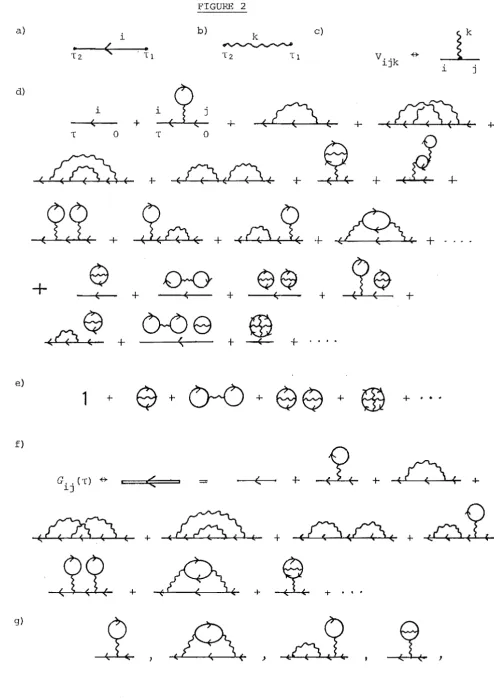
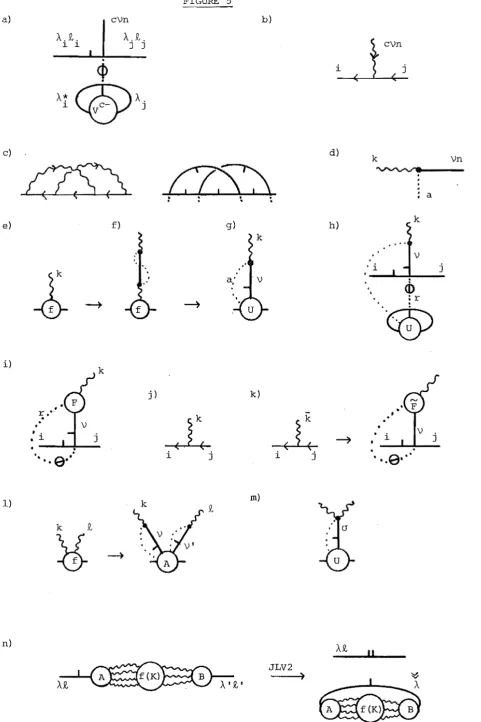
If these propagators are represented by the diagrams in Fig. 2(a),(b)
respect-ively, and the interaction by the vertex 2(c), then i t can be shown the
numer-ator and denominnumer-ator of (11-5) have the respective diagrammatic expansions
2(d) ,(e), where, in order to reproduce all the terms in (11-5), all possible
ways of connecting the propagators (11-6) are employed. For example, 2(d) ,(e)
contain all diagrams to fourth order in
v.
The advantage of the physicalinterpretation of each diagram in terms of the creation and annihilation of
virtual phonons changing the character of the bare electronic levels, is obvious.
Rather than evaluating the contribution of each (Feynman) diagram to
G ..
(T) (by integrating over T. variables, summing vertices over state variables1J 1
etc.) a simplification is made at this point. 2(d) consists of two classes
of diagrams; connected (the first 12) and disconnected (the remainder). The
T.-integrations in the latter factorize. Cancellation of the diagrams common 1
to 2(d) and (e) then occurs - this can be seen intuitively - and
G . .
(T) can be1J
rewritten as 2(f), the sum of all topologically distinct, connected diagrams
-the linked cluster -theorem.
Now we return to the one-particle system under consideration. The
vacuum state 10> and states occupied by more than one fermion e.g. at at 10>
1 J
(i~j) are not physical states of the ion. To eliminate their contribution when
evaluating quantities like-;:'A> in (11-5) Abrikosov (1965) added an extra o
energy 6 to each ionic level,
for the one-fermion states (1)
operator (Keiter (1971»,
p
~ (E.+6) 8. in (11-1), and removed its effect
1 1
at the end of the calculation via the projection
lim 8-<x>
e
S8
p <A> ~ <A>
o all states 0 1
The effect of P on the numerator of (11-5) is to eliminate all those diagrams
in 2(d) containing one or more fermion loops (e.g. 2(g» and the linked cluster
a)
d)
e)
f)
g)
h)
FIGURE 2
b)
c)25.
~k
V"k
**
- L
1J i j
( i
+
&
4-(0 (
+
(~(
+
(~.
+<
(~/~.
+
X
+
2
+
n
+
k
4-~
+
,6\,
+ ....
+
~
+
0;0
+
0(
$
+
~
+
G, ,CT)
**
1J+
( I =
ill
+ ---'--
+ ....
(
(C'l£':'., (
+
,~,
+
J::l/'0(
+
d
~
+
,tn,
+
Y
+ . . .
-2
~,~
-i,
i
« . ""
j"
[image:31.597.53.547.58.755.2]~E ERRATA
act essentially as a normalization factor and have no effect on the quantities
we wish to calculate (McKenzie (1978», so we ignore them. The resulting
diagram expansion of G, ,(c) for the electron-phonon system reduces to 2(h).
1J
The Fourier transformer of (11-3) is now taken:
f
s
z\l'G,,(zV):: dTe G,,(,), z
1J 0 1J
v
Corresponding definitions for (II-6) give,
1
d (x )
n V
1 X -E:
\I k
1
x
V
in
2V-S
(II-7)
(II-8)
These functions are defined only at discrete 'energies' z , x , (the subscript
V \I
\I will be dropped in the following). Now G, .(z) is also represented by the
1J
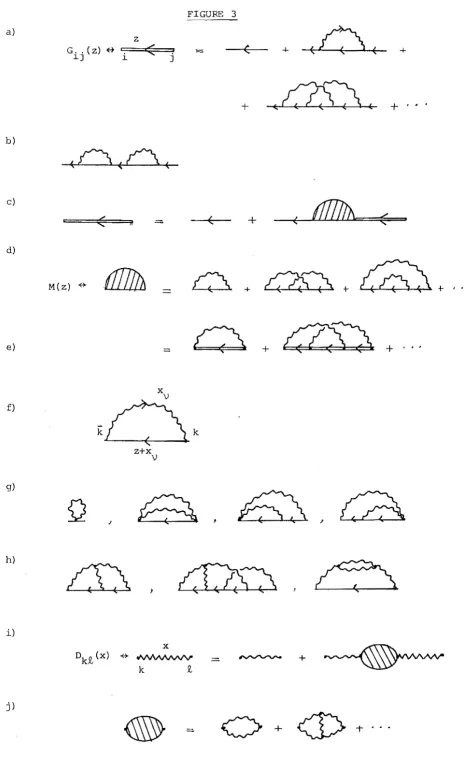
series 2(h) but with, replaced by an 'energy' z which must flow through each
diagram - Fig. 3(a}. The advantage of working with the Fourier transform is
that diagrams like Fig. 3(b} factorize in their contribution to G" (z). This
1J
results in the iterative Dyson equation.
equation is, in operator form,
G(z) = g(z}
+
g(z} M(z) G(z)Defining G. , (z)
1J <iIG(z}
Ip,
this(II-9)
where g (z) is diagonal in the basis
{I
i>}. (II-9) has the diagrammaticrep-resentation of 3(c). M(z) is the self-energy operator consisting of the sum
of all irreducible diagrams, 3(d), - those diagrams in G(z} which cannot be
factorized - and can be written most compactly as 3(e). If the inverses of
the operators g(z), {l-g(z) M(z)} are defined, (II-9) can be rearranged to,
G(z) {(g(z»-l - M(z)}-l
{z - H
e - M(z)} -1
(II-IO)
Although the complex functions G(z), M(z) are defined only at discrete points
along the imaginary axis I after evaluation (by rules to be given shortly) they
can be analytically continued to the whole complex z-plane, in particular to
the real axis I z ~ E
±
io (Fetter and Walecka) .~(E), r(E) may now be defined via,
-M(E ± io} ~(E)
+
i f(E)Two Hermitian operators
a)
b)
c)
d)
e)
f)
g)
h)
i)
j)
FIGURE 3
z
G .. (z) tf+ i . ( , =
~J ~ j
==(~~!'
-M(z) #
k
Q
jz+x
V
x
DkQ, (x) # tN\AA.IvvVV k Q,
k (
27.
+
+
+ ...
+
(
,
.
, [image:33.597.60.526.64.826.2]Restricting G(z) to diagonal elements for simplicity G, , (z) 11 near the poles (11-10) gives,
G, (E±io)
1 {E - 8, 1
!:", (E) ± i f, (E) }-l
1 1
G, (z), then 1
(II-12)
The interpretation of (11-12) is as follows: when
V
=
0, the stateIi>
has an energy 8, (the pole of g, (z»; for Vf
0, the energy is given by the solution1 1
of,
E - 8, - !:", (E)
1 1
o
(II-l3)and defines a dressed excitation shifted in energy from the bare state. In
the Lorentzian approximation in which the arguments of !:"" f, are made
indep-1 1
endent of E (in its simplest form E ~ 8, in the argument, but see Stedman 1
(1971), Hernandez and Walker (1972», this 'quasiparticle' decays with an
inverse lifetime ~ f,(e,) (Abrikosov et al). We refer to this as the width
1 1
of the excitation since the spectral function describing the excitation is a
Lorentzian of half-width f, (e,), peaked at 8,
+
!:", (8,), in this approximation1 1 1 1 1
(Stedman 1971).
Thus
!:,,(E), feE)
are interpreted as shift and width operators respectivelyfor the totality of ionic levels under consideration.
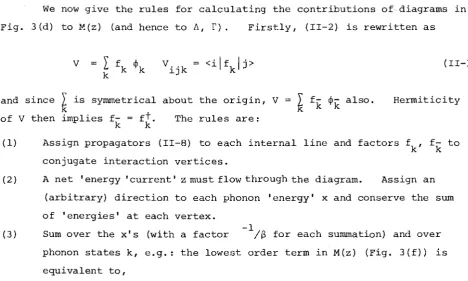
We now give the rules for calculating the contributions of diagrams in
Fig. 3(d) to M(z) (and hence to !:", f). Firstly, (II-2) is rewritten as
V
I
k
V
k (II-14)
and since
k
is symmetrical about the origin, V implies f- = ft. The rules are:Hermiticity
of V then
k k
(1) Assign propagators (II-8) to each internal line and factors f
k, fk to conjugate interaction vertices.
(2 )
(3)
A net 'energy 'current' z must flow through the diagram. Assign an
(arbitrary) direction to each phonon 'energy' x and conserve the sum
of 'energies' at each vertex.
Sum over the x's (with a factor -1
/p
for each summation) and over phonon states k, e.g.: the lowest order term in M(z) (Fig. 3(f» is [image:34.595.65.534.506.787.2]1
B
I
x\lk
29.
(4) Convert the sum on x to a contour integral over the complex x-plane
\I
and evaluate by the method of residues (Fetter and Walecka, Schreiffer
(1964» .
Since the residue of the pole of g (z+x) vanishes as
e
-+::0, the sum reduces to,1
I
B
x
\I
~
{e6Ek - l}-l is the Bose-Einstein population factor.Although individual diagrams are most easily calculated by the above
rules, a little thought shows that each diagram in Fig. 3(d) is reproduced by
a term in the expansion of
co
M(z)
=
I
(II-IS)n~o
Here Ip> is an eigenstate of H and the thermal average is over all excited p
states of the lattice:
Hlp>
p E p Ip>
-6Ep/
-6Ep
e Tr e
Only irreducible diagrams are to be included in the summations.
Finally we note that interactions other than (11-2), hereafter denoted
as
VI'
are easily dealt with by the appropriate diagrams.quadratic interaction,
For example the
(II-l6)
contributes diagrams like Fig. 3(g) to M(z). (In future we shall not draw
the mirror image of an asymmetric diagram as in 3(g) but i t is understood to
be included). And if we relax the approximation of
a
.harmonic crystal the(lowest order) anharmonic phonon interaction,
1
31.
I
kR.m
gives diagrams like 3(h). Strictly though,the last diagram in 3(h) will be
included in a full phonon propagator Dk~(xV)' also obeying a Dyson equation,
3 (i) ,
D(x) d(x)
+
d(x) P(x) D(x).The phonon self-energy P(x), would then correspond to the series 3(j), where
electronic loops are now eliminated by the Abrikosov procedure. The effect
of the replacement of the unperturbed propagations d(x) in 3(d) by D(x) would
be to change the value of
E
corresponding to H no longer being in the harmonicp p
approximation. We ignore these corrections.
1.2 Comparison With the Standard Procedure
Much of the literature concerned with perturbative solutions to the
electron-phonon problem uses the method of section (1.1) - explicit construction of the vibronic eigenstates. We compare this method with the Green function
approach. Firstly we note the effect of symmetry restrictions for the latter.
We have in mind that the electronic Hamiltonian, H =
~ e.a~a.
will represent e l l ]. 1a sequence of multiplets, not degenerate with one another, each of which may
be labelled by the irreps of the symmetry group of H , Ii> = IX.A.~.>. The
e l l ].
interaction
V
will modify the energies of these multiplets according to thesolutions 0 f ,
(E - H - ~(E) Ii»
=
0 ewhere Ii» is a vector constructed in the basis {Ii>}.
(II-18)
This is just the
generalization of (II-13) to include the off-diagonal elements. Since
V
andH are invariant with respect to the symmetry group so is (11-15), and there-o
fore ~(E). By Schur's lemma (cf. (II-39»,its matrix elements have the form,
f(E,x.x .. ,A.) 0 \
on n
1 J 1 AiAj kikj
and the shifts in energies will be the same for all the components ~. of a 1
particular multiplet. Thus the electronic degeneracies are retained when the
interaction is switched on.
Suppose we follow the usual procedure and construct exact eigenstates
{Iy,> :: IZKk>} of H =: H +V from the product states {la>18>
=
IXA~>lyvn>} of H .o ' 0
We can use the results of Brillouin-Wigner perturbation theory (Ziman (1969»
adapted for this problem. For simplicity we consider a single electronic
state, but many vibrational states 18 >, a
=
1,2, •.•zero-31.
order states la>ls> , of energy Eo ' the eigenstate Iy > of H is given by,
a a a
0 )
[E_IH
pvt
jy
>L
la>IS > (II-19)a a
n=o 0
(p = P
a
+
Ps - PaPS' is the complementary projection operator) with the corres-ponding eigenvalue,E <y
I
Hjy
>a a a
( II-20)
This also has the degeneracies of the symmetry group. We now construct the
state Iy> Ely>· It is not an eigenstate of H but we assume i t to be a a
approximately so with eigenvalue E E. This is allowable in the sense that a a
one can never specify the eigenstates
h
> precisely. Not only do they evolve ain time as a result of interactions ((II-19) is the time independent solution},
but the vibrational states Is > can never be specified either - in reality they a
depend upon the temperature of the system. Measured quantities of the system
are in fact (grand canonical) ensemble averages over the
{IS
>}. Performing athis for (II-20), we see that the change in the electronic energy, E (E -Eo ),
a a a
is just the energy shift ~ (E) obtained from (II-18), (one can replace
-1 _laa
(E-H) .P by (E-H ±io) - Van Kranendonk and Walker (1968». Thus the two
o 0
methods agree within our approximation.
Clearly the construction (II-19) makes i t impossible to know the real
matrix elements of operatOrs. And even assuming that one could calculate
the eigenstates of the time-dependent Schrodinger equation, (a very difficult
task), i t would be quite unnecessary: the one-particle thermal Green function
determines all there is to know about the ensemble averages of observables
corresponding to these operators (Ziman). The time evolution and temperature
dependence of the system is fully incorporated in the Green function. In
addition the coupling of the ion to the phonon continuum can be as complicated
as one pleases. None of this information is so easily available using the
standard procedure (for which reason many of the results have been simplistic) .
Thus whenever a perturbative solution is possible, one can forget about